Pro Sharepoint WithJquery New Phill Duffy
download
https://ebookbell.com/product/pro-sharepoint-with-jquery-new-
phill-duffy-2614458
Explore and download more ebooks at ebookbell.com
2.
Here are somerecommended products that we believe you will be
interested in. You can click the link to download.
Pro Sharepoint With Jquery Phill Duffy
https://ebookbell.com/product/pro-sharepoint-with-jquery-phill-
duffy-4120498
Pro Project Management With Sharepoint 2010 Mark Collins
https://ebookbell.com/product/pro-project-management-with-
sharepoint-2010-mark-collins-2030960
Pro Sharepoint 2010 Solution Development Combining Net Sharepoint And
Office 2010 Experts Voice In Sharepoint 1st Edition Ed Hild
https://ebookbell.com/product/pro-sharepoint-2010-solution-
development-combining-net-sharepoint-and-office-2010-experts-voice-in-
sharepoint-1st-edition-ed-hild-2098414
Pro Sharepoint 2010 Business Intelligence Solutions Sahil Malik
https://ebookbell.com/product/pro-sharepoint-2010-business-
intelligence-solutions-sahil-malik-2310350
3.
Pro Sharepoint 2010Search Josh Noble Robert Piddocke Dan
Bakmandmikalski
https://ebookbell.com/product/pro-sharepoint-2010-search-josh-noble-
robert-piddocke-dan-bakmandmikalski-2466732
Pro Sharepoint Designer 2010 1st Edition Steve Wright David Petersen
https://ebookbell.com/product/pro-sharepoint-designer-2010-1st-
edition-steve-wright-david-petersen-2477714
Pro Sharepoint 2010 Disaster Recovery And High Availability 1st
Edition Stephen Cummins
https://ebookbell.com/product/pro-sharepoint-2010-disaster-recovery-
and-high-availability-1st-edition-stephen-cummins-2504304
Pro Sharepoint 2013 App Development Steve Wright
https://ebookbell.com/product/pro-sharepoint-2013-app-development-
steve-wright-36180366
Pro Sharepoint 2003 Development Techniques Nikander Bruggeman Margriet
Bruggeman
https://ebookbell.com/product/pro-sharepoint-2003-development-
techniques-nikander-bruggeman-margriet-bruggeman-4106168
6.
For your convenienceApress has placed some of the front
matter material after the index. Please use the Bookmarks
and Contents at a Glance links to access them.
7.
iv
Contents at aGlance
About the Author ........................................................................................................x
About the Technical Reviewer...................................................................................xi
Acknowledgments....................................................................................................xii
Introduction.............................................................................................................xiii
■Chapter 1: Introduction ...........................................................................................1
■Chapter 2: Integrating jQuery into SharePoint ........................................................7
■Chapter 3: Common jQuery Features, Actions, and Methods ...............................27
■Chapter 4: Debugging jQuery.................................................................................75
■Chapter 5: Viewing SharePoint Data Using jQuery ................................................85
■Chapter 6: Building a Task List Viewer Application Page....................................107
■Chapter 7: Adding Controls to Create, Edit, and Delete Tasks.............................133
■Chapter 8: Enhancing SharePoint with jQuery.....................................................153
■Chapter 9: Using jQuery Plug-ins to Enhance SharePoint ...................................177
■Chapter 10: Extending jQuery..............................................................................227
Index.......................................................................................................................255
8.
xiii
Introduction
In 2009, LightningTools decided to take one of its best-selling products, a desktop application, and put it
into the browser as an application page in SharePoint—which turned out to be quite a challenge. When
we were looking at technologies to use, jQuery stood out as something that could be really helpful.
We spent a lot of time trying to understand how to make SharePoint and jQuery work together
initially, and then we started to learn what jQuery actually could do. Finding the information we needed
was often a struggle (not as many blogs on the topic were available at the time), but ultimately we
successfully created our product.
I learned so much about jQuery that I jumped at the chance to talk about SharePoint and jQuery
when the opportunity arose to speak about them at SPTechCon. I knew that so many people have
needed, and will continue to need, to create a client-side solution in SharePoint using jQuery, and I
wanted to share the benefit of my experience. In my talk I tried to communicate where to start and how
to explore what SharePoint with jQuery can do—and the feedback from the full room at SPTechCon was
positive.
When I was approached by Jonathan Hassell to write this book at SPTechCon in Boston in 2011, I
leapt at the chance. I wanted to write the book that I really could have used when I first started. I hope
your experience with this book is like learning to ride a bike: taking you from your first time in the seat
and getting acquainted with the controls to doing a lap around the neighborhood without training
wheels.
Who This Book Is For
This book is primarily written for SharePoint developers who are looking to expand their knowledge into
working with jQuery. SharePoint and jQuery is for intermediate programmers interested in building rich,
interactive web parts, application pages, and more using the combined power of jQuery and SharePoint.
jQuery is one of those technologies that has been around for a few years, and the kind of functionality it
offers is really quite amazing. Many of the “slick” web sites these days have a splash of jQuery in their
mix; if you want to bring this kind of dazzle to SharePoint, then this book is for you.
How This Book Is Structured
Pro SharePoint and jQuery will introduce to you some of the basics of jQuery, starting with what jQuery
is and looking at some of the advantages it offers over writing pure JavaScript. Then you will see some of
the different ways that jQuery can be deployed to your SharePoint environment. Activating jQuery to
make the library available on the page to your jQuery-consuming solutions is another task that can be
done in a multitude of ways; with this book, you will be able to compare them and figure out which one
suits your requirements. If you’re like me, wading into some examples and seeing how they work is a
great way to learn. That’s why there are lots of tasks to work through: from simply viewing information in
SharePoint with jQuery to building a complete Task Viewer application that demonstrates some key
principles of working with SharePoint and jQuery. Once you have learned the fundamentals, you will
learn how to work with plug-ins such as the jQuery UI library, and then you’ll go on to create your own.
9.
■ INTRODUCTION
xiv
Coding Conventions
Whenwriting production-standard code, you should always make sure that you handle exceptions
correctly and log errors when required. This book omits these steps for brevity.
The examples in this book are complete and will allow you to get a functional result that you can use
for further experimentation.
Prerequisites
You should be familiar with concepts such as SharePoint solutions, features, the SharePoint root, lists,
and libraries. You should also have some knowledge of working with JavaScript. C# developers will see
that jQuery is not too different from C#, but it is worth knowing where the differences are. Readers will
also need to have some experience working with Visual Studio, because it is used for most of the
development work.
Downloading the Code
The source code is available on the Apress web site (www.apress.com). Simply navigate to the book and
click the Source Code/Downloads tab.
Contacting the Author
If you have any questions regarding this book’s source code, are in need of clarification for a given
example, or simply want to offer your thoughts regarding SharePoint with jQuery, feel free to drop me a
line at mail@phillduffy.com , Skype me at phill.duffy, or even follow me on Twitter at
http://twitter.com/phillduffy. I’ll do my very best to get back to you as soon as possible; I’ll let you
know that I’ve received your message, but it may take a little time for me to respond in full. Finally, thank
you for buying this book. I hope you enjoy reading it and putting your newfound knowledge to good use.
10.
C H AP T E R 1
1
Introduction
Since you’ve picked up this book about SharePoint and jQuery I am going to assume you know a little
about SharePoint and have an idea of what jQuery is and what it does. This book will also assume that
you have done some client-side programming with JavaScript and are familiar with using methods such
as getElementById(). jQuery is one of those buzzwords that has been around for a little while now but
with Microsoft’s decision to make it part of the official development platform more people are taking a
serious look at what it can do for them.
This book is not looking to teach you everything about SharePoint: there are many books on that
topic. The aim of Pro SharePoint with jQuery is to take you all the way from understanding why
SharePoint and jQuery are good partners and how to get them to play nicely and on to giving you
enough information, examples, and desire to explore what can be achieved.
In your daily life on the Internet you would be hard-pressed not to come across a site that makes use
of jQuery. According to one web site (http://trends.builtwith.com/javascript/JQuery), there are 25
million sites using jQuery, and almost a quarter of the top 1 million sites use it. What can be achieved
using this relatively small file is frankly very impressive and you will get to explore what it is about this
library that makes it so very popular.
A Bit About SharePoint
SharePoint has been around since 2001, when it was known as SharePoint Server 2001. It has matured
from SharePoint Portal Server 2003 and Microsoft Office SharePoint Server 2007 (MOSS and WSS)
through to its current incarnation of SharePoint Server 2010 (Foundation and Server) and Office 365. In
this book, we will be looking at solutions that can work with 2007, 2010 and Office 365. The great thing
about jQuery is that it works with any HTML, which is what SharePoint boils down to on the browser. If
you can access the jQuery library in the HTML, then you can make use of its power within SharePoint.
SharePoint is a huge development platform based on the ASP.NET Framework with a large array of
facets to it. We’ll take a look at some of those areas now so you can see where you can use jQuery.
Web Parts
Web parts provide a unit of functionality to the end user, and their purpose can be whatever the
business requires or the developer can dream up. Web parts can range from simple tools for viewing
text, data from a SharePoint list, or even data from an external system to interactive maps, a video
player, or even a game.
11.
CHAPTER 1 ■INTRODUCTION
2
Office 365
Office 365 has offered companies a new way of being able to work with SharePoint. With hosted
SharePoint however it means that you’re no longer in charge of the “box” and it means that some of the
artifacts you can create for an on-premise installation are not available. Some of the restrictions are that
you can’t put any dynamic link libraries (DLLs ) into the Global Assembly Cache (GAC), and that
deploying files to the SharePoint filesystem location (known as the SharePoint root in 2010 or the 12 hive
in 2007) is not permitted.
Application Pages
When a web application was required in the past, the options usually were limited to either buying an
off-the-shelf piece of software or creating it in-house. These kinds of applications were traditionally
written in ASP.NET and mostly had to be written from scratch, taking into consideration how you were
going to handle user authentication, data storage, and the look and feel.
As well as creating web part pages in SharePoint 2007 and 2010, it is also possible to create
application pages. Application pages provide the ability to create web applications that are consistent
with the look and feel of SharePoint: the advantage is that you can make use of SharePoint’s security, its
list storage functionality, and its user interface. SharePoint has a powerful API that the developer can
code against, which provides much of the functionality that most business applications require.
Consequently, it saves time, money, and resources.
Framework
One of the concepts that developers sometimes take a while to understand is of thinking of SharePoint
as a framework. If you’re a traditional ASP.NET developer, it can be tricky to think of SharePoint as your
friend, instead seeing it as a block to your creativity. If you’re used to having complete control over the
exact behavior of your applications and all of a sudden it needs to “work with SharePoint,” it can be
daunting and occasionally frustrating. The frustration stops as soon as you realize that the framework is
there to help you. Microsoft has put a lot of time and effort into ensuring that it all works in harmony, so
if you realize that the application can make use of the SharePoint API, then you can avoid a lot of the
pain points in traditional development.
Scalability is another key area where Microsoft has worked hard, and it’s a point that is sometimes
missed by custom solutions. If you work following the best practices, then the solutions you write can
grow with your business.
SharePoint Lists
Ah, SharePoint Lists, the backbone of SharePoint. In my opinion, they’re great. So what do they do?
SharePoint Lists are SharePoint’s main mechanism for storing data. As a developer, they’re a life-saver:
most of the applications that developers are asked to write are of the simple variety: “I need to store
some data. I want some people to be able to see it, and some not. I want to be able to see that data. I
want to be able to edit that data…and so on.” SharePoint Lists give you this functionality out of the box.
You can configure a list, either by using the SharePoint UI, by using a declarative means such as a
Feature, or by using the API. You can even do a combination and use a feature to perform some API calls!
12.
CHAPTER 1 ■INTRODUCTION
3
What’s very useful with SharePoint Lists is that the UI is handled by SharePoint; it’s generated for
you as you create the List. However great this is, it will take you only so far. It will take 90 percent of the
requirements asked of developers all the way, but for the remaining 10 percent there are lots of ways you
can work with the underlying data through the API or Web Services.
Web Services
Microsoft has kindly opened up a lot of the SharePoint functionality via its Web Services, and you will
use these later on in the book to provide your Ajax functionality. You can easily pull the data out from a
SharePoint List and display it in whatever way you want. With the API and Web Services being so easy to
use, you are not constrained by the UI when working with your data.
Self-Service
The concept of allowing end users to manage their own content and sites was exciting, especially for
developers who would often find their days filled with updating small pieces of text here and there to
keep pages updated and preventing them from going stale. The end users also would be frustrated by
what seemed like a fairly simple task taking longer than they thought it should (but that’s just users for
you and who can blame them?).
The modern Internet has also changed the way that end users perceive their own intranet or
extranet sites. Web sites such as Twitter, Tumblr, Facebook, and so on all give users control over a page
or area where they can manage the content. Coming back from the World Wide Web to a static intranet
site where the content needs to be managed by another department seems impractical and old-
fashioned.
jQuery: The “Write Less, Do More JavaScript Library”
I have to admit that the jQuery tag line is genius; I am not sure who would read that and think “Nah, I
don’t think that’s for me!” The best way to introduce jQuery is in its own words:
jQuery is a fast and concise JavaScript Library that simplifies HTML document
traversing, event handling, animating, and Ajax interactions for rapid web
development. jQuery is designed to change the way that you write JavaScript.
jQuery is a library that aims to make writing JavaScript a magnitude easier than it has ever been
before. It was originally released at the beginning of 2006 which makes it even more incredible to think it
is now part of more than 25 million web sites.
It’s important to realize early on that jQuery is not a language; it’s an abstraction of JavaScript.
jQuery has been written to make web developers’ lives a whole lot easier and that is its only purpose in
life. If you take a look at the jQuery library, you will see that it is written in JavaScript and through some
clever JavaScript programming the authors have given consumers a greatly simplified way of performing
tasks. The best way to think of it is like what the .NET Framework gave to us. As well as providing a huge
array of functions for you to make use of, jQuery is also highly extensible through its plug-in capabilities.
As a developer, this is a huge plus as you can create reusable artifacts as well as use ever-growing pool of
plug-ins available on the Internet.
13.
CHAPTER 1 ■INTRODUCTION
4
Let’s take a look now at some of the key points to get you excited about using jQuery:
• It’s open source, and the project is licensed under an MIT and a GNU General
Public License (GPL).
• The documentation for jQuery is superb with “live” examples and inline code
demonstrations.
• It’s small and gzipped; at the time of writing, the file sizes were 31 KB minified and
229 KB uncompressed, respectively.
• It normalizes the differences between web browsers so that you don’t have to.
• There are a vast range plug-ins for it.
• It’s designed for rapid web development.
jQuery is written in JavaScript, and you will be required to understand how to write JavaScript to use
it. Although it is possible to deploy and load jQuery to your SharePoint page and then use the plethora of
plug-ins available, you will still need to understand what’s going on, as well as know how to configure
them correctly.
It is very important that you understand what jQuery is and the impact it can have on your end user
experience. The last thing you want to do is create a fancy new application page with all of the bells and
whistles and have it run slow.
With writing any code, it is important, arguably more important than coding, that you know how to
debug the code to find out why things may not be working the way you would have hoped. Later in the
book you will learn the invaluable tricks of how to look under the hood and understand how to resolve
any issues you come across.
Where Do You Get jQuery From?
The following sections explain where you can get jQuery.
Download and Host It Yourself
You can download jQuery from the jQuery web site (www.jquery.com), and it comes in two different
flavors:
• jQuery minified: For production
• jQuery regular: For development and testing
The two versions work exactly the same, and if you were writing your code against the library, you
wouldn’t be able to tell the difference. The difference becomes apparent when you want to see what
jQuery is like “under the hood.” The regular version is understandable, as you can see in Figure 1-1.
14.
CHAPTER 1 ■INTRODUCTION
5
Figure 1-1. jQuery regular
If you now take a look at the jQuery minified version (Figure 1-2), you will notice that it’s not quite
as easy to understand.
Figure 1-2. jQuery minified
There is method to this madness. There are considerable savings to be had by “minifying” the
library. For instance, it doesn’t need to be understandable in production, and the file size is reduced to
just 10 percent of its original size by removing unnecessary whitespace and changing the variables to
something as small as possible. On the other hand, while developing against jQuery, it makes sense to be
able to step through the code and be able to understand what is going on, which is why there is the
regular version too. Another very valid point of this shrinking down of the jQuery file is that with all web
pages, you want to reduce the amount of data needing to be transferred. So if you think that every visitor
to your site requires the file to be downloaded, you should make the file as small as possible. The size
issue benefits both the visitor, who has to wait for a page to load, as well as the server, which is dishing
out the files.
Content Delivery Network
Another way you can get access to the jQuery library is by using a content delivery network, more
commonly known as a CDN. A CDN-hosted version is basically a copy of the library hosted by a large
organization such as:
15.
CHAPTER 1 ■INTRODUCTION
6
• Google Ajax API CDN:
http://ajax.googleapis.com/ajax/libs/jquery/1.6.2/jquery.min.js
• Microsoft CDN: http://ajax.aspnetcdn.com/ajax/jQuery/jquery-1.6.2.min.js
• jQuery CDN: http://code.jquery.com/jquery-1.6.2.min.js
For the two different methods of getting access to the jQuery library there are some pros and cons to
consider. If your site is Internet-facing, it is a good way to off-load the task of delivering the jQuery
library to your visitors. The CDN will be making use of caching, large amounts of bandwidth,
redundancy, and lower latency. The main thing you will lose with this option is control of the library.
Although it is possible to point to a specific version of the library, you need to rely on the third party to
deliver that to your users. Otherwise, they won’t get the jQuery experience you were hoping for. It is
possible to add some clever jQuery to your solutions that can check for a missing library on the CDN and
then fall back to your in-house version (we’ll explain how to do this later in the book). By hosting the
library yourself, you are able to be in control of which version is available in your environment; it is also
the only option to use if you are working where access to the external CDN is not possible.
To sum up the options available, you need to consider whether the slight speed increase you may
get from using the external version is worth the risk of the reference disappearing, being replaced by
hijacked code, or somehow getting a bug that knocks out your pages. Otherwise, I recommend keeping it
in-house.
Summary
In this chapter we covered a brief history of SharePoint and its key features for our purposes in this book.
We also introduced jQuery, talked about downloading and hosting jQuery yourself, and explained how
to access jQuery via a CDN. In the next chapter, you’ll learn more detail on how to integrate jQuery into
SharePoint.
16.
C H AP T E R 2
7
Integrating jQuery into SharePoint
This chapter covers how SharePoint and jQuery can meet and work in harmony.
Integrating SharePoint and jQuery requires three tasks. The first task is putting the jQuery library in
a location where it can be accessed in your SharePoint environment. The second task is loading the
jQuery library in the SharePoint page, and the final task is creating an artifact that uses jQuery, such as
an application page or a web part on a web part page.
We’ll describe each of these tasks in its own section. This chapter will show you how to deploy and
make jQuery available, and in the next chapter, you will learn how to use it. You should be aware that it’s
entirely possible to deploy, activate, and deploy a jQuery-enabled web part from within one solution.
Separating these components, however, makes each a lot easier to manage. By using feature
dependencies, you can make sure one feature has been deployed before the next is able to do so.
Deploying jQuery to SharePoint
In this section, you will discover the different ways you can make jQuery available within SharePoint. As
you saw in the first chapter, there are two ways to get your hands on the jQuery library: downloading and
hosting it yourself or accessing a hosted version on a CDN. (If you are using the latter, you can skip this
section.)
When deploying to SharePoint, there are a few issues to consider, such as whether you are deploying
to a sandboxed solution. If you’re not sure what a sandboxed solution is, here is a little introduction.
A sandboxed solution runs in its own secure little bubble where the solution has only limited access
to part of your SharePoint environment. Because the service that runs the sandboxed solution is on a
different worker process than the standard W3WP.exe, it can be tightly secured and easily monitored. One
of the key benefits is that site collection administrators can deploy sandboxed solutions without
requiring a farm administrator to deploy them. Site collection administrators can monitor the solutions
to check how many resources are being consumed, and, if need be, a solution can be automatically
deactivated if it becomes too resource heavy. A solution uses resource points for performing certain
actions, and a farm administrator can set a limit on the number of points that can be used. A sandboxed
solution will not be able to deploy jQuery to the Layouts folder because it does not have access to the
filesystem. In addition, using jQuery does not involve deploying any assemblies, which is perfect for your
sandboxed solutions.
You also need to consider what happens when there is a new version of jQuery or somebody wants
to use a specific version of jQuery for their plug-in. Do you need to ensure there is just one version of
jQuery for everyone to use, or will you make all versions available and manage them centrally? Do you
want to allow site collection administrators to manage their own libraries by creating a document library
17.
CHAPTER 2 ■INTEGRATING JQUERY INTO SHAREPOINT
8
to store the version that they need? As mentioned in the previous chapter, jQuery is also greatly
enhanced by using plug-ins, so it’s worth thinking about how you want to manage their deployment too.
Let’s look at these questions in turn to figure out which deployment method would suit each
scenario.
To centrally manage the deployment of jQuery libraries, adding them to the Layouts folder is the
most suitable option. You can use the solution in Central Administration to deploy the necessary files to
the filesystem, and if another version comes along, you can update the solution, and the files can again
be deployed where necessary. When you deploy using this method, you have just one location where the
files reside, and they can be put there only by people with the correct permissions. The flip side of this is
that if someone retracts this solution, then jQuery will be unavailable across your business. It’s also
important to note that, like many libraries, just because there is a new version released doesn’t mean it
should be rolled out freely across your organization without forethought and testing.
Allowing site collection administrators to manage jQuery libraries can be a good way of allowing
freer reign of which jQuery version to use and which plug-ins to make available. To work with this
method, you can use a simple document library to house the jQuery files and allow administrators to
upload the libraries as they wish. There is a huge trust required here because you need to be happy that
your support queue won’t go through the roof with the wrong libraries showing up or being deleted, or
similar. This is a very simple way of enabling jQuery; all it takes is some code in a Content Editor web
part, and away you go!
The more controlled way of giving site-collection administrators control is if you provide the
libraries as features, scoped at either the web or site level, and then allow the administrator to enable the
features for the libraries they require. By putting an activation dependency on your web parts, you can
ensure that the correct libraries are available when you activate a web part.
It’s also worth planning how the library will be made available on the page; we will be going into this
in more detail in the “Making jQuery Available to the SharePoint Page” section.
Deploying Using a WSP (SharePoint Solution Package)
In this section, you will see some of the different options you have available for deploying the jQuery
library. There are pros and cons for each, so it is worth looking at each to figure out which is suitable for
your own scenario.
Deploying to the Layouts Folder
When deploying to the Layouts folder, the library will be available to artifacts such as a web part that
load the script directly:
<script type="text/javascript" src="http://sharepoint/_layouts/jquery/jquery-1.6.js"></script>
But if an artifact is just using the jQuery JavaScript code, and not referencing the script, this won’t
work because the library will not have been loaded in the SharePoint page. This is where the “Making
jQuery Available to the SharePoint Page” section is relevant, because you can choose how and when to
load the jQuery library.
When using the Layouts folder deployment option, the solution gets activated in Central
Administration, and the library gets deployed to the SharePoint filesystem. The advantage of deploying
to the filesystem is that the jQuery library will be available throughout your whole SharePoint
environment. This is because the Layouts folder works as a virtual directory meaning that any page will
be able to load the file at any site or subsite:
18.
CHAPTER 2 ■INTEGRATING JQUERY INTO SHAREPOINT
9
• http://sharepoint/_layouts/jquery/jquery-1.6.js
• http://sharepoint/subsite/_layouts/jquery/jquery-1.6.js
If you’re familiar with SharePoint, you should be familiar with the SharePointRoot folder, which is
the core SharePoint installation directory and which contains a large proportion of the files SharePoint
needs to run. In the SharePoint root, you’ll find the folders that contain site definitions, list definitions,
features, logs, DLLs, application pages, and so on as shown in Figure 2-1.
The SharePoint files typically live in the following directory, based on the version you’re using:
• SP2007 “12 hive”: C:Program FilesCommon FilesMicrosoft SharedWeb Server
Extensions12SP2010
• SP2010 “SharePoint root”: C:Program FilesCommon FilesMicrosoft Shared
Web Server Extensions14
Figure 2-1. SharePoint files on the filesystem
Within the SharePointRoot folder you’ll find a subfolder called TEMPLATELAYOUTS; this is where you
will deploy the jQuery library, in its own folder.
This gives you a tiny speed advantage because it means that the jQuery library will be loading from
the filesystem rather than the SharePoint database, as we will be doing with some of the other solutions.
Creating a Solution for Deploying to the Layouts Folder
The following example uses Visual Studio 2010 to deploy to a SharePoint 2010 environment; however,
the really nice thing about working with jQuery is that it doesn’t matter what the host is. Visual Studio
2010 has vastly improved the development process by including a rich set of SharePoint projects and
project items, as well as automatic feature, solution, and deployment generation. If you want to follow
the examples using SharePoint 2007 and Visual Studio 2008, you will need to manually create your folder
structure and write your own DDF files to build the necessary WSP. A tool such as WSPBuilder
19.
CHAPTER 2 ■INTEGRATING JQUERY INTO SHAREPOINT
10
(http://wspbuilder.codeplex.com/) can improve this development workflow in Visual Studio 2008.
Deployment and attaching the debugger are also manual processes.
1. Open Visual Studio 2010, and choose File ➤ New Project.
2. Select SharePoint ➤ 2010 ➤ Empty SharePoint Project. Name the project
jQueryDeploymentProject, and click OK as shown in Figure 2-2.
Figure 2-2. Creating an empty SharePoint project in Visual Studio 2010
3. In the next dialog, enter a valid URL where you want to deploy your solution
(see Figure 2-3). Once you’ve entered the URL, click Validate to check that it’s
OK. You will also be asked whether you want to deploy this as a sandbox or
farm solution. Select the farm solution because you will be deploying a file to
the SharePoint root, which is not possible in a sandboxed solution.
20.
CHAPTER 2 ■INTEGRATING JQUERY INTO SHAREPOINT
11
Figure 2-3. Selecting the trust level for the SharePoint solution
4. Once the project is loaded, you will need to add a mapped folder to Solution
Explorer. This tells SharePoint where to unpack the files once this solution is
deployed. To add a mapped folder, you need to right-click the project in the
Solution Explorer and select Add ➤ SharePoint “Layouts” Mapped Folder (see
Figure 2-4 for the location of the menu item).
21.
CHAPTER 2 ■INTEGRATING JQUERY INTO SHAREPOINT
12
Figure 2-4. Adding a SharePoint-mapped folder to the Visual Studio solution
The Layouts folder will be added to your Solution Explorer and will contain a folder with the same
name as your Visual Studio project. Rename the folder to jQuery. The reason it adds the extra folder is to
try to keep the Layouts folder tidy as well as making sure you are not overwriting existing files when you
deploy your solution. Although it is possible to deploy directly to the Layouts directory, it is best practice
to put your own deployment files into their own folder. A best practice for ensuring you have no conflicts
with other files is to adopt a syntax such as naming your solution’s deployment folders like
[CompanyName]jQuery.
1. Add your jQuery file to the folder; you can either drag and drop the file or
right-click and choose Add ➤ Existing Item….
2. This is all you need to do for this solution. When the solution is deployed, it
will place the file on the filesystem for this server.
3. To test this solution, you can either press F5 to deploy and activate the
solution (as well as open the browser to the URL specified in step 3) or right-
click the project (as highlighted in Figure 2-5) and click Deploy. It’s worth
noting that if you use the first method when you close the browser, the
solution will be retracted, whereas in the second method it won’t be.
22.
CHAPTER 2 ■INTEGRATING JQUERY INTO SHAREPOINT
13
Figure 2-5. Solution Explorer with the jQuery library added to a jQuery folder
4. After you have deployed the solution, you can check that it has been successful
in two ways; the first is to navigate to the filesystem and see whether the folder
and JS file exist:
C:Program FilesCommon FilesMicrosoft SharedWeb Server
Extensions14TEMPLATELAYOUTSProSharePointWithjQueryjQuery
The other method is to navigate to a SharePoint site and append the _layouts
path to see whether you can view the JS file:
http://sharepoint/_layouts/ProSharePointWithjQuery/jQuery/jquery-1.6.js
This completes the deployment to the Layouts folder. If you need to deploy a new version of the
jQuery library, you can add it to the jQuery folder in Visual Studio’s Solution Explorer and upgrade the
solution, which will redeploy the new changes to your environment.
Deploying jQuery to a Restricted SharePoint Library
The restricted SharePoint Library method of deployment is great if you want to put the library only on
certain site collections or webs. There is not a specific requirement to use a restricted library, as you will
see in the next example, but it does offer some protection from the library being accidentally changed.
By using a jQuery feature, it’s possible for a site collection administrator to activate or deactivate the
availability of jQuery. This will, however, mean that there will be lots of copies of the jQuery library
throughout your environment, but if a certain area needs a later release, it can be updated without
affecting other areas.
23.
CHAPTER 2 ■INTEGRATING JQUERY INTO SHAREPOINT
14
Creating a Solution to Deploy to a Restricted SharePoint Library
Follow these steps:
1. Open Visual Studio 2010, and choose File ➤ New Project.
2. Select SharePoint ➤ 2010 ➤ Module. Name the project
jQueryLibraryDeploymentProject, and click OK.
3. In the next dialog, enter a valid URL where you want to deploy your solution.
Once you’ve entered the URL, click Validate to check that it’s OK. Select
“Deploy as a sandboxed solution” from the two options.
4. You will see in the Solution Explorer that you have a module containing an
Elements.xml file and also a Sample.txt file, as shown in Figure 2-6.
Figure 2-6. Module added to the project
5. Rename the Module1 module to Assets, and delete the Sample.txt file. If you
have the Elements.xml file open while doing this, you will see it automatically
update to reflect these changes.
Add your jQuery file to the Assets module; you can either drag and drop the file
or right-click and choose Add ➤ Existing Item….
Again, as in Figure 2-7, you will see the Elements.xml file update with these
changes.
24.
CHAPTER 2 ■INTEGRATING JQUERY INTO SHAREPOINT
15
Figure 2-7. Module updated to deploy the jQuery library to the Assets library
6. Add a Url attribute to the Module element to tell SharePoint to deploy this
module to the SiteAssets library. It should look like this:
<?xml version="1.0" encoding="utf-8"?>
<Elements xmlns="http://schemas.microsoft.com/sharepoint/">
<Module Name="Assets" Url="SiteAssets">
<File Path="Assetsjquery-1.6.js" Url="jQuery/jquery-1.6.js" />
</Module>
</Elements>
You could deploy now, but we will be good citizens and name the feature more
appropriately for its use.
7. Expand the Feature node in Solution Explorer, and then rename Feature1
to jQuerySiteAssetsFeature, and then double-click the file to open the
configuration screen. In this screen (see Figure 2-8), you can change which
items are deployed by the feature as well as the title, description, and scope.
Change the following values to give the feature more meaning to those who
will be deploying it from within SharePoint, for example:
Title: Deploy jQuery to Site Assets Feature
Description: Feature to deploy jQuery to the Site Assets library
We are targeting the Site Assets library at the site collection here, which means
the feature will appear under Site Collection Features, and once activated, the
jQuery library will be available to all sites in the site collection.
25.
CHAPTER 2 ■INTEGRATING JQUERY INTO SHAREPOINT
16
Figure 2-8. Configuring a friendly title and description for the feature
8. Press F5 to deploy and activate this solution and its feature. If you want to be
able to deploy this solution manually, you can build and package the solution
and navigate to the bin directory and then deploy like you would any other
WSP.
9. You can test the deployment by navigating to the following location:
http://sharepoint/SiteAssets/jQuery/jquery-1.6.js
Deploying jQuery Directly to a Document Library
This method basically involves relinquishing control to your site collection administrators; it’s possible
to just upload the jQuery library to a document library. With this scenario, it’s more difficult tell
SharePoint how to load the library because it could be in any document library and could be called
anything. In this section, you will see how it is possible to get SharePoint to load the jQuery from a
document in the next section. This method has a couple of benefits: the first being that it can be
managed by “non-IT” users, which means they can upload new versions if they desire or even add extra
plug-ins. By using versioning, it’s possible to keep multiple versions of the libraries available. Again, as
when using a secure library, there will be a slight performance hit because of the file not being loaded
directly from the filesystem.
If you want to prevent your users from uploading JavaScript files, it is possible to block them. You
can find more information about this in the TechNet article “Manage blocked file types (SharePoint
Server 2010)” at http://technet.microsoft.com/en-us/library/cc262496.aspx.
26.
CHAPTER 2 ■INTEGRATING JQUERY INTO SHAREPOINT
17
Making jQuery Available to the SharePoint Page
Just like the deployment methods, you can make jQuery available to your SharePoint pages in a number
of ways:
• Content Editor web part
• Using custom actions
• AdditionalPageHead delegate control
• Adding the script to the master page
• Directly from an artifact
• Dynamically through code
These steps will assume that you have followed one of the previous steps to put the jQuery library
into a location available to use, or that you are using a CDN and you know the path to the library.
You need to make sure the library is loaded before any JavaScript code tries to run. If it hasn’t loaded
yet, you will encounter numerous errors. The head section of the HTML page is typically where scripts
are loaded to the page, and you will see the different ways you can achieve this. Some methods, however,
load the script in a more ad hoc method, which may lead to issues where the JavaScript tries to execute
some code without the library having loaded.
Let’s take a look at these in turn.
Using the Content Editor web part (CEWP)
Using the Content Editor web part (CEWP) is by far the simplest option available. This method will
enable jQuery on the same page where the Content Editor web part is added; it will not affect any other
pages and can be used in a sandboxed environment. Although this method is easy to get working with
jQuery, it also comes at a high risk, because anybody who has permissions to edit the page could either
remove or edit the web part and knock out the jQuery functionality.
Configuring Content Editor Web Part with the script Element
Follow these steps:
1. Navigate to a SharePoint web part page where you want to load jQuery.
2. Click Site Actions ➤ Edit, and then click the Add a Web Part link in one of the
web part zones.
3. Select the Content Editor web part from the Media and Content category and
click Add (Figure 2-9).
27.
CHAPTER 2 ■INTEGRATING JQUERY INTO SHAREPOINT
18
Figure 2-9. Adding a Content Editor web part
4. Click “Click here to add new content” to edit the contents of the web part.
5. In the Ribbon, go to the Format Text section, select HTML in the Markup
group, and choose HTML Source. Figure 2-10 shows the location of the menu
item.
Figure 2-10. Editing the HTML from the HTML Markup section
6. Add the following, making sure you replace the src so it points to the location
of your jQuery library:
<script type="text/javascript" src="http://sharepoint/_layouts/jquery/jquery-
1.6.js"></script>
You could also use the CDN URL here or the path to the Site Assets folder if
the library has been deployed there.
7. Exit edit mode. You may get a warning like that shown in Figure 2-11; this is
because sometimes when the HTML has been edited, SharePoint makes some
further changes. This is not something you need to worry about here.
28.
CHAPTER 2 ■INTEGRATING JQUERY INTO SHAREPOINT
19
Figure 2-11. Warning notification after editing the HTML
8. At the moment, all this web part does is load the jQuery library; it is not using it
in any way. You can check that it’s loaded by pressing F12 in Internet Explorer
and looking at which scripts have loaded. Go to the Script tab, and from the
drop-down list, you should be able to select jQuery-1.6.js. You can see that
the library has been loaded successfully, as shown in Figure 2-12.
Figure 2-12. Using the IE Developer Tools to check the library has loaded
Using a Custom Action
Using custom actions is a great way to be able to load the jQuery library if you are using it in a sandboxed
environment.
Creating a Custom Action Using Visual Studio
Follow these steps:
1. Open Visual Studio 2010, and choose File ➤ New Project. Select SharePoint ➤
2010 ➤ Empty SharePoint Project. Name the project
jQueryCustomActionProject, and click OK.
2. In the next dialog, enter a valid URL where you want to deploy your solution.
Once you’ve entered the URL, click Validate to check that it’s OK, and select
“Deploy as a sandboxed solution” from the two options.
29.
CHAPTER 2 ■INTEGRATING JQUERY INTO SHAREPOINT
20
3. Right-click the project in the Solution Explorer and choose Add ➤ New Item.
Select Empty Element, and call it jQueryCustomActionElement.
4. Open the Elements.xml file, which sits in the jQueryCustomActionElement
folder, as shown in Figure 2-13.
Figure 2-13. Visual Studio Project with a custom action added
5. Add the following between the element’s tags:
<CustomAction
ScriptSrc="~SiteCollection/SiteAssets/jQuery/jquery-1.6.js"
Location="ScriptLink"
Sequence="100">
</CustomAction>
ScriptSrc is the relative path to the jQuery library; here we are using the
~SiteCollection token, which SharePoint will replace with the current site
collection URL. It is possible to load the library from the Layouts folder using
the ScriptSrc attribute of jQuery/jquery-1.6.js, although this would not work
in a sandboxed solution because it is accessing a file on the filesystem. There is
no need to include the _layouts part of the URL because it is automatically
prepended. It is not possible to use a CDN URL with this method. The Location
attribute tells SharePoint to load the library in the head element of the page.
The full elements.xml file looks like this:
<?xml version="1.0" encoding="utf-8"?>
<Elements xmlns="http://schemas.microsoft.com/sharepoint/">
<CustomAction
ScriptSrc="~SiteCollection/SiteAssets/jQuery/jquery-1.6.js"
Location="ScriptLink"
Sequence="100">
</CustomAction>
</Elements>
30.
CHAPTER 2 ■INTEGRATING JQUERY INTO SHAREPOINT
21
6. Deploy the solution.
7. All the custom action does is just load the jQuery library; it is not using it in any
way. You can check that it’s loaded by pressing F12 in Internet Explorer, or you
can use the tools for your browser and look at which scripts have loaded. Go to
the Script tab, and from the drop-down list you should be able to select
jQuery-1.6.js loading from the Site Assets library.
Using the AdditionalPageHead Delegate Control
Provided that the master page you are using has the AdditionalPageHead control on, you can use an
ASCX file to reference the jQuery library.
Creating a Delegate Control Using Visual Studio
Follow these steps:
1. Open Visual Studio 2010, and choose File ➤ New Project. Select SharePoint ➤
2010 ➤ Empty SharePoint Project. Name the project
jQueryDelegateControlProject, and click OK.
2. Because an ASCX control is needed for this technique, the solution will need to
be deployed as a farm solution. This is because the ASCX file is put in the
ControlTemplates folder within the SharePoint root, and this cannot be done
with a sandboxed solution.
3. Next you need to add a mapped folder to tell SharePoint where to deploy the
user control. Add a SharePoint-mapped folder by clicking the project in
Solution Explorer and selecting Add ➤ SharePoint Mapped Folder…. In the
dialog that pops up (see Figure 2-14), you need to navigate to Template ➤
ControlTemplates and click OK.
31.
CHAPTER 2 ■INTEGRATING JQUERY INTO SHAREPOINT
22
Figure 2-14. Adding a SharePoint-mapped folder to the Control Templates folder
4. Inside the mapped folder, add a new folder called jQuery. This is to keep your
code and solutions separate in the ControlTemplates directory. You now need
to add the ASCX control to the jQuery folder you added, so right-click it, go to
Add ➤ New Item, and add a new User Control control called
jQueryDelegateControl.
5. If you expand the ASCX file in Solution Explorer, you will see two more files
nested underneath it; one is called jQueryDelegateControl.ascx.cs, and the
other is called jQueryDelegateControl.designer.ascx. Delete these files
because you’re only using the ASCX control to load the jQuery library. Usually
when you create an ASCX control, you want to put code behind to perform
certain server-side actions. Because all this control is doing is adding some
HTML, it is not required. Once you’re done, your project structure should look
like Figure 2-15.
32.
CHAPTER 2 ■INTEGRATING JQUERY INTO SHAREPOINT
23
Figure 2-15. ASCX control added to the mapped folder
6. Double-click the User Control to edit its contents. Because all this file is doing
is referencing the jQuery library, the code inside is very simple:
<%@ Control Language="C#" %>
<script type="text/javascript" src="http://sharepoint/_layouts/jQuery/jquery-
1.6.js"></script>
The src attribute can point to any location where jQuery is available, whether
it is from the Layouts directory as it is in this example, a SharePoint library, or
an external CDN.
7. With the User Control configured, you need to add a SharePoint element to tell
SharePoint that this control should be used in the AdditionalPageHead delegate
control. Right-click the project in Solution Explorer again, and add a new
empty element. Call this new element jQueryDelegateControlElement. With
the element added, open the Elements.xml file and add the following snippet
between the element tags:
<Control Id="AdditionalPageHead"
ControlSrc="~/_controltemplates/jQuery/jQueryDelegateControl.ascx" />
Here Id represents the delegate control you want to use, and ControlSrc is the
path to the User Control control that should be used. You may notice that
ControlSrc is using a relative path by using the ~.
8. If you want, you can configure the feature to change the scope. The good thing
about making SharePoint available in this way is that you can choose at which
scope an administrator can activate or deactivate the library.
9. Press F5 to deploy the solution.
33.
CHAPTER 2 ■INTEGRATING JQUERY INTO SHAREPOINT
24
10. All the custom action does is just load the jQuery library; it is not using it in any
way. You can check that it’s loaded by pressing F12 in Internet Explorer and
looking at which scripts have loaded. Go to the Script tab, and from the drop-
down list you should be able to select jQuery-1.6.js.
Adding the Script to the Master Page
This method is unsupported if you are editing the default master page, so you will need to be working on
a custom master page. It is worth remembering that you will need to update each master page you have
if you want to include jQuery.
It’s fairly straightforward to make this change. Open the master page, and in the head section add
the script reference to the jQuery library:
<Head runat="server">
. . .
<SharePoint:ScriptLink language="javascript" name="jQuery/jquery-1.6.js" Defer="false"
runat="server"/>
. . .
</Head>
Or you can use this:
<script type="text/javascript" src="http://sharepoint/_layouts/jQuery/jquery-1.6.js"></script>
For more information on master pages and how to edit them, check out
http://office.microsoft.com/en-us/sharepoint-designer-help/introduction-to-sharepoint-master-
pages-HA102019628.aspx.
Using the ScriptLink method of loading jQuery, you have the choice to defer the loading until the
page is ready, or you can get it to run asynchronously. In this example, because you want to make sure
the library is loaded, you do not want to defer the loading. The path to jQuery is a relative path in the
Layouts folder, which is why you can just use jQuery/jQuery-1.6.js. However, you can’t refer to it in any
other location, making it not an option for a sandboxed solution. Using the traditional script method of
loading the file, you are free to choose its location, and it will load asynchronously. If the ScriptLink
cannot find the JS file, it will display a SharePoint error, whereas the other method will just cause a
JavaScript error in the browser.
Adding a Script Reference from Within an Application Page
Loading the library using an application page allows you to enable jQuery just for that one application
and is an easy method to implement. It’s very similar to the master page technique; however, you are
using the existing content placeholders in the master page to allow you to insert the line to make the
script load.
When you create an application page, you have the ability to add content into the content
placeholders that the master page exposes. The placeholder you will want to use is
PlaceHolderAdditionalPageHead. As the name suggests, it puts the contents in the head section of the
page.
This is what the page looks like without any content in the placeholder:
<asp:Content ID="PageHead" ContentPlaceHolderID="PlaceHolderAdditionalPageHead"runat="server">
</asp:Content>
34.
CHAPTER 2 ■INTEGRATING JQUERY INTO SHAREPOINT
25
This is how it should look once you have added the script section:
<asp:Content ID="PageHead" ContentPlaceHolderID="PlaceHolderAdditionalPageHead"runat="server">
<SharePoint:ScriptLink language="javascript" name="jQuery/jquery-1.6.js" Defer="false"
runat="server"/>
</asp:Content>
The script source location depends on whether you want to deploy this as a sandboxed solution. If
you want it to be sandbox-compatible, make sure you’re not going to load the file from the filesystem.
Creating a Visual Web Part in Visual Studio to Make jQuery Available on the
Page
Using a Visual web part means that this solution will not be able to work in a sandboxed solution and
means that jQuery will be available only in locations where the web part has been added. A Visual web
part creates an ASCX control that is deployed to the ControlTemplates folder of the SharePoint root, and
like the delegate control technique, you can just add the following to the control to enable jQuery to
load:
<script type="text/javascript" src="http://sharepoint/_layouts/jQuery/jquery-
1.6.js"></script>
You can use this method for creating a web part, which just adds jQuery to the page, or the web part
can include a full application, which uses jQuery to provide a fully functional web part.
Adding a Script Reference Dynamically Through Code
It’s possible to dynamically inject the HTML required to load the jQuery library using a web part. This is
very similar to the Visual web part method, but rather than declaratively telling the page to load the
script, you are doing it programmatically.
To get things started, open Visual Studio 2010 and use the Empty SharePoint Project template to
create a project named jQueryDynamicWebPart. Select “Deploy as a farm solution” and click Finish. Add
a web part to the project by right-clicking the project and choosing Add ➤ New Item…. Name the web
part jQueryDynamic, as shown in Figure 2-16.
35.
CHAPTER 2 ■INTEGRATING JQUERY INTO SHAREPOINT
26
Figure 2-16. Adding a web part to the project
Open the jQueryDynamic.cs file that was just created if it’s not already opened. Override the
OnPreRender method and add the following:
protected override void OnPreRender(EventArgs e)
{
// Register the jQuery script from "_layouts/jQuery/jquery-1.6.js"
ScriptLink.Register(this.Page, "jQuery/jquery-1.6.js", false);
base.OnPreRender(e);
}
Once you have added the line of code, you can deploy this web part and add it to a page. This will
produce the following two lines of HTML on the page to load jQuery:
<script src="/_layouts/jquery/jquery.js?rev=1QT2rktNqE%2BC5kZ8LzXh3A%3D%3D"
type="text/javascript"></script>
Summary
In this chapter, you saw the different ways you can deploy the jQuery library to your SharePoint
environment. It’s important to think carefully about the most suitable way for your organization to
manage the deployment of jQuery. Once the jQuery has been deployed, you can consider the different
options you have for making the library available for your solutions to consume. Again, you have to
decide how much control you want and which approach is best for you. In the next chapter, you will
begin to see how you can use this newly available library in your SharePoint environment.
36.
C H AP T E R 3
27
Common jQuery Features,
Actions, and Methods
In this chapter, you will begin to see how you can use jQuery to work with HTML elements. You will start
with what is arguably the most powerful of the features, and that is the jQuery selector. The selectors
make working with elements in your application a cinch. You will also see the various ways you can
create new elements and use the jQuery utilities. Finally, you will learn about the rich set of tools
available to manipulate, transform, and handle events in your HTML.
Hello World
Creating an application page that has jQuery loaded will give you an excellent basis to begin learning
what you can do using jQuery. In the first few examples, you will work with some of the main concepts,
and the later examples will build upon the knowledge gained.
In the previous chapter, you explored the different ways you can make jQuery available to your
environment and how to load jQuery to the SharePoint page. Apart from looking at the HTML of the
page, there has been no real way to test that it has loaded correctly. Now that you have read about the
basics of jQuery, it’s time you wrote the obligatory “Hello World” example. You should already have
deployed jQuery to your SharePoint environment and have it loading to a page using one of the methods
discussed in the previous chapter.
To get started with the first “Hello World” example, open Visual Studio 2010 and use the Empty
SharePoint Project template to create a project called MyjQueryApplicationPage, as shown in Figure 3-1.
37.
CHAPTER 3 ■COMMON JQUERY FEATURES, ACTIONS, AND METHODS
28
Figure 3-1. Using the Empty SharePoint Project template to deploy the application page
In the SharePoint Customization Wizard, enter the URL you want to use to test the deployment of
this application page, choose “Deploy as a farm solution,” and click Finish. The application page gets
deployed to the Layouts folder, which is why you need to choose a farm solution.
Next, add a new Application Page item called jQueryBasics.aspx, and open the file once it’s created.
You should be able to see the different content placeholders available to you from the default master
page. Because I have opted to use the Site Actions method of adding jQuery to the page, I do not need
to put anything in the head section. However, if you wanted to have only jQuery available to this page,
you could have used the “Adding script” reference from within an application page, as described in
Chapter 2.
Change the contents in the PageTitle content placeholder to jQuery Basics and the
PageTitleInTitleArea to My jQuery Basics Page. I recommend deploying this page as it is just to make
sure it loads correctly; there’s nothing worse than wondering what’s up with your jQuery code when it
was just the page all along. If it’s working fine, then you’re good to add your first jQuery code. The
solution has put the application page only on the file system (in the Layouts folder), so the only way you
can get to it is to navigate to its URL directly:
http://sharepoint/_layouts/MyjQueryApplicationPage/jQueryBasics.aspx
You should see an empty page (how exciting), but it should have a title of My jQuery Basics Page, as
shown in Figure 3-2.
38.
CHAPTER 3 ■COMMON JQUERY FEATURES, ACTIONS, AND METHODS
29
Figure 3-2. Testing an application page to make sure it works
Close the browser or click the Stop button in Visual Studio to stop debugging the application page.
Now you’re ready to add the first lines of jQuery.
Within the Main content placeholder, add the following code, which shows an alert when the page
is ready. If you refer to the previous chapter, this piece of functionality was used to show that jQuery has
loaded; its exact functionality will be explained later in the chapter.
$(document).ready(function() {
alert('Hello World!');});
Deploy the solution again, and you should see the alert dialog once the page has loaded.
jQuery Basics
jQuery is most often used through its $ alias; in fact, you will see this symbol everywhere. The $ symbol is
a shortcut for the jQuery() global function, and you will be writing it so much that you will be glad of the
five characters it saves each time. But if you use the $ symbol in your own code or a third-party library, it
could override the use of the symbol, causing your code not to work as expected. To make sure there are
no conflicts when using the $, you can call jQuery.noConflict(), which will ensure that the jQuery
function is the one being used.
The jQuery() Function
You can overload the jQuery() function (or $()) in four ways. It can be passed in a CSS selector; in a
Document, Element, or Window object; in a string of HTML; or finally in a function. It also has a few utility
functions that you will be learning about. Using CSS selectors is the most common, so you will be
exploring them first.
39.
CHAPTER 3 ■COMMON JQUERY FEATURES, ACTIONS, AND METHODS
30
jQuery(selector)
Using jQuery selectors makes working with elements on your page orders of magnitude easier than if
you were just working with the JavaScript method of getObjectById(), as you will see in the later
examples. jQuery allows you to select elements from the HTML document using the same selectors as
available to you in CSS as well as a few more advanced selectors that will be covered later. By using just
the selectors, all you’re doing is returning those Document Object Model (DOM) elements, which does
nothing on its own. In the next section, you’ll add methods that will act on the group of elements you’re
returning from a query.
A few different selector types are available to help you select the elements that you want. It’s worth
noting at this point that in SharePoint there usually won’t just be the HTML elements you have created
on the page. The master page will be loading all of the standard SharePoint functionality. This is
fantastic if you want to be able to select and work with the SharePoint elements, but if you’re not
selecting your own specific elements, then you may be interfering with SharePoint functionality.
Selecting and editing the SharePoint UI may cause unforeseen issues and is not supported.
Basic Selectors
Table 3-1 lists the basic selectors.
Table 3-1. Basic Selectors
Name Syntax Example Query
All selector $('*') All of the elements
ID selector $('#id') $('#myId') Element with the matching id attribute
Class selector $('.class') $('.myClass') Elements with the matching class name
Element selector $('element') $('p') All elements with the matching tag
Let’s try these selectors straightaway to see them in action; open the MyjQueryApplicationPage
project in Visual Studio and edit the jQueryBasics.aspx file. Remove the existing contents of the
PlaceHolderMain and PageHolderAdditionalPageHead content placeholders and replace the contents so
they look like the following:
<asp:Content ID="PageHead" ContentPlaceHolderID="PlaceHolderAdditionalPageHead"
runat="server">
<script type="text/javascript">
$(document).ready(function () {
// All Elements
$('*').css('background-color', '#ADD8E6');
});
</script>
</asp:Content>
40.
CHAPTER 3 ■COMMON JQUERY FEATURES, ACTIONS, AND METHODS
31
<asp:Content ID="Main" ContentPlaceHolderID="PlaceHolderMain" runat="server">
<div id="myId">
<p class="myClass">class is set to myClass</p>
<p>Just a plain paragraph</p>
<p class="myClass">class is also set to myClass</p>
</div>
</asp:Content>
In this code, you are still using the document ready functionality. This time, however, when the
DOM has loaded, it will execute the selector and set the CSS of the elements returned to a blue color.
Once you have made the change to the code, recompile it and deploy to your SharePoint environment.
You will notice that everything is blue; this is because the selector used in this first example is selecting
all the elements on the page and setting their backgrounds to blue.
Now try the second example for Table 3.1, replacing $('*') with $('#myId'). This will change just
the background of the <div id='myId'> to blue. Compile the code again and deploy the solution. This
time, you will see that just the div has been selected by the jQuery query and the css() method has set
its color, as shown in Figure 3-3.
Figure 3-3. Setting the CSS of elements using the Id selector
Next, try to select just the elements with the myClass class by using $('.myClass'). You should see
that just the elements with the class set are highlighted in the blue, as shown in Figure 3-4.
41.
CHAPTER 3 ■COMMON JQUERY FEATURES, ACTIONS, AND METHODS
32
Figure 3-4. Selecting and setting CSS using the class selector
By now you should be beginning to see some of the potential of selectors. Once you begin to
combine the selectors with the other functionality of jQuery such as manipulation, events, and visual
effects, you will really see why jQuery is a tremendously powerful tool for developers.
The selectors that you have seen so far are the most basic available. You will use them the most
throughout your applications, but sometimes you need to be able to create more powerful queries. The
following sections will show you how you can further refine the queries to make sure you can easily and
succinctly get the elements you need to work with.
Combining or Using Multiple Selectors
It is possible to combine selectors or use multiple selectors in order for you to have a more precise
selection. For instance, if you wanted to select just the elements with the class of myClass within the myId
div, then you can combine the id selector and the element selector as follows:
$('#myId .myClass')
This will ensure that only elements inside the myId element are selected. As mentioned, this
precision can make sure that your jQuery code does not affect any elements on the page, which it should
not.
Using multiple selectors allows you to combine the results of two queries into one result set. For
example, if you want to select all paragraph elements with the class myClass and all the paragraph
elements with the myOtherClass too, you can use the following syntax:
$('p.myClass, p .myOtherClass)
42.
CHAPTER 3 ■COMMON JQUERY FEATURES, ACTIONS, AND METHODS
33
Hierarchy
HTML is mostly made up of nested elements, and the hierarchy selector allows for easy traversal of the
DOM (see Table 3-2).
Table 3-2. Hierarchy Selectors
Name Syntax Example Query
Child selector $('parent > child') $('ul#people >
li')
All direct child elements of parent
Descendant selector $('ancestor
descendant')
$('#myDiv1 p') All elements that are descendants
of the ancestor
Next adjacent
selector
$('prev + next') $('ul#people +
p')
All next elements matching next
that are immediately preceded by
a sibling prev
Next sibling selector $('prev ~ siblings') $('ul#people ~
p')
All elements on either side of the
prev; must share the same parent
Using the same Visual Studio project as before, add the following div just below the one that already
exists to enable you to see the hierarchy selectors in action.
<div id="myDiv1">
<p>
Paragraph before List</p>
<ul id="people">
<li>Phill</li>
<li>Pip</li>
<li>Les</li>
<li>Denise</li>
<li>Martin</li>
<li>Helen</li>
<li></li>
</ul>
<p>
Paragraph after List</p>
<div>
<p>
Paragraph inside another div</p>
</div>
</div>
This time, change the jQuery method from the existing one to this one; you should know from Table
3-2 that this will select all li elements from the unordered list with the id attribute of people.
$(document).ready(function () {
$('ul#people > li').css('background-color', '#ADD8E6');
});
43.
CHAPTER 3 ■COMMON JQUERY FEATURES, ACTIONS, AND METHODS
34
The result of this query and CSS method call will produce the page shown in Figure 3-5.
Figure 3-5. Selecting nested list items from an unordered list
Try working through the other examples from Tables 3.1 and 3.2 to see which elements get
highlighted.
The next two sections introduce a way of filtering the elements that are queried by applying certain
conditions on them.
Basic Filter
Filtering the selections allows for precise selection of the elements. Luckily, the jQuery filters are very
comprehensive, and there are lots of different ways to make sure you can get only the elements needed
as succinctly as possible. Another key benefit of using filters is that you can filter on their position in the
DOM, state, or other variables without necessarily needing to know the element’s type, ID, or class.
Table 3-3 lists the filtering selectors.
44.
CHAPTER 3 ■COMMON JQUERY FEATURES, ACTIONS, AND METHODS
35
Table 3-3. Filtering Selectors
Name Syntax Example Query
Animated selector :animated $('div:animated') All elements that are in the process of an
animation at the time the selector is run
Last selector :last $('ul#people
li:last')
Last-matched element
First selector :first $('#myId p:first') First-matched element
Not selector :not() $('#myId
p:not(.myClass)')
Elements not matching filter
Header selector :header $(':header') All elements that are headers
Equals selector :eq(index) $('ul#people
li:eq(2)')
Element at index
Greater than
selector
:gt(index) $('ul#people
li:gt(2)')
Elements with index greater than index
Less than selector :lt(index) $('ul#people
li:lt(2)')
All Elements with index less than index
Odd selector :odd $('ul#people li:odd') All elements with an odd index number
Even selector :even $('ul#people
li:even')
All elements with an even index number
Content Filter
As the name suggests, content filters allow you to select the elements based on their content, or lack
thereof. The filter is not just restricted to the text in an element; it can also traverse to the parent element
too. Table 3-4 lists the content filters.
45.
CHAPTER 3 ■COMMON JQUERY FEATURES, ACTIONS, AND METHODS
36
Table 3-4. Filtering Selectors Based on Content
Name Syntax Example Query
Contains
selector
:contains() $('ul#people
li:contains(Pip)')
All elements that contain the specified
text
Empty selector :empty $('ul#people li:empty') All elements that have no children
(including text nodes)
Has selector :has() $('div:has(ul)') All elements that contain at least one
element that matches the specified
selector as a descendant
Parent selector :parent $('li:parent') All elements that are the parent of
another element, including text nodes
Child Filter
A key point to remember with child filters is that unlike most of the index-based selectors, it starts its
indexing at one and not zero.
If you have the following unordered list on your page:
<ul id="people">
<li>Phill</li>
<li>Pip</li>
<li>Les</li>
<li>Denise</li>
<li>Martin</li>
<li>Helen</li>
<li></li>
</ul>
and you have the following code being executed in your application:
$('ul#people li:eq(2)').css({ background: "yellow" });
$('ul#people li:nth-child(2)').css({ background: "orange" });
you will see that the zero-based :eq(index) has selected Les and nth-child(index) has selected Pip, as
shown in Figure 3-6.
46.
CHAPTER 3 ■COMMON JQUERY FEATURES, ACTIONS, AND METHODS
37
Figure 3-6. Showing how the difference in index base affects the selection
Table 3-5 lists the child selectors.
Table 3-5. Child Selectors
Name Syntax Example Query
First child selector :first-child $('div ul:first-
child')
Elements that are
the first child of
their parent
Last child selector :last-child $('div span:last-
child')
Elements that are
the last child of their
parent
Nth child selector :nth-
child(index/even/odd/equation)
$('ul li:nth-
child(2)')
Elements that are
the nth-child of
their parent
Only child selector :only-child $('div button:only-
child')
Elements that are
the only child of
their parent
47.
CHAPTER 3 ■COMMON JQUERY FEATURES, ACTIONS, AND METHODS
38
Visibility Filter
This pair of filters is very handy when you want only certain elements of your DOM to be seen or hidden
depending on the state of the application (see Table 3-6).
Table 3-6. Visibility Filters
Name Syntax Example Query
Hidden selector :hidden $('input:hidden') All elements that are hidden
Visible selector :visible $('input:visible') All elements that are visible
Attributes
Using attributes is a useful way to select elements. By being able to read any attribute, it makes it easy to
select the elements that you want (see Table 3-7).
Table 3-7. Attribute Filters
Name Syntax Example Query
Attribute contains
prefix selector
[name|=value] $('a[hreflang|="en"]') Elements that have the
specified attribute with a value
either equal to a given string or
starting with that string
followed by a hyphen (-).
Attribute contains
selector
[name*=value] $('input[name*="dog"]') Elements that have the
specified attribute with a value
containing a given substring.
Attribute contains
word selector
[name~=value] $('input[name~="dog"]') Elements that have the
specified attribute with a value
containing a given word,
delimited by spaces.
Attribute ends
with selector
[name$=value] $('input[name$="animal"]') Elements that have the
specified attribute with a value
ending exactly with a given
string. The comparison is case
sensitive.
Attribute equals
selector
[name=value] $('input[value="Billy') Elements that have the
specified attribute with a value
exactly equal to a certain value.
48.
CHAPTER 3 ■COMMON JQUERY FEATURES, ACTIONS, AND METHODS
39
Name Syntax Example Query
Attribute not
equal selector
[name!=value] $('input[name!="edit"]') Elements that either don’t have
the specified attribute or do
have the specified attribute but
not with a certain value.
Attribute starts
with selector
[name^=value] $('input[name^="pet"]') Elements that have the
specified attribute with a value
beginning exactly with a given
string.
Has attribute
selector
[name] $('div[id]') Elements that have the
specified attribute, with any
value.
Multiple attribute
selector
[name=value]
[name1=value2]
$('input[id][name$="dog"]') Elements that match all of the
specified attribute filters.
Form
More often than not, one of the requirements of an application is to capture data of some form or
another, and having a specific set of filters to work with forms is brilliant. Let’s add some more HTML to
the existing application page to see how these filters behave and ideally gain an understanding of why
they will be useful.
Add the following HTML after the last /div in the PlaceHolderMain content placeholder:
<form action="#">
<input type="button" value="Input Button" />
<input type="checkbox" />
<input type="file" />
<input type="hidden" />
<input type="image" />
<input type="password" />
<input type="radio" />
<input type="reset" />
<input type="submit" />
<input type="text" />
<select>
<option>Option</option>
</select>
<textarea cols="10" rows="2">Text area</textarea>
<button>
Button</button>
</form>
Table 3-8 lists the form selectors.
49.
CHAPTER 3 ■COMMON JQUERY FEATURES, ACTIONS, AND METHODS
40
Table 3-8. Form Selectors
Name Syntax Example Query
Button selector :button $('input:button') All button elements and elements of
type button
Checkbox selector :checkbox $('input:checkbox') All elements of type checkbox
Checked selector :checked $('input:checked') All elements that are checked
Disabled selector :disabled $('input:disabled') All elements that are disabled
Enabled selector :enabled $('input:enabled') All elements that are enabled
File selector :file $('input:file') Elements of type file
Focused selector :focus $('input:focus') Element if it is currently focused
Image selector :image $('input:image') Elements of type image
Input selector :input $(':input') All input, textarea, select, and button
elements
Password selector :password $('input:password') Elements of type password
Radio selector :radio $('input:radio') Elements of type radio
Reset selector :reset $('input:reset') Elements of type reset
Selected selector :selected $('select
option:selected')
Elements that are selected
Submit selector :submit $('input:submit') Elements of type submit
Text selector :text $('input:text') Elements of type text
As with the other selectors you have seen, you are selecting only the elements. Try changing the
existing jQuery code to set the border of these form elements using the examples in Table 3-8 (see Figure
3-7):
$(document).ready(function () {
$('input:button').css({ border: "3px blue solid" });
});
50.
CHAPTER 3 ■COMMON JQUERY FEATURES, ACTIONS, AND METHODS
41
Figure 3-7. Highlighting the button element using form selector
Setting the Selector Context
It is also possible to supply a context to the selector to limit its search scope to just elements within it,
that is, jQuery(selector, [context]):
$('div.myClass').click(function() {
$('p', this).Hide();
})
This code will hide all of the paragraphs, p, within the div with class myClass. If you did not supply
the context, it would hide all of the p elements on the page.
Passing in a Document, Element, or Window to jQuery()
It is possible to pass in a Document, Element, or Window to the jQuery wrapper to enable it to use the jQuery
methods you have at your disposal. Wrapping the document object and using the ready() method is a
common way to put jQuery code into your script and wait until the DOM is available before executing
the function. This technique is usually employed when wiring up your events to elements on the page
because it needs to have the HTML elements to bind to.
The following code, which we will revisit later, gives an example of wrapping the document object
and using the ready() method to add a click() event handler to a button.
$(document).ready(function() {
$('#myButton').click(function())
{
// Do something;
};
});
Passing in a String of HTML to jQuery(html)
The other methods that you have seen so far have been querying and selecting elements, which already
exist in the DOM. By passing in HTML, you are able to create and insert new elements into the DOM on
the fly. This method is particularly useful when you are working with data returned from a web service,
because you can use the data to create new elements on the page easily.
var myData = GetMeData();
$.each(myData, function(index, value) {
$('<li>' + value + '</li>').appendTo('#myDataList');
});
In this example, we are getting our data and using the $.each() utility. We are iterating through each
item and creating a new list item, li, and appending it to our list with the id attribute of myDataList. You
will notice that you need to include the full HTML tag with the angle brackets; this is to ensure that
jQuery does not try to interpret it as a CSS selection.
51.
CHAPTER 3 ■COMMON JQUERY FEATURES, ACTIONS, AND METHODS
42
Let’s take a look at creating a little example to see how you can update the DOM on the fly. This
code will use the HTML already written in this chapter.
$(document).ready(function () {
// Create an array of the new people to add
var newPeople = ["Sam", "Zoe", "Graeme", "Gemma"];
// Use the each method to iterate through array
$.each(newPeople, function (index, value) {
// Create new List Item and append it to the people unordered list
$('<li>' + value + '</li>').appendTo('ul#people');
});
});
The list of people that contains Phill, Pip, Les, Denise, Martin, and Helen now has four more values:
Sam, Zoe, Graeme, and Gemma, as shown in Figure 3-8.
Figure 3-8. List item elements being dynamically added to a list
This functionality of being able to write HTML is something that you will be doing in the full
examples later in the book.
jQuery(callback)
You can use jQuery(function) or $(function) to call a function when the DOM is ready. This behaves in
the same way that $(document).ready() does and can be used to call other $() functions on the page that
require the DOM to have been loaded.
jQuery Utilities
jQuery also comes with a handy selection of utilities; you have seen one already, the each function. The
utilities make working on the client side a lot easier for the developer. The following are some of the
utilities you will likely be using:
52.
CHAPTER 3 ■COMMON JQUERY FEATURES, ACTIONS, AND METHODS
43
• $.each(function(index,Element)): A generic iterator function that can be used to
iterate over objects and arrays
• $.support: A collection of properties that represent the presence of different
browser features or bugs
• $.parseJSON: Takes a well-formed JSON string and returns the resulting JavaScript
object.
Common jQuery Actions and Methods
By now you should begin to understand what jQuery can do in terms of querying the DOM and see how
this allows you to easily select the elements on the page. It’s time to move on and see how jQuery can
work with the elements on the page.
First you’ll learn how to manipulate the elements on the page. jQuery has a large array of tools at
your disposal that you can use to manipulate the DOM. When you are creating your applications or
SharePoint customizations, it is important to be able to update the user interface either to show the user
that they need to perform a certain action, to highlight a value in a table, or to manipulate another part
of the page to change its look and feel. This is where the DOM manipulation comes into play. jQuery
allows the developer to easily manipulate the properties and attributes of the elements on the page,
whether that is to change a CSS class or update the text to a new value.
Let’s start by taking a look at a simple HTML element that can work as our base for testing the
jQuery manipulation:
<p id="ManipulationTest">My Test Text</p>
In the previous chapter, you learned that in order to highlight the elements that were being selected
by the queries, you use a jQuery method called css(). Let’s take another look at that code and break
down what it is doing:
$('p#ManipulationTest').css("background-color", "yellow");
The element on the page was initially being rendered in the same way as it was written on the
application page, as the jQuery method was loaded. However, the element’s attributes were updated
with the new changes applied from jQuery:
<p id="ManipulationTest" style="background-color: yellow;">My Test Text</p>
You should notice that the style attribute has been added with the css style as its value. It is the
manipulation of these name-value pairs that allows the developer to manipulate the elements on the
page.
Attributes
This section covers the different ways you can manipulate the attributes of an element using jQuery.
Table 3-9 summarizes how to work with attributes.
53.
CHAPTER 3 ■COMMON JQUERY FEATURES, ACTIONS, AND METHODS
44
Table 3-9. Working with Attributes
Name Syntax Example
Get attribute .attr(attributeName) $('a#myLink').attr('src')
Set attribute .attr(attributeName, value) $('a#myLink').attr('href',
'http://SharePoint')
Remove attribute .removeAttr(attributeName) $('a#myLink').removeAttr('Target')
Get property .prop(propertyName) $('#myCheckbox').prop('checked')
Set property .prop(propertyName, value) $('#myCheckbox').prop('checked', true)
Remove property .removeProp(propertyName, value) $('#myCheckbox').removeProp('class')
.attr()
The attr() method gives you the ability to get, set, or remove attributes on the element. If there is just
the one argument passed to the method, then the value of the attribute will be returned. If the second
argument is there, then the named attribute will be set to the value of the second parameter.
If you consider the following link, which you want to get the link for:
<a href="http://NotSharePoint" id="myLink">Link</a>
the following code within the document function will show you the link destination:
$(document).ready(function () {
var linkLocation = $('a#myLink').attr('href');
alert(linkLocation);
});
If you want to change the destination for the link, you can use the set attribute method to change its
value. In this example, you will change the value and show what it used to be, keep the link on the page,
but replace the script with the following:
<script type="text/javascript">
$(document).ready(function () {
ChangeLink();
});
function ChangeLink() {
// Read the href attribute
var originalLinkLocation = $('a#myLink').attr('href');
// Set the href
$('a#myLink').attr('href', "http://SharePoint");
54.
CHAPTER 3 ■COMMON JQUERY FEATURES, ACTIONS, AND METHODS
45
// Read the href attribute again
var newLinkLocation = $('a#myLink').attr('href');
alert('Link was to ' + originalLinkLocation + ' now it is ' + newLinkLocation);
}
</script>
Figure 3-9 shows the result.
Figure 3-9. Alert showing the href attribute of the link
If you look at the HTML on the page, you can see that the link now points to the new location (see
Figure 3-10).
Figure 3-10. Viewing the updated source of the link
.prop()
The property method works in a similar way to the attr() method, but it will get, set, and remove
properties from the element.
Class
The class methods allow for a simple way of working with the classes applied to an element (see
Table 3-10).
A
A broadside inblack letter, "printed, I suppose," says
Pinkerton, "about 1670," bound up with five other pieces
at the end of a copy of Blind Harry's 'Wallace,' Edin. 1673,
in the Pepysian Library.
My plaid awa, my plaid awa,
And ore the hill and far awa,
And far awa to Norrowa,
My plaid shall not be blown awa.
1
The elphin knight sits on yon hill,
Ba, ba, ba, lilli ba
He blaws his horn both lowd and shril.
The wind hath blown my plaid awa
2
He blowes it east, he blowes it west,
He blowes it where he lyketh best.
3
'I wish that horn were in my kist,
Yea, and the knight in my armes two.'
4
She had no sooner these words said,
When that the knight came to her bed.
5
'Thou art over young a maid,' quoth he,
'Married with me thou il wouldst be.'
57.
6
'I have asister younger than I,
And she was married yesterday.'
7
'Married with me if thou wouldst be,
A courtesie thou must do to me.
8
'For thou must shape a sark to me,
Without any cut or heme,' quoth he.
9
'Thou must shape it knife-and-sheerlesse,
And also sue it needle-threedlesse.'
10
'If that piece of courtesie I do to thee,
Another thou must do to me.
11
'I have an aiker of good ley-land,
Which lyeth low by yon sea-strand.
12
'For thou must eare it with thy horn,
So thou must sow it with thy corn.
13
'And bigg a cart of stone and lyme,
Robin Redbreast he must trail it hame.
14
'Thou must barn it in a mouse-holl,
And thrash it into thy shoes soll.
15
58.
'And thou mustwinnow it in thy looff,
And also seck it in thy glove.
16
'For thou must bring it over the sea,
And thou must bring it dry home to me.
17
'When thou hast gotten thy turns well done,
Then come to me and get thy sark then.'
18
'I'l not quite my plaid for my life;
It haps my seven bairns and my wife.'
The wind shall not blow my plaid awa
19
'My maidenhead I'l then keep still,
Let the elphin knight do what he will.'
The wind's not blown my plaid awa
B
A Collection of Curious Old Ballads, etc., p. 3. Partly from
an old copy in black letter, and partly from the recitation
of an old lady.
My plaid awa, my plaid awa,
And owre the hills and far awa,
And far awa to Norrowa,
My plaid shall not be blawn awa.
1
The Elphin knight sits on yon hill,
Ba, ba, ba, lillie ba
He blaws his horn baith loud and shrill.
59.
The wind hathblawn my plaid awa
2
He blaws it east, he blaws it west,
He blaws it where he liketh best.
3
'I wish that horn were in my kist,
Yea, and the knight in my arms niest.'
4
She had no sooner these words said,
Than the knight came to her bed.
5
'Thou art oer young a maid,' quoth he,
'Married with me that thou wouldst be.'
6
'I have a sister, younger than I,
And she was married yesterday.'
7
'Married with me if thou wouldst be,
A curtisie thou must do to me.
8
'It's ye maun mak a sark to me,
Without any cut or seam,' quoth he.
9
'And ye maun shape it, knife-, sheerless,
And also sew it needle-, threedless.'
10
'If that piece of courtisie I do to thee,
Another thou must do to me.
60.
11
'I have anaiker of good ley land,
Which lyeth low by yon sea strand.
12
'It's ye maun till 't wi your touting horn,
And ye maun saw 't wi the pepper corn.
13
'And ye maun harrow 't wi a thorn,
And hae your wark done ere the morn.
14
'And ye maun shear it wi your knife,
And no lose a stack o 't for your life.
15
'And ye maun stack it in a mouse hole,
And ye maun thrash it in your shoe sole.
16
'And ye maun dight it in your loof,
And also sack it in your glove.
17
'And thou must bring it over the sea,
Fair and clean and dry to me.
18
'And when that ye have done your wark,
Come back to me, and ye'll get your sark.'
19
'I'll not quite my plaid for my life;
It haps my seven bairns and my wife.'
20
61.
'My maidenhead I'llthen keep still,
Let the elphin knight do what he will.'
C
Kinloch's A. S. Ballads, p. 145. From the recitation of M.
Kinnear, a native of Mearnsshire, 23 Aug., 1826.
1
There stands a knicht at the tap o yon hill,
Oure the hills and far awa
He has blawn his horn loud and shall.
The cauld wind's blawn my plaid awa
2
'If I had the horn that I hear blawn,
And the knicht that blaws that horn!'
3
She had na sooner thae words said,
Than the elfin knicht cam to her side.
4
'Are na ye oure young a may
Wi onie young man doun to lie?'
5
'I have a sister younger than I,
And she was married yesterday.'
6
'Married wi me ye sall neer be nane
Till ye mak to me a sark but a seam.
7
'And ye maun shape it knife-, sheer-less,
62.
And ye maunsew it needle-, threed-less.
8
'And ye maun wash it in yon cistran,
Whare water never stood nor ran.
9
'And ye maun dry it on yon hawthorn,
Whare the sun neer shon sin man was born.'
10
'Gin that courtesie I do for thee,
Ye maun do this for me.
11
'Ye'll get an acre o gude red-land
Atween the saut sea and the sand.
12
'I want that land for to be corn,
And ye maun aer it wi your horn.
13
'And ye maun saw it without a seed,
And ye maun harrow it wi a threed.
14
'And ye maun shear it wi your knife,
And na tyne a pickle o't for your life.
15
'And ye maun moue it in yon mouse-hole
And ye maun thrash it in your shoe-sole.
16
'And ye maun fan it wi your luves,
And ye maun sack it in your gloves.
63.
17
'And ye maunbring it oure the sea,
Fair and clean and dry to me.
18
'And whan that your wark is weill deen,
Yese get your sark without a seam.'
D
Buchan's Ballads of the North of Scotland, II, 296.
1
The Elfin knight stands on yon hill,
Blaw, blaw, blaw winds, blaw
Blawing his horn loud and shrill.
And the wind has blawin my plaid awa
2
'If I had yon horn in my kist,
And the bonny laddie here that I luve best!
3
'I hae a sister eleven years auld,
And she to the young men's bed has made bauld.
4
'And I mysell am only nine,
And oh! sae fain, luve, as I woud be thine.'
5
'Ye maun make me a fine Holland sark,
Without ony stitching or needle wark.
6
'And ye maun wash it in yonder well,
64.
Where the dewnever wat, nor the rain ever fell.
7
'And ye maun dry it upon a thorn
That never budded sin Adam was born.'
8
'Now sin ye've askd some things o me,
It's right I ask as mony o thee.
9
'My father he askd me an acre o land,
Between the saut sea and the strand.
10
'And ye maun plow 't wi your blawing horn,
And ye maun saw 't wi pepper corn.
11
'And ye maun harrow 't wi a single tyne,
And ye maun shear 't wi a sheep's shank bane.
12
'And ye maun big it in the sea,
And bring the stathle dry to me.
13
'And ye maun barn 't in yon mouse hole,
And ye maun thrash 't in your shee sole.
14
'And ye maun sack it in your gluve,
And ye maun winno 't in your leuve.
15
'And ye maun dry 't without candle or coal,
And grind it without quirn or mill.
65.
16
'Ye'll big acart o stane and lime,
Gar Robin Redbreast trail it syne.
17
'When ye've dune, and finishd your wark,
Ye'll come to me, luve, and get your sark.'
E
Motherwell's MS., p. 492.
1
The Elfin Knight sits on yon hill,
Ba ba lilly ba
Blowing his horn loud and shill.
And the wind has blawn my plaid awa
2
'I love to hear that horn blaw;
I wish him [here] owns it and a'.'
3
That word it was no sooner spoken,
Than Elfin Knight in her arms was gotten.
4
'You must mak to me a sark,
Without threed, sheers or needle wark.'
F
Kinloch MSS, I, 75. From Mary Barr.
1
'Did ye ever travel twist Berwick and Lyne?
66.
Sober and gravegrows merry in time
There ye'll meet wi a handsome young dame,
Ance she was a true love o mine.
2
'Tell her to sew me a holland sark,
And sew it all without needle-wark:
And syne we'll be true lovers again.
3
'Tell her to wash it at yon spring-well,
Where neer wind blew, nor yet rain fell.
4
'Tell her to dry it on yon hawthorn,
That neer sprang up sin Adam was born.
5
'Tell her to iron it wi a hot iron,
And plait it a' in ae plait round.'
6
'Did ye ever travel twixt Berwick and Lyne?
There ye'll meet wi a handsome young man,
Ance he was a true lover o mine.
7
'Tell him to plough me an acre o land
Betwixt the sea-side hot and the sea-sand,
And syne we'll be true lovers again.
8
'Tell him to saw it wi ae peck o corn,
And harrow it a' wi ae harrow tine.
9
'Tell him to shear it wi ae hook-tooth,
67.
And carry ithame just into his loof.
10
'Tell him to stack it in yon mouse-hole,
And thrash it a' just wi his shoe-sole.
11
'Tell him to dry it on yon ribless kiln,
And grind it a' in yon waterless miln.
12
Tell this young man, whan he's finished his wark,
He may come to me, and hese get his sark.'
G
Gammer Gurten's Garland, p. 3, ed. 1810.
1
'Can you make me a cambrick shirt,
Parsley, sage, rosemary and thyme
Without any seam or needle work?
And you shall be a true lover of mine
2
'Can you wash it in yonder well,
Where never sprung water nor rain ever fell?
3
'Can you dry it on yonder thorn,
Which never bore blossom since Adam was born?'
4
'Now you have askd me questions three,
I hope you'll answer as many for me.
68.
5
'Can you findme an acre of land
Between the salt water and the sea sand?
6
'Can you plow it with a ram's horn,
And sow it all over with one pepper corn?
7
'Can you reap it with a sickle of leather,
And bind it up with a peacock's feather?
8
'When you have done, and finishd your work,
Then come to me for your cambrick shirt.'
H
Motherwell's MS., p. 92.
1
'Come, pretty Nelly, and sit thee down by me,
Every rose grows merry wi thyme
And I will ask thee questions three,
And then thou wilt be a true lover of mine.
2
'Thou must buy me a cambrick smock
Without any stitch of needlework.
3
'Thou must wash it in yonder strand,
Where wood never grew and water neer ran.
4
'Thou must dry it on yonder thorn,
69.
Where the sunnever shined on since Adam was
formed.'
5
'Thou hast asked me questions three;
Sit down till I ask as many of thee.
6
'Thou must buy me an acre of land
Betwixt the salt water, love, and the sea-sand.
7
'Thou must plow it wi a ram's horn,
And sow it all over wi one pile o corn.
8
'Thou must shear it wi a strap o leather,
And tie it all up in a peacock feather.
9
'Thou must stack it in the sea,
And bring the stale o 't hame dry to me.
10
'When my love's done, and finished his work,
Let him come to me for his cambric smock.'
I
Motherwell's MS., p. 103. From the recitation of John
McWhinnie, collier, Newtown Green, Ayr.
1
A lady wonned on yonder hill,
Hee ba and balou ba
And she had musick at her will.
70.
And the windhas blown my plaid awa
2
Up and cam an auld, auld man,
Wi his blue bonnet in his han.
3
'I will ask ye questions three;
Resolve them, or ye'll gang wi me.
4
'Ye maun mak to me a sark,
It maun be free o woman's wark.
5
'Ye maun shape it knife-sheerless,
And ye maun sew it needle-threedless.
6
'Ye maun wash it in yonder well,
Whare rain nor dew has ever fell.
7
'Ye maun dry it on yonder thorn,
Where leaf neer grew since man was born.'
8
'I will ask ye questions three;
Resolve them, or ye'll neer get me.
9
'I hae a rig o bonnie land
Atween the saut sea and the sand.
10
'Ye maun plow it wi ae horse bane,
And harrow it wi ae harrow pin.
71.
11
'Ye maun shear't wi a whang o leather,
And ye maun bind 't bot strap or tether.
12
'Ye maun stack it in the sea,
And bring the stale hame dry to me.
13
'Ye maun mak a cart o stane,
And yoke the wren and bring it hame.
14
'Ye maun thresh't atween your lufes,
And ye maun sack't atween your thies.'
15
'My curse on those wha learnëd thee;
This night I weend ye'd gane wi me.'
J
Communicated by Rev. F. D. Huntington, Bishop of
Western New York, as sung to him by his father in 1828,
at Hadley, Mass.; derived from a rough, roystering
"character" in the town.
1
Now you are a-going to Cape Ann,
Follomingkathellomeday
Remember me to the self-same man.
Ummatiddle, ummatiddle, ummatallyho, tallyho,
follomingkathellomeday
2
Tell him to buy me an acre of land
72.
Between the salt-waterand the sea-sand.
3
Tell him to plough it with a ram's horn,
Tell him to sow it with one peppercorn.
4
Tell him to reap it with a penknife,
And tell him to cart it with two mice.
5
Tell him to cart it to yonder new barn
That never was built since Adam was born.
6
Tell him to thrash it with a goose quill,
Tell him to fan it with an egg-shell.
7
Tell the fool, when he's done his work,
To come to me, and he shall have his shirt.
K
Halliwell's Nursery Rhymes of England, 6th ed., p. 109, No
171.
1
My father left me three acres of land,
Sing ivy, sing ivy
My father left me three acres of land.
Sing holly, go whistle and ivy
2
I ploughed it with a ram's horn,
And sowed it all over with one pepper corn.
73.
3
I harrowed itwith a bramble bush,
And reaped it with my little penknife.
4
I got the mice to carry it to the barn,
And thrashed it with a goose's quill.
5
I got the cat to carry it to the mill;
The miller he swore he would have her paw,
And the cat she swore she would scratch his face.
L
Notes and Queries, 1st S., VII, 8. Signed D.
1
My father gave me an acre of land,
Sing ivy, sing ivy
My father gave me an acre of land.
Sing green bush, holly and ivy
2
I ploughd it with a ram's horn.
3
I harrowd it with a bramble.
4
I sowd it with a pepper corn.
5
I reapd it with my penknife.
6
74.
I carried itto the mill upon the cat's back.
* * * * *
7
I made a cake for all the king's men.
A.
The verses here prefaced to the ballad are appended to
the last stanza in the broadside. For Norrowa, v. 3,
Pinkerton has To-morrow. 91
, needle and sheerlesse.
B.
'A Proper New Ballad entitled The Wind hath blawn my
Plaid awa, or a Discourse between a Young Woman and
the Elphin Knight. To be sung with its own proper tune.'
"This ballad is printed partly from an old copy in black
letter, and partly from the recitation of an old lady, which
appears to be the Scottish version, and is here chiefly
adhered to."
D.
32
. hae made.
91
. askd should perhaps be left, or gave, as in K1
, L1
.
E.
Burden2
, in MS., 1, blown her; 2, 3, blawn her; 4, blawn
my.
21
, blow; 22
, and a.
H.
11
. He speaks, in the margin of MS.
75.
Burden1
, time inmargin.
51
. Maid speaks, in margin.
I.
Not divided regularly into stanzas in the MS.
42
. needlewark in margin.
101
. shin? in margin.
L.
After 6: "Then follows some more which I forget, but I
think it ends thus."
FOOTNOTES:
[13] All that was required of the burden, Mr Chappell kindly
writes me, was to support the voice by harmonious notes under
the melody; it was not sung after each half of the stanza, or after
the stanza, and it was heard separately only when the voices
singing the air stopped. Even the Danish ballads exhibit but a few
cases of these "burden-stems," as Grundwig calls them: see
Danmarks Gamle Folkeviser, II, 221, B 1; 295, B 1; 393, A 1: III,
197, D; 470, A. Such burden-stems are, however, very common in
Icelandic ballads. They are, for the most part, of a different metre
from the ballad, and very often not of the same number of lines
as the ballad stanza. A part of the burden stem would seem to be
taken for the refrain; as Íslenzk Fornkvæði, I, 30, of four verses,
1, 2, 4; 129, of two, the last half of the first and all the second;
194, of four, the last; 225, of five, the last two; II, 52, of five, the
second and last two.
In later times the Danish stev-stamme was made to conform to
the metre of the ballad, and sung as the first stanza, the last line
perhaps forming the burden. Compare the stev-stamme,
Grundwig, III, 470, with the first stanza of the ballad at p. 475. If
not so changed, says Grundtvig, it dropped away. Lyngbye, at the
end of his Færöiske Qvæder, gives the music of a ballad which he
had heard sung. The whole stem is sung first, and then repeated
as a burden at the end of every verse. The modern way, judging
76.
by Berggreen, Folke-Sangeog Melodier, 3d ed., I, 352, 358, is
simply to sing the whole stem after each verse, and so says
Grundtvig, III, 200, D. The whole stem is appended to the last
stanza (where, as usual, the burden, which had been omitted
after stanza 1, is again expressed) in the Færöe ballad in
Grundtvig, III, 199, exactly as in our broadside, or in Motherwell's
Minstrelsy, Appendix, p. iii. I must avow myself to be very much
in the dark as to the exact relation of stem and burden.
[14] Grundtvig has noticed the resemblance of G.R. 64 and the
ballad.—Much of what follows is derived from the admirable
Benfey's papers, 'Die kluge Dirne, Die indischen Märchen von den
klugen Räthsellösern, und ihre Verbreitung über Asien und
Europa,' Ausland, 1859, p. 457, 486, 511, 567, 589, in Nos 20,
21, 22, 24, 25.
[15] Ragnar Loðbrók (Saga, c. 4, Rafn, Fornaldar Sögur, I, 245),
as pointed out by the Grimms, notes to No 94, requires Kraka
(Aslaug) to come to him clothed and not clothed, fasting and not
fasting, alone and not without a companion. She puts on a fishing
net, bites a leek, and takes her dog with her. References for the
very frequent occurrence of this feature may be found in
Oesterley's note to Gesta Romanorum, No 124, at p. 732.
[16] Benfey, Das Ausland, 1859, p. 459. The versions referred to
are: Shukasaptati (Seventy Tales of a Parrot), 47th and 48th
night; the Buddhist Kanjur, Vinaya, III, fol. 71-83, and Dsanglun,
oder der Weise u. der Thor, also from the Kanjur, translated by
I.J. Schmidt, c. 23; the Mongol translation of Dsanglun [see
Popow, Mongolische Chrestomathie, p. 19, Schiefner's preface to
Radloff, I, xi, xii]; an imperfect Singhalese version in Spence
Hardy's Manual of Buddhism, p. 220, 'The History of Wisákhá;'
'Geschichte des weisen Heykar,' 1001 Nacht, Habicht, v. d. Hagen
u. Schall, XIII, 71, ed. 1840; 'Histoire de Sinkarib et de ses deux
Visirs,' Cabinet des Fées, XXXIX, 266 (Persian); two old Russian
translations of Greek tales derived from Arabic, Pypin, 'in the
Papers of the Second Division of the Imperial Acad. of Sciences,
St Petersburg, 1858, IV, 63-85;' Planudes, Life of Æsop; A. and A.
Schott, Walachische Mæhrchen, p. 125, No 9, 'Vom weissen und
vom rothen Kaiser;' Erdélyi, Népdalok és Mondák, III, 262, No 8,
'The Little Boy with the Secret and his Little Sword.' To these is to
be added, 'L'Histoire de Moradbak,' Caylus, Nouveaux Contes
Orientaux, Œuvres Badines, VII, 289 ff, Cabinet des Fées, XXV, 9-
406 (from the Turkish?). In the opinion of Benfey, it is in the
77.
highest degree likely,though not demonstrable, that the Indian
tale antedates our era by several centuries. Ausland, p. 511; see
also pp. 487, 459.
[17] Ingenuity is one of the six transcendental virtues of
Mahāyāna Buddhism. Schlagintweit, Buddhism in Tíbet, p. 36.
[18] The resemblance to the Siberian tale is here especially
striking.
[19] The Shukasaptati, in the form in which we have them, are
supposed to date from about the 6th century, and are regarded
as abridgments of longer tales. The Vinaya probably took a
permanent shape as early as the beginning of the Christian era.
As already remarked, there is scarcely a doubt that the Indian
story is some centuries older still.
[20] Amasis in return (8) puts some of the questions which we
are apt to think of as peculiarly mediæval: What is oldest? What
is most beautiful, biggest, wisest, strongest? etc. Two of these we
have had in Zingerle's story. They are answered in a
commonplace way by the Æthiop, with more refinement by
Thales. Seven similar questions were propounded by David to his
sons, to determine who was worthiest to succeed him, and
answered by Solomon, according to an Arabian writer of the 14th
century: Rosenöl, I, 167. Amasis also sent a victim to Bias (2),
and asked him to cut out the best and worst of the flesh. Bias cut
out the tongue. Here the two anticipate the Anglo-Saxon Salomon
and Saturn: "Tell me what is best and worst among men." "I tell
thee word is best and worst:" Kemble, p. 188, No 37; Adrian and
Ritheus, p. 204, No 43; and Bedæ Collectanea, p. 326. This is
made into a very long story in the Life of Æsop, 11. See other
examples in Knust, Mittheilungen aus dem Eskurial, p. 326 f, note
b, and Nachtrag, p. 647; Oesterley's Kirchhof, v, 94, note to 3,
129; and Landsberger, Die Fabeln des Sophos, cx, ff. We may add
that Plutarch's question, Which was first, the bird or the egg?
(Quæst. Conviv. l. 2, q. 3), comes up again in The Demaundes
Joyous, No 41, Kemble's Salomon and Saturn, p. 290.
[21] Afanasief, Poetic Views of the Slavonians about Nature, I, 25.
The poludnitsa seems to belong to the same class: Afanasief, III,
76; Ralston, Songs of the Russian People, p. 147.
[22] The legend of St Andrew in Legenda Aurea, Grässe, cap. II,
9, p. 19 ff; also in the Fornsvenskt Legendarium, I, 143 ff;
Zambrini, Leggende Inedite, II, 94 ff; Pitré, Canti pop. Siciliani, II,
78.
232 ff: thatof St Bartholomew, Grässe, p. 545, cap. CXXIII, 5,
and in a German Passional, Mone's Anzeiger, 1839, VIII, col. 319
f: that of St Ulrich in Achazel and Korytko, I, 76, 'Svéti Ureh,'
translated by A. Grün, Volkslieder aus Krain, p. 136 ff. The third
question and answer are in all the same. St Serf also has the
credit of having baffled the devil by answering occult questions in
divinity: Wintown's Scottish Chronicle, I, 131, V, 1238 ff, first
pointed out by Motherwell, Minstrelsy, p. lxxiv, who besides cites
the legend of St Andrew.
79.
3
THE FAUSE KNIGHTUPON THE
ROAD
A. 'The Fause Knight upon the Road,' Motherwell's
Minstrelsy, Introduction, p. lxxiv.
B. 'The False Knight,' Motherwell's Minstrelsy, Appendix,
Musick, p. xxiv.
This singular ballad is known only through Motherwell. The opening
stanza of a second version is given by the editor of the music, Mr.
Blaikie, in the Appendix to the Minstrelsy. The idea at the bottom of
the piece is that the devil will carry off the wee boy if he can nonplus
him. So, in certain humorous stories, a fool wins a princess by
dumfounding her: e.g., Halliwell's Popular Rhymes and Nursery-
Tales, p. 32; Von der Hagen's Gesammtabenteuer, No 63, iii, 179;
Asbjørnsen og Moe, Norske Folkeeventyr, No 4. But here the boy
always gets the last word. (See further on, under 'Captain
Wedderburn's Courtship.')
An extremely curious Swedish ballad of the same description, from
the Lappfiord, Finland, with the substitution of an old crone, possibly
a witch, and clearly no better than one of the wicked, for the false
knight, is given by Oskar Rancken in Några Prof af Folksång och
Saga i det svenska Österbotten, p. 25, No 10. It is a point in both
that the replicant is a wee boy (gossen, som liten var).
1
'Why are you driving over my field?' said the carlin:
'Because the way lies over it,' answered the boy, who
was a little fellow.
80.
2
'I will cut[hew] your traces,' said etc.:
'Yes, you hew, and I'll build,' answered etc.
3
'I wish you were in the wild wood:'
'Yes, you in, and I outside.'
4
'I wish you were in the highest tree-top:'
'Yes, you up in the top, and I at the roots.'
5
'I wish you were in the wild sea:'
'Yes, you in the sea, and I in a boat.'
6
'I'll bore a hole in your boat:'
'Yes, you bore, and I'll plug.'
7
'I wish you were in hell:'
'Yes, you in, and I outside.'
8
'I wish you were in heaven:'
'Yes, I in, and you outside.'
Chambers, in his Popular Rhymes of Scotland, p. 66 of the new
edition, gives, without a word of explanation, a piece, 'Harpkin,'
which seems to have been of the same character, but now sounds
only like a "flyting."[23] The first stanza would lead us to expect that
Harpkin is to be a form of the Elfin Knight of the preceding ballad,
but Fin is seen to be the uncanny one of the two by the light of the
other ballads. Finn (Fin) is an ancestor of Woden, a dwarf in Völuspá
16 (19), and also a trold (otherwise a giant), who is induced by a
saint to build a church: Thiele, Danske Folkesagn, I, 45, Grimm,
81.
Mythologie, p. 455.The name is therefore diabolic by many
antecedents.
HARPKIN.
1
Harpkin gaed up to the hill,
And blew his horn loud and shrill,
And by came Fin.
2
'What for stand you there?' quo Fin:
'Spying the weather,' quo Harpkin.
3
'What for had you your staff on your shouther?' quo
Fin:
'To haud the cauld frae me,' quo Harpkin.
4
'Little cauld will that haud frae you,' quo Fin:
'As little will it win through me,' quo Harpkin.
5
'I came by your door,' quo Fin:
'It lay in your road,' quo Harpkin.
6
'Your dog barkit at me,' quo Fin:
'It's his use and custom,' quo Harpkin.
7
'I flang a stane at him,' quo Fin:
'I'd rather it had been a bane,' quo Harpkin.
8
82.
'Your wife's lichter,'quo Fin:
'She'll clim the brae the brichter,' quo Harpkin.
9
'Of a braw lad bairn,' quo Fin:
'There'll be the mair men for the king's wars,' quo
Harpkin.
10
'There's a strae at your beard,' quo Fin:
'I'd rather it had been a thrave,' quo Harpkin.
11
'The ox is eating at it,' quo Fin:
'If the ox were i the water,' quo Harpkin.
12
'And the water were frozen,' quo Fin:
'And the smith and his fore-hammer at it,' quo Harpkin.
13
'And the smith were dead,' quo Fin:
'And another in his stead,' quo Harpkin.
14
'Giff, gaff,' quo Fin:
'Your mou's fou o draff,' quo Harpkin.
The peit (peat) in st. 3, below, as I am informed by Dr Davidson, is
the wee boy's contribution to the school firing.
A.
83.
Motherwell's Minstrelsy, Introduction,p. lxxiv. From
Galloway.
1
'O whare are ye gaun?'
Quo the fause knicht upon the road:
'I'm gaun to the scule,'
Quo the wee boy, and still he stude.
2
'What is that upon your back? ' quo etc.
'Atweel it is my bukes,' quo etc.
3
'What's that ye've got in your arm?'
'Atweel it is my peit.'
4
'Wha's aucht they sheep?'
'They are mine and my mither's.'
5
'How monie o them are mine?'
'A' they that hae blue tails.'
6
'I wiss ye were on yon tree:'
'And a gude ladder under me.'
7
'And the ladder for to break:'
'And you for to fa down.'
8
'I wiss ye were in yon sie:'
'And a gude bottom under me.'
84.
9
'And the bottomfor to break:'
'And ye to be drowned.'
B.
Motherwell's Minstrelsy, Appendix, p. xxiv, No xxxii.
'O whare are ye gaun?' quo the false knight,
And false, false was his rede:
'I'm gaun to the scule,' says the pretty little boy,
And still, still he stude.
FOOTNOTES:
[23] At the last moment I come upon this: "The only safeguard
against the malice of witches is 'to flight wi dem,' that is, draw
them into a controversy and scold them roundly:" (Mrs Saxby, in
an interesting contribution of folk-lore from Unst, Shetland, in The
Leisure Hour, for March 27, 1880, p. 199.) This view, which has
apparently affected 'Harpkin,' is clearly a modern
misunderstanding. Let no one trust to scolding for foiling a witch,
unless he "knows more words."
85.
Welcome to ourwebsite – the perfect destination for book lovers and
knowledge seekers. We believe that every book holds a new world,
offering opportunities for learning, discovery, and personal growth.
That’s why we are dedicated to bringing you a diverse collection of
books, ranging from classic literature and specialized publications to
self-development guides and children's books.
More than just a book-buying platform, we strive to be a bridge
connecting you with timeless cultural and intellectual values. With an
elegant, user-friendly interface and a smart search system, you can
quickly find the books that best suit your interests. Additionally,
our special promotions and home delivery services help you save time
and fully enjoy the joy of reading.
Join us on a journey of knowledge exploration, passion nurturing, and
personal growth every day!
ebookbell.com


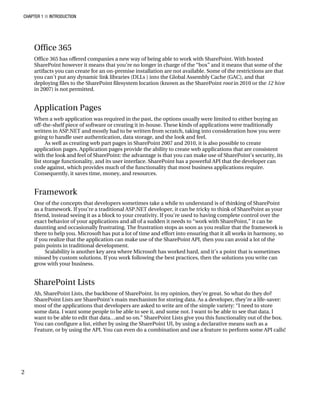
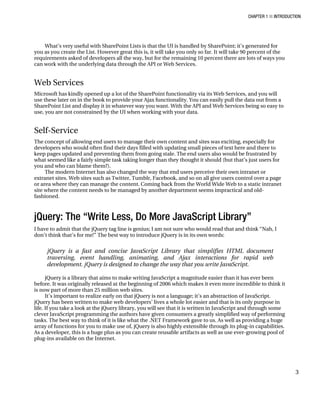
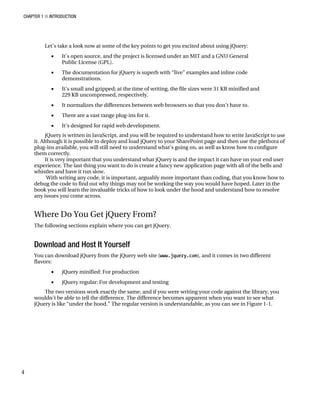
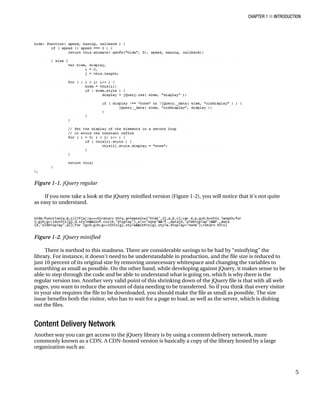
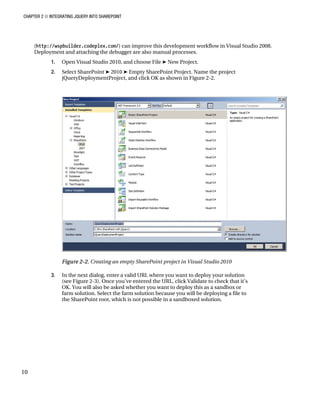
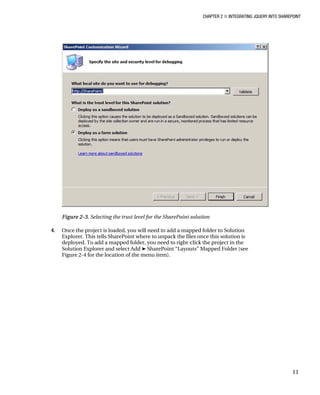
![CHAPTER 2 ■ INTEGRATING JQUERY INTO SHAREPOINT
12
Figure 2-4. Adding a SharePoint-mapped folder to the Visual Studio solution
The Layouts folder will be added to your Solution Explorer and will contain a folder with the same
name as your Visual Studio project. Rename the folder to jQuery. The reason it adds the extra folder is to
try to keep the Layouts folder tidy as well as making sure you are not overwriting existing files when you
deploy your solution. Although it is possible to deploy directly to the Layouts directory, it is best practice
to put your own deployment files into their own folder. A best practice for ensuring you have no conflicts
with other files is to adopt a syntax such as naming your solution’s deployment folders like
[CompanyName]jQuery.
1. Add your jQuery file to the folder; you can either drag and drop the file or
right-click and choose Add ➤ Existing Item….
2. This is all you need to do for this solution. When the solution is deployed, it
will place the file on the filesystem for this server.
3. To test this solution, you can either press F5 to deploy and activate the
solution (as well as open the browser to the URL specified in step 3) or right-
click the project (as highlighted in Figure 2-5) and click Deploy. It’s worth
noting that if you use the first method when you close the browser, the
solution will be retracted, whereas in the second method it won’t be.](https://image.slidesharecdn.com/1307229-250529234001-0a7d5831/85/Pro-Sharepoint-With-Jquery-New-Phill-Duffy-21-320.jpg)
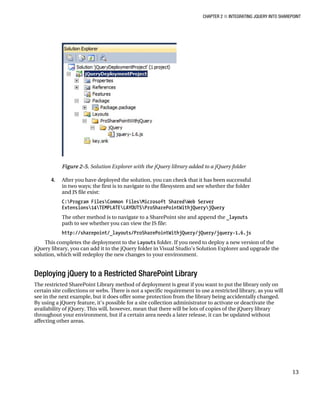
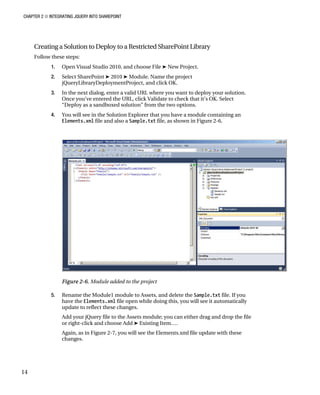
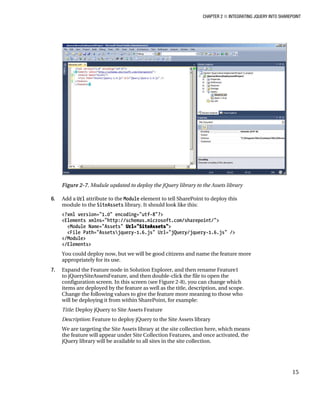
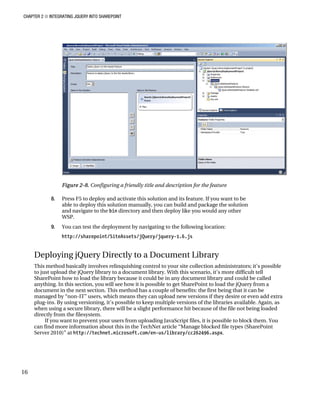
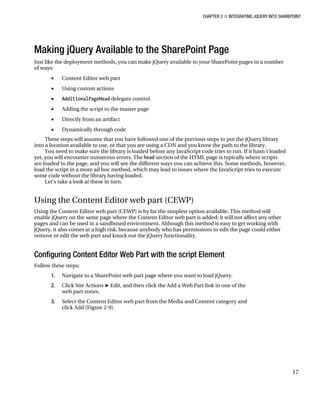
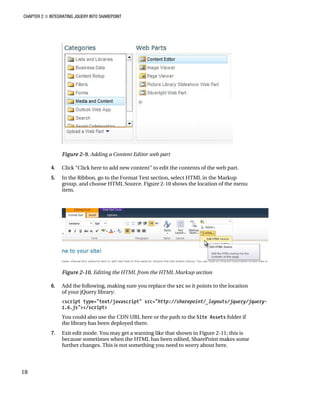
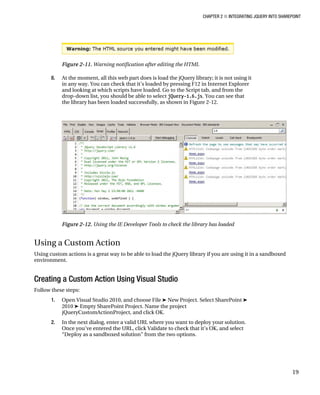
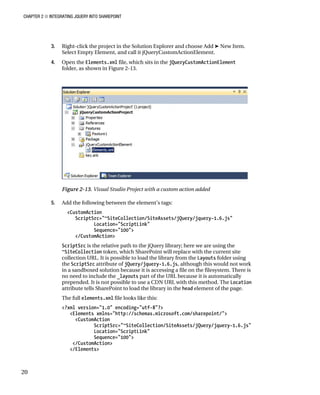

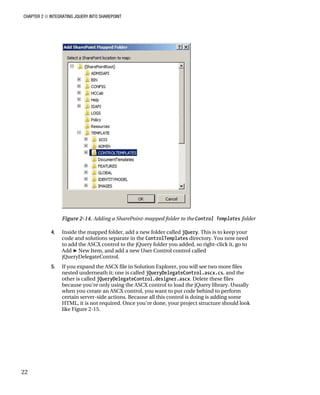
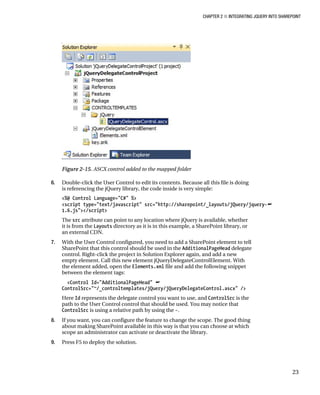
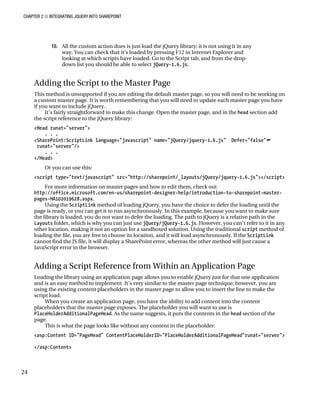
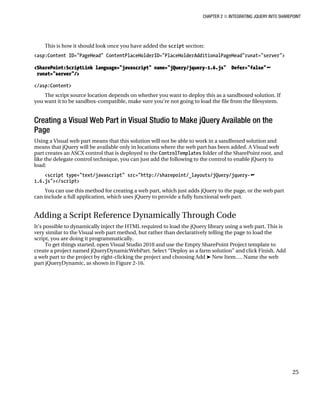
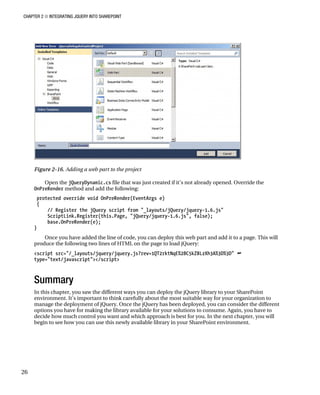
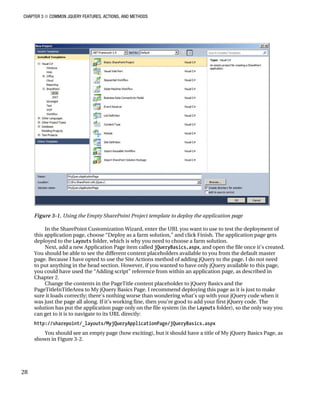
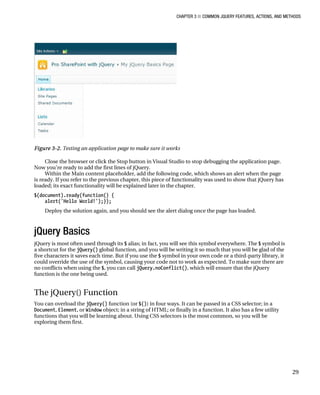
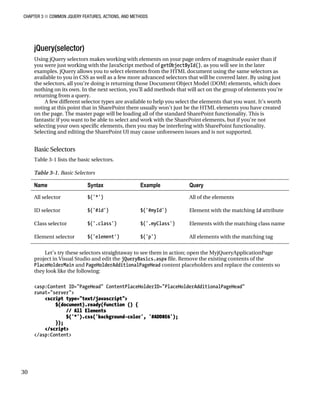
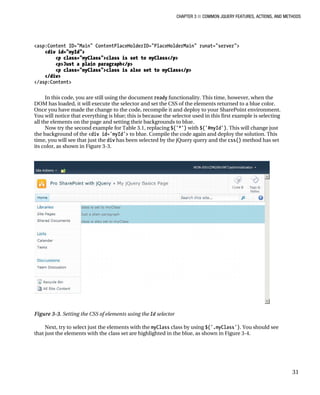
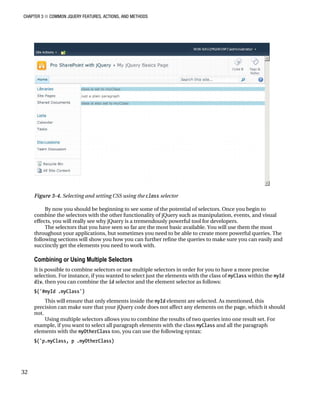
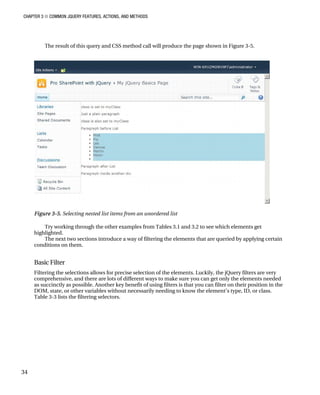
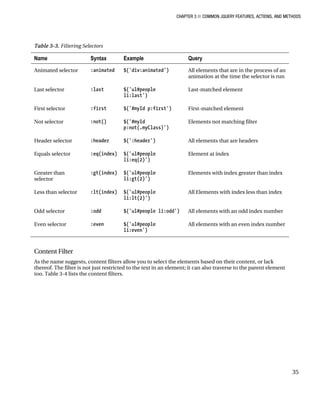

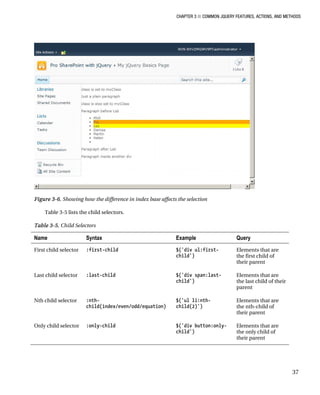
![CHAPTER 3 ■ COMMON JQUERY FEATURES, ACTIONS, AND METHODS
38
Visibility Filter
This pair of filters is very handy when you want only certain elements of your DOM to be seen or hidden
depending on the state of the application (see Table 3-6).
Table 3-6. Visibility Filters
Name Syntax Example Query
Hidden selector :hidden $('input:hidden') All elements that are hidden
Visible selector :visible $('input:visible') All elements that are visible
Attributes
Using attributes is a useful way to select elements. By being able to read any attribute, it makes it easy to
select the elements that you want (see Table 3-7).
Table 3-7. Attribute Filters
Name Syntax Example Query
Attribute contains
prefix selector
[name|=value] $('a[hreflang|="en"]') Elements that have the
specified attribute with a value
either equal to a given string or
starting with that string
followed by a hyphen (-).
Attribute contains
selector
[name*=value] $('input[name*="dog"]') Elements that have the
specified attribute with a value
containing a given substring.
Attribute contains
word selector
[name~=value] $('input[name~="dog"]') Elements that have the
specified attribute with a value
containing a given word,
delimited by spaces.
Attribute ends
with selector
[name$=value] $('input[name$="animal"]') Elements that have the
specified attribute with a value
ending exactly with a given
string. The comparison is case
sensitive.
Attribute equals
selector
[name=value] $('input[value="Billy') Elements that have the
specified attribute with a value
exactly equal to a certain value.](https://image.slidesharecdn.com/1307229-250529234001-0a7d5831/85/Pro-Sharepoint-With-Jquery-New-Phill-Duffy-47-320.jpg)
![CHAPTER 3 ■ COMMON JQUERY FEATURES, ACTIONS, AND METHODS
39
Name Syntax Example Query
Attribute not
equal selector
[name!=value] $('input[name!="edit"]') Elements that either don’t have
the specified attribute or do
have the specified attribute but
not with a certain value.
Attribute starts
with selector
[name^=value] $('input[name^="pet"]') Elements that have the
specified attribute with a value
beginning exactly with a given
string.
Has attribute
selector
[name] $('div[id]') Elements that have the
specified attribute, with any
value.
Multiple attribute
selector
[name=value]
[name1=value2]
$('input[id][name$="dog"]') Elements that match all of the
specified attribute filters.
Form
More often than not, one of the requirements of an application is to capture data of some form or
another, and having a specific set of filters to work with forms is brilliant. Let’s add some more HTML to
the existing application page to see how these filters behave and ideally gain an understanding of why
they will be useful.
Add the following HTML after the last /div in the PlaceHolderMain content placeholder:
<form action="#">
<input type="button" value="Input Button" />
<input type="checkbox" />
<input type="file" />
<input type="hidden" />
<input type="image" />
<input type="password" />
<input type="radio" />
<input type="reset" />
<input type="submit" />
<input type="text" />
<select>
<option>Option</option>
</select>
<textarea cols="10" rows="2">Text area</textarea>
<button>
Button</button>
</form>
Table 3-8 lists the form selectors.](https://image.slidesharecdn.com/1307229-250529234001-0a7d5831/85/Pro-Sharepoint-With-Jquery-New-Phill-Duffy-48-320.jpg)
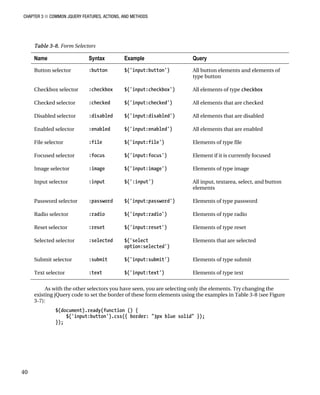
![CHAPTER 3 ■ COMMON JQUERY FEATURES, ACTIONS, AND METHODS
41
Figure 3-7. Highlighting the button element using form selector
Setting the Selector Context
It is also possible to supply a context to the selector to limit its search scope to just elements within it,
that is, jQuery(selector, [context]):
$('div.myClass').click(function() {
$('p', this).Hide();
})
This code will hide all of the paragraphs, p, within the div with class myClass. If you did not supply
the context, it would hide all of the p elements on the page.
Passing in a Document, Element, or Window to jQuery()
It is possible to pass in a Document, Element, or Window to the jQuery wrapper to enable it to use the jQuery
methods you have at your disposal. Wrapping the document object and using the ready() method is a
common way to put jQuery code into your script and wait until the DOM is available before executing
the function. This technique is usually employed when wiring up your events to elements on the page
because it needs to have the HTML elements to bind to.
The following code, which we will revisit later, gives an example of wrapping the document object
and using the ready() method to add a click() event handler to a button.
$(document).ready(function() {
$('#myButton').click(function())
{
// Do something;
};
});
Passing in a String of HTML to jQuery(html)
The other methods that you have seen so far have been querying and selecting elements, which already
exist in the DOM. By passing in HTML, you are able to create and insert new elements into the DOM on
the fly. This method is particularly useful when you are working with data returned from a web service,
because you can use the data to create new elements on the page easily.
var myData = GetMeData();
$.each(myData, function(index, value) {
$('<li>' + value + '</li>').appendTo('#myDataList');
});
In this example, we are getting our data and using the $.each() utility. We are iterating through each
item and creating a new list item, li, and appending it to our list with the id attribute of myDataList. You
will notice that you need to include the full HTML tag with the angle brackets; this is to ensure that
jQuery does not try to interpret it as a CSS selection.](https://image.slidesharecdn.com/1307229-250529234001-0a7d5831/85/Pro-Sharepoint-With-Jquery-New-Phill-Duffy-50-320.jpg)
![CHAPTER 3 ■ COMMON JQUERY FEATURES, ACTIONS, AND METHODS
42
Let’s take a look at creating a little example to see how you can update the DOM on the fly. This
code will use the HTML already written in this chapter.
$(document).ready(function () {
// Create an array of the new people to add
var newPeople = ["Sam", "Zoe", "Graeme", "Gemma"];
// Use the each method to iterate through array
$.each(newPeople, function (index, value) {
// Create new List Item and append it to the people unordered list
$('<li>' + value + '</li>').appendTo('ul#people');
});
});
The list of people that contains Phill, Pip, Les, Denise, Martin, and Helen now has four more values:
Sam, Zoe, Graeme, and Gemma, as shown in Figure 3-8.
Figure 3-8. List item elements being dynamically added to a list
This functionality of being able to write HTML is something that you will be doing in the full
examples later in the book.
jQuery(callback)
You can use jQuery(function) or $(function) to call a function when the DOM is ready. This behaves in
the same way that $(document).ready() does and can be used to call other $() functions on the page that
require the DOM to have been loaded.
jQuery Utilities
jQuery also comes with a handy selection of utilities; you have seen one already, the each function. The
utilities make working on the client side a lot easier for the developer. The following are some of the
utilities you will likely be using:](https://image.slidesharecdn.com/1307229-250529234001-0a7d5831/85/Pro-Sharepoint-With-Jquery-New-Phill-Duffy-51-320.jpg)

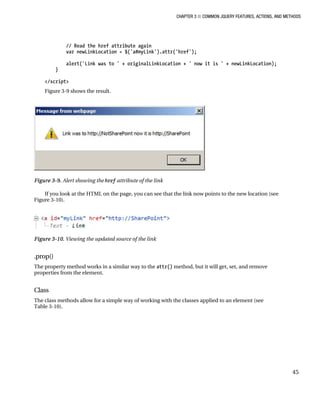


![16
'Ye'll big a cart o stane and lime,
Gar Robin Redbreast trail it syne.
17
'When ye've dune, and finishd your wark,
Ye'll come to me, luve, and get your sark.'
E
Motherwell's MS., p. 492.
1
The Elfin Knight sits on yon hill,
Ba ba lilly ba
Blowing his horn loud and shill.
And the wind has blawn my plaid awa
2
'I love to hear that horn blaw;
I wish him [here] owns it and a'.'
3
That word it was no sooner spoken,
Than Elfin Knight in her arms was gotten.
4
'You must mak to me a sark,
Without threed, sheers or needle wark.'
F
Kinloch MSS, I, 75. From Mary Barr.
1
'Did ye ever travel twist Berwick and Lyne?](https://image.slidesharecdn.com/1307229-250529234001-0a7d5831/85/Pro-Sharepoint-With-Jquery-New-Phill-Duffy-65-320.jpg)
![Burden1
, time in margin.
51
. Maid speaks, in margin.
I.
Not divided regularly into stanzas in the MS.
42
. needlewark in margin.
101
. shin? in margin.
L.
After 6: "Then follows some more which I forget, but I
think it ends thus."
FOOTNOTES:
[13] All that was required of the burden, Mr Chappell kindly
writes me, was to support the voice by harmonious notes under
the melody; it was not sung after each half of the stanza, or after
the stanza, and it was heard separately only when the voices
singing the air stopped. Even the Danish ballads exhibit but a few
cases of these "burden-stems," as Grundwig calls them: see
Danmarks Gamle Folkeviser, II, 221, B 1; 295, B 1; 393, A 1: III,
197, D; 470, A. Such burden-stems are, however, very common in
Icelandic ballads. They are, for the most part, of a different metre
from the ballad, and very often not of the same number of lines
as the ballad stanza. A part of the burden stem would seem to be
taken for the refrain; as Íslenzk Fornkvæði, I, 30, of four verses,
1, 2, 4; 129, of two, the last half of the first and all the second;
194, of four, the last; 225, of five, the last two; II, 52, of five, the
second and last two.
In later times the Danish stev-stamme was made to conform to
the metre of the ballad, and sung as the first stanza, the last line
perhaps forming the burden. Compare the stev-stamme,
Grundwig, III, 470, with the first stanza of the ballad at p. 475. If
not so changed, says Grundtvig, it dropped away. Lyngbye, at the
end of his Færöiske Qvæder, gives the music of a ballad which he
had heard sung. The whole stem is sung first, and then repeated
as a burden at the end of every verse. The modern way, judging](https://image.slidesharecdn.com/1307229-250529234001-0a7d5831/85/Pro-Sharepoint-With-Jquery-New-Phill-Duffy-75-320.jpg)
![by Berggreen, Folke-Sange og Melodier, 3d ed., I, 352, 358, is
simply to sing the whole stem after each verse, and so says
Grundtvig, III, 200, D. The whole stem is appended to the last
stanza (where, as usual, the burden, which had been omitted
after stanza 1, is again expressed) in the Færöe ballad in
Grundtvig, III, 199, exactly as in our broadside, or in Motherwell's
Minstrelsy, Appendix, p. iii. I must avow myself to be very much
in the dark as to the exact relation of stem and burden.
[14] Grundtvig has noticed the resemblance of G.R. 64 and the
ballad.—Much of what follows is derived from the admirable
Benfey's papers, 'Die kluge Dirne, Die indischen Märchen von den
klugen Räthsellösern, und ihre Verbreitung über Asien und
Europa,' Ausland, 1859, p. 457, 486, 511, 567, 589, in Nos 20,
21, 22, 24, 25.
[15] Ragnar Loðbrók (Saga, c. 4, Rafn, Fornaldar Sögur, I, 245),
as pointed out by the Grimms, notes to No 94, requires Kraka
(Aslaug) to come to him clothed and not clothed, fasting and not
fasting, alone and not without a companion. She puts on a fishing
net, bites a leek, and takes her dog with her. References for the
very frequent occurrence of this feature may be found in
Oesterley's note to Gesta Romanorum, No 124, at p. 732.
[16] Benfey, Das Ausland, 1859, p. 459. The versions referred to
are: Shukasaptati (Seventy Tales of a Parrot), 47th and 48th
night; the Buddhist Kanjur, Vinaya, III, fol. 71-83, and Dsanglun,
oder der Weise u. der Thor, also from the Kanjur, translated by
I.J. Schmidt, c. 23; the Mongol translation of Dsanglun [see
Popow, Mongolische Chrestomathie, p. 19, Schiefner's preface to
Radloff, I, xi, xii]; an imperfect Singhalese version in Spence
Hardy's Manual of Buddhism, p. 220, 'The History of Wisákhá;'
'Geschichte des weisen Heykar,' 1001 Nacht, Habicht, v. d. Hagen
u. Schall, XIII, 71, ed. 1840; 'Histoire de Sinkarib et de ses deux
Visirs,' Cabinet des Fées, XXXIX, 266 (Persian); two old Russian
translations of Greek tales derived from Arabic, Pypin, 'in the
Papers of the Second Division of the Imperial Acad. of Sciences,
St Petersburg, 1858, IV, 63-85;' Planudes, Life of Æsop; A. and A.
Schott, Walachische Mæhrchen, p. 125, No 9, 'Vom weissen und
vom rothen Kaiser;' Erdélyi, Népdalok és Mondák, III, 262, No 8,
'The Little Boy with the Secret and his Little Sword.' To these is to
be added, 'L'Histoire de Moradbak,' Caylus, Nouveaux Contes
Orientaux, Œuvres Badines, VII, 289 ff, Cabinet des Fées, XXV, 9-
406 (from the Turkish?). In the opinion of Benfey, it is in the](https://image.slidesharecdn.com/1307229-250529234001-0a7d5831/85/Pro-Sharepoint-With-Jquery-New-Phill-Duffy-76-320.jpg)
![highest degree likely, though not demonstrable, that the Indian
tale antedates our era by several centuries. Ausland, p. 511; see
also pp. 487, 459.
[17] Ingenuity is one of the six transcendental virtues of
Mahāyāna Buddhism. Schlagintweit, Buddhism in Tíbet, p. 36.
[18] The resemblance to the Siberian tale is here especially
striking.
[19] The Shukasaptati, in the form in which we have them, are
supposed to date from about the 6th century, and are regarded
as abridgments of longer tales. The Vinaya probably took a
permanent shape as early as the beginning of the Christian era.
As already remarked, there is scarcely a doubt that the Indian
story is some centuries older still.
[20] Amasis in return (8) puts some of the questions which we
are apt to think of as peculiarly mediæval: What is oldest? What
is most beautiful, biggest, wisest, strongest? etc. Two of these we
have had in Zingerle's story. They are answered in a
commonplace way by the Æthiop, with more refinement by
Thales. Seven similar questions were propounded by David to his
sons, to determine who was worthiest to succeed him, and
answered by Solomon, according to an Arabian writer of the 14th
century: Rosenöl, I, 167. Amasis also sent a victim to Bias (2),
and asked him to cut out the best and worst of the flesh. Bias cut
out the tongue. Here the two anticipate the Anglo-Saxon Salomon
and Saturn: "Tell me what is best and worst among men." "I tell
thee word is best and worst:" Kemble, p. 188, No 37; Adrian and
Ritheus, p. 204, No 43; and Bedæ Collectanea, p. 326. This is
made into a very long story in the Life of Æsop, 11. See other
examples in Knust, Mittheilungen aus dem Eskurial, p. 326 f, note
b, and Nachtrag, p. 647; Oesterley's Kirchhof, v, 94, note to 3,
129; and Landsberger, Die Fabeln des Sophos, cx, ff. We may add
that Plutarch's question, Which was first, the bird or the egg?
(Quæst. Conviv. l. 2, q. 3), comes up again in The Demaundes
Joyous, No 41, Kemble's Salomon and Saturn, p. 290.
[21] Afanasief, Poetic Views of the Slavonians about Nature, I, 25.
The poludnitsa seems to belong to the same class: Afanasief, III,
76; Ralston, Songs of the Russian People, p. 147.
[22] The legend of St Andrew in Legenda Aurea, Grässe, cap. II,
9, p. 19 ff; also in the Fornsvenskt Legendarium, I, 143 ff;
Zambrini, Leggende Inedite, II, 94 ff; Pitré, Canti pop. Siciliani, II,](https://image.slidesharecdn.com/1307229-250529234001-0a7d5831/85/Pro-Sharepoint-With-Jquery-New-Phill-Duffy-77-320.jpg)
![2
'I will cut [hew] your traces,' said etc.:
'Yes, you hew, and I'll build,' answered etc.
3
'I wish you were in the wild wood:'
'Yes, you in, and I outside.'
4
'I wish you were in the highest tree-top:'
'Yes, you up in the top, and I at the roots.'
5
'I wish you were in the wild sea:'
'Yes, you in the sea, and I in a boat.'
6
'I'll bore a hole in your boat:'
'Yes, you bore, and I'll plug.'
7
'I wish you were in hell:'
'Yes, you in, and I outside.'
8
'I wish you were in heaven:'
'Yes, I in, and you outside.'
Chambers, in his Popular Rhymes of Scotland, p. 66 of the new
edition, gives, without a word of explanation, a piece, 'Harpkin,'
which seems to have been of the same character, but now sounds
only like a "flyting."[23] The first stanza would lead us to expect that
Harpkin is to be a form of the Elfin Knight of the preceding ballad,
but Fin is seen to be the uncanny one of the two by the light of the
other ballads. Finn (Fin) is an ancestor of Woden, a dwarf in Völuspá
16 (19), and also a trold (otherwise a giant), who is induced by a
saint to build a church: Thiele, Danske Folkesagn, I, 45, Grimm,](https://image.slidesharecdn.com/1307229-250529234001-0a7d5831/85/Pro-Sharepoint-With-Jquery-New-Phill-Duffy-80-320.jpg)
![9
'And the bottom for to break:'
'And ye to be drowned.'
B.
Motherwell's Minstrelsy, Appendix, p. xxiv, No xxxii.
'O whare are ye gaun?' quo the false knight,
And false, false was his rede:
'I'm gaun to the scule,' says the pretty little boy,
And still, still he stude.
FOOTNOTES:
[23] At the last moment I come upon this: "The only safeguard
against the malice of witches is 'to flight wi dem,' that is, draw
them into a controversy and scold them roundly:" (Mrs Saxby, in
an interesting contribution of folk-lore from Unst, Shetland, in The
Leisure Hour, for March 27, 1880, p. 199.) This view, which has
apparently affected 'Harpkin,' is clearly a modern
misunderstanding. Let no one trust to scolding for foiling a witch,
unless he "knows more words."](https://image.slidesharecdn.com/1307229-250529234001-0a7d5831/85/Pro-Sharepoint-With-Jquery-New-Phill-Duffy-84-320.jpg)