



Principles for effective ministry
            (Part 1)
          Mathew 10:5 to 15
I – Historical and contextual background
                        After studying the 12 men whom God has
                        chosen to spread the Gospel of the Kingdom
                  .     we now study the principles of effective
                        ministry as taught by Jesus to his apostles.
                        Mathew Chapter 10 can be divided into 3
                        parts. The first section (vs. 5-15) deals with
                        the basic task of the ministry. The next
                        section (vs. 16 to 23) the reaction of the
                        ministry and the last section (vs. 24-42) the
                        cost of the ministry.

        In these text, Jesus is laying down the principles on how to
effectively do his work. At this time, Jesus was telling them how to do
their short term missions with some specific instructions, applicable
only at that time. However the basic concepts apply to every believer
doing ministry work. Those who are doing the work of the ministry
cannot effectively minister if they do not follow the principles that
Jesus laid down.
I – A DIVINE COMMISSION

“These twelve Jesus sent forth, and commanded them, saying” – Mathew 10:5a

                 .
      The 12 did not volunteer to become apostles, they were
sovereignly called and commissioned just as the prophet
Jeremiah was called by God. (Jer. 1:5)

      The particular ministry that the apostles were sent to
probably lasted only a few weeks but it was of course significant
because it was the first time the Gospel of the Kingdom was
preached by others than Christ himself. Christ is now sending
each one of them in his behalf in fulfillment of the purpose of
which Christ had asked them to follow him.

       Today, God’s calling and sending may not be as direct as
that but there are three ways in which a believer can determine
whether or not he is called to do ministry work or not.
The following criteria will help a believer
determine if he is called to ministry work:

1.) A strong desire - God’s Word says
                     .
that if we delight ourselves in Him, he will
give us the desires of our heart. The
Christian who loves the Lord and wants
above all to please Him is sensitive to his
will. When one’s life is centered in
obedience it is appropriate to see a place
of ministry in the Lord service. 1 Timothy
3:1 says that if a man desires the office of
a bishop “it is a fine work he desires to
do.” The closer we walk with the Lord,
the more certain we can be that our
desires are his desires.
2.) Confirmation of other believers

    When a person feels the strong desire to
.
    preach but does not have the
    encouragement and support of other
    believers who know him well, he should
    reevaluate his feelings. The Lord uses
    other believer within the church to confirm
    his call to individuals. (1 Timothy 4:14)
    The qualifications by which church leaders
    are to be measured is found in 1 Timothy
    3 and Titus 1.
    3.) Opportunity – God will open a clear
    door of service if a person is really called
    to do ministry work.
The 12 were called and sent out by direct spoken
command of Jesus. “Parangello” the verb behind “commanded”
means to bind a person to make the proper response to an
instruction just as a soldier is bound to obey the orders of his
superiors.

       When one realizes his calling is of the Lord, he has no
choice but to respond to his superior. God sets the standards and
gives the orders, our responsibility is to obey. (Acts 26:19)

       In general every believer is commissioned by the Lord to
make disciples. But not everyone is called to be a preacher,
teacher, pastor or missionary. So the first and most essential
element for ministry is understanding that one is sovereignly
called. As Christians we do not make our own destiny or mark our
own plans. We are under divine orders and our concern must be
to submit to Christ in all things.
II – A CENTRAL OBJECTIVE

“Go not into the way of the Gentiles, and into any city of the Samaritans enter
ye not: But go rather to the lost sheep of the house of Israel.” – Mathew 10:5b-6
                     .
         The second principle for ministry is having a central objective. A
ministry that is not focused on certain priority objectives is a ministry doomed to
mediocrity. God gives us different objectives and from time to time changes
such objective. But he never ask a person to do everything in sight.

         The Apostles were instructed not to at this time carry the Kingdom
message into an area belonging to the Gentiles or the Samaritans. This was
only a temporary command considering Jesus instruction in the Great
Commission and the fact that he already ministered to several Gentiles and
Samaritans.

        The redemption of the whole world has always been in God’s plan but
Jesus instruction here has a certain purpose which are probably as follows:
1.) The special place of the Jews in God’s plan.

They were the chosen people. John The Baptist
preached the Gospel of the Kingdom first to a
                  .
Jewish audience. Jesus begin his own ministry
first to the Jews and explained to the Samaritan
woman that “Salvation is from the Jews” (John
4:22) This is in fulfillment of God’s promise that
through his seed all nation’s of the earth will be
blessed. Israel was the launching point for taking
the Gospel to the rest of the world.

Had the Apostles gone first to the Samaritans and
Gentiles, the Jews would have been very reluctant
to listen to them because they would say that the
apostles were bearing a pagan religion.
2.) A matter of effectiveness - The
    apostles were barely up to the task of
    witnessing effectively to their own people
.
    much less witnessing to the Gentiles and
    Samaritans whose cultures and ways they
    little understood and greatly despised.

    Except for a few isolated cases, the Gospel
    had little impact in the Gentile world, until
    the Lord raised up the Apostle Paul.
    Although a former Pharisee and a Jew in
    the truest sense of the word he grew up in
    the Gentile city of Tarsus and learned
    Gentile literature, religion and culture.
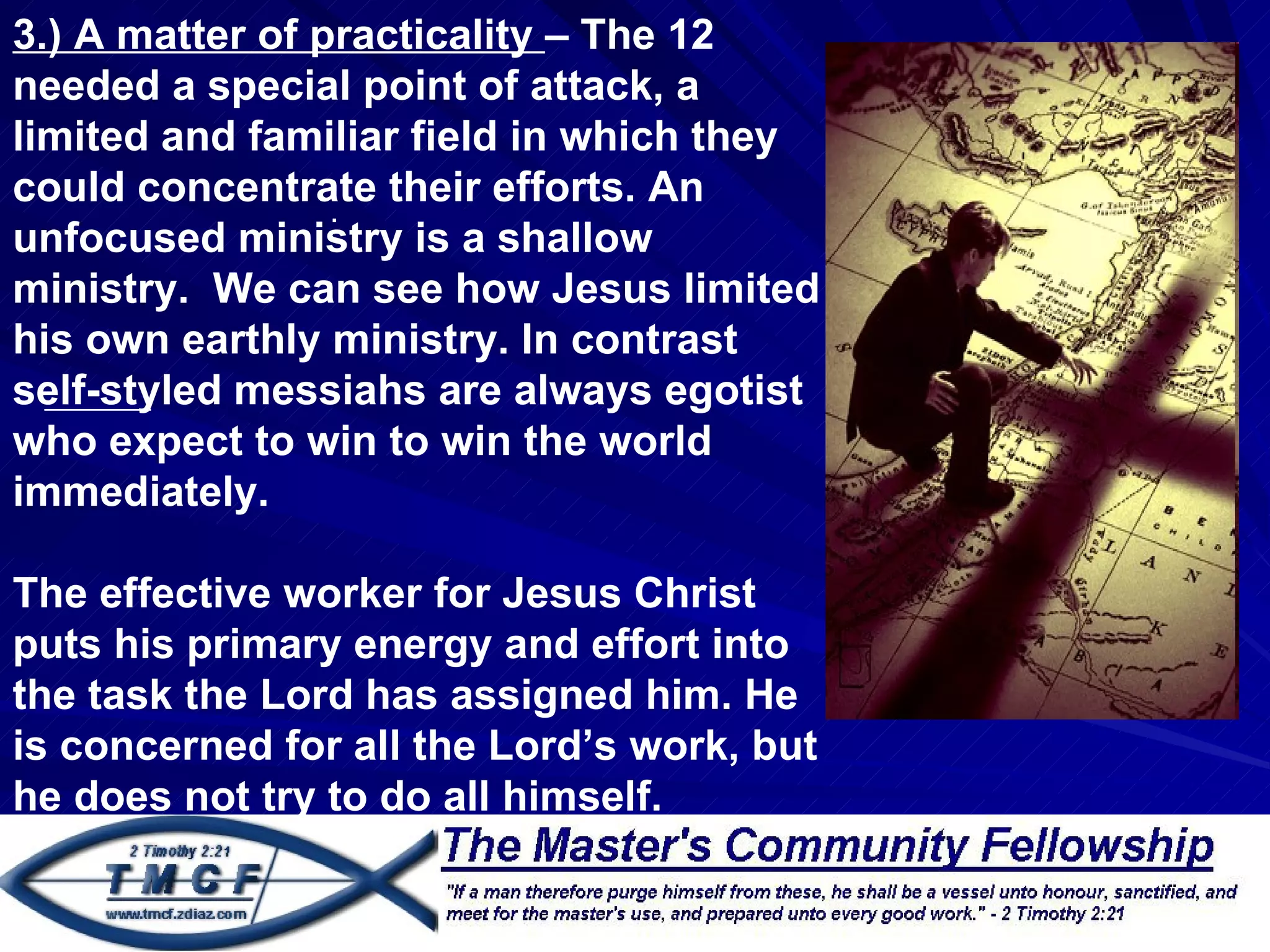
3.) A matter of practicality – The 12
needed a special point of attack, a
limited and familiar field in which they
could concentrate their efforts. An
                 .
unfocused ministry is a shallow
ministry. We can see how Jesus limited
his own earthly ministry. In contrast
self-styled messiahs are always egotist
who expect to win to win the world
immediately.

The effective worker for Jesus Christ
puts his primary energy and effort into
the task the Lord has assigned him. He
is concerned for all the Lord’s work, but
he does not try to do all himself.

Principles for effective ministry part 1 - Mathew 10 verses 5 - 15

  • 1.
    Principles for effectiveministry (Part 1) Mathew 10:5 to 15
  • 2.
    I – Historicaland contextual background After studying the 12 men whom God has chosen to spread the Gospel of the Kingdom . we now study the principles of effective ministry as taught by Jesus to his apostles. Mathew Chapter 10 can be divided into 3 parts. The first section (vs. 5-15) deals with the basic task of the ministry. The next section (vs. 16 to 23) the reaction of the ministry and the last section (vs. 24-42) the cost of the ministry. In these text, Jesus is laying down the principles on how to effectively do his work. At this time, Jesus was telling them how to do their short term missions with some specific instructions, applicable only at that time. However the basic concepts apply to every believer doing ministry work. Those who are doing the work of the ministry cannot effectively minister if they do not follow the principles that Jesus laid down.
  • 3.
    I – ADIVINE COMMISSION “These twelve Jesus sent forth, and commanded them, saying” – Mathew 10:5a . The 12 did not volunteer to become apostles, they were sovereignly called and commissioned just as the prophet Jeremiah was called by God. (Jer. 1:5) The particular ministry that the apostles were sent to probably lasted only a few weeks but it was of course significant because it was the first time the Gospel of the Kingdom was preached by others than Christ himself. Christ is now sending each one of them in his behalf in fulfillment of the purpose of which Christ had asked them to follow him. Today, God’s calling and sending may not be as direct as that but there are three ways in which a believer can determine whether or not he is called to do ministry work or not.
  • 4.
    The following criteriawill help a believer determine if he is called to ministry work: 1.) A strong desire - God’s Word says . that if we delight ourselves in Him, he will give us the desires of our heart. The Christian who loves the Lord and wants above all to please Him is sensitive to his will. When one’s life is centered in obedience it is appropriate to see a place of ministry in the Lord service. 1 Timothy 3:1 says that if a man desires the office of a bishop “it is a fine work he desires to do.” The closer we walk with the Lord, the more certain we can be that our desires are his desires.
  • 5.
    2.) Confirmation ofother believers When a person feels the strong desire to . preach but does not have the encouragement and support of other believers who know him well, he should reevaluate his feelings. The Lord uses other believer within the church to confirm his call to individuals. (1 Timothy 4:14) The qualifications by which church leaders are to be measured is found in 1 Timothy 3 and Titus 1. 3.) Opportunity – God will open a clear door of service if a person is really called to do ministry work.
  • 6.
    The 12 werecalled and sent out by direct spoken command of Jesus. “Parangello” the verb behind “commanded” means to bind a person to make the proper response to an instruction just as a soldier is bound to obey the orders of his superiors. When one realizes his calling is of the Lord, he has no choice but to respond to his superior. God sets the standards and gives the orders, our responsibility is to obey. (Acts 26:19) In general every believer is commissioned by the Lord to make disciples. But not everyone is called to be a preacher, teacher, pastor or missionary. So the first and most essential element for ministry is understanding that one is sovereignly called. As Christians we do not make our own destiny or mark our own plans. We are under divine orders and our concern must be to submit to Christ in all things.
  • 7.
    II – ACENTRAL OBJECTIVE “Go not into the way of the Gentiles, and into any city of the Samaritans enter ye not: But go rather to the lost sheep of the house of Israel.” – Mathew 10:5b-6 . The second principle for ministry is having a central objective. A ministry that is not focused on certain priority objectives is a ministry doomed to mediocrity. God gives us different objectives and from time to time changes such objective. But he never ask a person to do everything in sight. The Apostles were instructed not to at this time carry the Kingdom message into an area belonging to the Gentiles or the Samaritans. This was only a temporary command considering Jesus instruction in the Great Commission and the fact that he already ministered to several Gentiles and Samaritans. The redemption of the whole world has always been in God’s plan but Jesus instruction here has a certain purpose which are probably as follows:
  • 8.
    1.) The specialplace of the Jews in God’s plan. They were the chosen people. John The Baptist preached the Gospel of the Kingdom first to a . Jewish audience. Jesus begin his own ministry first to the Jews and explained to the Samaritan woman that “Salvation is from the Jews” (John 4:22) This is in fulfillment of God’s promise that through his seed all nation’s of the earth will be blessed. Israel was the launching point for taking the Gospel to the rest of the world. Had the Apostles gone first to the Samaritans and Gentiles, the Jews would have been very reluctant to listen to them because they would say that the apostles were bearing a pagan religion.
  • 9.
    2.) A matterof effectiveness - The apostles were barely up to the task of witnessing effectively to their own people . much less witnessing to the Gentiles and Samaritans whose cultures and ways they little understood and greatly despised. Except for a few isolated cases, the Gospel had little impact in the Gentile world, until the Lord raised up the Apostle Paul. Although a former Pharisee and a Jew in the truest sense of the word he grew up in the Gentile city of Tarsus and learned Gentile literature, religion and culture.
  • 10.
    3.) A matterof practicality – The 12 needed a special point of attack, a limited and familiar field in which they could concentrate their efforts. An . unfocused ministry is a shallow ministry. We can see how Jesus limited his own earthly ministry. In contrast self-styled messiahs are always egotist who expect to win to win the world immediately. The effective worker for Jesus Christ puts his primary energy and effort into the task the Lord has assigned him. He is concerned for all the Lord’s work, but he does not try to do all himself.