Prime Numbers,
Cryptography
and Network
Security
José Bermúdez, Ph.D.
Cryptography
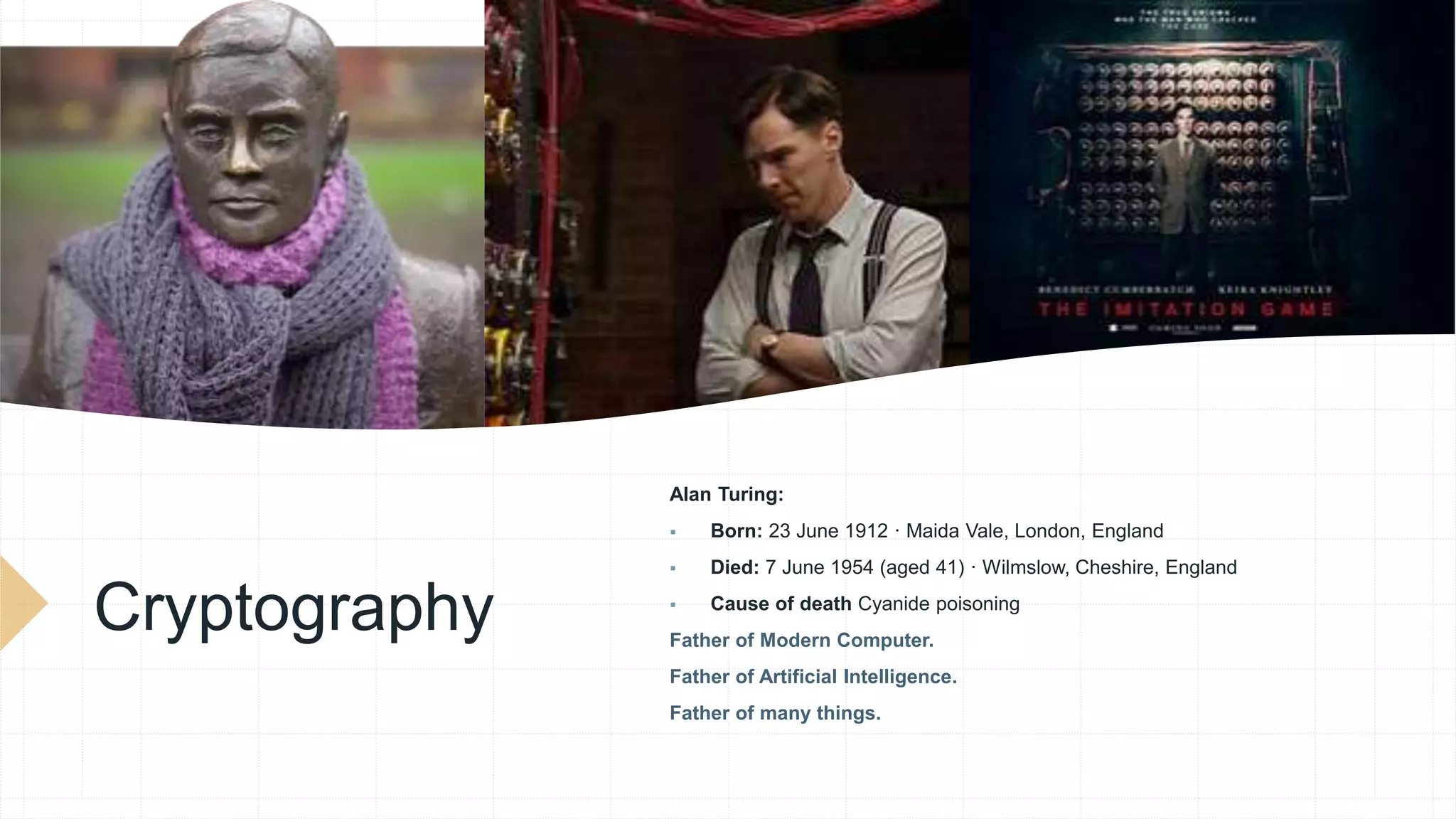
Alan Turing:
 Born: 23 June 1912 · Maida Vale, London, England
 Died: 7 June 1954 (aged 41) · Wilmslow, Cheshire, England
 Cause of death Cyanide poisoning
Father of Modern Computer.
Father of Artificial Intelligence.
Father of many things.
Outcomes:
Upon the completion of this session, the learners will be able to:
 Understand about prime numbers and composite numbers.
 Know some facts about prime numbers.
 Know the role to prime numbers in cryptography.
Prime Numbers
 Have exactly two divisors.
 If "X" is prime, then the divisor are 1 and "X".
 All numbers have prime factors
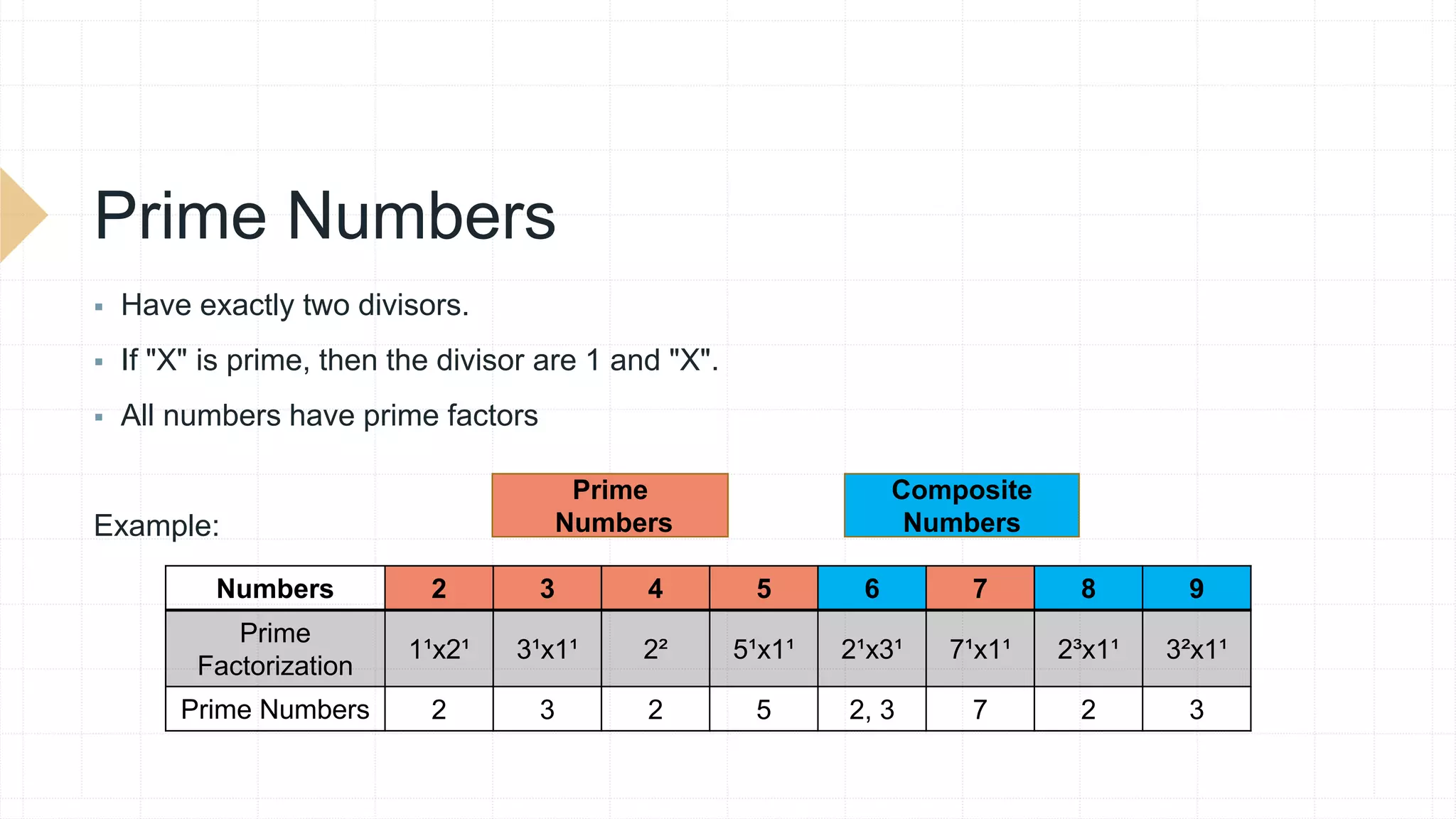
Example:
Numbers 2 3 4 5 6 7 8 9
Prime
Factorization
1¹x2¹ 3¹x1¹ 2² 5¹x1¹ 2¹x3¹ 7¹x1¹ 2³x1¹ 3²x1¹
Prime Numbers 2 3 2 5 2, 3 7 2 3
Prime Numbers
 Have exactly two divisors.
 If "X" is prime, then the divisor are 1 and "X".
 All numbers have prime factors
Example:
Numbers 2 3 4 5 6 7 8 9
Prime
Factorization
1¹x2¹ 3¹x1¹ 2² 5¹x1¹ 2¹x3¹ 7¹x1¹ 2³x1¹ 3²x1¹
Prime Numbers 2 3 2 5 2, 3 7 2 3
Prime
Numbers
Composite
Numbers
Prime Numbers
 A prime number is a number greater than 1 with only two factors, itself and one.
 It cannot be divided further by any other number without leaving a remainder.
Why prime numbers
are important for
cryptography
 Many encryption algorithms are based on
prime numbers.
 Very fast to multiply two large prime numbers.
 Extreme computer-intensive to do the reverse
(found the prime numbers)
 Factoring very large numbers is very hard.
86331288713595159341392743491288713595
1359583051879012887
Prime Numbers
Conjectures
 Goldbach's conjecture
 Twin prime conjecture
 Andrica's conjecture,
 Brocard's conjecture,
 Legendre's conjecture,
 Oppermann's conjecture
 Cramér conjecture
 ...
Summary:
 Learned about prime numbers and composite numbers.
 Know some facts about prime numbers.
 Know the role to prime numbers in cryptography.
Prime Numbers,
Cryptography
and Network
Security
José Bermúdez, Ph.D.

Prime Numbers.pptx

  • 1.
  • 2.
    Cryptography Alan Turing:  Born:23 June 1912 · Maida Vale, London, England  Died: 7 June 1954 (aged 41) · Wilmslow, Cheshire, England  Cause of death Cyanide poisoning Father of Modern Computer. Father of Artificial Intelligence. Father of many things.
  • 3.
    Outcomes: Upon the completionof this session, the learners will be able to:  Understand about prime numbers and composite numbers.  Know some facts about prime numbers.  Know the role to prime numbers in cryptography.
  • 4.
    Prime Numbers  Haveexactly two divisors.  If "X" is prime, then the divisor are 1 and "X".  All numbers have prime factors Example: Numbers 2 3 4 5 6 7 8 9 Prime Factorization 1¹x2¹ 3¹x1¹ 2² 5¹x1¹ 2¹x3¹ 7¹x1¹ 2³x1¹ 3²x1¹ Prime Numbers 2 3 2 5 2, 3 7 2 3
  • 5.
    Prime Numbers  Haveexactly two divisors.  If "X" is prime, then the divisor are 1 and "X".  All numbers have prime factors Example: Numbers 2 3 4 5 6 7 8 9 Prime Factorization 1¹x2¹ 3¹x1¹ 2² 5¹x1¹ 2¹x3¹ 7¹x1¹ 2³x1¹ 3²x1¹ Prime Numbers 2 3 2 5 2, 3 7 2 3 Prime Numbers Composite Numbers
  • 6.
    Prime Numbers  Aprime number is a number greater than 1 with only two factors, itself and one.  It cannot be divided further by any other number without leaving a remainder.
  • 7.
    Why prime numbers areimportant for cryptography  Many encryption algorithms are based on prime numbers.  Very fast to multiply two large prime numbers.  Extreme computer-intensive to do the reverse (found the prime numbers)  Factoring very large numbers is very hard. 86331288713595159341392743491288713595 1359583051879012887
  • 8.
    Prime Numbers Conjectures  Goldbach'sconjecture  Twin prime conjecture  Andrica's conjecture,  Brocard's conjecture,  Legendre's conjecture,  Oppermann's conjecture  Cramér conjecture  ...
  • 9.
    Summary:  Learned aboutprime numbers and composite numbers.  Know some facts about prime numbers.  Know the role to prime numbers in cryptography.
  • 10.