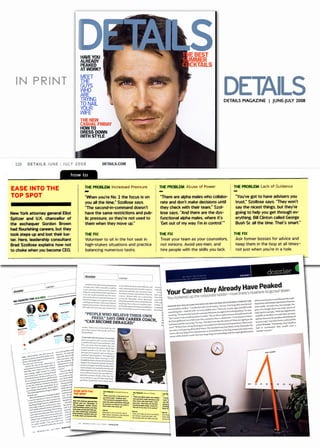
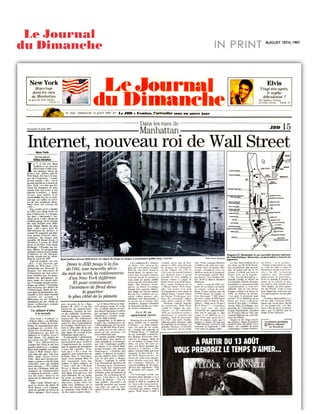
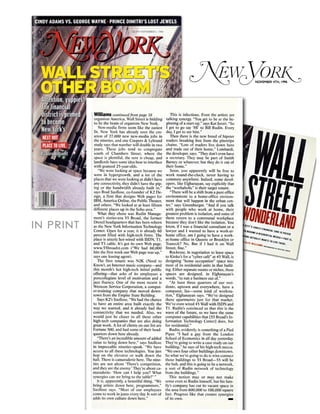
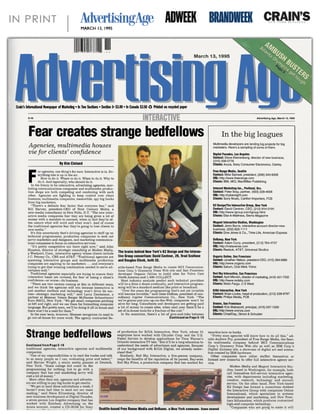
Original Link: http://www.forbes.com/sites/ianaltman/2015/10/06/how-to-sell-your-ideas-to-millennials/
How To Sell Your
Ideas to Millennials
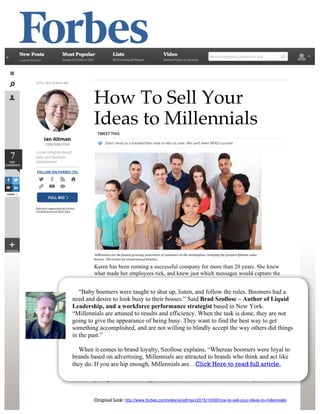
Karen has been running a successful company for more than 20 years. She knew
what made her employees tick, and knew just which messages would capture the
attention of her ideal customer. Over the past several years she noticed with more
employees and customers coming from the Millennial Generation (also known as
Generation Y), things have changed. What used to motivate her employees doesn’t
seem to be working anymore. And, her customers now have different expectations.
Karen commented that if she doesn’t figure out how to adapt, she could be in
trouble. If this sounds familiar, you might be interested in how to sell your ideas to
Millennials.
Who Are Millennials?
Millennials are not a separate species. They are loosely defined as the generation
that approached adulthood around the year 2000. They might be described as a bit
irreverent, arrogant, and independent. They might not dress respectfully – the same
terms that were used to describe baby boomers 30+ years ago. You can bury your
head in the sand and hope that the Millennial Generation will start acting like the
prior generation. That approach, however, didn’t work so well in the past, and is…
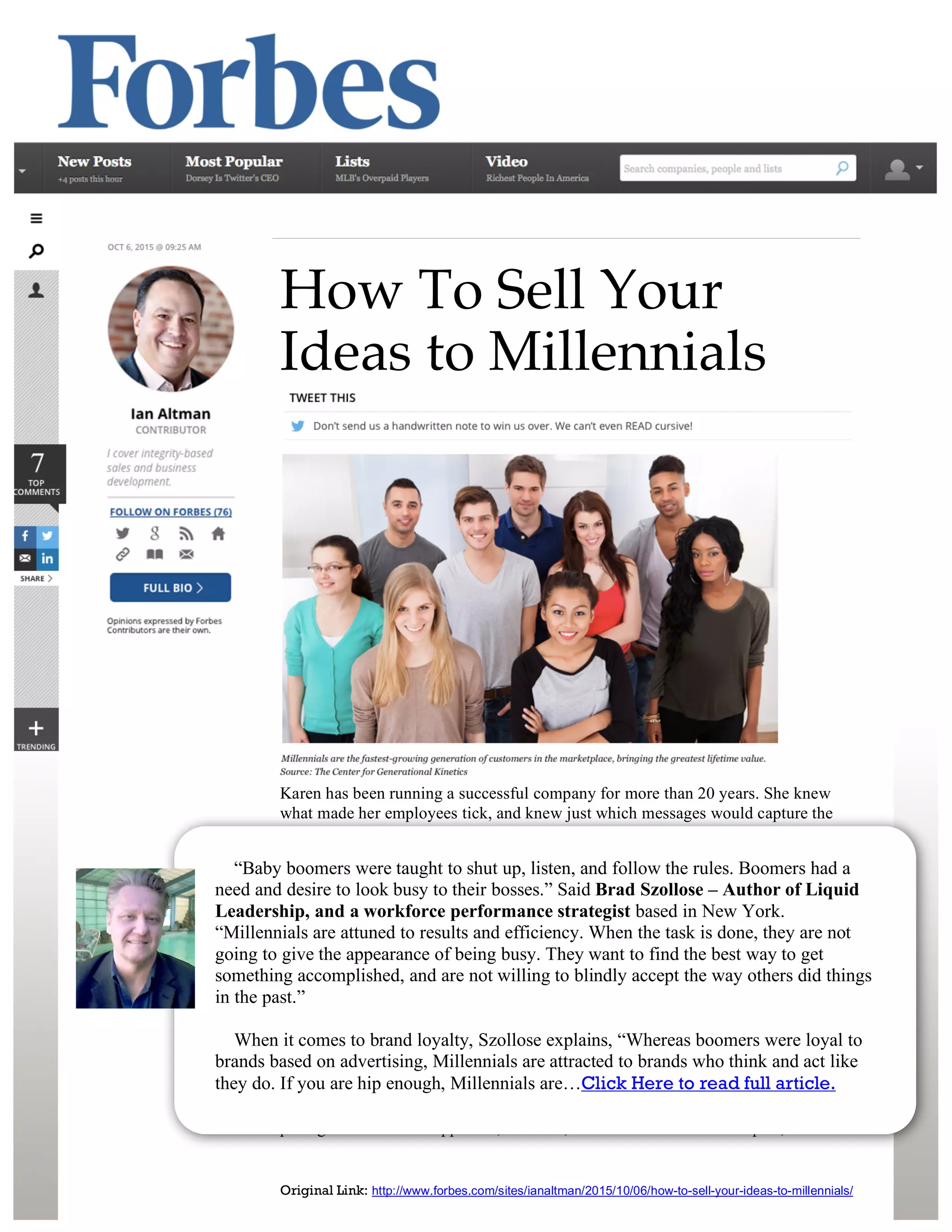
“Baby boomers were taught to shut up, listen, and follow the rules. Boomers had a
need and desire to look busy to their bosses.” Said Brad Szollose – Author of Liquid
Leadership, and a workforce performance strategist based in New York.
“Millennials are attuned to results and efficiency. When the task is done, they are not
going to give the appearance of being busy. They want to find the best way to get
something accomplished, and are not willing to blindly accept the way others did things
in the past.”
When it comes to brand loyalty, Szollose explains, “Whereas boomers were loyal to
brands based on advertising, Millennials are attracted to brands who think and act like
they do. If you are hip enough, Millennials are…Click Here to read full article.
Original Link: http://www.inc.com/jeff-haden/75-inspiring-motivational-quotes-on-leadership.html
#38. "If you really want the key to success, start by doing the opposite of
what everyone else is doing." — Brad Szollose
Original Article by Bill Sobel from CMS Newswire: Connecting With Bill Sobel
http://www.cmswire.com/cms/social-business/brad-szollose-stop-running-your-business-like-its-1969-027198.php
Brad Szollose:
Stop Running Your Business Like It's 1969
By Bill Sobel
November 17th, 2014
Brad Szollose is a lot of things: a serial
entrepreneur, former C-Level executive
of a public company, a business adviser,
millennial expert and an award-winning
business author. So he knows a few things
about which he speaks — and this is what he
wants businesses to know.
Flatten your hierarchies, embrace innovation
and stop expecting your employees to follow
the rules, keep their mouths shut and listen. Those days are over, and they aren't
coming back.
"The	
  digital	
  age	
  requires	
  a	
  smarter	
  worker.	
  In	
  today’s	
  world,	
  we	
  make	
  
very	
  sophisticated	
  stuff	
  that	
  does	
  not	
  conform	
  to	
  simple	
  rules.	
  
Responsibility,	
  troubleshooting	
  and	
  decision-­‐making	
  have	
  all	
  moved	
  to	
  
the	
  frontline.	
  This	
  requires	
  open-­‐source	
  style	
  communication,"	
  he	
  said.	
  
Bridging	
  the	
  Generational	
  Chasm	
  
As a web pioneer, Szollose co-founded K2 Design, one of the
first online advertising shops and the first dot-com agency to go
public on NASDAQ.
You may remember the company: it picked up its first major
assignment in March 1994 for Sierra Magazineʻs online edition.
In August 1994, it was hired by NetMarket, which claimed to be
the first company to conduct a secure transaction on the Internet. It also staged the
first IBM versus Kasparov chess match, a landmark event in the then novel world
of cybercasting.
Szollose's management model received the Arthur Andersen Enterprise Award
for Best Practices for Fostering Innovation.
Continued on next page….
Original Article by Bill Sobel from CMS Newswire: Connecting With Bill Sobel
http://www.cmswire.com/cms/social-business/brad-szollose-stop-running-your-business-like-its-1969-027198.php
Szollose is the author of Liquid Leadership: From Woodstock to Wikipedia,
which explores the subject of new leadership styles, specifically how to get the
tech-savvy Generation Y and analog driven Baby Boomers working together.
He's also senior managing director of Liquid Leadership Worldwide, which was formed
to help companies like Dell and MasterCard gain a better understanding of the ways
technology has transformed corporate culture and behavior.
CMSWire caught up with Szollose recently to discuss leadership, creativity and
strategies for success in the digital workplace.
Sobel:	
  You	
  started	
  your	
  first	
  business	
  at	
  age	
  16.	
  Can	
  you	
  tell	
  	
  
us	
  about	
  that?	
  
Szollose: Don't be impressed that I started my first business at 16. My father made it
so hard to ask for a $20 that it was easier to start a business. But it put me on the path
to understanding…
Click here to continue reading…
Bill Sobel
Contributing Author working from New York City, NY
Covers Social media, social business, personal branding
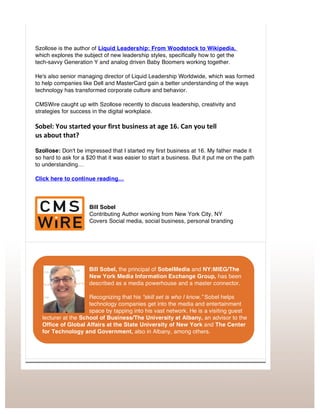
Bill Sobel, the principal of SobelMedia and NY:MIEG/The
New York Media Information Exchange Group, has been
described as a media powerhouse and a master connector.
Recognizing that his “skill set is who I know,” Sobel helps
technology companies get into the media and entertainment
space by tapping into his vast network. He is a visiting guest
lecturer at the School of Business/The University at Albany, an advisor to the
Office of Global Affairs at the State University of New York and The Center
for Technology and Government, also in Albany, among others.
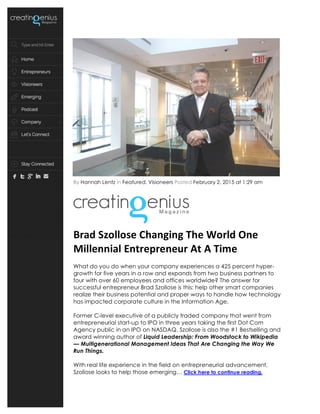
By Hannah Lentz in Featured, Visioneers Posted February 2, 2015 at 1:29 am
	
  
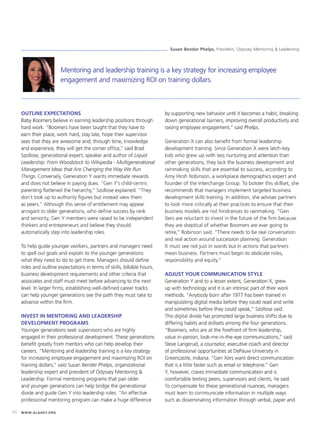
Brad	
  Szollose	
  Changing	
  The	
  World	
  One	
  
Millennial	
  Entrepreneur	
  At	
  A	
  Time	
  
What do you do when your company experiences a 425 percent hyper-
growth for five years in a row and expands from two business partners to
four with over 60 employees and offices worldwide? The answer for
successful entrepreneur Brad Szollose is this: help other smart companies
realize their business potential and proper ways to handle how technology
has impacted corporate culture in the Information Age.
Former C-level executive of a publicly traded company that went from
entrepreneurial start-up to IPO in three years taking the first Dot Com
Agency public in an IPO on NASDAQ. Szollose is also the #1 Bestselling and
award winning author of Liquid Leadership: From Woodstock to Wikipedia
— Multigenerational Management Ideas That Are Changing the Way We
Run Things.
With real life experience in the field on entrepreneurial advancement,
Szollose looks to help those emerging… Click here to continue reading.
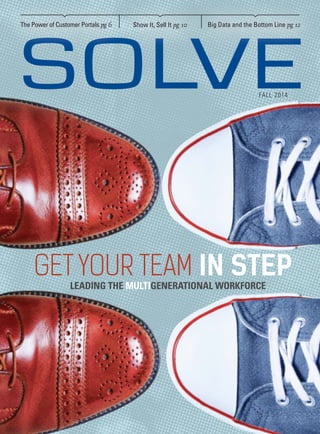
FALL 2014
GET YOUR TEAM IN STEPLEADING THE MULTIGENERATIONAL WORKFORCE
The Power of Customer Portals pg 6 Show It, Sell It pg 10 Big Data and the Bottom Line pg 12
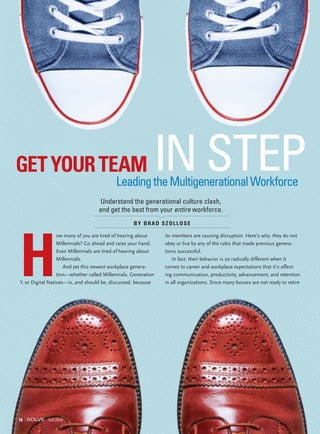
BY BRAD SZOLLOSE
GETYOURTEAM
LeadingtheMultigenerationalWorkforce
IN STEP
Understand the generational culture clash,
and get the best from your entire workforce.
16 Fall 2014
H
ow many of you are tired of hearing about
Millennials? Go ahead and raise your hand.
Even Millennials are tired of hearing about
Millennials.
And yet this newest workplace genera-
tion—whether called Millennials, Generation
Y, or Digital Natives—is, and should be, discussed, because
its members are causing disruption. Here’s why: they do not
obey or live by any of the rules that made previous genera-
tions successful.
In fact, their behavior is so radically different when it
comes to career and workplace expectations that it’s affect-
ing communication, productivity, advancement, and retention
in all organizations. Since many bosses are not ready to retire
17Fall 2014
anytime soon, and Millennials are moving into management
positions, a traffic jam has begun.
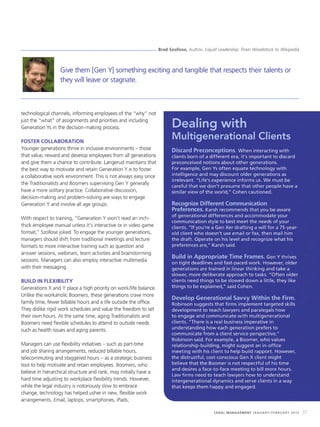
As a leader you need to understand this generational phe-
nomenon. To propel your business forward, you need insight
into the behavioral dynamics of each generation in order to
create a positive corporate culture and prepare the next gen-
eration for leadership.
Step one is to understand what, as a general rule, moti-
vates each generation.
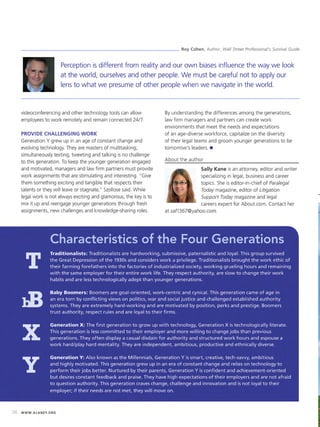
WHAT BOOMERS EXPECT
When defining generational categories, we’ll keep it simple.
Many divide the generations into Traditionalists, Gen X,
and so on, but the real workplace differences are between
Millennials and everyone else.
As a rule, anyone born before 1977 (Baby Boomers, Gen X)
was taught a traditional path to success. Listen to the teacher,
study hard, pass the test, then you move forward.
Age + Time + Experience = Status and Salary.
Getting ahead took time and effort.
Boomers know their place in an organization, never expect-
ing to chat with the CEO until they have earned the right to do
so, either through title, experience, or age. And when a Boomer
has a much younger boss, he or she can feel like a failure.
For anyone born after 1977 (Millennials)—age is not a crite-
rion for advancement. Skill set is. So when a 25-year-old joins
a company, he or she sees no issue with entering at the same
level as the Boomer with years of hard-earned experience.
What causes this disconnect in expectations?
INSIDE THE MILLENNIAL MINDSET
Millennials grew up in a time of child-centric parenting,
in which they were routinely consulted about their wishes
and included in adult discussions. This approach spread to
schools and sports, and the effect was a flattening of hierarchy
in Millennials’ lives.
As a result, they see their older workplace superiors not as
authority figures, but as peers—approachable and easily avail-
able to hang out with, learn from, and run new ideas past.
This lack of intimidation is not a lack of respect. Millennials
simply don’t recognize traditional boundaries.
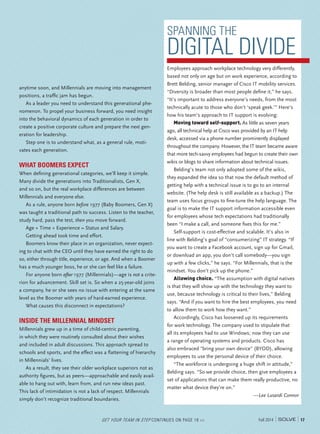
SPANNING THE
DIGITAL DIVIDE
Employees approach workplace technology very differently,
based not only on age but on work experience, according to
Brett Belding, senior manager of Cisco IT mobility services.
“Diversity is broader than most people define it,” he says.
“It’s important to address everyone’s needs, from the most
technically acute to those who don’t ‘speak geek.’” Here’s
how his team’s approach to IT support is evolving:
Moving toward self-support. As little as seven years
ago, all technical help at Cisco was provided by an IT help
desk, accessed via a phone number prominently displayed
throughout the company. However, the IT team became aware
that more tech-savvy employees had begun to create their own
wikis or blogs to share information about technical issues.
Belding’s team not only adopted some of the wikis,
they expanded the idea so that now the default method of
getting help with a technical issue is to go to an internal
website. (The help desk is still available as a backup.) The
team uses focus groups to fine-tune the help language. The
goal is to make the IT support information accessible even
for employees whose tech expectations had traditionally
been “I make a call, and someone fixes this for me.”
Self-support is cost-effective and scalable. It’s also in
line with Belding’s goal of “consumerizing” IT strategy. “If
you want to create a Facebook account, sign up for Gmail,
or download an app, you don’t call somebody—you sign
up with a few clicks,” he says. “For Millennials, that is the
mindset. You don’t pick up the phone.”
Allowing choice. “The assumption with digital natives
is that they will show up with the technology they want to
use, because technology is critical to their lives,” Belding
says. “And if you want to hire the best employees, you need
to allow them to work how they want.”
Accordingly, Cisco has loosened up its requirements
for work technology. The company used to stipulate that
all its employees had to use Windows; now they can use
a range of operating systems and products. Cisco has
also embraced "bring your own device" (BYOD), allowing
employees to use the personal device of their choice.
“The workforce is undergoing a huge shift in attitude,”
Belding says. “So we provide choice, then give employees a
set of applications that can make them really productive, no
matter what device they’re on.”
—Lee Lusardi Connor
GET YOUR TEAM IN STEP CONTINUES ON PAGE 18 >>
Second, technology changes behavior. Millennials were
raised to adapt to rapid change. With hundreds of software
upgrades, the Internet, and interactive toys, Millennials
learned to manipulate digital information before they
could read and write, and in some cases, before they could
speak. Because of this, nothing is ever “finished.” Constant
change is normal.
Millennials were also immersed in a new entertainment
platform: video games. And it shaped them. How do you learn
in a complex video game? You do not read a manual; you par-
ticipate and learn the rules intuitively. Leadership is rotational
and you use your team players and their individual skill sets
as needed. After mastering one level, you discard what you’ve
learned, because the rules change at the next level.
Boomers were taught that if you screw up, your career is
over. Meanwhile, Millennials were trained that making mis-
takes is the only way to learn.
FOCUS ON THE WORK
Both Boomers and Millennials have crucial skills, experiences,
and insights for your business. Moreover, Millennials have
something to teach management about new technology, a
new workforce, and a new customer. We are in a marketplace
in which technology allows smaller companies to compete
with big brands; in which old jobs are disappearing and new
ones are being created.
To keep your company both relevant and harmonious,
create an environment where all generations can thrive. Here
are a few ways to do that.
• Groom for leadership. Don’t simply hope that new hires will
figure out the way your company does things; show them.
Develop an internal apprenticeship program to give them
the proper training in your company’s methodologies.
This is where Boomer experience pays off in dividends.
Become a valued mentor instead of a boss.
• Flatten your hierarchy. If you are clinging to traditional
management styles, then you are waiting for decisions to
go through the chain of command, and that creates bot-
tlenecks. By flattening your organization, training people
to make decisions without you, and giving them the tools
they need, you create an organization that moves faster.
And that makes all generations more productive.
• Consider a Results-Only Work Environment (ROWE). ROWE
is a flexible management strategy, created by Cali Ressler
and Jody Thompson. Because it focuses on results, it
allows individuals to work in the way that suits them best.
For example, Boomers tend to see work as a “place you go
to”—the office—while Millennials see it as a “thing you
do,” to be done anywhere, at any time, even in a coffee
shop. A ROWE approach can accommodate all styles.
Consider each project a mission, with deadlines and
tactics, and yourself a mission leader whose job is more
support than command. Let each team member set his or her
own goals for the week, do all you can to support those goals,
and stay in touch with weekly check-ins. In this way, talented
individuals can rise to the surface and be given greater and
greater responsibilities. And this keeps the best people in any
generation engaged and excited by their work.
Business consultant Brad Szollose helps smart com-
panies understand how technology has transformed
a new generation and how that impacts businesses.
He is the author of the bestselling Liquid Leadership:
From Woodstock to Wikipedia.
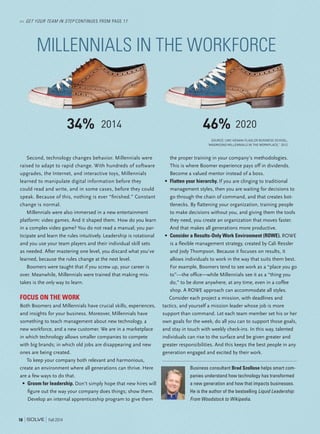
MILLENNIALS IN THE WORKFORCE
<< GET YOUR TEAM IN STEP CONTINUES FROM PAGE 17
18 Fall 2014
SOURCE: UNC KENAN-FLAGLER BUSINESS SCHOOL,
“MAXIMIZING MILLENNIALS IN THE WORKPLACE,” 2012
46% 202034% 2014
Original Article by D. Murali from The Hindu Business Line
http://www.thehindubusinessline.com/opinion/columns/d-murali/article2465186.ece?homepage=true
Press kit brad-szollose-2015

Press kit brad-szollose-2015

  • 1.
    Original Link: http://www.forbes.com/sites/ianaltman/2015/10/06/how-to-sell-your-ideas-to-millennials/ HowTo Sell Your Ideas to Millennials Karen has been running a successful company for more than 20 years. She knew what made her employees tick, and knew just which messages would capture the attention of her ideal customer. Over the past several years she noticed with more employees and customers coming from the Millennial Generation (also known as Generation Y), things have changed. What used to motivate her employees doesn’t seem to be working anymore. And, her customers now have different expectations. Karen commented that if she doesn’t figure out how to adapt, she could be in trouble. If this sounds familiar, you might be interested in how to sell your ideas to Millennials. Who Are Millennials? Millennials are not a separate species. They are loosely defined as the generation that approached adulthood around the year 2000. They might be described as a bit irreverent, arrogant, and independent. They might not dress respectfully – the same terms that were used to describe baby boomers 30+ years ago. You can bury your head in the sand and hope that the Millennial Generation will start acting like the prior generation. That approach, however, didn’t work so well in the past, and is… “Baby boomers were taught to shut up, listen, and follow the rules. Boomers had a need and desire to look busy to their bosses.” Said Brad Szollose – Author of Liquid Leadership, and a workforce performance strategist based in New York. “Millennials are attuned to results and efficiency. When the task is done, they are not going to give the appearance of being busy. They want to find the best way to get something accomplished, and are not willing to blindly accept the way others did things in the past.” When it comes to brand loyalty, Szollose explains, “Whereas boomers were loyal to brands based on advertising, Millennials are attracted to brands who think and act like they do. If you are hip enough, Millennials are…Click Here to read full article.
  • 2.
    Original Link: http://www.inc.com/jeff-haden/75-inspiring-motivational-quotes-on-leadership.html #38."If you really want the key to success, start by doing the opposite of what everyone else is doing." — Brad Szollose
  • 3.
    Original Article byBill Sobel from CMS Newswire: Connecting With Bill Sobel http://www.cmswire.com/cms/social-business/brad-szollose-stop-running-your-business-like-its-1969-027198.php Brad Szollose: Stop Running Your Business Like It's 1969 By Bill Sobel November 17th, 2014 Brad Szollose is a lot of things: a serial entrepreneur, former C-Level executive of a public company, a business adviser, millennial expert and an award-winning business author. So he knows a few things about which he speaks — and this is what he wants businesses to know. Flatten your hierarchies, embrace innovation and stop expecting your employees to follow the rules, keep their mouths shut and listen. Those days are over, and they aren't coming back. "The  digital  age  requires  a  smarter  worker.  In  today’s  world,  we  make   very  sophisticated  stuff  that  does  not  conform  to  simple  rules.   Responsibility,  troubleshooting  and  decision-­‐making  have  all  moved  to   the  frontline.  This  requires  open-­‐source  style  communication,"  he  said.   Bridging  the  Generational  Chasm   As a web pioneer, Szollose co-founded K2 Design, one of the first online advertising shops and the first dot-com agency to go public on NASDAQ. You may remember the company: it picked up its first major assignment in March 1994 for Sierra Magazineʻs online edition. In August 1994, it was hired by NetMarket, which claimed to be the first company to conduct a secure transaction on the Internet. It also staged the first IBM versus Kasparov chess match, a landmark event in the then novel world of cybercasting. Szollose's management model received the Arthur Andersen Enterprise Award for Best Practices for Fostering Innovation. Continued on next page….
  • 4.
    Original Article byBill Sobel from CMS Newswire: Connecting With Bill Sobel http://www.cmswire.com/cms/social-business/brad-szollose-stop-running-your-business-like-its-1969-027198.php Szollose is the author of Liquid Leadership: From Woodstock to Wikipedia, which explores the subject of new leadership styles, specifically how to get the tech-savvy Generation Y and analog driven Baby Boomers working together. He's also senior managing director of Liquid Leadership Worldwide, which was formed to help companies like Dell and MasterCard gain a better understanding of the ways technology has transformed corporate culture and behavior. CMSWire caught up with Szollose recently to discuss leadership, creativity and strategies for success in the digital workplace. Sobel:  You  started  your  first  business  at  age  16.  Can  you  tell     us  about  that?   Szollose: Don't be impressed that I started my first business at 16. My father made it so hard to ask for a $20 that it was easier to start a business. But it put me on the path to understanding… Click here to continue reading… Bill Sobel Contributing Author working from New York City, NY Covers Social media, social business, personal branding Bill Sobel, the principal of SobelMedia and NY:MIEG/The New York Media Information Exchange Group, has been described as a media powerhouse and a master connector. Recognizing that his “skill set is who I know,” Sobel helps technology companies get into the media and entertainment space by tapping into his vast network. He is a visiting guest lecturer at the School of Business/The University at Albany, an advisor to the Office of Global Affairs at the State University of New York and The Center for Technology and Government, also in Albany, among others.
  • 5.
    By Hannah Lentzin Featured, Visioneers Posted February 2, 2015 at 1:29 am   Brad  Szollose  Changing  The  World  One   Millennial  Entrepreneur  At  A  Time   What do you do when your company experiences a 425 percent hyper- growth for five years in a row and expands from two business partners to four with over 60 employees and offices worldwide? The answer for successful entrepreneur Brad Szollose is this: help other smart companies realize their business potential and proper ways to handle how technology has impacted corporate culture in the Information Age. Former C-level executive of a publicly traded company that went from entrepreneurial start-up to IPO in three years taking the first Dot Com Agency public in an IPO on NASDAQ. Szollose is also the #1 Bestselling and award winning author of Liquid Leadership: From Woodstock to Wikipedia — Multigenerational Management Ideas That Are Changing the Way We Run Things. With real life experience in the field on entrepreneurial advancement, Szollose looks to help those emerging… Click here to continue reading.
  • 6.
    FALL 2014 GET YOURTEAM IN STEPLEADING THE MULTIGENERATIONAL WORKFORCE The Power of Customer Portals pg 6 Show It, Sell It pg 10 Big Data and the Bottom Line pg 12
  • 7.
    BY BRAD SZOLLOSE GETYOURTEAM LeadingtheMultigenerationalWorkforce INSTEP Understand the generational culture clash, and get the best from your entire workforce. 16 Fall 2014 H ow many of you are tired of hearing about Millennials? Go ahead and raise your hand. Even Millennials are tired of hearing about Millennials. And yet this newest workplace genera- tion—whether called Millennials, Generation Y, or Digital Natives—is, and should be, discussed, because its members are causing disruption. Here’s why: they do not obey or live by any of the rules that made previous genera- tions successful. In fact, their behavior is so radically different when it comes to career and workplace expectations that it’s affect- ing communication, productivity, advancement, and retention in all organizations. Since many bosses are not ready to retire
  • 8.
    17Fall 2014 anytime soon,and Millennials are moving into management positions, a traffic jam has begun. As a leader you need to understand this generational phe- nomenon. To propel your business forward, you need insight into the behavioral dynamics of each generation in order to create a positive corporate culture and prepare the next gen- eration for leadership. Step one is to understand what, as a general rule, moti- vates each generation. WHAT BOOMERS EXPECT When defining generational categories, we’ll keep it simple. Many divide the generations into Traditionalists, Gen X, and so on, but the real workplace differences are between Millennials and everyone else. As a rule, anyone born before 1977 (Baby Boomers, Gen X) was taught a traditional path to success. Listen to the teacher, study hard, pass the test, then you move forward. Age + Time + Experience = Status and Salary. Getting ahead took time and effort. Boomers know their place in an organization, never expect- ing to chat with the CEO until they have earned the right to do so, either through title, experience, or age. And when a Boomer has a much younger boss, he or she can feel like a failure. For anyone born after 1977 (Millennials)—age is not a crite- rion for advancement. Skill set is. So when a 25-year-old joins a company, he or she sees no issue with entering at the same level as the Boomer with years of hard-earned experience. What causes this disconnect in expectations? INSIDE THE MILLENNIAL MINDSET Millennials grew up in a time of child-centric parenting, in which they were routinely consulted about their wishes and included in adult discussions. This approach spread to schools and sports, and the effect was a flattening of hierarchy in Millennials’ lives. As a result, they see their older workplace superiors not as authority figures, but as peers—approachable and easily avail- able to hang out with, learn from, and run new ideas past. This lack of intimidation is not a lack of respect. Millennials simply don’t recognize traditional boundaries. SPANNING THE DIGITAL DIVIDE Employees approach workplace technology very differently, based not only on age but on work experience, according to Brett Belding, senior manager of Cisco IT mobility services. “Diversity is broader than most people define it,” he says. “It’s important to address everyone’s needs, from the most technically acute to those who don’t ‘speak geek.’” Here’s how his team’s approach to IT support is evolving: Moving toward self-support. As little as seven years ago, all technical help at Cisco was provided by an IT help desk, accessed via a phone number prominently displayed throughout the company. However, the IT team became aware that more tech-savvy employees had begun to create their own wikis or blogs to share information about technical issues. Belding’s team not only adopted some of the wikis, they expanded the idea so that now the default method of getting help with a technical issue is to go to an internal website. (The help desk is still available as a backup.) The team uses focus groups to fine-tune the help language. The goal is to make the IT support information accessible even for employees whose tech expectations had traditionally been “I make a call, and someone fixes this for me.” Self-support is cost-effective and scalable. It’s also in line with Belding’s goal of “consumerizing” IT strategy. “If you want to create a Facebook account, sign up for Gmail, or download an app, you don’t call somebody—you sign up with a few clicks,” he says. “For Millennials, that is the mindset. You don’t pick up the phone.” Allowing choice. “The assumption with digital natives is that they will show up with the technology they want to use, because technology is critical to their lives,” Belding says. “And if you want to hire the best employees, you need to allow them to work how they want.” Accordingly, Cisco has loosened up its requirements for work technology. The company used to stipulate that all its employees had to use Windows; now they can use a range of operating systems and products. Cisco has also embraced "bring your own device" (BYOD), allowing employees to use the personal device of their choice. “The workforce is undergoing a huge shift in attitude,” Belding says. “So we provide choice, then give employees a set of applications that can make them really productive, no matter what device they’re on.” —Lee Lusardi Connor GET YOUR TEAM IN STEP CONTINUES ON PAGE 18 >>
  • 9.
    Second, technology changesbehavior. Millennials were raised to adapt to rapid change. With hundreds of software upgrades, the Internet, and interactive toys, Millennials learned to manipulate digital information before they could read and write, and in some cases, before they could speak. Because of this, nothing is ever “finished.” Constant change is normal. Millennials were also immersed in a new entertainment platform: video games. And it shaped them. How do you learn in a complex video game? You do not read a manual; you par- ticipate and learn the rules intuitively. Leadership is rotational and you use your team players and their individual skill sets as needed. After mastering one level, you discard what you’ve learned, because the rules change at the next level. Boomers were taught that if you screw up, your career is over. Meanwhile, Millennials were trained that making mis- takes is the only way to learn. FOCUS ON THE WORK Both Boomers and Millennials have crucial skills, experiences, and insights for your business. Moreover, Millennials have something to teach management about new technology, a new workforce, and a new customer. We are in a marketplace in which technology allows smaller companies to compete with big brands; in which old jobs are disappearing and new ones are being created. To keep your company both relevant and harmonious, create an environment where all generations can thrive. Here are a few ways to do that. • Groom for leadership. Don’t simply hope that new hires will figure out the way your company does things; show them. Develop an internal apprenticeship program to give them the proper training in your company’s methodologies. This is where Boomer experience pays off in dividends. Become a valued mentor instead of a boss. • Flatten your hierarchy. If you are clinging to traditional management styles, then you are waiting for decisions to go through the chain of command, and that creates bot- tlenecks. By flattening your organization, training people to make decisions without you, and giving them the tools they need, you create an organization that moves faster. And that makes all generations more productive. • Consider a Results-Only Work Environment (ROWE). ROWE is a flexible management strategy, created by Cali Ressler and Jody Thompson. Because it focuses on results, it allows individuals to work in the way that suits them best. For example, Boomers tend to see work as a “place you go to”—the office—while Millennials see it as a “thing you do,” to be done anywhere, at any time, even in a coffee shop. A ROWE approach can accommodate all styles. Consider each project a mission, with deadlines and tactics, and yourself a mission leader whose job is more support than command. Let each team member set his or her own goals for the week, do all you can to support those goals, and stay in touch with weekly check-ins. In this way, talented individuals can rise to the surface and be given greater and greater responsibilities. And this keeps the best people in any generation engaged and excited by their work. Business consultant Brad Szollose helps smart com- panies understand how technology has transformed a new generation and how that impacts businesses. He is the author of the bestselling Liquid Leadership: From Woodstock to Wikipedia. MILLENNIALS IN THE WORKFORCE << GET YOUR TEAM IN STEP CONTINUES FROM PAGE 17 18 Fall 2014 SOURCE: UNC KENAN-FLAGLER BUSINESS SCHOOL, “MAXIMIZING MILLENNIALS IN THE WORKPLACE,” 2012 46% 202034% 2014
  • 15.
    Original Article byD. Murali from The Hindu Business Line http://www.thehindubusinessline.com/opinion/columns/d-murali/article2465186.ece?homepage=true