India
India’
’s Nuclear
s Nuclear Programme
Programme
V Raghuraman
V Raghuraman
Confederation of Indian Industry
ENERGY SCENARIO
ENERGY SCENARIO
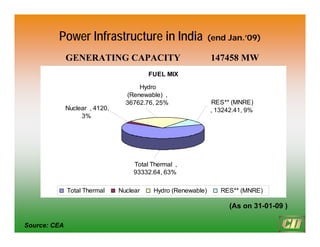
GENERATING CAPACITY 147458 MW
Power Infrastructure in India (end Jan.’09)
Source: CEA
(As on 31-01-09 )
FUEL MIX
RES** (MNRE)
, 13242.41, 9%
Hydro
(Renewable) ,
36762.76, 25%
Nuclear , 4120,
3%
Total Thermal ,
93332.64, 63%
Total Thermal Nuclear Hydro (Renewable) RES** (MNRE)
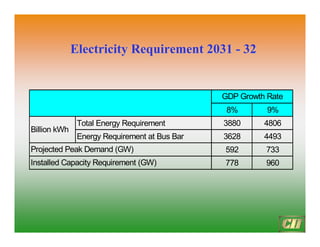
Electricity Requirement 2031
Electricity Requirement 2031 -
- 32
32
8% 9%
Total Energy Requirement 3880 4806
Energy Requirement at Bus Bar 3628 4493
592 733
778 960
Billion kWh
Projected Peak Demand (GW)
Installed Capacity Requirement (GW)
GDP Growth Rate
190
226
157
213
117
300
220
320
100
150
200
250
300
350
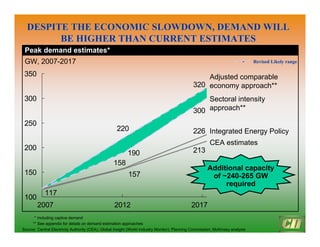
DESPITE THE ECONOMIC SLOWDOWN, DEMAND WILL
BE HIGHER THAN CURRENT ESTIMATES
* Including captive demand
** See appendix for details on demand estimation approaches
Source: Central Electricity Authority (CEA); Global Insight (World Industry Monitor); Planning Commission; McKinsey analysis
•
• Revised Likely range
Revised Likely range
Peak demand estimates*
GW, 2007-2017
Adjusted comparable
economy approach**
Sectoral intensity
approach**
Integrated Energy Policy
CEA estimates
158
2012 2017
2007
Additional capacity
of ~240-265 GW
required
6
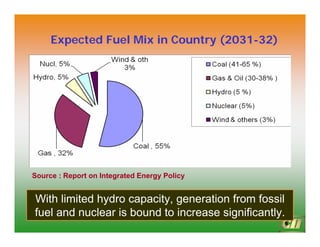
Expected Fuel Mix in Country (2031-32)
Source : Report on Integrated Energy Policy
With limited hydro capacity, generation from fossil
fuel and nuclear is bound to increase significantly.
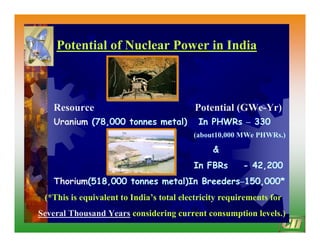
Potential of Nuclear Power in India
Resource Potential (GWe-Yr)
Uranium (78,000 tonnes metal) In PHWRs – 330
(about10,000 MWe PHWRs.)
&
In FBRs - 42,200
Thorium(518,000 tonnes metal)In Breeders–150,000*
(*This is equivalent to India’s total electricity requirements for
Several Thousand Years considering current consumption levels.)
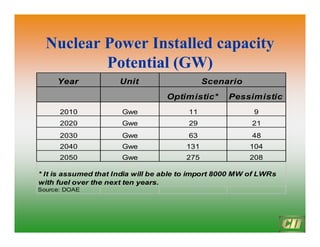
Nuclear Power Installed capacity
Potential (GW)
Potential (GW)
Year Unit
Optimistic* Pessimistic
2010 Gwe 11 9
2020 Gwe 29 21
2030 Gwe 63 48
2040 Gwe 131 104
2050 Gwe 275 208
Source: DOAE
* It is assumed that India will be able to import 8000 MW of LWRs
with fuel over the next ten years.
Scenario
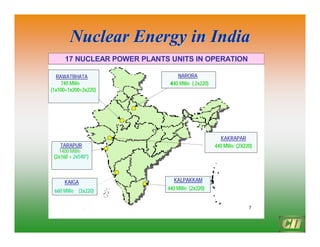
Nuclear Energy in India
7
NARORA
440 MWe ( 2x220)
17 NUCLEAR POWER PLANTS UNITS IN OPERATION
RAWATBHATA
740 MWe
(1x100+1x200+2x220)
KAIGA
660 MWe (3x220)
KALPAKKAM
440 MWe (2x220)
KAKRAPAR
440 MWe (2X220)
TARAPUR
1400 MWe
(2x160 + 2x540*)
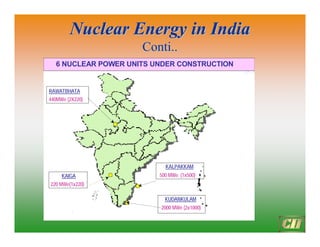
Nuclear Energy in India
Conti..
Conti..
15
6 NUCLEAR POWER UNITS UNDER CONSTRUCTION
RAWATBHATA
440MWe (2X220)
KUDANKULAM
2000 MWe (2x1000)
KAIGA
220 MWe(1x220)
KALPAKKAM
500 MWe (1x500)
Nuclear Energy in India
Conti..
Conti..
28
Narora, UP
2 (440 MWe) 2 (1400 MWe)
IN OPERATION
UNDER CONSTRUCTION
LIKELY ADDITIONS
NUCLEAR POWER PLANTS PLANNED
Rawatbhatajasthan
3 (640 MWe)
2(440 MWe)
2(1400MWe)
Kudankulam, TN
2 (2000 MWe)
4 (4000 MWe)
Kaiga,Karnataka
2 (440 MWe)
2 (440 MWe)
2 (1400 MWe)
Kalpakkam, TN
2 (440 MWe)
1 (500 MWe)
2 (1000 MWe)
Kakrapar, Gujarat
2 (440 MWe)
2 (1400 MWe)
Tarapur, Maharashtra
3 (860 MWe)
1 (540 MWe)
3 (2300 MWe)
Jaitapur, Maharashtra
6 (6000-8000 MWe)
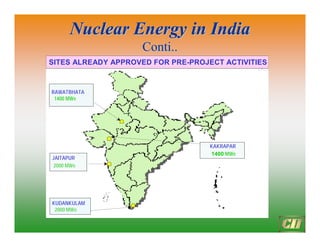
SITES ALREADY APPROVED FOR PRE-PROJECT ACTIVITIES
RAWATBHATA
1400 MWe
KUDANKULAM
2000 MWe
KAKRAPAR
1400 MWe
JAITAPUR
2000 MWe
Nuclear Energy in India
Conti..
Conti..
29
Narora, UP
2 (440 MWe) 2 (1400 MWe)
IN OPERATION
UNDER CONSTRUCTION
LIKELY ADDITIONS
NUCLEAR POWER PLANTS PLANNED
Rawatbhatajasthan
3 (640 MWe)
2(440 MWe)
2(1400MWe)
Kudankulam, TN
2 (2000 MWe)
4 (4000 MWe)
Kaiga,Karnataka
2 (440 MWe)
2 (440 MWe)
2 (1400 MWe)
Kalpakkam, TN
2 (440 MWe)
1 (500 MWe)
2 (1000 MWe)
Kakrapar, Gujarat
2 (440 MWe)
2 (1400 MWe)
Tarapur, Maharashtra
3 (860 MWe)
1 (540 MWe)
3 (2300 MWe)
Jaitapur, Maharashtra
6 (6000-8000 MWe)
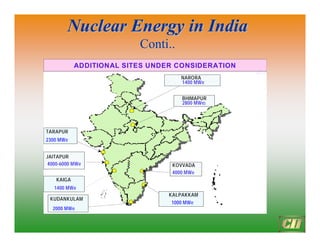
BHIMAPUR
2800 MWe)
ADDITIONAL SITES UNDER CONSIDERATION
KUDANKULAM
2000 MWe
KAIGA
1400 MWe
KALPAKKAM
1000 MWe
TARAPUR
2300 MWe
JAITAPUR
4000-6000 MWe KOVVADA
4000 MWe
NARORA
1400 MWe
Nuclear Energy in India
6
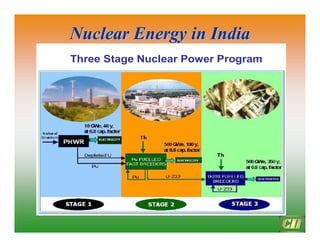
Three Stage Nuclear Power Program
Ownership Models
ƒ All operating nuclear power plants owned & operated by NPCIL
ƒ FBR under construction is owned & will be operated by BHAVINI
ƒ Presently ownership is limited by law to –
¾Government of India or,
¾A Government Company
NTPC as a Government Company proposes to participate in Nuclear
Power Generation
Current Situation in Nuclear Power Generation in India
15
Project Execution Models
ƒ Indigenous nuclear power plants executed on multi-package model
ƒ Plants supplied by overseas entities executed on E & P or EPC basis
Current Situation in Nuclear Power Generation in India
16
Prospective Ownership Models
y
y Existing DAE Corporations
Existing DAE Corporations
e.g., NPCIL, BHAVINI
y
y New Government owned
New Government owned SPVs
SPVs created under DAE auspices
created under DAE auspices
y
y Non
Non-
-DAE Government Corporations
DAE Government Corporations
e.g., NTPC
e.g., NTPC
y
y Public
Public –
– Private Partnerships (PPP)
Private Partnerships (PPP)
y
y Private Ownership
Private Ownership
Domestic / Overseas / JV
Emerging trends in Nuclear Power Generation in India
17
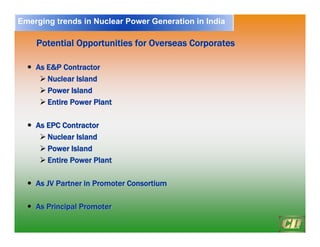
Potential Opportunities for Overseas
Potential Opportunities for Overseas Corporates
Corporates
y
y As E&P Contractor
As E&P Contractor
¾
¾ Nuclear Island
Nuclear Island
¾
¾ Power Island
Power Island
¾
¾ Entire Power Plant
Entire Power Plant
y
y As EPC Contractor
As EPC Contractor
¾
¾ Nuclear Island
Nuclear Island
¾
¾ Power Island
Power Island
¾
¾ Entire Power Plant
Entire Power Plant
y
y As JV Partner in Promoter Consortium
As JV Partner in Promoter Consortium
y
y As Principal Promoter
As Principal Promoter
Emerging trends in Nuclear Power Generation in India
18
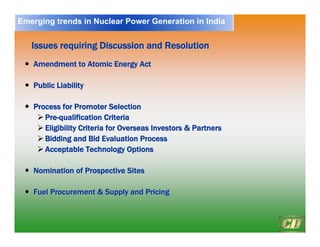
Issues requiring Discussion and Resolution
y
y Amendment to Atomic Energy Act
Amendment to Atomic Energy Act
y
y Public Liability
Public Liability
y
y Process for Promoter Selection
Process for Promoter Selection
¾
¾ Pre
Pre-
-qualification Criteria
qualification Criteria
¾
¾ Eligibility Criteria for Overseas Investors & Partners
Eligibility Criteria for Overseas Investors & Partners
¾
¾ Bidding and Bid Evaluation Process
Bidding and Bid Evaluation Process
¾
¾ Acceptable Technology Options
Acceptable Technology Options
y
y Nomination of Prospective Sites
Nomination of Prospective Sites
y
y Fuel Procurement & Supply and Pricing
Fuel Procurement & Supply and Pricing
Emerging trends in Nuclear Power Generation in India
19
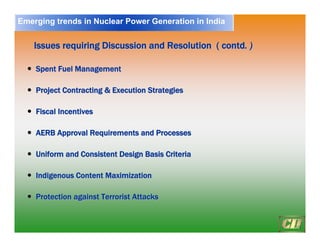
Issues requiring Discussion and Resolution ( contd
Issues requiring Discussion and Resolution ( contd. )
. )
y
y Spent Fuel Management
Spent Fuel Management
y
y Project Contracting & Execution Strategies
Project Contracting & Execution Strategies
y
y Fiscal Incentives
Fiscal Incentives
y
y AERB Approval Requirements and Processes
AERB Approval Requirements and Processes
y
y Uniform and Consistent Design Basis Criteria
Uniform and Consistent Design Basis Criteria
y
y Indigenous Content Maximization
Indigenous Content Maximization
y
y Protection against Terrorist Attacks
Protection against Terrorist Attacks
Emerging trends in Nuclear Power Generation in India
20
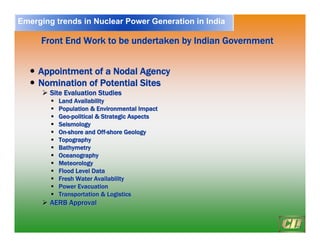
Front End Work to be undertaken by Indian Government
y
y Appointment of a Nodal Agency
Appointment of a Nodal Agency
y
y Nomination of Potential Sites
Nomination of Potential Sites
¾
¾ Site Evaluation Studies
Site Evaluation Studies
ƒ
ƒ Land Availability
Land Availability
ƒ
ƒ Population & Environmental Impact
Population & Environmental Impact
ƒ
ƒ Geo
Geo-
-political & Strategic Aspects
political & Strategic Aspects
ƒ
ƒ Seismology
Seismology
ƒ
ƒ On
On-
-shore and Off
shore and Off-
-shore Geology
shore Geology
ƒ
ƒ Topography
Topography
ƒ
ƒ Bathymetry
Bathymetry
ƒ
ƒ Oceanography
Oceanography
ƒ
ƒ Meteorology
Meteorology
ƒ
ƒ Flood Level Data
Flood Level Data
ƒ
ƒ Fresh Water Availability
Fresh Water Availability
ƒ
ƒ Power Evacuation
Power Evacuation
ƒ
ƒ Transportation & Logistics
Transportation & Logistics
¾
¾ AERB Approval
AERB Approval
Emerging trends in Nuclear Power Generation in India
21
y
y Formation of Shell Companies
Formation of Shell Companies
y
y Land Acquisition and Development
Land Acquisition and Development
y
y Development of Plant Design Bases
Development of Plant Design Bases
y
y Enunciation of Principles of PPA
Enunciation of Principles of PPA
y
y Development of Tendering Norms & Conditions and Bid
Development of Tendering Norms & Conditions and Bid-
-qualification &
qualification &
Selection processes
Selection processes
Front End Work to be undertaken by Indian Government
( contd. )
( contd. )
Emerging trends in Nuclear Power Generation in India
22
y
y Adaptation of Standard Designs to Indian Conditions
Adaptation of Standard Designs to Indian Conditions
y
y Evaluation of Indian Manufacturing and Construction Capabilities
Evaluation of Indian Manufacturing and Construction Capabilities
& Capacities
& Capacities
y
y Firming up Scope and Details of Procurement of Equipment and
Firming up Scope and Details of Procurement of Equipment and
Services from India
Services from India
y
y Basic Engineering for Site Dependent
Basic Engineering for Site Dependent BoP
BoP Facilities in respect of
Facilities in respect of
Identified Sites
Identified Sites
Suggested Initiatives for Overseas
Suggested Initiatives for Overseas Corporates
Corporates
Emerging trends in Nuclear Power Generation in India
THANK YOU
THANK YOU

Presentation_V_Raghuraman_Se hjjhhhhhssionV.PDF

  • 1.
    India India’ ’s Nuclear s NuclearProgramme Programme V Raghuraman V Raghuraman Confederation of Indian Industry Confederation of Indian Industry Confederation of Indian Industry
  • 2.
  • 3.
    GENERATING CAPACITY 147458MW Power Infrastructure in India (end Jan.’09) Source: CEA (As on 31-01-09 ) FUEL MIX RES** (MNRE) , 13242.41, 9% Hydro (Renewable) , 36762.76, 25% Nuclear , 4120, 3% Total Thermal , 93332.64, 63% Total Thermal Nuclear Hydro (Renewable) RES** (MNRE)
  • 4.
    Electricity Requirement 2031 ElectricityRequirement 2031 - - 32 32 8% 9% Total Energy Requirement 3880 4806 Energy Requirement at Bus Bar 3628 4493 592 733 778 960 Billion kWh Projected Peak Demand (GW) Installed Capacity Requirement (GW) GDP Growth Rate
  • 5.
    190 226 157 213 117 300 220 320 100 150 200 250 300 350 DESPITE THE ECONOMICSLOWDOWN, DEMAND WILL DESPITE THE ECONOMIC SLOWDOWN, DEMAND WILL BE HIGHER THAN CURRENT ESTIMATES BE HIGHER THAN CURRENT ESTIMATES * Including captive demand ** See appendix for details on demand estimation approaches Source: Central Electricity Authority (CEA); Global Insight (World Industry Monitor); Planning Commission; McKinsey analysis • • Revised Likely range Revised Likely range Peak demand estimates* GW, 2007-2017 Adjusted comparable economy approach** Sectoral intensity approach** Integrated Energy Policy CEA estimates 158 2012 2017 2007 Additional capacity of ~240-265 GW required
  • 6.
    6 Expected Fuel Mixin Country (2031-32) Source : Report on Integrated Energy Policy With limited hydro capacity, generation from fossil fuel and nuclear is bound to increase significantly.
  • 7.
    Potential of NuclearPower in India Resource Potential (GWe-Yr) Uranium (78,000 tonnes metal) In PHWRs – 330 (about10,000 MWe PHWRs.) & In FBRs - 42,200 Thorium(518,000 tonnes metal)In Breeders–150,000* (*This is equivalent to India’s total electricity requirements for Several Thousand Years considering current consumption levels.)
  • 8.
    Nuclear Power Installedcapacity Nuclear Power Installed capacity Potential (GW) Potential (GW) Year Unit Optimistic* Pessimistic 2010 Gwe 11 9 2020 Gwe 29 21 2030 Gwe 63 48 2040 Gwe 131 104 2050 Gwe 275 208 Source: DOAE * It is assumed that India will be able to import 8000 MW of LWRs with fuel over the next ten years. Scenario
  • 9.
    Nuclear Energy inIndia Nuclear Energy in India 7 NARORA 440 MWe ( 2x220) 17 NUCLEAR POWER PLANTS UNITS IN OPERATION RAWATBHATA 740 MWe (1x100+1x200+2x220) KAIGA 660 MWe (3x220) KALPAKKAM 440 MWe (2x220) KAKRAPAR 440 MWe (2X220) TARAPUR 1400 MWe (2x160 + 2x540*)
  • 10.
    Nuclear Energy inIndia Nuclear Energy in India Conti.. Conti.. 15 6 NUCLEAR POWER UNITS UNDER CONSTRUCTION RAWATBHATA 440MWe (2X220) KUDANKULAM 2000 MWe (2x1000) KAIGA 220 MWe(1x220) KALPAKKAM 500 MWe (1x500)
  • 11.
    Nuclear Energy inIndia Nuclear Energy in India Conti.. Conti.. 28 Narora, UP 2 (440 MWe) 2 (1400 MWe) IN OPERATION UNDER CONSTRUCTION LIKELY ADDITIONS NUCLEAR POWER PLANTS PLANNED Rawatbhatajasthan 3 (640 MWe) 2(440 MWe) 2(1400MWe) Kudankulam, TN 2 (2000 MWe) 4 (4000 MWe) Kaiga,Karnataka 2 (440 MWe) 2 (440 MWe) 2 (1400 MWe) Kalpakkam, TN 2 (440 MWe) 1 (500 MWe) 2 (1000 MWe) Kakrapar, Gujarat 2 (440 MWe) 2 (1400 MWe) Tarapur, Maharashtra 3 (860 MWe) 1 (540 MWe) 3 (2300 MWe) Jaitapur, Maharashtra 6 (6000-8000 MWe) SITES ALREADY APPROVED FOR PRE-PROJECT ACTIVITIES RAWATBHATA 1400 MWe KUDANKULAM 2000 MWe KAKRAPAR 1400 MWe JAITAPUR 2000 MWe
  • 12.
    Nuclear Energy inIndia Nuclear Energy in India Conti.. Conti.. 29 Narora, UP 2 (440 MWe) 2 (1400 MWe) IN OPERATION UNDER CONSTRUCTION LIKELY ADDITIONS NUCLEAR POWER PLANTS PLANNED Rawatbhatajasthan 3 (640 MWe) 2(440 MWe) 2(1400MWe) Kudankulam, TN 2 (2000 MWe) 4 (4000 MWe) Kaiga,Karnataka 2 (440 MWe) 2 (440 MWe) 2 (1400 MWe) Kalpakkam, TN 2 (440 MWe) 1 (500 MWe) 2 (1000 MWe) Kakrapar, Gujarat 2 (440 MWe) 2 (1400 MWe) Tarapur, Maharashtra 3 (860 MWe) 1 (540 MWe) 3 (2300 MWe) Jaitapur, Maharashtra 6 (6000-8000 MWe) BHIMAPUR 2800 MWe) ADDITIONAL SITES UNDER CONSIDERATION KUDANKULAM 2000 MWe KAIGA 1400 MWe KALPAKKAM 1000 MWe TARAPUR 2300 MWe JAITAPUR 4000-6000 MWe KOVVADA 4000 MWe NARORA 1400 MWe
  • 13.
    Nuclear Energy inIndia Nuclear Energy in India 6 Three Stage Nuclear Power Program
  • 14.
    Ownership Models ƒ Alloperating nuclear power plants owned & operated by NPCIL ƒ FBR under construction is owned & will be operated by BHAVINI ƒ Presently ownership is limited by law to – ¾Government of India or, ¾A Government Company NTPC as a Government Company proposes to participate in Nuclear Power Generation Current Situation in Nuclear Power Generation in India
  • 15.
    15 Project Execution Models ƒIndigenous nuclear power plants executed on multi-package model ƒ Plants supplied by overseas entities executed on E & P or EPC basis Current Situation in Nuclear Power Generation in India
  • 16.
    16 Prospective Ownership Models ProspectiveOwnership Models y y Existing DAE Corporations Existing DAE Corporations e.g., NPCIL, BHAVINI e.g., NPCIL, BHAVINI y y New Government owned New Government owned SPVs SPVs created under DAE auspices created under DAE auspices y y Non Non- -DAE Government Corporations DAE Government Corporations e.g., NTPC e.g., NTPC y y Public Public – – Private Partnerships (PPP) Private Partnerships (PPP) y y Private Ownership Private Ownership Domestic / Overseas / JV Domestic / Overseas / JV Emerging trends in Nuclear Power Generation in India
  • 17.
    17 Potential Opportunities forOverseas Potential Opportunities for Overseas Corporates Corporates y y As E&P Contractor As E&P Contractor ¾ ¾ Nuclear Island Nuclear Island ¾ ¾ Power Island Power Island ¾ ¾ Entire Power Plant Entire Power Plant y y As EPC Contractor As EPC Contractor ¾ ¾ Nuclear Island Nuclear Island ¾ ¾ Power Island Power Island ¾ ¾ Entire Power Plant Entire Power Plant y y As JV Partner in Promoter Consortium As JV Partner in Promoter Consortium y y As Principal Promoter As Principal Promoter Emerging trends in Nuclear Power Generation in India
  • 18.
    18 Issues requiring Discussionand Resolution Issues requiring Discussion and Resolution y y Amendment to Atomic Energy Act Amendment to Atomic Energy Act y y Public Liability Public Liability y y Process for Promoter Selection Process for Promoter Selection ¾ ¾ Pre Pre- -qualification Criteria qualification Criteria ¾ ¾ Eligibility Criteria for Overseas Investors & Partners Eligibility Criteria for Overseas Investors & Partners ¾ ¾ Bidding and Bid Evaluation Process Bidding and Bid Evaluation Process ¾ ¾ Acceptable Technology Options Acceptable Technology Options y y Nomination of Prospective Sites Nomination of Prospective Sites y y Fuel Procurement & Supply and Pricing Fuel Procurement & Supply and Pricing Emerging trends in Nuclear Power Generation in India
  • 19.
    19 Issues requiring Discussionand Resolution ( contd Issues requiring Discussion and Resolution ( contd. ) . ) y y Spent Fuel Management Spent Fuel Management y y Project Contracting & Execution Strategies Project Contracting & Execution Strategies y y Fiscal Incentives Fiscal Incentives y y AERB Approval Requirements and Processes AERB Approval Requirements and Processes y y Uniform and Consistent Design Basis Criteria Uniform and Consistent Design Basis Criteria y y Indigenous Content Maximization Indigenous Content Maximization y y Protection against Terrorist Attacks Protection against Terrorist Attacks Emerging trends in Nuclear Power Generation in India
  • 20.
    20 Front End Workto be undertaken by Indian Government Front End Work to be undertaken by Indian Government y y Appointment of a Nodal Agency Appointment of a Nodal Agency y y Nomination of Potential Sites Nomination of Potential Sites ¾ ¾ Site Evaluation Studies Site Evaluation Studies ƒ ƒ Land Availability Land Availability ƒ ƒ Population & Environmental Impact Population & Environmental Impact ƒ ƒ Geo Geo- -political & Strategic Aspects political & Strategic Aspects ƒ ƒ Seismology Seismology ƒ ƒ On On- -shore and Off shore and Off- -shore Geology shore Geology ƒ ƒ Topography Topography ƒ ƒ Bathymetry Bathymetry ƒ ƒ Oceanography Oceanography ƒ ƒ Meteorology Meteorology ƒ ƒ Flood Level Data Flood Level Data ƒ ƒ Fresh Water Availability Fresh Water Availability ƒ ƒ Power Evacuation Power Evacuation ƒ ƒ Transportation & Logistics Transportation & Logistics ¾ ¾ AERB Approval AERB Approval Emerging trends in Nuclear Power Generation in India
  • 21.
    21 y y Formation ofShell Companies Formation of Shell Companies y y Land Acquisition and Development Land Acquisition and Development y y Development of Plant Design Bases Development of Plant Design Bases y y Enunciation of Principles of PPA Enunciation of Principles of PPA y y Development of Tendering Norms & Conditions and Bid Development of Tendering Norms & Conditions and Bid- -qualification & qualification & Selection processes Selection processes Front End Work to be undertaken by Indian Government Front End Work to be undertaken by Indian Government ( contd. ) ( contd. ) Emerging trends in Nuclear Power Generation in India
  • 22.
    22 y y Adaptation ofStandard Designs to Indian Conditions Adaptation of Standard Designs to Indian Conditions y y Evaluation of Indian Manufacturing and Construction Capabilities Evaluation of Indian Manufacturing and Construction Capabilities & Capacities & Capacities y y Firming up Scope and Details of Procurement of Equipment and Firming up Scope and Details of Procurement of Equipment and Services from India Services from India y y Basic Engineering for Site Dependent Basic Engineering for Site Dependent BoP BoP Facilities in respect of Facilities in respect of Identified Sites Identified Sites Suggested Initiatives for Overseas Suggested Initiatives for Overseas Corporates Corporates Emerging trends in Nuclear Power Generation in India
  • 23.