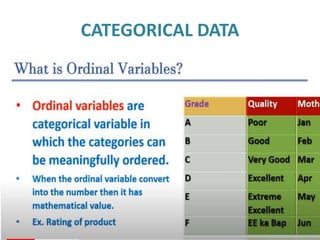
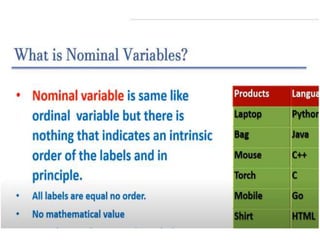
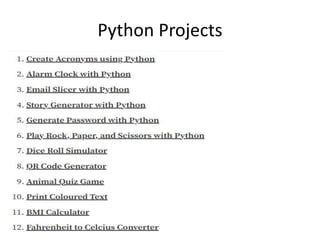
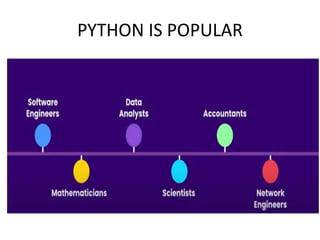
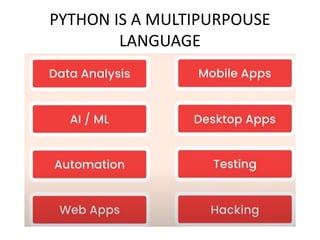
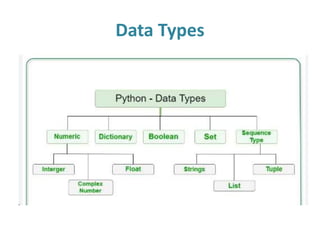
Python is a multi-purpose programming language that is gaining popularity. It supports mutable data types like lists and dictionaries that allow their contents to be modified, as well as immutable types like numbers and strings that cannot be changed once created. The document discusses Python data types and how they can be manipulated, providing examples of adding, deleting, and modifying items in lists, tuples, sets, and dictionaries. It also mentions counting the occurrences of list items and analyzing categorical data with Python projects.

![DATA TYPES Manipulations
LIST Tuple SET Dictionary
Add x.append()
x.insert()
NA x.update()
x.add()
X[key]=value
Delete x.remove()
x.pop()
NA x.pop() x.pop
https://www.tutorialsteacher.com/articles/how-to-count-occurences-of-list-items-in-python](https://image.slidesharecdn.com/presentationpython-240204043151-2f40816c/85/PRESENTATION_PYTHON-pptx-11-320.jpg)