Acquisition
Analysis
Presentation by:
Quark Financials
Public
Industry Overview : Alcoholic Beverages
Beer
dominates
the alcoholic
beverages
Industry
Beer sales
picked up in
2010 after
the
slowdown in
2009
Western
Europe
accounts for
a quarter of
global
spending on
beer
Consolidation
has been a
very common
phenomena
in this
industry
Beer Total Volume by Region 2005 -2010
Volume wise Alcoholic Beverage Market
50%
38%
0%
1% 5%
6%
Alcoholic Drinks
Beer
Cider/Perry
RTDs
Spirits
Wine
 Top 10 brewers represent about 61% of total
beer volume.
 Imported beer has very little share in total
sales, 90% of the beer is consumed where it
is produced
 R&D and distribution are considered to be
most critical functions
 Globally Beer Industry is highly regulated
and in many countries alcoholic beverages
are heavily taxed
 Within alcoholic drinks, beer will remain the
fastest growing category in volume terms
Beer Industry
0
20
40
60
80
100
120
140
2005 2006 2007 2008 2009 2010
Thousands
Liters
Asia Pacific North America
Eastern Europe Latin America
Western Europe Middle East and Africa
 Worldwide per capital consumption
increased to 22.8 liters
 Major Players includes -
Spirits Diageo, Pernod Ricard & Campari,
Beer AB Inbev, Carlsberg & SABMiller
 Alcoholic beverages industry has been
through a period of intense consolidation
 Mounting taxes on alcohol poses a major
threat to the industry.
Alcoholic Beverages
Source: Euromonitor International
Analysis : Beer Industry
 With rising disposable incomes, the
emerging markets are driving the growth
 Globally the consumers are moving
towards more sophisticated products
 Brewers continue to diversify and expand
their brand portfolios to cater to changing
consumer preferences
 Growing health concerns and stringent
traffic rules are pushing brewers to
provide lighter (low alcohol) alternatives
 Internet retailing had been most dynamic
channel and expected to grow even faster
 Rising Input costs - Prices of barley and
hops and packaging material such as glass
and aluminum has gone up significantly
 Changing Government regulations -
Sudden duty hike of 200% in Russian
market in 2010
 Strict anti- alcoholism legal norms – Ban
of sales of alcoholic beverages in countries
like Saudi Arabia are pushing brewers to
look for other opportunities like soft
drinks, bottled water etc.
Beer volume
is expected to
increase over
next five years
Concentration
is a very high-
Top 5 brewers
represent
about 47% of
total beer
volume
Beer Industry
always faces
additional
threat from
spirits and
wines
Global Beer Market Forecast Performance
0
0.5
1
1.5
2
2.5
3
3.5
4
170
180
190
200
210
220
230
2010 2011 2012 2013 2014 2015
%
growth
Billion
litres
Beer Total Volume Total volume growth
Trends and Growth Drivers
Risks and Constraints
Major Players and their market share
Source: Euromonitor International
Company Overview : SABMiller
Overview
Financials
Group Strategy
Region wise Revenue Distribution
Source: Euromonitor International, JPMC Research Report, Company’s Annual Report
 World’s second largest brewer with a 9.5%
global market share in 2010, behind
Anheuser-Busch InBev
 World’s largest bottlers of Coca-Cola
 Broad geographic spread with more than
200 beer brands across geographies
 premium international beers such as Pilsner,
Peroni and Grolsch, as well as major local
brands such as Aguila, Castle and Tyskie
1
2
4
3
Creating a
balanced and
attractive
global spread
of businesses
Developing strong,
relevant brand
portfolios that win
in the local market
Constantly raising the
profitability of local
businesses, sustainably
Leveraging our
skills and global
scale
2009 2010 2011 2012E
Revenue 20919 21783 23317 25341
growth 7.4% 4.1% 7.0% 8.7%
EBITDA 4958 5262 5948 6590
Margin (%) 23.7% 24.2% 25.5% 26.0%
Net Profit 2065 2507 3018 3485
Margin (%) 9.9% 11.51% 12.94% 13.75%
EPS($) 1.37 1.61 1.91 2.20
All figures in $ million
Strong
presence in
Middle East
& Africa and
North
America
Solid revenue
performance
driven by
volume and
price growth
Company Overview : Carlsberg
Overview
Financials
Group Strategy
Geography wise Distribution
 World’s fourth largest brewer with more
than 500 beer brands and 90 breweries
 Best selling brands includes Carlsberg
Tuborg, Baltika & Kronenbourg
 Grows through dynamic partnerships with
licensing, export and duty-free partners in
countries where is has no breweries
 Contribution to growth, earnings and
development differs within the group
People
To be the fastest
growing global
beer company
2008 2009 2010 2011E
Revenue 59944 59382 60054 62464
growth 33.95% -0.94% 1.13% 4.01%
EBITDA 11606 13159 14236 15,060
Margin (%) 19.36% 22.16% 23.71% 24.10%
Net Profit 2621 3602 5351 6735.85
Margin (%) 4.29% 6.01% 8.79% 10.78%
EPS (in DKK) 20.93 27.31 39.07 44.15
All figures in DKK million
Source: Euromonitor International, JPMC Research Report, Company’s Annual Report
Second
largest
brewer in
Northern and
Western
Europe
Emerging
markets such
as India and
China offer
huge growth
opportunities
Decrease in
operating
margin
resulting due
to higher
input costs
SWOT Analysis : Carlsberg & SABMiller
Strengths
Opportunities Threats
Weakness
Carlsberg SABMiller Carlsberg SABMiller
 Leading brewer in
Russia.
 Retained long-term
potential and
provides a strong
base for expansion
 Protection against
takeover by claim of
Carlsberg
Foundation on
voting rights and
share capital
 Global Coverage
can take advantage
in growing markets
 Dominant control
in operations in US
gives a second
position in US
 Increasing presence
and strong growth
in emerging
markets
 Presence in the
fast-growing
cider/perry
category in several
Nordic markets,
providing a base for
expansion in Europe
 Rising concerns
about impact of
alcohol
consumption on
health may
decrease the sales
 Weak position to
compete major
rivals for the
potential targets in
global beer market
 Limited capacity to
raise capital due to
company‘s
ownership structure
 Its reliant to
Eastern and
Western Europe
 Limited production
operations and low
import size for beer
in Western Europe
 Still lacks a
presence in Brazil,
Mexico and several
countries in Asia
Pacific
 The acquisition of
Anheuser-Busch by
InBev could result in
a stronger
competitor in US
 Key markets
suffered from
global downturn,
which will impact
severely on its
revenues
 Being leader
brewer in Africa, it
can take advantage
of heavy growth in
growing regions
 Well placed to make
acquisitions of any
divestments by
other brewers, or to
make investment in
struggling
companies
Reasons to acquire : Geographical Presence & Segment Coverage
SAB Miller
has under
represented
operations in
Western
Europe
Carlsberg has
huge sales in
Western and
Eastern
Europe
Carlsberg has
ninety plus
production
sites in 45
countries
Geographical Presence
SABMiller
Carlsberg
 Carlsberg’s beer portfolio is primarily led
by premium brands, which are less
sensitive to difficult economic conditions
than economy ones
 SABMiller focuses basically on local brands
catering to local tastes
 SABMiller can improve its margins by
acquiring Carlsberg
Segment Coverage Combined Entity Market Share
0.0
10.0
20.0
30.0
40.0
50.0
%
Market
Share
SABMiller Carlsberg
Source: Euromonitor International, Company’s Annual Report, Team Analysis
Reasons to acquire : Product, Distribution, Management & Strategy
•SAB Miller will benefit from Carlsberg’s innovation strategy.
•Carlsberg’s concept of targeting women with new category shows how they tapped latent
demand in this segment.
•General shift in consumer preference towards healthier substitutes would need innovation
in the business
Product &
Innovation
•SABMiller maintains strong distribution agreements with many national retailers.
•Carlsberg can achieve CAGR of 12% in areas like Asia Pacific and growth of 11% in African
countries with the help of SAB Miller’s distribution network.
•Economies of Scale would be achieved in the distribution network
Distribution
•Carlsberg’s Global Talent Management system and strategic people resourcing would help
SAB Miller to provide sufficient pipeline of talented managers for current and future needs
Management
Capabilities
•Both has adopted a local as well as global approach to focus on entire business needs
•SABMiller has 4 global brands and 200+ local brands. Also, Carlsberg has few global brands
such as Carlsberg and Tuborg and 400+ local brands
•Finding the right GloCal balance in a matrix structure would be key to the combined entity’s
ambition and success
GloCal
Strategy
Source: Company’s Annual Report, Team Analysis
Reasons to acquire : Complementing Brand Portfolio
SABMiller
Grolsch and Pernoni – Major brands
1.6% of total share collectively out of
3.1% share in Western Europe.
Carling & Castle - Major brands
Very strong presence in Africa
with almost 30% market share
Baltika and Tuborg – Major
brands
9.4% of market share (25%) is
contributed by these brands
Carlsberg and Kronenbourg –
Major brands
 50% of market share (11%) is
contributed by these brands
Tuborg & Moussy Classic – Major
special non-alcoholic brands
Very weak presence in Africa
High brand equity in Saudi Arabia
Carlsberg
Zubr and Tyskie – Major brands
 Strong market share of around 14%
and 18% in Poland of these brands
Minimal presence in other areas
We should continue with
Baltika and Tuborg. In eastern
Europe but we can merge or
discontinue Zubr and Tyskie in
Eastern Europe other than Poland.
Carlsberg and
Kronenbourg has more
than 50% of total
Carlsberg A/S market
share (11%) in this region
Very weak presence in Africa but
have brand equity in Saudi Arabia.
Tuborg and Moussy Classic are the
special non-alcoholic brands
Middle East and Africa
Eastern Europe
Northern and Western Europe
Key Issues and Risks to consider in acquisition
Financial Risk
 Considering the cross border nature of deal, proportion of cash and stock needs to be considered and SABMiller
needs to gauge the willingness of current share holders to accept stocks traded in another market
Integration Risk
 Carlsberg has unified platform across the company whereas SABMiller has finance, HR and procurement
centralized whereas sales distribution and SCM are on regional system platforms. This could lead to complex and
costly IT integration
 These two have developed relations with partners in many areas and these partners compete with each other
This chemistry could hamper the integration process in the merged entity
Legal Risk
 Combined entity will gain market leadership in large number of categories with market share over 90% in few
regions across the markets. This may trigger antitrust cases and the deal may not get executed ultimately
Interloper Risk
 A strong contender for the acquisition means that price will be pushed higher and SAB Miller will have to pay a
heavier premium than usual
Organizational Risk
 There could be cases of culture mismatch or management clash which includes possible loss of experienced staff.
 The Merged entity will incur significant transaction and integration costs
Currency Risk
 SABMiller has high exposure in the emerging markets where as Carlsberg in Russia. Therefore the new entity will
be more vulnerable to Yuan-Dollar and Rouble-Dollar fluctuations
Source: Team Analysis
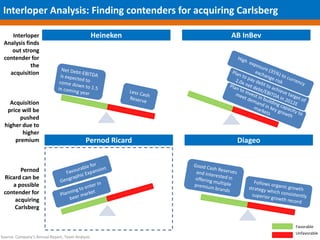
Interloper Analysis: Finding contenders for acquiring Carlsberg
Interloper
Analysis finds
out strong
contender for
the
acquisition
Acquisition
price will be
pushed
higher due to
higher
premium
Pernod
Ricard can be
a possible
contender for
acquiring
Carlsberg
Heineken AB InBev
Pernod Ricard Diageo
Favorable
Unfavorable
Source: Company’s Annual Report, Team Analysis
Pernod Ricard: Possible threat to SABMiller
Proposal
from Pernod
Ricard can
increase the
premium
paid for
Carlsberg
Possibility of
Pernod
Ricard
acquiring
Carlsberg is
low
Due to
SABMiller’s
size and
power it can
easily outbid
Pernod
Ricard
Overview
Feasibility
Combined Market Share
 Possibility of Pernod Ricard acquiring
Carlsberg is low because of following
reasons:-
 Constraint in financing as debt to
EBITDA ratio is more than 5
 Integration process of recent
acquisition of Vin & Spirit is still in
progress
 However, a proposal from Pernod Ricard
for Carlsberg can spell trouble for
SABMiller
 Pernod Ricard is leader in premium
segment and world co-leader in wines and
spirits
 Undertakes aggressive growth strategy
through acquisitions which includes part of
Seagram businesses (2001) , Allied
Domecq (2005) and Vin & Spirit (2008)
 Plans to enter into beer market
inorganically
Pernod Ricard
Carlsberg
Category
Coverage
Geographical
Coverage
Brand Synergy
Prenod Ricard’s
spirits business
and Carlsberg’s
beer business
will
complement
each other
Pernod Ricard’s
leadership in
Americas and
Carlsberg’s
presence in
Europe will
make each
other stronger
Both of them
focus on
creating global
brands and
premium
segment
Synergy
Source: Euromonitor International, Company’s Annual Report, Team Analysis
0.0
5.0
10.0
15.0
20.0
25.0
Pernod Ricard Carlsberg
Credit Worthiness Assessment of SABMiller
With a score of
4.01 out of 6,
we can
categorize
SABMiller as
Investment
grade company
Adequate
capacity to
meet financial
commitments
Subjected to
adverse
economic
conditions
External
Credit Ratings
S&P - BBB+
Fitch - BBB+
Moody’s - Baa1
Credit Score - Internal Assessment
Good experience in industry- established in 1895
Aggressive business policy – organic and
inorganic
Highly qualified board
No group support
Well diverse market with presence across world
Portfolio of 200 + brands adapting to local taste
No assured off-take with demand
varying with net disposable
income
High interest coverage ratio low D-E
ratio reflecting good debt serving capabilities
Steady and free cash flow from operations
Average ROCE and operating margin
Low levels of liquidity reflected in current ratio
Rising net disposable income
High growth in emerging markets
Shift in consumer preference towards
sophisticated products resulting in higher
margins
Rising input costs and taxes levied
Overall
Score 4.01/6
 Evaluation parameters are categorized into quantitative and qualitative parameters
 Each parameter scored between 0-6 with 6 indicating the lowest risk
 Different weights are assigned to parameters based upon the relative importance
 Aggregate scores are calculated by finding weighted average of every risk
Business Risk - 3.40
Industry Risk – 4.0
Management Risk – 4.03
Financial Risk - 4.25
Scoring Methodology
Source: Company’s Annual Report, Team Analysis
Valuation Drivers for Carlsberg
Geography wise sales growth
 Company is expected to see good growth numbers in Asia Pacific region being an emerging market and in
Eastern Europe after recovering from drop in sales.
 Northern and Western Europe market seems to grow with an average growth
Rising Input Cost
 For 2011, the Group will face higher input costs, which will lead to increased prices. Even then, this would
surely hit margins
 In Eastern Europe, the impact of increased input costs will be higher than the Group average and
consequently operating profit margin in the region will be impacted negatively for 2011 and 2012.
Disposable Income and Strong Consumer Dynamics
 Volumes are driven by disposable income, strong consumer dynamics and consumers’ aspirations towards
brands and innovation.
 As per the above argument, volumes in Western and Eastern European markets are expected to be flat or
slightly declining. Outlook of Continued growth in Asian region would be a positive driver by hitting top line
growth.
Research and Innovation
 In order to ensure the focus, efficiency, speed and scale of the innovation efforts, the Group’s integrated
Innovation, Research and Development organization spans the entire innovation process, from raw materials,
through consumer insights and trends, to idea generation, production processes and packaging.
 This ensure long term sustainable growth in all regions.
Exchange Rate Fluctuation
 Strength of key local currencies benefits input costs
Source: Company’s Annual Report, Team Analysis
Valuation : Transaction Multiples Model
Mean
FV/Revenue
and FV/EBITDA
is 2.59 and
11.99
respectively.
FV/Revenue
and FV/EBITDA
multiple ranges
from
2.4x – 2.6x
and 11.7x -12x.
Share prices
will vary
between 691
and 782 based
on FV/revenue
multiple and
between 870
and 897 based
on FV/EBITDA
multiple.
Transaction Multiples Selection Criteria
Advantages Disadvantages
 Appropriate to find out valuation of
controlling stake in business
 Incorporates the market premium instead
of looking only into financials
 Easy to calculate
 Helpful in M&A negotiations as information
is publicly available
 Transactions are rarely directly comparable
due to differences in premium paid based
on synergy
 Huge differences could also be due to
various business cycles, economic
condition, ease of financing etc.
 Transaction multiples can be heavily
dependent on industry
 Transactions in the
same industry
 Similar size transactions
 Only recent
transactions or mergers
and acquisitions
happened in the
industry
 Growth, margins and
capital structure of the
target company should
be similar
Source: JPMC Research Report, Team Analysis
Valuation : Market Multiples Model
Comparable Market Multiples
 Values the company based on market prices
instead of only financials
 Reflects the valuation as on today as
market multiples reflect current prices
prevalent
 Easy to calculate
 Uses easily available current market data
eliminating the need for projecting cash
flows
 Difficult to find companies that are truly
comparable
 Each step in valuing using multiples
analysis is subjective and provides an
opening for manipulation of results
 Business being valued is typically not an
average business. Ignoring fundamentals
can lead to significant errors in valuation
 Using the Price to earnings (P/E) ratio
ignores the cost of capital, time value of
money and is sensitive to the accounting
policies adopted
Advantages Disadvantages
 Similar industry and
product mix
 Same geography
 Shares similar risk
 Growth prospects in
earnings and sales,
profitability margins
 Cost structure and
capital structure
Selection Criteria
Source: JPMC Research Report, Team Analysis
Mean
FV/Revenue
FV/EBITDA and
P/E is
2.87,9.82 and
14.66
respectively.
FV/Revenue,
FV/EBITDA and
P/E multiple
ranges from
2.8x– 3.1x
9.7x -10.5x
and
13.9x – 16.2x
Share prices
will vary
between 814
and 832 based
on FV/revenue
multiple.
Valuation : Discounted Cash Flow Model
Projected Free Cash Flow
 Forward-looking and depends more future
expectations rather than historical results
 Focused on cash flow generation and is less
affected by accounting practices
 Allows different components of a business
or synergies to be valued separately
 More inward-looking, relying on the
fundamental expectations of the business
and less influential to volatile external
factors
 Allows expected operating strategies to be
factored into the valuation
 Highly dependent on the quality of the
assumptions regarding Free Cash Flow,
Terminal Value and discount rate
 As Terminal Value represents a large
percentage of DCF valuation, it is largely
dependent on TV assumptions rather than
operating assumptions for the business
 Difficult to calculate as compared to other
valuation techniques
 Does not take into account the current
market dynamics
Advantages Disadvantages
 Forecast sales is as per
development plans in
JPMC equity research
report
 Straight line deprecation
method is used
 2020 is the terminal year
 Sales and COGS growth
assumed is 5% after 2015
 Sales forecast of each
region is done based on its
economy and demand
Assumptions
Source: Company’s Annual Report, Team Analysis
3-stage
discount model
has been used
Region wise
sales growth is
estimated to
forecast top
line
Share prices
will vary
between 556
and 772
However, with
WACC of 9%
and perpetuity
growth rate of
1.5%, share
price would be
at 650
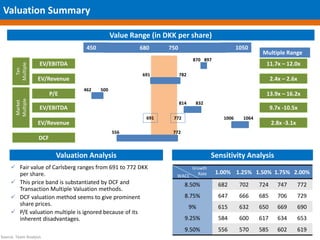
Valuation Summary
Value Range (in DKK per share)
EV/EBITDA
DCF
EV/Revenue
EV/EBITDA
P/E
EV/Revenue
Txn
Multiple
Market
Multiple
450 1050
Multiple Range
11.7x – 12.0x
2.4x – 2.6x
9.7x -10.5x
13.9x – 16.2x
2.8x -3.1x
680 750
772
556 772
814 832
870 897
1006 1064
462 500
691 782
WACC
1.00% 1.25% 1.50% 1.75% 2.00%
8.50% 682 702 724 747 772
8.75% 647 666 685 706 729
9% 615 632 650 669 690
9.25% 584 600 617 634 653
9.50% 556 570 585 602 619
Sensitivity Analysis
Valuation Analysis
Growth
Rate
 Fair value of Carlsberg ranges from 691 to 772 DKK
per share.
 This price band is substantiated by DCF and
Transaction Multiple Valuation methods.
 DCF valuation method seems to give prominent
share prices.
 P/E valuation multiple is ignored because of its
inherent disadvantages.
Source: Team Analysis
691
Appendix 1: Credit Worthiness Evaluation Model
Risk Type Category Evaluation Parameters Weights Scores
(0-6)
Management Risk
(15)
Track Record Experience in the industry 5 5
Board Composition 2 4.50
Business and Financial Policy 3 4
Other Factors Management Pro-activeness 2 4
Strategic Initiatives 1 4.5
Group Support 2 1
Financial Risk (50) Expected Financial
Performance
ROCE, Operating Margin, Interest
Coverage etc.
20 3.9
Current Financial
Performance
ROCE, Operating Margin, Interest
Coverage etc.
30 4.48
Business Risk
(20)
Operating Efficiency Integration of operations 3 3
Capacity utilization 4 3
Bargaining power with suppliers 3 3
Market Position Consistency of quality 3 4
Customization of product 2 4.50
Diversification of markets 3 5
Assured off-take 2 1
Industry Risk (15) 15 4.0
Appendix 2- Discounted Cash Flow Valuation Model
Year 2011E 2012E 2013E 2014E 2015E 2016E 2017E 2018E 2019E 2020E
EBIT 10947 12124 14134 16973 19106 21069 22806 24262 25381 26110
Tax % 26% 26% 26% 26% 26% 26% 26% 26% 26% 26%
NOPAT 8101 8972 10459 12560 14138 15591 16877 17954 18782 19322
Capex - Depriciation 3331 3464 3615 3838 4133 4423 4702 4967 5212 5433
Increase in WC 0 0 0 0 0 0 0 0 0 0
FCFF 4770 5508 6845 8722 10005 11168 12174 12987 13569 13888
%growth 15.5% 24.3% 27.4% 14.7% 11.6% 9.0% 6.7% 4.5% 2.3%
WACC 8.99% 8.99% 8.99% 8.99% 8.99% 8.99% 8.99% 8.99% 8.99% 8.99%
Years to Perpetuity 1 2 3 4 5 6 7 8 9 10
PV(FCFF) 4377 4637 5286 6181 6505 6662 6663 6521 6252 5870
Carlsberg WACC Calculation Equity Value of Carlsberg
Debt (in mm £) 52759 Perpetuity Growth Rate 1.50%
Equity (in mm £) 64248 WACC 8.99%
UK Corporate Tax rate 26% PV of Cash Flow (10E-20E) (£ mm) 58953.26
D/E 0.8212 Terminal Value (£ mm) 188138.15
(1-T)*D/E 0.6077 PV of Terminal Value 79525.11
Levered beta 0.7064 Firm value (£ mm) 138478.373
Market Return 18.40% cash & cash equivalents (£ mm) 2735
Risk free Rate for UK (10 Yr Govt Bonds) 3.75% ST Debt (£ mm) 3959
Market Risk Premium 14.65% LT Debt (£ mm) 32587
Cost of equity 14.10% Net Debt (£ mm) 33811
Before Tax 3.750% Minority Interest (£ mm) 5381
After Tax 2.78% Equity Value (£ mm) 99286.3728
D+E 117007 Shares (mm) 152.557
WACC 8.99% Value of 1 share (£) 650.81

Presentation.ppt

  • 1.
  • 2.
    Industry Overview :Alcoholic Beverages Beer dominates the alcoholic beverages Industry Beer sales picked up in 2010 after the slowdown in 2009 Western Europe accounts for a quarter of global spending on beer Consolidation has been a very common phenomena in this industry Beer Total Volume by Region 2005 -2010 Volume wise Alcoholic Beverage Market 50% 38% 0% 1% 5% 6% Alcoholic Drinks Beer Cider/Perry RTDs Spirits Wine  Top 10 brewers represent about 61% of total beer volume.  Imported beer has very little share in total sales, 90% of the beer is consumed where it is produced  R&D and distribution are considered to be most critical functions  Globally Beer Industry is highly regulated and in many countries alcoholic beverages are heavily taxed  Within alcoholic drinks, beer will remain the fastest growing category in volume terms Beer Industry 0 20 40 60 80 100 120 140 2005 2006 2007 2008 2009 2010 Thousands Liters Asia Pacific North America Eastern Europe Latin America Western Europe Middle East and Africa  Worldwide per capital consumption increased to 22.8 liters  Major Players includes - Spirits Diageo, Pernod Ricard & Campari, Beer AB Inbev, Carlsberg & SABMiller  Alcoholic beverages industry has been through a period of intense consolidation  Mounting taxes on alcohol poses a major threat to the industry. Alcoholic Beverages Source: Euromonitor International
  • 3.
    Analysis : BeerIndustry  With rising disposable incomes, the emerging markets are driving the growth  Globally the consumers are moving towards more sophisticated products  Brewers continue to diversify and expand their brand portfolios to cater to changing consumer preferences  Growing health concerns and stringent traffic rules are pushing brewers to provide lighter (low alcohol) alternatives  Internet retailing had been most dynamic channel and expected to grow even faster  Rising Input costs - Prices of barley and hops and packaging material such as glass and aluminum has gone up significantly  Changing Government regulations - Sudden duty hike of 200% in Russian market in 2010  Strict anti- alcoholism legal norms – Ban of sales of alcoholic beverages in countries like Saudi Arabia are pushing brewers to look for other opportunities like soft drinks, bottled water etc. Beer volume is expected to increase over next five years Concentration is a very high- Top 5 brewers represent about 47% of total beer volume Beer Industry always faces additional threat from spirits and wines Global Beer Market Forecast Performance 0 0.5 1 1.5 2 2.5 3 3.5 4 170 180 190 200 210 220 230 2010 2011 2012 2013 2014 2015 % growth Billion litres Beer Total Volume Total volume growth Trends and Growth Drivers Risks and Constraints Major Players and their market share Source: Euromonitor International
  • 4.
    Company Overview :SABMiller Overview Financials Group Strategy Region wise Revenue Distribution Source: Euromonitor International, JPMC Research Report, Company’s Annual Report  World’s second largest brewer with a 9.5% global market share in 2010, behind Anheuser-Busch InBev  World’s largest bottlers of Coca-Cola  Broad geographic spread with more than 200 beer brands across geographies  premium international beers such as Pilsner, Peroni and Grolsch, as well as major local brands such as Aguila, Castle and Tyskie 1 2 4 3 Creating a balanced and attractive global spread of businesses Developing strong, relevant brand portfolios that win in the local market Constantly raising the profitability of local businesses, sustainably Leveraging our skills and global scale 2009 2010 2011 2012E Revenue 20919 21783 23317 25341 growth 7.4% 4.1% 7.0% 8.7% EBITDA 4958 5262 5948 6590 Margin (%) 23.7% 24.2% 25.5% 26.0% Net Profit 2065 2507 3018 3485 Margin (%) 9.9% 11.51% 12.94% 13.75% EPS($) 1.37 1.61 1.91 2.20 All figures in $ million Strong presence in Middle East & Africa and North America Solid revenue performance driven by volume and price growth
  • 5.
    Company Overview :Carlsberg Overview Financials Group Strategy Geography wise Distribution  World’s fourth largest brewer with more than 500 beer brands and 90 breweries  Best selling brands includes Carlsberg Tuborg, Baltika & Kronenbourg  Grows through dynamic partnerships with licensing, export and duty-free partners in countries where is has no breweries  Contribution to growth, earnings and development differs within the group People To be the fastest growing global beer company 2008 2009 2010 2011E Revenue 59944 59382 60054 62464 growth 33.95% -0.94% 1.13% 4.01% EBITDA 11606 13159 14236 15,060 Margin (%) 19.36% 22.16% 23.71% 24.10% Net Profit 2621 3602 5351 6735.85 Margin (%) 4.29% 6.01% 8.79% 10.78% EPS (in DKK) 20.93 27.31 39.07 44.15 All figures in DKK million Source: Euromonitor International, JPMC Research Report, Company’s Annual Report Second largest brewer in Northern and Western Europe Emerging markets such as India and China offer huge growth opportunities Decrease in operating margin resulting due to higher input costs
  • 6.
    SWOT Analysis :Carlsberg & SABMiller Strengths Opportunities Threats Weakness Carlsberg SABMiller Carlsberg SABMiller Carlsberg SABMiller Carlsberg SABMiller  Leading brewer in Russia.  Retained long-term potential and provides a strong base for expansion  Protection against takeover by claim of Carlsberg Foundation on voting rights and share capital  Global Coverage can take advantage in growing markets  Dominant control in operations in US gives a second position in US  Increasing presence and strong growth in emerging markets  Presence in the fast-growing cider/perry category in several Nordic markets, providing a base for expansion in Europe  Rising concerns about impact of alcohol consumption on health may decrease the sales  Weak position to compete major rivals for the potential targets in global beer market  Limited capacity to raise capital due to company‘s ownership structure  Its reliant to Eastern and Western Europe  Limited production operations and low import size for beer in Western Europe  Still lacks a presence in Brazil, Mexico and several countries in Asia Pacific  The acquisition of Anheuser-Busch by InBev could result in a stronger competitor in US  Key markets suffered from global downturn, which will impact severely on its revenues  Being leader brewer in Africa, it can take advantage of heavy growth in growing regions  Well placed to make acquisitions of any divestments by other brewers, or to make investment in struggling companies
  • 7.
    Reasons to acquire: Geographical Presence & Segment Coverage SAB Miller has under represented operations in Western Europe Carlsberg has huge sales in Western and Eastern Europe Carlsberg has ninety plus production sites in 45 countries Geographical Presence SABMiller Carlsberg  Carlsberg’s beer portfolio is primarily led by premium brands, which are less sensitive to difficult economic conditions than economy ones  SABMiller focuses basically on local brands catering to local tastes  SABMiller can improve its margins by acquiring Carlsberg Segment Coverage Combined Entity Market Share 0.0 10.0 20.0 30.0 40.0 50.0 % Market Share SABMiller Carlsberg Source: Euromonitor International, Company’s Annual Report, Team Analysis
  • 8.
    Reasons to acquire: Product, Distribution, Management & Strategy •SAB Miller will benefit from Carlsberg’s innovation strategy. •Carlsberg’s concept of targeting women with new category shows how they tapped latent demand in this segment. •General shift in consumer preference towards healthier substitutes would need innovation in the business Product & Innovation •SABMiller maintains strong distribution agreements with many national retailers. •Carlsberg can achieve CAGR of 12% in areas like Asia Pacific and growth of 11% in African countries with the help of SAB Miller’s distribution network. •Economies of Scale would be achieved in the distribution network Distribution •Carlsberg’s Global Talent Management system and strategic people resourcing would help SAB Miller to provide sufficient pipeline of talented managers for current and future needs Management Capabilities •Both has adopted a local as well as global approach to focus on entire business needs •SABMiller has 4 global brands and 200+ local brands. Also, Carlsberg has few global brands such as Carlsberg and Tuborg and 400+ local brands •Finding the right GloCal balance in a matrix structure would be key to the combined entity’s ambition and success GloCal Strategy Source: Company’s Annual Report, Team Analysis
  • 9.
    Reasons to acquire: Complementing Brand Portfolio SABMiller Grolsch and Pernoni – Major brands 1.6% of total share collectively out of 3.1% share in Western Europe. Carling & Castle - Major brands Very strong presence in Africa with almost 30% market share Baltika and Tuborg – Major brands 9.4% of market share (25%) is contributed by these brands Carlsberg and Kronenbourg – Major brands  50% of market share (11%) is contributed by these brands Tuborg & Moussy Classic – Major special non-alcoholic brands Very weak presence in Africa High brand equity in Saudi Arabia Carlsberg Zubr and Tyskie – Major brands  Strong market share of around 14% and 18% in Poland of these brands Minimal presence in other areas We should continue with Baltika and Tuborg. In eastern Europe but we can merge or discontinue Zubr and Tyskie in Eastern Europe other than Poland. Carlsberg and Kronenbourg has more than 50% of total Carlsberg A/S market share (11%) in this region Very weak presence in Africa but have brand equity in Saudi Arabia. Tuborg and Moussy Classic are the special non-alcoholic brands Middle East and Africa Eastern Europe Northern and Western Europe
  • 10.
    Key Issues andRisks to consider in acquisition Financial Risk  Considering the cross border nature of deal, proportion of cash and stock needs to be considered and SABMiller needs to gauge the willingness of current share holders to accept stocks traded in another market Integration Risk  Carlsberg has unified platform across the company whereas SABMiller has finance, HR and procurement centralized whereas sales distribution and SCM are on regional system platforms. This could lead to complex and costly IT integration  These two have developed relations with partners in many areas and these partners compete with each other This chemistry could hamper the integration process in the merged entity Legal Risk  Combined entity will gain market leadership in large number of categories with market share over 90% in few regions across the markets. This may trigger antitrust cases and the deal may not get executed ultimately Interloper Risk  A strong contender for the acquisition means that price will be pushed higher and SAB Miller will have to pay a heavier premium than usual Organizational Risk  There could be cases of culture mismatch or management clash which includes possible loss of experienced staff.  The Merged entity will incur significant transaction and integration costs Currency Risk  SABMiller has high exposure in the emerging markets where as Carlsberg in Russia. Therefore the new entity will be more vulnerable to Yuan-Dollar and Rouble-Dollar fluctuations Source: Team Analysis
  • 11.
    Interloper Analysis: Findingcontenders for acquiring Carlsberg Interloper Analysis finds out strong contender for the acquisition Acquisition price will be pushed higher due to higher premium Pernod Ricard can be a possible contender for acquiring Carlsberg Heineken AB InBev Pernod Ricard Diageo Favorable Unfavorable Source: Company’s Annual Report, Team Analysis
  • 12.
    Pernod Ricard: Possiblethreat to SABMiller Proposal from Pernod Ricard can increase the premium paid for Carlsberg Possibility of Pernod Ricard acquiring Carlsberg is low Due to SABMiller’s size and power it can easily outbid Pernod Ricard Overview Feasibility Combined Market Share  Possibility of Pernod Ricard acquiring Carlsberg is low because of following reasons:-  Constraint in financing as debt to EBITDA ratio is more than 5  Integration process of recent acquisition of Vin & Spirit is still in progress  However, a proposal from Pernod Ricard for Carlsberg can spell trouble for SABMiller  Pernod Ricard is leader in premium segment and world co-leader in wines and spirits  Undertakes aggressive growth strategy through acquisitions which includes part of Seagram businesses (2001) , Allied Domecq (2005) and Vin & Spirit (2008)  Plans to enter into beer market inorganically Pernod Ricard Carlsberg Category Coverage Geographical Coverage Brand Synergy Prenod Ricard’s spirits business and Carlsberg’s beer business will complement each other Pernod Ricard’s leadership in Americas and Carlsberg’s presence in Europe will make each other stronger Both of them focus on creating global brands and premium segment Synergy Source: Euromonitor International, Company’s Annual Report, Team Analysis 0.0 5.0 10.0 15.0 20.0 25.0 Pernod Ricard Carlsberg
  • 13.
    Credit Worthiness Assessmentof SABMiller With a score of 4.01 out of 6, we can categorize SABMiller as Investment grade company Adequate capacity to meet financial commitments Subjected to adverse economic conditions External Credit Ratings S&P - BBB+ Fitch - BBB+ Moody’s - Baa1 Credit Score - Internal Assessment Good experience in industry- established in 1895 Aggressive business policy – organic and inorganic Highly qualified board No group support Well diverse market with presence across world Portfolio of 200 + brands adapting to local taste No assured off-take with demand varying with net disposable income High interest coverage ratio low D-E ratio reflecting good debt serving capabilities Steady and free cash flow from operations Average ROCE and operating margin Low levels of liquidity reflected in current ratio Rising net disposable income High growth in emerging markets Shift in consumer preference towards sophisticated products resulting in higher margins Rising input costs and taxes levied Overall Score 4.01/6  Evaluation parameters are categorized into quantitative and qualitative parameters  Each parameter scored between 0-6 with 6 indicating the lowest risk  Different weights are assigned to parameters based upon the relative importance  Aggregate scores are calculated by finding weighted average of every risk Business Risk - 3.40 Industry Risk – 4.0 Management Risk – 4.03 Financial Risk - 4.25 Scoring Methodology Source: Company’s Annual Report, Team Analysis
  • 14.
    Valuation Drivers forCarlsberg Geography wise sales growth  Company is expected to see good growth numbers in Asia Pacific region being an emerging market and in Eastern Europe after recovering from drop in sales.  Northern and Western Europe market seems to grow with an average growth Rising Input Cost  For 2011, the Group will face higher input costs, which will lead to increased prices. Even then, this would surely hit margins  In Eastern Europe, the impact of increased input costs will be higher than the Group average and consequently operating profit margin in the region will be impacted negatively for 2011 and 2012. Disposable Income and Strong Consumer Dynamics  Volumes are driven by disposable income, strong consumer dynamics and consumers’ aspirations towards brands and innovation.  As per the above argument, volumes in Western and Eastern European markets are expected to be flat or slightly declining. Outlook of Continued growth in Asian region would be a positive driver by hitting top line growth. Research and Innovation  In order to ensure the focus, efficiency, speed and scale of the innovation efforts, the Group’s integrated Innovation, Research and Development organization spans the entire innovation process, from raw materials, through consumer insights and trends, to idea generation, production processes and packaging.  This ensure long term sustainable growth in all regions. Exchange Rate Fluctuation  Strength of key local currencies benefits input costs Source: Company’s Annual Report, Team Analysis
  • 15.
    Valuation : TransactionMultiples Model Mean FV/Revenue and FV/EBITDA is 2.59 and 11.99 respectively. FV/Revenue and FV/EBITDA multiple ranges from 2.4x – 2.6x and 11.7x -12x. Share prices will vary between 691 and 782 based on FV/revenue multiple and between 870 and 897 based on FV/EBITDA multiple. Transaction Multiples Selection Criteria Advantages Disadvantages  Appropriate to find out valuation of controlling stake in business  Incorporates the market premium instead of looking only into financials  Easy to calculate  Helpful in M&A negotiations as information is publicly available  Transactions are rarely directly comparable due to differences in premium paid based on synergy  Huge differences could also be due to various business cycles, economic condition, ease of financing etc.  Transaction multiples can be heavily dependent on industry  Transactions in the same industry  Similar size transactions  Only recent transactions or mergers and acquisitions happened in the industry  Growth, margins and capital structure of the target company should be similar Source: JPMC Research Report, Team Analysis
  • 16.
    Valuation : MarketMultiples Model Comparable Market Multiples  Values the company based on market prices instead of only financials  Reflects the valuation as on today as market multiples reflect current prices prevalent  Easy to calculate  Uses easily available current market data eliminating the need for projecting cash flows  Difficult to find companies that are truly comparable  Each step in valuing using multiples analysis is subjective and provides an opening for manipulation of results  Business being valued is typically not an average business. Ignoring fundamentals can lead to significant errors in valuation  Using the Price to earnings (P/E) ratio ignores the cost of capital, time value of money and is sensitive to the accounting policies adopted Advantages Disadvantages  Similar industry and product mix  Same geography  Shares similar risk  Growth prospects in earnings and sales, profitability margins  Cost structure and capital structure Selection Criteria Source: JPMC Research Report, Team Analysis Mean FV/Revenue FV/EBITDA and P/E is 2.87,9.82 and 14.66 respectively. FV/Revenue, FV/EBITDA and P/E multiple ranges from 2.8x– 3.1x 9.7x -10.5x and 13.9x – 16.2x Share prices will vary between 814 and 832 based on FV/revenue multiple.
  • 17.
    Valuation : DiscountedCash Flow Model Projected Free Cash Flow  Forward-looking and depends more future expectations rather than historical results  Focused on cash flow generation and is less affected by accounting practices  Allows different components of a business or synergies to be valued separately  More inward-looking, relying on the fundamental expectations of the business and less influential to volatile external factors  Allows expected operating strategies to be factored into the valuation  Highly dependent on the quality of the assumptions regarding Free Cash Flow, Terminal Value and discount rate  As Terminal Value represents a large percentage of DCF valuation, it is largely dependent on TV assumptions rather than operating assumptions for the business  Difficult to calculate as compared to other valuation techniques  Does not take into account the current market dynamics Advantages Disadvantages  Forecast sales is as per development plans in JPMC equity research report  Straight line deprecation method is used  2020 is the terminal year  Sales and COGS growth assumed is 5% after 2015  Sales forecast of each region is done based on its economy and demand Assumptions Source: Company’s Annual Report, Team Analysis 3-stage discount model has been used Region wise sales growth is estimated to forecast top line Share prices will vary between 556 and 772 However, with WACC of 9% and perpetuity growth rate of 1.5%, share price would be at 650
  • 18.
    Valuation Summary Value Range(in DKK per share) EV/EBITDA DCF EV/Revenue EV/EBITDA P/E EV/Revenue Txn Multiple Market Multiple 450 1050 Multiple Range 11.7x – 12.0x 2.4x – 2.6x 9.7x -10.5x 13.9x – 16.2x 2.8x -3.1x 680 750 772 556 772 814 832 870 897 1006 1064 462 500 691 782 WACC 1.00% 1.25% 1.50% 1.75% 2.00% 8.50% 682 702 724 747 772 8.75% 647 666 685 706 729 9% 615 632 650 669 690 9.25% 584 600 617 634 653 9.50% 556 570 585 602 619 Sensitivity Analysis Valuation Analysis Growth Rate  Fair value of Carlsberg ranges from 691 to 772 DKK per share.  This price band is substantiated by DCF and Transaction Multiple Valuation methods.  DCF valuation method seems to give prominent share prices.  P/E valuation multiple is ignored because of its inherent disadvantages. Source: Team Analysis 691
  • 19.
    Appendix 1: CreditWorthiness Evaluation Model Risk Type Category Evaluation Parameters Weights Scores (0-6) Management Risk (15) Track Record Experience in the industry 5 5 Board Composition 2 4.50 Business and Financial Policy 3 4 Other Factors Management Pro-activeness 2 4 Strategic Initiatives 1 4.5 Group Support 2 1 Financial Risk (50) Expected Financial Performance ROCE, Operating Margin, Interest Coverage etc. 20 3.9 Current Financial Performance ROCE, Operating Margin, Interest Coverage etc. 30 4.48 Business Risk (20) Operating Efficiency Integration of operations 3 3 Capacity utilization 4 3 Bargaining power with suppliers 3 3 Market Position Consistency of quality 3 4 Customization of product 2 4.50 Diversification of markets 3 5 Assured off-take 2 1 Industry Risk (15) 15 4.0
  • 20.
    Appendix 2- DiscountedCash Flow Valuation Model Year 2011E 2012E 2013E 2014E 2015E 2016E 2017E 2018E 2019E 2020E EBIT 10947 12124 14134 16973 19106 21069 22806 24262 25381 26110 Tax % 26% 26% 26% 26% 26% 26% 26% 26% 26% 26% NOPAT 8101 8972 10459 12560 14138 15591 16877 17954 18782 19322 Capex - Depriciation 3331 3464 3615 3838 4133 4423 4702 4967 5212 5433 Increase in WC 0 0 0 0 0 0 0 0 0 0 FCFF 4770 5508 6845 8722 10005 11168 12174 12987 13569 13888 %growth 15.5% 24.3% 27.4% 14.7% 11.6% 9.0% 6.7% 4.5% 2.3% WACC 8.99% 8.99% 8.99% 8.99% 8.99% 8.99% 8.99% 8.99% 8.99% 8.99% Years to Perpetuity 1 2 3 4 5 6 7 8 9 10 PV(FCFF) 4377 4637 5286 6181 6505 6662 6663 6521 6252 5870 Carlsberg WACC Calculation Equity Value of Carlsberg Debt (in mm £) 52759 Perpetuity Growth Rate 1.50% Equity (in mm £) 64248 WACC 8.99% UK Corporate Tax rate 26% PV of Cash Flow (10E-20E) (£ mm) 58953.26 D/E 0.8212 Terminal Value (£ mm) 188138.15 (1-T)*D/E 0.6077 PV of Terminal Value 79525.11 Levered beta 0.7064 Firm value (£ mm) 138478.373 Market Return 18.40% cash & cash equivalents (£ mm) 2735 Risk free Rate for UK (10 Yr Govt Bonds) 3.75% ST Debt (£ mm) 3959 Market Risk Premium 14.65% LT Debt (£ mm) 32587 Cost of equity 14.10% Net Debt (£ mm) 33811 Before Tax 3.750% Minority Interest (£ mm) 5381 After Tax 2.78% Equity Value (£ mm) 99286.3728 D+E 117007 Shares (mm) 152.557 WACC 8.99% Value of 1 share (£) 650.81