Kippy Ball, Cassandra Georgantas,
Drew Ross, Emma Meharg,
Mauricio Toscano
A Little History….
● J.C. Jacobson founded Carlsberg in 1847 on Valby Hill in Copenhagen.
● His son Carl, was the namesake of the company
● Jacobson, a lover of science and progress, made all discoveries found in his lab available to the public because he
believed he had nothing to fear from competitors.
● Carl travelled to Bavaria to learn how they brew beer, and when he made suggestions to his father, the two fought
and had a falling out
○ This cause Carls to start a rival brewery next door to his father’s
● Before his death, J.C. and Carl made amends, but J.C. left his brewery to the Carlsberg Foundation, not Carl
○ A few years later the two breweries merged
● Today, Carlsberg is one of the four largest beer producers in the world
○ Dominant in Scandinavia
Denmark PEST Analysis
Political
● Low level of government
intervention
○ Alcohol regulations
● Laws disallowing breweries to
monopolize their products at
restaurants
● Beer tax
○ 10% in the final product
Economic
● Low employment rate
(6.3%)
○ More people can
afford beer
● VAT tax
● Wealthy country
Social
● Aging population, more old people than young
people
● 60% of Danes attend at least one concert per year
● Pregames
● Increasing health trend decreases demand for beer
● Danish pride of successful Danish companies
Technological
● Country has strong digital infrastructure
● High education level, high technology literacy
rates
● Alcohol culture with youth
○ 18-29 year olds
○ Highly involved in social media
Carlsberg SWOT
Opportunities
● Introduce a high ABV beer, which the company
currently does not offer (Tuborg BLACKED)
● Improve digital platforms such as their website,
Facebook, Instagram, and Twitter
● Gamification of drinking
Strengths
● 55% of the beer market in Denmark
● variety of product offerings other than beer
● good sustainability strategy
● responsible drinking campaigns
● recognizability with J-day and holiday beer
Weaknesses
● Less innovation in recent in terms of product
offerings
Threats
● Losing battle to liquor within target crowd
● Smaller craft beers are becoming more popular,
● Aggressive pricing from competition in Denmark
Royal Unibrew SWOT
Opportunities
● Break into the craft beer market
Expand product offerings by acquiring more brands
● Acquire more recognition in markets outside of
Denmark
Strengths
● Range of product offerings beyond beer
Weaknesses
● Little brand recognition outside of Denmark
● Difficult to increase market share in Denmark where
Carlsberg is so closely associated with the national
identity
Threats
● Growing preference for liquor above beer amongst
younger people
● Difficult to compete with other industry giants that
have global recognition
Heineken SWOT
Opportunities
● Continuing to buy smaller beer brands
in order to increase the company’s
portfolio
● Continuing to expand their craft beer
offerings
Strengths
● Widespread brand recognition
● Geographically diverse in terms of
where their manufacturing facilities
are located
● Product diversity in terms of the types
of beers offered
● One of the largest global beer brands
in the world
Weaknesses
● Maintaining positive image globally can
be challenge since the company is so
large
Threats
● Growing preference for liquor in
younger markets
● Increased taxes and government
regulations surrounding the sale of
alcohol in certain locations
Porter’s Five Forces
- Competition from existing rivals - MODERATE
- Royal Unibrew and Heineken are major competitors in Denmark
- Carlsberg holds 63% of beer market, 50% of soft drink market within country
- Threat of Substitute Products - HIGH
- Beer easily substitutable with other brands and other refreshments
- Little product differentiation causing lack of customer loyalty
- Bargaining Power of Buyers - MODERATE
- Many buyers, but also a large number of competitors
- Only a few competitive substitutes to Carlsberg within beer
- Bargaining Power of Suppliers - LOW
- Low supplier power due to minimal brand strength
- Low switching costs for producers
- Highly substitutable ingredients
- Threat of New Entrants - LOW
- Hard for smaller brands to enter the market because it’s difficult to differentiate beers and
Carlsberg’s strong market share
- Carlsberg has strong brand strength
Five Forces Conclusion
Carlsberg currently holds a strong place in the market in Denmark
● 63% of the beer market and 50% of the soft drink market.
● Customer preferences could shift towards craft beer, for example, and away from Carlsberg and Tuborg,
which would hurt the company
● The threat of substitutes is the most significant because there is little product differentiation and little
variation in beer prices, meaning that customers could easily buy different brands.
○ In addition, many customers switch from beer to other alcoholic beverages away from beer as a
substitute with no switching costs
● Unless customer preferences shift dramatically, there is not expected to be a shift in the near future.
Objectives
Increase beer preference and boost sales
Strategy for Success
Needs Based Strategy
Find target groups for each of
Carlsberg’s major brands,
nationally and internationally, and
cover all of their needs
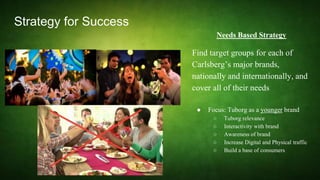
● Focus: Tuborg as a younger brand
○ Tuborg relevance
○ Interactivity with brand
○ Awareness of brand
○ Increase Digital and Physical traffic
○ Build a base of consumers
Activities
In order to connect with a younger crowd, Carlsberg should aim to make
Tuborg the party drink of choice through improved digital landscapes and
gamification of drinking.
Improve the Instagram Platform Introduce a Tuborg Music Snapchat
Special edition cans featuring different artists
MØ Guldggreng
Lukas Graham
Introduce a Tuborg Music app
Fits
● The activities are aimed to enhance Tuborg’s current digital platforms.
● By improving each of the digital mediums, Carlsberg can engage in
omnichannel marketing
● Through the introduction of a lighter beer and a higher alcohol content
beer, Carlsberg covers all of their customers’ needs within a particular
segment
● Market segmentation allows products to not compete with one another
between target groups
Tradeoffs
● By focusing on so many target groups, Carlsberg gives up the
image of being a small craft brew
● By trying to reach an international audience, Carlsberg gives up
being associated with the national identity in Denmark.
Conclusions
● Currently, Carlsberg has a wide variety of product offerings
● By finding target groups for each of the major brands, and adopting
activities to meet all of the needs of each of these groups, we believe
that Carlsberg will be able to increase beer preference and boost sales
● This report has focused on the target group for Tuborg, which has
been defined young party goers
● By improving digital landscapes, Carlsberg will be able to make Tuborg
the party drink of choice
Implementation
● Improve the Instagram Platform
○ Align Instagram with the website in terms of
aesthetics
■ Utilize student reps
#tuborgcampaign
Giveaways if
someone
reaches X
amount of likes
● Tuborg Music App
○ All-purpose app
○ Gamification
Implementation
Tuborg Music Snapchat
Questions? Concerns?
Thank You :)

Carlsberg

  • 1.
    Kippy Ball, CassandraGeorgantas, Drew Ross, Emma Meharg, Mauricio Toscano
  • 2.
    A Little History…. ●J.C. Jacobson founded Carlsberg in 1847 on Valby Hill in Copenhagen. ● His son Carl, was the namesake of the company ● Jacobson, a lover of science and progress, made all discoveries found in his lab available to the public because he believed he had nothing to fear from competitors. ● Carl travelled to Bavaria to learn how they brew beer, and when he made suggestions to his father, the two fought and had a falling out ○ This cause Carls to start a rival brewery next door to his father’s ● Before his death, J.C. and Carl made amends, but J.C. left his brewery to the Carlsberg Foundation, not Carl ○ A few years later the two breweries merged ● Today, Carlsberg is one of the four largest beer producers in the world ○ Dominant in Scandinavia
  • 3.
    Denmark PEST Analysis Political ●Low level of government intervention ○ Alcohol regulations ● Laws disallowing breweries to monopolize their products at restaurants ● Beer tax ○ 10% in the final product Economic ● Low employment rate (6.3%) ○ More people can afford beer ● VAT tax ● Wealthy country Social ● Aging population, more old people than young people ● 60% of Danes attend at least one concert per year ● Pregames ● Increasing health trend decreases demand for beer ● Danish pride of successful Danish companies Technological ● Country has strong digital infrastructure ● High education level, high technology literacy rates ● Alcohol culture with youth ○ 18-29 year olds ○ Highly involved in social media
  • 4.
    Carlsberg SWOT Opportunities ● Introducea high ABV beer, which the company currently does not offer (Tuborg BLACKED) ● Improve digital platforms such as their website, Facebook, Instagram, and Twitter ● Gamification of drinking Strengths ● 55% of the beer market in Denmark ● variety of product offerings other than beer ● good sustainability strategy ● responsible drinking campaigns ● recognizability with J-day and holiday beer Weaknesses ● Less innovation in recent in terms of product offerings Threats ● Losing battle to liquor within target crowd ● Smaller craft beers are becoming more popular, ● Aggressive pricing from competition in Denmark
  • 5.
    Royal Unibrew SWOT Opportunities ●Break into the craft beer market Expand product offerings by acquiring more brands ● Acquire more recognition in markets outside of Denmark Strengths ● Range of product offerings beyond beer Weaknesses ● Little brand recognition outside of Denmark ● Difficult to increase market share in Denmark where Carlsberg is so closely associated with the national identity Threats ● Growing preference for liquor above beer amongst younger people ● Difficult to compete with other industry giants that have global recognition
  • 6.
    Heineken SWOT Opportunities ● Continuingto buy smaller beer brands in order to increase the company’s portfolio ● Continuing to expand their craft beer offerings Strengths ● Widespread brand recognition ● Geographically diverse in terms of where their manufacturing facilities are located ● Product diversity in terms of the types of beers offered ● One of the largest global beer brands in the world Weaknesses ● Maintaining positive image globally can be challenge since the company is so large Threats ● Growing preference for liquor in younger markets ● Increased taxes and government regulations surrounding the sale of alcohol in certain locations
  • 7.
    Porter’s Five Forces -Competition from existing rivals - MODERATE - Royal Unibrew and Heineken are major competitors in Denmark - Carlsberg holds 63% of beer market, 50% of soft drink market within country - Threat of Substitute Products - HIGH - Beer easily substitutable with other brands and other refreshments - Little product differentiation causing lack of customer loyalty - Bargaining Power of Buyers - MODERATE - Many buyers, but also a large number of competitors - Only a few competitive substitutes to Carlsberg within beer - Bargaining Power of Suppliers - LOW - Low supplier power due to minimal brand strength - Low switching costs for producers - Highly substitutable ingredients - Threat of New Entrants - LOW - Hard for smaller brands to enter the market because it’s difficult to differentiate beers and Carlsberg’s strong market share - Carlsberg has strong brand strength
  • 8.
    Five Forces Conclusion Carlsbergcurrently holds a strong place in the market in Denmark ● 63% of the beer market and 50% of the soft drink market. ● Customer preferences could shift towards craft beer, for example, and away from Carlsberg and Tuborg, which would hurt the company ● The threat of substitutes is the most significant because there is little product differentiation and little variation in beer prices, meaning that customers could easily buy different brands. ○ In addition, many customers switch from beer to other alcoholic beverages away from beer as a substitute with no switching costs ● Unless customer preferences shift dramatically, there is not expected to be a shift in the near future.
  • 9.
  • 10.
    Strategy for Success NeedsBased Strategy Find target groups for each of Carlsberg’s major brands, nationally and internationally, and cover all of their needs ● Focus: Tuborg as a younger brand ○ Tuborg relevance ○ Interactivity with brand ○ Awareness of brand ○ Increase Digital and Physical traffic ○ Build a base of consumers
  • 11.
    Activities In order toconnect with a younger crowd, Carlsberg should aim to make Tuborg the party drink of choice through improved digital landscapes and gamification of drinking.
  • 12.
    Improve the InstagramPlatform Introduce a Tuborg Music Snapchat Special edition cans featuring different artists MØ Guldggreng Lukas Graham
  • 13.
  • 14.
    Fits ● The activitiesare aimed to enhance Tuborg’s current digital platforms. ● By improving each of the digital mediums, Carlsberg can engage in omnichannel marketing ● Through the introduction of a lighter beer and a higher alcohol content beer, Carlsberg covers all of their customers’ needs within a particular segment ● Market segmentation allows products to not compete with one another between target groups
  • 15.
    Tradeoffs ● By focusingon so many target groups, Carlsberg gives up the image of being a small craft brew ● By trying to reach an international audience, Carlsberg gives up being associated with the national identity in Denmark.
  • 16.
    Conclusions ● Currently, Carlsberghas a wide variety of product offerings ● By finding target groups for each of the major brands, and adopting activities to meet all of the needs of each of these groups, we believe that Carlsberg will be able to increase beer preference and boost sales ● This report has focused on the target group for Tuborg, which has been defined young party goers ● By improving digital landscapes, Carlsberg will be able to make Tuborg the party drink of choice
  • 17.
    Implementation ● Improve theInstagram Platform ○ Align Instagram with the website in terms of aesthetics ■ Utilize student reps #tuborgcampaign Giveaways if someone reaches X amount of likes ● Tuborg Music App ○ All-purpose app ○ Gamification
  • 18.
  • 19.

Editor's Notes

  • #3 EMMA J.C. Jacobson founded Carlsberg in 1847 He named the company for his son Carl Carl become a lover of studing the sciene of brewing and he went to Bavaria to study this When he returned he stated suggesting changes to his father, which his father really didn’t like and the two stopped speaking So Carl decided to open a rival brewery next door. Jacobsen left his brewery to the Carlsberg foundation but a few years later the breweries merged Today Carlsberg is one of the four largest beer producers in the world
  • #4 EMMA Political There is generally a low level of government intervention in the economy However, there are laws that state that breweries can’t monopolize their products at restaurants There are also alcohol regulations - such as the government raising awareness about effect on health which could lead to lower demand There is an excise tax on beer Economic The unemployment rate is low Denmark is a relatively wealthy country High VAT tax at 25% Social Denmark has an aging population There are increasing health trends which decrease the demand for beer Trend of young people moving away from beer, in favor of hard alcohol Technological Denmark has strong digital infrastructure There is a high educational level and high technological literacy There aren’t many changes going on in the technological process of beer making
  • #5 Cassie
  • #6 CAS
  • #7 CAS
  • #8 KIP Threat of Substitute Products Little variation in beer costs Low switching costs for customers
  • #9 KIP
  • #10 KIP
  • #11 MAUR Focus on Tuborg as a younger brand rather than focusing on many different segments: Make Tuborg relevant for the consumer with digital services Entertain, inform, and interact with live music consumers Expand awareness of Tuborg brand Increase Digital and Physical traffic Build a base of consumers to use as an asset towards tuborg on trade and off trade partners
  • #12 Using digital landscapes and gamification of drinking, we can connect with a younger crowd.
  • #13 MAUR
  • #14 MAUR Map of venue and concert times E-ticket, and payment system Drinking games
  • #15 CAS
  • #16 KIP Alienate current customers
  • #17 CAS
  • #18 MAUR Include more photos with people enjoying Tuborg at music festivals and parties Include videos of different artists that they have promoted Align Instagram with the website in terms of aesthetics Utilize student reps #tuborg campaign with giveaways if someone reaches a certain amount of likes All encompassing app that takes over the existing platforms for music festivals in Denmark and eventually internationally Festival maps, schedules, mobile tickets, utilize mobilepay software to allow customers to pay for beer with the app Live calendar smaller music events around Copenhagen Gamification: every cap you scan gets you more points
  • #19  Utilize student reps to take snaps of concerts and festivals in exchange for rewards with Tuborg Special edition cans featuring different artists Have artists on snaps drinking the beer as a feature Snapchat filter, so people watch snaps and etc. Introduce a light beer for health conscious youth and a high alcohol content beer to compete with liquor.