Download as PDF, PPTX

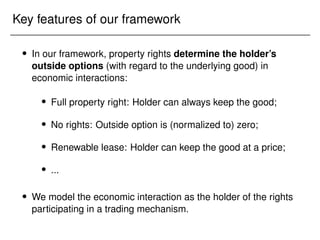
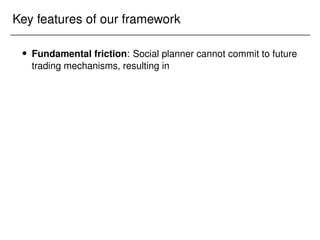
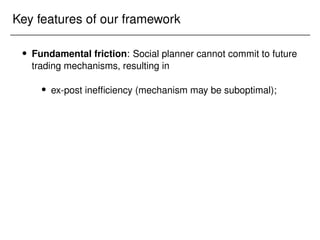
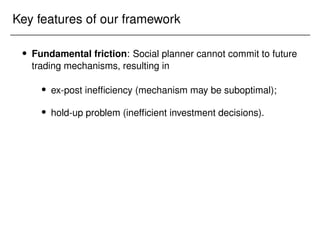
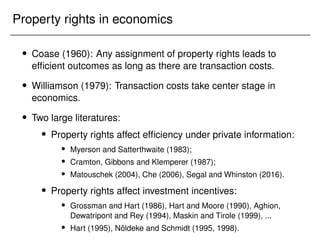
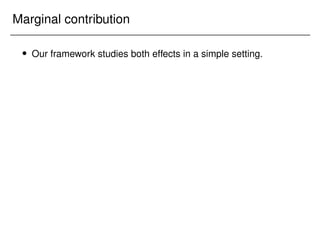
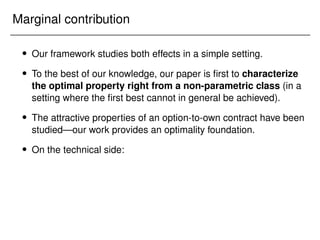
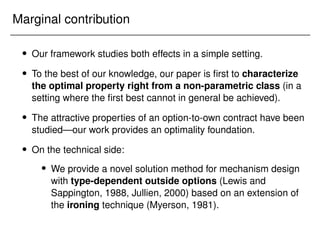
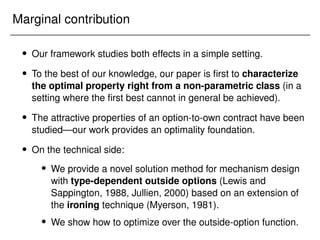
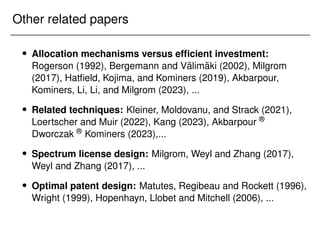
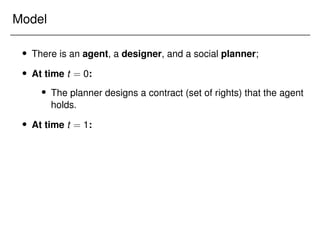
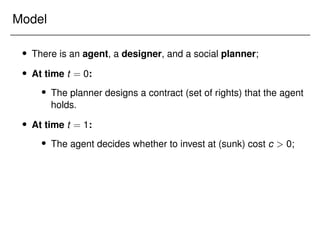
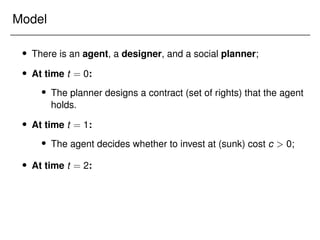
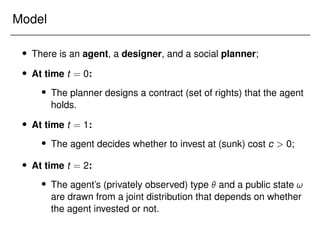
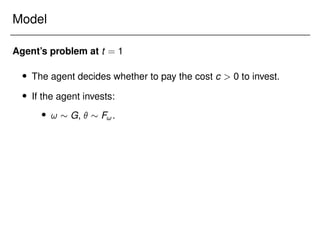
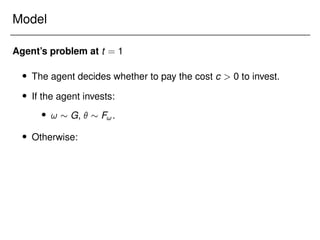
![Model
Time t = 2 continued:
Designer chooses a trading mechanism (x!(); t!()), where
x 2 [0; 1] denotes an allocation, and t 2 R denotes a transfer;](https://image.slidesharecdn.com/presentation-231123230158-530bead9/85/Presentation-pdf-46-320.jpg)
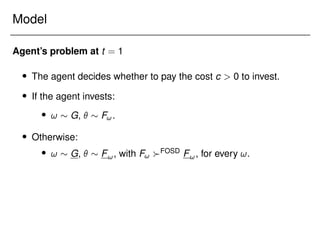
![Model
Time t = 2 continued:
Designer chooses a trading mechanism (x!(); t!()), where
x 2 [0; 1] denotes an allocation, and t 2 R denotes a transfer;
Mechanism is chosen subject to IC and IR constraints, and must
respect the rights that the agent holds.](https://image.slidesharecdn.com/presentation-231123230158-530bead9/85/Presentation-pdf-47-320.jpg)
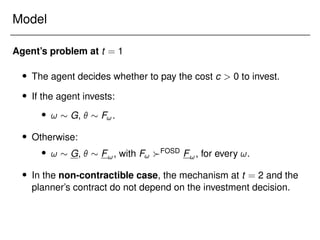
![Model
Time t = 2 continued:
Designer chooses a trading mechanism (x!(); t!()), where
x 2 [0; 1] denotes an allocation, and t 2 R denotes a transfer;
Mechanism is chosen subject to IC and IR constraints, and must
respect the rights that the agent holds.
Designer maximizes V(; !) x + t, where 0.](https://image.slidesharecdn.com/presentation-231123230158-530bead9/85/Presentation-pdf-48-320.jpg)
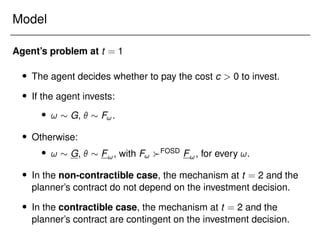
![Model
Time t = 2 continued:
Designer chooses a trading mechanism (x!(); t!()), where
x 2 [0; 1] denotes an allocation, and t 2 R denotes a transfer;
Mechanism is chosen subject to IC and IR constraints, and must
respect the rights that the agent holds.
Designer maximizes V(; !) x + t, where 0.
Agent’s utility is x t.](https://image.slidesharecdn.com/presentation-231123230158-530bead9/85/Presentation-pdf-49-320.jpg)
![Model
Social planner’s problem at t = 0
Social planner chooses a contract that is a menu of “rights”
M = f(xi; ti)gi2I;
where xi 2 [0; 1], ti 2 R, and set I is arbitrary (M is compact).](https://image.slidesharecdn.com/presentation-231123230158-530bead9/85/Presentation-pdf-57-320.jpg)
![Model
Social planner’s problem at t = 0
Social planner chooses a contract that is a menu of “rights”
M = f(xi; ti)gi2I;
where xi 2 [0; 1], ti 2 R, and set I is arbitrary (M is compact).
The agent can “execute” any one of these rights at t = 2.](https://image.slidesharecdn.com/presentation-231123230158-530bead9/85/Presentation-pdf-58-320.jpg)
![Model
Social planner’s problem at t = 0
Social planner chooses a contract that is a menu of “rights”
M = f(xi; ti)gi2I;
where xi 2 [0; 1], ti 2 R, and set I is arbitrary (M is compact).
The agent can “execute” any one of these rights at t = 2.
Social planner maximizes V?
(; !)x + ?
t, where ?
0.](https://image.slidesharecdn.com/presentation-231123230158-530bead9/85/Presentation-pdf-59-320.jpg)
![Model
Social planner’s problem at t = 0
Social planner chooses a contract that is a menu of “rights”
M = f(xi; ti)gi2I;
where xi 2 [0; 1], ti 2 R, and set I is arbitrary (M is compact).
The agent can “execute” any one of these rights at t = 2.
Social planner maximizes V?
(; !)x + ?
t, where ?
0.](https://image.slidesharecdn.com/presentation-231123230158-530bead9/85/Presentation-pdf-60-320.jpg)
![Model
Social planner’s problem at t = 0
Social planner chooses a contract that is a menu of “rights”
M = f(xi; ti)gi2I;
where xi 2 [0; 1], ti 2 R, and set I is arbitrary (M is compact).
The agent can “execute” any one of these rights at t = 2.
Social planner maximizes V?
(; !)x + ?
t, where ?
0.
Assume: Investment is preferred by the social planner to no
investment; investment can be induced by some contract; but it is not
induced if the agent holds no rights.](https://image.slidesharecdn.com/presentation-231123230158-530bead9/85/Presentation-pdf-61-320.jpg)
![Model
Social planner’s problem at t = 0
Social planner chooses a contract that is a menu of “rights”
M = f(xi; ti)gi2I;
where xi 2 [0; 1], ti 2 R, and set I is arbitrary (M is compact).
The agent can “execute” any one of these rights at t = 2.
Social planner maximizes V?
(; !)x + ?
t, where ?
0.
Technicalities: Θ [; ¯
] is a compact subset of R; V and V?
are
continuous in (and measurable in !), F has a continuous positive
density on Θ.](https://image.slidesharecdn.com/presentation-231123230158-530bead9/85/Presentation-pdf-62-320.jpg)
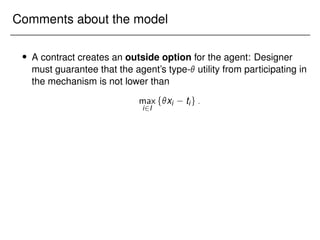
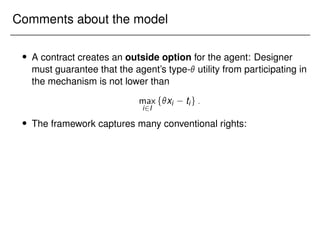
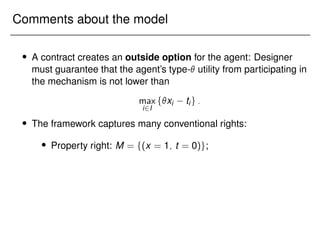
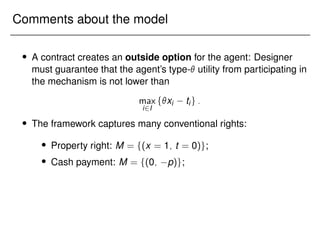
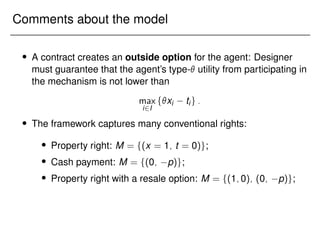
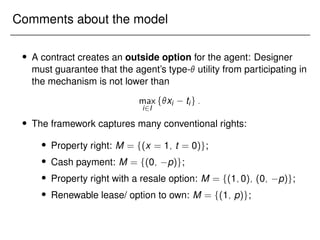
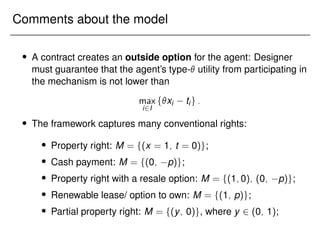
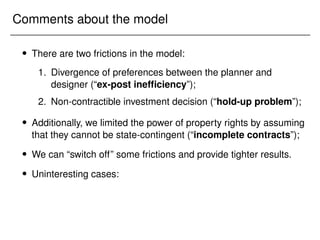
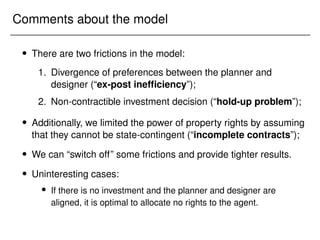
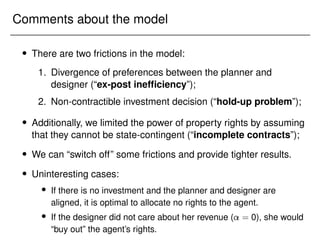
![Comments about the model
A contract creates an outside option for the agent: Designer
must guarantee that the agent’s type- utility from participating in
the mechanism is not lower than
max
i2I
fxi tig:
The framework captures many conventional rights:
Property right: M = f(x = 1; t = 0)g;
Cash payment: M = f(0; p)g;
Property right with a resale option: M = f(1;0); (0; p)g;
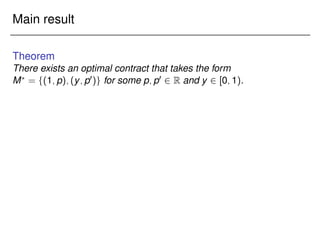
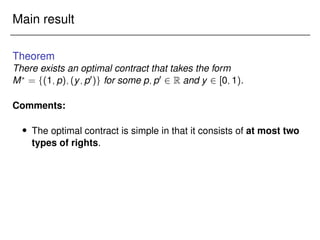
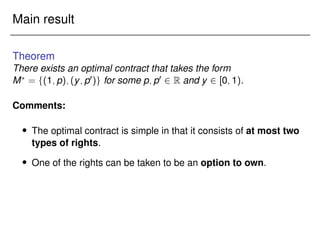
Renewable lease/ option to own: M = f(1; p)g;
Partial property right: M = f(y; 0)g, where y 2 (0; 1);
Flexible property right: M = fs; p(s))gs2[0; 1].](https://image.slidesharecdn.com/presentation-231123230158-530bead9/85/Presentation-pdf-70-320.jpg)
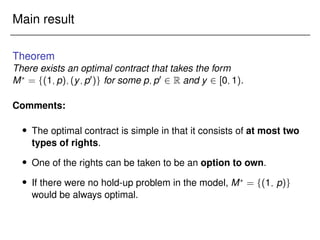
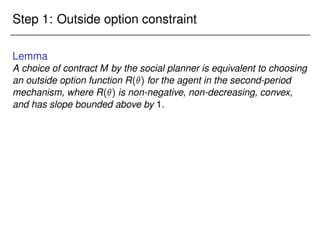
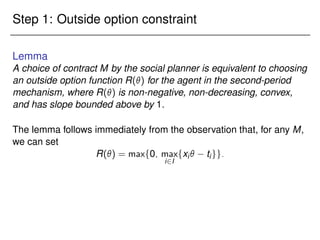
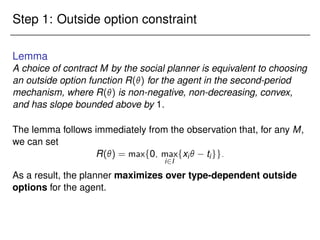
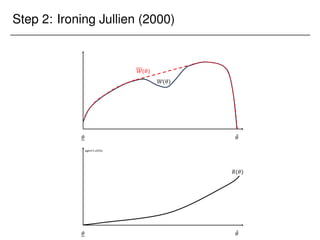
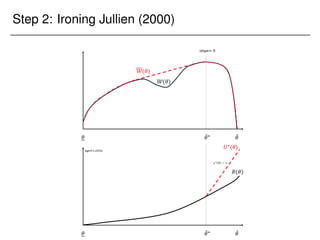
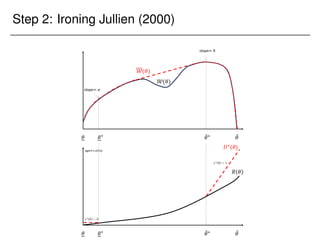
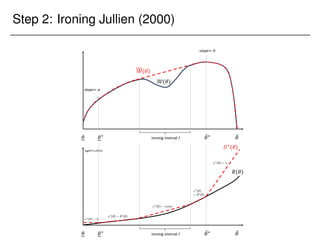
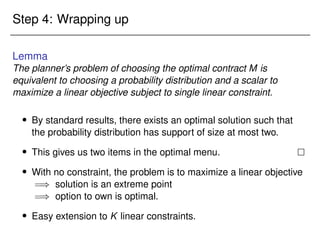
![Step 1: Outside option constraint
Fixing ! (and dropping it from the notation), the designer solves:
max
x:Θ![0;1]; u0
Z
W()x()d u
s.t. x is non-decreasing;
U() u +
Z
x() d R(); 8 2 Θ;
where
W() (V() + B()) f();
and
B() =
1 F()
f()
:](https://image.slidesharecdn.com/presentation-231123230158-530bead9/85/Presentation-pdf-92-320.jpg)
![Step 1: Outside option constraint
Fixing ! (and dropping it from the notation), the designer solves:
max
x:Θ![0;1]; u0
Z
W()x()d u
s.t. x is non-decreasing;
U() u +
Z
x() d R(); 8 2 Θ;
where
W() (V() + B()) f();
and
B() =
1 F()
f()
:
This is the problem considered by Jullien (2000).](https://image.slidesharecdn.com/presentation-231123230158-530bead9/85/Presentation-pdf-93-320.jpg)
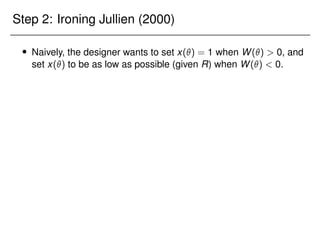
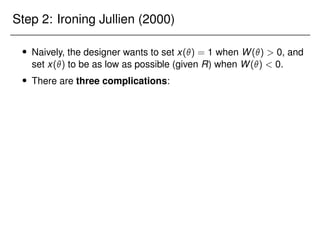
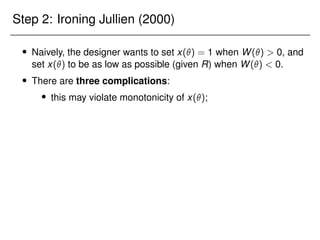
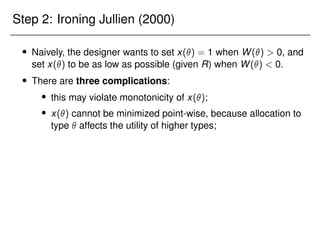
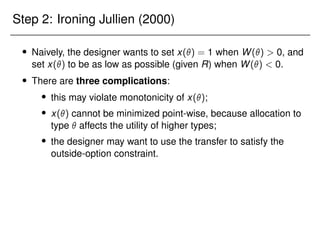
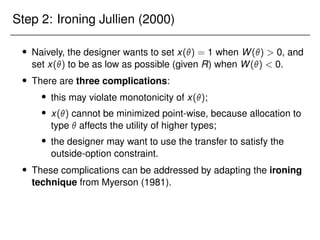
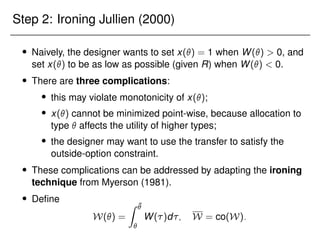
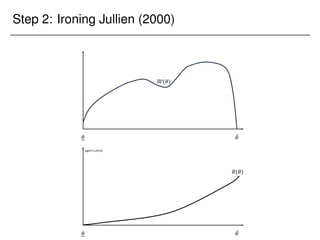
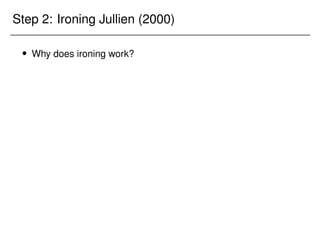
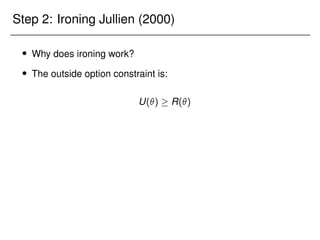
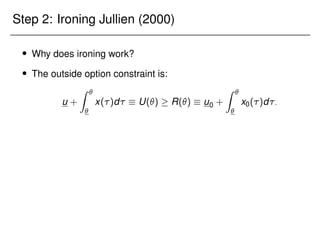
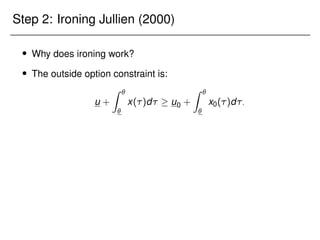
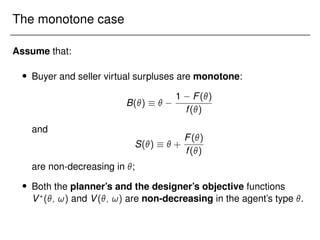
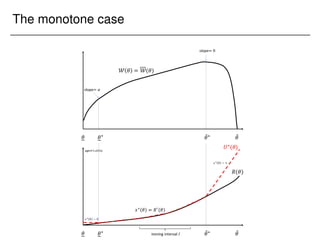
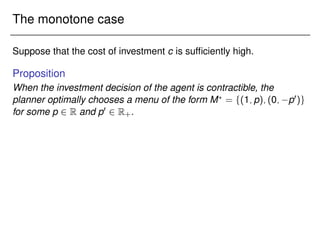
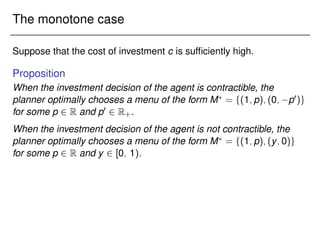
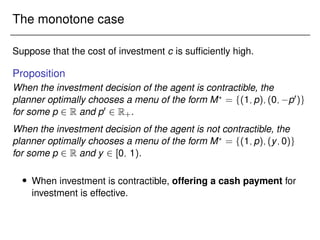
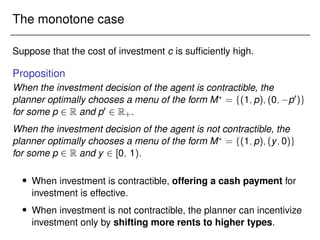
![The monotone case
Lemma (The monotone case)
For any outside option function R(), the mechanism designer in the
second period will choose an optimal mechanism in which the
outside-option constraint binds for types in the interval [!; ¯
!].](https://image.slidesharecdn.com/presentation-231123230158-530bead9/85/Presentation-pdf-125-320.jpg)
![The monotone case
Lemma (The monotone case)
For any outside option function R(), the mechanism designer in the
second period will choose an optimal mechanism in which the
outside-option constraint binds for types in the interval [!; ¯
!].
Moreover, except for the case of a boundary solution,
V(!; !) + S(!) = 0;
V(¯
!; !) + B(¯
!) = 0:](https://image.slidesharecdn.com/presentation-231123230158-530bead9/85/Presentation-pdf-126-320.jpg)
![The monotone case
Lemma (The monotone case)
For any outside option function R(), the mechanism designer in the
second period will choose an optimal mechanism in which the
outside-option constraint binds for types in the interval [!; ¯
!].
Moreover, except for the case of a boundary solution,
V(!; !) + S(!) = 0;
V(¯
!; !) + B(¯
!) = 0:
For ¯
!, the designer wants to allocate the good to the agent
anyway, so the outside-option constraint is slack;](https://image.slidesharecdn.com/presentation-231123230158-530bead9/85/Presentation-pdf-127-320.jpg)
![The monotone case
Lemma (The monotone case)
For any outside option function R(), the mechanism designer in the
second period will choose an optimal mechanism in which the
outside-option constraint binds for types in the interval [!; ¯
!].
Moreover, except for the case of a boundary solution,
V(!; !) + S(!) = 0;
V(¯
!; !) + B(¯
!) = 0:
For ¯
!, the designer wants to allocate the good to the agent
anyway, so the outside-option constraint is slack;](https://image.slidesharecdn.com/presentation-231123230158-530bead9/85/Presentation-pdf-128-320.jpg)
![The monotone case
Lemma (The monotone case)
For any outside option function R(), the mechanism designer in the
second period will choose an optimal mechanism in which the
outside-option constraint binds for types in the interval [!; ¯
!].
Moreover, except for the case of a boundary solution,
V(!; !) + S(!) = 0;
V(¯
!; !) + B(¯
!) = 0:
For ¯
!, the designer wants to allocate the good to the agent
anyway, so the outside-option constraint is slack;
For !, the designer prefers to “buy out” the rights using a
monetary payment, so the constraint is again slack.](https://image.slidesharecdn.com/presentation-231123230158-530bead9/85/Presentation-pdf-129-320.jpg)
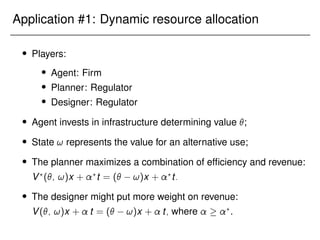
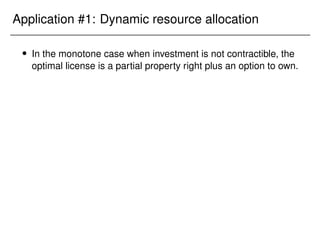
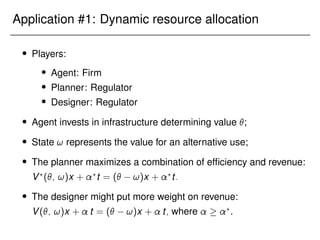
![Application #1: Dynamic resource allocation
In the monotone case when investment is not contractible, the
optimal license is a partial property right plus an option to own.
Suppose that F! is uniform on [0; 1], and F! is an atom at 0.](https://image.slidesharecdn.com/presentation-231123230158-530bead9/85/Presentation-pdf-138-320.jpg)
![Application #1: Dynamic resource allocation
In the monotone case when investment is not contractible, the
optimal license is a partial property right plus an option to own.
Suppose that F! is uniform on [0; 1], and F! is an atom at 0.
The optimal property right as a function of value for revenue:](https://image.slidesharecdn.com/presentation-231123230158-530bead9/85/Presentation-pdf-139-320.jpg)
![Application #1: Dynamic resource allocation
In the monotone case when investment is not contractible, the
optimal license is a partial property right plus an option to own.
Suppose that F! is uniform on [0; 1], and F! is an atom at 0.
The optimal property right as a function of value for revenue:
= ?
= 1: option to own (1; p)
(p makes the investment-obedience constraint bind);](https://image.slidesharecdn.com/presentation-231123230158-530bead9/85/Presentation-pdf-140-320.jpg)
![Application #1: Dynamic resource allocation
In the monotone case when investment is not contractible, the
optimal license is a partial property right plus an option to own.
Suppose that F! is uniform on [0; 1], and F! is an atom at 0.
The optimal property right as a function of value for revenue:
= ?
= 1: option to own (1; p)
(p makes the investment-obedience constraint bind);
= 1; ?
= 0: partial property right (0; y)
(y makes the investment-obedience constraint bind);](https://image.slidesharecdn.com/presentation-231123230158-530bead9/85/Presentation-pdf-141-320.jpg)
![Application #1: Dynamic resource allocation
In the monotone case when investment is not contractible, the
optimal license is a partial property right plus an option to own.
Suppose that F! is uniform on [0; 1], and F! is an atom at 0.
The optimal property right as a function of value for revenue:
= ?
= 1: option to own (1; p)
(p makes the investment-obedience constraint bind);
= 1; ?
= 0: partial property right (0; y)
(y makes the investment-obedience constraint bind);
= ?
= 0: no right
(this is just Rogerson (1992)!)](https://image.slidesharecdn.com/presentation-231123230158-530bead9/85/Presentation-pdf-142-320.jpg)
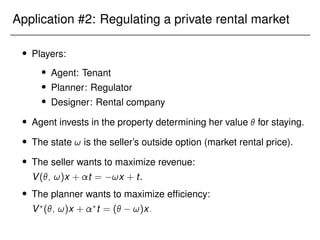
![Application #2: Regulating a private rental market
Suppose that without investment, value is uniform on [0; 1];
with investment, the value is drawn from [∆; 1 + ∆] instead.](https://image.slidesharecdn.com/presentation-231123230158-530bead9/85/Presentation-pdf-144-320.jpg)
![Application #2: Regulating a private rental market
Suppose that without investment, value is uniform on [0; 1];
with investment, the value is drawn from [∆; 1 + ∆] instead.
Suppose that ! is known (and lies in a certain range).](https://image.slidesharecdn.com/presentation-231123230158-530bead9/85/Presentation-pdf-145-320.jpg)
![Application #2: Regulating a private rental market
Suppose that without investment, value is uniform on [0; 1];
with investment, the value is drawn from [∆; 1 + ∆] instead.
Suppose that ! is known (and lies in a certain range).
The optimal contract is a renewable lease with price
p?
= ! ∆;
where is the Lagrange multiplier on the investment constraint.](https://image.slidesharecdn.com/presentation-231123230158-530bead9/85/Presentation-pdf-146-320.jpg)
![Application #2: Regulating a private rental market
Suppose that without investment, value is uniform on [0; 1];
with investment, the value is drawn from [∆; 1 + ∆] instead.
Suppose that ! is known (and lies in a certain range).
The optimal contract is a renewable lease with price
p?
= ! ∆;
where is the Lagrange multiplier on the investment constraint.
If investment constraint is slack, p?
= !, so the planner “forces”
the seller to use a VCG mechanism.](https://image.slidesharecdn.com/presentation-231123230158-530bead9/85/Presentation-pdf-147-320.jpg)
![Application #2: Regulating a private rental market
Suppose that without investment, value is uniform on [0; 1];
with investment, the value is drawn from [∆; 1 + ∆] instead.
Suppose that ! is known (and lies in a certain range).
The optimal contract is a renewable lease with price
p?
= ! ∆;
where is the Lagrange multiplier on the investment constraint.
If investment constraint is slack, p?
= !, so the planner “forces”
the seller to use a VCG mechanism.
If ! is random, then (assuming interior solution)
p?
= E[ ! j ?
! p?
?
!] ∆:](https://image.slidesharecdn.com/presentation-231123230158-530bead9/85/Presentation-pdf-148-320.jpg)
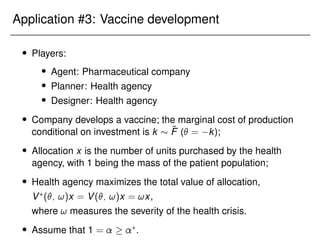
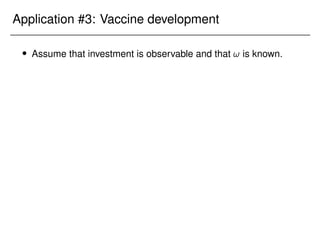
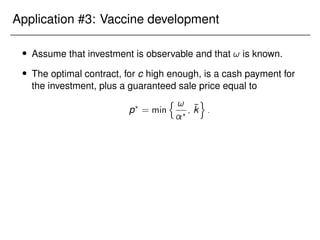
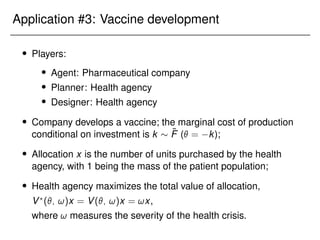
![Application #3: Vaccine development
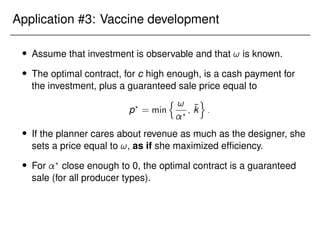
If ! is stochastic, then the optimal price satisfies
p?
= min
(
E
!j! 2 [!p? ; ¯
!p? ]
?
; k̄
)
;
where [!p? ; ¯
!p? ] is the interval of !’s for which the choice of p?
changes the second-period mechanism.](https://image.slidesharecdn.com/presentation-231123230158-530bead9/85/Presentation-pdf-154-320.jpg)
![Application #3: Vaccine development
If ! is stochastic, then the optimal price satisfies
p?
= min
(
E
!j! 2 [!p? ; ¯
!p? ]
?
; k̄
)
;
where [!p? ; ¯
!p? ] is the interval of !’s for which the choice of p?
changes the second-period mechanism.
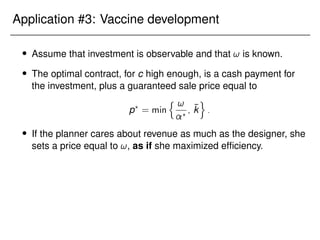
If the realized ! is high (health crisis is severe), the designer will
offer a price better than p?
.](https://image.slidesharecdn.com/presentation-231123230158-530bead9/85/Presentation-pdf-155-320.jpg)
![Application #3: Vaccine development
If ! is stochastic, then the optimal price satisfies
p?
= min
(
E
!j! 2 [!p? ; ¯
!p? ]
?
; k̄
)
;
where [!p? ; ¯
!p? ] is the interval of !’s for which the choice of p?
changes the second-period mechanism.
If the realized ! is high (health crisis is severe), the designer will
offer a price better than p?
.
If the realized ! is low (health crisis is mild), the designer will
offer a price lower than p?
and compensate the producer with an
additional cash payment (on top of the payment for investment).](https://image.slidesharecdn.com/presentation-231123230158-530bead9/85/Presentation-pdf-156-320.jpg)
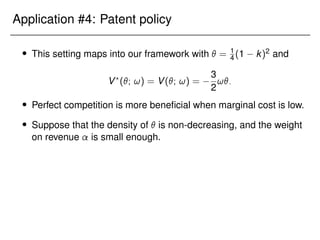
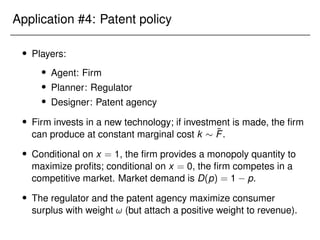
![Application #4: Patent policy
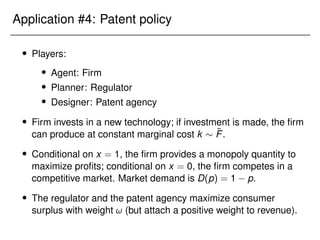
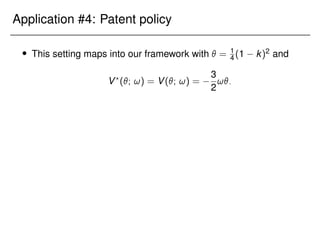
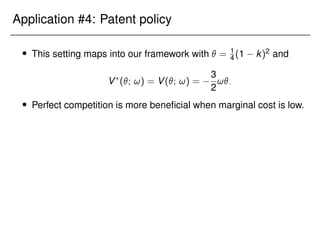
This setting maps into our framework with = 1
4 (1 k)2 and
V?
(; !) = V(; !) =
3
2
!:
Perfect competition is more beneficial when marginal cost is low.
Suppose that the density of is non-decreasing, and the weight
on revenue is small enough.
Then, an optimal contract is to offer full patent protection to the
invention (x = 1) with exogenous probability y 2 (0; 1] at no
payment.](https://image.slidesharecdn.com/presentation-231123230158-530bead9/85/Presentation-pdf-161-320.jpg)

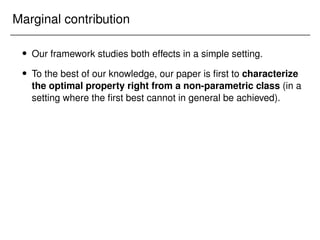
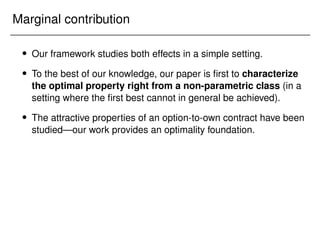
The document presents a framework for studying the optimal design of contractual property rights. It discusses how property rights determine parties' outside options in economic interactions and impact efficiency and investment incentives. The framework models an interaction where a property rights holder participates in a trading mechanism. The optimal property right balances ex-post inefficiency and hold-up problems arising from the planner's inability to commit. The paper contributes by characterizing the optimal right from a non-parametric class of options and provides a foundation for why option-to-own contracts are attractive.


