Computational Intelligence, Communications, and Business
Analytics (CICBA 2023) (27 – 28 January, 2023 )
A Proposed Method for Underwater Image Enhancement
using Color Balancing, Contrast Stretching, Increasing
Sharpness, etc
Mr. Raja Sarkar
Murshidabad College of Engineering & Technology, Banjetia,
Berhampore, West Bengal, India, rajasarkarjadavpur@gmail.com
Disclaimer
The use of general descriptive names, registered names,
trademarks, service marks, etc. in this presentation does not
imply, even in the absence of a specific statement, that such
names are exempt from the relevant protective laws and
regulations and therefore free for general use.
The authors and the editors are safe to assume that the advice
and information in this presentation are believed to be true and
accurate at the date of presentation. Neither the organisers nor
the editors give a warranty, express or implied, with respect to
the material contained herein or for any errors or omissions
that may have been made.
Paper Outline
1. Abstract
2. Introduction
3. Proposed Method
– White Balance using Gray World Algorithm
– Simplest Color Balance
– Contrast Enhancement using CLAHE
– Increase Sharpness
4. Experimental Result and Analysis
5. Conclusion
6. Future works
Motivation
 underwater image in several environmental conditions like-
low visibility, non-uniform lighting, scattering, abundance
of moving marine particles[1-7] results degradation of
visual quality of the images it require retrieval process.
 Due to transmission factor and atmospheric light many
times important important image information is lost in such
degraded images. Therefore restoration of the contrast,
color, and lost image information using the image
processing techniques is necessary in real time
applications.
Abstract
Underwater image are essentially characterize by their
poorvisibility because light is exponentially attenuated as it
travels in the water
Underwater images mainly suffer from the problem of poor
color contrast and poor visibility. These problems occur due
to the non-uniform ligting, scattering of light and refraction
of light while entering from rarer to denser medium.
Scattering causes the blurring of light and reduces the color
contrast resulting important information from the image
gets lost.
Introduction
• Underwater image are essentially characterize by their
poorvisibility because light is exponentially attenuated as it
travels in the water
• Underwater images are different from its counterpart which is
captured in the open air[1-13].
• Underwater images suffer from degradation due to poor
visibility conditions and effects such as light absorption, light
reflection, bending of light and scattering of light[1][2].
• Water absorbs light more than air resulting lower lighting in
deeper underwater image.
Proposed Method
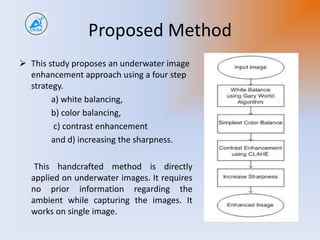
 This study proposes an underwater image
enhancement approach using a four step
strategy.
a) white balancing,
b) color balancing,
c) contrast enhancement
and d) increasing the sharpness.
This handcrafted method is directly
applied on underwater images. It requires
no prior information regarding the
ambient while capturing the images. It
works on single image.
White Balance using Gray World Algorithm
Input: Raw image, Output: Enhanced image
 Step 1: Convert RGB image to gray scale image to get the mean
luminance.
 Step 2: Seperate individual color channels- Red, Green, and Blue.
 Step 3: Normalize each channel seperately so that all channels
have the same mean.
 Step 4: Combine all normalized color channels into a single, true
color RGB image.
Simplest Color Balance
Input: Array of N elements,
Output: Array of stretched N elements.
 Step 1:
Sorting of the intensity values: The image is converted into a
one dimensional array of size and the array is sorted. A copy
of the original unsorted array is kept also.
 Step 2:
Selection the quantiles from the ascending ordered array: Let
the saturation level be s=s1+s2 , in the range[0,100] . Set the
element at
 Step 3:
Saturation of pixels: Update(saturate) all pixel values
 Step 4:
Map the values in new range: Remaining pixel values are
updated in the range [MAX , MIN] using the affine
transformation
Contrast Enhancement using CLAHE
 Step 1:
Convert the RGB image into the L*a*b* color space.
 Step 2:
Perform CLAHE on the L channel using the following steps 2.a
to 2.d.
a) Divide the L channel into tiles.
b) Enhance contrast of each tile separately.
c) Join the contrast enhanced tiles together.
d) Apply interpolation to remove induced boundaries.
Thus L channel in restored.
 Step 3:
Convert the resulting image back into the RGB color space
Increase Sharpness
 Sharpening is any enhancement technique that highlights edges
by increasing the contrast between bright and dark regions to
bring out features. Addition of the original image to a signal
proportional to a high-pass filtered version of the original image.
The sharpening operation is performed using
Is(i,j)=I(I,j) + λ*F(I(i,j))
Where I(i,j) is the original pixel value of Image, I at the
coordinate (I,j) . F() is the high-pass filter, Is(I,j) is the respective
sharpened pixel. λ > 0 is a tuning parameter decides the grade of
sharpness desired. Higher value of λ gives more sharpened
image.
Experimental Result and Analysis
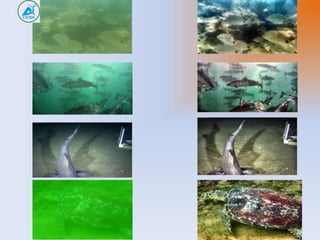
 We have tested our method on many images. The present
work is implemented using MATLAB R2018b version.
 The output shows that the overall visual quality of the
result images is significantly improved.
 Contrast and color of the objects are improved reasonably,
and the objects are clearer from the background.
 Our approach significantly improves image details, reduces
the noises, and enhances the contrast.
Few sample output images are shown here
 For quantitative analysis of performance of the proposed method,
we tried to measure the Peak Signal to Noise Ratio (PSNR)[21],
 Structural Similarity Index Measure (SSIM) [21] between the
original image and the enhanced images and also Measure of
Entropy(MoE) [22] of the original underwater image as well as the
enhanced image.
 Below Table shows the computed PSNR and SSIM between the
underwater image and its respective enhanced image and also gives
a comparative study with another handcrafted method[10]
reported in 2011 where Dark Channel Prior along with Simple Color
Balance are applied.
 From the result it is can be seen that in almost 66% cases our
methods performs better in terms of PSNR and SSIM.
TABLE I. Computed PSNR and SSIM using DCP with SCB, proposed
method where CLAHE applied on RGB image and proposed
method where CLAHE applied on l channel of L*a*b image
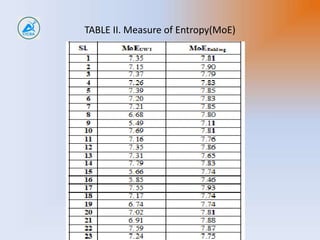
 Entropy is a statistical measure of randomness that
characterizes the texture of the image.
 Here for quantitative analysis Measure of Entropy(MoE)
[22] is calculated on original underwater image as well
as on the enhanced image using the proposed
method(where CLAHE is applied on L channel of L*a*b
color model).
 The result in the table clearly shows the proposed
method significantly improves the image information of
the underwater images
TABLE II. Measure of Entropy(MoE)
Conclusion
 This study proposes a handcrafted filter based
underwater image enhancement method that directly
works on the input underwater image.
 This study solves common issues of underwater
images like poor visibility, noises, loss of important
information etc.
 The experimental result shows that the method
successfully restores the contrast, color and lost
information from images.
Future works
 Future works may be focused on modification of the steps
for better performance.
References
1. K. Iqbal, R. A. Salam, A. Osman and A. Z. Talib, “Underwater image enhancement using integrated color
model”, IAENG International Journal of Computer Science, Vol. 34, No. 2 , 2007.
2. Abdul Ghani, A.S., Mat Isa, “Underwater image quality enhancement through composition of dual-
intensity images and Rayleigh-stretching”, SpringerPlus 3, 757, 2014, https://doi.org/10.1186/2193-1801-
3-757.
3. W. N. J. H. W. Yussof, M. S. Hitam, E. A. Awalludin, and Z. Bachok, “Performing Contrast Limited Adaptive
Histogram Equalization Technique on Combined Color Models for Underwater Image Enhancement
International Journal of Interactive Digital Media, Vol. 1, No. 1, 2013.
4. Sonam bharal, “L*a*b based contrast limited adaptive histogram equalization for underwater images”,
International Journal of Computer Application (2250-1797), Vol. 5, No. 4, pp. 165-174, 2015.
5. Huimin Lu, Yujie Li, and Seiichi Serikawa, “Underwater image enhancement using guided trigonometric
bilateral and fast automatic color correction”, IEEE International Conference on Image Processing, pp.
3412–3416, 2013.
6. Shu Zhang, TingWang, Junyu Dong, and Hui Yu, “Underwater image enhancement via extended multi-
scale Retinex”, Neurocomputing, Vol. 245, pp. 1–9, 2017, https://doi.org/10.1016/j.neucom.2017.03.029.
7. D. Akkaynak and T. Treibitz, “A Revised Underwater Image Formation Model”, 2018 IEEE/CVF Conference
on Computer Vision and Pattern Recognition, 2018, pp. 6723- 6732, DOI: 10.1109/CVPR.2018.00703.
8. C. O. Ancuti, C. Ancuti, C. De Vleeschouwer and P. Bekaert, “Color Balance and Fusion for Underwater
Image Enhancement” IEEE Transactions On Image Pro-cessing, Vol. 27, No. 1, 2018, pp. 379-393.
9. Dana Berman, Deborah Levy, Shai Avidan, and Tali Treibitz, “Underwater single image color restoration
using haze-lines and a new quantitative dataset”, IEEE Transactions on Pattern Analysis and Machine
Intelligence, Vol. 43, pp. 2822-2837, 2021, DOI: 10.1109/TPAMI.2020.2977624.
10. Kaiming He, Jian Sun, and Xiaoou Tang, “Single image haze removal using dark channel prior”, IEEE
Transactions on Pattern Analysis and Machine Intelligence, Vol. 33, No. 12, pp. 2341–2353, 2011.
11. Bolun Cai, Xiangmin Xu, Kui Jia, Chunmei Qing, and Dacheng Tao, “DehazeNET: An end-to-end system
for single image haze removal”, IEEE Transactions on Image Processing, Vol. 25, No. 11, pp. 5187–5198,
2016.
12. Cameron Fabbri, Md Jahidul Islam, and Junaed Sattar, “Enhancing underwater imagery using
Generative Adversarial Networks”, IEEE International Conference on Robotics and Automation (ICRA), pp.
7159–7165, 2018.
13. Jie Li, Katherine Skinner, Ryan Eustice, and Matthew Johnson-Roberson, “WaterGAN: Unsupervised
Generative Network to enable real-time color correction of monocular underwater images”. IEEE Robotics
and Automation Letters, pp. 387-394, Vol. 3, No. 1, 2018.
Question
And
Answer
Thank You

Presentation_CON (2).pptx

  • 1.
    Computational Intelligence, Communications,and Business Analytics (CICBA 2023) (27 – 28 January, 2023 ) A Proposed Method for Underwater Image Enhancement using Color Balancing, Contrast Stretching, Increasing Sharpness, etc Mr. Raja Sarkar Murshidabad College of Engineering & Technology, Banjetia, Berhampore, West Bengal, India, rajasarkarjadavpur@gmail.com
  • 2.
    Disclaimer The use ofgeneral descriptive names, registered names, trademarks, service marks, etc. in this presentation does not imply, even in the absence of a specific statement, that such names are exempt from the relevant protective laws and regulations and therefore free for general use. The authors and the editors are safe to assume that the advice and information in this presentation are believed to be true and accurate at the date of presentation. Neither the organisers nor the editors give a warranty, express or implied, with respect to the material contained herein or for any errors or omissions that may have been made.
  • 3.
    Paper Outline 1. Abstract 2.Introduction 3. Proposed Method – White Balance using Gray World Algorithm – Simplest Color Balance – Contrast Enhancement using CLAHE – Increase Sharpness 4. Experimental Result and Analysis 5. Conclusion 6. Future works
  • 4.
    Motivation  underwater imagein several environmental conditions like- low visibility, non-uniform lighting, scattering, abundance of moving marine particles[1-7] results degradation of visual quality of the images it require retrieval process.  Due to transmission factor and atmospheric light many times important important image information is lost in such degraded images. Therefore restoration of the contrast, color, and lost image information using the image processing techniques is necessary in real time applications.
  • 5.
    Abstract Underwater image areessentially characterize by their poorvisibility because light is exponentially attenuated as it travels in the water Underwater images mainly suffer from the problem of poor color contrast and poor visibility. These problems occur due to the non-uniform ligting, scattering of light and refraction of light while entering from rarer to denser medium. Scattering causes the blurring of light and reduces the color contrast resulting important information from the image gets lost.
  • 6.
    Introduction • Underwater imageare essentially characterize by their poorvisibility because light is exponentially attenuated as it travels in the water • Underwater images are different from its counterpart which is captured in the open air[1-13]. • Underwater images suffer from degradation due to poor visibility conditions and effects such as light absorption, light reflection, bending of light and scattering of light[1][2]. • Water absorbs light more than air resulting lower lighting in deeper underwater image.
  • 7.
    Proposed Method  Thisstudy proposes an underwater image enhancement approach using a four step strategy. a) white balancing, b) color balancing, c) contrast enhancement and d) increasing the sharpness. This handcrafted method is directly applied on underwater images. It requires no prior information regarding the ambient while capturing the images. It works on single image.
  • 8.
    White Balance usingGray World Algorithm Input: Raw image, Output: Enhanced image  Step 1: Convert RGB image to gray scale image to get the mean luminance.  Step 2: Seperate individual color channels- Red, Green, and Blue.  Step 3: Normalize each channel seperately so that all channels have the same mean.  Step 4: Combine all normalized color channels into a single, true color RGB image.
  • 9.
    Simplest Color Balance Input:Array of N elements, Output: Array of stretched N elements.  Step 1: Sorting of the intensity values: The image is converted into a one dimensional array of size and the array is sorted. A copy of the original unsorted array is kept also.
  • 10.
     Step 2: Selectionthe quantiles from the ascending ordered array: Let the saturation level be s=s1+s2 , in the range[0,100] . Set the element at  Step 3: Saturation of pixels: Update(saturate) all pixel values  Step 4: Map the values in new range: Remaining pixel values are updated in the range [MAX , MIN] using the affine transformation
  • 11.
    Contrast Enhancement usingCLAHE  Step 1: Convert the RGB image into the L*a*b* color space.  Step 2: Perform CLAHE on the L channel using the following steps 2.a to 2.d. a) Divide the L channel into tiles. b) Enhance contrast of each tile separately. c) Join the contrast enhanced tiles together. d) Apply interpolation to remove induced boundaries. Thus L channel in restored.  Step 3: Convert the resulting image back into the RGB color space
  • 12.
    Increase Sharpness  Sharpeningis any enhancement technique that highlights edges by increasing the contrast between bright and dark regions to bring out features. Addition of the original image to a signal proportional to a high-pass filtered version of the original image. The sharpening operation is performed using Is(i,j)=I(I,j) + λ*F(I(i,j)) Where I(i,j) is the original pixel value of Image, I at the coordinate (I,j) . F() is the high-pass filter, Is(I,j) is the respective sharpened pixel. λ > 0 is a tuning parameter decides the grade of sharpness desired. Higher value of λ gives more sharpened image.
  • 13.
    Experimental Result andAnalysis  We have tested our method on many images. The present work is implemented using MATLAB R2018b version.  The output shows that the overall visual quality of the result images is significantly improved.  Contrast and color of the objects are improved reasonably, and the objects are clearer from the background.  Our approach significantly improves image details, reduces the noises, and enhances the contrast. Few sample output images are shown here
  • 15.
     For quantitativeanalysis of performance of the proposed method, we tried to measure the Peak Signal to Noise Ratio (PSNR)[21],  Structural Similarity Index Measure (SSIM) [21] between the original image and the enhanced images and also Measure of Entropy(MoE) [22] of the original underwater image as well as the enhanced image.  Below Table shows the computed PSNR and SSIM between the underwater image and its respective enhanced image and also gives a comparative study with another handcrafted method[10] reported in 2011 where Dark Channel Prior along with Simple Color Balance are applied.  From the result it is can be seen that in almost 66% cases our methods performs better in terms of PSNR and SSIM.
  • 16.
    TABLE I. ComputedPSNR and SSIM using DCP with SCB, proposed method where CLAHE applied on RGB image and proposed method where CLAHE applied on l channel of L*a*b image
  • 17.
     Entropy isa statistical measure of randomness that characterizes the texture of the image.  Here for quantitative analysis Measure of Entropy(MoE) [22] is calculated on original underwater image as well as on the enhanced image using the proposed method(where CLAHE is applied on L channel of L*a*b color model).  The result in the table clearly shows the proposed method significantly improves the image information of the underwater images
  • 18.
    TABLE II. Measureof Entropy(MoE)
  • 19.
    Conclusion  This studyproposes a handcrafted filter based underwater image enhancement method that directly works on the input underwater image.  This study solves common issues of underwater images like poor visibility, noises, loss of important information etc.  The experimental result shows that the method successfully restores the contrast, color and lost information from images.
  • 20.
    Future works  Futureworks may be focused on modification of the steps for better performance.
  • 21.
    References 1. K. Iqbal,R. A. Salam, A. Osman and A. Z. Talib, “Underwater image enhancement using integrated color model”, IAENG International Journal of Computer Science, Vol. 34, No. 2 , 2007. 2. Abdul Ghani, A.S., Mat Isa, “Underwater image quality enhancement through composition of dual- intensity images and Rayleigh-stretching”, SpringerPlus 3, 757, 2014, https://doi.org/10.1186/2193-1801- 3-757. 3. W. N. J. H. W. Yussof, M. S. Hitam, E. A. Awalludin, and Z. Bachok, “Performing Contrast Limited Adaptive Histogram Equalization Technique on Combined Color Models for Underwater Image Enhancement International Journal of Interactive Digital Media, Vol. 1, No. 1, 2013. 4. Sonam bharal, “L*a*b based contrast limited adaptive histogram equalization for underwater images”, International Journal of Computer Application (2250-1797), Vol. 5, No. 4, pp. 165-174, 2015. 5. Huimin Lu, Yujie Li, and Seiichi Serikawa, “Underwater image enhancement using guided trigonometric bilateral and fast automatic color correction”, IEEE International Conference on Image Processing, pp. 3412–3416, 2013. 6. Shu Zhang, TingWang, Junyu Dong, and Hui Yu, “Underwater image enhancement via extended multi- scale Retinex”, Neurocomputing, Vol. 245, pp. 1–9, 2017, https://doi.org/10.1016/j.neucom.2017.03.029.
  • 22.
    7. D. Akkaynakand T. Treibitz, “A Revised Underwater Image Formation Model”, 2018 IEEE/CVF Conference on Computer Vision and Pattern Recognition, 2018, pp. 6723- 6732, DOI: 10.1109/CVPR.2018.00703. 8. C. O. Ancuti, C. Ancuti, C. De Vleeschouwer and P. Bekaert, “Color Balance and Fusion for Underwater Image Enhancement” IEEE Transactions On Image Pro-cessing, Vol. 27, No. 1, 2018, pp. 379-393. 9. Dana Berman, Deborah Levy, Shai Avidan, and Tali Treibitz, “Underwater single image color restoration using haze-lines and a new quantitative dataset”, IEEE Transactions on Pattern Analysis and Machine Intelligence, Vol. 43, pp. 2822-2837, 2021, DOI: 10.1109/TPAMI.2020.2977624. 10. Kaiming He, Jian Sun, and Xiaoou Tang, “Single image haze removal using dark channel prior”, IEEE Transactions on Pattern Analysis and Machine Intelligence, Vol. 33, No. 12, pp. 2341–2353, 2011. 11. Bolun Cai, Xiangmin Xu, Kui Jia, Chunmei Qing, and Dacheng Tao, “DehazeNET: An end-to-end system for single image haze removal”, IEEE Transactions on Image Processing, Vol. 25, No. 11, pp. 5187–5198, 2016. 12. Cameron Fabbri, Md Jahidul Islam, and Junaed Sattar, “Enhancing underwater imagery using Generative Adversarial Networks”, IEEE International Conference on Robotics and Automation (ICRA), pp. 7159–7165, 2018. 13. Jie Li, Katherine Skinner, Ryan Eustice, and Matthew Johnson-Roberson, “WaterGAN: Unsupervised Generative Network to enable real-time color correction of monocular underwater images”. IEEE Robotics and Automation Letters, pp. 387-394, Vol. 3, No. 1, 2018.
  • 23.
  • 24.