Forecast-Driven MPC for Decentralized
Multi-Robot Collision Avoidance
Hadush Hailu, Bruk Gebregziabher and Prudhvi Raj
IRCE 2025, Kunming
19 August 2025
Table of Contents
1 Motivation
▶ Motivation
▶ Contributions
▶ Method Overview
▶ Experiments
▶ Discussion
Why This Matters
1 Motivation
• Centralized Approach – 0ptimal but doesn’t scale, Single Point of Failure
(SPoF)
• Decentralized Approach – scalable and robust but suboptimal
— RL-based – high sample inefficiency and sim-to-real gap
— Optimization and Control – limited by real-time solvability
— Sampling-Based – limited reactivity and suboptimality
— Geometric and Velocity-Space – efficient but limited interaction reasoning, may
cause oscillations
* Iterative Forecast Planner(IFP) – Geometric and the fastest
Challenges
1 Motivation
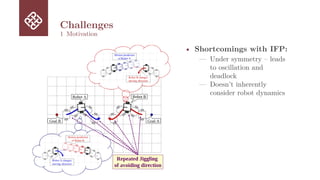
• Shortcomings with IFP:
— Under symmetry – leads
to oscillation and
deadlock
— Doesn’t inherently
consider robot dynamics
Table of Contents
2 Contributions
▶ Motivation
▶ Contributions
▶ Method Overview
▶ Experiments
▶ Discussion
Forecast-Driven, Decentralized MPC
2 Contributions
Contributions
• TCPA (Time-to-Collision based) obstacle ranking
• Cost-function for via-point(global path) evaluation (not only the shortest)
• Integration with MPC
Table of Contents
3 Method Overview
▶ Motivation
▶ Contributions
▶ Method Overview
▶ Experiments
▶ Discussion
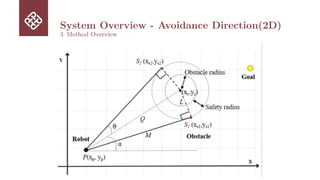
System Overview - Avoidance Direction(2D)
3 Method Overview
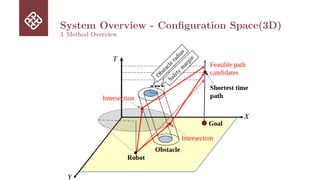
System Overview - Configuration Space(3D)
3 Method Overview
Robot Model
(Discrete unicycle dynamics)
3 Method Overview
State xk = [x, y, θ]⊤
, control uk = [v, ω]⊤
, ∆t sampling:
xk+1 =


xk + vk cos θk ∆t
yk + vk sin θk ∆t
θk + ωk ∆t

 , v ∈ [vmin, vmax], ω ∈ [ωmin, ωmax]
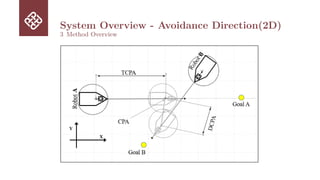
System Overview - Avoidance Direction(2D)
3 Method Overview
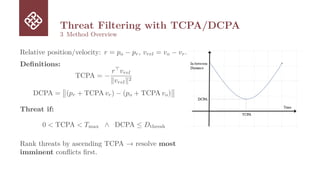
Threat Filtering with TCPA/DCPA
3 Method Overview
Relative position/velocity: r = po − pr, vrel = vo − vr.
Definitions:
TCPA = −
r⊤
vrel
∥vrel∥2
DCPA = (pr + TCPA vr) − (po + TCPA vo)
Threat if:
0 < TCPA < Tmax ∧ DCPA ≤ Dthresh
Rank threats by ascending TCPA → resolve most
imminent conflicts first.
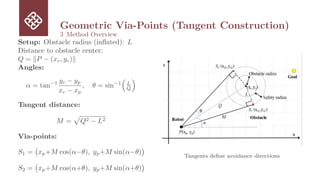
Geometric Via-Points (Tangent Construction)
3 Method Overview
Setup: Obstacle radius (inflated): L
Distance to obstacle center:
Q = ∥P − (xc, yc)∥
Angles:
α = tan−1 yc − yp
xc − xp
, θ = sin−1

L
Q

Tangent distance:
M =
p
Q2 − L2
Via-points:
S1 = xp+M cos(α−θ), yp+M sin(α−θ)

S2 = xp+M cos(α+θ), yp+M sin(α+θ)

Tangents define avoidance directions
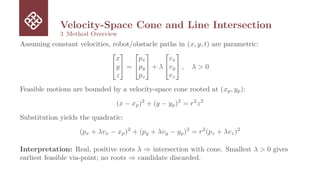
Velocity-Space Cone and Line Intersection
3 Method Overview
Assuming constant velocities, robot/obstacle paths in (x, y, t) are parametric:


x
y
z

 =


px
py
pz

 + λ


vx
vy
vz

 , λ  0
Feasible motions are bounded by a velocity-space cone rooted at (xp, yp):
(x − xp)2
+ (y − yp)2
= r2
z2
Substitution yields the quadratic:
(px + λvx − xp)2
+ (py + λvy − yp)2
= r2
(pz + λvz)2
Interpretation: Real, positive roots λ ⇒ intersection with cone. Smallest λ  0 gives
earliest feasible via-point; no roots ⇒ candidate discarded.
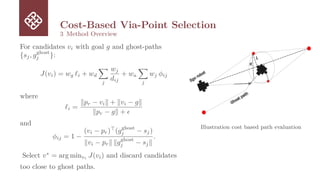
Cost-Based Via-Point Selection
3 Method Overview
For candidates vi with goal g and ghost-paths
{sj, gghost
j }:
J(vi) = wg ℓi + wd
X
j
wj
dij
+ wa
X
j
wj ϕij
where
ℓi =
∥pr − vi∥ + ∥vi − g∥
∥pr − g∥ + ϵ
and
ϕij = 1 −
(vi − pr)⊤
(gghost
j − sj)
∥vi − pr∥ ∥gghost
j − sj∥
.
Select v∗
= arg minvi J(vi) and discard candidates
too close to ghost paths.
Illustration cost based path evaluation
Trajectory Smoothing  MPC Tracking
3 Method Overview
After selecting a via-point, the robot smooths waypoints and tracks them with MPC.
Spline Smoothing:
p(t) =

Sx(t)
Sy(t)

, t ∈ [0, 1]
Continuous cubic splines {Sx, Sy} provide positions  derivatives.
Unicycle Dynamics:
xk+1 =


xk + vk cos θk ∆t
yk + vk sin θk ∆t
θk + ωk ∆t


MPC Optimization:
min
{uk}
N−1
X
k=0
∥xk − xref
k ∥2
Q + ∥uk∥2
R

subject to input bounds vmin ≤ vk ≤ vmax, ωmin ≤ ωk ≤ ωmax.
Predicted obstacles can be added as inequality constraints.
Table of Contents
4 Experiments
▶ Motivation
▶ Contributions
▶ Method Overview
▶ Experiments
▶ Discussion
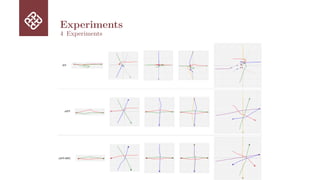
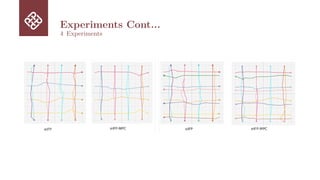
Experimental Setup
4 Experiments
Scenarios
• Two-robot mirror
• 3-robot T and 120◦
• 4-robot cross
• 5-robot central converge
• 12-robot multi-directional
• 16-robot cross-flows
Experiments
4 Experiments
Experiments Cont...
4 Experiments
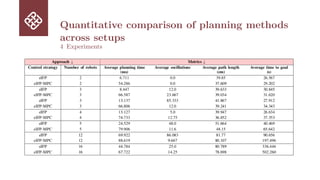
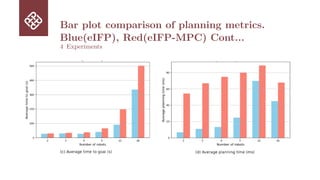
Quantitative comparison of planning methods
across setups
4 Experiments
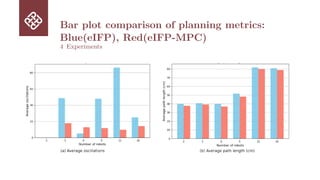
Bar plot comparison of planning metrics:
Blue(eIFP), Red(eIFP-MPC)
4 Experiments
Bar plot comparison of planning metrics.
Blue(eIFP), Red(eIFP-MPC) Cont...
4 Experiments
Table of Contents
5 Discussion
▶ Motivation
▶ Contributions
▶ Method Overview
▶ Experiments
▶ Discussion
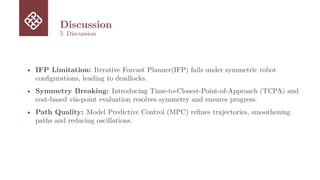
Discussion
5 Discussion
• IFP Limitation: Iterative Forcast Planner(IFP) fails under symmetric robot
configurations, leading to deadlocks.
• Symmetry Breaking: Introducing Time-to-Closest-Point-of-Approach (TCPA) and
cost-based via-point evaluation resolves symmetry and ensures progress.
• Path Quality: Model Predictive Control (MPC) refines trajectories, smoothening
paths and reducing oscillations.
Thank You
Questions welcome | had.hailu@gmail.com

Forecast-Driven MPC for Decentralized Multi-Robot Collision Avoidance

  • 1.
    Forecast-Driven MPC forDecentralized Multi-Robot Collision Avoidance Hadush Hailu, Bruk Gebregziabher and Prudhvi Raj IRCE 2025, Kunming 19 August 2025
  • 2.
    Table of Contents 1Motivation ▶ Motivation ▶ Contributions ▶ Method Overview ▶ Experiments ▶ Discussion
  • 3.
    Why This Matters 1Motivation • Centralized Approach – 0ptimal but doesn’t scale, Single Point of Failure (SPoF) • Decentralized Approach – scalable and robust but suboptimal — RL-based – high sample inefficiency and sim-to-real gap — Optimization and Control – limited by real-time solvability — Sampling-Based – limited reactivity and suboptimality — Geometric and Velocity-Space – efficient but limited interaction reasoning, may cause oscillations * Iterative Forecast Planner(IFP) – Geometric and the fastest
  • 4.
    Challenges 1 Motivation • Shortcomingswith IFP: — Under symmetry – leads to oscillation and deadlock — Doesn’t inherently consider robot dynamics
  • 5.
    Table of Contents 2Contributions ▶ Motivation ▶ Contributions ▶ Method Overview ▶ Experiments ▶ Discussion
  • 6.
    Forecast-Driven, Decentralized MPC 2Contributions Contributions • TCPA (Time-to-Collision based) obstacle ranking • Cost-function for via-point(global path) evaluation (not only the shortest) • Integration with MPC
  • 7.
    Table of Contents 3Method Overview ▶ Motivation ▶ Contributions ▶ Method Overview ▶ Experiments ▶ Discussion
  • 8.
    System Overview -Avoidance Direction(2D) 3 Method Overview
  • 9.
    System Overview -Configuration Space(3D) 3 Method Overview
  • 10.
    Robot Model (Discrete unicycledynamics) 3 Method Overview State xk = [x, y, θ]⊤ , control uk = [v, ω]⊤ , ∆t sampling: xk+1 =   xk + vk cos θk ∆t yk + vk sin θk ∆t θk + ωk ∆t   , v ∈ [vmin, vmax], ω ∈ [ωmin, ωmax]
  • 11.
    System Overview -Avoidance Direction(2D) 3 Method Overview
  • 12.
    Threat Filtering withTCPA/DCPA 3 Method Overview Relative position/velocity: r = po − pr, vrel = vo − vr. Definitions: TCPA = − r⊤ vrel ∥vrel∥2 DCPA = (pr + TCPA vr) − (po + TCPA vo) Threat if: 0 < TCPA < Tmax ∧ DCPA ≤ Dthresh Rank threats by ascending TCPA → resolve most imminent conflicts first.
  • 13.
    Geometric Via-Points (TangentConstruction) 3 Method Overview Setup: Obstacle radius (inflated): L Distance to obstacle center: Q = ∥P − (xc, yc)∥ Angles: α = tan−1 yc − yp xc − xp , θ = sin−1 L Q Tangent distance: M = p Q2 − L2 Via-points: S1 = xp+M cos(α−θ), yp+M sin(α−θ) S2 = xp+M cos(α+θ), yp+M sin(α+θ) Tangents define avoidance directions
  • 14.
    Velocity-Space Cone andLine Intersection 3 Method Overview Assuming constant velocities, robot/obstacle paths in (x, y, t) are parametric:   x y z   =   px py pz   + λ   vx vy vz   , λ 0 Feasible motions are bounded by a velocity-space cone rooted at (xp, yp): (x − xp)2 + (y − yp)2 = r2 z2 Substitution yields the quadratic: (px + λvx − xp)2 + (py + λvy − yp)2 = r2 (pz + λvz)2 Interpretation: Real, positive roots λ ⇒ intersection with cone. Smallest λ 0 gives earliest feasible via-point; no roots ⇒ candidate discarded.
  • 15.
    Cost-Based Via-Point Selection 3Method Overview For candidates vi with goal g and ghost-paths {sj, gghost j }: J(vi) = wg ℓi + wd X j wj dij + wa X j wj ϕij where ℓi = ∥pr − vi∥ + ∥vi − g∥ ∥pr − g∥ + ϵ and ϕij = 1 − (vi − pr)⊤ (gghost j − sj) ∥vi − pr∥ ∥gghost j − sj∥ . Select v∗ = arg minvi J(vi) and discard candidates too close to ghost paths. Illustration cost based path evaluation
  • 16.
    Trajectory Smoothing MPC Tracking 3 Method Overview After selecting a via-point, the robot smooths waypoints and tracks them with MPC. Spline Smoothing: p(t) = Sx(t) Sy(t) , t ∈ [0, 1] Continuous cubic splines {Sx, Sy} provide positions derivatives. Unicycle Dynamics: xk+1 =   xk + vk cos θk ∆t yk + vk sin θk ∆t θk + ωk ∆t   MPC Optimization: min {uk} N−1 X k=0 ∥xk − xref k ∥2 Q + ∥uk∥2 R subject to input bounds vmin ≤ vk ≤ vmax, ωmin ≤ ωk ≤ ωmax. Predicted obstacles can be added as inequality constraints.
  • 17.
    Table of Contents 4Experiments ▶ Motivation ▶ Contributions ▶ Method Overview ▶ Experiments ▶ Discussion
  • 18.
    Experimental Setup 4 Experiments Scenarios •Two-robot mirror • 3-robot T and 120◦ • 4-robot cross • 5-robot central converge • 12-robot multi-directional • 16-robot cross-flows
  • 19.
  • 20.
  • 21.
    Quantitative comparison ofplanning methods across setups 4 Experiments
  • 22.
    Bar plot comparisonof planning metrics: Blue(eIFP), Red(eIFP-MPC) 4 Experiments
  • 23.
    Bar plot comparisonof planning metrics. Blue(eIFP), Red(eIFP-MPC) Cont... 4 Experiments
  • 24.
    Table of Contents 5Discussion ▶ Motivation ▶ Contributions ▶ Method Overview ▶ Experiments ▶ Discussion
  • 25.
    Discussion 5 Discussion • IFPLimitation: Iterative Forcast Planner(IFP) fails under symmetric robot configurations, leading to deadlocks. • Symmetry Breaking: Introducing Time-to-Closest-Point-of-Approach (TCPA) and cost-based via-point evaluation resolves symmetry and ensures progress. • Path Quality: Model Predictive Control (MPC) refines trajectories, smoothening paths and reducing oscillations.
  • 26.
    Thank You Questions welcome| had.hailu@gmail.com