СFD analysis of different Greenhouse
ventilation designs using ОрenFОАM
9th
International and 49th
National
conference of FMFP - 2022
IIT Roorkee| Dec 14-16
Samar Singhal, M.TECH Dr. Ashwini Kumar Yadav, PhD Dr. Ravi Prakash, PhD
PhD scholar Assistant professor Professor
Introduction
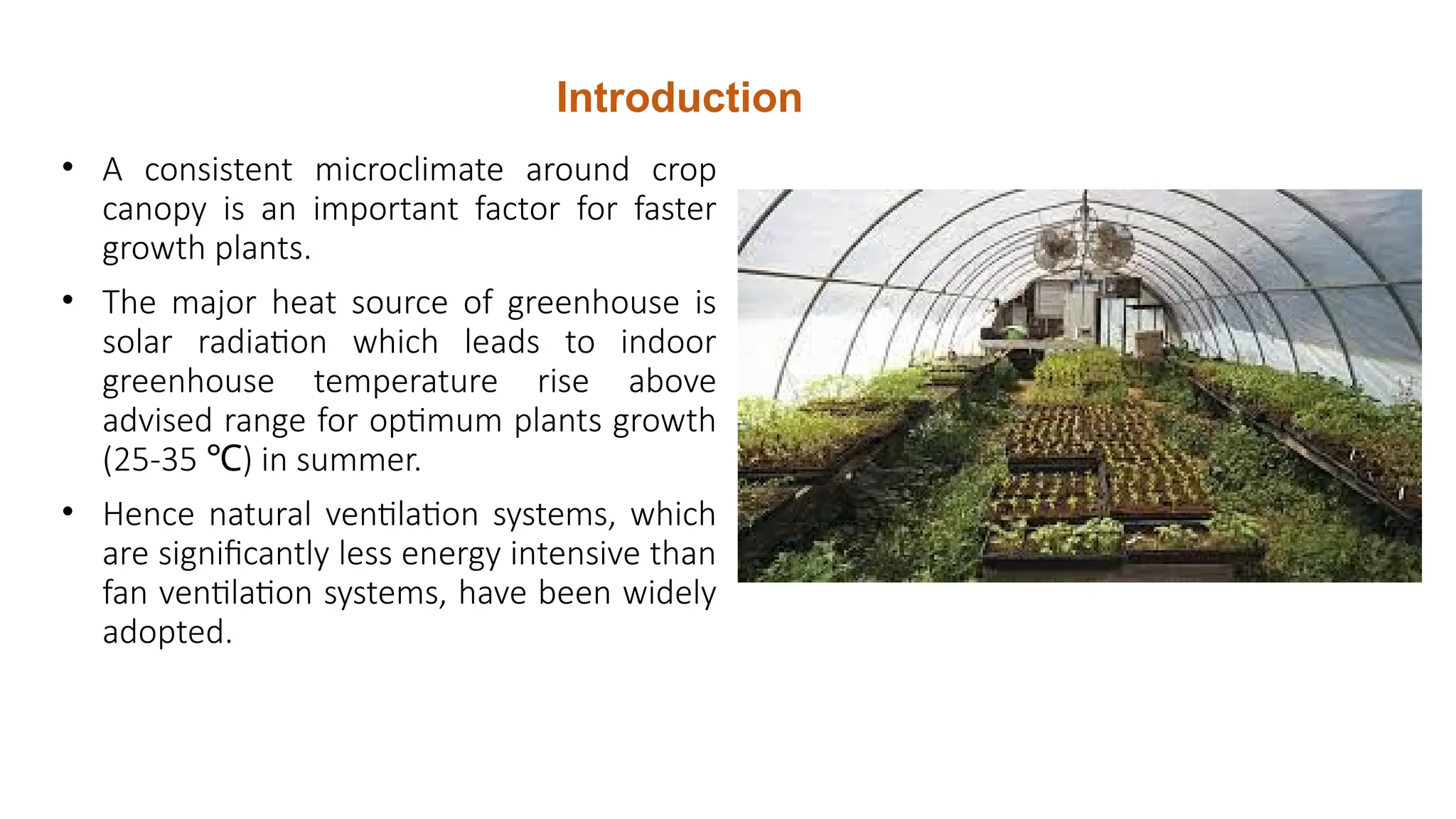
• A consistent microclimate around crop
canopy is an important factor for faster
growth plants.
• The major heat source of greenhouse is
solar radiation which leads to indoor
greenhouse temperature rise above
advised range for optimum plants growth
(25-35 ) in summer.
℃
• Hence natural ventilation systems, which
are significantly less energy intensive than
fan ventilation systems, have been widely
adopted.
Introduction
Many CFD investigation were carried out in the past to investigate the
mass air flow rate and temperature distribution inside the
greenhouse[1]. The impact of the sun position and wind on the
greenhouse microclimate was investigated using a discrete ordinate
(DO) model [2].
As the humidity too plays an important role for plant growth, energy
balance simulations to study humidity control in unheated
greenhouses were conducted [3].
Dynamic models were developed to predict all the internal greenhouse
temperatures for uneven span, even span, single span, vinery, Quonset
and arch type green houses from solar radiation availability point of
view[4].CFD study of greenhouse microclimates was carried out using
FLOTRAN module of ANSYS for underground heated tubes[5].
Objective
• It is aperient from literature that very few investigation were
carried out to study velocity and temperature distribution inside
the greenhouse for tropical conditions like India. The aim of this
study is to predict the effect vent and roof openings on the
greenhouse internal air temperature and ventilation rate, a
computational fluid dynamics (CFD) analysis was performed
using OpenFOAM. The specific objective was to assess the
efficacy of natural ventilation strategies in greenhouse cooling.
Methodology
The Fig. 1 shows dimensions and vent location of various
greenhouses selected for present numerical study.
Method
The Fig. 2 Boundary conditions and meshing of domain
Method
Parameter value
Density of air (kg/m3
) 1.2
Thermal Expansion Factor (1/K) 0.003
Specific heat of air (J/kg) 1005
Prandtl Number 0.7
Dynamic Viscosity ( Kg/m-s) 1e-5
Direct normal radiation on Earth (W/m2
) 744
Diffused solar radiation on vertical surface 114
Diffused solar radiation on horizontal
surface (W/m2
)
100
Table 1: Input parameters for basic directories
Method
(1)
(3)
Continuity
Momentum
Energy
Governing Equations
(6)
(5)
(7)
Boussineque approximation
Turbulent Kinetic Energy
Dissipation Rate
Method
Solver buoyantSimpleFoam
Time dependency Steady State
Discretization scheme Gauss upwind
Convergence Criteria (Residual tolerance) for
pressure, velocity and temperature
1e-7
Table 2: Solution Method
Results and Discussions: Temp. and Vel. distribution
Figure 3: Contours
Results and Discussions: Temp. and Vel. distribution
Figure 4: Contours
Results and Discussions: Density contours
Figure 5: Contours
Case 1 Case 2
Case 3 Case 4
Results and Discussions
Figure 5: Temperature along width at 1.1 m height Figure 6: Wind velocity along width at 1.1 m height
Results and Discussions
• The Fig. 5 shows temperature and velocity profiles for various configurations. From the contour plots of
temperature and wind speed it was observed that wind could not reach to downward region of the
entrance in domain and thereby temperature in that region is slightly higher.
• For all the cases, the air from windward side went deeper into the greenhouse and exit from ridge
opening. The cool incoming air initially followed a horizontally trajectory along the floor and as it was
heated up during the movement it went up towards the roof vent at the middle of the greenhouse due
to stack effect.
• A minor recirculation zone was also observed in all the cases toward closed vent side (right side).
• The Fig. 5 and Fig. 6 show variation of temperature and velocity along width of greenhouse for various
cases. The incoming air temperature increased from the inlet side due to greenhouse effect within the
domain and reached up-to 307 K near 2 m width of greenhouse.
• The velocity of incoming air reduced from 1m/s at inlet to 0.1 m/s till the 2 m width and then increased
up-to 0.3 m/s due to stack effect.
Conclusions
• The air movement caused by wind and stack effect in greenhouse was an
important factor that affected the uniformity of greenhouse temperature.
• The solar radiation transmitted through the greenhouse was absorbed by
the soil and it got heated up. The absorbed heat by soil was transmitted to
underground soil by conduction and to adjacent air inside the greenhouse
by convection. Hence for all the cases maximum temperature of air was 38
near the soil.
℃
• The case-2 greenhouse ventilation system had the most uniform and
lowest air temperature at the crop heights of 1.1m which is optimum
plants growth temperature (between 25-35 ).
℃
References
[1] R. Nebbali, J. C. Roy, and T. Boulard, “Dynamic simulation of the distributed radiative and
convective climate within a cropped greenhouse,” Renewable Energy, vol. 43, pp. 111–129, 2012.
[2] D. Piscia, P. Muñoz, C. Panadès, and J. I. Montero, “A method of coupling CFD and energy balance
simulations to study humidity control in unheated greenhouses,” Comput. Electron. Agric., vol. 115,
pp. 129–141, 2015, doi: 10.1016/j.compag.2015.05.005.
[3] H. G. Mobtaker, Y. Ajabshirchi, S. F. Ranjbar, and M. Matloobi, “Simulation of thermal performance
of solar greenhouse in north-west of Iran: An experimental validation,” Renew. Energy, vol. 135, pp.
88–97,2019.
[4] Senhaji, A., Mouqallid, M., Majdoubi, H., 2019. CFD Assisted Study of Multi-Chapels Greenhouse
Vents Openings Effect on Inside Airflow Circulation and Microclimate Patterns. Open Journal of Fluid
Dynamics 09, 119–139. https://doi.org/10.4236/ojfd.2019.92009
[5] Rouboa, A., Monteiro, E., 2007.Computational fluid dynamics analysis of greenhouse microclimates
by heated underground tubes, vol. 21, pp. 2196-2204.

Presentation_4898 cfd analysis of greenhouse vents.pptx

  • 1.
    СFD analysis ofdifferent Greenhouse ventilation designs using ОрenFОАM 9th International and 49th National conference of FMFP - 2022 IIT Roorkee| Dec 14-16 Samar Singhal, M.TECH Dr. Ashwini Kumar Yadav, PhD Dr. Ravi Prakash, PhD PhD scholar Assistant professor Professor
  • 2.
    Introduction • A consistentmicroclimate around crop canopy is an important factor for faster growth plants. • The major heat source of greenhouse is solar radiation which leads to indoor greenhouse temperature rise above advised range for optimum plants growth (25-35 ) in summer. ℃ • Hence natural ventilation systems, which are significantly less energy intensive than fan ventilation systems, have been widely adopted.
  • 3.
    Introduction Many CFD investigationwere carried out in the past to investigate the mass air flow rate and temperature distribution inside the greenhouse[1]. The impact of the sun position and wind on the greenhouse microclimate was investigated using a discrete ordinate (DO) model [2]. As the humidity too plays an important role for plant growth, energy balance simulations to study humidity control in unheated greenhouses were conducted [3]. Dynamic models were developed to predict all the internal greenhouse temperatures for uneven span, even span, single span, vinery, Quonset and arch type green houses from solar radiation availability point of view[4].CFD study of greenhouse microclimates was carried out using FLOTRAN module of ANSYS for underground heated tubes[5].
  • 4.
    Objective • It isaperient from literature that very few investigation were carried out to study velocity and temperature distribution inside the greenhouse for tropical conditions like India. The aim of this study is to predict the effect vent and roof openings on the greenhouse internal air temperature and ventilation rate, a computational fluid dynamics (CFD) analysis was performed using OpenFOAM. The specific objective was to assess the efficacy of natural ventilation strategies in greenhouse cooling.
  • 5.
    Methodology The Fig. 1shows dimensions and vent location of various greenhouses selected for present numerical study.
  • 6.
    Method The Fig. 2Boundary conditions and meshing of domain
  • 7.
    Method Parameter value Density ofair (kg/m3 ) 1.2 Thermal Expansion Factor (1/K) 0.003 Specific heat of air (J/kg) 1005 Prandtl Number 0.7 Dynamic Viscosity ( Kg/m-s) 1e-5 Direct normal radiation on Earth (W/m2 ) 744 Diffused solar radiation on vertical surface 114 Diffused solar radiation on horizontal surface (W/m2 ) 100 Table 1: Input parameters for basic directories
  • 8.
  • 9.
  • 10.
    Method Solver buoyantSimpleFoam Time dependencySteady State Discretization scheme Gauss upwind Convergence Criteria (Residual tolerance) for pressure, velocity and temperature 1e-7 Table 2: Solution Method
  • 11.
    Results and Discussions:Temp. and Vel. distribution Figure 3: Contours
  • 12.
    Results and Discussions:Temp. and Vel. distribution Figure 4: Contours
  • 13.
    Results and Discussions:Density contours Figure 5: Contours Case 1 Case 2 Case 3 Case 4
  • 14.
    Results and Discussions Figure5: Temperature along width at 1.1 m height Figure 6: Wind velocity along width at 1.1 m height
  • 15.
    Results and Discussions •The Fig. 5 shows temperature and velocity profiles for various configurations. From the contour plots of temperature and wind speed it was observed that wind could not reach to downward region of the entrance in domain and thereby temperature in that region is slightly higher. • For all the cases, the air from windward side went deeper into the greenhouse and exit from ridge opening. The cool incoming air initially followed a horizontally trajectory along the floor and as it was heated up during the movement it went up towards the roof vent at the middle of the greenhouse due to stack effect. • A minor recirculation zone was also observed in all the cases toward closed vent side (right side). • The Fig. 5 and Fig. 6 show variation of temperature and velocity along width of greenhouse for various cases. The incoming air temperature increased from the inlet side due to greenhouse effect within the domain and reached up-to 307 K near 2 m width of greenhouse. • The velocity of incoming air reduced from 1m/s at inlet to 0.1 m/s till the 2 m width and then increased up-to 0.3 m/s due to stack effect.
  • 16.
    Conclusions • The airmovement caused by wind and stack effect in greenhouse was an important factor that affected the uniformity of greenhouse temperature. • The solar radiation transmitted through the greenhouse was absorbed by the soil and it got heated up. The absorbed heat by soil was transmitted to underground soil by conduction and to adjacent air inside the greenhouse by convection. Hence for all the cases maximum temperature of air was 38 near the soil. ℃ • The case-2 greenhouse ventilation system had the most uniform and lowest air temperature at the crop heights of 1.1m which is optimum plants growth temperature (between 25-35 ). ℃
  • 17.
    References [1] R. Nebbali,J. C. Roy, and T. Boulard, “Dynamic simulation of the distributed radiative and convective climate within a cropped greenhouse,” Renewable Energy, vol. 43, pp. 111–129, 2012. [2] D. Piscia, P. Muñoz, C. Panadès, and J. I. Montero, “A method of coupling CFD and energy balance simulations to study humidity control in unheated greenhouses,” Comput. Electron. Agric., vol. 115, pp. 129–141, 2015, doi: 10.1016/j.compag.2015.05.005. [3] H. G. Mobtaker, Y. Ajabshirchi, S. F. Ranjbar, and M. Matloobi, “Simulation of thermal performance of solar greenhouse in north-west of Iran: An experimental validation,” Renew. Energy, vol. 135, pp. 88–97,2019. [4] Senhaji, A., Mouqallid, M., Majdoubi, H., 2019. CFD Assisted Study of Multi-Chapels Greenhouse Vents Openings Effect on Inside Airflow Circulation and Microclimate Patterns. Open Journal of Fluid Dynamics 09, 119–139. https://doi.org/10.4236/ojfd.2019.92009 [5] Rouboa, A., Monteiro, E., 2007.Computational fluid dynamics analysis of greenhouse microclimates by heated underground tubes, vol. 21, pp. 2196-2204.