Case Presentation On Mgt Of chronic Ectopic Px
YIRGALEM HOSPITAL MEDICAL COLLEGE
Presenter: Dr. Awgichew (OBGYN-RI)
Consultant: Dr. Anbese (Ass’t Pro.of obstetrics & gynecology ,RH subspecialist)
Dr. Diba (OBGYN- RII)
June- 19,2023
Presentation outline
 Objective
 case
 Case Summary
 Comments
 Discussion
 References
Objective
 Discuss on management of chronic ectopic pregnancy
using a case as an-entry.
Case - Identification
 Name –A.T
 Age- 22 yrs
 Sex - Female
 Adress – Sidama –dale woreda
 Admitted on -29/09/15 E.C
 Discharged on – 03/10/15 E.C
Case…History
C/c- Vaginal bleeding of 3wks duration
o This 22 yr old primigravida lady ,she didn’t remember her
date, amenoric for last 3mths.
o Presented with spotting vaginal bleeding of 3wks
duration ,associated with intermittent lower abdominal
pain which get worse in the last 3 days prior to
presentation.
Case…History
o she is married since last 7mths and live with him ,but she
had another boy friend for 3yrs prior to current husband.
o she had been using post pills repeatedly while she was
with her prior boy friend and once after recent marriage.
o Otherwise no hx of
o DM/HTN, Rx for STI ,surgery
o smoking, ABM or fainting
Case…PE
Physical examination
o GA--- healthy looking
o V/s –BP= 130/70 PR= 78 RR= 20 T= ATT
o HEENT – pink conjectiva ,NIS
o Abdomen – flat move with respiration
- No organomegaly or mass
- No sign of fluid collection
o GUS - no active Vx bleeding
- Cx is closed with motion tenderness
- blood stained examining finger
o CNS - COTPP
Case…Investigations
CBC
o wbc--- 7000
o HCT – 43%
o Hgb – 17gm/dl
o PLT – 532,000
Urine HCG – Positive
BG/Rh ---B+
U/A – B/d -+4 , RBC – full ,WBC – 2-5
Case…Investigations
Pelvic ultrasound
o empty uterine cavity
o No free fluid in the paracolic gutter and morison
pouch
o There is 7*7 cm complex Lt adnexal hyperechoic mass
with minimal cul-de-sac collection
Index - ? Chronic ectopic pregnancy
Case…Ass’t and plan
Ass’t – Primigravida
_ ? Chronic ectopic pregnancy
Plan
o admited to Gyn-side
o Prepare 2-x-matched blood
o Prepare for next day laparaomy
Case…Done (Mgt)
Laparotomy – Lt Salphingo-ophorectomy
o SA ,then to GA
o Pfannensiel Incision
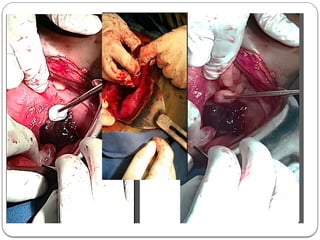
o IOF
 Health looking non-gravid Ux
 Healthy looking Rt tube and ovary
 Lt ovary and tubes distorted and form a mass and
adhesion to sigmoid colon
 200ml heamoperitonium
Case…Done (Mgt)
Laparotomy – Lt Salphingo-ophorectomy
oDone
 heamo-peritonium sucked out
 Adhesion between mass and bowel released until it
resist and strongly adhere mass capsule left
 Lt Salphingo-opheroctomy
 Lavaged with 1000ml warn saline
 After haemostasis secured and checked ,and correct
count reported abdominal layers closed layer by
layer.
Case…Done (Mgt)
Immediate post op- after Lt salphingo-opheroctomy was done
for the indication of Lt-side chronic EP.
o Post op order
o 3 bag over 24hrs
o ceftriaxone 1gm iv bid
o Metronidazole 500mg iv tid for 48hrs
o Diclofenac 75mg im bid
o keep catheter for 24hrs
o NPO for 12 hrs
o post op Hct after 24hrs
o V/s q15’ for 2hrs, q30’ for 2hrs then q4hrs
o send sample for histopathology
o Doxycycline 100mg po bid
o Metronidazole 500mg po bid for 2wks at discharge
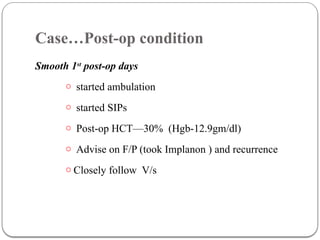
Case…Post-op condition
Smooth 1st
post-op days
o started ambulation
o started SIPs
o Post-op HCT—30% (Hgb-12.9gm/dl)
o Advise on F/P (took Implanon ) and recurrence
o Closely follow V/s
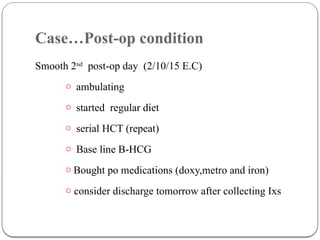
Case…Post-op condition
Smooth 2nd
post-op day (2/10/15 E.C)
o ambulating
o started regular diet
o serial HCT (repeat)
o Base line B-HCG
o Bought po medications (doxy,metro and iron)
o consider discharge tomorrow after collecting Ixs
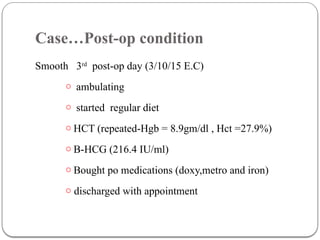
Case…Post-op condition
Smooth 3rd
post-op day (3/10/15 E.C)
o ambulating
o started regular diet
o HCT (repeated-Hgb = 8.9gm/dl , Hct =27.9%)
o B-HCG (216.4 IU/ml)
o Bought po medications (doxy,metro and iron)
o discharged with appointment
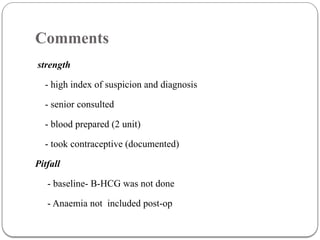
Comments
strength
- high index of suspicion and diagnosis
- senior consulted
- blood prepared (2 unit)
- took contraceptive (documented)
Pitfall
- baseline- B-HCG was not done
- Anaemia not included post-op
Problem Identified
⁍Primigravida
⁍ Chronic ectopic pregnancy
⁍ Anaemia
Chronic ectopic pregnancy (CEP)
Introduction
 Ectopic pregnancy (EP)
 2% of all pregnancies (9% of pregnancy-related deaths)
o African countries 0.5 - 2.3%
o In Ethiopia - 0.82%
 leading cause of death in the 1st
tmp (4%)
 6–16 % of ER patient with vaginal bleeding and/or
abdominal pain ( index of suspicion needs to be high)
Introduction…con’t
 Ectopic pregnancy (EP)
 We can have lists of risk factors, but exact aetiology not known
 Etio-pathologic theories are generally distinguished between
maternal and embryonic factors (maternal –infection, tubal
surgery ,IUD and p-only pills ,and embryonic factors-
chromosomal and structural anomalies-high incidence of Ep )
Introduction…con’t
 Ectopic pregnancy (EP)
 Has risk factors ,but up to 50 % of cases without risk factors
 one of important risk is prior hx - 8–15% will repeat EP.
 one-half -diagnosed at initial presentation
 one-half - diagnosed only after further medical surveillance
 two hypothetical natural histories of ectopic pregnancy
o acute presentation (type I)
o chronic presentation (type II)
Chronic ectopic pregnancy (CEP)
 CEP
 Asymptomatic / protracted clinical presentation
 HCG level -low or absent and resistance for MTX.
 Rupture late/ not at all
 variable and non-specific clinical signs and symptoms and there
remains no universal agreement about the definition of CEP.
 it is retrospective dx considering c/f & intra operative finding
 develops when the trophoblastic tissue gradually invades
implantation site leading to repeated rupture and continued minor
bleeding over time develop haematocele and appear a pelvic mass
Chronic ectopic pregnancy (CEP)
 CEP
 exact incidence is difficult due to varied criteria for definition.
o 6- 20% of EP
 final dx often made with histology findings of haemorrhage and
blood clots, disintegration of the tubal wall, multiple minor
ruptures, areas of dense fibrosis and necrosis embedded within
degenerated and/or a vital chorionic villi.
Chronic ectopic pregnancy (CEP)
 CEP
 its atypical symptom (complicate patients & difficult to
diagnose)
 incidence - difficult to assess due to rarity and varying
definitions used
 a more unusual situation, resulting from minor ruptures that
develop into a haematocele (typically surrounded by adhesions
and induces an inflammatory response)
Chronic ectopic pregnancy (CEP)
 A study to compare acute vs chronic presentation of EP to look for
differences in the patient characteristics and short-term sequelae.
 University of Pennsylvania, Philadelphia, Pennsylvania
 retrospective cohort study
 Department OBGYN has developed its own electronic data
management systems since 1989
 452 patients diagnosed with EP in the years 1993–1998.
 total of 37 parameters were analysed.
Chronic ectopic pregnancy (CEP)
 analysed based on 37 parameters
o age, race, gravity, parity
o Hx of EP, number of prior miscarriages, number of prior
elective terminations, number of prior cesarean sections
o Prior pelvic surgery, tubal ligation, PID
o IUD placement
o outpatient treatment for gonorrhoea and Chlamydia
o fertility medications
o blood type and Rh status.
Chronic ectopic pregnancy (CEP)
 Result (452)
 249 (55%) dxsed at initial visit and 203 (45%) required >1vist
 Hx of EP, prior miscarriages, prior pelvic surgery, tubal
ligation, PID and IUD placement has similar effect.
 About 30% had >=1 STDs in both group
 primary presentation for delayed one was
• bleeding than pain
• less likely to be hypotensive
• has non-diagnostic Ultrasound
Chronic ectopic pregnancy (CEP)
 Result (452)
 primary presentation for delayed one was
• More likely to be managed medically
• less likely to be ruptured (usually on ampulla)
• Lower EBL and shorter hospital stay
Chronic ectopic pregnancy (CEP)
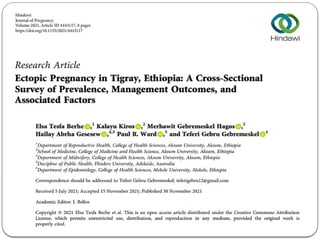
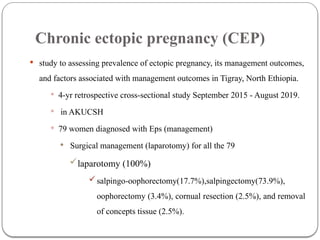
 study to assessing prevalence of ectopic pregnancy, its management outcomes,
and factors associated with management outcomes in Tigray, North Ethiopia.
 4-yr retrospective cross-sectional study September 2015 - August 2019.
 in AKUCSH
 79 women diagnosed with Eps (management)
 Surgical management (laparotomy) for all the 79
laparotomy (100%)
salpingo-oophorectomy(17.7%),salpingectomy(73.9%),
oophorectomy (3.4%), cornual resection (2.5%), and removal
of concepts tissue (2.5%).
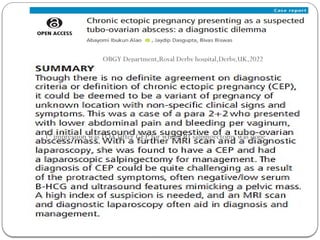
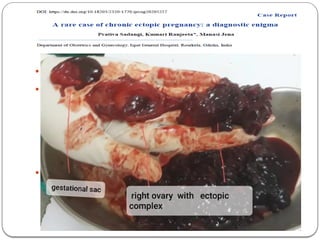
OBGY Department,Royal Derby hospital,Derby,UK,2022
1st
impression wasTOA latter CEP for whom Rt salpingectomy was done
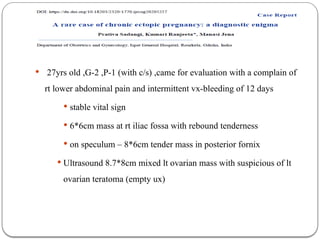
 27yrs old ,G-2 ,P-1 (with c/s) ,came for evaluation with a complain of
rt lower abdominal pain and intermittent vx-bleeding of 12 days
 stable vital sign
 6*6cm mass at rt iliac fossa with rebound tenderness
 on speculum – 8*6cm tender mass in posterior fornix
 Ultrasound 8.7*8cm mixed lt ovarian mass with suspicious of lt
ovarian teratoma (empty ux)
 Pelvic CT—10*8cm rt tubo-ovarian mass (sugestive of CEP)
 Exploratory laparotomy done
 small bowel adhesion to cystic mass in rt FT along with rt
ovary,that densely adher to posterior surface of Ux
 entire complet with tube and ovary removed with Rt
salphingoophorectomy
 Histo-pathologic result showed a dilated FT containing blood clot and
trophoblast along with fibrin rich infarcted and viable chorionic villi,
confirming the diagnosis of ectopic pregnancy.
DDX for CEP
 malignant germ cell tumor (GCT)
 PID
 Endometriosis
 Myoma
Management of CEP
 main stay of management is surgery
 Salpingectomy
 salphingostomy
 Diagnosis confirmed by
 surgery and histopathology
 medical
 MTX
Persistent ectopic pregnancy
 following surgery
 Rare following Salpingectomy
 5-15% (5-20%) of salphingostomy
 laparotomy less than laparoscopy
 Factor increase rate
 small px (<2cm)
 early therapy (before 42menstrual days)
 serum hcg >3000miu/ml
 implantation to salphingostomy site
Postoperative HCG follow up
 single or multidose
Take-home message
 Even though it is rare, bilateral ectopic pregnancy should be
considered in all patients with ectopic pregnancy, and
contralateral adnexa has to be examined during sonographic
evaluation, laparoscopy or laparotomy
 The diagnosis of CEP could be quite challenging as a result
of the protracted symptoms, often negative/low serum B-
HCG and ultrasound features mimicking a pelvic mass.A high
index of suspicion is needed, and an MRI scan and diagnostic
laparoscopy often aid in diagnosis and management
Reference
 D. Abebe, D. Tukue, A. Aregay, and L. Gebremariam,
“Magnitude and Associated Factors with Ectopic Pregnancy
Treated in Adigrat Hospital, Tigray Region, Northern
Ethiopia,” International Journal of Pharmaceutical Sciences
and Research, vol. 7, no. 1, pp. 30–39, 2017.
 Elsa Tesfa Berhe , Kalayu Kiros ,Merhawit Gebremeskel
Hagos and eta’l, ‘‘Ectopic Pregnancy Management
Outcomes, and Associated Factor in Tigray, Ethiopia,
Hindawi Journal of Pregnancy, ID 4443117, 8 pagesVolume
2021.
Thank you

Presentation2 Chronic Ep (1).pptxggggggg

  • 1.
    Case Presentation OnMgt Of chronic Ectopic Px YIRGALEM HOSPITAL MEDICAL COLLEGE Presenter: Dr. Awgichew (OBGYN-RI) Consultant: Dr. Anbese (Ass’t Pro.of obstetrics & gynecology ,RH subspecialist) Dr. Diba (OBGYN- RII) June- 19,2023
  • 2.
    Presentation outline  Objective case  Case Summary  Comments  Discussion  References
  • 3.
    Objective  Discuss onmanagement of chronic ectopic pregnancy using a case as an-entry.
  • 4.
    Case - Identification Name –A.T  Age- 22 yrs  Sex - Female  Adress – Sidama –dale woreda  Admitted on -29/09/15 E.C  Discharged on – 03/10/15 E.C
  • 5.
    Case…History C/c- Vaginal bleedingof 3wks duration o This 22 yr old primigravida lady ,she didn’t remember her date, amenoric for last 3mths. o Presented with spotting vaginal bleeding of 3wks duration ,associated with intermittent lower abdominal pain which get worse in the last 3 days prior to presentation.
  • 6.
    Case…History o she ismarried since last 7mths and live with him ,but she had another boy friend for 3yrs prior to current husband. o she had been using post pills repeatedly while she was with her prior boy friend and once after recent marriage. o Otherwise no hx of o DM/HTN, Rx for STI ,surgery o smoking, ABM or fainting
  • 7.
    Case…PE Physical examination o GA---healthy looking o V/s –BP= 130/70 PR= 78 RR= 20 T= ATT o HEENT – pink conjectiva ,NIS o Abdomen – flat move with respiration - No organomegaly or mass - No sign of fluid collection o GUS - no active Vx bleeding - Cx is closed with motion tenderness - blood stained examining finger o CNS - COTPP
  • 8.
    Case…Investigations CBC o wbc--- 7000 oHCT – 43% o Hgb – 17gm/dl o PLT – 532,000 Urine HCG – Positive BG/Rh ---B+ U/A – B/d -+4 , RBC – full ,WBC – 2-5
  • 9.
    Case…Investigations Pelvic ultrasound o emptyuterine cavity o No free fluid in the paracolic gutter and morison pouch o There is 7*7 cm complex Lt adnexal hyperechoic mass with minimal cul-de-sac collection Index - ? Chronic ectopic pregnancy
  • 11.
    Case…Ass’t and plan Ass’t– Primigravida _ ? Chronic ectopic pregnancy Plan o admited to Gyn-side o Prepare 2-x-matched blood o Prepare for next day laparaomy
  • 12.
    Case…Done (Mgt) Laparotomy –Lt Salphingo-ophorectomy o SA ,then to GA o Pfannensiel Incision o IOF  Health looking non-gravid Ux  Healthy looking Rt tube and ovary  Lt ovary and tubes distorted and form a mass and adhesion to sigmoid colon  200ml heamoperitonium
  • 14.
    Case…Done (Mgt) Laparotomy –Lt Salphingo-ophorectomy oDone  heamo-peritonium sucked out  Adhesion between mass and bowel released until it resist and strongly adhere mass capsule left  Lt Salphingo-opheroctomy  Lavaged with 1000ml warn saline  After haemostasis secured and checked ,and correct count reported abdominal layers closed layer by layer.
  • 15.
    Case…Done (Mgt) Immediate postop- after Lt salphingo-opheroctomy was done for the indication of Lt-side chronic EP. o Post op order o 3 bag over 24hrs o ceftriaxone 1gm iv bid o Metronidazole 500mg iv tid for 48hrs o Diclofenac 75mg im bid o keep catheter for 24hrs o NPO for 12 hrs o post op Hct after 24hrs o V/s q15’ for 2hrs, q30’ for 2hrs then q4hrs o send sample for histopathology o Doxycycline 100mg po bid o Metronidazole 500mg po bid for 2wks at discharge
  • 16.
    Case…Post-op condition Smooth 1st post-opdays o started ambulation o started SIPs o Post-op HCT—30% (Hgb-12.9gm/dl) o Advise on F/P (took Implanon ) and recurrence o Closely follow V/s
  • 17.
    Case…Post-op condition Smooth 2nd post-opday (2/10/15 E.C) o ambulating o started regular diet o serial HCT (repeat) o Base line B-HCG o Bought po medications (doxy,metro and iron) o consider discharge tomorrow after collecting Ixs
  • 18.
    Case…Post-op condition Smooth 3rd post-opday (3/10/15 E.C) o ambulating o started regular diet o HCT (repeated-Hgb = 8.9gm/dl , Hct =27.9%) o B-HCG (216.4 IU/ml) o Bought po medications (doxy,metro and iron) o discharged with appointment
  • 19.
    Comments strength - high indexof suspicion and diagnosis - senior consulted - blood prepared (2 unit) - took contraceptive (documented) Pitfall - baseline- B-HCG was not done - Anaemia not included post-op
  • 20.
  • 21.
  • 22.
    Introduction  Ectopic pregnancy(EP)  2% of all pregnancies (9% of pregnancy-related deaths) o African countries 0.5 - 2.3% o In Ethiopia - 0.82%  leading cause of death in the 1st tmp (4%)  6–16 % of ER patient with vaginal bleeding and/or abdominal pain ( index of suspicion needs to be high)
  • 23.
    Introduction…con’t  Ectopic pregnancy(EP)  We can have lists of risk factors, but exact aetiology not known  Etio-pathologic theories are generally distinguished between maternal and embryonic factors (maternal –infection, tubal surgery ,IUD and p-only pills ,and embryonic factors- chromosomal and structural anomalies-high incidence of Ep )
  • 24.
    Introduction…con’t  Ectopic pregnancy(EP)  Has risk factors ,but up to 50 % of cases without risk factors  one of important risk is prior hx - 8–15% will repeat EP.  one-half -diagnosed at initial presentation  one-half - diagnosed only after further medical surveillance  two hypothetical natural histories of ectopic pregnancy o acute presentation (type I) o chronic presentation (type II)
  • 25.
    Chronic ectopic pregnancy(CEP)  CEP  Asymptomatic / protracted clinical presentation  HCG level -low or absent and resistance for MTX.  Rupture late/ not at all  variable and non-specific clinical signs and symptoms and there remains no universal agreement about the definition of CEP.  it is retrospective dx considering c/f & intra operative finding  develops when the trophoblastic tissue gradually invades implantation site leading to repeated rupture and continued minor bleeding over time develop haematocele and appear a pelvic mass
  • 26.
  • 27.
    Chronic ectopic pregnancy(CEP)  CEP  exact incidence is difficult due to varied criteria for definition. o 6- 20% of EP  final dx often made with histology findings of haemorrhage and blood clots, disintegration of the tubal wall, multiple minor ruptures, areas of dense fibrosis and necrosis embedded within degenerated and/or a vital chorionic villi.
  • 28.
    Chronic ectopic pregnancy(CEP)  CEP  its atypical symptom (complicate patients & difficult to diagnose)  incidence - difficult to assess due to rarity and varying definitions used  a more unusual situation, resulting from minor ruptures that develop into a haematocele (typically surrounded by adhesions and induces an inflammatory response)
  • 30.
    Chronic ectopic pregnancy(CEP)  A study to compare acute vs chronic presentation of EP to look for differences in the patient characteristics and short-term sequelae.  University of Pennsylvania, Philadelphia, Pennsylvania  retrospective cohort study  Department OBGYN has developed its own electronic data management systems since 1989  452 patients diagnosed with EP in the years 1993–1998.  total of 37 parameters were analysed.
  • 31.
    Chronic ectopic pregnancy(CEP)  analysed based on 37 parameters o age, race, gravity, parity o Hx of EP, number of prior miscarriages, number of prior elective terminations, number of prior cesarean sections o Prior pelvic surgery, tubal ligation, PID o IUD placement o outpatient treatment for gonorrhoea and Chlamydia o fertility medications o blood type and Rh status.
  • 32.
    Chronic ectopic pregnancy(CEP)  Result (452)  249 (55%) dxsed at initial visit and 203 (45%) required >1vist  Hx of EP, prior miscarriages, prior pelvic surgery, tubal ligation, PID and IUD placement has similar effect.  About 30% had >=1 STDs in both group  primary presentation for delayed one was • bleeding than pain • less likely to be hypotensive • has non-diagnostic Ultrasound
  • 33.
    Chronic ectopic pregnancy(CEP)  Result (452)  primary presentation for delayed one was • More likely to be managed medically • less likely to be ruptured (usually on ampulla) • Lower EBL and shorter hospital stay
  • 35.
    Chronic ectopic pregnancy(CEP)  study to assessing prevalence of ectopic pregnancy, its management outcomes, and factors associated with management outcomes in Tigray, North Ethiopia.  4-yr retrospective cross-sectional study September 2015 - August 2019.  in AKUCSH  79 women diagnosed with Eps (management)  Surgical management (laparotomy) for all the 79 laparotomy (100%) salpingo-oophorectomy(17.7%),salpingectomy(73.9%), oophorectomy (3.4%), cornual resection (2.5%), and removal of concepts tissue (2.5%).
  • 36.
    OBGY Department,Royal Derbyhospital,Derby,UK,2022 1st impression wasTOA latter CEP for whom Rt salpingectomy was done
  • 37.
     27yrs old,G-2 ,P-1 (with c/s) ,came for evaluation with a complain of rt lower abdominal pain and intermittent vx-bleeding of 12 days  stable vital sign  6*6cm mass at rt iliac fossa with rebound tenderness  on speculum – 8*6cm tender mass in posterior fornix  Ultrasound 8.7*8cm mixed lt ovarian mass with suspicious of lt ovarian teratoma (empty ux)
  • 38.
     Pelvic CT—10*8cmrt tubo-ovarian mass (sugestive of CEP)  Exploratory laparotomy done  small bowel adhesion to cystic mass in rt FT along with rt ovary,that densely adher to posterior surface of Ux  entire complet with tube and ovary removed with Rt salphingoophorectomy  Histo-pathologic result showed a dilated FT containing blood clot and trophoblast along with fibrin rich infarcted and viable chorionic villi, confirming the diagnosis of ectopic pregnancy.
  • 39.
    DDX for CEP malignant germ cell tumor (GCT)  PID  Endometriosis  Myoma
  • 40.
    Management of CEP main stay of management is surgery  Salpingectomy  salphingostomy  Diagnosis confirmed by  surgery and histopathology  medical  MTX
  • 41.
    Persistent ectopic pregnancy following surgery  Rare following Salpingectomy  5-15% (5-20%) of salphingostomy  laparotomy less than laparoscopy  Factor increase rate  small px (<2cm)  early therapy (before 42menstrual days)  serum hcg >3000miu/ml  implantation to salphingostomy site
  • 42.
    Postoperative HCG followup  single or multidose
  • 43.
    Take-home message  Eventhough it is rare, bilateral ectopic pregnancy should be considered in all patients with ectopic pregnancy, and contralateral adnexa has to be examined during sonographic evaluation, laparoscopy or laparotomy  The diagnosis of CEP could be quite challenging as a result of the protracted symptoms, often negative/low serum B- HCG and ultrasound features mimicking a pelvic mass.A high index of suspicion is needed, and an MRI scan and diagnostic laparoscopy often aid in diagnosis and management
  • 44.
    Reference  D. Abebe,D. Tukue, A. Aregay, and L. Gebremariam, “Magnitude and Associated Factors with Ectopic Pregnancy Treated in Adigrat Hospital, Tigray Region, Northern Ethiopia,” International Journal of Pharmaceutical Sciences and Research, vol. 7, no. 1, pp. 30–39, 2017.  Elsa Tesfa Berhe , Kalayu Kiros ,Merhawit Gebremeskel Hagos and eta’l, ‘‘Ectopic Pregnancy Management Outcomes, and Associated Factor in Tigray, Ethiopia, Hindawi Journal of Pregnancy, ID 4443117, 8 pagesVolume 2021.
  • 45.