USLTH PCMH, OBGYN RESIDENTS’ WEEKLY
TUTORIALS
TOPIC: ECTOPIC PREGNANCY
PRESENTER: DR. SAM ISSA BANGURA
SUPERVISOR: DR.ROSSETTA COLE
CONSULTANT: DR. MICHAEL EZEANOCHIE
1
31 JULY 2024 JULY 31 2024
2
PRESENTATION OUTLINE
• INTRODUCTION
• EPIDEMIOLOGY
• ETIOLOGY
• CLINICAL APPROACH
• DIADNOSIS
• DIFFERENTIAL DIAGNOSIS
• MANAGEMENT
• SUMMARY
• REFERENCES
31 JULY 2024
3
Introduction
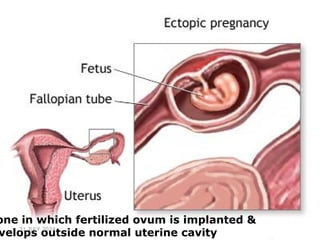
Ectopic pregnancy is any pregnancy where the
fertilised ovum gets implanted & develops in a site
other than normal uterine cavity.
Ectopic pregnancy is a more appropriate term than
extrauterine pregnancy because pregnancy may be
located in the uterus and yet be ectopic.
31 JULY 2024
4
 Ectopic pregnancy is a common gynaecological
emergency in Sub- Saharan Africa and has become a
public health problem of epidemic proportion.
 It still continue to exert it toll on human reproduction
contributing to increasing morbidity and mortality
 It represents a serious hazard to a woman’s health and
reproductive potential, requiring prompt recognition and
early aggressive intervention.
31 JULY 2024
5
one in which fertilized ovum is implanted &
velops outside normal uterine cavity
31 JULY 2024
6
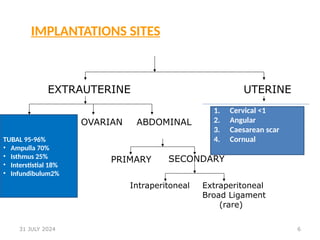
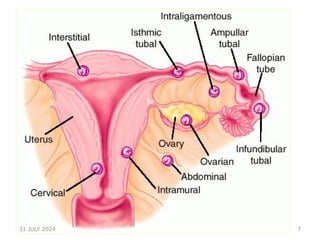
IMPLANTATIONS SITES
EXTRAUTERINE UTERINE
OVARIAN ABDOMINAL
PRIMARY SECONDARY
Intraperitoneal Extraperitoneal
Broad Ligament
(rare)
1. Cervical <1
2. Angular
3. Caesarean scar
4. Cornual
TUBAL 95-96%
• Ampulla 70%
• Isthmus 25%
• Interstistial 18%
• Infundibulum2%
31 JULY 2024
7
31 JULY 2024
8
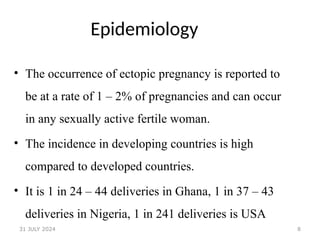
Epidemiology
• The occurrence of ectopic pregnancy is reported to
be at a rate of 1 – 2% of pregnancies and can occur
in any sexually active fertile woman.
• The incidence in developing countries is high
compared to developed countries.
• It is 1 in 24 – 44 deliveries in Ghana, 1 in 37 – 43
deliveries in Nigeria, 1 in 241 deliveries is USA
31 JULY 2024
9
• The increased in incidence in the past few decades is thought to be due
to:
(i) Rise in the incidence of STIs and salpingitis.
(ii) Rise in the incidence of pregnancy following ART procedures.
(iii) IUCD use
(iv) Increased tubal surgery (either sterilization or tuboplasty procedure).
(v) Early detection of cases that were otherwise destined to undergo
spontaneous absorption.
31 JULY 2024
10
• While there has been about fourfold increase in
incidence over the couple of decades, but the mortality
has been slashed down by 80%:
 Recognition of high-risk cases
 Early diagnosis (even before rupture) with the use of
TVS, serum b-hCG and laparoscopy have significantly
improved the management of ectopic pregnancy.
31 JULY 2024
11
ETIOLOGY:
• Any factor that causes delayed transport of the fertilised
ovum through the tube.
• Fallopian tube favours implantation in the tubal mucosa
itself thus giving rise to a tubal ectopic pregnancy.
• These factors may be Congenital or Acquired.
31 JULY 2024
12
ETIOLOGY
CONGENITAL
– Tubal Hypoplasia
– Tortuosity
– Congenital diverticuli
– Accessory ostia
– Partial stenosis
– Elongation
– Intramural polyp Entrap the ovum on its way.
31 JULY 2024
13
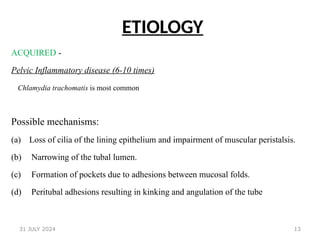
ETIOLOGY
ACQUIRED -
Pelvic Inflammatory disease (6-10 times)
Chlamydia trachomatis is most common
Possible mechanisms:
(a) Loss of cilia of the lining epithelium and impairment of muscular peristalsis.
(b) Narrowing of the tubal lumen.
(c) Formation of pockets due to adhesions between mucosal folds.
(d) Peritubal adhesions resulting in kinking and angulation of the tube
31 JULY 2024
14
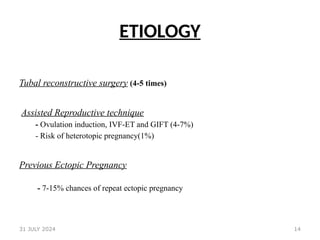
ETIOLOGY
Tubal reconstructive surgery (4-5 times)
Assisted Reproductive technique
- Ovulation induction, IVF-ET and GIFT (4-7%)
- Risk of heterotopic pregnancy(1%)
Previous Ectopic Pregnancy
- 7-15% chances of repeat ectopic pregnancy
31 JULY 2024
15
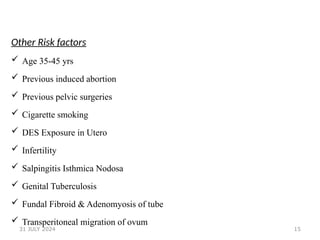
Other Risk factors
 Age 35-45 yrs
 Previous induced abortion
 Previous pelvic surgeries
 Cigarette smoking
 DES Exposure in Utero
 Infertility
 Salpingitis Isthmica Nodosa
 Genital Tuberculosis
 Fundal Fibroid & Adenomyosis of tube
 Transperitoneal migration of ovum
31 JULY 2024
16
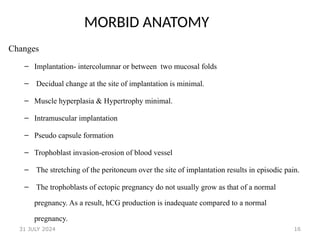
MORBID ANATOMY
Changes
– Implantation- intercolumnar or between two mucosal folds
– Decidual change at the site of implantation is minimal.
– Muscle hyperplasia & Hypertrophy minimal.
– Intramuscular implantation
– Pseudo capsule formation
– Trophoblast invasion-erosion of blood vessel
– The stretching of the peritoneum over the site of implantation results in episodic pain.
– The trophoblasts of ectopic pregnancy do not usually grow as that of a normal
pregnancy. As a result, hCG production is inadequate compared to a normal
pregnancy.
31 JULY 2024
17
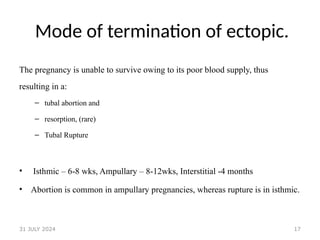
Mode of termination of ectopic.
The pregnancy is unable to survive owing to its poor blood supply, thus
resulting in a:
– tubal abortion and
– resorption, (rare)
– Tubal Rupture
• Isthmic – 6-8 wks, Ampullary – 8-12wks, Interstitial -4 months
• Abortion is common in ampullary pregnancies, whereas rupture is in isthmic.
31 JULY 2024
18
Arias – Stella Reaction
This is characterized by a typical adenomatous change of the endometrial glands.
Intraluminal budding together with typical cell changes:
– Loss of polarity
– Pleomorphism
– Hyperchromatic nuclei
– Vacuolated cytoplasm
– Intraluminal budding
This is strikingly due to progesterone influence. It is present in about 10– 15% cases of
ectopic pregnancy
Though seen in Ectopic Pregnancy but is not specific for it and can also be seen in
uterine pregnancy
31 JULY 2024
19
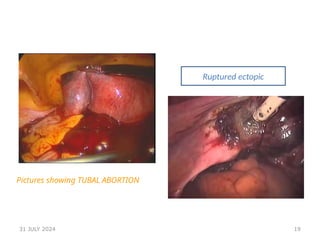
Pictures showing TUBAL ABORTION
Ruptured ectopic
31 JULY 2024
20
CLINICAL APPROACH
• Diagnosis can be done by history, detail examination and
judicious use of investigation.
• H/o past PID, tubal surgery, current contraceptive measures
should be asked
• Wide spectrum of clinical presentation from asymptomatic
patient to others with acute abdomen and in shock.
• Clinically three distinct types are described:
Acute, unruptured, and subacute (chronic or old)
31 JULY 2024
21
ACUTE ECTOPIC PREGNANCY
It is associated with cases of tubal rupture or tubal abortion with massive
intraperitoneal hemorrhage.
• Classical triad is present in 50% of pt with
rupture ectopic.
- PAIN:- most constant feature in 95% pt
- variable in severity and nature
- AMENORRHOEA:- 60-80% of pt
- there may be delayed period or slight
spotting at the time of expected menses.
- VAGINAL BLEEDING: - scanty dark brown
• Feeling of nausea,vomiting,fainting attack, syncope attack(10%) due to reflex vasomotor
disturbance.
• Abdominal pain most common feature. Shoulder tip pain.
31 JULY 2024
22
• O/E:- patient is restless in agony, looks blanched, pale, sweating with
cold clammy skin. Features of shock, tachycardia, hypotension.
• P/A:- abdomen tense, tender mostly in lower abdomen, shifting
dullness, rigidity may be present.
• P/S:- minimal bleeding may be present
• P/V:- uterus may be bulky, deviated to opposite side, fornix is tender,
excitation pain on movement of cervix. POD may be full, uterus
floats as if in water.
31 JULY 2024
23
CHRONIC ECTOPIC PREGNANCY
Symptoms
• It can be diagnosed by high clinical suspicion
• Patient had previous attack of acute pain from which she has
recovered.
• She may have amenorrhea, vaginal bleeding with dull pain
in abdomen and with bladder and bowel complaints like
dysuria, frequency or retention of urine, rectal tenesmus.
31 JULY 2024
24
• O/E:- patient look ill, varying degree of pallor,
slightly raised temperature. Features of shock
are absent.
• P/A:- Tenderness and muscle guard on the lower
abdomen.
A mass may be felt, irregular and tender.
• P/V:- Vaginal mucosa pale, uterus may be normal
in size or bulky, ill defined boggy tender
mass may be felt in one of the fornix.
31 JULY 2024
25
UNRUPTURED ECTOPIC
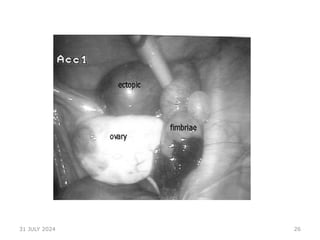
• High degree of suspicion & ectopic conscious clinician can diagnose.
• Diagnosed accidentally in Laparoscopy or Laparotomy
C/F – delayed period, spotting with discomfort in
lower abdomen.
P/A – tenderness in lower abdomen
P/V
– should be done gently
– uterus is normal size, firm
– small tender mass may be felt in the fornix
Investigations- TVS, radioimmunoassay of β-HCG and Laparoscopy
31 JULY 2024
26
31 JULY 2024
27
DIAGNOSIS
• In recent years, in spite of an increase in the incidence of ectopic pregnancy there
has been a fall in the case fatality rate.
• This is due to the widespread introduction of diagnostic tests and an increased
awareness of the serious nature of this disease.
• This has resulted in early diagnosis and effective treatment.
• Now the rate of tubal rupture is as low as 20%.
31 JULY 2024
28
DIAGNOSIS
• Patient with acute ectopic can be diagnosed clinically.
• Blood should be drawn for Hb%, CBC, blood grouping and cross matching, Serology and Coagulation
profile.
• Should be catheterized to know urine output.
Bed side test:-
1. Urine pregnancy test:- positive in 95% cases.
ELISA is sensitive to 10-50 mlU/ml of β hCG and can be detected on 24th
day after LMP.
2. Culdocentesis:- (70-90%)
• Can be done with 16-18 G lumbar puncture needle through posterior fornix into POD.
• Positive tap is 0.5ml of non clotting blood.
31 JULY 2024
29
DIAGNOSIS
Imaging:-
1. Ultra Sonography-
a) Transvaginal Sonography (TVS):
– Is more sensitive
– It detect intrauterine gestational sac at 4-5wks and at S-β hCG level as low as
1500 IU/L .
The diagnostic features are:
(1) Absence of intrauterine pregnancy with a positive pregnancy test.
(2) Fluid (echogenic) in the pouch of Douglas.
(3) Adnexal mass clearly separated from the ovary.
(4) Rarely cardiac motion may be seen in an unruptured tubal ectopic pregnancy.
31 JULY 2024
30
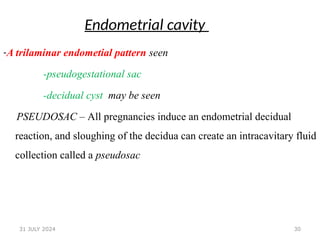
Endometrial cavity
-A trilaminar endometial pattern seen
-pseudogestational sac
-decidual cyst may be seen
PSEUDOSAC – All pregnancies induce an endometrial decidual
reaction, and sloughing of the decidua can create an intracavitary fluid
collection called a pseudosac
31 JULY 2024
31
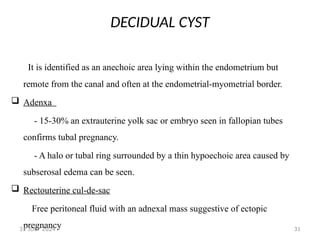
DECIDUAL CYST
It is identified as an anechoic area lying within the endometrium but
remote from the canal and often at the endometrial-myometrial border.
 Adenxa
- 15-30% an extrauterine yolk sac or embryo seen in fallopian tubes
confirms tubal pregnancy.
- A halo or tubal ring surrounded by a thin hypoechoic area caused by
subserosal edema can be seen.
 Rectouterine cul-de-sac
Free peritoneal fluid with an adnexal mass suggestive of ectopic
pregnancy
31 JULY 2024
32
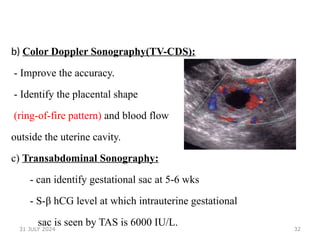
b) Color Doppler Sonography(TV-CDS):
- Improve the accuracy.
- Identify the placental shape
(ring-of-fire pattern) and blood flow
outside the uterine cavity.
c) Transabdominal Sonography:
- can identify gestational sac at 5-6 wks
- S-β hCG level at which intrauterine gestational
sac is seen by TAS is 6000 IU/L.
31 JULY 2024
33
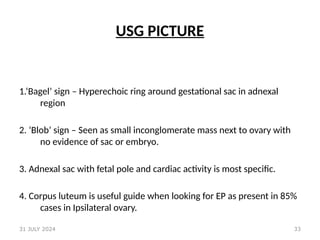
USG PICTURE
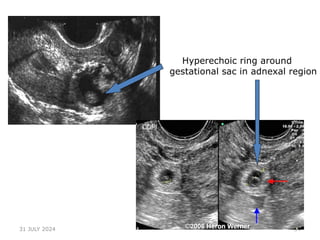
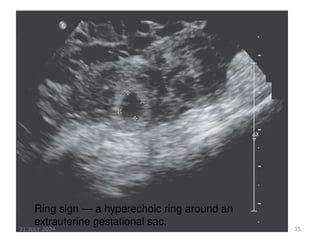
1.‘Bagel’ sign – Hyperechoic ring around gestational sac in adnexal
region
2. ‘Blob’ sign – Seen as small inconglomerate mass next to ovary with
no evidence of sac or embryo.
3. Adnexal sac with fetal pole and cardiac activity is most specific.
4. Corpus luteum is useful guide when looking for EP as present in 85%
cases in Ipsilateral ovary.
31 JULY 2024
34
Hyperechoic ring around
gestational sac in adnexal region
31 JULY 2024
35
Ring sign — a hyperechoic ring around an
extrauterine gestational sac.
31 JULY 2024
36
2. β-HCG Assay-
a) Single β-HCG: little value
b) Serial β-HCG: is required when result of
initial USG is confusing.
- When hCG level < 2000 IU/L doubling time
help to predict viable Vs nonviable pregnancy.
-Rise of β-HCG <66% in 48 hrs indicate
ectopic pregnancy or nonviable intrauterine
pregnancy .
Biochemical pregnancy is applied to those
women who have two β-HCG values >10 IU/L
31 JULY 2024
37
Discriminatory zone
 The lowest level of serum b-hCG at which a gestational sac is
consistently visible using TVS (discriminatory zone) is 1,500
IU/L.
 The corresponding value of serum b-hCG for TAS is 6,000
IU/L.
a. When the b-hCG value is greater than 1,500 IU/L and there is
an empty uterine cavity, ectopic pregnancy is more likely.
b. Failure to double the value of b-hCG by 48 hours along with
an empty uterus is very much suggestive.
31 JULY 2024
38
3. Serum Progesterone –
– level >25 ngm/ml is suggestive of normal intrauterine pregnancy.
– level <15 ngm/ml is suggestive of ectopic pregnancy.
– level <5 ngm/ml indicates nonviable pregnancy, irrespective of its
location.
4. Diagnostic Laparoscopy (Gold standard)–
Can be done only when patient is haemodynamically stable.
-It confirms the diagnosis and removal of
ectopic mass can be done at the same time.
31 JULY 2024
39
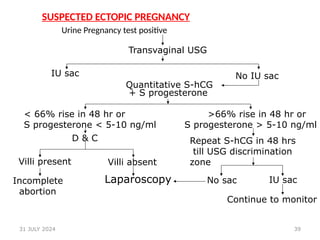
SUSPECTED ECTOPIC PREGNANCY
Urine Pregnancy test positive
Transvaginal USG
IU sac No IU sac
Quantitative S-hCG
+ S progesterone
< 66% rise in 48 hr or
S progesterone < 5-10 ng/ml
D & C
Villi present Villi absent
Incomplete
abortion
Laparoscopy
>66% rise in 48 hr or
S progesterone > 5-10 ng/ml
Repeat S-hCG in 48 hrs
till USG discrimination
zone
No sac IU sac
Continue to monitor
31 JULY 2024
40
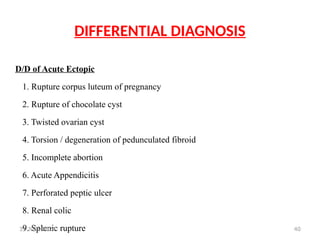
DIFFERENTIAL DIAGNOSIS
D/D of Acute Ectopic
1. Rupture corpus luteum of pregnancy
2. Rupture of chocolate cyst
3. Twisted ovarian cyst
4. Torsion / degeneration of pedunculated fibroid
5. Incomplete abortion
6. Acute Appendicitis
7. Perforated peptic ulcer
8. Renal colic
9. Splenic rupture
31 JULY 2024
41
D/D OF CHRONIC (SUB ACUTE) ECTOPIC
1. Pelvic abscess
2. Pyosalpinx
3. Subserous uterine fibroid
4. Salpingintis
5. Retroverted gravid uterus
6. Appendicular lump
31 JULY 2024
42
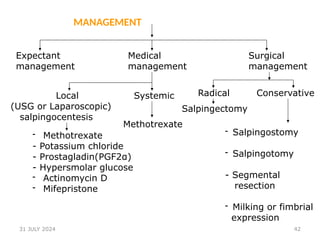
MANAGEMENT
Expectant
management
Medical
management
Surgical
management
Local Systemic
(USG or Laparoscopic)
salpingocentesis
- Methotrexate
- Potassium chloride
- Prostagladin(PGF2α)
- Hypersmolar glucose
- Actinomycin D
- Mifepristone
Methotrexate
Radical
Salpingectomy
Conservative
- Salpingostomy
- Salpingotomy
- Segmental
resection
- Milking or fimbrial
expression
31 JULY 2024
43
MANAGEMENT OF ECTOPIC-
PRINCIPLE: Resuscitation and Laparotomy/Laparoscopy
ANTI SHOCK TREATEMENT:
- IV line made patent, crystalloid is started
- Blood sample for Hb, blood grouping & cross matching, BT, CT
- Folley’s catheterization done
- Colloids for volume replacement
LAPAROTOMY:
Principle is ‘Quick in and Quick out’
- Rapid exploration of abdominal cavity is done
- Salpingectomy is the definitive surgery (sent for HP study)
- Blood transfusion to be given
- Autotransfusion only when donated blood not available.
31 JULY 2024
44
MANAGEMENT OF ECTOPIC PREGNANCY-
Laparoscopy
 Preferred method if haemodynamically stable
 Tubal Patency no significant difference
 Followed by similar number of uterine pregnancy
 Shorter operative time
Salpingostomy
 Less than 2cm size
 10-15mm incision
31 JULY 2024
45
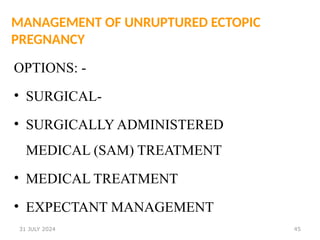
MANAGEMENT OF UNRUPTURED ECTOPIC
PREGNANCY
OPTIONS: -
• SURGICAL-
• SURGICALLY ADMINISTERED
MEDICAL (SAM) TREATMENT
• MEDICAL TREATMENT
• EXPECTANT MANAGEMENT
31 JULY 2024
46
EXPECTANT MANAGEMENT
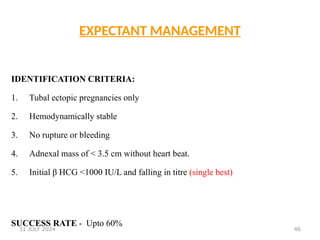
IDENTIFICATION CRITERIA:
1. Tubal ectopic pregnancies only
2. Hemodynamically stable
3. No rupture or bleeding
4. Adnexal mass of < 3.5 cm without heart beat.
5. Initial β HCG <1000 IU/L and falling in titre (single best)
SUCCESS RATE - Upto 60%
31 JULY 2024
47
EXPECTANT MANAGEMENT
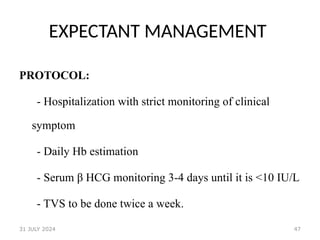
PROTOCOL:
- Hospitalization with strict monitoring of clinical
symptom
- Daily Hb estimation
- Serum β HCG monitoring 3-4 days until it is <10 IU/L
- TVS to be done twice a week.
31 JULY 2024
48
EXPECTANT MANAGEMENT
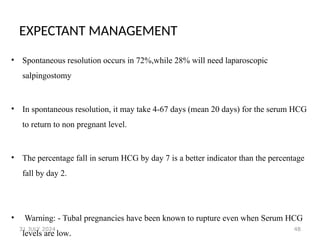
• Spontaneous resolution occurs in 72%,while 28% will need laparoscopic
salpingostomy
• In spontaneous resolution, it may take 4-67 days (mean 20 days) for the serum HCG
to return to non pregnant level.
• The percentage fall in serum HCG by day 7 is a better indicator than the percentage
fall by day 2.
• Warning: - Tubal pregnancies have been known to rupture even when Serum HCG
levels are low.
31 JULY 2024
49
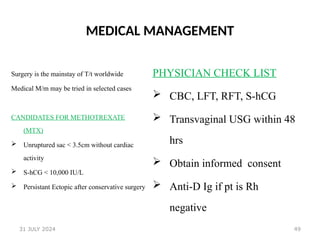
MEDICAL MANAGEMENT
Surgery is the mainstay of T/t worldwide
Medical M/m may be tried in selected cases
CANDIDATES FOR METHOTREXATE
(MTX)
 Unruptured sac < 3.5cm without cardiac
activity
 S-hCG < 10,000 IU/L
 Persistant Ectopic after conservative surgery
PHYSICIAN CHECK LIST
 CBC, LFT, RFT, S-hCG
 Transvaginal USG within 48
hrs
 Obtain informed consent
 Anti-D Ig if pt is Rh
negative
31 JULY 2024
50
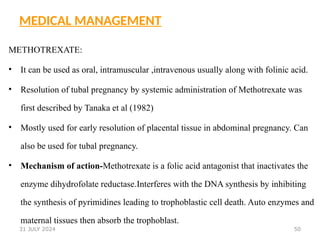
MEDICAL MANAGEMENT
METHOTREXATE:
• It can be used as oral, intramuscular ,intravenous usually along with folinic acid.
• Resolution of tubal pregnancy by systemic administration of Methotrexate was
first described by Tanaka et al (1982)
• Mostly used for early resolution of placental tissue in abdominal pregnancy. Can
also be used for tubal pregnancy.
• Mechanism of action-Methotrexate is a folic acid antagonist that inactivates the
enzyme dihydrofolate reductase.Interferes with the DNA synthesis by inhibiting
the synthesis of pyrimidines leading to trophoblastic cell death. Auto enzymes and
maternal tissues then absorb the trophoblast.
31 JULY 2024
51
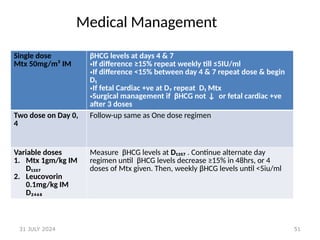
Medical Management
Single dose
Mtx 50mg/m² IM
βHCG levels at days 4 & 7
•If difference ≥15% repeat weekly till ≤5IU/ml
•If difference ˂15% between day 4 & 7 repeat dose & begin
D₁
•If fetal Cardiac +ve at D₇ repeat D₁ Mtx
•Surgical management if βHCG not ↓ or fetal cardiac +ve
after 3 doses
Two dose on Day 0,
4
Follow-up same as One dose regimen
Variable doses
1. Mtx 1gm/kg IM
D₁₃₅₇
2. Leucovorin
0.1mg/kg IM
D₂₄₆₈
Measure βHCG levels at D₁₃₅₇ . Continue alternate day
regimen until βHCG levels decrease ≥15% in 48hrs, or 4
doses of Mtx given. Then, weekly βHCG levels until <5iu/ml
31 JULY 2024
52
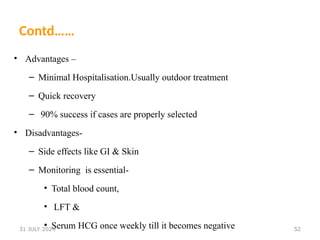
Contd……
• Advantages –
– Minimal Hospitalisation.Usually outdoor treatment
– Quick recovery
– 90% success if cases are properly selected
• Disadvantages-
– Side effects like GI & Skin
– Monitoring is essential-
• Total blood count,
• LFT &
• Serum HCG once weekly till it becomes negative
31 JULY 2024
53
SURGICALLY ADMINISTERED MEDICAL Tt (SAM)
• Aim- trophoblastic destruction without systemic side effects
• Technique- Injection of trophotoxic substance into the ectopic
pregnancy sac or into the affected tube by-
– Laparoscopy or
– Ultrasonographically guided
• Transabdominal (Porreco, 1992)
• Transvaginal (Feichtingar, 1987)
– With Falloposcopic control (Kiss, 1993)
31 JULY 2024
54
Trophotoxic substances used-
Methtrexate (Pansky, 1989)
Potassium Chloride (Robertson, 1987)
Mifiprostone (RU 486)
PGF2 (Limblom, 1987)
Hyper osmolar glucose solution
Actinomycin D
SURGICALLY ADMINISTERED MEDICAL Tt (SAM)
31 JULY 2024
55
Advantage of local MTX :
- Increase tissue concentration at local site
- Decrease systemic side effects
- Decrease hospitalization
- Greater preservation of fertility
Follow up: - Serum β HCG twice weekly till < 5 IU/L
- TVS weekly for 4-6 weeks
- HCG after 6 months for tubal patency
31 JULY 2024
56
INSTRUCTION TO THE PATIENTS
 If T/t on outpatient basis rapid transportation should be available
 Refrain from alcohol, sunlight, multivitamins with folic acid, and
sexual intercourse until S-hCG is negative.
 Report immediately when vaginal bleeding, abdominal pain, dizziness,
syncope (mild pain is common called separation pain or resolution
pain)
 Failure of medical therapy require retreatment
 Chance of tubal rupture in 5-10 % require emergency Laparotomy
31 JULY 2024
57
SURGICAL MANAGEMENT OF ECTOPIC
Conservative Surgery
Can be done Laparoscopically or by microsurgical laparotomy
INDICATION:
- Patient desires future fertility
- Contralateral tube is damaged or surgically removed
previously
CHOICE OF TECHNIQUE: depends on
- Location and size of gestational sac
- Condition of tubes
- Accessibility
31 JULY 2024
58
VARIOUS CONSERVATIVE SURGERIES
1.Linear Salpingostomy:
- Indicated in unruptured ectopic <2cm in ampullary region.
- Linear incision given on antimesentric border over the site
and product removed by fingers, scalpel handle or gentle
suction and irrigation.
- Incision line kept open (heals by secondary intention)
2. Linear Salpingotomy :
- Incision line is closed in two layers with 7-0 interrupted
vicryl sutures.
3. Segmental Resection & Anastomosis:
- Indicated in unruptured isthmic pregnancy
- End to end anastomosis is done immediately or at later
date
31 JULY 2024
59
4. Milking or fimbrial Expression:
- This is ideal in distal ampullary or infundibular pregnancy.
- It has got increased risk of persistent ectopic pregnancy.
ADVANTAGES OF LAPAROSCOPY
- It helps in diagnosis, evaluation, and treatment .
- Diagnose other causes of infertility.
- Decreased hospitalization, operative time, recovery period,
analgesic requirement.
Follow up after conservative surgery
-With weekly Serum β HCG titre till it is negative.
- If titre increases methotrexate can be given.
31 JULY 2024
60
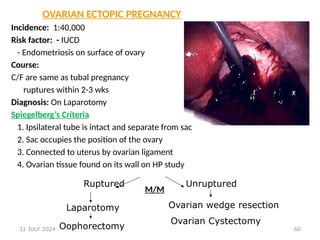
OVARIAN ECTOPIC PREGNANCY
Incidence: 1:40,000
Risk factor: - IUCD
- Endometriosis on surface of ovary
Course:
C/F are same as tubal pregnancy
ruptures within 2-3 wks
Diagnosis: On Laparotomy
Spiegelberg’s Criteria
1. Ipsilateral tube is intact and separate from sac
2. Sac occupies the position of the ovary
3. Connected to uterus by ovarian ligament
4. Ovarian tissue found on its wall on HP study
M/M
Ruptured
Laparotomy
Oophorectomy
Unruptured
Ovarian wedge resection
Ovarian Cystectomy
31 JULY 2024
61
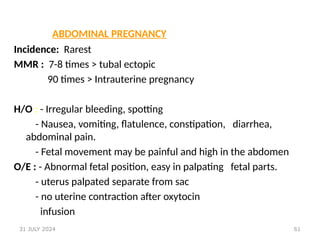
ABDOMINAL PREGNANCY
Incidence: Rarest
MMR : 7-8 times > tubal ectopic
90 times > Intrauterine pregnancy
H/O : - Irregular bleeding, spotting
- Nausea, vomiting, flatulence, constipation, diarrhea,
abdominal pain.
- Fetal movement may be painful and high in the abdomen
O/E : - Abnormal fetal position, easy in palpating fetal parts.
- uterus palpated separate from sac
- no uterine contraction after oxytocin
infusion
31 JULY 2024
62
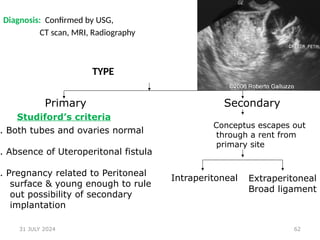
Diagnosis: Confirmed by USG,
CT scan, MRI, Radiography
TYPE
Primary Secondary
Studiford’s criteria
. Both tubes and ovaries normal
. Absence of Uteroperitonal fistula
. Pregnancy related to Peritoneal
surface & young enough to rule
out possibility of secondary
implantation
Conceptus escapes out
through a rent from
primary site
Intraperitoneal Extraperitoneal
Broad ligament
31 JULY 2024
63
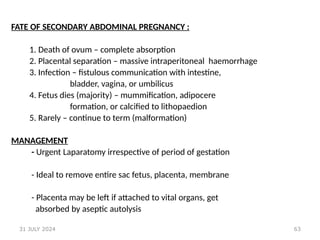
FATE OF SECONDARY ABDOMINAL PREGNANCY :
1. Death of ovum – complete absorption
2. Placental separation – massive intraperitoneal haemorrhage
3. Infection – fistulous communication with intestine,
bladder, vagina, or umbilicus
4. Fetus dies (majority) – mummification, adipocere
formation, or calcified to lithopaedion
5. Rarely – continue to term (malformation)
MANAGEMENT
- Urgent Laparatomy irrespective of period of gestation
- Ideal to remove entire sac fetus, placenta, membrane
- Placenta may be left if attached to vital organs, get
absorbed by aseptic autolysis
31 JULY 2024
64
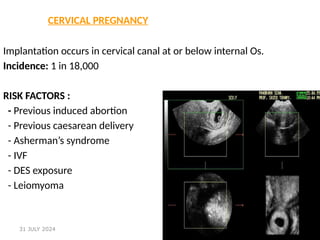
CERVICAL PREGNANCY
Implantation occurs in cervical canal at or below internal Os.
Incidence: 1 in 18,000
RISK FACTORS :
- Previous induced abortion
- Previous caesarean delivery
- Asherman’s syndrome
- IVF
- DES exposure
- Leiomyoma
31 JULY 2024
65
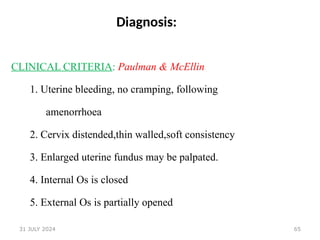
Diagnosis:
CLINICAL CRITERIA: Paulman & McEllin
1. Uterine bleeding, no cramping, following
amenorrhoea
2. Cervix distended,thin walled,soft consistency
3. Enlarged uterine fundus may be palpated.
4. Internal Os is closed
5. External Os is partially opened
31 JULY 2024
66
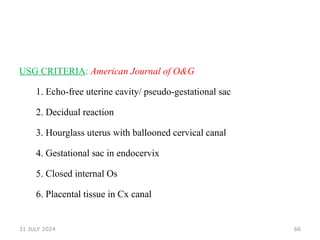
USG CRITERIA: American Journal of O&G
1. Echo-free uterine cavity/ pseudo-gestational sac
2. Decidual reaction
3. Hourglass uterus with ballooned cervical canal
4. Gestational sac in endocervix
5. Closed internal Os
6. Placental tissue in Cx canal
31 JULY 2024
67
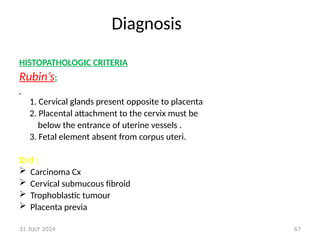
Diagnosis
HISTOPATHOLOGIC CRITERIA
Rubin’s:
1. Cervical glands present opposite to placenta
2. Placental attachment to the cervix must be
below the entrance of uterine vessels .
3. Fetal element absent from corpus uteri.
D/d :
 Carcinoma Cx
 Cervical submucous fibroid
 Trophoblastic tumour
 Placenta previa
31 JULY 2024
68
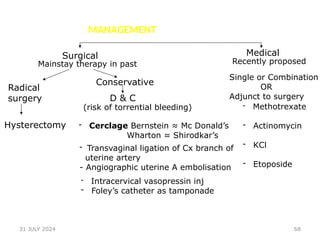
MANAGEMENT
Surgical
Mainstay therapy in past
Radical
surgery
Hysterectomy
Conservative
D & C
(risk of torrential bleeding)
- Cerclage Bernstein ≈ Mc Donald’s
Wharton ≈ Shirodkar’s
- Transvaginal ligation of Cx branch of
uterine artery
- Angiographic uterine A embolisation
- Intracervical vasopressin inj
- Foley’s catheter as tamponade
Medical
Recently proposed
Single or Combination
OR
Adjunct to surgery
- Methotrexate
- Actinomycin
- KCl
- Etoposide
31 JULY 2024
69
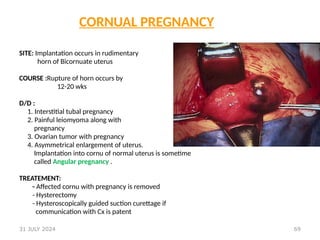
CORNUAL PREGNANCY
SITE: Implantation occurs in rudimentary
horn of Bicornuate uterus
COURSE :Rupture of horn occurs by
12-20 wks
D/D :
1. Interstitial tubal pregnancy
2. Painful leiomyoma along with
pregnancy
3. Ovarian tumor with pregnancy
4. Asymmetrical enlargement of uterus.
Implantation into cornu of normal uterus is sometime
called Angular pregnancy .
TREATEMENT:
- Affected cornu with pregnancy is removed
- Hysterectomy
- Hysteroscopically guided suction curettage if
communication with Cx is patent
31 JULY 2024
70
HETEROTYPIC PREGNANCY
Co-existing intrauterine and extra uterine pregnancies
Incidence: 1 : 30,000
- With ART – 1:7000
- With ovulation induction – 1:900
More likely:
a) Ass. reproductive technique
b) Rising HCG titre after D & C
c) More than 1 corpus luteum at laparotomy
M/M :
Depends on the site. Ectopic site may be removed
with continuation of IU pregnancy
(Rh Immunoglobulin: dose of 50 μ gm is sufficient to
prevent sensitization.)
31 JULY 2024
71
INTERSTITAL PREGNANCY (2%)
It ruptures late at 3-4 months gestation.
Fatal rupture – severe bleeding as both uterine &
ovarian artery supply.
Early & Unruptured – Local or IM MTX with followup
Cornual resection by Laparotomy may be done.
There is high risk of uterine rupture in
subsequent pregnancy.
Rupture – Hysterectomy is indicated
31 JULY 2024
72
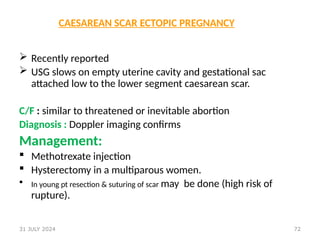
CAESAREAN SCAR ECTOPIC PREGNANCY
 Recently reported
 USG slows on empty uterine cavity and gestational sac
attached low to the lower segment caesarean scar.
C/F : similar to threatened or inevitable abortion
Diagnosis : Doppler imaging confirms
Management:
 Methotrexate injection
 Hysterectomy in a multiparous women.
 In young pt resection & suturing of scar may be done (high risk of
rupture).
31 JULY 2024
73
OTHER RARE TYPES
1. Multiple Ectopic pregnancy
2. Pregnancy after hysterectomy
3. Primary splenic pregnancy
4. Primary hepatic pregnancy
5. Rectroperitoneal pregnancy
6. Diaphragmatic pregnancy
MORTALITY : In general population is 10-15% mainly
due to haemorrhage.
31 JULY 2024
74
SUMMARY - KEY POINTS
 Incidence of ectopic pregnancy is rising while maternal mortality from it is
falling.
 Ectopic pregnancy can be diagnosed early (before it ruptures) with recent
advances in Immunoassay to detect β-hCG , high resolution USG, and
diagnostic Laparoscopy.
 There has been shift in the M/m from ablative surgery to conservative fertility
preserving therapy
 Laparotomy should be done when in doubt
 The choice today is Laparoscopic treatment of un-ruptured ectopic pregnancy.
 Careful monitoring and proper counselling of patients is mandatory.
31 JULY 2024
75
THANK YOU FOR
LISTENING
31 JULY 2024
76
REFERENCES
• TEXTBOOK OF DC DUTTA’S OBSTETRIC
• COMPREHENSIVE GYNAECOLOGY IN THE
TROPICS
• UP TO DATE
31 JULY 2024

ectopic pregnancy LECTURE FOR UNDERGRADUATE

  • 1.
    USLTH PCMH, OBGYNRESIDENTS’ WEEKLY TUTORIALS TOPIC: ECTOPIC PREGNANCY PRESENTER: DR. SAM ISSA BANGURA SUPERVISOR: DR.ROSSETTA COLE CONSULTANT: DR. MICHAEL EZEANOCHIE 1 31 JULY 2024 JULY 31 2024
  • 2.
    2 PRESENTATION OUTLINE • INTRODUCTION •EPIDEMIOLOGY • ETIOLOGY • CLINICAL APPROACH • DIADNOSIS • DIFFERENTIAL DIAGNOSIS • MANAGEMENT • SUMMARY • REFERENCES 31 JULY 2024
  • 3.
    3 Introduction Ectopic pregnancy isany pregnancy where the fertilised ovum gets implanted & develops in a site other than normal uterine cavity. Ectopic pregnancy is a more appropriate term than extrauterine pregnancy because pregnancy may be located in the uterus and yet be ectopic. 31 JULY 2024
  • 4.
    4  Ectopic pregnancyis a common gynaecological emergency in Sub- Saharan Africa and has become a public health problem of epidemic proportion.  It still continue to exert it toll on human reproduction contributing to increasing morbidity and mortality  It represents a serious hazard to a woman’s health and reproductive potential, requiring prompt recognition and early aggressive intervention. 31 JULY 2024
  • 5.
    5 one in whichfertilized ovum is implanted & velops outside normal uterine cavity 31 JULY 2024
  • 6.
    6 IMPLANTATIONS SITES EXTRAUTERINE UTERINE OVARIANABDOMINAL PRIMARY SECONDARY Intraperitoneal Extraperitoneal Broad Ligament (rare) 1. Cervical <1 2. Angular 3. Caesarean scar 4. Cornual TUBAL 95-96% • Ampulla 70% • Isthmus 25% • Interstistial 18% • Infundibulum2% 31 JULY 2024
  • 7.
  • 8.
    8 Epidemiology • The occurrenceof ectopic pregnancy is reported to be at a rate of 1 – 2% of pregnancies and can occur in any sexually active fertile woman. • The incidence in developing countries is high compared to developed countries. • It is 1 in 24 – 44 deliveries in Ghana, 1 in 37 – 43 deliveries in Nigeria, 1 in 241 deliveries is USA 31 JULY 2024
  • 9.
    9 • The increasedin incidence in the past few decades is thought to be due to: (i) Rise in the incidence of STIs and salpingitis. (ii) Rise in the incidence of pregnancy following ART procedures. (iii) IUCD use (iv) Increased tubal surgery (either sterilization or tuboplasty procedure). (v) Early detection of cases that were otherwise destined to undergo spontaneous absorption. 31 JULY 2024
  • 10.
    10 • While therehas been about fourfold increase in incidence over the couple of decades, but the mortality has been slashed down by 80%:  Recognition of high-risk cases  Early diagnosis (even before rupture) with the use of TVS, serum b-hCG and laparoscopy have significantly improved the management of ectopic pregnancy. 31 JULY 2024
  • 11.
    11 ETIOLOGY: • Any factorthat causes delayed transport of the fertilised ovum through the tube. • Fallopian tube favours implantation in the tubal mucosa itself thus giving rise to a tubal ectopic pregnancy. • These factors may be Congenital or Acquired. 31 JULY 2024
  • 12.
    12 ETIOLOGY CONGENITAL – Tubal Hypoplasia –Tortuosity – Congenital diverticuli – Accessory ostia – Partial stenosis – Elongation – Intramural polyp Entrap the ovum on its way. 31 JULY 2024
  • 13.
    13 ETIOLOGY ACQUIRED - Pelvic Inflammatorydisease (6-10 times) Chlamydia trachomatis is most common Possible mechanisms: (a) Loss of cilia of the lining epithelium and impairment of muscular peristalsis. (b) Narrowing of the tubal lumen. (c) Formation of pockets due to adhesions between mucosal folds. (d) Peritubal adhesions resulting in kinking and angulation of the tube 31 JULY 2024
  • 14.
    14 ETIOLOGY Tubal reconstructive surgery(4-5 times) Assisted Reproductive technique - Ovulation induction, IVF-ET and GIFT (4-7%) - Risk of heterotopic pregnancy(1%) Previous Ectopic Pregnancy - 7-15% chances of repeat ectopic pregnancy 31 JULY 2024
  • 15.
    15 Other Risk factors Age 35-45 yrs  Previous induced abortion  Previous pelvic surgeries  Cigarette smoking  DES Exposure in Utero  Infertility  Salpingitis Isthmica Nodosa  Genital Tuberculosis  Fundal Fibroid & Adenomyosis of tube  Transperitoneal migration of ovum 31 JULY 2024
  • 16.
    16 MORBID ANATOMY Changes – Implantation-intercolumnar or between two mucosal folds – Decidual change at the site of implantation is minimal. – Muscle hyperplasia & Hypertrophy minimal. – Intramuscular implantation – Pseudo capsule formation – Trophoblast invasion-erosion of blood vessel – The stretching of the peritoneum over the site of implantation results in episodic pain. – The trophoblasts of ectopic pregnancy do not usually grow as that of a normal pregnancy. As a result, hCG production is inadequate compared to a normal pregnancy. 31 JULY 2024
  • 17.
    17 Mode of terminationof ectopic. The pregnancy is unable to survive owing to its poor blood supply, thus resulting in a: – tubal abortion and – resorption, (rare) – Tubal Rupture • Isthmic – 6-8 wks, Ampullary – 8-12wks, Interstitial -4 months • Abortion is common in ampullary pregnancies, whereas rupture is in isthmic. 31 JULY 2024
  • 18.
    18 Arias – StellaReaction This is characterized by a typical adenomatous change of the endometrial glands. Intraluminal budding together with typical cell changes: – Loss of polarity – Pleomorphism – Hyperchromatic nuclei – Vacuolated cytoplasm – Intraluminal budding This is strikingly due to progesterone influence. It is present in about 10– 15% cases of ectopic pregnancy Though seen in Ectopic Pregnancy but is not specific for it and can also be seen in uterine pregnancy 31 JULY 2024
  • 19.
    19 Pictures showing TUBALABORTION Ruptured ectopic 31 JULY 2024
  • 20.
    20 CLINICAL APPROACH • Diagnosiscan be done by history, detail examination and judicious use of investigation. • H/o past PID, tubal surgery, current contraceptive measures should be asked • Wide spectrum of clinical presentation from asymptomatic patient to others with acute abdomen and in shock. • Clinically three distinct types are described: Acute, unruptured, and subacute (chronic or old) 31 JULY 2024
  • 21.
    21 ACUTE ECTOPIC PREGNANCY Itis associated with cases of tubal rupture or tubal abortion with massive intraperitoneal hemorrhage. • Classical triad is present in 50% of pt with rupture ectopic. - PAIN:- most constant feature in 95% pt - variable in severity and nature - AMENORRHOEA:- 60-80% of pt - there may be delayed period or slight spotting at the time of expected menses. - VAGINAL BLEEDING: - scanty dark brown • Feeling of nausea,vomiting,fainting attack, syncope attack(10%) due to reflex vasomotor disturbance. • Abdominal pain most common feature. Shoulder tip pain. 31 JULY 2024
  • 22.
    22 • O/E:- patientis restless in agony, looks blanched, pale, sweating with cold clammy skin. Features of shock, tachycardia, hypotension. • P/A:- abdomen tense, tender mostly in lower abdomen, shifting dullness, rigidity may be present. • P/S:- minimal bleeding may be present • P/V:- uterus may be bulky, deviated to opposite side, fornix is tender, excitation pain on movement of cervix. POD may be full, uterus floats as if in water. 31 JULY 2024
  • 23.
    23 CHRONIC ECTOPIC PREGNANCY Symptoms •It can be diagnosed by high clinical suspicion • Patient had previous attack of acute pain from which she has recovered. • She may have amenorrhea, vaginal bleeding with dull pain in abdomen and with bladder and bowel complaints like dysuria, frequency or retention of urine, rectal tenesmus. 31 JULY 2024
  • 24.
    24 • O/E:- patientlook ill, varying degree of pallor, slightly raised temperature. Features of shock are absent. • P/A:- Tenderness and muscle guard on the lower abdomen. A mass may be felt, irregular and tender. • P/V:- Vaginal mucosa pale, uterus may be normal in size or bulky, ill defined boggy tender mass may be felt in one of the fornix. 31 JULY 2024
  • 25.
    25 UNRUPTURED ECTOPIC • Highdegree of suspicion & ectopic conscious clinician can diagnose. • Diagnosed accidentally in Laparoscopy or Laparotomy C/F – delayed period, spotting with discomfort in lower abdomen. P/A – tenderness in lower abdomen P/V – should be done gently – uterus is normal size, firm – small tender mass may be felt in the fornix Investigations- TVS, radioimmunoassay of β-HCG and Laparoscopy 31 JULY 2024
  • 26.
  • 27.
    27 DIAGNOSIS • In recentyears, in spite of an increase in the incidence of ectopic pregnancy there has been a fall in the case fatality rate. • This is due to the widespread introduction of diagnostic tests and an increased awareness of the serious nature of this disease. • This has resulted in early diagnosis and effective treatment. • Now the rate of tubal rupture is as low as 20%. 31 JULY 2024
  • 28.
    28 DIAGNOSIS • Patient withacute ectopic can be diagnosed clinically. • Blood should be drawn for Hb%, CBC, blood grouping and cross matching, Serology and Coagulation profile. • Should be catheterized to know urine output. Bed side test:- 1. Urine pregnancy test:- positive in 95% cases. ELISA is sensitive to 10-50 mlU/ml of β hCG and can be detected on 24th day after LMP. 2. Culdocentesis:- (70-90%) • Can be done with 16-18 G lumbar puncture needle through posterior fornix into POD. • Positive tap is 0.5ml of non clotting blood. 31 JULY 2024
  • 29.
    29 DIAGNOSIS Imaging:- 1. Ultra Sonography- a)Transvaginal Sonography (TVS): – Is more sensitive – It detect intrauterine gestational sac at 4-5wks and at S-β hCG level as low as 1500 IU/L . The diagnostic features are: (1) Absence of intrauterine pregnancy with a positive pregnancy test. (2) Fluid (echogenic) in the pouch of Douglas. (3) Adnexal mass clearly separated from the ovary. (4) Rarely cardiac motion may be seen in an unruptured tubal ectopic pregnancy. 31 JULY 2024
  • 30.
    30 Endometrial cavity -A trilaminarendometial pattern seen -pseudogestational sac -decidual cyst may be seen PSEUDOSAC – All pregnancies induce an endometrial decidual reaction, and sloughing of the decidua can create an intracavitary fluid collection called a pseudosac 31 JULY 2024
  • 31.
    31 DECIDUAL CYST It isidentified as an anechoic area lying within the endometrium but remote from the canal and often at the endometrial-myometrial border.  Adenxa - 15-30% an extrauterine yolk sac or embryo seen in fallopian tubes confirms tubal pregnancy. - A halo or tubal ring surrounded by a thin hypoechoic area caused by subserosal edema can be seen.  Rectouterine cul-de-sac Free peritoneal fluid with an adnexal mass suggestive of ectopic pregnancy 31 JULY 2024
  • 32.
    32 b) Color DopplerSonography(TV-CDS): - Improve the accuracy. - Identify the placental shape (ring-of-fire pattern) and blood flow outside the uterine cavity. c) Transabdominal Sonography: - can identify gestational sac at 5-6 wks - S-β hCG level at which intrauterine gestational sac is seen by TAS is 6000 IU/L. 31 JULY 2024
  • 33.
    33 USG PICTURE 1.‘Bagel’ sign– Hyperechoic ring around gestational sac in adnexal region 2. ‘Blob’ sign – Seen as small inconglomerate mass next to ovary with no evidence of sac or embryo. 3. Adnexal sac with fetal pole and cardiac activity is most specific. 4. Corpus luteum is useful guide when looking for EP as present in 85% cases in Ipsilateral ovary. 31 JULY 2024
  • 34.
    34 Hyperechoic ring around gestationalsac in adnexal region 31 JULY 2024
  • 35.
    35 Ring sign —a hyperechoic ring around an extrauterine gestational sac. 31 JULY 2024
  • 36.
    36 2. β-HCG Assay- a)Single β-HCG: little value b) Serial β-HCG: is required when result of initial USG is confusing. - When hCG level < 2000 IU/L doubling time help to predict viable Vs nonviable pregnancy. -Rise of β-HCG <66% in 48 hrs indicate ectopic pregnancy or nonviable intrauterine pregnancy . Biochemical pregnancy is applied to those women who have two β-HCG values >10 IU/L 31 JULY 2024
  • 37.
    37 Discriminatory zone  Thelowest level of serum b-hCG at which a gestational sac is consistently visible using TVS (discriminatory zone) is 1,500 IU/L.  The corresponding value of serum b-hCG for TAS is 6,000 IU/L. a. When the b-hCG value is greater than 1,500 IU/L and there is an empty uterine cavity, ectopic pregnancy is more likely. b. Failure to double the value of b-hCG by 48 hours along with an empty uterus is very much suggestive. 31 JULY 2024
  • 38.
    38 3. Serum Progesterone– – level >25 ngm/ml is suggestive of normal intrauterine pregnancy. – level <15 ngm/ml is suggestive of ectopic pregnancy. – level <5 ngm/ml indicates nonviable pregnancy, irrespective of its location. 4. Diagnostic Laparoscopy (Gold standard)– Can be done only when patient is haemodynamically stable. -It confirms the diagnosis and removal of ectopic mass can be done at the same time. 31 JULY 2024
  • 39.
    39 SUSPECTED ECTOPIC PREGNANCY UrinePregnancy test positive Transvaginal USG IU sac No IU sac Quantitative S-hCG + S progesterone < 66% rise in 48 hr or S progesterone < 5-10 ng/ml D & C Villi present Villi absent Incomplete abortion Laparoscopy >66% rise in 48 hr or S progesterone > 5-10 ng/ml Repeat S-hCG in 48 hrs till USG discrimination zone No sac IU sac Continue to monitor 31 JULY 2024
  • 40.
    40 DIFFERENTIAL DIAGNOSIS D/D ofAcute Ectopic 1. Rupture corpus luteum of pregnancy 2. Rupture of chocolate cyst 3. Twisted ovarian cyst 4. Torsion / degeneration of pedunculated fibroid 5. Incomplete abortion 6. Acute Appendicitis 7. Perforated peptic ulcer 8. Renal colic 9. Splenic rupture 31 JULY 2024
  • 41.
    41 D/D OF CHRONIC(SUB ACUTE) ECTOPIC 1. Pelvic abscess 2. Pyosalpinx 3. Subserous uterine fibroid 4. Salpingintis 5. Retroverted gravid uterus 6. Appendicular lump 31 JULY 2024
  • 42.
    42 MANAGEMENT Expectant management Medical management Surgical management Local Systemic (USG orLaparoscopic) salpingocentesis - Methotrexate - Potassium chloride - Prostagladin(PGF2α) - Hypersmolar glucose - Actinomycin D - Mifepristone Methotrexate Radical Salpingectomy Conservative - Salpingostomy - Salpingotomy - Segmental resection - Milking or fimbrial expression 31 JULY 2024
  • 43.
    43 MANAGEMENT OF ECTOPIC- PRINCIPLE:Resuscitation and Laparotomy/Laparoscopy ANTI SHOCK TREATEMENT: - IV line made patent, crystalloid is started - Blood sample for Hb, blood grouping & cross matching, BT, CT - Folley’s catheterization done - Colloids for volume replacement LAPAROTOMY: Principle is ‘Quick in and Quick out’ - Rapid exploration of abdominal cavity is done - Salpingectomy is the definitive surgery (sent for HP study) - Blood transfusion to be given - Autotransfusion only when donated blood not available. 31 JULY 2024
  • 44.
    44 MANAGEMENT OF ECTOPICPREGNANCY- Laparoscopy  Preferred method if haemodynamically stable  Tubal Patency no significant difference  Followed by similar number of uterine pregnancy  Shorter operative time Salpingostomy  Less than 2cm size  10-15mm incision 31 JULY 2024
  • 45.
    45 MANAGEMENT OF UNRUPTUREDECTOPIC PREGNANCY OPTIONS: - • SURGICAL- • SURGICALLY ADMINISTERED MEDICAL (SAM) TREATMENT • MEDICAL TREATMENT • EXPECTANT MANAGEMENT 31 JULY 2024
  • 46.
    46 EXPECTANT MANAGEMENT IDENTIFICATION CRITERIA: 1.Tubal ectopic pregnancies only 2. Hemodynamically stable 3. No rupture or bleeding 4. Adnexal mass of < 3.5 cm without heart beat. 5. Initial β HCG <1000 IU/L and falling in titre (single best) SUCCESS RATE - Upto 60% 31 JULY 2024
  • 47.
    47 EXPECTANT MANAGEMENT PROTOCOL: - Hospitalizationwith strict monitoring of clinical symptom - Daily Hb estimation - Serum β HCG monitoring 3-4 days until it is <10 IU/L - TVS to be done twice a week. 31 JULY 2024
  • 48.
    48 EXPECTANT MANAGEMENT • Spontaneousresolution occurs in 72%,while 28% will need laparoscopic salpingostomy • In spontaneous resolution, it may take 4-67 days (mean 20 days) for the serum HCG to return to non pregnant level. • The percentage fall in serum HCG by day 7 is a better indicator than the percentage fall by day 2. • Warning: - Tubal pregnancies have been known to rupture even when Serum HCG levels are low. 31 JULY 2024
  • 49.
    49 MEDICAL MANAGEMENT Surgery isthe mainstay of T/t worldwide Medical M/m may be tried in selected cases CANDIDATES FOR METHOTREXATE (MTX)  Unruptured sac < 3.5cm without cardiac activity  S-hCG < 10,000 IU/L  Persistant Ectopic after conservative surgery PHYSICIAN CHECK LIST  CBC, LFT, RFT, S-hCG  Transvaginal USG within 48 hrs  Obtain informed consent  Anti-D Ig if pt is Rh negative 31 JULY 2024
  • 50.
    50 MEDICAL MANAGEMENT METHOTREXATE: • Itcan be used as oral, intramuscular ,intravenous usually along with folinic acid. • Resolution of tubal pregnancy by systemic administration of Methotrexate was first described by Tanaka et al (1982) • Mostly used for early resolution of placental tissue in abdominal pregnancy. Can also be used for tubal pregnancy. • Mechanism of action-Methotrexate is a folic acid antagonist that inactivates the enzyme dihydrofolate reductase.Interferes with the DNA synthesis by inhibiting the synthesis of pyrimidines leading to trophoblastic cell death. Auto enzymes and maternal tissues then absorb the trophoblast. 31 JULY 2024
  • 51.
    51 Medical Management Single dose Mtx50mg/m² IM βHCG levels at days 4 & 7 •If difference ≥15% repeat weekly till ≤5IU/ml •If difference ˂15% between day 4 & 7 repeat dose & begin D₁ •If fetal Cardiac +ve at D₇ repeat D₁ Mtx •Surgical management if βHCG not ↓ or fetal cardiac +ve after 3 doses Two dose on Day 0, 4 Follow-up same as One dose regimen Variable doses 1. Mtx 1gm/kg IM D₁₃₅₇ 2. Leucovorin 0.1mg/kg IM D₂₄₆₈ Measure βHCG levels at D₁₃₅₇ . Continue alternate day regimen until βHCG levels decrease ≥15% in 48hrs, or 4 doses of Mtx given. Then, weekly βHCG levels until <5iu/ml 31 JULY 2024
  • 52.
    52 Contd…… • Advantages – –Minimal Hospitalisation.Usually outdoor treatment – Quick recovery – 90% success if cases are properly selected • Disadvantages- – Side effects like GI & Skin – Monitoring is essential- • Total blood count, • LFT & • Serum HCG once weekly till it becomes negative 31 JULY 2024
  • 53.
    53 SURGICALLY ADMINISTERED MEDICALTt (SAM) • Aim- trophoblastic destruction without systemic side effects • Technique- Injection of trophotoxic substance into the ectopic pregnancy sac or into the affected tube by- – Laparoscopy or – Ultrasonographically guided • Transabdominal (Porreco, 1992) • Transvaginal (Feichtingar, 1987) – With Falloposcopic control (Kiss, 1993) 31 JULY 2024
  • 54.
    54 Trophotoxic substances used- Methtrexate(Pansky, 1989) Potassium Chloride (Robertson, 1987) Mifiprostone (RU 486) PGF2 (Limblom, 1987) Hyper osmolar glucose solution Actinomycin D SURGICALLY ADMINISTERED MEDICAL Tt (SAM) 31 JULY 2024
  • 55.
    55 Advantage of localMTX : - Increase tissue concentration at local site - Decrease systemic side effects - Decrease hospitalization - Greater preservation of fertility Follow up: - Serum β HCG twice weekly till < 5 IU/L - TVS weekly for 4-6 weeks - HCG after 6 months for tubal patency 31 JULY 2024
  • 56.
    56 INSTRUCTION TO THEPATIENTS  If T/t on outpatient basis rapid transportation should be available  Refrain from alcohol, sunlight, multivitamins with folic acid, and sexual intercourse until S-hCG is negative.  Report immediately when vaginal bleeding, abdominal pain, dizziness, syncope (mild pain is common called separation pain or resolution pain)  Failure of medical therapy require retreatment  Chance of tubal rupture in 5-10 % require emergency Laparotomy 31 JULY 2024
  • 57.
    57 SURGICAL MANAGEMENT OFECTOPIC Conservative Surgery Can be done Laparoscopically or by microsurgical laparotomy INDICATION: - Patient desires future fertility - Contralateral tube is damaged or surgically removed previously CHOICE OF TECHNIQUE: depends on - Location and size of gestational sac - Condition of tubes - Accessibility 31 JULY 2024
  • 58.
    58 VARIOUS CONSERVATIVE SURGERIES 1.LinearSalpingostomy: - Indicated in unruptured ectopic <2cm in ampullary region. - Linear incision given on antimesentric border over the site and product removed by fingers, scalpel handle or gentle suction and irrigation. - Incision line kept open (heals by secondary intention) 2. Linear Salpingotomy : - Incision line is closed in two layers with 7-0 interrupted vicryl sutures. 3. Segmental Resection & Anastomosis: - Indicated in unruptured isthmic pregnancy - End to end anastomosis is done immediately or at later date 31 JULY 2024
  • 59.
    59 4. Milking orfimbrial Expression: - This is ideal in distal ampullary or infundibular pregnancy. - It has got increased risk of persistent ectopic pregnancy. ADVANTAGES OF LAPAROSCOPY - It helps in diagnosis, evaluation, and treatment . - Diagnose other causes of infertility. - Decreased hospitalization, operative time, recovery period, analgesic requirement. Follow up after conservative surgery -With weekly Serum β HCG titre till it is negative. - If titre increases methotrexate can be given. 31 JULY 2024
  • 60.
    60 OVARIAN ECTOPIC PREGNANCY Incidence:1:40,000 Risk factor: - IUCD - Endometriosis on surface of ovary Course: C/F are same as tubal pregnancy ruptures within 2-3 wks Diagnosis: On Laparotomy Spiegelberg’s Criteria 1. Ipsilateral tube is intact and separate from sac 2. Sac occupies the position of the ovary 3. Connected to uterus by ovarian ligament 4. Ovarian tissue found on its wall on HP study M/M Ruptured Laparotomy Oophorectomy Unruptured Ovarian wedge resection Ovarian Cystectomy 31 JULY 2024
  • 61.
    61 ABDOMINAL PREGNANCY Incidence: Rarest MMR: 7-8 times > tubal ectopic 90 times > Intrauterine pregnancy H/O : - Irregular bleeding, spotting - Nausea, vomiting, flatulence, constipation, diarrhea, abdominal pain. - Fetal movement may be painful and high in the abdomen O/E : - Abnormal fetal position, easy in palpating fetal parts. - uterus palpated separate from sac - no uterine contraction after oxytocin infusion 31 JULY 2024
  • 62.
    62 Diagnosis: Confirmed byUSG, CT scan, MRI, Radiography TYPE Primary Secondary Studiford’s criteria . Both tubes and ovaries normal . Absence of Uteroperitonal fistula . Pregnancy related to Peritoneal surface & young enough to rule out possibility of secondary implantation Conceptus escapes out through a rent from primary site Intraperitoneal Extraperitoneal Broad ligament 31 JULY 2024
  • 63.
    63 FATE OF SECONDARYABDOMINAL PREGNANCY : 1. Death of ovum – complete absorption 2. Placental separation – massive intraperitoneal haemorrhage 3. Infection – fistulous communication with intestine, bladder, vagina, or umbilicus 4. Fetus dies (majority) – mummification, adipocere formation, or calcified to lithopaedion 5. Rarely – continue to term (malformation) MANAGEMENT - Urgent Laparatomy irrespective of period of gestation - Ideal to remove entire sac fetus, placenta, membrane - Placenta may be left if attached to vital organs, get absorbed by aseptic autolysis 31 JULY 2024
  • 64.
    64 CERVICAL PREGNANCY Implantation occursin cervical canal at or below internal Os. Incidence: 1 in 18,000 RISK FACTORS : - Previous induced abortion - Previous caesarean delivery - Asherman’s syndrome - IVF - DES exposure - Leiomyoma 31 JULY 2024
  • 65.
    65 Diagnosis: CLINICAL CRITERIA: Paulman& McEllin 1. Uterine bleeding, no cramping, following amenorrhoea 2. Cervix distended,thin walled,soft consistency 3. Enlarged uterine fundus may be palpated. 4. Internal Os is closed 5. External Os is partially opened 31 JULY 2024
  • 66.
    66 USG CRITERIA: AmericanJournal of O&G 1. Echo-free uterine cavity/ pseudo-gestational sac 2. Decidual reaction 3. Hourglass uterus with ballooned cervical canal 4. Gestational sac in endocervix 5. Closed internal Os 6. Placental tissue in Cx canal 31 JULY 2024
  • 67.
    67 Diagnosis HISTOPATHOLOGIC CRITERIA Rubin’s: 1. Cervicalglands present opposite to placenta 2. Placental attachment to the cervix must be below the entrance of uterine vessels . 3. Fetal element absent from corpus uteri. D/d :  Carcinoma Cx  Cervical submucous fibroid  Trophoblastic tumour  Placenta previa 31 JULY 2024
  • 68.
    68 MANAGEMENT Surgical Mainstay therapy inpast Radical surgery Hysterectomy Conservative D & C (risk of torrential bleeding) - Cerclage Bernstein ≈ Mc Donald’s Wharton ≈ Shirodkar’s - Transvaginal ligation of Cx branch of uterine artery - Angiographic uterine A embolisation - Intracervical vasopressin inj - Foley’s catheter as tamponade Medical Recently proposed Single or Combination OR Adjunct to surgery - Methotrexate - Actinomycin - KCl - Etoposide 31 JULY 2024
  • 69.
    69 CORNUAL PREGNANCY SITE: Implantationoccurs in rudimentary horn of Bicornuate uterus COURSE :Rupture of horn occurs by 12-20 wks D/D : 1. Interstitial tubal pregnancy 2. Painful leiomyoma along with pregnancy 3. Ovarian tumor with pregnancy 4. Asymmetrical enlargement of uterus. Implantation into cornu of normal uterus is sometime called Angular pregnancy . TREATEMENT: - Affected cornu with pregnancy is removed - Hysterectomy - Hysteroscopically guided suction curettage if communication with Cx is patent 31 JULY 2024
  • 70.
    70 HETEROTYPIC PREGNANCY Co-existing intrauterineand extra uterine pregnancies Incidence: 1 : 30,000 - With ART – 1:7000 - With ovulation induction – 1:900 More likely: a) Ass. reproductive technique b) Rising HCG titre after D & C c) More than 1 corpus luteum at laparotomy M/M : Depends on the site. Ectopic site may be removed with continuation of IU pregnancy (Rh Immunoglobulin: dose of 50 μ gm is sufficient to prevent sensitization.) 31 JULY 2024
  • 71.
    71 INTERSTITAL PREGNANCY (2%) Itruptures late at 3-4 months gestation. Fatal rupture – severe bleeding as both uterine & ovarian artery supply. Early & Unruptured – Local or IM MTX with followup Cornual resection by Laparotomy may be done. There is high risk of uterine rupture in subsequent pregnancy. Rupture – Hysterectomy is indicated 31 JULY 2024
  • 72.
    72 CAESAREAN SCAR ECTOPICPREGNANCY  Recently reported  USG slows on empty uterine cavity and gestational sac attached low to the lower segment caesarean scar. C/F : similar to threatened or inevitable abortion Diagnosis : Doppler imaging confirms Management:  Methotrexate injection  Hysterectomy in a multiparous women.  In young pt resection & suturing of scar may be done (high risk of rupture). 31 JULY 2024
  • 73.
    73 OTHER RARE TYPES 1.Multiple Ectopic pregnancy 2. Pregnancy after hysterectomy 3. Primary splenic pregnancy 4. Primary hepatic pregnancy 5. Rectroperitoneal pregnancy 6. Diaphragmatic pregnancy MORTALITY : In general population is 10-15% mainly due to haemorrhage. 31 JULY 2024
  • 74.
    74 SUMMARY - KEYPOINTS  Incidence of ectopic pregnancy is rising while maternal mortality from it is falling.  Ectopic pregnancy can be diagnosed early (before it ruptures) with recent advances in Immunoassay to detect β-hCG , high resolution USG, and diagnostic Laparoscopy.  There has been shift in the M/m from ablative surgery to conservative fertility preserving therapy  Laparotomy should be done when in doubt  The choice today is Laparoscopic treatment of un-ruptured ectopic pregnancy.  Careful monitoring and proper counselling of patients is mandatory. 31 JULY 2024
  • 75.
  • 76.
    76 REFERENCES • TEXTBOOK OFDC DUTTA’S OBSTETRIC • COMPREHENSIVE GYNAECOLOGY IN THE TROPICS • UP TO DATE 31 JULY 2024