BLUETOOTH AND OBSTACLE AVOIDING BASED ROBO CAR
#Abstract:
Arduino car contains Arduino microcontroller with basic mobility features. The Program contains instructions between android controller car and microcontroller (ATmega328). Android mobile Controller uses different mobile sensors to supervise motions. An appropriate program is compiled into Arduino microprocessor by a software known as Arduino (IDE) 1.0 to interact with the android controller. The obstacle avoiding car uses ultrasonic sensors to locate walls using echo Locations. The 4 DC motors are powered by a 3.7V battery and are driven by a motor drive which is instructed by Arduino uno. The car moves forward until it sees a wall less than 35cm (about 1.15 ft) away. If this Condition is met the car backs up and the servo motor rotates 90 degrees to the Left for the sensor to scan how far away the left wall is. The servo motor then Rotates 180 degree to the right to scan the distance of the right wall.in Bluetooth controlled we use an app that has similar buttons or instructions as that of a remote by pressing each of the buttons the car can be controlled. This app contains an accelerometer that can control the speed of the car. Bluetooth after giving instructions to Arduino for various actions through interface via Bluetooth module.
I. INTRODUCTION
Robots are more efficient as they can perform many autonomous functions in many fields. This project is built using ultrasonic sensors for its movement. This performs tasks according to human guidance as specified. The Arduino obstacle avoiding car uses “HC-SR04 ultra sonic sensor module” that is mounted on top of a 9gm servo motor to locate any objects that are present in front of the car. the 4 DC motor are powered by l293d motor drive. the car moves forward until it sees any obstacle that is less than 35cm away. thus, if any obstacle is detected the servo rotates to 90degrees to the left to locate any obstacle by sending ultra-sonic waves. if the obstacle is detected the servo rotates to 180degrees right to scan any obstacle if present. If the distance of the object i.e., obstacle that is in left is greater than right the car turns 90 degrees to the left or vice versa. the ultra-sonic sensor sends sound waves for every 10 microseconds. if any obstruction is present the sensor receives the echo therefore the distance between sensor and object is calculated. therefore, the car creates its own path avoiding all the objects that are appearing in front of it. this project is designed to navigate in unknown conditions where human interaction with the environment can be dangerous.
In Bluetooth controlled car we use “HC-05 BLUETOOTH MODULE”, we already know that Bluetooth is used for wireless communication between two devices. at first, we pair Bluetooth module with android through an app called “BLUETOOTH RC CONTROL.” Now while doing different operation such as when we are pressing any keys it sends the data value to the Bluetooth mo

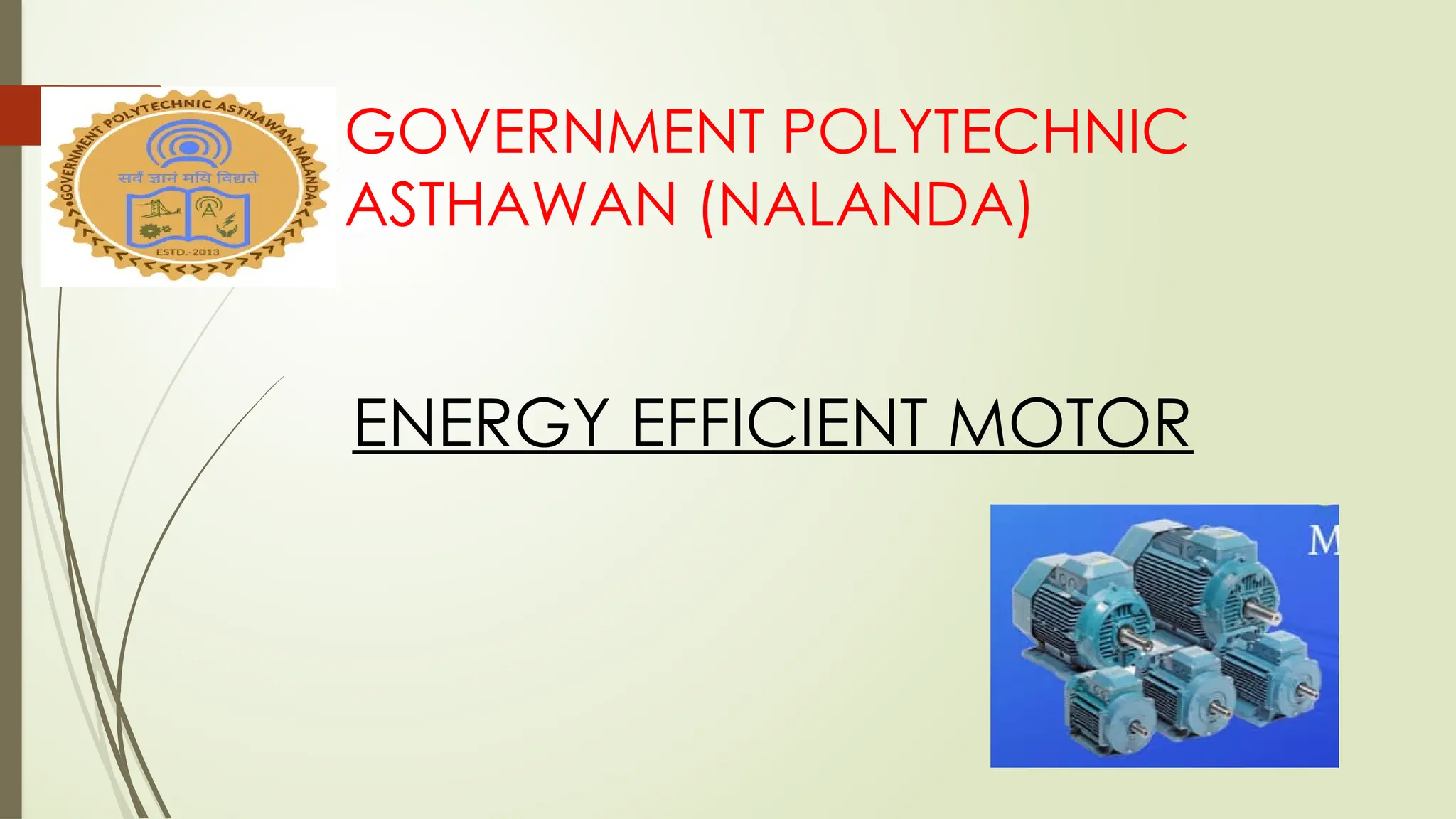
![Energy efficient motors
Enhancing Performance, Reducing Energy
Costs
Presented by: []](https://image.slidesharecdn.com/presentation1sonuoo-250414040240-ee9e01d7/85/Presentation1energy-efficient-motor-sonuoo-pptx-2-320.jpg)





![Organic presentation ENERGY EFFICIENT MOTOR[1][1][1].pptx](https://cdn.slidesharecdn.com/ss_thumbnails/organicpresentationenergyefficientmotor111-260112104953-fd35734a-thumbnail.jpg?width=640&height=640&fit=bounds)


