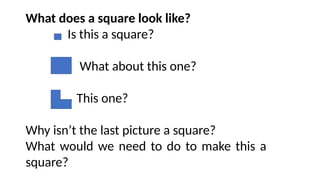
What does a square look like?
Is this a square?
What about this one?
This one?
Why isn’t the last picture a square?
What would we need to do to make this a
square?
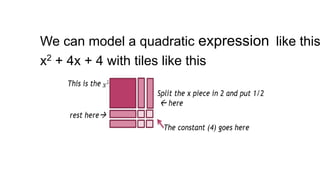
We can model a quadratic expression like this
x2
+ 4x + 4 with tiles like this
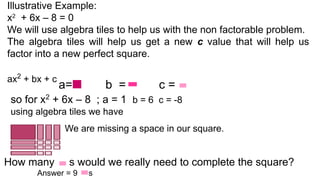
We are missing a space in our square.
Illustrative Example:
x2
+ 6x – 8 = 0
We will use algebra tiles to help us with the non factorable problem.
The algebra tiles will help us get a new c value that will help us
factor into a new perfect square.
ax2
+ bx + c
a= b = c =
so for x2
+ 6x – 8 ; a = 1 b = 6 c = -8
using algebra tiles we have
How many s would we really need to complete the square?
Answer = 9 s
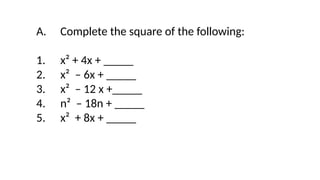
A. Complete the square of the following:
1. x² + 4x + _____
2. x² – 6x + _____
3. x² – 12 x +_____
4. n² – 18n + _____
5. x² + 8x + _____
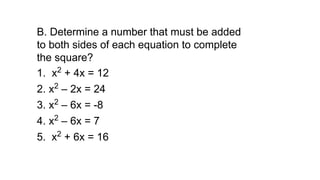
B. Determine a number that must be added
to both sides of each equation to complete
the square?
1. x2
+ 4x = 12
2. x2
– 2x = 24
3. x2
– 6x = -8
4. x2
– 6x = 7
5. x2
+ 6x = 16
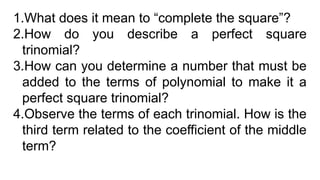
1.What does it mean to “complete the square”?
2.How do you describe a perfect square
trinomial?
3.How can you determine a number that must be
added to the terms of polynomial to make it a
perfect square trinomial?
4.Observe the terms of each trinomial. How is the
third term related to the coefficient of the middle
term?
Presentation1.pptx perfect square trinomial

Presentation1.pptx perfect square trinomial

  • 3.
    What does asquare look like? Is this a square? What about this one? This one? Why isn’t the last picture a square? What would we need to do to make this a square?
  • 4.
    We can modela quadratic expression like this x2 + 4x + 4 with tiles like this
  • 5.
    We are missinga space in our square. Illustrative Example: x2 + 6x – 8 = 0 We will use algebra tiles to help us with the non factorable problem. The algebra tiles will help us get a new c value that will help us factor into a new perfect square. ax2 + bx + c a= b = c = so for x2 + 6x – 8 ; a = 1 b = 6 c = -8 using algebra tiles we have How many s would we really need to complete the square? Answer = 9 s
  • 6.
    A. Complete thesquare of the following: 1. x² + 4x + _____ 2. x² – 6x + _____ 3. x² – 12 x +_____ 4. n² – 18n + _____ 5. x² + 8x + _____
  • 7.
    B. Determine anumber that must be added to both sides of each equation to complete the square? 1. x2 + 4x = 12 2. x2 – 2x = 24 3. x2 – 6x = -8 4. x2 – 6x = 7 5. x2 + 6x = 16
  • 8.
    1.What does itmean to “complete the square”? 2.How do you describe a perfect square trinomial? 3.How can you determine a number that must be added to the terms of polynomial to make it a perfect square trinomial? 4.Observe the terms of each trinomial. How is the third term related to the coefficient of the middle term?