Ranking Factors
Listed All The Factors are not 100 %
Proven
Few are Proven
Few are controversial
&
Others are SEO nerd speculation
Ranking Criteria
Domain Factors
Page-Level Factors
Site-Level Factors
Backlink Factors
User Interaction
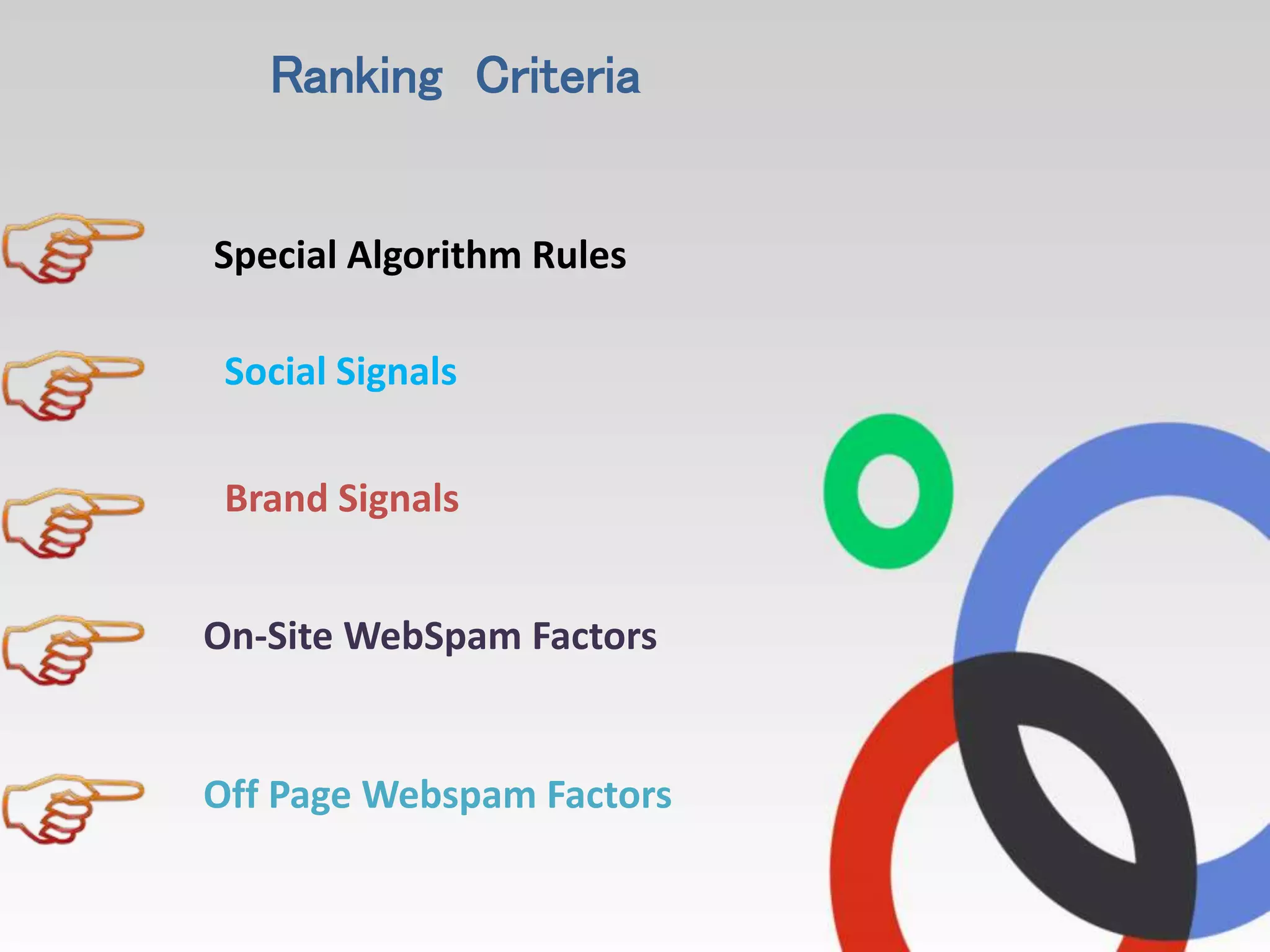
Ranking Criteria
Special Algorithm Rules
Social Signals
Brand Signals
On-Site WebSpam Factors
Off Page Webspam Factors
Domain Factors
#1. Keyword in Top
Level Domain
Domain names are the human-readable Internet addresses of
websites. Top Level domains, which are identified by their domain
names, have extensions such as .com, .org, .net, etc. (Ex.
http://www.example.com)
For best ranking results, avoid uncommon top-level domains (TLDs).
Like hyphens, TLDs such as .info, .cc, .ws, and .name are spam
indicators. - MOZ
Having your keyword in the domain still acts as a relevancy signal.
#2. Keyword in Subdomain
Name
Having the target keyword in the subdomain name,
especially as the first word, adds a boost to your rank.
A subdomain is a "third level" domain name that is
part of a larger, top-level domain.
For example, "blog.example.com" and
"english.example.com" are both subdomains of the
".example.com" root domain. Subdomains are free to
create under any root domain that a webmaster
controls.
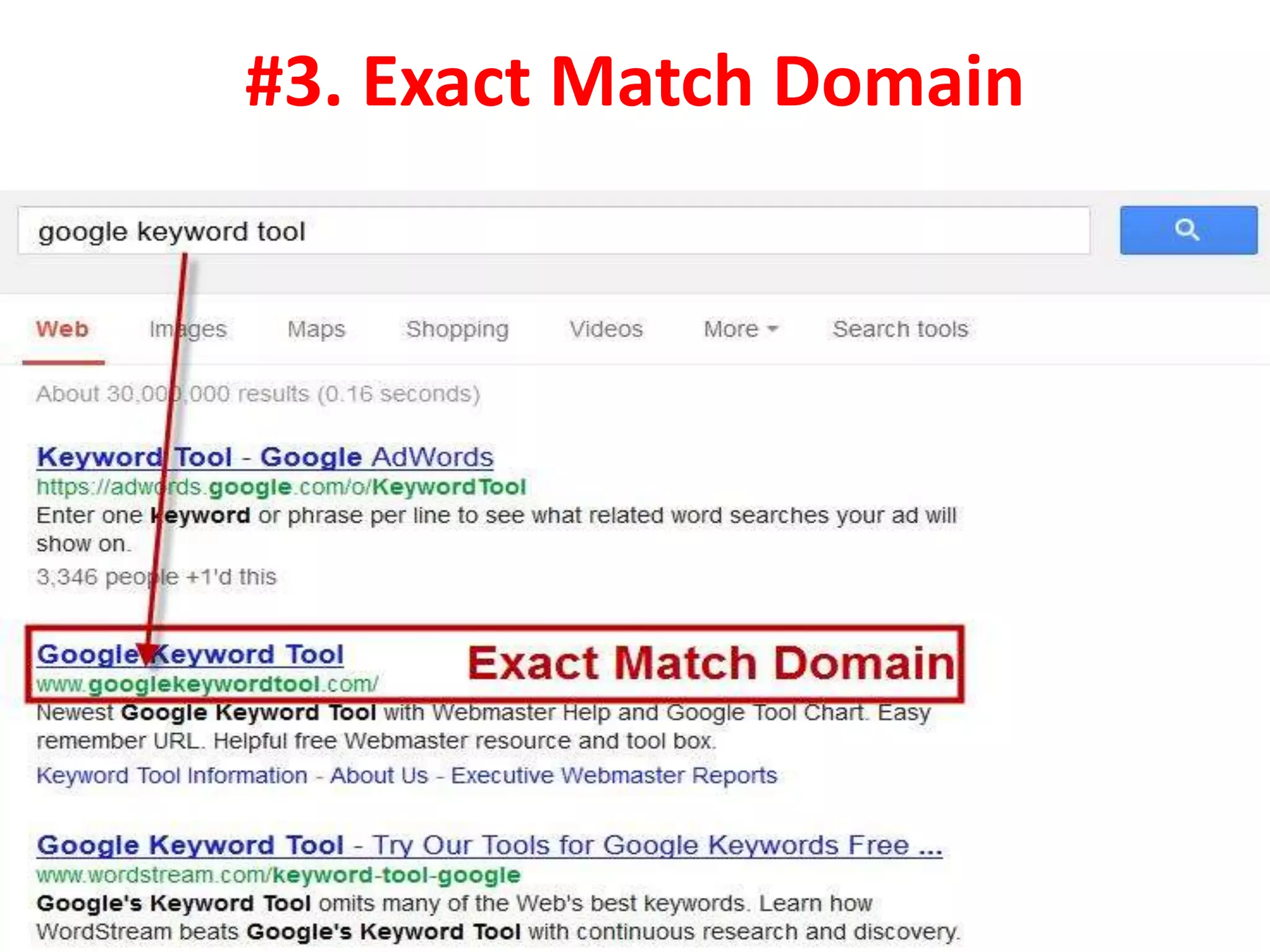
#3. Exact Match Domain
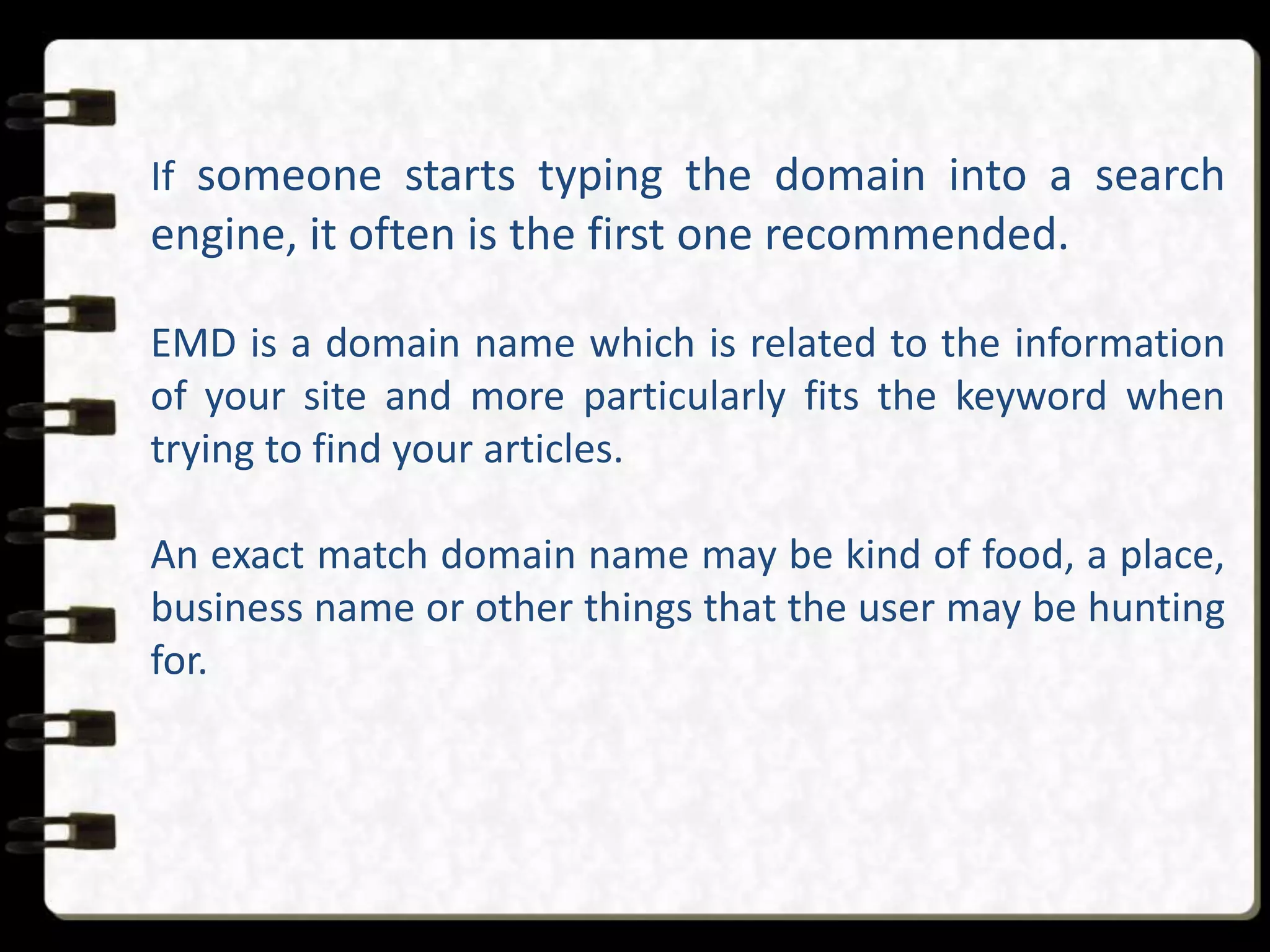
If someone starts typing the domain into a search
engine, it often is the first one recommended.
EMD is a domain name which is related to the information
of your site and more particularly fits the keyword when
trying to find your articles.
An exact match domain name may be kind of food, a place,
business name or other things that the user may be hunting
for.
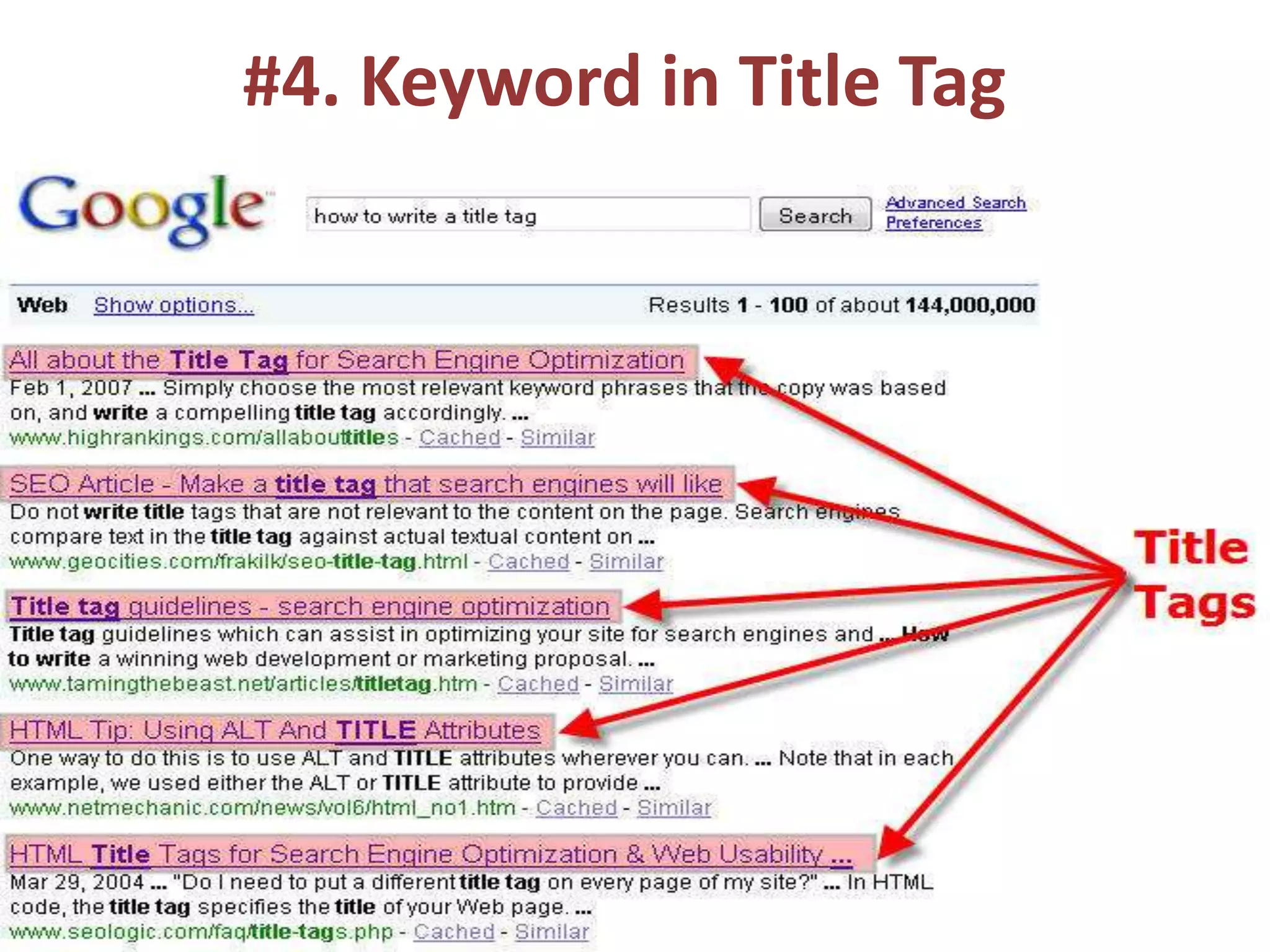
#4. Keyword in Title Tag
Title tags are very important for any website for SEO purpose
Google consider first keyword as main keyword and increases SERP
based on that
For example, if our keyword “seo company in ahmedabad”. Google
will consider seo company as main keyword on basis of Keyword
order, that means Google gives more emphasis to seo then Company
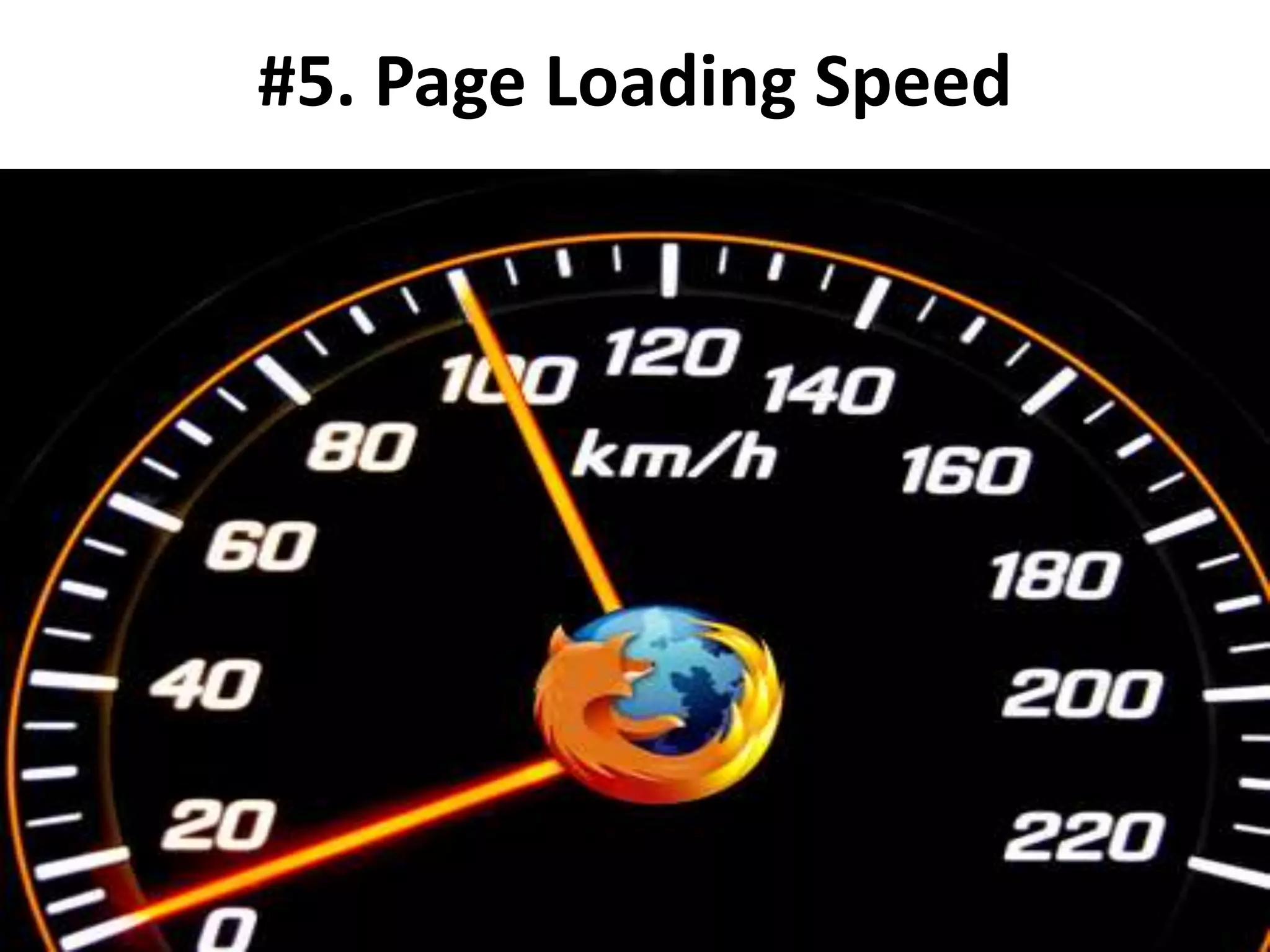
#5. Page Loading Speed
Google Has The Need For Speed
Google announced that page speed would impact your website
ranking. It actually refers to the time a visitor have to wait until
your page is completely loaded. On average, a page load for e-
commerce website takes 7 seconds meanwhile the ideal load time
is around 3 seconds or less.
A search result for a resource having a short load time relative to resources
having longer load times can be promoted in a presentation order, and search
results for the resources having longer load times can be demoted
#6. Duplicate Content
Identical content on the same site (even slightly modified) can
negatively influence a site’s search engine visibility.
Google doesn’t like using the word ‘penalty’ but if your entire
site is made of entirely of republished content – Google does not
want to rank it
#7. Rel=Canonical
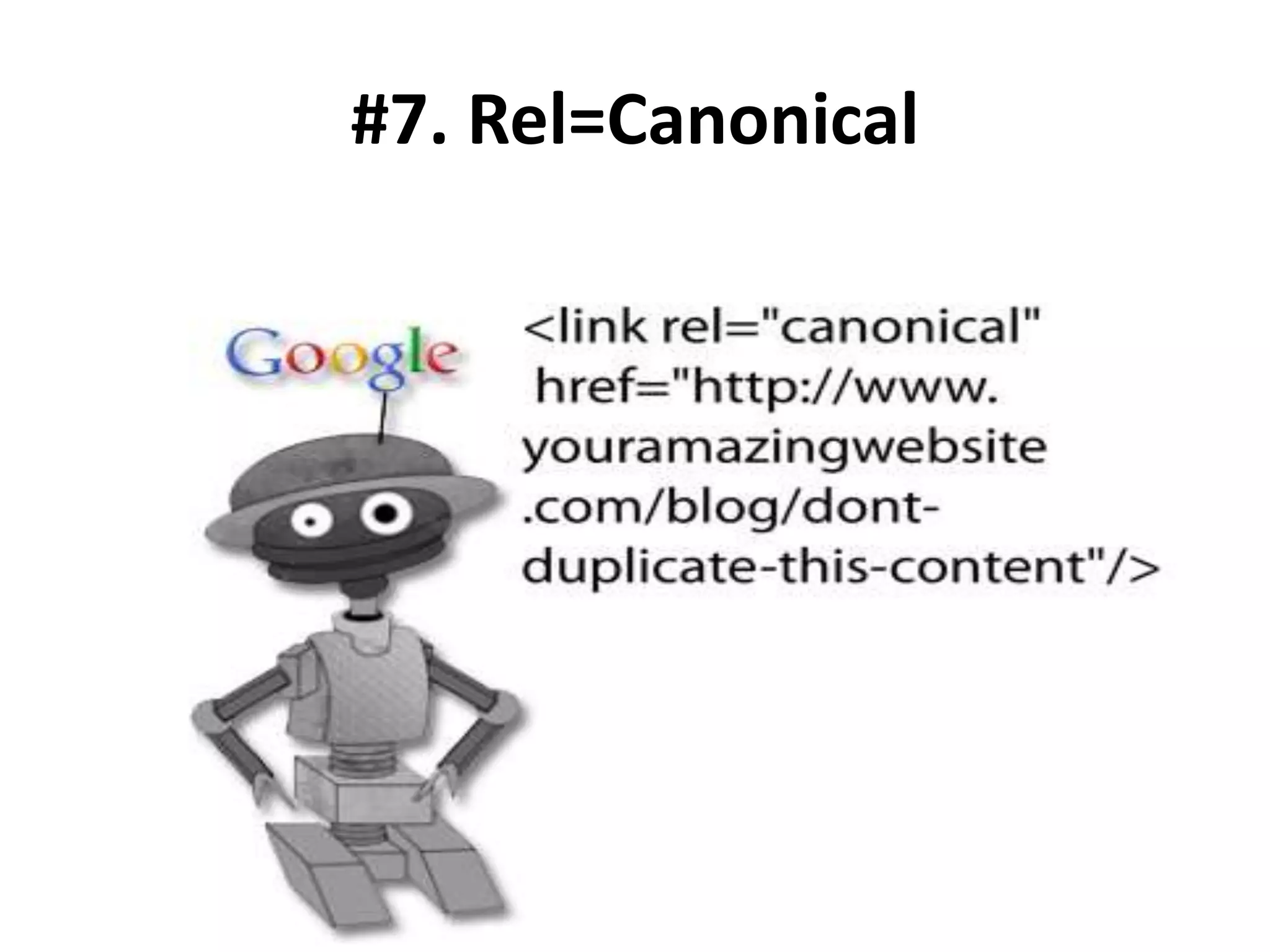
Put simply, the rel=canonical tag is a way to tell Google that
one URL is equivalent to another URL, for search purposes.
Typically, a URL (B) is a duplicate of URL (A), and the canonical
tag points to (A). The following tag would appear on the page
that generates URL (B), in the <head></head>:
<link rel=”canonical” href=”http://www.example.com/url-
a.html” />
Use Relevant keywords and high quality unique contenmts.
This will bring you lot of good traffic
#8. Keyword Prominence
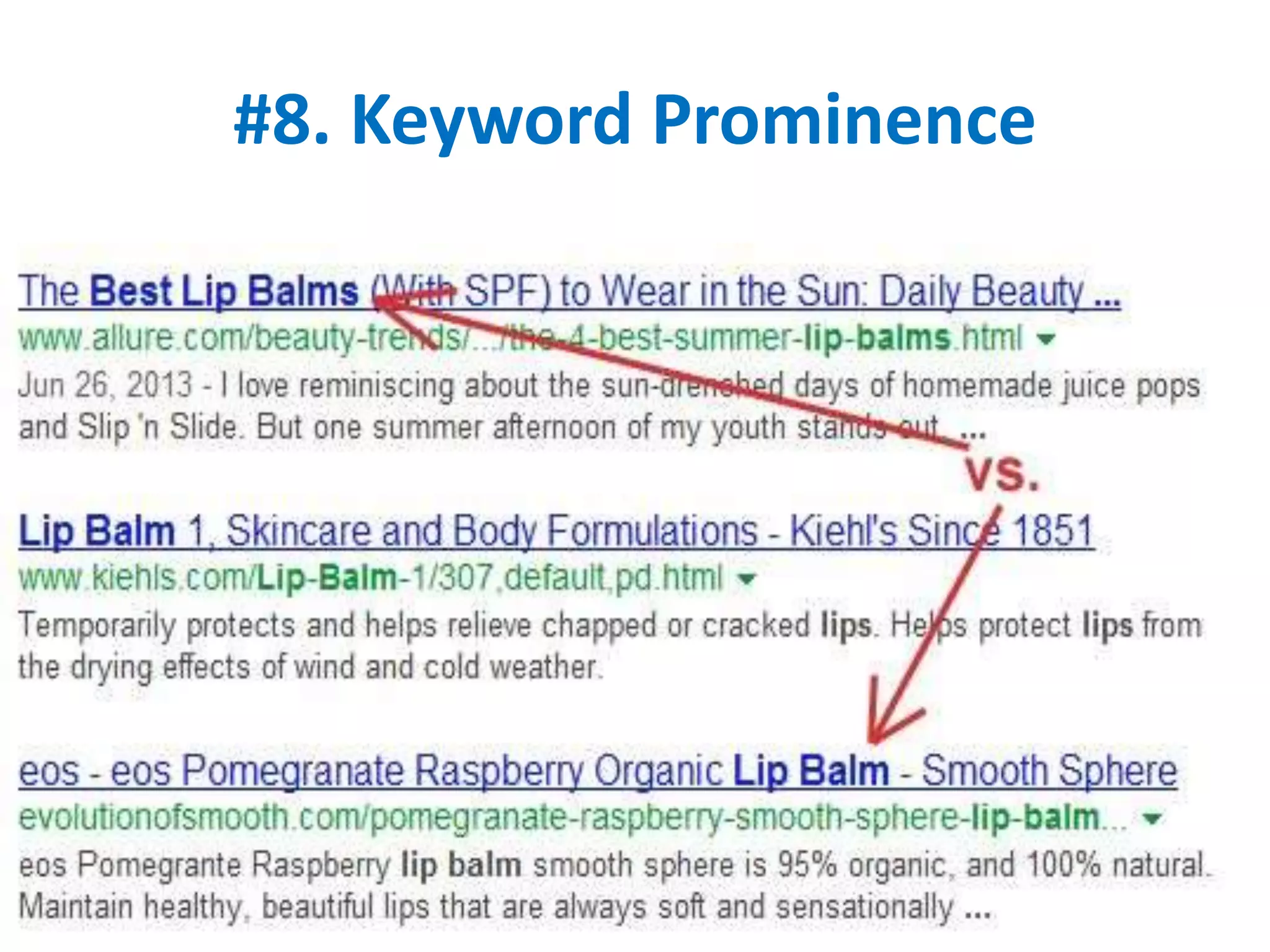
Keyword prominence refers to how prominent
your keywords are within key elements of your web
page. Specifically, how close to the beginning of the
page's TITLE tag, heading tags (H1, H2, H3, etc.), and
meta DESCRIPTION, your keyword phrase is placed.
Having a keyword appear in the Title tag, headings,
first 100-words of a page’s content appears to be a
significant relevancy signal.
#9. Outbound Link Quality
Try to link up with blogs/sites having same niche as your blog/sites.
This will help you to attract targeted visitors to your blog. Try to link
to domains which are already trusted and have good MOZ rank and
domain value.
Many SEOs think that linking out to authority sites helps send trust
signals to Google.
#10
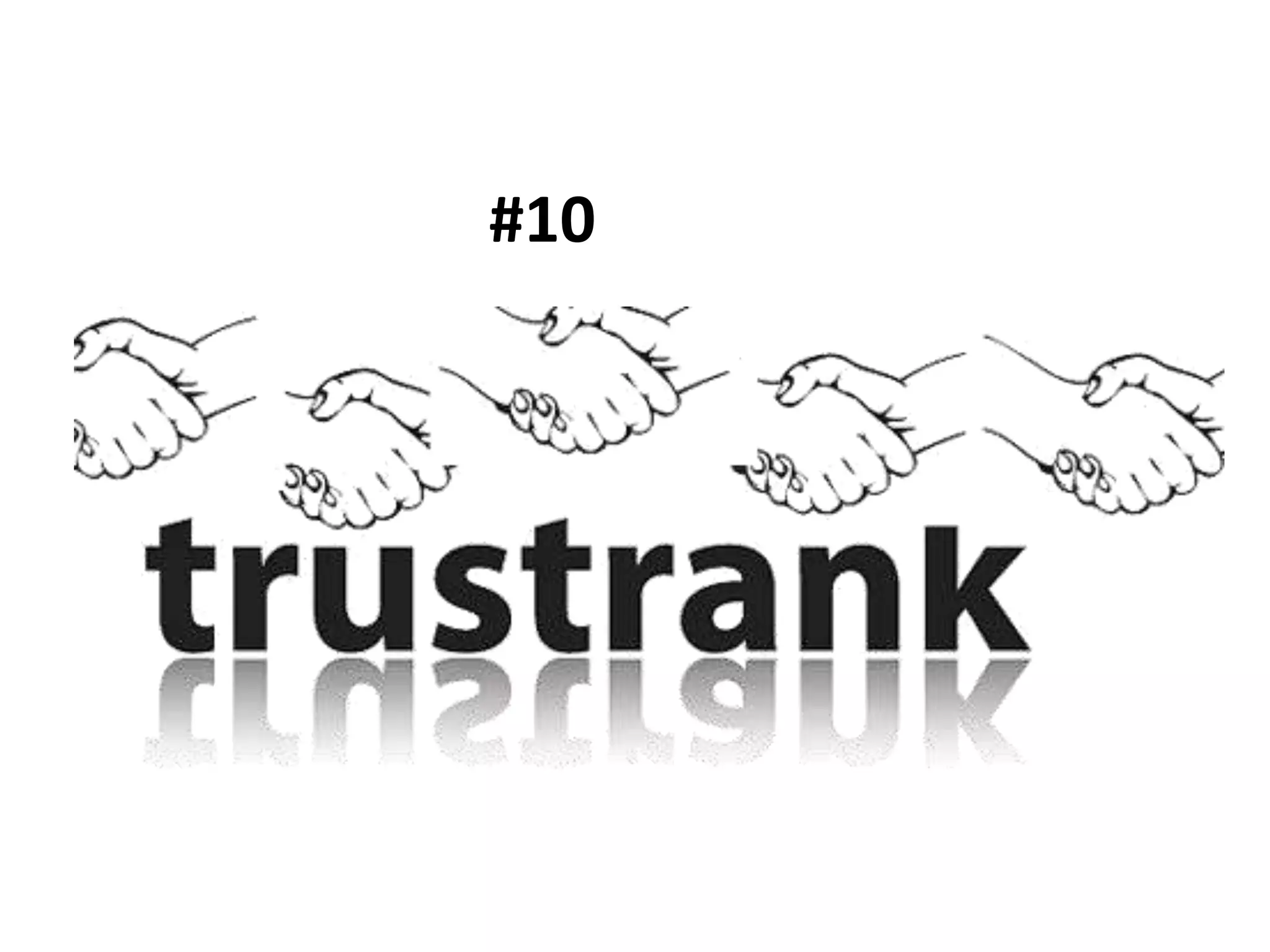
Site trust — measured by how many links away your site is
from highly-trusted seed sites — is a massively important
ranking factor.
What's Included in the Calculation of Trust Rank?
The age of the domain (Probably the age of the site)
Quality of the content
Quality of the backlinks (Ex- .edu or .gov sites)
Social signals
Trust of the user on the site
Freshness of content
Traffic to the Site
A sitemap helps search engines index your pages easier and
more thoroughly, improving visibility.
A sitemap has a benefit for the visitors as well. When a visitor
goes to your site they can access the sitemap to find any pages
that they are interested in viewing.
Usually the sitemap is to benefit the people who visit your site
and give them a quick and easy way to navigate your site.
#11
#12
Google’s official stance on mobile is to create a responsive site. It’s
likely that responsive sites get an edge in searches from a mobile
device.
Google also started penalizing in Mobile search that
aren’t mobile friendly
One of the best ways to prepare is to test that
Google considers your web pages to be mobile-
friendly by using its Mobile Friendly Test Tool.
#13 Website Usability
Usability means user-centered design. Both the design and
development process are focuss around the prospective user — to
make sure their goals, mental models, and requirements are met —
to build products that are efficient and easy to use.
A site that’s difficult to use or to navigate can hurt ranking by
reducing time on site, pages viewed and bounce rate.
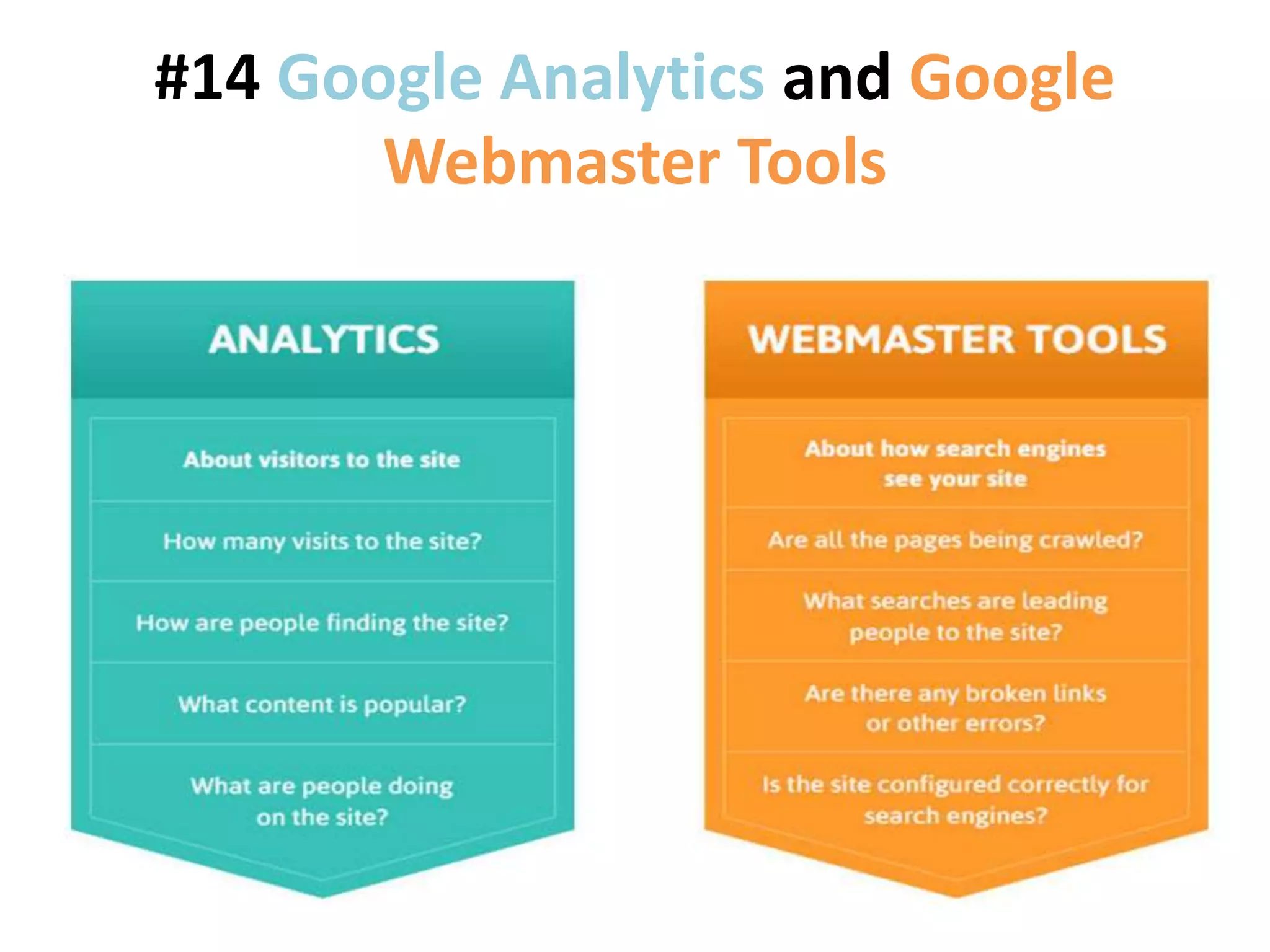
#14 Google Analytics and Google
Webmaster Tools
Having these two programs installed on your site can
improve your page’s indexing.
They may also directly influence rank by giving Google
more data to work with (ie. more accurate bounce rate,
whether or not you get referall traffic from
your backlinks etc.).
#15 C-Class IPs
Links from seperate class-c IP addresses
suggest a wider breadth of sites linking
to you.
#16 Link from Competitor
Links from other pages ranking in the same SERP may
be more valuable for a page’s rank for that particular
keyword.
Benefits of using Competitor Back Link Analysis
•Relatively easy compared to other link building methods
•Data is readily available to help prioritise
•Targeted towards sites you know will have a positive impact
on your search efforts
#17 Diversity of Link Types
Having an unnaturally large percentage of your links come
from a single source (ie. forum profiles, blog comments) may
be a sign of webspam.
On the other hand, links from diverse sources is a sign of a
natural link profile.
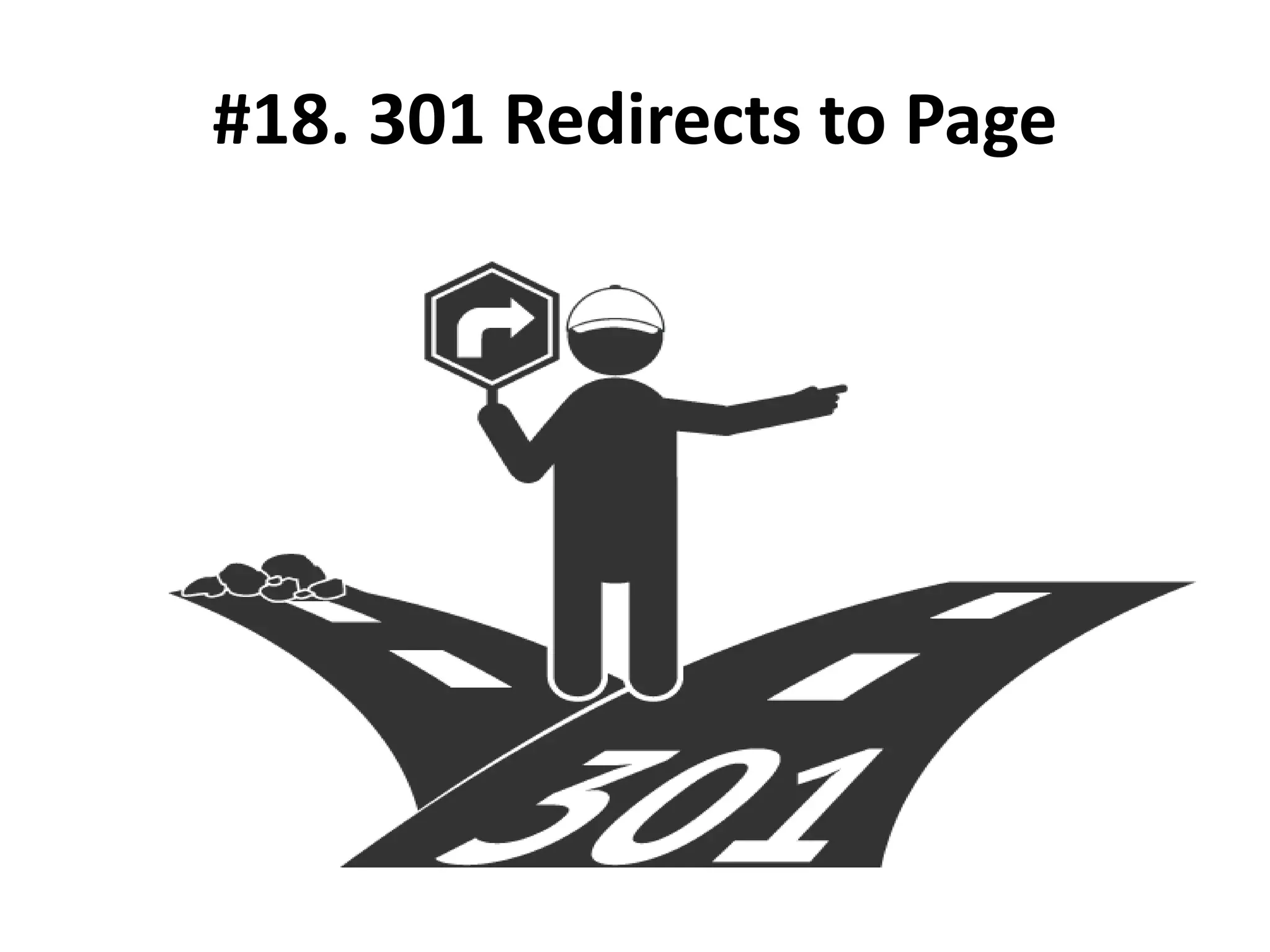
#18. 301 Redirects to Page
Links coming from 301 redirects dilute some (or
even all) PR, according to a Webmaster.
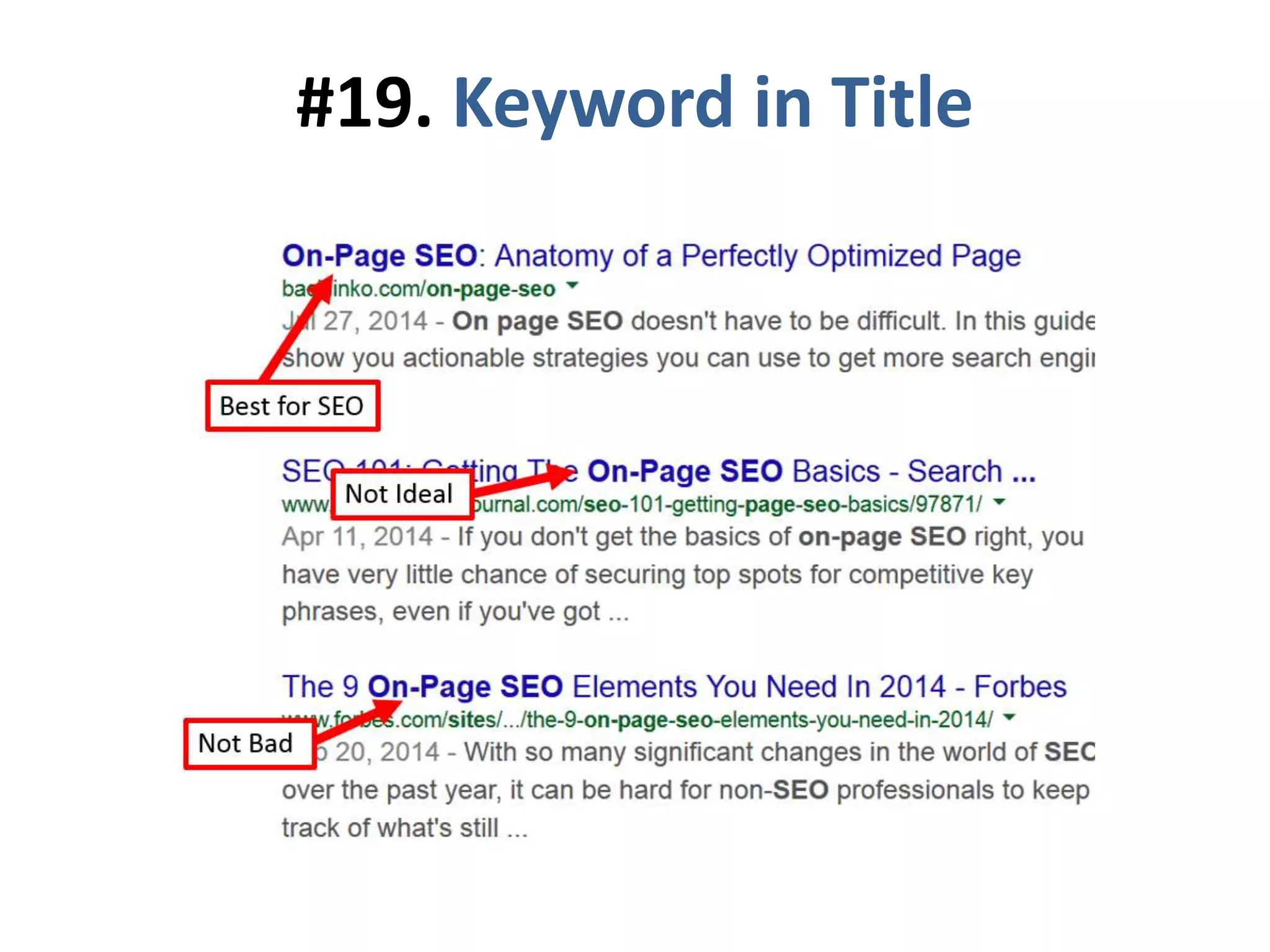
#19. Keyword in Title
Google gives extra love to links on pages that
contain your page’s keyword in the title
#20.Linked to as Wikipedia
Although the links are nofollow, many think that
getting a link from Wikipedia gives you a little added
trust and authority in the eyes of search engines.
#21. Bounce Rate
A high bounce rate can be indicative of a number of things but usually falls into one
of two categories:
•You're acquiring the wrong kind of traffic to your page(s), or
•You're acquiring exactly the right kind of traffic to your page(s).
Not everyone in SEO agrees bounce rate matters, but it may be a way of Google to use
their users as quality testers (pages where people quickly bounce is probably not very
good).
Ways to use your bounce rate to improve your website.
•You Should Probably Avoid Pop-ups
•Poor Design is Increasingly Less Tolerable
•Speed
•Is Your Website Mobile Usable
•Remove 404 Page
#22. Direct Traffic
It’s confirmed that Google uses data from Google
Chrome to determine whether or not people visit a
site (and how often). Sites with lots of direct traffic
are likely higher quality than sites that get very little
direct traffic.
#23 User Browsing History
Sites that you frequently visit while
signed into Google get a SERP bump
for your searches.
#24 Search History
If you search for “reviews” then search for
“toasters”, Google is more likely to show
toaster review sites higher in the SERPs.
Thank You

Presentation1

  • 1.
  • 2.
    Listed All TheFactors are not 100 % Proven Few are Proven Few are controversial & Others are SEO nerd speculation
  • 3.
    Ranking Criteria Domain Factors Page-LevelFactors Site-Level Factors Backlink Factors User Interaction
  • 4.
    Ranking Criteria Special AlgorithmRules Social Signals Brand Signals On-Site WebSpam Factors Off Page Webspam Factors
  • 5.
  • 6.
    #1. Keyword inTop Level Domain
  • 7.
    Domain names arethe human-readable Internet addresses of websites. Top Level domains, which are identified by their domain names, have extensions such as .com, .org, .net, etc. (Ex. http://www.example.com) For best ranking results, avoid uncommon top-level domains (TLDs). Like hyphens, TLDs such as .info, .cc, .ws, and .name are spam indicators. - MOZ Having your keyword in the domain still acts as a relevancy signal.
  • 8.
    #2. Keyword inSubdomain Name
  • 9.
    Having the targetkeyword in the subdomain name, especially as the first word, adds a boost to your rank. A subdomain is a "third level" domain name that is part of a larger, top-level domain. For example, "blog.example.com" and "english.example.com" are both subdomains of the ".example.com" root domain. Subdomains are free to create under any root domain that a webmaster controls.
  • 10.
  • 11.
    If someone startstyping the domain into a search engine, it often is the first one recommended. EMD is a domain name which is related to the information of your site and more particularly fits the keyword when trying to find your articles. An exact match domain name may be kind of food, a place, business name or other things that the user may be hunting for.
  • 13.
    #4. Keyword inTitle Tag
  • 14.
    Title tags arevery important for any website for SEO purpose Google consider first keyword as main keyword and increases SERP based on that For example, if our keyword “seo company in ahmedabad”. Google will consider seo company as main keyword on basis of Keyword order, that means Google gives more emphasis to seo then Company
  • 15.
  • 16.
    Google Has TheNeed For Speed Google announced that page speed would impact your website ranking. It actually refers to the time a visitor have to wait until your page is completely loaded. On average, a page load for e- commerce website takes 7 seconds meanwhile the ideal load time is around 3 seconds or less. A search result for a resource having a short load time relative to resources having longer load times can be promoted in a presentation order, and search results for the resources having longer load times can be demoted
  • 17.
  • 18.
    Identical content onthe same site (even slightly modified) can negatively influence a site’s search engine visibility. Google doesn’t like using the word ‘penalty’ but if your entire site is made of entirely of republished content – Google does not want to rank it
  • 19.
  • 20.
    Put simply, therel=canonical tag is a way to tell Google that one URL is equivalent to another URL, for search purposes. Typically, a URL (B) is a duplicate of URL (A), and the canonical tag points to (A). The following tag would appear on the page that generates URL (B), in the <head></head>: <link rel=”canonical” href=”http://www.example.com/url- a.html” /> Use Relevant keywords and high quality unique contenmts. This will bring you lot of good traffic
  • 21.
  • 22.
    Keyword prominence refersto how prominent your keywords are within key elements of your web page. Specifically, how close to the beginning of the page's TITLE tag, heading tags (H1, H2, H3, etc.), and meta DESCRIPTION, your keyword phrase is placed. Having a keyword appear in the Title tag, headings, first 100-words of a page’s content appears to be a significant relevancy signal.
  • 23.
  • 24.
    Try to linkup with blogs/sites having same niche as your blog/sites. This will help you to attract targeted visitors to your blog. Try to link to domains which are already trusted and have good MOZ rank and domain value. Many SEOs think that linking out to authority sites helps send trust signals to Google.
  • 26.
  • 27.
    Site trust —measured by how many links away your site is from highly-trusted seed sites — is a massively important ranking factor. What's Included in the Calculation of Trust Rank? The age of the domain (Probably the age of the site) Quality of the content Quality of the backlinks (Ex- .edu or .gov sites) Social signals Trust of the user on the site Freshness of content Traffic to the Site
  • 28.
    A sitemap helpssearch engines index your pages easier and more thoroughly, improving visibility. A sitemap has a benefit for the visitors as well. When a visitor goes to your site they can access the sitemap to find any pages that they are interested in viewing. Usually the sitemap is to benefit the people who visit your site and give them a quick and easy way to navigate your site.
  • 29.
  • 30.
  • 31.
    Google’s official stanceon mobile is to create a responsive site. It’s likely that responsive sites get an edge in searches from a mobile device. Google also started penalizing in Mobile search that aren’t mobile friendly One of the best ways to prepare is to test that Google considers your web pages to be mobile- friendly by using its Mobile Friendly Test Tool.
  • 32.
  • 33.
    Usability means user-centereddesign. Both the design and development process are focuss around the prospective user — to make sure their goals, mental models, and requirements are met — to build products that are efficient and easy to use. A site that’s difficult to use or to navigate can hurt ranking by reducing time on site, pages viewed and bounce rate.
  • 34.
    #14 Google Analyticsand Google Webmaster Tools
  • 35.
    Having these twoprograms installed on your site can improve your page’s indexing. They may also directly influence rank by giving Google more data to work with (ie. more accurate bounce rate, whether or not you get referall traffic from your backlinks etc.).
  • 37.
  • 38.
    Links from seperateclass-c IP addresses suggest a wider breadth of sites linking to you.
  • 39.
    #16 Link fromCompetitor
  • 40.
    Links from otherpages ranking in the same SERP may be more valuable for a page’s rank for that particular keyword. Benefits of using Competitor Back Link Analysis •Relatively easy compared to other link building methods •Data is readily available to help prioritise •Targeted towards sites you know will have a positive impact on your search efforts
  • 41.
    #17 Diversity ofLink Types
  • 42.
    Having an unnaturallylarge percentage of your links come from a single source (ie. forum profiles, blog comments) may be a sign of webspam. On the other hand, links from diverse sources is a sign of a natural link profile.
  • 43.
  • 44.
    Links coming from301 redirects dilute some (or even all) PR, according to a Webmaster.
  • 45.
  • 46.
    Google gives extralove to links on pages that contain your page’s keyword in the title
  • 47.
  • 48.
    Although the linksare nofollow, many think that getting a link from Wikipedia gives you a little added trust and authority in the eyes of search engines.
  • 50.
  • 51.
    A high bouncerate can be indicative of a number of things but usually falls into one of two categories: •You're acquiring the wrong kind of traffic to your page(s), or •You're acquiring exactly the right kind of traffic to your page(s). Not everyone in SEO agrees bounce rate matters, but it may be a way of Google to use their users as quality testers (pages where people quickly bounce is probably not very good). Ways to use your bounce rate to improve your website. •You Should Probably Avoid Pop-ups •Poor Design is Increasingly Less Tolerable •Speed •Is Your Website Mobile Usable •Remove 404 Page
  • 52.
  • 53.
    It’s confirmed thatGoogle uses data from Google Chrome to determine whether or not people visit a site (and how often). Sites with lots of direct traffic are likely higher quality than sites that get very little direct traffic.
  • 55.
  • 56.
    Sites that youfrequently visit while signed into Google get a SERP bump for your searches.
  • 57.
  • 58.
    If you searchfor “reviews” then search for “toasters”, Google is more likely to show toaster review sites higher in the SERPs.
  • 60.