Eloise Hatton
The majority of my documentaries which I
analysed came across to be mixed, however
some were self reflective.
 Most of my documentaries were single
stranded, linear and had a closed narrative.
However, some can still have open endings.
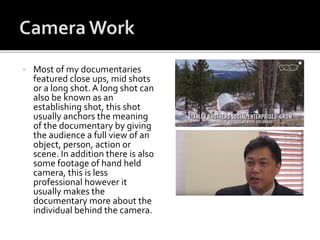
 Most of my documentaries
featured close ups, mid shots
or a long shot. A long shot can
also be known as an
establishing shot, this shot
usually anchors the meaning
of the documentary by giving
the audience a full view of an
object, person, action or
scene. In addition there is also
some footage of hand held
camera, this is less
professional however it
usually makes the
documentary more about the
individual behind the camera.
Mise-en-scene is different,
however the use of mise-en-
scene usually relates to the
topic/storyline within the
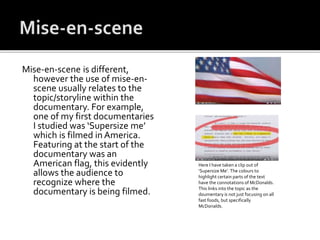
documentary. For example,
one of my first documentaries
I studied was ‘Supersize me’
which is filmed in America.
Featuring at the start of the
documentary was an
American flag, this evidently
allows the audience to
recognize where the
documentary is being filmed.
Here I have taken a clip out of
‘Supersize Me’. The colours to
highlight certain parts of the text
have the connotations of McDonalds.
This links into the topic as the
doumentary is not just focusing on all
fast foods, but specifically
McDonalds.
 Each documentary has a range of non
diegetic and diegetic sound. Diegetic sound is
when something on screen creates the noise
such as a person or object and you can see it
happening. Non diegetic sound is sound such
as background music etc.
 As usual, a lot of cuts have been used
throughout each documentary, however I
have also noticed a lot of fast paced editing.
Fast paced editing represents the passing of
time and also to show action.This was
strongly represented in the documentary I
covered ‘FemaleChinese Bodyguards’.
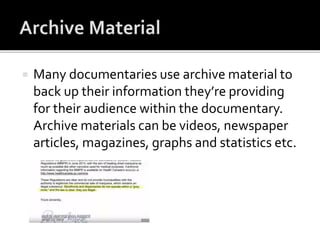
 Many documentaries use archive material to
back up their information they’re providing
for their audience within the documentary.
Archive materials can be videos, newspaper
articles, magazines, graphs and statistics etc.
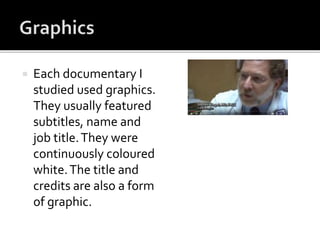
 Each documentary I
studied used graphics.
They usually featured
subtitles, name and
job title.They were
continuously coloured
white.The title and
credits are also a form
of graphic.

Presentation1

  • 1.
  • 2.
    The majority ofmy documentaries which I analysed came across to be mixed, however some were self reflective.
  • 3.
     Most ofmy documentaries were single stranded, linear and had a closed narrative. However, some can still have open endings.
  • 4.
     Most ofmy documentaries featured close ups, mid shots or a long shot. A long shot can also be known as an establishing shot, this shot usually anchors the meaning of the documentary by giving the audience a full view of an object, person, action or scene. In addition there is also some footage of hand held camera, this is less professional however it usually makes the documentary more about the individual behind the camera.
  • 5.
    Mise-en-scene is different, howeverthe use of mise-en- scene usually relates to the topic/storyline within the documentary. For example, one of my first documentaries I studied was ‘Supersize me’ which is filmed in America. Featuring at the start of the documentary was an American flag, this evidently allows the audience to recognize where the documentary is being filmed. Here I have taken a clip out of ‘Supersize Me’. The colours to highlight certain parts of the text have the connotations of McDonalds. This links into the topic as the doumentary is not just focusing on all fast foods, but specifically McDonalds.
  • 6.
     Each documentaryhas a range of non diegetic and diegetic sound. Diegetic sound is when something on screen creates the noise such as a person or object and you can see it happening. Non diegetic sound is sound such as background music etc.
  • 7.
     As usual,a lot of cuts have been used throughout each documentary, however I have also noticed a lot of fast paced editing. Fast paced editing represents the passing of time and also to show action.This was strongly represented in the documentary I covered ‘FemaleChinese Bodyguards’.
  • 8.
     Many documentariesuse archive material to back up their information they’re providing for their audience within the documentary. Archive materials can be videos, newspaper articles, magazines, graphs and statistics etc.
  • 9.
     Each documentaryI studied used graphics. They usually featured subtitles, name and job title.They were continuously coloured white.The title and credits are also a form of graphic.