PENTACKLES
TEAM MEMBERS
COMPUTER SCIENCE (5A)
AAKANSHA TYAGI (2000290120001)
AAKRITI GUPTA (2000290120002)
AYUSH JAISWAL (2000290120052)
AYUSH TYAGI (2000290120056)
CONTENT
* INTRODUCTION
* OBJECTIVE
* PROBLEM STATEMENT
* TECHNOLOGY USED
* FLOWCHART
* FUTURE SCOPE
* CONCLUSION
3
INTRODUCTION
 The system we have proposed is user friendly to get help and
advice on health issues immediately through the online
healthcare system.
 This project includes a website which will predict the most
possible diseases based on the given symptoms by the user and
precautionary measures required to avoid the aggression of
diseases.
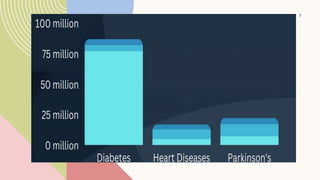
 This proposed website can predict the diseases such as
Diabetes, Heart diseases, and Parkinson’s using machine
learning.
 The main motive of the proposed system is the prediction of the
commonly occurring diseases in the early phase as when they
are not checked or examined they can turn into a disease more
OBJECTIVE
. 5
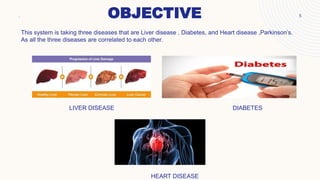
This system is taking three diseases that are Liver disease , Diabetes, and Heart disease ,Parkinson’s.
As all the three diseases are correlated to each other.
LIVER DISEASE DIABETES
HEART DISEASE
PROBLEM STATEMENT
 Many of the existing machine learning models for health care
analysis are concentrating on one disease per analysis.
 If a user wants to predict more than one disease, he/she has to
go through different sites.
 There is no common system where one analysis can perform
more than one disease prediction. Some of the models have
lower accuracy which can seriously affect patients’ health.
 When an organization wants to analyse their patient’s health
reports, they have to deploy many models which in turn
increases the cost as well as time Some of the existing systems
consider very few parameters which can yield false results.
.
6
.
. .
7
TECHNOLOGY USED
. 8
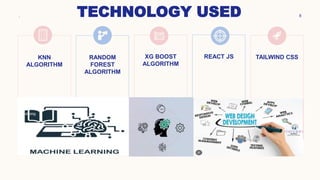
KNN
ALGORITHM
RANDOM
FOREST
ALGORITHM
Disseminate
standardized
metrics
XG BOOST
ALGORITHM
Coordinate e-
business
applications
REACT JS
Foster holistically
superior
methodologies
TAILWIND CSS
Deploy strategic
networks with
compelling e-
business needs
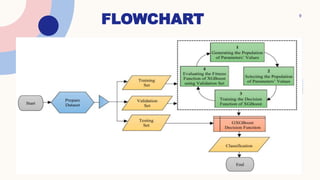
FLOWCHART 9
NOV 20XX JAN 20XX MAR 20XX MAY 20XX
Synergize scalable
e-commerce
Disseminate
standardized
metrics
Coordinate e-
business applications
Foster holistically
superior methodologies
Deploy strategic
networks with
compelling e-
business needs
FUTURE SCOPE 10
.
 In the future we can add more diseases in the existing
API.
 We can try to improve the accuracy of prediction in
order to decrease the mortality rate.
 We try to add chatbot for users so that the system
work more efficiently.
.
• .
CONCLUSION
. 11
 This project was to create a system that would
predict more than one disease and do so with high
accuracy. Because of this project the user doesn’t
need to traverse different websites which saves
time as well.
 Diseases if predicted early can increase your life
expectancy as well as save you from financial
troubles. For this purpose, we have used various
machine learning algorithms like Random Forest,
XG Boost, and K nearest neighbour (KNN) to
achieve maximum accuracy.
THANK YOU
.

Presentation pentackles (2).pptx

  • 1.
  • 2.
    TEAM MEMBERS COMPUTER SCIENCE(5A) AAKANSHA TYAGI (2000290120001) AAKRITI GUPTA (2000290120002) AYUSH JAISWAL (2000290120052) AYUSH TYAGI (2000290120056)
  • 3.
    CONTENT * INTRODUCTION * OBJECTIVE *PROBLEM STATEMENT * TECHNOLOGY USED * FLOWCHART * FUTURE SCOPE * CONCLUSION 3
  • 4.
    INTRODUCTION  The systemwe have proposed is user friendly to get help and advice on health issues immediately through the online healthcare system.  This project includes a website which will predict the most possible diseases based on the given symptoms by the user and precautionary measures required to avoid the aggression of diseases.  This proposed website can predict the diseases such as Diabetes, Heart diseases, and Parkinson’s using machine learning.  The main motive of the proposed system is the prediction of the commonly occurring diseases in the early phase as when they are not checked or examined they can turn into a disease more
  • 5.
    OBJECTIVE . 5 This systemis taking three diseases that are Liver disease , Diabetes, and Heart disease ,Parkinson’s. As all the three diseases are correlated to each other. LIVER DISEASE DIABETES HEART DISEASE
  • 6.
    PROBLEM STATEMENT  Manyof the existing machine learning models for health care analysis are concentrating on one disease per analysis.  If a user wants to predict more than one disease, he/she has to go through different sites.  There is no common system where one analysis can perform more than one disease prediction. Some of the models have lower accuracy which can seriously affect patients’ health.  When an organization wants to analyse their patient’s health reports, they have to deploy many models which in turn increases the cost as well as time Some of the existing systems consider very few parameters which can yield false results. . 6
  • 7.
  • 8.
    TECHNOLOGY USED . 8 KNN ALGORITHM RANDOM FOREST ALGORITHM Disseminate standardized metrics XGBOOST ALGORITHM Coordinate e- business applications REACT JS Foster holistically superior methodologies TAILWIND CSS Deploy strategic networks with compelling e- business needs
  • 9.
    FLOWCHART 9 NOV 20XXJAN 20XX MAR 20XX MAY 20XX Synergize scalable e-commerce Disseminate standardized metrics Coordinate e- business applications Foster holistically superior methodologies Deploy strategic networks with compelling e- business needs
  • 10.
    FUTURE SCOPE 10 . In the future we can add more diseases in the existing API.  We can try to improve the accuracy of prediction in order to decrease the mortality rate.  We try to add chatbot for users so that the system work more efficiently. . • .
  • 11.
    CONCLUSION . 11  Thisproject was to create a system that would predict more than one disease and do so with high accuracy. Because of this project the user doesn’t need to traverse different websites which saves time as well.  Diseases if predicted early can increase your life expectancy as well as save you from financial troubles. For this purpose, we have used various machine learning algorithms like Random Forest, XG Boost, and K nearest neighbour (KNN) to achieve maximum accuracy.
  • 12.