Presentation
On life of a Java Developer
Content on java
• Where is java used?
• Feature of java
• Java
machine
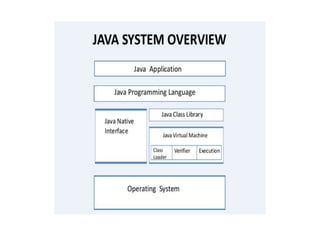
• Java system overview
• Java program-development phase
• Advantage of java
• lAmdas
What is java?
 Java is a general – purpose , object-oriented
programming language developed by sun
Microsoft of USA in 1991.
 Originally called Oak by james gosling,one
of the inventors of the language.
Java is a first programming language which
provide the concept of writing programs that
can be executed using the web.
where is java used?
Desktop application :-acrobat reader,Media
player,antiviruse etc.
Enterprise application :-
banking application,Business application.
 Mobile.
Embedded system.
Games.
Robotics.
java Features
• Compiled and interpreted
• Plateform-independent and portable
• Object-oriented
• Robust and secure
• Distributed
• Familiar
• Simple and small
• High performance
Java does not include the C unique
statement keywords sizeof,and typedef.
Java does not contain the data types
struct and union.
Java does not support an explicit pointer
type.
Java does not have a preprocessor and
therefore we cannot use #define,#include
statement.
Java requires that the functions with no
arguments must be declared with empty
parenthesis and not with the void keyword
as done in c.
Java adds new operators such as
instanceof and >>.
Java adds labelled break and continue
statement.
Java adds many features required for
object-oriented programming.
• Class is class
What is OOP?
Object-oriented programming is a method of
implementation.
A language in which everything represent in
the form of object is called object oriented
programming language.
It not only makes the program less complex
but also makes the software reuse feasible
and possible.
Java is not truly object oriented programming
language.
Concept of oop
Object
Class
Encapsulation
Inheritance
Polymorphism
Abstraction
Garbage collection
Garbage collection is the mechanism that
De allocate the memory of an object when
it is no longer referenced by a variable.
In c++, the memory of an object is
released by use of delete operator.
Java virtual machine determines when to
free up the memory of an object.
Advantages of java
 java is simple language.
Java does not support POINTERS.
Java is first language in which programs
can be executed using web.
Write once run anywhere(WORA).
Disadvantage on java
Slow performance.
No support for low level programming.
Poor features in java.
No control over Garbage collection.
Java virtual machine
Java virtual machine is the like usual
computer which translate high level
language into machine language.
Just like that java virtual machine also
translate Bytecode into machine language.
JVM are available for many hardware and
software plateform.
Sample java program
Class SampleOne
{
Public static void main(string args [])
{
System .out.println(“java is better than c++);
}
}

Presentation on java life of a deveoper.pptx

  • 1.
    Presentation On life ofa Java Developer
  • 2.
    Content on java •Where is java used? • Feature of java • Java machine • Java system overview • Java program-development phase • Advantage of java • lAmdas
  • 3.
    What is java? Java is a general – purpose , object-oriented programming language developed by sun Microsoft of USA in 1991.  Originally called Oak by james gosling,one of the inventors of the language. Java is a first programming language which provide the concept of writing programs that can be executed using the web.
  • 4.
    where is javaused? Desktop application :-acrobat reader,Media player,antiviruse etc. Enterprise application :- banking application,Business application.  Mobile. Embedded system. Games. Robotics.
  • 5.
    java Features • Compiledand interpreted • Plateform-independent and portable • Object-oriented • Robust and secure • Distributed • Familiar • Simple and small • High performance
  • 6.
    Java does notinclude the C unique statement keywords sizeof,and typedef. Java does not contain the data types struct and union. Java does not support an explicit pointer type. Java does not have a preprocessor and therefore we cannot use #define,#include statement.
  • 7.
    Java requires thatthe functions with no arguments must be declared with empty parenthesis and not with the void keyword as done in c. Java adds new operators such as instanceof and >>. Java adds labelled break and continue statement. Java adds many features required for object-oriented programming.
  • 9.
  • 10.
    What is OOP? Object-orientedprogramming is a method of implementation. A language in which everything represent in the form of object is called object oriented programming language. It not only makes the program less complex but also makes the software reuse feasible and possible. Java is not truly object oriented programming language.
  • 11.
  • 12.
    Garbage collection Garbage collectionis the mechanism that De allocate the memory of an object when it is no longer referenced by a variable. In c++, the memory of an object is released by use of delete operator. Java virtual machine determines when to free up the memory of an object.
  • 13.
    Advantages of java java is simple language. Java does not support POINTERS. Java is first language in which programs can be executed using web. Write once run anywhere(WORA).
  • 14.
    Disadvantage on java Slowperformance. No support for low level programming. Poor features in java. No control over Garbage collection.
  • 15.
    Java virtual machine Javavirtual machine is the like usual computer which translate high level language into machine language. Just like that java virtual machine also translate Bytecode into machine language. JVM are available for many hardware and software plateform.
  • 16.
    Sample java program ClassSampleOne { Public static void main(string args []) { System .out.println(“java is better than c++); } }