Sacred Dwarka
Temple
" A Divine Destination"
INTRO
The Dwarkadhish temple, also
known as the Jagat Mandir and
often spelled Dwarakadheesh, is a
Hindu temple devoted to Krishna,
who is known as Dwarkadhish, or
'King of Dwarka' here. The temple
is located in Dwarka, Gujarat, India,
and is one of the stops on the Char
Dham pilgrimage circuit.
2
STRUCTURE
The temple covers area of 27-metre by
21-metre with east–west length of 29-metre
and north–south width of 23 metres. The
temple is constructed of limestone and has
intricate carvings.
It is a five storied edifice built over 72 pillars .
There are two important entrances to the
temple, one is the main entry door which is
called the Moksha Dvara (meaning "Door to
Salvation") and the exit door which is known as
the Svarga Dvara (meaning: "Gate to Heaven").
Outside this doorway are 56 steps that leads to
the Gomati River.
Dwarka is regarded as Gujarat's first capital. The name of the city literally means
"gateway." Dwarka has also been known as "Mokshapuri" throughout its history. It
is mentioned in the Mahabharata, an ancient epic period.Krishna is said to have
stayed here after defeating and killing his uncle Kamsa in Mathura.This
mythological narrative of Krishna's migration from Mathura to Dwarka is deeply
tied with Gujarati culture. Krishna also appears to have reclaimed 12 yojanas, or 96
square kilometers (37 square miles), of sea-level land to build Dwarka.
Archaeological evidence suggests that the original Dwarkadhish Temple,
dedicated to Krishna, was built around 200 BCE.
The Lost City
Dwarka city has an archaeological
mystery, along with being a
pilgrimage site. According to the
text in Mahabharata, it stretched
almost 84 km. It was a beautiful
fortified city. Archaeologists are
trying to find evidence of a sunken
city beneath the sea. They have
discovered stone blocks, pillars,
and artifacts. An underwater
excavation that took place a few
years ago confirmed that there
were architectural remains under
the sea.
The shrine of Rukmini Devi -
Rukmini Temple
The temple stands about 2 km away from the
Dwarkadhish Temple. The story goes that Rishi Durvasa,
who happens to be the Kul Guru of Yadavas, had his
ashram at some distance away from Dwarka. Krishna and
Rukmini went over to invite him for food with all their
chariots. He agreed to come but, on the condition, that
the chariot would not be drawn by horses or any other
animals but by Krishna and Rukmini themselves. They
agreed.Now she was a queen not used to pulling the
chariots. After a while her throat was dry and she looked
at Krishna. He understood she needs water. He pressed
his right toe into the earth and out came the Ganga. She
had water. She was so thirsty that she forgot to offer it to
Rishi Durvasa first. This made him angry and he cursed
that the couple would be separated and live apart. This is
why Rukmini’s temple is away from the Dwarkadhish
temple
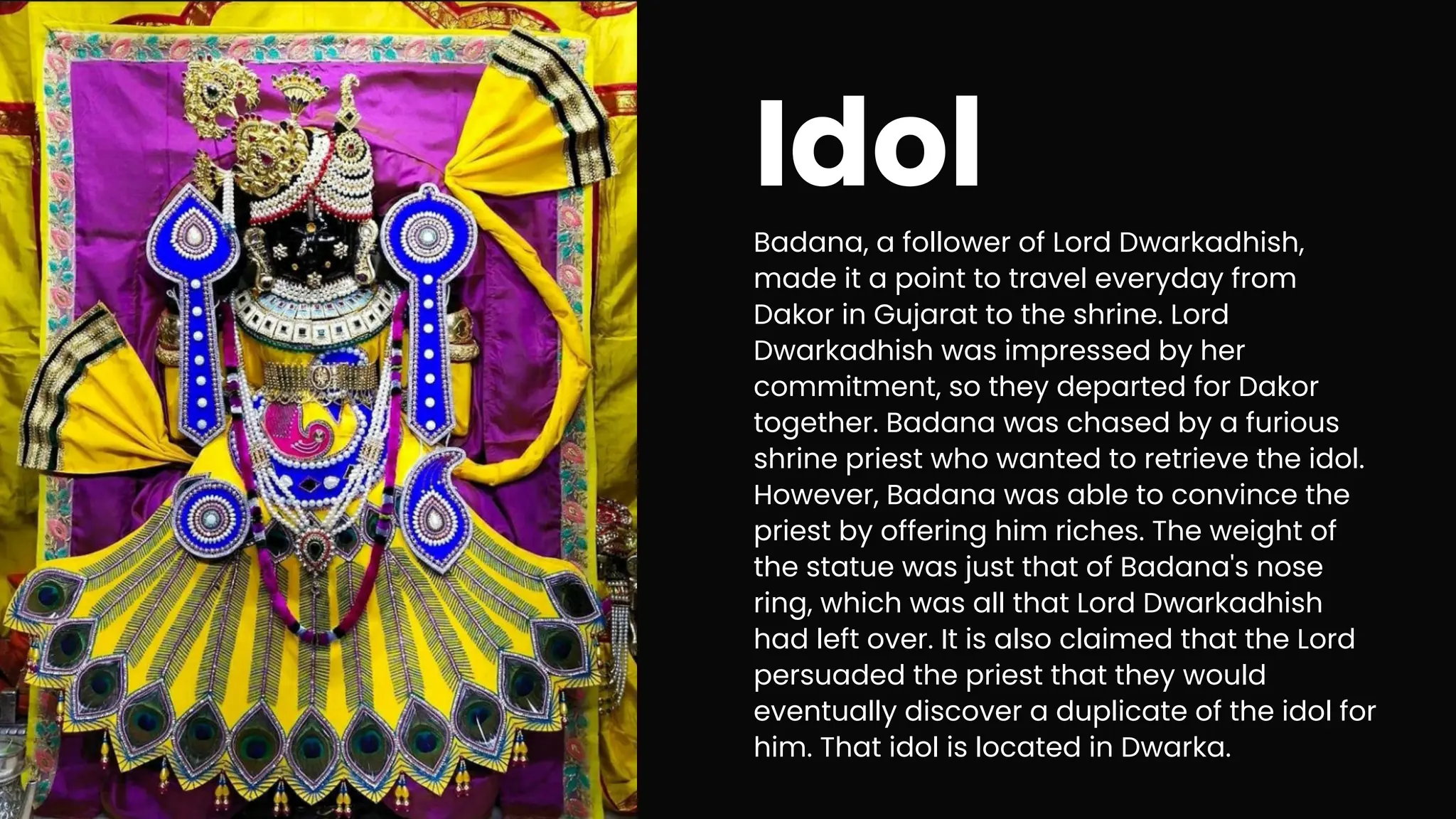
Idol
Badana, a follower of Lord Dwarkadhish,
made it a point to travel everyday from
Dakor in Gujarat to the shrine. Lord
Dwarkadhish was impressed by her
commitment, so they departed for Dakor
together. Badana was chased by a furious
shrine priest who wanted to retrieve the idol.
However, Badana was able to convince the
priest by offering him riches. The weight of
the statue was just that of Badana's nose
ring, which was all that Lord Dwarkadhish
had left over. It is also claimed that the Lord
persuaded the priest that they would
eventually discover a duplicate of the idol for
him. That idol is located in Dwarka.
Dhwaja Arohan
The massive waving flag on top of the Dwarkadish
temple is visible from every angle. You'll also note that
the temple has a different flag every time you look at it.
The flag is changed five times a day, three times in the
morning and twice in the evening.
52 yards of woven cloth is used for making the Dhwaja
out of which fifty-two nos. of small flags are made and
joined together to make a single flag. Each small flag
has its own significance & identity. Each yard indicates
the entrance to Dwarka of Sri Krishna’s era and it also
symbolizes flags on the residences of fifty-two officers
of Dwarka in the ministry of Lord Sri Krishna. These 52
yards symbolizes, fifty entrances (gates) to the palace of
Dwarkadheesh Lord Sri Krishna, with each gate having a
Dhwaja (flag) besides the two main gates Swarga Dwar &
Moksha Dwar of Dwarkadheesh palace.
CARVINGS AND SCLPTURES
THANK YOU
Made By :- Nisarg Depani(RA2111018010014)
Indian Art Forms
Faculty :- Dr.Anitha Kumari

Presentation on Dwarkadhish temple India

  • 1.
    Sacred Dwarka Temple " ADivine Destination"
  • 2.
    INTRO The Dwarkadhish temple,also known as the Jagat Mandir and often spelled Dwarakadheesh, is a Hindu temple devoted to Krishna, who is known as Dwarkadhish, or 'King of Dwarka' here. The temple is located in Dwarka, Gujarat, India, and is one of the stops on the Char Dham pilgrimage circuit. 2
  • 3.
    STRUCTURE The temple coversarea of 27-metre by 21-metre with east–west length of 29-metre and north–south width of 23 metres. The temple is constructed of limestone and has intricate carvings. It is a five storied edifice built over 72 pillars . There are two important entrances to the temple, one is the main entry door which is called the Moksha Dvara (meaning "Door to Salvation") and the exit door which is known as the Svarga Dvara (meaning: "Gate to Heaven"). Outside this doorway are 56 steps that leads to the Gomati River.
  • 4.
    Dwarka is regardedas Gujarat's first capital. The name of the city literally means "gateway." Dwarka has also been known as "Mokshapuri" throughout its history. It is mentioned in the Mahabharata, an ancient epic period.Krishna is said to have stayed here after defeating and killing his uncle Kamsa in Mathura.This mythological narrative of Krishna's migration from Mathura to Dwarka is deeply tied with Gujarati culture. Krishna also appears to have reclaimed 12 yojanas, or 96 square kilometers (37 square miles), of sea-level land to build Dwarka. Archaeological evidence suggests that the original Dwarkadhish Temple, dedicated to Krishna, was built around 200 BCE.
  • 5.
    The Lost City Dwarkacity has an archaeological mystery, along with being a pilgrimage site. According to the text in Mahabharata, it stretched almost 84 km. It was a beautiful fortified city. Archaeologists are trying to find evidence of a sunken city beneath the sea. They have discovered stone blocks, pillars, and artifacts. An underwater excavation that took place a few years ago confirmed that there were architectural remains under the sea.
  • 6.
    The shrine ofRukmini Devi - Rukmini Temple The temple stands about 2 km away from the Dwarkadhish Temple. The story goes that Rishi Durvasa, who happens to be the Kul Guru of Yadavas, had his ashram at some distance away from Dwarka. Krishna and Rukmini went over to invite him for food with all their chariots. He agreed to come but, on the condition, that the chariot would not be drawn by horses or any other animals but by Krishna and Rukmini themselves. They agreed.Now she was a queen not used to pulling the chariots. After a while her throat was dry and she looked at Krishna. He understood she needs water. He pressed his right toe into the earth and out came the Ganga. She had water. She was so thirsty that she forgot to offer it to Rishi Durvasa first. This made him angry and he cursed that the couple would be separated and live apart. This is why Rukmini’s temple is away from the Dwarkadhish temple
  • 7.
    Idol Badana, a followerof Lord Dwarkadhish, made it a point to travel everyday from Dakor in Gujarat to the shrine. Lord Dwarkadhish was impressed by her commitment, so they departed for Dakor together. Badana was chased by a furious shrine priest who wanted to retrieve the idol. However, Badana was able to convince the priest by offering him riches. The weight of the statue was just that of Badana's nose ring, which was all that Lord Dwarkadhish had left over. It is also claimed that the Lord persuaded the priest that they would eventually discover a duplicate of the idol for him. That idol is located in Dwarka.
  • 8.
    Dhwaja Arohan The massivewaving flag on top of the Dwarkadish temple is visible from every angle. You'll also note that the temple has a different flag every time you look at it. The flag is changed five times a day, three times in the morning and twice in the evening. 52 yards of woven cloth is used for making the Dhwaja out of which fifty-two nos. of small flags are made and joined together to make a single flag. Each small flag has its own significance & identity. Each yard indicates the entrance to Dwarka of Sri Krishna’s era and it also symbolizes flags on the residences of fifty-two officers of Dwarka in the ministry of Lord Sri Krishna. These 52 yards symbolizes, fifty entrances (gates) to the palace of Dwarkadheesh Lord Sri Krishna, with each gate having a Dhwaja (flag) besides the two main gates Swarga Dwar & Moksha Dwar of Dwarkadheesh palace.
  • 9.
  • 10.
    THANK YOU Made By:- Nisarg Depani(RA2111018010014) Indian Art Forms Faculty :- Dr.Anitha Kumari