Presentation of the
Training Methodology
Lisbon, 8 July 2013
Recommended Summative and Comparative Report outcomes
which constituted the basis for the development of the Training
Methodology manual
Basic literacy and other skills
School necessary procedures and obligations
Directions and information for specific services
Directions and information on parents’ involvement in school
Information on how to deal with stress and anxiety as well as
how to recognise and overcome discrimination
Increase students’ self learning
Activation and empowerment of Roma parents
Training Methodology Manual
“Practice-oriented and propose relevant methods that could be
used by the Roma women to increase the school performance of
their children and prevent early school leaving such as games,
story-telling, useful tips for pressure management etc.” (SEDRIN’s
Description of the Project p. 44)
it is suggested that the Training Methodology manual is used
selectively, in a flexible way and the trainers are encouraged to
select modules and topics which best suit Roma needs in each of
the countries’ context. They will, therefore, need to make choice
between some activities/and or adopt some that do not apply in
their context in a way that they are more content specific.
Training Methodology Manual
The Training Methodology manual is based on the example of
Cyprus
Partners need to create in some modules their own information
that will provide the respective local information
Training Methodology Manual
Is composed of two workshops:
Workshop I
Provides Roma woman with all the information, directions and
assistance to support their children to go to school, as well as to
acknowledge Roma women’s necessary presence in the school
involvement process if aiming to ensure longer term retention of
Roma children in school.
Workshop II
Enhances Roma’s children school attendance by praising the
school importance and increasing students’ self-learning through
games and stories.
Training Methodology Manual
Workshop I ACTIVATION AND EMPOWERMENT OF ROMA
WOMEN
Module 1: Basic and general skills and support
Basic skills (set of cards)
Directions and information for specific services (set of cards)
Module 2: School support
School procedures and obligations (booklet)
Involvement in school (booklet)
Training Methodology Manual
WORKSHOP II EMPOWERMENT OF ROMA CHILDREN
Module 1: Appraisal of school importance
Attending school regularly (story, pictures, games)
Reading and homework (games)
Pressure management (tips)
Discrimination and bullying (stories, tips)
Module 2: Increase of students’ self learning
Students‘ self learning (tips)
Training Methodology Manual
Concluding Proposed Activity
The training suggested in the manual might take place in various locations
depending on the facilities of the partners, and in most cases not in schools.
What is lacking is the trained Roma women to have immediate, personal and
informal acquaintance with the school environment as such.
Based on each partner’s training provider contacts and links to kindergarten,
primary schools, and institutions that Roma children attend, the trained Roma
women could be guided to visit the school and meet with the principal and the
teacher staff etc (e.g.. through a guided visit). Also, if this is possible in a joint
activity with non-Roma women and parents. The possible contribution of the
Parents’ Association could be considered.
To Discuss
 To discuss the option to have separate appendixes on a more context specific base; each partner
develops his/her own appendixes
 To discuss more topics or modules on a more context specific base (in that case the partners will
developed the topics or modules). Sandor’s feedback as an example
 In Workshop 2, Module 1 the positive pictures showing children both in kindergarten and in
primary school are set as an example. Each partner must find the pictures that reflects their national
school context
 Ideas for songs that can assist our purpose
 In Workshop 2, Module 1 discuss the ‘red’ and ‘blue’ stamp technique in relation with the
punishment idea
To Discuss
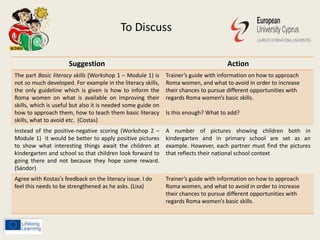
Suggestion Action
The part Basic literacy skills (Workshop 1 – Module 1) is
not so much developed. For example in the literacy skills,
the only guideline which is given is how to inform the
Roma women on what is available on improving their
skills, which is useful but also it is needed some guide on
how to approach them, how to teach them basic literacy
skills, what to avoid etc. (Costas)
Trainer’s guide with information on how to approach
Roma women, and what to avoid in order to increase
their chances to pursue different opportunities with
regards Roma women’s basic skills.
Is this enough? What to add?
Instead of the positive-negative scoring (Workshop 2 –
Module 1) it would be better to apply positive pictures
to show what interesting things await the children at
kindergarten and school so that children look forward to
going there and not because they hope some reward.
(Sándor)
A number of pictures showing children both in
kindergarten and in primary school are set as an
example. However, each partner must find the pictures
that reflects their national school context
Agree with Kostas's feedback on the literacy issue. I do
feel this needs to be strengthened as he asks. (Lisa)
Trainer’s guide with information on how to approach
Roma women, and what to avoid in order to increase
their chances to pursue different opportunities with
regards Roma women’s basic skills.
To Discuss
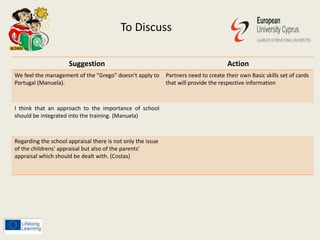
Suggestion Action
We feel the management of the "Grego" doesn't apply to
Portugal (Manuela).
Partners need to create their own Basic skills set of cards
that will provide the respective information
I think that an approach to the importance of school
should be integrated into the training. (Manuela)
Regarding the school appraisal there is not only the issue
of the childrens' appraisal but also of the parents'
appraisal which should be dealt with. (Costas)

Presentation of training methodology

  • 1.
    Presentation of the TrainingMethodology Lisbon, 8 July 2013
  • 2.
    Recommended Summative andComparative Report outcomes which constituted the basis for the development of the Training Methodology manual Basic literacy and other skills School necessary procedures and obligations Directions and information for specific services Directions and information on parents’ involvement in school Information on how to deal with stress and anxiety as well as how to recognise and overcome discrimination Increase students’ self learning Activation and empowerment of Roma parents
  • 3.
    Training Methodology Manual “Practice-orientedand propose relevant methods that could be used by the Roma women to increase the school performance of their children and prevent early school leaving such as games, story-telling, useful tips for pressure management etc.” (SEDRIN’s Description of the Project p. 44) it is suggested that the Training Methodology manual is used selectively, in a flexible way and the trainers are encouraged to select modules and topics which best suit Roma needs in each of the countries’ context. They will, therefore, need to make choice between some activities/and or adopt some that do not apply in their context in a way that they are more content specific.
  • 4.
    Training Methodology Manual TheTraining Methodology manual is based on the example of Cyprus Partners need to create in some modules their own information that will provide the respective local information
  • 5.
    Training Methodology Manual Iscomposed of two workshops: Workshop I Provides Roma woman with all the information, directions and assistance to support their children to go to school, as well as to acknowledge Roma women’s necessary presence in the school involvement process if aiming to ensure longer term retention of Roma children in school. Workshop II Enhances Roma’s children school attendance by praising the school importance and increasing students’ self-learning through games and stories.
  • 6.
    Training Methodology Manual WorkshopI ACTIVATION AND EMPOWERMENT OF ROMA WOMEN Module 1: Basic and general skills and support Basic skills (set of cards) Directions and information for specific services (set of cards) Module 2: School support School procedures and obligations (booklet) Involvement in school (booklet)
  • 7.
    Training Methodology Manual WORKSHOPII EMPOWERMENT OF ROMA CHILDREN Module 1: Appraisal of school importance Attending school regularly (story, pictures, games) Reading and homework (games) Pressure management (tips) Discrimination and bullying (stories, tips) Module 2: Increase of students’ self learning Students‘ self learning (tips)
  • 8.
    Training Methodology Manual ConcludingProposed Activity The training suggested in the manual might take place in various locations depending on the facilities of the partners, and in most cases not in schools. What is lacking is the trained Roma women to have immediate, personal and informal acquaintance with the school environment as such. Based on each partner’s training provider contacts and links to kindergarten, primary schools, and institutions that Roma children attend, the trained Roma women could be guided to visit the school and meet with the principal and the teacher staff etc (e.g.. through a guided visit). Also, if this is possible in a joint activity with non-Roma women and parents. The possible contribution of the Parents’ Association could be considered.
  • 9.
    To Discuss  Todiscuss the option to have separate appendixes on a more context specific base; each partner develops his/her own appendixes  To discuss more topics or modules on a more context specific base (in that case the partners will developed the topics or modules). Sandor’s feedback as an example  In Workshop 2, Module 1 the positive pictures showing children both in kindergarten and in primary school are set as an example. Each partner must find the pictures that reflects their national school context  Ideas for songs that can assist our purpose  In Workshop 2, Module 1 discuss the ‘red’ and ‘blue’ stamp technique in relation with the punishment idea
  • 10.
    To Discuss Suggestion Action Thepart Basic literacy skills (Workshop 1 – Module 1) is not so much developed. For example in the literacy skills, the only guideline which is given is how to inform the Roma women on what is available on improving their skills, which is useful but also it is needed some guide on how to approach them, how to teach them basic literacy skills, what to avoid etc. (Costas) Trainer’s guide with information on how to approach Roma women, and what to avoid in order to increase their chances to pursue different opportunities with regards Roma women’s basic skills. Is this enough? What to add? Instead of the positive-negative scoring (Workshop 2 – Module 1) it would be better to apply positive pictures to show what interesting things await the children at kindergarten and school so that children look forward to going there and not because they hope some reward. (Sándor) A number of pictures showing children both in kindergarten and in primary school are set as an example. However, each partner must find the pictures that reflects their national school context Agree with Kostas's feedback on the literacy issue. I do feel this needs to be strengthened as he asks. (Lisa) Trainer’s guide with information on how to approach Roma women, and what to avoid in order to increase their chances to pursue different opportunities with regards Roma women’s basic skills.
  • 11.
    To Discuss Suggestion Action Wefeel the management of the "Grego" doesn't apply to Portugal (Manuela). Partners need to create their own Basic skills set of cards that will provide the respective information I think that an approach to the importance of school should be integrated into the training. (Manuela) Regarding the school appraisal there is not only the issue of the childrens' appraisal but also of the parents' appraisal which should be dealt with. (Costas)