This presentation explores the essential
definition, classification, and
applications of turbomachines,
emphasizing their significance in
engineering and fluid systems within
various industries.
Introduction to
Turbomachines
BARISO BINO
Turbomachines are essential devices that transfer energy between a rotor
and a fluid, facilitating mechanical work. Their significance in engineering
spans various applications, from power generation to aerospace. This
presentation will explore their definitions, classifications, applications, and
underlying principles, equipping the audience with a robust understanding of
turbomachines.
Introduction to
Turbomachines:
Setting the Stage
UNDERSTANDING THE DEFINITION AND IMPORTANCE OF
ENERGY TRANSFER DEVICES
"Turbomachines
are the heart of
modern energy
systems."
– UNKNOWN
A vital perspective
Definition and
Classification of
Turbomachines
UNDERSTANDING TYPES AND ENERGY TRANSFER
MECHANISMS IN ENGINEERING
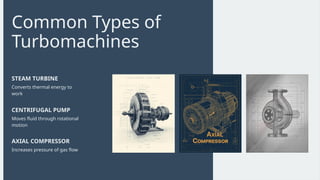
Common Types of
Turbomachines
Converts thermal energy to
work
STEAM TURBINE
Moves fluid through rotational
motion
CENTRIFUGAL PUMP
Increases pressure of gas flow
AXIAL COMPRESSOR
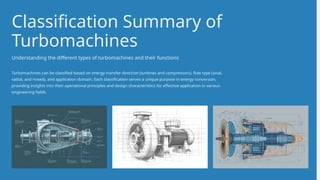
Turbomachines can be classified based on energy transfer direction (turbines and compressors), flow type (axial,
radial, and mixed), and application domain. Each classification serves a unique purpose in energy conversion,
providing insights into their operational principles and design characteristics for effective application in various
engineering fields.
Classification Summary of
Turbomachines
Understanding the different types of turbomachines and their functions
In the aerospace industry, turbomachines are essential for
propulsion and energy management. Jet engines utilize gas turbines
for thrust, while compressors maintain airflow, contributing to
efficient flight operations and enhancing overall aircraft
performance.
AEROSPACE INDUSTRY
In the automotive sector, turbomachines such as turbochargers
improve engine performance by increasing air intake, leading to
enhanced combustion efficiency. This technology not only boosts
power output but also minimizes emissions, contributing to greener
automotive solutions.
AUTOMOTIVE APPLICATIONS
Turbomachines play a crucial role in power generation, converting
kinetic energy from fluids into mechanical energy. Gas turbines and
steam turbines are widely used in power plants, providing efficient
energy extraction from varying sources, including fossil fuels and
renewables.
POWER GENERATION
Turbomachines are integral to HVAC systems, ensuring effective
climate control in buildings. Centrifugal fans and chillers circulate air
and manage temperature, enhancing comfort and energy efficiency
in residential and commercial spaces.
HVAC SYSTEMS
Real-World Applications of
Turbomachines
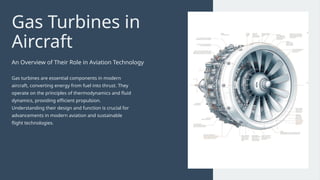
Gas Turbines in
Aircraft
An Overview of Their Role in Aviation Technology
Gas turbines are essential components in modern
aircraft, converting energy from fuel into thrust. They
operate on the principles of thermodynamics and fluid
dynamics, providing efficient propulsion.
Understanding their design and function is crucial for
advancements in modern aviation and sustainable
flight technologies.
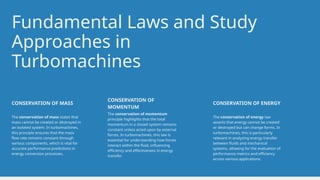
Fundamental Laws and Study
Approaches in
Turbomachines
The conservation of mass states that
mass cannot be created or destroyed in
an isolated system. In turbomachines,
this principle ensures that the mass
flow rate remains constant through
various components, which is vital for
accurate performance predictions in
energy conversion processes.
CONSERVATION OF MASS
The conservation of momentum
principle highlights that the total
momentum in a closed system remains
constant unless acted upon by external
forces. In turbomachines, this law is
essential for understanding how forces
interact within the fluid, influencing
efficiency and effectiveness in energy
transfer.
CONSERVATION OF
MOMENTUM
The conservation of energy law
asserts that energy cannot be created
or destroyed but can change forms. In
turbomachines, this is particularly
relevant in analyzing energy transfer
between fluids and mechanical
systems, allowing for the evaluation of
performance metrics and efficiency
across various applications.
CONSERVATION OF ENERGY
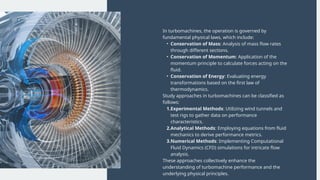
In turbomachines, the operation is governed by
fundamental physical laws, which include:
• Conservation of Mass: Analysis of mass flow rates
through different sections.
• Conservation of Momentum: Application of the
momentum principle to calculate forces acting on the
fluid.
• Conservation of Energy: Evaluating energy
transformations based on the first law of
thermodynamics.
Study approaches in turbomachines can be classified as
follows:
1.Experimental Methods: Utilizing wind tunnels and
test rigs to gather data on performance
characteristics.
2.Analytical Methods: Employing equations from fluid
mechanics to derive performance metrics.
3.Numerical Methods: Implementing Computational
Fluid Dynamics (CFD) simulations for intricate flow
analysis.
These approaches collectively enhance the
understanding of turbomachine performance and the
underlying physical principles.
Fundamental
Equations of Energy
Transfer
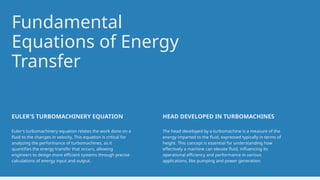
Euler's turbomachinery equation relates the work done on a
fluid to the changes in velocity. This equation is critical for
analyzing the performance of turbomachines, as it
quantifies the energy transfer that occurs, allowing
engineers to design more efficient systems through precise
calculations of energy input and output.
EULER'S TURBOMACHINERY EQUATION
The head developed by a turbomachine is a measure of the
energy imparted to the fluid, expressed typically in terms of
height. This concept is essential for understanding how
effectively a machine can elevate fluid, influencing its
operational efficiency and performance in various
applications, like pumping and power generation.
HEAD DEVELOPED IN TURBOMACHINES
Energy Transfer
Equations in
Turbomachines
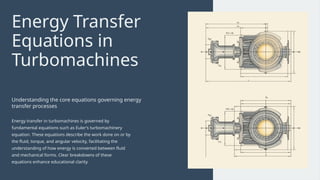
Understanding the core equations governing energy
transfer processes
Energy transfer in turbomachines is governed by
fundamental equations such as Euler’s turbomachinery
equation. These equations describe the work done on or by
the fluid, torque, and angular velocity, facilitating the
understanding of how energy is converted between fluid
and mechanical forms. Clear breakdowns of these
equations enhance educational clarity.
Dimensional Analysis
in Turbomachines
KEY DIMENSIONLESS NUMBERS AND THEIR APPLICATIONS IN
DESIGN AND TESTING
The Mach number is the ratio of the speed of a fluid to the speed of
sound in that fluid. It is particularly important in turbomachinery
operating at high speeds, as it helps assess compressibility effects
and aerodynamic performance, influencing design and operational
parameters.
MACH NUMBER
The flow coefficient quantifies the relationship between the actual
flow rate and the theoretical flow rate through a turbomachine. This
dimensionless number is essential for evaluating performance and
efficiency, allowing designers to optimize fluid handling and energy
transfer in various applications.
FLOW COEFFICIENT
The Reynolds number is a dimensionless quantity that characterizes
the flow regime of a fluid. It compares inertial forces to viscous
forces and helps predict flow patterns in different scenarios. This
number is crucial in determining whether flow is laminar or turbulent
in turbomachines.
REYNOLDS NUMBER
Specific speed is a dimensionless parameter that describes the
geometric similarity and performance characteristics of
turbomachines. It provides insight into the efficiency and operational
range of pumps and turbines. This number aids engineers in
selecting appropriate designs for specific applications.
SPECIFIC SPEED
Dimensional Analysis in Turbomachines:
Key Dimensionless Numbers
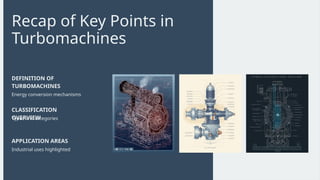
Recap of Key Points in
Turbomachines
Energy conversion mechanisms
DEFINITION OF
TURBOMACHINES
Types and categories
CLASSIFICATION
OVERVIEW
Industrial uses highlighted
APPLICATION AREAS
Thank You for Your
Attention
reallygreatsite.com
WEBSITE
123-456-7890
PHONE NUMBER
hello@reallygreatsite.com
EMAIL ADDRESS


Presentation - Introduction to Turbomachineries.pptx

  • 1.
    This presentation exploresthe essential definition, classification, and applications of turbomachines, emphasizing their significance in engineering and fluid systems within various industries. Introduction to Turbomachines BARISO BINO
  • 2.
    Turbomachines are essentialdevices that transfer energy between a rotor and a fluid, facilitating mechanical work. Their significance in engineering spans various applications, from power generation to aerospace. This presentation will explore their definitions, classifications, applications, and underlying principles, equipping the audience with a robust understanding of turbomachines. Introduction to Turbomachines: Setting the Stage UNDERSTANDING THE DEFINITION AND IMPORTANCE OF ENERGY TRANSFER DEVICES
  • 3.
    "Turbomachines are the heartof modern energy systems." – UNKNOWN A vital perspective
  • 4.
    Definition and Classification of Turbomachines UNDERSTANDINGTYPES AND ENERGY TRANSFER MECHANISMS IN ENGINEERING
  • 5.
    Common Types of Turbomachines Convertsthermal energy to work STEAM TURBINE Moves fluid through rotational motion CENTRIFUGAL PUMP Increases pressure of gas flow AXIAL COMPRESSOR
  • 6.
    Turbomachines can beclassified based on energy transfer direction (turbines and compressors), flow type (axial, radial, and mixed), and application domain. Each classification serves a unique purpose in energy conversion, providing insights into their operational principles and design characteristics for effective application in various engineering fields. Classification Summary of Turbomachines Understanding the different types of turbomachines and their functions
  • 7.
    In the aerospaceindustry, turbomachines are essential for propulsion and energy management. Jet engines utilize gas turbines for thrust, while compressors maintain airflow, contributing to efficient flight operations and enhancing overall aircraft performance. AEROSPACE INDUSTRY In the automotive sector, turbomachines such as turbochargers improve engine performance by increasing air intake, leading to enhanced combustion efficiency. This technology not only boosts power output but also minimizes emissions, contributing to greener automotive solutions. AUTOMOTIVE APPLICATIONS Turbomachines play a crucial role in power generation, converting kinetic energy from fluids into mechanical energy. Gas turbines and steam turbines are widely used in power plants, providing efficient energy extraction from varying sources, including fossil fuels and renewables. POWER GENERATION Turbomachines are integral to HVAC systems, ensuring effective climate control in buildings. Centrifugal fans and chillers circulate air and manage temperature, enhancing comfort and energy efficiency in residential and commercial spaces. HVAC SYSTEMS Real-World Applications of Turbomachines
  • 8.
    Gas Turbines in Aircraft AnOverview of Their Role in Aviation Technology Gas turbines are essential components in modern aircraft, converting energy from fuel into thrust. They operate on the principles of thermodynamics and fluid dynamics, providing efficient propulsion. Understanding their design and function is crucial for advancements in modern aviation and sustainable flight technologies.
  • 9.
    Fundamental Laws andStudy Approaches in Turbomachines The conservation of mass states that mass cannot be created or destroyed in an isolated system. In turbomachines, this principle ensures that the mass flow rate remains constant through various components, which is vital for accurate performance predictions in energy conversion processes. CONSERVATION OF MASS The conservation of momentum principle highlights that the total momentum in a closed system remains constant unless acted upon by external forces. In turbomachines, this law is essential for understanding how forces interact within the fluid, influencing efficiency and effectiveness in energy transfer. CONSERVATION OF MOMENTUM The conservation of energy law asserts that energy cannot be created or destroyed but can change forms. In turbomachines, this is particularly relevant in analyzing energy transfer between fluids and mechanical systems, allowing for the evaluation of performance metrics and efficiency across various applications. CONSERVATION OF ENERGY
  • 10.
    In turbomachines, theoperation is governed by fundamental physical laws, which include: • Conservation of Mass: Analysis of mass flow rates through different sections. • Conservation of Momentum: Application of the momentum principle to calculate forces acting on the fluid. • Conservation of Energy: Evaluating energy transformations based on the first law of thermodynamics. Study approaches in turbomachines can be classified as follows: 1.Experimental Methods: Utilizing wind tunnels and test rigs to gather data on performance characteristics. 2.Analytical Methods: Employing equations from fluid mechanics to derive performance metrics. 3.Numerical Methods: Implementing Computational Fluid Dynamics (CFD) simulations for intricate flow analysis. These approaches collectively enhance the understanding of turbomachine performance and the underlying physical principles.
  • 11.
    Fundamental Equations of Energy Transfer Euler'sturbomachinery equation relates the work done on a fluid to the changes in velocity. This equation is critical for analyzing the performance of turbomachines, as it quantifies the energy transfer that occurs, allowing engineers to design more efficient systems through precise calculations of energy input and output. EULER'S TURBOMACHINERY EQUATION The head developed by a turbomachine is a measure of the energy imparted to the fluid, expressed typically in terms of height. This concept is essential for understanding how effectively a machine can elevate fluid, influencing its operational efficiency and performance in various applications, like pumping and power generation. HEAD DEVELOPED IN TURBOMACHINES
  • 12.
    Energy Transfer Equations in Turbomachines Understandingthe core equations governing energy transfer processes Energy transfer in turbomachines is governed by fundamental equations such as Euler’s turbomachinery equation. These equations describe the work done on or by the fluid, torque, and angular velocity, facilitating the understanding of how energy is converted between fluid and mechanical forms. Clear breakdowns of these equations enhance educational clarity.
  • 13.
    Dimensional Analysis in Turbomachines KEYDIMENSIONLESS NUMBERS AND THEIR APPLICATIONS IN DESIGN AND TESTING
  • 14.
    The Mach numberis the ratio of the speed of a fluid to the speed of sound in that fluid. It is particularly important in turbomachinery operating at high speeds, as it helps assess compressibility effects and aerodynamic performance, influencing design and operational parameters. MACH NUMBER The flow coefficient quantifies the relationship between the actual flow rate and the theoretical flow rate through a turbomachine. This dimensionless number is essential for evaluating performance and efficiency, allowing designers to optimize fluid handling and energy transfer in various applications. FLOW COEFFICIENT The Reynolds number is a dimensionless quantity that characterizes the flow regime of a fluid. It compares inertial forces to viscous forces and helps predict flow patterns in different scenarios. This number is crucial in determining whether flow is laminar or turbulent in turbomachines. REYNOLDS NUMBER Specific speed is a dimensionless parameter that describes the geometric similarity and performance characteristics of turbomachines. It provides insight into the efficiency and operational range of pumps and turbines. This number aids engineers in selecting appropriate designs for specific applications. SPECIFIC SPEED Dimensional Analysis in Turbomachines: Key Dimensionless Numbers
  • 15.
    Recap of KeyPoints in Turbomachines Energy conversion mechanisms DEFINITION OF TURBOMACHINES Types and categories CLASSIFICATION OVERVIEW Industrial uses highlighted APPLICATION AREAS
  • 16.
    Thank You forYour Attention reallygreatsite.com WEBSITE 123-456-7890 PHONE NUMBER hello@reallygreatsite.com EMAIL ADDRESS