MOLECULAR
ORBITAL THEORY
BY-HIMANSHI SONI
B.Sc I Semester
INDEX
1. INTRODUCTION
2. POSTULATES OF MOT
3. TYPES OF MOT
4. DIFFERENCE B/W SIGMA AND PI BONDS.
5. LCAO
INTRODUCTION
• Initially developed by Robert S. Mullikan.
• The bonding between atom is described.
• Allow one to predict the distribution of electrons in molecules.
POSTULATES
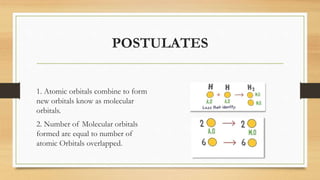
1. Atomic orbitals combine to form
new orbitals know as molecular
orbitals.
2. Number of Molecular orbitals
formed are equal to number of
atomic Orbitals overlapped.
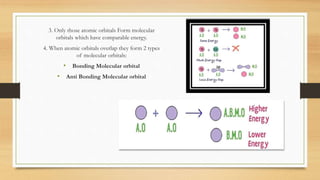
3. Only those atomic orbitals Form molecular
orbitals which have comparable energy.
4. When atomic orbitals overlap they form 2 types
of molecular orbitals:
• Bonding Molecular orbital
• Anti Bonding Molecular orbital
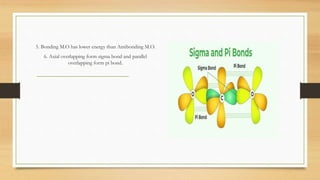
5. Bonding M.O has lower energy than Antibonding M.O.
6. Axial overlapping form sigma bond and parallel
overlapping form pi bond.
TYPES OF MOT:
Bonding molecular orbitals
• BMO are a type of molecular
orbitals that are involved in the
formation of a chemical bond.
• Electron density is higher.
• Energy is comparatively lower.
Antibonding molecular orbitals
• ABMO are orbitals containing
electrons outside the region
between two atomic nuclei.
• Electron density is lower.
• Energy is comparatively higher.
DIFFERENCE BETWEEN SIGMA AND
PI BONDS
Sigma Bonds
• These are formed Bonds axial
overlapping of half filled atomic
orbitals of atom.
• Exist independently.
• Stronger than pi bonds.
Pi Bonds
• These are formed by the lateral
overlapping of half filled atomic
orbitals of atom.
• Exist along with sigma bond.
• Not as strong as pi bonds.
LINEAR COMBINATION OF ATOMIC
ORBITALS (LCAO)
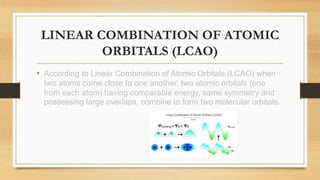
• According to Linear Combination of Atomic Orbitals (LCAO) when
two atoms come close to one another, two atomic orbitals (one
from each atom) having comparable energy, same symmetry and
possessing large overlaps, combine to form two molecular orbitals.
Presentation for molecular orbital theory pptx

Presentation for molecular orbital theory pptx

  • 1.
  • 2.
    INDEX 1. INTRODUCTION 2. POSTULATESOF MOT 3. TYPES OF MOT 4. DIFFERENCE B/W SIGMA AND PI BONDS. 5. LCAO
  • 3.
    INTRODUCTION • Initially developedby Robert S. Mullikan. • The bonding between atom is described. • Allow one to predict the distribution of electrons in molecules.
  • 4.
    POSTULATES 1. Atomic orbitalscombine to form new orbitals know as molecular orbitals. 2. Number of Molecular orbitals formed are equal to number of atomic Orbitals overlapped.
  • 5.
    3. Only thoseatomic orbitals Form molecular orbitals which have comparable energy. 4. When atomic orbitals overlap they form 2 types of molecular orbitals: • Bonding Molecular orbital • Anti Bonding Molecular orbital
  • 6.
    5. Bonding M.Ohas lower energy than Antibonding M.O. 6. Axial overlapping form sigma bond and parallel overlapping form pi bond.
  • 7.
    TYPES OF MOT: Bondingmolecular orbitals • BMO are a type of molecular orbitals that are involved in the formation of a chemical bond. • Electron density is higher. • Energy is comparatively lower. Antibonding molecular orbitals • ABMO are orbitals containing electrons outside the region between two atomic nuclei. • Electron density is lower. • Energy is comparatively higher.
  • 8.
    DIFFERENCE BETWEEN SIGMAAND PI BONDS Sigma Bonds • These are formed Bonds axial overlapping of half filled atomic orbitals of atom. • Exist independently. • Stronger than pi bonds. Pi Bonds • These are formed by the lateral overlapping of half filled atomic orbitals of atom. • Exist along with sigma bond. • Not as strong as pi bonds.
  • 9.
    LINEAR COMBINATION OFATOMIC ORBITALS (LCAO) • According to Linear Combination of Atomic Orbitals (LCAO) when two atoms come close to one another, two atomic orbitals (one from each atom) having comparable energy, same symmetry and possessing large overlaps, combine to form two molecular orbitals.