Assessing Reading
Basic Typesof
Reading
Characteristics
Perceptive Involve attending to letters, words, punctuation, etc.
Bottom-up processing is implied.
Selective Stimuli include sentences, brief paragraphs, and
simple charts and graphs. Brief responses are
intended as well. Bottom-up and top-down
processing may be used.
Interactive Descriptions, excerpts from longer texts, directions,
recipes, etc. are used in interactive reading. The focus
of interactive tasks is to identify relevant features
(lexical, symbolic, grammatical, and discourse)
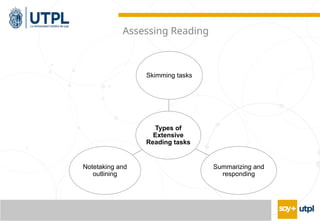
Extensive The purpose is to tap into a learner’s global
understanding of a text.
3.
Assessing Reading
Perceptive
Recognition ofalphabetic symbols,
capitalized and lowercase letters,
punctuation, and grapheme-
phoneme correspondence is
implied in perceptive reading
tasks.
Examples:
- Read aloud
- Picture-cued tasks
- Multiple-choice
- Written responses
4.
Assessing Reading
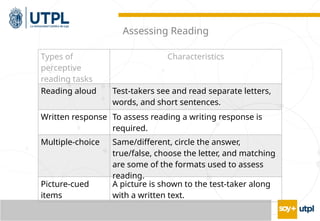
Types of
perceptive
readingtasks
Characteristics
Reading aloud Test-takers see and read separate letters,
words, and short sentences.
Written response To assess reading a writing response is
required.
Multiple-choice Same/different, circle the answer,
true/false, choose the letter, and matching
are some of the formats used to assess
reading.
Picture-cued
items
A picture is shown to the test-taker along
with a written text.
Assessing Reading
Types ofselective
reading tasks
Characteristics
Multiple-choice They serve as vocabulary and grammar check.
Matching tasks The test-taker task is to respond correctly. The most
frequently appearing criterion in matching procedures is
vocabulary.
Editing tasks Editing for grammatical or rhetorical errors. Test-takers
discern errors in written passages.
Picture-cued tasks Test-takers read a sentence or passage and choose one of
the pictures that is being described.
Gap-filling tasks The test-taker response is to write a word or phrase.
7.
Assessing Reading
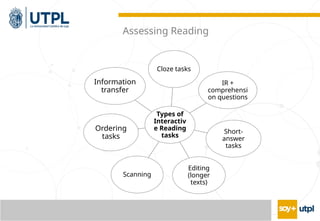
Types of
Interactiv
eReading
tasks
Cloze tasks
IR +
comprehensi
on questions
Short-
answer
tasks
Editing
(longer
texts)
Scanning
Ordering
tasks
Information
transfer
References
Brown, D. &Abeywickrama, P. (2019). Language Assessment: Principles
and Classroom Practices. (3rd. Ed.). White Plains, NY:Pearson Education,
Inc.
Assessing Reading