Identifying Target
Audiences
Alyssa Galvez, Andrea Mitchell, Noelle Brooks,
Andrey Zuniga
Key Terms
• Target Audience :" a group of consumers that a company has decided to
organize its marketing strategies to reach with their message"
• Personas: simplify the audience into groups to make it easier to
approach/understand them through social media marketing.
• Demographics: age, level of Internet expertise, spending habits.
• Constraints : technological, language, ,vision.
• Needs and wants: challenges facing persona/ solutions offered to a real life
consumer.
Persona
Development Cycle
• Identify Persona roles.
• List needs, situational triggers and
concerns, symptoms as well as problems.
• Create messaging objectives
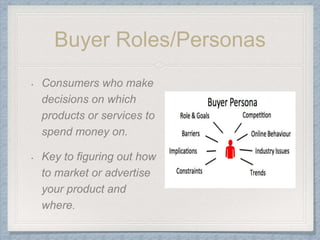
Buyer Roles/Personas
• Consumers who make
decisions on which
products or services to
spend money on.
• Key to figuring out how
to market or advertise
your product and
where.
Situational Triggers
• Gaining perspective of
each persona and
thinking about
concerns, problems
and needs an individual
might face.
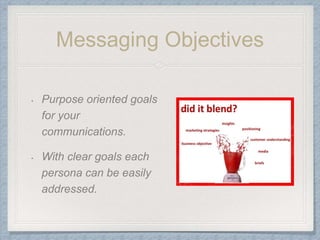
Messaging Objectives
• Purpose oriented goals
for your
communications.
• With clear goals each
persona can be easily
addressed.
Determining Optimal
Target Audience
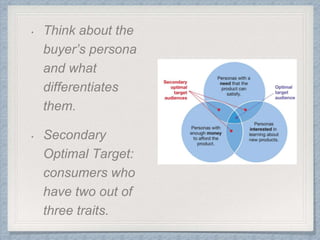
• Think about the
buyer’s persona
and what
differentiates
them.
• Secondary
Optimal Target:
consumers who
have two out of
three traits.
Example of Persona
Development
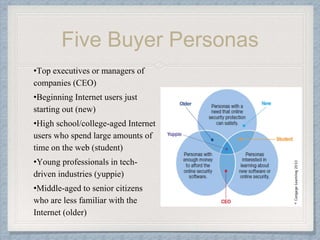
•Top executives or managers of
companies (CEO)
•Beginning Internet users just
starting out (new)
•High school/college-aged Internet
users who spend large amounts of
time on the web (student)
•Young professionals in tech-
driven industries (yuppie)
•Middle-aged to senior citizens
who are less familiar with the
Internet (older)
Five Buyer Personas
Developing
Specificity Within
Personas
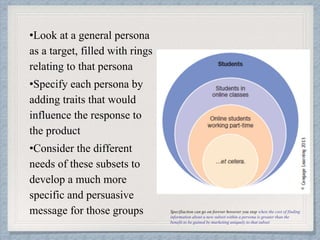
•Look at a general persona
as a target, filled with rings
relating to that persona
•Specify each persona by
adding traits that would
influence the response to
the product
•Consider the different
needs of these subsets to
develop a much more
specific and persuasive
message for those groups Specifiaction can go on forever however you stop when the cost of finding
information about a new subset within a persona is greater than the
benefit to be gained by marketing uniquely to that subset
The Social
Technographics
Profile
What is it?
The most influential methodology for
creating social personas.
•Forrester Research surveys consumers
Uses demographics to identify social
media users into personas based on
their activity online
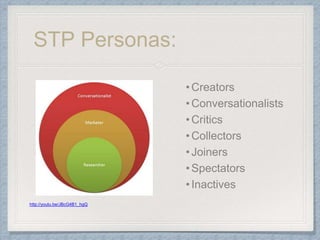
STP Personas:
• Creators
• Conversationalists
• Critics
• Collectors
• Joiners
• Spectators
• Inactives
http://youtu.be/JBcG4B1_hgQ
Research Findings
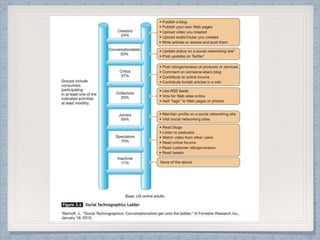
•Generation Y holds largest group of Creators
•37% of consumers ranging from 18-29yrs old
•Most active in creating videos, blogs, articles,
discussion and forum text etc
•Ladder reveals not only WHAT people are doing
on the social web but WHERE they are doing it
•Helps marketers know where to aim and the
helps create the aim
Colgate Case-Study
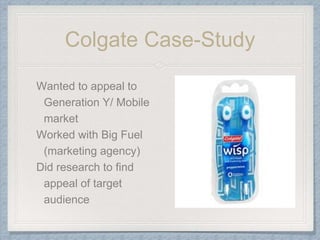
Wanted to appeal to
Generation Y/ Mobile
market
Worked with Big Fuel
(marketing agency)
Did research to find
appeal of target
audience
Colgate Case-Study
Developed a Be More Kissable website
• Attached a bunch of irrelevant videos to grab attention,
used celebrity endorsers, and how-to, comedy, and
talk show videos
Be The Face contest
• Widgets to be shared through MySpace Facebook and
the ColgateWisp site.
• Option through the contest to invite friends to be a part
of the contest and vote for contestants
• Developed app with Spin the Wisp
Where is the
Audience
Participating Online?
Social Technographics Profiles “where”
Social Technographics Ladder helps
locate answers to:
• What news sites do members of target audience go?
• What discussion forums do they participate in?
• What social networks are they active on?
• What sharing sites are they active on?
• Are there significant social groups on these sites?
• Are there niche online groups that the target audience is part of?
• What blogs do they read?
• Who are influential bloggers?
• Who is influential on Twitter?
• Who are the community leaders?
• Are they members of organizations
• What social news sites are they a part of?
What Does The
Audience Talk
About?
Personas enable organizations to locate its target market on the
social web and gain understanding of how the target audience
participants.
• It is critical to understand what personas, such as creators,
conversationalist, and critics, frequently talk about online.
• What are the subject areas they are passionate about?
• What videos,posts, articles, and comments get the most
comments.
• Knowing what the target audience wants to talk about is crucial to
creating content that its members will respond to.
Importance of Personas
Understanding Your Audience
-Once you understand who the target audience is, where it spends its time
online, and what it is interested in talking about, the next important need is
to understand how they talk to each other.
-It is necessary to fit in with the conversations and to sound “natural”
-It is important to be able to relate to the target audience, using language
that is familiar and comfortable to its members. Marketing messages that
seem alien and unfamiliar are less likely to be successful.
-Knowing where to find the target audience and understanding how to adapt
the message to make it more appealing to each specific group is important.
Market
Segmentation
LEGO’s Market
Segmentation
The lego group faced the challenge of how to market their LEGO
bricks on the social web.
Eventually The LEGO group was able to change the culture within
the organization, so they could use the web to build
-Relationships with customers
-Generate new product ideas
-Better understand their customers
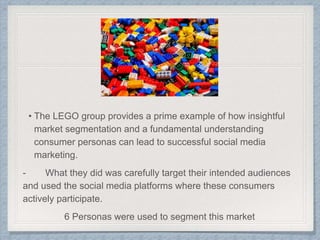
• The LEGO group provides a prime example of how insightful
market segmentation and a fundamental understanding
consumer personas can lead to successful social media
marketing.
- What they did was carefully target their intended audiences
and used the social media platforms where these consumers
actively participate.
6 Personas were used to segment this market
1-Lead users- People LEGO actively engages
with on product design.
2- 1:1 community- people whose names and
address they know
3-Connected community- people who have
bought LEGO, and have been to a LEGO shop
or park.
4-Active households- People who have bought
lego in the last 12 months
5-Covered households- people who have bought
LEGO once
6-All households- those who have never bought
LEGO
In 2010 The lego group became
the world's fourth largest toy
manufacturer, capturing 6.9% of
the global market share of toy
sales and continues to sustain a
high growth rate.
They show a net profit of 688
millions dollars a year.
References
Barker, Melissa S. Barker, Donald Nicholas F
Bormann and Krista Neher. Social Media
Marketing: A strategic Approach. Mason OH:
South Western Cenage Learning. 2013. Print

Presentation 4

  • 1.
    Identifying Target Audiences Alyssa Galvez,Andrea Mitchell, Noelle Brooks, Andrey Zuniga
  • 2.
    Key Terms • TargetAudience :" a group of consumers that a company has decided to organize its marketing strategies to reach with their message" • Personas: simplify the audience into groups to make it easier to approach/understand them through social media marketing. • Demographics: age, level of Internet expertise, spending habits. • Constraints : technological, language, ,vision. • Needs and wants: challenges facing persona/ solutions offered to a real life consumer.
  • 3.
  • 4.
    • Identify Personaroles. • List needs, situational triggers and concerns, symptoms as well as problems. • Create messaging objectives
  • 5.
    Buyer Roles/Personas • Consumerswho make decisions on which products or services to spend money on. • Key to figuring out how to market or advertise your product and where.
  • 6.
    Situational Triggers • Gainingperspective of each persona and thinking about concerns, problems and needs an individual might face.
  • 7.
    Messaging Objectives • Purposeoriented goals for your communications. • With clear goals each persona can be easily addressed.
  • 8.
  • 9.
    • Think aboutthe buyer’s persona and what differentiates them. • Secondary Optimal Target: consumers who have two out of three traits.
  • 10.
  • 11.
    •Top executives ormanagers of companies (CEO) •Beginning Internet users just starting out (new) •High school/college-aged Internet users who spend large amounts of time on the web (student) •Young professionals in tech- driven industries (yuppie) •Middle-aged to senior citizens who are less familiar with the Internet (older) Five Buyer Personas
  • 12.
  • 13.
    •Look at ageneral persona as a target, filled with rings relating to that persona •Specify each persona by adding traits that would influence the response to the product •Consider the different needs of these subsets to develop a much more specific and persuasive message for those groups Specifiaction can go on forever however you stop when the cost of finding information about a new subset within a persona is greater than the benefit to be gained by marketing uniquely to that subset
  • 14.
  • 15.
    What is it? Themost influential methodology for creating social personas. •Forrester Research surveys consumers Uses demographics to identify social media users into personas based on their activity online
  • 16.
    STP Personas: • Creators •Conversationalists • Critics • Collectors • Joiners • Spectators • Inactives http://youtu.be/JBcG4B1_hgQ
  • 18.
    Research Findings •Generation Yholds largest group of Creators •37% of consumers ranging from 18-29yrs old •Most active in creating videos, blogs, articles, discussion and forum text etc •Ladder reveals not only WHAT people are doing on the social web but WHERE they are doing it •Helps marketers know where to aim and the helps create the aim
  • 19.
    Colgate Case-Study Wanted toappeal to Generation Y/ Mobile market Worked with Big Fuel (marketing agency) Did research to find appeal of target audience
  • 20.
    Colgate Case-Study Developed aBe More Kissable website • Attached a bunch of irrelevant videos to grab attention, used celebrity endorsers, and how-to, comedy, and talk show videos Be The Face contest • Widgets to be shared through MySpace Facebook and the ColgateWisp site. • Option through the contest to invite friends to be a part of the contest and vote for contestants • Developed app with Spin the Wisp
  • 21.
    Where is the Audience ParticipatingOnline? Social Technographics Profiles “where”
  • 22.
    Social Technographics Ladderhelps locate answers to: • What news sites do members of target audience go? • What discussion forums do they participate in? • What social networks are they active on? • What sharing sites are they active on? • Are there significant social groups on these sites? • Are there niche online groups that the target audience is part of? • What blogs do they read? • Who are influential bloggers? • Who is influential on Twitter? • Who are the community leaders? • Are they members of organizations • What social news sites are they a part of?
  • 23.
  • 24.
    Personas enable organizationsto locate its target market on the social web and gain understanding of how the target audience participants. • It is critical to understand what personas, such as creators, conversationalist, and critics, frequently talk about online. • What are the subject areas they are passionate about? • What videos,posts, articles, and comments get the most comments. • Knowing what the target audience wants to talk about is crucial to creating content that its members will respond to. Importance of Personas
  • 25.
    Understanding Your Audience -Onceyou understand who the target audience is, where it spends its time online, and what it is interested in talking about, the next important need is to understand how they talk to each other. -It is necessary to fit in with the conversations and to sound “natural” -It is important to be able to relate to the target audience, using language that is familiar and comfortable to its members. Marketing messages that seem alien and unfamiliar are less likely to be successful. -Knowing where to find the target audience and understanding how to adapt the message to make it more appealing to each specific group is important.
  • 26.
  • 27.
    LEGO’s Market Segmentation The legogroup faced the challenge of how to market their LEGO bricks on the social web. Eventually The LEGO group was able to change the culture within the organization, so they could use the web to build -Relationships with customers -Generate new product ideas -Better understand their customers
  • 28.
    • The LEGOgroup provides a prime example of how insightful market segmentation and a fundamental understanding consumer personas can lead to successful social media marketing. - What they did was carefully target their intended audiences and used the social media platforms where these consumers actively participate. 6 Personas were used to segment this market
  • 29.
    1-Lead users- PeopleLEGO actively engages with on product design. 2- 1:1 community- people whose names and address they know 3-Connected community- people who have bought LEGO, and have been to a LEGO shop or park. 4-Active households- People who have bought lego in the last 12 months 5-Covered households- people who have bought LEGO once 6-All households- those who have never bought LEGO In 2010 The lego group became the world's fourth largest toy manufacturer, capturing 6.9% of the global market share of toy sales and continues to sustain a high growth rate. They show a net profit of 688 millions dollars a year.
  • 30.
    References Barker, Melissa S.Barker, Donald Nicholas F Bormann and Krista Neher. Social Media Marketing: A strategic Approach. Mason OH: South Western Cenage Learning. 2013. Print