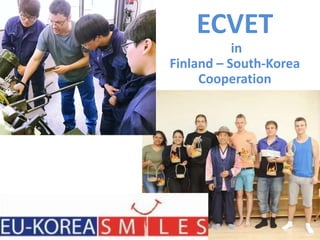
ECVET
in
Finland – South-Korea
Cooperation
ECVET
European Credit system for Vocational Education and Training
• Facilitate the mobility of VET students
across the Europe,
• recognition of learning outcomes
achieved abroad,
• integrate mobility learners’ individual
learning pathways,
• make national qualifications transparent,
• support lifelong learning.
https://youtu.be/M2b_QLVQizQ
The ECVET -processBuilding
Partnership
Develop
understanding
of the
vocational
education and
training system
in both
countries.
Build trust.
Before Student Mobility
• Memorandum of
Understanding (MOU)
• Identify Units of Learning
Outcomes
• Discuss Assessment
• Agree How to Document
Learners' Achievements
• Clarify Validation and
Recognition
• Students sign Learning
Agreement
During mobility
• Provide Learning
Activities
• Carry Out
Assessment
• Document
Assessment
Results - Personal
Transcript
After Mobility
• Validate and
Recognise
Learning
Outcomes
• Evaluate Process
and Results /
Added-value
Before Student Mobility
Building Partnership
Before Student Mobility
Identifying units of learning outcomes
Knowledge, Skills and Competencies
Before Student Mobility
Discussing Assessment
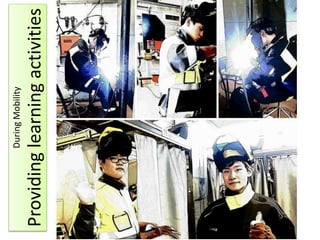
DuringMobility
Providinglearningactivities
During Mobility
Carrying out Assessment and
Documenting it
Welder approval test
certificate
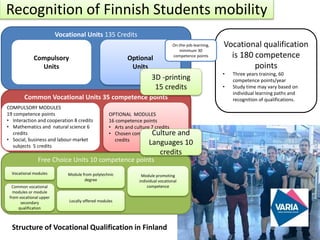
Structure of Vocational Qualification in Finland
Vocational qualification
is 180 competence
points
• Three years training, 60
competence points/year
• Study time may vary based on
individual learning paths and
recognition of qualifications.
Vocational Units 135 Credits
Compulsory
Units
Optional
Units
Common Vocational Units 35 competence points
COMPULSORY MODULES
19 competence points
• Interaction and cooperation 8 credits
• Mathematics and natural science 6
credits
• Social, business and labour-market
subjects 5 credits
OPTIONAL MODULES
16 competence points
• Arts and culture 7 credits
• Chosen compulsory modules 3
credits
On-the-job-learning,
minimum 30
competence points
Free Choice Units 10 competence points
Vocational modules
Common vocational
modules or module
from vocational upper
secondary
qualification
Module promoting
individual vocational
competence
Module from polytechnic
degree
Locally offered modules
Recognition of Finnish Students mobility
3D -printing
15 credits
Culture and
Languages 10
credits
During the Smiles Project we have
• learned how to implement ECVET –process in cooperation
between Finnish and Korean colleges,
• implemented MOU and Learning Agreement -documents,
• made curriculum mapping in technical field of education,
• identifyed expected learning outcomes (skills and
competencies) in welding and machinery,
• agreed about the assessment and how to document it,
• recognized finnish students mobility periods as a part of
their learning pathways.
Conclusion
Thank You
감사합니다
Laila Bröcker
Development Manager
Vantaa Vocational College Varia
Laila.brocker@vantaa.fi

Presentation 26.9. in Daegu

  • 1.
  • 2.
    ECVET European Credit systemfor Vocational Education and Training • Facilitate the mobility of VET students across the Europe, • recognition of learning outcomes achieved abroad, • integrate mobility learners’ individual learning pathways, • make national qualifications transparent, • support lifelong learning. https://youtu.be/M2b_QLVQizQ
  • 3.
    The ECVET -processBuilding Partnership Develop understanding ofthe vocational education and training system in both countries. Build trust. Before Student Mobility • Memorandum of Understanding (MOU) • Identify Units of Learning Outcomes • Discuss Assessment • Agree How to Document Learners' Achievements • Clarify Validation and Recognition • Students sign Learning Agreement During mobility • Provide Learning Activities • Carry Out Assessment • Document Assessment Results - Personal Transcript After Mobility • Validate and Recognise Learning Outcomes • Evaluate Process and Results / Added-value
  • 4.
  • 5.
    Before Student Mobility Identifyingunits of learning outcomes Knowledge, Skills and Competencies
  • 6.
  • 7.
  • 8.
    During Mobility Carrying outAssessment and Documenting it Welder approval test certificate
  • 9.
    Structure of VocationalQualification in Finland Vocational qualification is 180 competence points • Three years training, 60 competence points/year • Study time may vary based on individual learning paths and recognition of qualifications. Vocational Units 135 Credits Compulsory Units Optional Units Common Vocational Units 35 competence points COMPULSORY MODULES 19 competence points • Interaction and cooperation 8 credits • Mathematics and natural science 6 credits • Social, business and labour-market subjects 5 credits OPTIONAL MODULES 16 competence points • Arts and culture 7 credits • Chosen compulsory modules 3 credits On-the-job-learning, minimum 30 competence points Free Choice Units 10 competence points Vocational modules Common vocational modules or module from vocational upper secondary qualification Module promoting individual vocational competence Module from polytechnic degree Locally offered modules Recognition of Finnish Students mobility 3D -printing 15 credits Culture and Languages 10 credits
  • 10.
    During the SmilesProject we have • learned how to implement ECVET –process in cooperation between Finnish and Korean colleges, • implemented MOU and Learning Agreement -documents, • made curriculum mapping in technical field of education, • identifyed expected learning outcomes (skills and competencies) in welding and machinery, • agreed about the assessment and how to document it, • recognized finnish students mobility periods as a part of their learning pathways. Conclusion
  • 11.
    Thank You 감사합니다 Laila Bröcker DevelopmentManager Vantaa Vocational College Varia Laila.brocker@vantaa.fi

Editor's Notes

  • #12 When presenting please do emphasize the fact that the goal of the framework is recognition for the activity undertaken on mobility as part of a course of study. Please also emphasize the importance of the forms we use.