ECVET IN BULGARIA
EUROPEAN CREDI T SYSTEM
FOR VOCATI ONAL EDUCATI ON AND TRAI NI NG
2 0 1 4
Transferring Competences and Promoting ECVET, 2013-1-TR1-LEO04-47973 2
THE EUROPEAN CREDIT SYSTEM
FOR VOCATIONAL EDUCATION AND TRAINING
 is an initiative for the accumulation and
transfer of credits gained through the
recognition of learning outcomes in vocational
education and training (VET)
 developed to facilitate the recognition of
achievements in vocational education and
training, in formal, and where appropriate - non-
formal and informal learning (NFIL)
 aimed to facilitate the mobility of the
workforce in VET across Europe
E C V E T I N B U L G A R I A
Transferring Competences and Promoting ECVET, 2013-1-TR1-LEO04-47973 2
NATIONAL AIMS FOR THE IMPLEMENTATION OF
ECVET IN BULGARIA
 Reform of the VET system through effective and simultaneous
implementation of European instruments such as EQF, ECVET,
ECTS, EQARF, Europass in favour of:
- validation and recognition of qualifications and skills in the
process of lifelong learning;
- increased mobility of VET system;
- relation/interaction between VET and higher education.
 Improvement in the international educational and occupational
mobility of students and adult learners
E C V E T I N B U L G A R I A
Transferring Competences and Promoting ECVET, 2013-1-TR1-LEO04-47973 2
PREREQUISITES FOR ECVET IMPLEMENTATION
 Establishing National Contact Points (NCPs) and national team of
experts for the introduction of ECVET;
 ECVET- experts training;
 Increased awareness and stakeholder support - training institutions,
professional organizations, employers and social partners;
 Informing the general public about ECVET and the benefits of
implementing it;
 Forming and development of “a community of ECVET practitioners”.
E C V E T I N B U L G A R I A
Transferring Competences and Promoting ECVET, 2013-1-TR1-LEO04-47973 2
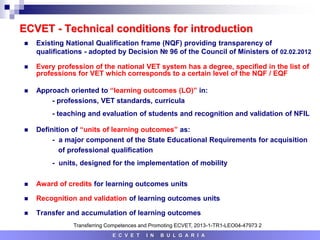
ECVET - Technical conditions for introduction
 Existing National Qualification frame (NQF) providing transparency of
qualifications - adopted by Decision № 96 of the Council of Ministers of 02.02.2012
 Every profession of the national VET system has a degree, specified in the list of
professions for VET which corresponds to a certain level of the NQF / EQF
 Approach oriented to “learning outcomes (LO)” in:
- professions, VET standards, curricula
- teaching and evaluation of students and recognition and validation of NFIL
 Definition of “units of learning outcomes” as:
- a major component of the State Educational Requirements for acquisition
of professional qualification
- units, designed for the implementation of mobility
 Award of credits for learning outcomes units
 Recognition and validation of learning outcomes units
 Transfer and accumulation of learning outcomes
E C V E T I N B U L G A R I A
Transferring Competences and Promoting ECVET, 2013-1-TR1-LEO04-47973 2
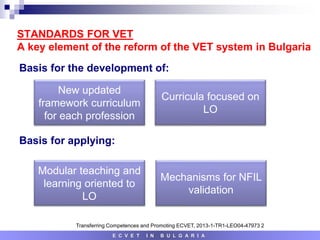
STANDARDS FOR VET
A key element of the reform of the VET system in Bulgaria
Basis for the development of:
Basis for applying:
E C V E T I N B U L G A R I A
Modular teaching and
learning oriented to
LO
Mechanisms for NFIL
validation
New updated
framework curriculum
for each profession
Curricula focused on
LO
Transferring Competences and Promoting ECVET, 2013-1-TR1-LEO04-47973 2
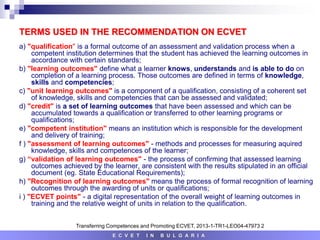
TERMS USED IN THE RECOMMENDATION ON ECVET
a) "qualification" is a formal outcome of an assessment and validation process when a
competent institution determines that the student has achieved the learning outcomes in
accordance with certain standards;
b) "learning outcomes" define what a learner knows, understands and is able to do on
completion of a learning process. Those outcomes are defined in terms of knowledge,
skills and competencies;
c) "unit learning outcomes" is a component of a qualification, consisting of a coherent set
of knowledge, skills and competencies that can be assessed and validated;
d) "credit" is a set of learning outcomes that have been assessed and which can be
accumulated towards a qualification or transferred to other learning programs or
qualifications;
e) "competent institution" means an institution which is responsible for the development
and delivery of training;
f ) "assessment of learning outcomes" - methods and processes for measuring aquired
knowledge, skills and competences of the learner;
g) “validation of learning outcomes" - the process of confirming that assessed learning
outcomes achieved by the learner, are consistent with the results stipulated in an official
document (eg. State Educational Requirements);
h) "Recognition of learning outcomes" means the process of formal recognition of learning
outcomes through the awarding of units or qualifications;
i ) "ECVET points" - a digital representation of the overall weight of learning outcomes in
training and the relative weight of units in relation to the qualification.
E C V E T I N B U L G A R I A
Transferring Competences and Promoting ECVET, 2013-1-TR1-LEO04-47973 2
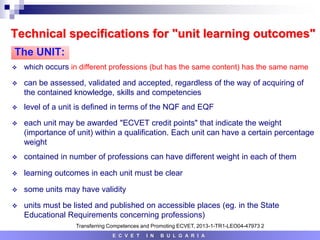
Technical specifications for "unit learning outcomes"
 which occurs in different professions (but has the same content) has the same name
 can be assessed, validated and accepted, regardless of the way of acquiring of
the contained knowledge, skills and competencies
 level of a unit is defined in terms of the NQF and EQF
 each unit may be awarded "ECVET credit points" that indicate the weight
(importance of unit) within a qualification. Each unit can have a certain percentage
weight
 contained in number of professions can have different weight in each of them
 learning outcomes in each unit must be clear
 some units may have validity
 units must be listed and published on accessible places (eg. in the State
Educational Requirements concerning professions)
E C V E T I N B U L G A R I A
The UNIT:
Transferring Competences and Promoting ECVET, 2013-1-TR1-LEO04-47973 2
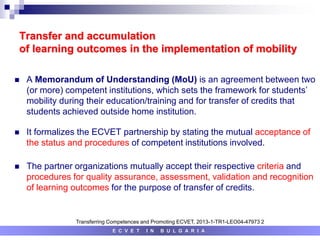
Transfer and accumulation
of learning outcomes in the implementation of mobility
 A Memorandum of Understanding (MoU) is an agreement between two
(or more) competent institutions, which sets the framework for students’
mobility during their education/training and for transfer of credits that
students achieved outside home institution.
 It formalizes the ECVET partnership by stating the mutual acceptance of
the status and procedures of competent institutions involved.
 The partner organizations mutually accept their respective criteria and
procedures for quality assurance, assessment, validation and recognition
of learning outcomes for the purpose of transfer of credits.
E C V E T I N B U L G A R I A
Transferring Competences and Promoting ECVET, 2013-1-TR1-LEO04-47973 2
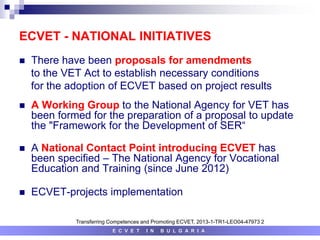
ECVET - NATIONAL INITIATIVES
 There have been proposals for amendments
to the VET Act to establish necessary conditions
for the adoption of ECVET based on project results
 A Working Group to the National Agency for VET has
been formed for the preparation of a proposal to update
the "Framework for the Development of SER“
 A National Contact Point introducing ECVET has
been specified – The National Agency for Vocational
Education and Training (since June 2012)
 ECVET-projects implementation
E C V E T I N B U L G A R I A
Transferring Competences and Promoting ECVET, 2013-1-TR1-LEO04-47973 2
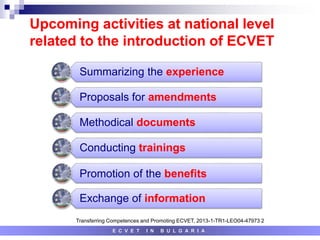
Upcoming activities at national level
related to the introduction of ECVET
E C V E T I N B U L G A R I A
Summarizing the experience
Proposals for amendments
Methodical documents
Conducting trainings
Promotion of the benefits
Exchange of information
Transferring Competences and Promoting ECVET, 2013-1-TR1-LEO04-47973 2
E C V E T I N B U L G A R I A
Transferring Competences and Promoting ECVET, 2013-1-TR1-LEO04-47973 2
For more info about ECVET in:
• Turkey
• Italy
• Portugal and
• Romania
Please, visit: www.turcvet.com
E C V E T I N B U L G A R I A
Transferring Competences and Promoting ECVET, 2013-1-TR1-LEO04-47973 2
This project has been funded with support
from the European Commission. This
presentation reflects the views only of the
author, and the Commission cannot be held
responsible for any use which may be made
of the information contained therein.
T H A N K Y O U
F O R Y O U R A T T E N T I O N !
Transferring Competences and Promoting ECVET, 2013-1-TR1-LEO04-47973 2

ECVET in Bulgaria

  • 1.
    ECVET IN BULGARIA EUROPEANCREDI T SYSTEM FOR VOCATI ONAL EDUCATI ON AND TRAI NI NG 2 0 1 4 Transferring Competences and Promoting ECVET, 2013-1-TR1-LEO04-47973 2
  • 2.
    THE EUROPEAN CREDITSYSTEM FOR VOCATIONAL EDUCATION AND TRAINING  is an initiative for the accumulation and transfer of credits gained through the recognition of learning outcomes in vocational education and training (VET)  developed to facilitate the recognition of achievements in vocational education and training, in formal, and where appropriate - non- formal and informal learning (NFIL)  aimed to facilitate the mobility of the workforce in VET across Europe E C V E T I N B U L G A R I A Transferring Competences and Promoting ECVET, 2013-1-TR1-LEO04-47973 2
  • 3.
    NATIONAL AIMS FORTHE IMPLEMENTATION OF ECVET IN BULGARIA  Reform of the VET system through effective and simultaneous implementation of European instruments such as EQF, ECVET, ECTS, EQARF, Europass in favour of: - validation and recognition of qualifications and skills in the process of lifelong learning; - increased mobility of VET system; - relation/interaction between VET and higher education.  Improvement in the international educational and occupational mobility of students and adult learners E C V E T I N B U L G A R I A Transferring Competences and Promoting ECVET, 2013-1-TR1-LEO04-47973 2
  • 4.
    PREREQUISITES FOR ECVETIMPLEMENTATION  Establishing National Contact Points (NCPs) and national team of experts for the introduction of ECVET;  ECVET- experts training;  Increased awareness and stakeholder support - training institutions, professional organizations, employers and social partners;  Informing the general public about ECVET and the benefits of implementing it;  Forming and development of “a community of ECVET practitioners”. E C V E T I N B U L G A R I A Transferring Competences and Promoting ECVET, 2013-1-TR1-LEO04-47973 2
  • 5.
    ECVET - Technicalconditions for introduction  Existing National Qualification frame (NQF) providing transparency of qualifications - adopted by Decision № 96 of the Council of Ministers of 02.02.2012  Every profession of the national VET system has a degree, specified in the list of professions for VET which corresponds to a certain level of the NQF / EQF  Approach oriented to “learning outcomes (LO)” in: - professions, VET standards, curricula - teaching and evaluation of students and recognition and validation of NFIL  Definition of “units of learning outcomes” as: - a major component of the State Educational Requirements for acquisition of professional qualification - units, designed for the implementation of mobility  Award of credits for learning outcomes units  Recognition and validation of learning outcomes units  Transfer and accumulation of learning outcomes E C V E T I N B U L G A R I A Transferring Competences and Promoting ECVET, 2013-1-TR1-LEO04-47973 2
  • 6.
    STANDARDS FOR VET Akey element of the reform of the VET system in Bulgaria Basis for the development of: Basis for applying: E C V E T I N B U L G A R I A Modular teaching and learning oriented to LO Mechanisms for NFIL validation New updated framework curriculum for each profession Curricula focused on LO Transferring Competences and Promoting ECVET, 2013-1-TR1-LEO04-47973 2
  • 7.
    TERMS USED INTHE RECOMMENDATION ON ECVET a) "qualification" is a formal outcome of an assessment and validation process when a competent institution determines that the student has achieved the learning outcomes in accordance with certain standards; b) "learning outcomes" define what a learner knows, understands and is able to do on completion of a learning process. Those outcomes are defined in terms of knowledge, skills and competencies; c) "unit learning outcomes" is a component of a qualification, consisting of a coherent set of knowledge, skills and competencies that can be assessed and validated; d) "credit" is a set of learning outcomes that have been assessed and which can be accumulated towards a qualification or transferred to other learning programs or qualifications; e) "competent institution" means an institution which is responsible for the development and delivery of training; f ) "assessment of learning outcomes" - methods and processes for measuring aquired knowledge, skills and competences of the learner; g) “validation of learning outcomes" - the process of confirming that assessed learning outcomes achieved by the learner, are consistent with the results stipulated in an official document (eg. State Educational Requirements); h) "Recognition of learning outcomes" means the process of formal recognition of learning outcomes through the awarding of units or qualifications; i ) "ECVET points" - a digital representation of the overall weight of learning outcomes in training and the relative weight of units in relation to the qualification. E C V E T I N B U L G A R I A Transferring Competences and Promoting ECVET, 2013-1-TR1-LEO04-47973 2
  • 8.
    Technical specifications for"unit learning outcomes"  which occurs in different professions (but has the same content) has the same name  can be assessed, validated and accepted, regardless of the way of acquiring of the contained knowledge, skills and competencies  level of a unit is defined in terms of the NQF and EQF  each unit may be awarded "ECVET credit points" that indicate the weight (importance of unit) within a qualification. Each unit can have a certain percentage weight  contained in number of professions can have different weight in each of them  learning outcomes in each unit must be clear  some units may have validity  units must be listed and published on accessible places (eg. in the State Educational Requirements concerning professions) E C V E T I N B U L G A R I A The UNIT: Transferring Competences and Promoting ECVET, 2013-1-TR1-LEO04-47973 2
  • 9.
    Transfer and accumulation oflearning outcomes in the implementation of mobility  A Memorandum of Understanding (MoU) is an agreement between two (or more) competent institutions, which sets the framework for students’ mobility during their education/training and for transfer of credits that students achieved outside home institution.  It formalizes the ECVET partnership by stating the mutual acceptance of the status and procedures of competent institutions involved.  The partner organizations mutually accept their respective criteria and procedures for quality assurance, assessment, validation and recognition of learning outcomes for the purpose of transfer of credits. E C V E T I N B U L G A R I A Transferring Competences and Promoting ECVET, 2013-1-TR1-LEO04-47973 2
  • 10.
    ECVET - NATIONALINITIATIVES  There have been proposals for amendments to the VET Act to establish necessary conditions for the adoption of ECVET based on project results  A Working Group to the National Agency for VET has been formed for the preparation of a proposal to update the "Framework for the Development of SER“  A National Contact Point introducing ECVET has been specified – The National Agency for Vocational Education and Training (since June 2012)  ECVET-projects implementation E C V E T I N B U L G A R I A Transferring Competences and Promoting ECVET, 2013-1-TR1-LEO04-47973 2
  • 11.
    Upcoming activities atnational level related to the introduction of ECVET E C V E T I N B U L G A R I A Summarizing the experience Proposals for amendments Methodical documents Conducting trainings Promotion of the benefits Exchange of information Transferring Competences and Promoting ECVET, 2013-1-TR1-LEO04-47973 2
  • 12.
    E C VE T I N B U L G A R I A Transferring Competences and Promoting ECVET, 2013-1-TR1-LEO04-47973 2 For more info about ECVET in: • Turkey • Italy • Portugal and • Romania Please, visit: www.turcvet.com
  • 13.
    E C VE T I N B U L G A R I A Transferring Competences and Promoting ECVET, 2013-1-TR1-LEO04-47973 2 This project has been funded with support from the European Commission. This presentation reflects the views only of the author, and the Commission cannot be held responsible for any use which may be made of the information contained therein.
  • 14.
    T H AN K Y O U F O R Y O U R A T T E N T I O N ! Transferring Competences and Promoting ECVET, 2013-1-TR1-LEO04-47973 2