How computers can help us in future??? Produced by: Farid Karagah
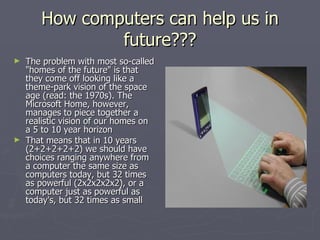
How computers can help us in future??? The problem with most so-called "homes of the future" is that they come off looking like a theme-park vision of the space age (read: the 1970s). The Microsoft Home, however, manages to piece together a realistic vision of our homes on a 5 to 10 year horizon   That means that in 10 years (2+2+2+2+2) we should have choices ranging anywhere from a computer the same size as computers today, but 32 times as powerful (2x2x2x2x2), or a computer just as powerful as today's, but 32 times as small
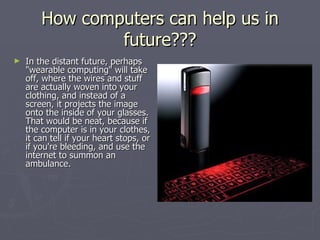
How computers can help us in future??? In the distant future, perhaps "wearable computing" will take off, where the wires and stuff are actually woven into your clothing, and instead of a screen, it projects the image onto the inside of your glasses. That would be neat, because if the computer is in your clothes, it can tell if your heart stops, or if you're bleeding, and use the internet to summon an ambulance.
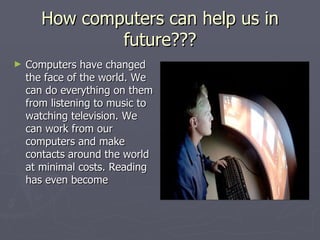
How computers can help us in future??? Computers have changed the face of the world. We can do everything on them from listening to music to watching television. We can work from our computers and make contacts around the world at minimal costs. Reading has even become
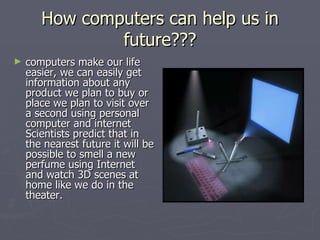
How computers can help us in future??? computers make our life easier, we can easily get information about any product we plan to buy or place we plan to visit over a second using personal computer and internet Scientists predict that in the nearest future it will be possible to smell a new perfume using Internet and watch 3D scenes at home like we do in the theater.
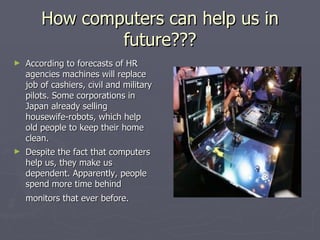
How computers can help us in future??? According to forecasts of HR agencies machines will replace job of cashiers, civil and military pilots. Some corporations in Japan already selling housewife-robots, which help old people to keep their home clean.  Despite the fact that computers help us, they make us dependent. Apparently, people spend more time behind monitors that ever before.

presentation

  • 1.
    How computers canhelp us in future??? Produced by: Farid Karagah
  • 2.
    How computers canhelp us in future??? The problem with most so-called "homes of the future" is that they come off looking like a theme-park vision of the space age (read: the 1970s). The Microsoft Home, however, manages to piece together a realistic vision of our homes on a 5 to 10 year horizon That means that in 10 years (2+2+2+2+2) we should have choices ranging anywhere from a computer the same size as computers today, but 32 times as powerful (2x2x2x2x2), or a computer just as powerful as today's, but 32 times as small
  • 3.
    How computers canhelp us in future??? In the distant future, perhaps "wearable computing" will take off, where the wires and stuff are actually woven into your clothing, and instead of a screen, it projects the image onto the inside of your glasses. That would be neat, because if the computer is in your clothes, it can tell if your heart stops, or if you're bleeding, and use the internet to summon an ambulance.
  • 4.
    How computers canhelp us in future??? Computers have changed the face of the world. We can do everything on them from listening to music to watching television. We can work from our computers and make contacts around the world at minimal costs. Reading has even become
  • 5.
    How computers canhelp us in future??? computers make our life easier, we can easily get information about any product we plan to buy or place we plan to visit over a second using personal computer and internet Scientists predict that in the nearest future it will be possible to smell a new perfume using Internet and watch 3D scenes at home like we do in the theater.
  • 6.
    How computers canhelp us in future??? According to forecasts of HR agencies machines will replace job of cashiers, civil and military pilots. Some corporations in Japan already selling housewife-robots, which help old people to keep their home clean. Despite the fact that computers help us, they make us dependent. Apparently, people spend more time behind monitors that ever before.