Medical Marijuana
      Nick Fitz
Relevance
•   the world’s most popular illicit drug - around
    190 million users worldwide
•   41% of Americans have smoked pot - 26
    million regularly use - multi-billion dollar
    industry - nation’s leading cash crop
•   ~750,000 people are arrested for possession
    of MJ each year - half of all drug abuse
    violations
•   81% of Americans support medical
    legalization and 45% support general
    legalization - popular
•   currently on many states’ agendas
The Problem

• marijuana’s illegality is causing significant
  problems for society
Aspects
• public opinion
• health
• philosophical/moral/ethical
• freedom
• crime, terrorism, and social order
• economic
History
•   Federal Marijuana Act of 1937 - first outlawed

•   Comprehensive Drug Abuse Prevention and
    Control Act of 1970 - National Commission on
    Marijuana - rec’d decriminalization but Nixon shot
    down

•   1972, NORML petitions DEA to downgrade MJ
    from class I

•   1973, Oregon enacts form of decriminalization

•   1982, NIH/NAS begin to study medicinal value

•   1984, Anti-Drug Abuse Act - severe penalties
History
•   1988, Judge Young concludes reclassifying MJ
    to class II (physicians prescribe), but DEA
    rejects
•   1996, CA passes prop. 215 - medical use -
    begins federal tension and intensifies
    economic cost/benefit debate
•   2005, Gonzales v. Raich - congress may ban
    MJ regardless of state legislation
•   now, MJ back on agenda - 10/09 Dept. of
    Justice decision not to prosecute patients
Health
•   the foundation: legitimate medical use - overwhelming
    pro/neutral evidence - but enough political uncertainty to
    stunt action

•   MJ likely has a natural role in pain modulation, appetite,
    control of movement, and memory

•   average potency increased very little since 70s (~3%)

•   in driving studies, MJ may actually reduce the
    responsibility rate and lower crash risk

•   DEA Judge, Young - “In strict medical terms MJ is far safer
    than many foods we commonly consume,” in fact, “MJ in
    its natural form is one of the safest therapeutically active
    substances known to man.”

•   “cannabis poses a much less serious public health
    problem than is currently posed by alcohol and tobacco
    in western societies." - strong policy implications
Health
•   Johns Hopkins - "no significant differences in cognitive decline
    between heavy users, light users, and nonusers of cannabis."

•   the WHO report - "it is doubtful that cannabis use produces a
    well defined amotivational syndrome."

•   the majority of occasional users “will not suffer any lasting
    physical or mental harm” - little evidence that effects persist after
    drug use stops “or that any direct cause and effect relationships
    are involved.”

•   NIH - “marijuana does not have a long-term negative impact on
    global intelligence.”

•   Nat. Com. on MJ and WHO - careful search of the literature/
    testimony of nation’s health officials has not revealed a single
    human fatality in the US proven to have resulted solely from
    ingestion of MJ. Experiments on monkeys conclude that the dose
    required for OD death was enormous and for all practical
    purposes unachievable by humans.
Health
•   "contrary to our expectations, we found no positive
    associations between MJ use and lung or UAT cancers”

•   IOM on “gateway theory”- “there is no conclusive
    evidence that the drug effects of MJ are causally linked to
    the subsequent abuse of other illicit drugs."

•   Nat. Com on MJ - “rather than inducing violent/aggressive
    behavior and weakening impulse control, MJ was found to
    inhibit the expression of aggressive impulses by pacifying
    the user, interfering with muscular coordination, reducing
    psychomotor activities and generally producing states of
    drowsiness lethargy, timidity and passivity."

•   “MJ’s relative potential for harm to the vast majority of
    individual users and its actual impact on society does not
    justify a social policy designed to seek out and firmly
    punish those who use it.”
Philosophical
• ethical argument - response of societal
  context (alcohol/tobacco)
• moral normative argument - danger (real vs
  perceived) - legalization increase control -
  government/collective vs individual
• ontological - personal freedom (John Mill)
  vs constitutional and implicit fundamental
  freedoms
• philosophical critique of decriminalization -
  inappropriate, constitutionally suspect, and
  functionally irrational - then legalization
Economic/Social Cost
•   current policy - prohibition - citizens will abstain from
    actions if the actions are typed as unlawful and the
    prohibitions are enforced by law enforcement

•   Jimmy Carter - “penalties against drug use should not be
    more damaging to an individual than the use of the drug
    itself. Nowhere is this more clear than in the laws against
    the possession of marijuana in private for personal use." -

•   more than 700,000 arrested on MJ charges last year (~5
    million in past decade) - 90% of arrests are for simple
    possession - and increased arrest rates are not
    associated with reduced MJ use/availability/new users/
    potency - waste of resources

•   MJ offenders incarcerated in US jails now outnumber the
    total number of prisoners in 1980 as well as the entire
    EU prisoner population - massive spending on prisons as
    opposed to education/health
Economic/Social Cost
•   MJ arrests disproportionately impact young males

•   state costs for MJ arrests are ~$7.6 billion/year - police
    costs $3.7 billion, judicial/legal costs $853 million, and
    correctional costs $3.1 billion. In CA/NY, state costs for
    MJ law enforcement are over $1 billion/year each

•   the US prohibition effort is currently a $30 billion
    campaign - only includes direct enforcement
    expenditures - significantly more with addition of
    economic impact of holding 400,000 prisoners on
    prohibition violations

•   CA has a landmark bill to tax and regulate marijuana like
    alcohol - estimated $1.4 billion/year revenue from fees/
    sales/excise taxes

•   estimates hold that MJ legalization would yield tax
    revenue of $2.4 billion/year if taxed like all other goods
    and $6.2 billion/year if taxed at alcohol/tobacco rates
International Cost
•   former undercover DEA agent Michael Levine explained
    his work with Colombian cartel: “I learned that not only
    did they not fear our war on drugs, they counted on it to
    increase the market price and to weed out the smaller,
    inefficient drug dealers. They found U.S. interdiction
    efforts laughable. The only U.S. action they feared was an
    effective demand reduction program. Top cartel chief,
    Jorge Roman, expressed his gratitude for the drug war,
    calling it “a sham put on for the American taxpayer” that
    was actually “good for business”

•   current system of criminalization provides powerful
    incentive for political/enforcement corruption

•   “bad neighbor policy” - Latin American countries criticize
    US prohibition for providing the massive market that
Alternatives
•   business-as-usual / do nothing (prohibitionism)

•   philosopher Husak explains “current drug policies lead to
    immense personal suffering, as well as police corruption,
    organized crime, and make drugs more dangerous b/c not
    subject to proper controls” - “it is now beyond
    reasonable doubt that applying criminal sanctions for
    minor cannabis offenses is not in the best interests of the
    community."

•   decriminalization - abolition of criminal penalties,
    retroactively, though fines may still apply - solves much of
    issue, but is logically incongruous, without major benefit

•   legalization - removing a legal prohibition - would open
    up new, massive, regulated markets.
Criteria
• economic efficiency (cost/benefit analysis)
• political acceptability
• strength and improvability
• process values - transparency, citizen
  access/voice, rationality
• freedom/equality
• legal implementation and efficacy
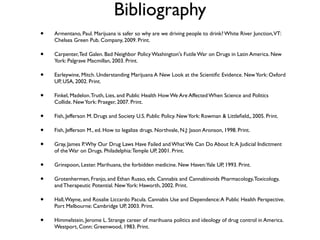
Bibliography
•   Armentano, Paul. Marijuana is safer so why are we driving people to drink? White River Junction,VT:
    Chelsea Green Pub. Company, 2009. Print.

•   Carpenter, Ted Galen. Bad Neighbor Policy Washington's Futile War on Drugs in Latin America. New
    York: Palgrave Macmillan, 2003. Print.

•   Earleywine, Mitch. Understanding Marijuana A New Look at the Scientific Evidence. New York: Oxford
    UP, USA, 2002. Print.

•   Finkel, Madelon. Truth, Lies, and Public Health How We Are Affected When Science and Politics
    Collide. New York: Praeger, 2007. Print.

•   Fish, Jefferson M. Drugs and Society U.S. Public Policy. New York: Rowman & Littlefield,, 2005. Print.

•   Fish, Jefferson M., ed. How to legalize drugs. Northvale, N.J: Jason Aronson, 1998. Print.

•   Gray, James P. Why Our Drug Laws Have Failed and What We Can Do About It: A Judicial Indictment
    of the War on Drugs. Philadelphia: Temple UP, 2001. Print.

•   Grinspoon, Lester. Marihuana, the forbidden medicine. New Haven:Yale UP, 1993. Print.

•   Grotenhermen, Franjo, and Ethan Russo, eds. Cannabis and Cannabinoids Pharmacology, Toxicology,
    and Therapeutic Potential. New York: Haworth, 2002. Print.

•   Hall, Wayne, and Rosalie Liccardo Pacula. Cannabis Use and Dependence: A Public Health Perspective.
    Port Melbourne: Cambridge UP, 2003. Print.

•   Himmelstein, Jerome L. Strange career of marihuana politics and ideology of drug control in America.
    Westport, Conn: Greenwood, 1983. Print.
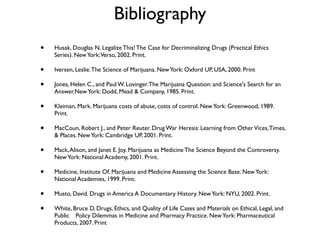
Bibliography
•   Husak, Douglas N. Legalize This! The Case for Decriminalizing Drugs (Practical Ethics
    Series). New York: Verso, 2002. Print.

•   Iversen, Leslie. The Science of Marijuana. New York: Oxford UP, USA, 2000. Print

•   Jones, Helen C., and Paul W. Lovinger. The Marijuana Question: and Science's Search for an
    Answer.New York: Dodd, Mead & Company, 1985. Print.

•   Kleiman, Mark. Marijuana costs of abuse, costs of control. New York: Greenwood, 1989.
    Print.

•   MacCoun, Robert J., and Peter Reuter. Drug War Heresis: Learning from Other Vices, Times,
    & Places. New York: Cambridge UP, 2001. Print.

•   Mack, Alison, and Janet E. Joy. Marijuana as Medicine The Science Beyond the Controversy.
    New York: National Academy, 2001. Print.

•   Medicine, Institute Of. Marijuana and Medicine Assessing the Science Base. New York:
    National Academies, 1999. Print.

•   Musto, David. Drugs in America A Documentary History. New York: NYU, 2002. Print.

•   White, Bruce D. Drugs, Ethics, and Quality of Life Cases and Materials on Ethical, Legal, and
    Public 
 Policy Dilemmas in Medicine and Pharmacy Practice. New York: Pharmaceutical
    Products, 2007. Print

Presentation 1 Key

  • 1.
  • 2.
    Relevance • the world’s most popular illicit drug - around 190 million users worldwide • 41% of Americans have smoked pot - 26 million regularly use - multi-billion dollar industry - nation’s leading cash crop • ~750,000 people are arrested for possession of MJ each year - half of all drug abuse violations • 81% of Americans support medical legalization and 45% support general legalization - popular • currently on many states’ agendas
  • 3.
    The Problem • marijuana’sillegality is causing significant problems for society
  • 4.
    Aspects • public opinion •health • philosophical/moral/ethical • freedom • crime, terrorism, and social order • economic
  • 5.
    History • Federal Marijuana Act of 1937 - first outlawed • Comprehensive Drug Abuse Prevention and Control Act of 1970 - National Commission on Marijuana - rec’d decriminalization but Nixon shot down • 1972, NORML petitions DEA to downgrade MJ from class I • 1973, Oregon enacts form of decriminalization • 1982, NIH/NAS begin to study medicinal value • 1984, Anti-Drug Abuse Act - severe penalties
  • 6.
    History • 1988, Judge Young concludes reclassifying MJ to class II (physicians prescribe), but DEA rejects • 1996, CA passes prop. 215 - medical use - begins federal tension and intensifies economic cost/benefit debate • 2005, Gonzales v. Raich - congress may ban MJ regardless of state legislation • now, MJ back on agenda - 10/09 Dept. of Justice decision not to prosecute patients
  • 7.
    Health • the foundation: legitimate medical use - overwhelming pro/neutral evidence - but enough political uncertainty to stunt action • MJ likely has a natural role in pain modulation, appetite, control of movement, and memory • average potency increased very little since 70s (~3%) • in driving studies, MJ may actually reduce the responsibility rate and lower crash risk • DEA Judge, Young - “In strict medical terms MJ is far safer than many foods we commonly consume,” in fact, “MJ in its natural form is one of the safest therapeutically active substances known to man.” • “cannabis poses a much less serious public health problem than is currently posed by alcohol and tobacco in western societies." - strong policy implications
  • 8.
    Health • Johns Hopkins - "no significant differences in cognitive decline between heavy users, light users, and nonusers of cannabis." • the WHO report - "it is doubtful that cannabis use produces a well defined amotivational syndrome." • the majority of occasional users “will not suffer any lasting physical or mental harm” - little evidence that effects persist after drug use stops “or that any direct cause and effect relationships are involved.” • NIH - “marijuana does not have a long-term negative impact on global intelligence.” • Nat. Com. on MJ and WHO - careful search of the literature/ testimony of nation’s health officials has not revealed a single human fatality in the US proven to have resulted solely from ingestion of MJ. Experiments on monkeys conclude that the dose required for OD death was enormous and for all practical purposes unachievable by humans.
  • 9.
    Health • "contrary to our expectations, we found no positive associations between MJ use and lung or UAT cancers” • IOM on “gateway theory”- “there is no conclusive evidence that the drug effects of MJ are causally linked to the subsequent abuse of other illicit drugs." • Nat. Com on MJ - “rather than inducing violent/aggressive behavior and weakening impulse control, MJ was found to inhibit the expression of aggressive impulses by pacifying the user, interfering with muscular coordination, reducing psychomotor activities and generally producing states of drowsiness lethargy, timidity and passivity." • “MJ’s relative potential for harm to the vast majority of individual users and its actual impact on society does not justify a social policy designed to seek out and firmly punish those who use it.”
  • 10.
    Philosophical • ethical argument- response of societal context (alcohol/tobacco) • moral normative argument - danger (real vs perceived) - legalization increase control - government/collective vs individual • ontological - personal freedom (John Mill) vs constitutional and implicit fundamental freedoms • philosophical critique of decriminalization - inappropriate, constitutionally suspect, and functionally irrational - then legalization
  • 11.
    Economic/Social Cost • current policy - prohibition - citizens will abstain from actions if the actions are typed as unlawful and the prohibitions are enforced by law enforcement • Jimmy Carter - “penalties against drug use should not be more damaging to an individual than the use of the drug itself. Nowhere is this more clear than in the laws against the possession of marijuana in private for personal use." - • more than 700,000 arrested on MJ charges last year (~5 million in past decade) - 90% of arrests are for simple possession - and increased arrest rates are not associated with reduced MJ use/availability/new users/ potency - waste of resources • MJ offenders incarcerated in US jails now outnumber the total number of prisoners in 1980 as well as the entire EU prisoner population - massive spending on prisons as opposed to education/health
  • 12.
    Economic/Social Cost • MJ arrests disproportionately impact young males • state costs for MJ arrests are ~$7.6 billion/year - police costs $3.7 billion, judicial/legal costs $853 million, and correctional costs $3.1 billion. In CA/NY, state costs for MJ law enforcement are over $1 billion/year each • the US prohibition effort is currently a $30 billion campaign - only includes direct enforcement expenditures - significantly more with addition of economic impact of holding 400,000 prisoners on prohibition violations • CA has a landmark bill to tax and regulate marijuana like alcohol - estimated $1.4 billion/year revenue from fees/ sales/excise taxes • estimates hold that MJ legalization would yield tax revenue of $2.4 billion/year if taxed like all other goods and $6.2 billion/year if taxed at alcohol/tobacco rates
  • 13.
    International Cost • former undercover DEA agent Michael Levine explained his work with Colombian cartel: “I learned that not only did they not fear our war on drugs, they counted on it to increase the market price and to weed out the smaller, inefficient drug dealers. They found U.S. interdiction efforts laughable. The only U.S. action they feared was an effective demand reduction program. Top cartel chief, Jorge Roman, expressed his gratitude for the drug war, calling it “a sham put on for the American taxpayer” that was actually “good for business” • current system of criminalization provides powerful incentive for political/enforcement corruption • “bad neighbor policy” - Latin American countries criticize US prohibition for providing the massive market that
  • 14.
    Alternatives • business-as-usual / do nothing (prohibitionism) • philosopher Husak explains “current drug policies lead to immense personal suffering, as well as police corruption, organized crime, and make drugs more dangerous b/c not subject to proper controls” - “it is now beyond reasonable doubt that applying criminal sanctions for minor cannabis offenses is not in the best interests of the community." • decriminalization - abolition of criminal penalties, retroactively, though fines may still apply - solves much of issue, but is logically incongruous, without major benefit • legalization - removing a legal prohibition - would open up new, massive, regulated markets.
  • 15.
    Criteria • economic efficiency(cost/benefit analysis) • political acceptability • strength and improvability • process values - transparency, citizen access/voice, rationality • freedom/equality • legal implementation and efficacy
  • 16.
    Bibliography • Armentano, Paul. Marijuana is safer so why are we driving people to drink? White River Junction,VT: Chelsea Green Pub. Company, 2009. Print. • Carpenter, Ted Galen. Bad Neighbor Policy Washington's Futile War on Drugs in Latin America. New York: Palgrave Macmillan, 2003. Print. • Earleywine, Mitch. Understanding Marijuana A New Look at the Scientific Evidence. New York: Oxford UP, USA, 2002. Print. • Finkel, Madelon. Truth, Lies, and Public Health How We Are Affected When Science and Politics Collide. New York: Praeger, 2007. Print. • Fish, Jefferson M. Drugs and Society U.S. Public Policy. New York: Rowman & Littlefield,, 2005. Print. • Fish, Jefferson M., ed. How to legalize drugs. Northvale, N.J: Jason Aronson, 1998. Print. • Gray, James P. Why Our Drug Laws Have Failed and What We Can Do About It: A Judicial Indictment of the War on Drugs. Philadelphia: Temple UP, 2001. Print. • Grinspoon, Lester. Marihuana, the forbidden medicine. New Haven:Yale UP, 1993. Print. • Grotenhermen, Franjo, and Ethan Russo, eds. Cannabis and Cannabinoids Pharmacology, Toxicology, and Therapeutic Potential. New York: Haworth, 2002. Print. • Hall, Wayne, and Rosalie Liccardo Pacula. Cannabis Use and Dependence: A Public Health Perspective. Port Melbourne: Cambridge UP, 2003. Print. • Himmelstein, Jerome L. Strange career of marihuana politics and ideology of drug control in America. Westport, Conn: Greenwood, 1983. Print.
  • 17.
    Bibliography • Husak, Douglas N. Legalize This! The Case for Decriminalizing Drugs (Practical Ethics Series). New York: Verso, 2002. Print. • Iversen, Leslie. The Science of Marijuana. New York: Oxford UP, USA, 2000. Print • Jones, Helen C., and Paul W. Lovinger. The Marijuana Question: and Science's Search for an Answer.New York: Dodd, Mead & Company, 1985. Print. • Kleiman, Mark. Marijuana costs of abuse, costs of control. New York: Greenwood, 1989. Print. • MacCoun, Robert J., and Peter Reuter. Drug War Heresis: Learning from Other Vices, Times, & Places. New York: Cambridge UP, 2001. Print. • Mack, Alison, and Janet E. Joy. Marijuana as Medicine The Science Beyond the Controversy. New York: National Academy, 2001. Print. • Medicine, Institute Of. Marijuana and Medicine Assessing the Science Base. New York: National Academies, 1999. Print. • Musto, David. Drugs in America A Documentary History. New York: NYU, 2002. Print. • White, Bruce D. Drugs, Ethics, and Quality of Life Cases and Materials on Ethical, Legal, and Public Policy Dilemmas in Medicine and Pharmacy Practice. New York: Pharmaceutical Products, 2007. Print