Shachy Rivas
Instructor Jim Tantillo
Nature and Culture
13 July 2012
Exploring the “Dangers” of Cannabis Sativa
“‘I am skeptical that a society that is so tolerant of alcohol and cigarettes should come
down so hard on marijuana use and send people to prison for life without parole… We should
not repeal drug laws overnight, but we should begin with marijuana and see whether the sky
falls.’1
”2
As Chief Judge Richard Posner, I am also skeptical. The controversy of marijuana and
whether it should be legal or restricted has been debated for decades and is still being debated
today. Although it is difficult to justify the use of drugs, people should be able to decide whether
they would like to partake in the use of these substances without interference of the government.
The development and use of drugs, such as marijuana, has altered society and culture, which has
in turn arose the question: What role does the environment play in our world?
What is it and What is it Used For?
Humans have constantly manipulated nature, such as the development of marijuana, in
order to achieve a temporary “high.” Marijuana is a widely known substance that is derived from
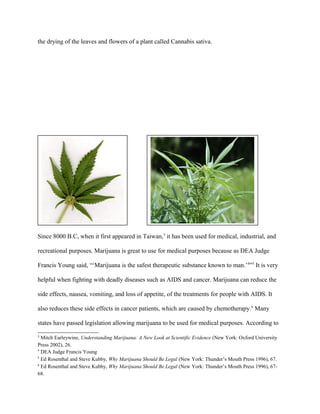
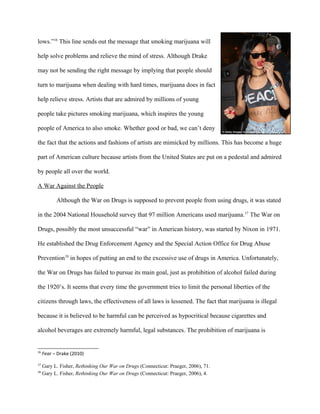
natural resources. Marijuana, also commonly known as weed, bud, and Mary Jane, is created by
1
Richard Posner, Chief Judge of the U.S. Seventh Circuit Court of Appeals in Chicago, USA Today, September 14,
1995.
2
Ed Rosenthal and Steve Kubby, Why Marijuana Should Be Legal (New York: Thunder’s Mountain Press, 1996),
7.
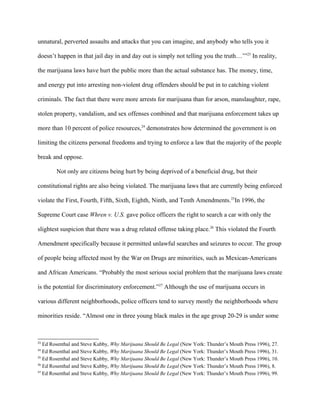
the drying of the leaves and flowers of a plant called Cannabis sativa.
Since 8000 B.C, when it first appeared in Taiwan,3
it has been used for medical, industrial, and
recreational purposes. Marijuana is great to use for medical purposes because as DEA Judge
Francis Young said, “‘Marijuana is the safest therapeutic substance known to man.’4
”5
It is very
helpful when fighting with deadly diseases such as AIDS and cancer. Marijuana can reduce the
side effects, nausea, vomiting, and loss of appetite, of the treatments for people with AIDS. It
also reduces these side effects in cancer patients, which are caused by chemotherapy.6
Many
states have passed legislation allowing marijuana to be used for medical purposes. According to
3
Mitch Earleywine, Understanding Marijuana: A New Look at Scientific Evidence (New York: Oxford University
Press 2002), 26.
4
DEA Judge Francis Young
5
Ed Rosenthal and Steve Kubby, Why Marijuana Should Be Legal (New York: Thunder’s Mouth Press 1996), 67.
6
Ed Rosenthal and Steve Kubby, Why Marijuana Should Be Legal (New York: Thunder’s Mouth Press 1996), 67-
68.
Why Marijuana Should Be Legal, “Forty-four percent of oncologists responding to a
questionnaire said they had recommended marijuana to their cancer patients. Fifty-four percent
said they would recommend medical marijuana if it were legal.”7
Marijuana can help alleviate
the pain and suffering that many people throughout the world are going through and make their
lives a little easier to live.
Americans have disappointed the father of their country, George Washington, by
ignoring his advice to, “‘Make the most of the hemp seed. Sow it everywhere.’8
”9
In attempt to
prohibit the use of marijuana, Congress has also prohibited the cultivation of industrial hemp,
which can be very helpful to the environment. “It contains the longest fiber in the plant kingdom
and one of the strongest and most durable.”10
Industrial hemp may have been considered
favorable to George Washington, as well as others, because it lasts long, pesticides are not
needed when growing it, and it can be grown in a short amount of time. It can replace products,
such as cotton, wood pulp, detergents, plastics, paints, varnishes, cosmetics, and textiles.11
Industrial hemp can be used to make environmentally friendly products to replace materials that
are currently harming the environment. Because this product is grown in various successful
countries, such as France, England, Australia, China, Hungary, and the Ukraine12
, it should also
be grown in the United States. Unlike marijuana which contains about 2% tetrahydrocannabino
(THC), industrial hemp contains only .15% THC.13
This means that, as Rosenthal and Kubby put
7
Ed Rosenthal and Steve Kubby, Why Marijuana Should Be Legal (New York: Thunder’s Mouth Press 1996), 75.
8
George Washington
9
Ed Rosenthal and Steve Kubby, Why Marijuana Should Be Legal (New York: Thunder’s Mouth Press 1996), 59.
10
Ed Rosenthal and Steve Kubby, Why Marijuana Should Be Legal (New York: Thunder’s Mouth Press 1996), 42.
11
Ed Rosenthal and Steve Kubby, Why Marijuana Should Be Legal (New York: Thunder’s Mouth Press 1996), 59-
61.
12
Ed Rosenthal and Steve Kubby, Why Marijuana Should Be Legal (New York: Thunder’s Mouth Press 1996), 61.
13
Mitch Earleywine, Undestanding Marijuana: A New Look at the Scientific Evidence (New York: Oxford
University Press 2002), 3-4.
it in their book Why Marijuana Should Be Legal, “You couldn’t get a buzz if you smoked a bale
of hemp…”14
With industrial hemp being such an environmentally friendly product, it is
extremely difficult to understand why it is illegal.
Cannabis Culture
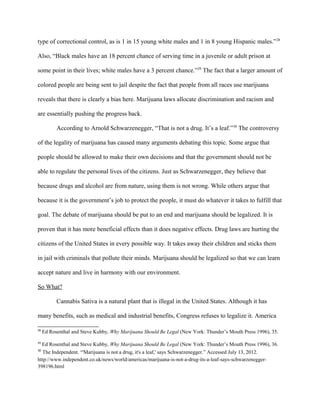
Marijuana has been associated with many different
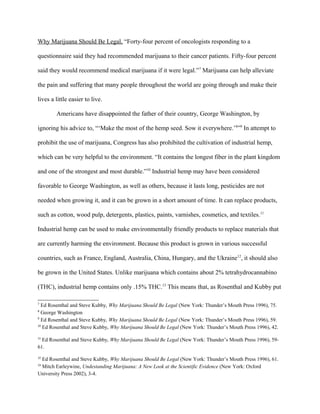
people and cultures, such as the hippies. Hippies were a group of
middle class people that were involved in a youth movement
during the 1960’s. They promoted the ideals of peace, love, and
freedom. Hippies disregarded the importance of material things
and, instead, focused on unity and living a free life. At this time,
the morals of the Hippies were very
appealing because people had a hard time accepting constitutional
laws and living a “normal” life. They opposed war and started
protests against the Vietnam War. Hippies wish to connect with
nature by living natural lives. They had parties that consisted of
music by artists like Jimi Hendrix and Bob Marley and smoked
marijuana.15
The overall goal of the Hippies was to live life to the fullest with no worries. The
Hippie movement influenced culture in the United States by creating a worldwide culture shift in
which people were more relaxed and connected with nature.
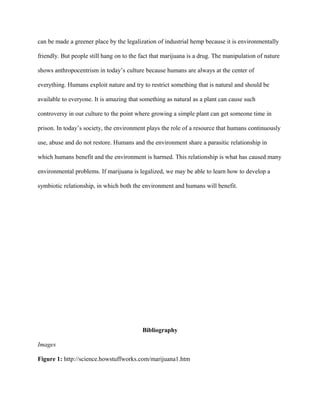
Marijuana has influenced today’s culture through hip-hop. Famous artists, such as Little
Wayne, Drake, and Snoop Dog, incorporate the themes of sex, marijuana, alcohol, and money
into their lyrics. In his hit song Fear Drake says, “I been getting high just to balance out the
14
Ed Rosenthal and Steve Kubby, Why Marijuana Should Be Legal (New York: Thunder’s Mouth Press 1996), 59.
15
Psychedelic Junction. “The Hippie Movement - History, Culture and Legacy.” Accessed July 13, 2012.
http://www.psychedelicjunction.com/2010/08/hippie-movement-history-culture-and.html
lows.”16
This line sends out the message that smoking marijuana will
help solve problems and relieve the mind of stress. Although Drake
may not be sending the right message by implying that people should
turn to marijuana when dealing with hard times, marijuana does in fact
help relieve stress. Artists that are admired by millions of young
people take pictures smoking marijuana, which inspires the young
people of America to also smoke. Whether good or bad, we can’t deny
the fact that the actions and fashions of artists are mimicked by millions. This has become a huge
part of American culture because artists from the United States are put on a pedestal and admired
by people all over the world.
A War Against the People
Although the War on Drugs is supposed to prevent people from using drugs, it was stated
in the 2004 National Household survey that 97 million Americans used marijuana.17
The War on
Drugs, possibly the most unsuccessful “war” in American history, was started by Nixon in 1971.
He established the Drug Enforcement Agency and the Special Action Office for Drug Abuse
Prevention18
in hopes of putting an end to the excessive use of drugs in America. Unfortunately,
the War on Drugs has failed to pursue its main goal, just as prohibition of alcohol failed during
the 1920’s. It seems that every time the government tries to limit the personal liberties of the
citizens through laws, the effectiveness of all laws is lessened. The fact that marijuana is illegal
because it is believed to be harmful can be perceived as hypocritical because cigarettes and
alcohol beverages are extremely harmful, legal substances. The prohibition of marijuana is
16
Fear – Drake (2010)
17
Gary L. Fisher, Rethinking Our War on Drugs (Connecticut: Praeger, 2006), 71.
18
Gary L. Fisher, Rethinking Our War on Drugs (Connecticut: Praeger, 2006), 4.
favored by many due to the belief that it has the ability to destroy families and cause people to
abandon their traditional values. Due to the excessive use of marijuana, its absence would leave
many policemen and lawyers jobless. The government spends millions of dollars on research that
is intended to prove the damaging effects of marijuana, money that would be lost if it were made
legal. Unfortunately, the government fails to see that marijuana can be a steady source of income
because marijuana could potentially be a strong competitor to the liquor and pharmaceutical
companies because marijuana is easy to access because it can be grown.19
Citizens of the United States have constantly been arrested for possession of marijuana,
but is this so-called-drug really deadly or is it the law that is killing us? The United States’ war
on drugs has had a great affect on the country because the prison population is about six to ten
times higher than other nations. The United States has the greatest amount of citizens in prison in
respect to its population and it is second in the world in its rate of incarnation.20
When speaking
of the War on Drugs, Thomas Wiseman said, “‘We’ve just about lost a generation of young
people. We’re building new prison beds at the rate of about 1,000 a week and we’re still
overcrowded…We’ve spent $100 billion on the war on drugs and we’re losing it.’21
”22
According
to the 1995 FBI Office of Uniform Crime Reports, there were 481,098 arrests for marijuana in
1994. People that have only one non-violent offense of possession of marijuana are being put in
the same cells as murderers and rapists, the real criminals of America. “…Judge Charles W.
Halleck of the District of Columbia Court of General Sessions explained why he no longer gave
jail sentences to youthful marijuana offenders: ‘If I send a [long-haired marijuana offender] to
jail even for 30 days, Senator, he is going to be the victim of the most brutal type of homosexual,
19
Ed Rosenthal and Steve Kubby, Why Marijuana Should Be Legal (New York: Thunder’s Mouth Press 1996), 2.
20
Ed Rosenthal and Steve Kubby, Why Marijuana Should Be Legal (New York: Thunder’s Mouth Press 1996), 35.
21
Thomas Wiseman, U.S. District Judge
22
Ed Rosenthal and Steve Kubby, Why Marijuana Should Be Legal (New York: Thunder’s Mouth Press 1996), 23.
unnatural, perverted assaults and attacks that you can imagine, and anybody who tells you it
doesn’t happen in that jail day in and day out is simply not telling you the truth…’”23
In reality,
the marijuana laws have hurt the public more than the actual substance has. The money, time,
and energy put into arresting non-violent drug offenders should be put in to catching violent
criminals. The fact that there were more arrests for marijuana than for arson, manslaughter, rape,
stolen property, vandalism, and sex offenses combined and that marijuana enforcement takes up
more than 10 percent of police resources,24
demonstrates how determined the government is on
limiting the citizens personal freedoms and trying to enforce a law that the majority of the people
break and oppose.
Not only are citizens being hurt by being deprived of a beneficial drug, but their
constitutional rights are also being violated. The marijuana laws that are currently being enforced
violate the First, Fourth, Fifth, Sixth, Eighth, Ninth, and Tenth Amendments.25
In 1996, the
Supreme Court case Whren v. U.S. gave police officers the right to search a car with only the
slightest suspicion that there was a drug related offense taking place.26
This violated the Fourth
Amendment specifically because it permitted unlawful searches and seizures to occur. The group
of people being affected most by the War on Drugs are minorities, such as Mexican-Americans
and African Americans. “Probably the most serious social problem that the marijuana laws create
is the potential for discriminatory enforcement.”27
Although the use of marijuana occurs in
various different neighborhoods, police officers tend to survey mostly the neighborhoods where
minorities reside. “Almost one in three young black males in the age group 20-29 is under some
23
Ed Rosenthal and Steve Kubby, Why Marijuana Should Be Legal (New York: Thunder’s Mouth Press 1996), 27.
24
Ed Rosenthal and Steve Kubby, Why Marijuana Should Be Legal (New York: Thunder’s Mouth Press 1996), 31.
25
Ed Rosenthal and Steve Kubby, Why Marijuana Should Be Legal (New York: Thunder’s Mouth Press 1996), 10.
26
Ed Rosenthal and Steve Kubby, Why Marijuana Should Be Legal (New York: Thunder’s Mouth Press 1996), 8.
27
Ed Rosenthal and Steve Kubby, Why Marijuana Should Be Legal (New York: Thunder’s Mouth Press 1996), 99.
type of correctional control, as is 1 in 15 young white males and 1 in 8 young Hispanic males.”28
Also, “Black males have an 18 percent chance of serving time in a juvenile or adult prison at
some point in their lives; white males have a 3 percent chance.”29
The fact that a larger amount of
colored people are being sent to jail despite the fact that people from all races use marijuana
reveals that there is clearly a bias here. Marijuana laws allocate discrimination and racism and
are essentially pushing the progress back.
According to Arnold Schwarzenegger, “That is not a drug. It’s a leaf.”30
The controversy
of the legality of marijuana has caused many arguments debating this topic. Some argue that
people should be allowed to make their own decisions and that the government should not be
able to regulate the personal lives of the citizens. Just as Schwarzenegger, they believe that
because drugs and alcohol are from nature, using them is not wrong. While others argue that
because it is the government’s job to protect the people, it must do whatever it takes to fulfill that
goal. The debate of marijuana should be put to an end and marijuana should be legalized. It is
proven that it has more beneficial effects than it does negative effects. Drug laws are hurting the
citizens of the United States in every possible way. It takes away their children and sticks them
in jail with criminals that pollute their minds. Marijuana should be legalized so that we can learn
accept nature and live in harmony with our environment.
So What?
Cannabis Sativa is a natural plant that is illegal in the United States. Although it has
many benefits, such as medical and industrial benefits, Congress refuses to legalize it. America
28
Ed Rosenthal and Steve Kubby, Why Marijuana Should Be Legal (New York: Thunder’s Mouth Press 1996), 35.
29
Ed Rosenthal and Steve Kubby, Why Marijuana Should Be Legal (New York: Thunder’s Mouth Press 1996), 36.
30
The Independent. “'Marijuana is not a drug, it's a leaf,' says Schwarzenegger.” Accessed July 13, 2012.
http://www.independent.co.uk/news/world/americas/marijuana-is-not-a-drug-its-a-leaf-says-schwarzenegger-
398196.html
can be made a greener place by the legalization of industrial hemp because it is environmentally
friendly. But people still hang on to the fact that marijuana is a drug. The manipulation of nature
shows anthropocentrism in today’s culture because humans are always at the center of
everything. Humans exploit nature and try to restrict something that is natural and should be
available to everyone. It is amazing that something as natural as a plant can cause such
controversy in our culture to the point where growing a simple plant can get someone time in
prison. In today’s society, the environment plays the role of a resource that humans continuously
use, abuse and do not restore. Humans and the environment share a parasitic relationship in
which humans benefit and the environment is harmed. This relationship is what has caused many
environmental problems. If marijuana is legalized, we may be able to learn how to develop a
symbiotic relationship, in which both the environment and humans will benefit.
Bibliography
Images
Figure 1: http://science.howstuffworks.com/marijuana1.htm
Figure 2: http://commons.wikimedia.org/wiki/File:Cannabis_sativa_plant_%288%29.JPG
Fugure 3: http://vietnamartwork.wordpress.com/hippies-anti-war/
Figure 4: http://hiphollywood.com/2012/04/bob-marley-doc-in-theaters-today/
Figure 5: http://www.justfashion.ca/gossip-news/rihanna-scribbles-thug-life-across-her-
midriff-in-memory-of-tupac-at-coachella-2012/

Rivas_paper

  • 1.
    Shachy Rivas Instructor JimTantillo Nature and Culture 13 July 2012 Exploring the “Dangers” of Cannabis Sativa “‘I am skeptical that a society that is so tolerant of alcohol and cigarettes should come down so hard on marijuana use and send people to prison for life without parole… We should not repeal drug laws overnight, but we should begin with marijuana and see whether the sky falls.’1 ”2 As Chief Judge Richard Posner, I am also skeptical. The controversy of marijuana and whether it should be legal or restricted has been debated for decades and is still being debated today. Although it is difficult to justify the use of drugs, people should be able to decide whether they would like to partake in the use of these substances without interference of the government. The development and use of drugs, such as marijuana, has altered society and culture, which has in turn arose the question: What role does the environment play in our world? What is it and What is it Used For? Humans have constantly manipulated nature, such as the development of marijuana, in order to achieve a temporary “high.” Marijuana is a widely known substance that is derived from natural resources. Marijuana, also commonly known as weed, bud, and Mary Jane, is created by 1 Richard Posner, Chief Judge of the U.S. Seventh Circuit Court of Appeals in Chicago, USA Today, September 14, 1995. 2 Ed Rosenthal and Steve Kubby, Why Marijuana Should Be Legal (New York: Thunder’s Mountain Press, 1996), 7.
  • 2.
    the drying ofthe leaves and flowers of a plant called Cannabis sativa. Since 8000 B.C, when it first appeared in Taiwan,3 it has been used for medical, industrial, and recreational purposes. Marijuana is great to use for medical purposes because as DEA Judge Francis Young said, “‘Marijuana is the safest therapeutic substance known to man.’4 ”5 It is very helpful when fighting with deadly diseases such as AIDS and cancer. Marijuana can reduce the side effects, nausea, vomiting, and loss of appetite, of the treatments for people with AIDS. It also reduces these side effects in cancer patients, which are caused by chemotherapy.6 Many states have passed legislation allowing marijuana to be used for medical purposes. According to 3 Mitch Earleywine, Understanding Marijuana: A New Look at Scientific Evidence (New York: Oxford University Press 2002), 26. 4 DEA Judge Francis Young 5 Ed Rosenthal and Steve Kubby, Why Marijuana Should Be Legal (New York: Thunder’s Mouth Press 1996), 67. 6 Ed Rosenthal and Steve Kubby, Why Marijuana Should Be Legal (New York: Thunder’s Mouth Press 1996), 67- 68.
  • 3.
    Why Marijuana ShouldBe Legal, “Forty-four percent of oncologists responding to a questionnaire said they had recommended marijuana to their cancer patients. Fifty-four percent said they would recommend medical marijuana if it were legal.”7 Marijuana can help alleviate the pain and suffering that many people throughout the world are going through and make their lives a little easier to live. Americans have disappointed the father of their country, George Washington, by ignoring his advice to, “‘Make the most of the hemp seed. Sow it everywhere.’8 ”9 In attempt to prohibit the use of marijuana, Congress has also prohibited the cultivation of industrial hemp, which can be very helpful to the environment. “It contains the longest fiber in the plant kingdom and one of the strongest and most durable.”10 Industrial hemp may have been considered favorable to George Washington, as well as others, because it lasts long, pesticides are not needed when growing it, and it can be grown in a short amount of time. It can replace products, such as cotton, wood pulp, detergents, plastics, paints, varnishes, cosmetics, and textiles.11 Industrial hemp can be used to make environmentally friendly products to replace materials that are currently harming the environment. Because this product is grown in various successful countries, such as France, England, Australia, China, Hungary, and the Ukraine12 , it should also be grown in the United States. Unlike marijuana which contains about 2% tetrahydrocannabino (THC), industrial hemp contains only .15% THC.13 This means that, as Rosenthal and Kubby put 7 Ed Rosenthal and Steve Kubby, Why Marijuana Should Be Legal (New York: Thunder’s Mouth Press 1996), 75. 8 George Washington 9 Ed Rosenthal and Steve Kubby, Why Marijuana Should Be Legal (New York: Thunder’s Mouth Press 1996), 59. 10 Ed Rosenthal and Steve Kubby, Why Marijuana Should Be Legal (New York: Thunder’s Mouth Press 1996), 42. 11 Ed Rosenthal and Steve Kubby, Why Marijuana Should Be Legal (New York: Thunder’s Mouth Press 1996), 59- 61. 12 Ed Rosenthal and Steve Kubby, Why Marijuana Should Be Legal (New York: Thunder’s Mouth Press 1996), 61. 13 Mitch Earleywine, Undestanding Marijuana: A New Look at the Scientific Evidence (New York: Oxford University Press 2002), 3-4.
  • 4.
    it in theirbook Why Marijuana Should Be Legal, “You couldn’t get a buzz if you smoked a bale of hemp…”14 With industrial hemp being such an environmentally friendly product, it is extremely difficult to understand why it is illegal. Cannabis Culture Marijuana has been associated with many different people and cultures, such as the hippies. Hippies were a group of middle class people that were involved in a youth movement during the 1960’s. They promoted the ideals of peace, love, and freedom. Hippies disregarded the importance of material things and, instead, focused on unity and living a free life. At this time, the morals of the Hippies were very appealing because people had a hard time accepting constitutional laws and living a “normal” life. They opposed war and started protests against the Vietnam War. Hippies wish to connect with nature by living natural lives. They had parties that consisted of music by artists like Jimi Hendrix and Bob Marley and smoked marijuana.15 The overall goal of the Hippies was to live life to the fullest with no worries. The Hippie movement influenced culture in the United States by creating a worldwide culture shift in which people were more relaxed and connected with nature. Marijuana has influenced today’s culture through hip-hop. Famous artists, such as Little Wayne, Drake, and Snoop Dog, incorporate the themes of sex, marijuana, alcohol, and money into their lyrics. In his hit song Fear Drake says, “I been getting high just to balance out the 14 Ed Rosenthal and Steve Kubby, Why Marijuana Should Be Legal (New York: Thunder’s Mouth Press 1996), 59. 15 Psychedelic Junction. “The Hippie Movement - History, Culture and Legacy.” Accessed July 13, 2012. http://www.psychedelicjunction.com/2010/08/hippie-movement-history-culture-and.html
  • 5.
    lows.”16 This line sendsout the message that smoking marijuana will help solve problems and relieve the mind of stress. Although Drake may not be sending the right message by implying that people should turn to marijuana when dealing with hard times, marijuana does in fact help relieve stress. Artists that are admired by millions of young people take pictures smoking marijuana, which inspires the young people of America to also smoke. Whether good or bad, we can’t deny the fact that the actions and fashions of artists are mimicked by millions. This has become a huge part of American culture because artists from the United States are put on a pedestal and admired by people all over the world. A War Against the People Although the War on Drugs is supposed to prevent people from using drugs, it was stated in the 2004 National Household survey that 97 million Americans used marijuana.17 The War on Drugs, possibly the most unsuccessful “war” in American history, was started by Nixon in 1971. He established the Drug Enforcement Agency and the Special Action Office for Drug Abuse Prevention18 in hopes of putting an end to the excessive use of drugs in America. Unfortunately, the War on Drugs has failed to pursue its main goal, just as prohibition of alcohol failed during the 1920’s. It seems that every time the government tries to limit the personal liberties of the citizens through laws, the effectiveness of all laws is lessened. The fact that marijuana is illegal because it is believed to be harmful can be perceived as hypocritical because cigarettes and alcohol beverages are extremely harmful, legal substances. The prohibition of marijuana is 16 Fear – Drake (2010) 17 Gary L. Fisher, Rethinking Our War on Drugs (Connecticut: Praeger, 2006), 71. 18 Gary L. Fisher, Rethinking Our War on Drugs (Connecticut: Praeger, 2006), 4.
  • 6.
    favored by manydue to the belief that it has the ability to destroy families and cause people to abandon their traditional values. Due to the excessive use of marijuana, its absence would leave many policemen and lawyers jobless. The government spends millions of dollars on research that is intended to prove the damaging effects of marijuana, money that would be lost if it were made legal. Unfortunately, the government fails to see that marijuana can be a steady source of income because marijuana could potentially be a strong competitor to the liquor and pharmaceutical companies because marijuana is easy to access because it can be grown.19 Citizens of the United States have constantly been arrested for possession of marijuana, but is this so-called-drug really deadly or is it the law that is killing us? The United States’ war on drugs has had a great affect on the country because the prison population is about six to ten times higher than other nations. The United States has the greatest amount of citizens in prison in respect to its population and it is second in the world in its rate of incarnation.20 When speaking of the War on Drugs, Thomas Wiseman said, “‘We’ve just about lost a generation of young people. We’re building new prison beds at the rate of about 1,000 a week and we’re still overcrowded…We’ve spent $100 billion on the war on drugs and we’re losing it.’21 ”22 According to the 1995 FBI Office of Uniform Crime Reports, there were 481,098 arrests for marijuana in 1994. People that have only one non-violent offense of possession of marijuana are being put in the same cells as murderers and rapists, the real criminals of America. “…Judge Charles W. Halleck of the District of Columbia Court of General Sessions explained why he no longer gave jail sentences to youthful marijuana offenders: ‘If I send a [long-haired marijuana offender] to jail even for 30 days, Senator, he is going to be the victim of the most brutal type of homosexual, 19 Ed Rosenthal and Steve Kubby, Why Marijuana Should Be Legal (New York: Thunder’s Mouth Press 1996), 2. 20 Ed Rosenthal and Steve Kubby, Why Marijuana Should Be Legal (New York: Thunder’s Mouth Press 1996), 35. 21 Thomas Wiseman, U.S. District Judge 22 Ed Rosenthal and Steve Kubby, Why Marijuana Should Be Legal (New York: Thunder’s Mouth Press 1996), 23.
  • 7.
    unnatural, perverted assaultsand attacks that you can imagine, and anybody who tells you it doesn’t happen in that jail day in and day out is simply not telling you the truth…’”23 In reality, the marijuana laws have hurt the public more than the actual substance has. The money, time, and energy put into arresting non-violent drug offenders should be put in to catching violent criminals. The fact that there were more arrests for marijuana than for arson, manslaughter, rape, stolen property, vandalism, and sex offenses combined and that marijuana enforcement takes up more than 10 percent of police resources,24 demonstrates how determined the government is on limiting the citizens personal freedoms and trying to enforce a law that the majority of the people break and oppose. Not only are citizens being hurt by being deprived of a beneficial drug, but their constitutional rights are also being violated. The marijuana laws that are currently being enforced violate the First, Fourth, Fifth, Sixth, Eighth, Ninth, and Tenth Amendments.25 In 1996, the Supreme Court case Whren v. U.S. gave police officers the right to search a car with only the slightest suspicion that there was a drug related offense taking place.26 This violated the Fourth Amendment specifically because it permitted unlawful searches and seizures to occur. The group of people being affected most by the War on Drugs are minorities, such as Mexican-Americans and African Americans. “Probably the most serious social problem that the marijuana laws create is the potential for discriminatory enforcement.”27 Although the use of marijuana occurs in various different neighborhoods, police officers tend to survey mostly the neighborhoods where minorities reside. “Almost one in three young black males in the age group 20-29 is under some 23 Ed Rosenthal and Steve Kubby, Why Marijuana Should Be Legal (New York: Thunder’s Mouth Press 1996), 27. 24 Ed Rosenthal and Steve Kubby, Why Marijuana Should Be Legal (New York: Thunder’s Mouth Press 1996), 31. 25 Ed Rosenthal and Steve Kubby, Why Marijuana Should Be Legal (New York: Thunder’s Mouth Press 1996), 10. 26 Ed Rosenthal and Steve Kubby, Why Marijuana Should Be Legal (New York: Thunder’s Mouth Press 1996), 8. 27 Ed Rosenthal and Steve Kubby, Why Marijuana Should Be Legal (New York: Thunder’s Mouth Press 1996), 99.
  • 8.
    type of correctionalcontrol, as is 1 in 15 young white males and 1 in 8 young Hispanic males.”28 Also, “Black males have an 18 percent chance of serving time in a juvenile or adult prison at some point in their lives; white males have a 3 percent chance.”29 The fact that a larger amount of colored people are being sent to jail despite the fact that people from all races use marijuana reveals that there is clearly a bias here. Marijuana laws allocate discrimination and racism and are essentially pushing the progress back. According to Arnold Schwarzenegger, “That is not a drug. It’s a leaf.”30 The controversy of the legality of marijuana has caused many arguments debating this topic. Some argue that people should be allowed to make their own decisions and that the government should not be able to regulate the personal lives of the citizens. Just as Schwarzenegger, they believe that because drugs and alcohol are from nature, using them is not wrong. While others argue that because it is the government’s job to protect the people, it must do whatever it takes to fulfill that goal. The debate of marijuana should be put to an end and marijuana should be legalized. It is proven that it has more beneficial effects than it does negative effects. Drug laws are hurting the citizens of the United States in every possible way. It takes away their children and sticks them in jail with criminals that pollute their minds. Marijuana should be legalized so that we can learn accept nature and live in harmony with our environment. So What? Cannabis Sativa is a natural plant that is illegal in the United States. Although it has many benefits, such as medical and industrial benefits, Congress refuses to legalize it. America 28 Ed Rosenthal and Steve Kubby, Why Marijuana Should Be Legal (New York: Thunder’s Mouth Press 1996), 35. 29 Ed Rosenthal and Steve Kubby, Why Marijuana Should Be Legal (New York: Thunder’s Mouth Press 1996), 36. 30 The Independent. “'Marijuana is not a drug, it's a leaf,' says Schwarzenegger.” Accessed July 13, 2012. http://www.independent.co.uk/news/world/americas/marijuana-is-not-a-drug-its-a-leaf-says-schwarzenegger- 398196.html
  • 9.
    can be madea greener place by the legalization of industrial hemp because it is environmentally friendly. But people still hang on to the fact that marijuana is a drug. The manipulation of nature shows anthropocentrism in today’s culture because humans are always at the center of everything. Humans exploit nature and try to restrict something that is natural and should be available to everyone. It is amazing that something as natural as a plant can cause such controversy in our culture to the point where growing a simple plant can get someone time in prison. In today’s society, the environment plays the role of a resource that humans continuously use, abuse and do not restore. Humans and the environment share a parasitic relationship in which humans benefit and the environment is harmed. This relationship is what has caused many environmental problems. If marijuana is legalized, we may be able to learn how to develop a symbiotic relationship, in which both the environment and humans will benefit. Bibliography Images Figure 1: http://science.howstuffworks.com/marijuana1.htm
  • 10.
    Figure 2: http://commons.wikimedia.org/wiki/File:Cannabis_sativa_plant_%288%29.JPG Fugure3: http://vietnamartwork.wordpress.com/hippies-anti-war/ Figure 4: http://hiphollywood.com/2012/04/bob-marley-doc-in-theaters-today/ Figure 5: http://www.justfashion.ca/gossip-news/rihanna-scribbles-thug-life-across-her- midriff-in-memory-of-tupac-at-coachella-2012/