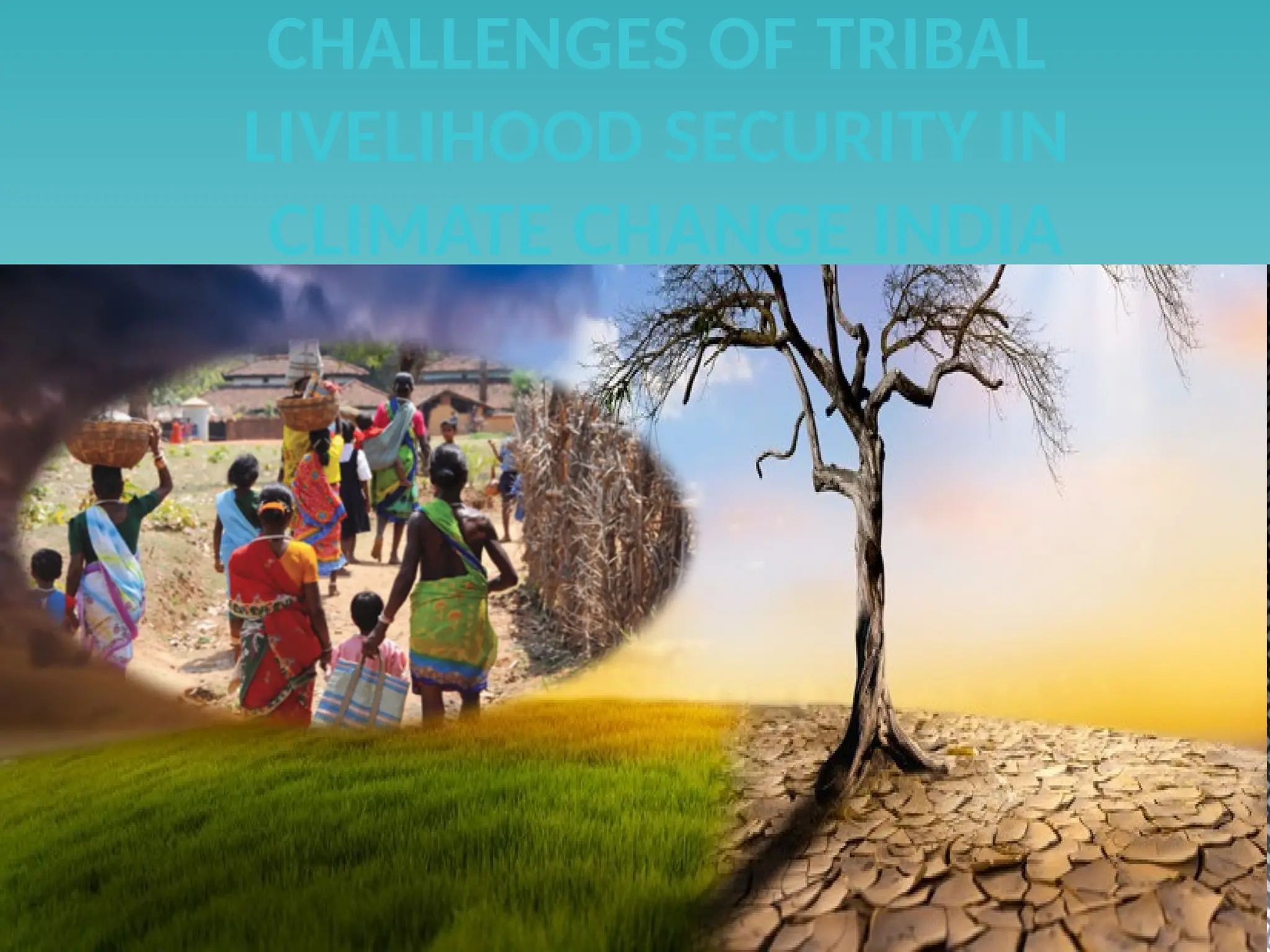
CHALLENGES OF TRIBAL
LIVELIHOOD SECURITY IN
CLIMATE CHANGE INDIA
ABSTRACT
Tribal communities in India face escalating challenges to their livelihood security due
to the adverse impacts of climate change. This study explores the multifaceted
challenges encountered by tribal populations in sustaining their livelihoods amidst
changing climatic patterns. Factors such as diminishing water resources, erratic
rainfall, biodiversity loss, and shifting agricultural practices significantly affect the
traditional livelihood strategies of these communities. Additionally, inadequate access
to resources, limited infrastructure, and socio-economic marginalization exacerbate
their vulnerability. Understanding these challenges is crucial for designing effective
adaptation and mitigation strategies to enhance tribal livelihood resilience. The Indian
region is one of the world’s 8 centers of crop plant origin and diversity with 166
food/crop species and 320 wild relatives of crops have originated here (Dr R.S. Rana,
personal communication). India has 700 recorded tribal groups with population of 104
million as per 2011 census and many of them practicing diverse indigenous farming
techniques to suit the needs of various respective Eco climatic zones. The present
study has been designed as a literature-based analytical review of such practices
among 4 different ethnic groups in 4 different agro climatic and geographical zones of
India, viz, the Apatanis of Arunachal Pradesh, the Dongria Kondh of Niamgiri hills of
Odisha, the Irular in the Nilgiris, and the Lahaulas of Himachal Pradesh. This paper
underscores the urgent need for interdisciplinary research and policy interventions
aimed at safeguarding the livelihood security of tribal populations amidst the rapidly
changing climate scenario in India.
INTRODUCTION
In India, home to over 1.3 billion people, is one of the world's most populous and
rapidly developing nations. Yet, amidst its dynamic growth, India faces an
increasingly urgent challenge in climate change. With its vast geographical diversity,
from the Himalayas in the north to the coastal plains in the south, India is uniquely
vulnerable to the impacts of a changing climate. This article explores the pressing
issue of climate change in India, backed by compelling data that elucidate the scale
and scope of the challenge on tribal people.
 Loss of Livelihoods and Food Insecurity
 Displacement and Loss of Cultural Heritage
 Health Risks and Vulnerability
There are an estimated 476 million Indigenous Peoples worldwide. (World Bank) In
India, 705 ethnic groups are recognized as Scheduled Tribes. In central India, the
Scheduled Tribes are usually referred to as Adivasis, which literally means
Indigenous Peoples. With an estimated population of 104 million, they comprise
8.6% of the total population. (International work group for indigenous affairs 2023).
Here I focus on the 4 different ethnic groups in 4 different agro climatic and
geographical zones of India, viz, the Apatanis of Arunachal Pradesh, the Dongria
Kondh of Niamgiri hills of Odisha, the Irular in the Nilgiris, and the Lahaulas of
Himachal Pradesh.
OBJECTIVES
To assess the farming situation.
Exploring Indigenous Knowledge and
Adaptive Strategies.
Assessing the Impact of Climate Change on
Tribal Livelihoods.
Sensitivity highlights: The increasing frequency and intensity of extreme weather
events in India, including erratic rainfall, prolonged droughts, and severe cyclones.
For indigenous communities whose livelihoods are intimately tied to agriculture,
forestry, and traditional water management systems, these changes pose significant
challenges. Reduced agricultural productivity, loss of crops, and depletion of water
sources exacerbate food insecurity and economic hardships among indigenous
populations.
Disruption of Traditional Livelihoods: The reliance of indigenous communities on
natural resources makes them particularly susceptible to disruptions caused by
climate change. Data from the Ministry of Tribal Affairs and academic studies reveal
how shifts in weather patterns and environmental degradation impact traditional
livelihoods such as agriculture, fishing, hunting, and gathering. Coastal indigenous
communities, for instance, face threats from sea-level rise, saltwater intrusion, and
loss of biodiversity, endangering their fishing-based livelihoods and cultural
practices.
BACKGROUND OF THE STUDY
environmental degradation are driving indigenous communities towards forced migration
from their ancestral lands. Data from the Internal Displacement Monitoring Centre (IDMC)
highlight how climate-induced displacement exacerbates vulnerabilities, leading to loss of
land rights, social marginalization, and conflicts over dwindling resources. Internal
migration to urban areas often results in precarious living conditions, lack of access to basic
services, and loss of cultural heritage, further exacerbating the challenges faced by
indigenous peoples.
Limited Access to Adaptive Resources: Despite their heightened vulnerability, indigenous
communities often have limited access to resources and support mechanisms for climate
change adaptation. Data from the National Institute of Disaster Management (NIDM) reveal
gaps in infrastructure, healthcare, education, and social protection schemes in indigenous
areas, hindering their capacity to cope with climate impacts. Moreover, exclusionary policies
and inadequate representation exacerbate indigenous communities' marginalization in
decision-making processes related to climate change adaptation and mitigation.
Loss of Biodiversity and Ecosystem Services: India's rich biodiversity, encompassing
diverse ecosystems from forests to grasslands, is under threat from climate change-induced
habitat loss and degradation. Data from the Ministry of Environment, Forest and Climate
Change (MoEFCC) indicate alarming rates of deforestation and forest fragmentation,
directly impacting indigenous communities' access to forest resources and ecosystem
services. The loss of traditional medicinal plants, fuel wood, and non-timber forest products
not only undermines indigenous livelihoods but also erodes cultural identities and
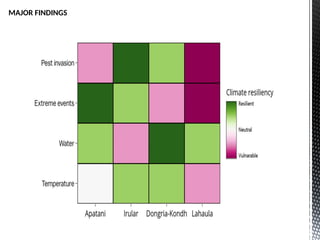
MAJOR FINDINGS
RESHAPING POLICY
The policy outcome may be summarizing as follows:
Recognition of Indigenous Knowledge:
Policies must acknowledge and integrate traditional ecological knowledge held by
tribal communities.
Water recycling techniques :
It can be brought into awareness by setting common purifier in their locality and
furrow used by Apatani and Lahaul tribes could be adopted by Irular and Dongria
Kondh tribes as Nilgiri and Koraput region will face extreme water stress in coming
decades.
Climate Adaptation and Mitigation Strategies:
Policies must support tribes in developing and implementing climate adaptation and
mitigation strategies tailored to their specific needs. This may include promoting
sustainable land-use practices, enhancing infrastructure resilience, and facilitating
access to climate-smart technologies and renewable energy alternatives
Government and educational institutions:
They need to focus on harvesting the traditional knowledge by the indigenous
community.
CONLUSION
Addressing the intersection of climate change and tribal livelihoods
necessitates a holistic policy approach that recognizes indigenous
knowledge, upholds land rights, promotes adaptation and mitigation
strategies, invests in capacity building, and fosters collaborative
governance. By prioritizing the resilience and sustainability of tribal
communities, policymakers can not only mitigate the adverse effects
of climate change but also support the preservation of indigenous
cultures and ecosystems for future generations

Presentatioion on the title on challenge

  • 1.
    CHALLENGES OF TRIBAL LIVELIHOODSECURITY IN CLIMATE CHANGE INDIA
  • 2.
    ABSTRACT Tribal communities inIndia face escalating challenges to their livelihood security due to the adverse impacts of climate change. This study explores the multifaceted challenges encountered by tribal populations in sustaining their livelihoods amidst changing climatic patterns. Factors such as diminishing water resources, erratic rainfall, biodiversity loss, and shifting agricultural practices significantly affect the traditional livelihood strategies of these communities. Additionally, inadequate access to resources, limited infrastructure, and socio-economic marginalization exacerbate their vulnerability. Understanding these challenges is crucial for designing effective adaptation and mitigation strategies to enhance tribal livelihood resilience. The Indian region is one of the world’s 8 centers of crop plant origin and diversity with 166 food/crop species and 320 wild relatives of crops have originated here (Dr R.S. Rana, personal communication). India has 700 recorded tribal groups with population of 104 million as per 2011 census and many of them practicing diverse indigenous farming techniques to suit the needs of various respective Eco climatic zones. The present study has been designed as a literature-based analytical review of such practices among 4 different ethnic groups in 4 different agro climatic and geographical zones of India, viz, the Apatanis of Arunachal Pradesh, the Dongria Kondh of Niamgiri hills of Odisha, the Irular in the Nilgiris, and the Lahaulas of Himachal Pradesh. This paper underscores the urgent need for interdisciplinary research and policy interventions aimed at safeguarding the livelihood security of tribal populations amidst the rapidly changing climate scenario in India.
  • 3.
    INTRODUCTION In India, hometo over 1.3 billion people, is one of the world's most populous and rapidly developing nations. Yet, amidst its dynamic growth, India faces an increasingly urgent challenge in climate change. With its vast geographical diversity, from the Himalayas in the north to the coastal plains in the south, India is uniquely vulnerable to the impacts of a changing climate. This article explores the pressing issue of climate change in India, backed by compelling data that elucidate the scale and scope of the challenge on tribal people.  Loss of Livelihoods and Food Insecurity  Displacement and Loss of Cultural Heritage  Health Risks and Vulnerability There are an estimated 476 million Indigenous Peoples worldwide. (World Bank) In India, 705 ethnic groups are recognized as Scheduled Tribes. In central India, the Scheduled Tribes are usually referred to as Adivasis, which literally means Indigenous Peoples. With an estimated population of 104 million, they comprise 8.6% of the total population. (International work group for indigenous affairs 2023). Here I focus on the 4 different ethnic groups in 4 different agro climatic and geographical zones of India, viz, the Apatanis of Arunachal Pradesh, the Dongria Kondh of Niamgiri hills of Odisha, the Irular in the Nilgiris, and the Lahaulas of Himachal Pradesh.
  • 4.
    OBJECTIVES To assess thefarming situation. Exploring Indigenous Knowledge and Adaptive Strategies. Assessing the Impact of Climate Change on Tribal Livelihoods.
  • 5.
    Sensitivity highlights: Theincreasing frequency and intensity of extreme weather events in India, including erratic rainfall, prolonged droughts, and severe cyclones. For indigenous communities whose livelihoods are intimately tied to agriculture, forestry, and traditional water management systems, these changes pose significant challenges. Reduced agricultural productivity, loss of crops, and depletion of water sources exacerbate food insecurity and economic hardships among indigenous populations. Disruption of Traditional Livelihoods: The reliance of indigenous communities on natural resources makes them particularly susceptible to disruptions caused by climate change. Data from the Ministry of Tribal Affairs and academic studies reveal how shifts in weather patterns and environmental degradation impact traditional livelihoods such as agriculture, fishing, hunting, and gathering. Coastal indigenous communities, for instance, face threats from sea-level rise, saltwater intrusion, and loss of biodiversity, endangering their fishing-based livelihoods and cultural practices. BACKGROUND OF THE STUDY
  • 6.
    environmental degradation aredriving indigenous communities towards forced migration from their ancestral lands. Data from the Internal Displacement Monitoring Centre (IDMC) highlight how climate-induced displacement exacerbates vulnerabilities, leading to loss of land rights, social marginalization, and conflicts over dwindling resources. Internal migration to urban areas often results in precarious living conditions, lack of access to basic services, and loss of cultural heritage, further exacerbating the challenges faced by indigenous peoples. Limited Access to Adaptive Resources: Despite their heightened vulnerability, indigenous communities often have limited access to resources and support mechanisms for climate change adaptation. Data from the National Institute of Disaster Management (NIDM) reveal gaps in infrastructure, healthcare, education, and social protection schemes in indigenous areas, hindering their capacity to cope with climate impacts. Moreover, exclusionary policies and inadequate representation exacerbate indigenous communities' marginalization in decision-making processes related to climate change adaptation and mitigation. Loss of Biodiversity and Ecosystem Services: India's rich biodiversity, encompassing diverse ecosystems from forests to grasslands, is under threat from climate change-induced habitat loss and degradation. Data from the Ministry of Environment, Forest and Climate Change (MoEFCC) indicate alarming rates of deforestation and forest fragmentation, directly impacting indigenous communities' access to forest resources and ecosystem services. The loss of traditional medicinal plants, fuel wood, and non-timber forest products not only undermines indigenous livelihoods but also erodes cultural identities and
  • 7.
  • 8.
    RESHAPING POLICY The policyoutcome may be summarizing as follows: Recognition of Indigenous Knowledge: Policies must acknowledge and integrate traditional ecological knowledge held by tribal communities. Water recycling techniques : It can be brought into awareness by setting common purifier in their locality and furrow used by Apatani and Lahaul tribes could be adopted by Irular and Dongria Kondh tribes as Nilgiri and Koraput region will face extreme water stress in coming decades. Climate Adaptation and Mitigation Strategies: Policies must support tribes in developing and implementing climate adaptation and mitigation strategies tailored to their specific needs. This may include promoting sustainable land-use practices, enhancing infrastructure resilience, and facilitating access to climate-smart technologies and renewable energy alternatives Government and educational institutions: They need to focus on harvesting the traditional knowledge by the indigenous community.
  • 9.
    CONLUSION Addressing the intersectionof climate change and tribal livelihoods necessitates a holistic policy approach that recognizes indigenous knowledge, upholds land rights, promotes adaptation and mitigation strategies, invests in capacity building, and fosters collaborative governance. By prioritizing the resilience and sustainability of tribal communities, policymakers can not only mitigate the adverse effects of climate change but also support the preservation of indigenous cultures and ecosystems for future generations