Technovation-2018
(2-4 February 2018)
Organized by
Poornima University IEEE Student Branch & Associated Society Chapters
Supported by
IEEE Rajasthan Subsection, ISTE, IEI & ISLE
113: Demonetization : Impact on Cashless Economy
By
Dr. Rakesh Gupta
Virendra Singh Solanki
Shiv Sharma
Authored by
Dr. Rakesh Gupta
Virendra singh solanki
Shiv Sharma
3/2/2018
Technovation-2018
2
Presentation Overview
Demonetization: IntroductionofDemonetization
Historyof Demonetization
India’sjourneytowardscashlesseconomy
Phases of Demonetization
Globalscenarioofcashlesseconomy
Trigger of change in economy- Demonetization
Govt.initiativetowardscashlesseconomy
Advantages and Disadvantages
Conclusion
Introduction of Demonetization
 Demonetization is the concept of destroying of the highest
denomination currency notes so that can address by the government for
tax evasion, counterfeit currency and funding of illegal activities.
India has one of the highest levels of currencies in circulation at over
12% of GDP and of this cash, 86% is in the form of Rs 500 and Rs 1,000
notes.
History of Demonetization
Demonetization is not taken for the first time in the history of
Indian economy. It has been happen twice in the past
The first currency ban was announced as on 12th January,
1946(Saturday) by RBI headquarter. At that time currency notes of
1000 and 10,000 were totally removed from economy.
The second currency ban was made on 16th January, 1978. At that
time currency ban was taken 1000, 5000 and 10,000 out of
circulation.
Finally the 3rd, the most recent demonetization had been announced
as on 8th November, 2016 by Prime Minister Narendra Modi. This
time the currency of 500 and 1000 notes are demonetized from
economy.
India’s Journey towards Cashless Economy
In the 1990s the Reserve bank of India introduced Electronic Clearing Services
(ECS) Credit to handle bulk and repetitive payment requirement (like salaries,
interest, dividend payments) of corporate and other institutes.
In 2004 Real Time Gross Settlement (RTGS) and in 2005 National Electronic
Fund Transfer (NEFT) was introduced, now it was easy for Individuals/corporate
to transfer money from one account/bank to another
Soon to follow was National Electronic Clearing Service (NECS), a new avatar
which allowed and managed multiple credits to beneficiary accounts.
Phases of Demonetisation
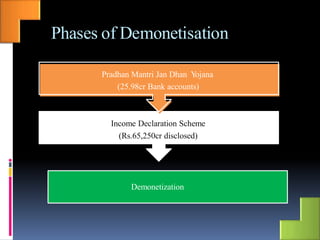
Demonetization
Income Declaration Scheme
(Rs.65,250cr disclosed)
Pradhan Mantri Jan Dhan Yojana
(25.98cr Bank accounts)
GLOBAL SCENERIO OF CASHLESS ECONOMY
India has the unique culture that is unlike any other country in the world. In India
people are happy in saving of money and preferred in spending money in cash expect
the digital medium
In 2016, 78% of all consumer payments in India were made in cash. Viewed in
comparison to the 3.5% to 8% for developed countries such as the U.S. and the UK,
cash in circulation in India accounted for 18% of the country’s GDP.
Trigger of change - Demonetization
 The mad scramble to exchange the notes began, as 86% of the cash in
circulation became instantly worthless. This was a very big deal,
considering that 90% of India's economy is cash.
 For small and medium businesses, which held 45-50% of the demonetized
note stock in the economy, there simply weren’t enough 100, 50, 20 and 10
rupee notes and coins on hand to satisfy instantaneous exchange demand.
 Although it’s a big decision as a giant economy of India so that its effected
the lifestyle of the Indians so they push themselves towards the e-wallets
like Paytm and cashless payment platform.
GOVT. INITIATIVES TOWARDS CASHLESS ECONOMY
The Central Government Petroleum PSUs shall give incentive by offering a discount at the
rate of 0.75% of the sale price to consumers on purchase of petrol/diesel if payment is made
through digital.
“Rupay Kisan Cards” initiatives taken by The Central Government for the support in rural
regional bank through NABARD.
On the booking of ticket by cashless method railway passengers availed free accidental
insurance cover of up to Rs. 10 lakh.
For the payment of toll at Toll Plazas on National Highways using RFID card/Fast Tags, a
discount of 10% will be available to users in the year 2016-17.
Up to Rs.2000 per transaction there are no service tax charged on digital and MDR
transactions.
Advantages & Disadvantages of cashless economy
A. Advantages:-
 Due to cashless economy system it is helpful in Saving a huge
expenditure or cost for the currency in country
 Going cashless will end the system of bribery to a very extent
at all levels as bribe through bank accounts would be under
proper check and will make people more alert in performing
their duties well.
B. Disadvantages:-
 India is a huge country and itself contain large number of
populations so that’s there are many perceptions of the people
towards the cashless and digital economy system.
 India is now in the developing phase for the digital and
cashless economy and there is always the reliability issue in
the new initiative taken by each and every authority.
Conclusion
Every new habit introduced in life needs at least 21 days to get used to and
the way Indian society pay for a thing is a cultural pattern which is hard to
change and each environment doesn’t accept the change so early its take time
for that and anything takes times in improving
Indian economy is growing rapidly in cashless economy and its required
some time it is reviewed by some experts that Indian economy is become a
very strong cashless economy in the world. In coming ten year there is no place
for the traditional way of payment.
Our government tried to lay a series of steps before announcing
demonetization but still somewhere it does seemed as an Trigger for the
cashless economy.
.
Presentatio technovation

Presentatio technovation

  • 1.
    Technovation-2018 (2-4 February 2018) Organizedby Poornima University IEEE Student Branch & Associated Society Chapters Supported by IEEE Rajasthan Subsection, ISTE, IEI & ISLE 113: Demonetization : Impact on Cashless Economy By Dr. Rakesh Gupta Virendra Singh Solanki Shiv Sharma Authored by Dr. Rakesh Gupta Virendra singh solanki Shiv Sharma
  • 2.
    3/2/2018 Technovation-2018 2 Presentation Overview Demonetization: IntroductionofDemonetization HistoryofDemonetization India’sjourneytowardscashlesseconomy Phases of Demonetization Globalscenarioofcashlesseconomy Trigger of change in economy- Demonetization Govt.initiativetowardscashlesseconomy Advantages and Disadvantages Conclusion
  • 3.
    Introduction of Demonetization Demonetization is the concept of destroying of the highest denomination currency notes so that can address by the government for tax evasion, counterfeit currency and funding of illegal activities. India has one of the highest levels of currencies in circulation at over 12% of GDP and of this cash, 86% is in the form of Rs 500 and Rs 1,000 notes.
  • 4.
    History of Demonetization Demonetizationis not taken for the first time in the history of Indian economy. It has been happen twice in the past The first currency ban was announced as on 12th January, 1946(Saturday) by RBI headquarter. At that time currency notes of 1000 and 10,000 were totally removed from economy. The second currency ban was made on 16th January, 1978. At that time currency ban was taken 1000, 5000 and 10,000 out of circulation. Finally the 3rd, the most recent demonetization had been announced as on 8th November, 2016 by Prime Minister Narendra Modi. This time the currency of 500 and 1000 notes are demonetized from economy.
  • 5.
    India’s Journey towardsCashless Economy In the 1990s the Reserve bank of India introduced Electronic Clearing Services (ECS) Credit to handle bulk and repetitive payment requirement (like salaries, interest, dividend payments) of corporate and other institutes. In 2004 Real Time Gross Settlement (RTGS) and in 2005 National Electronic Fund Transfer (NEFT) was introduced, now it was easy for Individuals/corporate to transfer money from one account/bank to another Soon to follow was National Electronic Clearing Service (NECS), a new avatar which allowed and managed multiple credits to beneficiary accounts.
  • 6.
    Phases of Demonetisation Demonetization IncomeDeclaration Scheme (Rs.65,250cr disclosed) Pradhan Mantri Jan Dhan Yojana (25.98cr Bank accounts)
  • 7.
    GLOBAL SCENERIO OFCASHLESS ECONOMY India has the unique culture that is unlike any other country in the world. In India people are happy in saving of money and preferred in spending money in cash expect the digital medium In 2016, 78% of all consumer payments in India were made in cash. Viewed in comparison to the 3.5% to 8% for developed countries such as the U.S. and the UK, cash in circulation in India accounted for 18% of the country’s GDP.
  • 8.
    Trigger of change- Demonetization  The mad scramble to exchange the notes began, as 86% of the cash in circulation became instantly worthless. This was a very big deal, considering that 90% of India's economy is cash.  For small and medium businesses, which held 45-50% of the demonetized note stock in the economy, there simply weren’t enough 100, 50, 20 and 10 rupee notes and coins on hand to satisfy instantaneous exchange demand.  Although it’s a big decision as a giant economy of India so that its effected the lifestyle of the Indians so they push themselves towards the e-wallets like Paytm and cashless payment platform.
  • 9.
    GOVT. INITIATIVES TOWARDSCASHLESS ECONOMY The Central Government Petroleum PSUs shall give incentive by offering a discount at the rate of 0.75% of the sale price to consumers on purchase of petrol/diesel if payment is made through digital. “Rupay Kisan Cards” initiatives taken by The Central Government for the support in rural regional bank through NABARD. On the booking of ticket by cashless method railway passengers availed free accidental insurance cover of up to Rs. 10 lakh. For the payment of toll at Toll Plazas on National Highways using RFID card/Fast Tags, a discount of 10% will be available to users in the year 2016-17. Up to Rs.2000 per transaction there are no service tax charged on digital and MDR transactions.
  • 10.
    Advantages & Disadvantagesof cashless economy A. Advantages:-  Due to cashless economy system it is helpful in Saving a huge expenditure or cost for the currency in country  Going cashless will end the system of bribery to a very extent at all levels as bribe through bank accounts would be under proper check and will make people more alert in performing their duties well. B. Disadvantages:-  India is a huge country and itself contain large number of populations so that’s there are many perceptions of the people towards the cashless and digital economy system.  India is now in the developing phase for the digital and cashless economy and there is always the reliability issue in the new initiative taken by each and every authority.
  • 11.
    Conclusion Every new habitintroduced in life needs at least 21 days to get used to and the way Indian society pay for a thing is a cultural pattern which is hard to change and each environment doesn’t accept the change so early its take time for that and anything takes times in improving Indian economy is growing rapidly in cashless economy and its required some time it is reviewed by some experts that Indian economy is become a very strong cashless economy in the world. In coming ten year there is no place for the traditional way of payment. Our government tried to lay a series of steps before announcing demonetization but still somewhere it does seemed as an Trigger for the cashless economy. .