1
Estonia
Psühholoogilise Abi
Keskus Ariadna
Natalja Skvortsova
Galina Kushanova
26.03.2015
Avís legal
Aquesta obra està subjecta a una llicència Reconeixement 3.0 de Creative Commons. Se'n permet la reproducció, la distribució, la
comunicació del material sempre que se citi l’autoria del material i el Centre d’Estudis Jurídics i Formació Especialitzada (Departament
de Justícia) i no se'n faci un ús comercial ni es transformi per generar obres derivades. La llicència Reconeixement–No comercial–Sense
obres derivades es pot consultar a http://creativecommons.org/licenses/by-nc-nd/3.0/es/deed.ca .
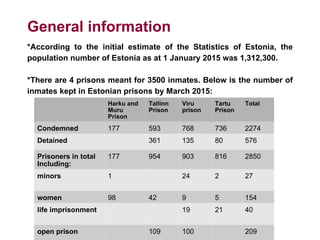
General information
*According to the initial estimate of the Statistics of Estonia, the
population number of Estonia as at 1 January 2015 was 1,312,300.
*There are 4 prisons meant for 3500 inmates. Below is the number of
inmates kept in Estonian prisons by March 2015:
Harku and
Muru
Prison
Tallinn
Prison
Viru
prison
Tartu
Prison
Total
Condemned 177 593 768 736 2274
Detained 361 135 80 576
Prisoners in total
Including:
177 954 903 816 2850
minors 1 24 2 27
women 98 42 9 5 154
life imprisonment 19 21 40
open prison 109 100 209
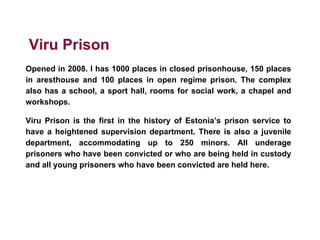
Viru Prison
Opened in 2008. I has 1000 places in closed prisonhouse, 150 places
in aresthouse and 100 places in open regime prison. The complex
also has a school, a sport hall, rooms for social work, a chapel and
workshops.
Viru Prison is the first in the history of Estonia’s prison service to
have a heightened supervision department. There is also a juvenile
department, accommodating up to 250 minors. All underage
prisoners who have been convicted or who are being held in custody
and all young prisoners who have been convicted are held here.
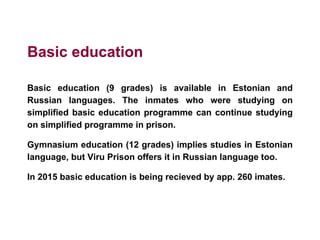
Basic education
Basic education (9 grades) is available in Estonian and
Russian languages. The inmates who were studying on
simplified basic education programme can continue studying
on simplified programme in prison.
Gymnasium education (12 grades) implies studies in Estonian
language, but Viru Prison offers it in Russian language too.
In 2015 basic education is being recieved by app. 260 imates.
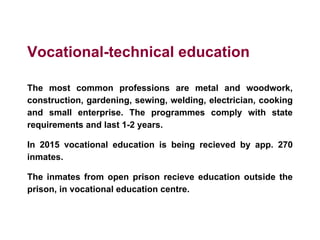
Vocational-technical education
The most common professions are metal and woodwork,
construction, gardening, sewing, welding, electrician, cooking
and small enterprise. The programmes comply with state
requirements and last 1-2 years.
In 2015 vocational education is being recieved by app. 270
inmates.
The inmates from open prison recieve education outside the
prison, in vocational education centre.
Estonian language
Non-Estonians are integrated into the Estonian society by the
state language and civic duty courses organized by the prison.
There are 793 the state language studying places created for
the inmates. 715 condemned and 48 detained prisoners took
part in Estonian language courses in 2014.
Estonian language courses are available until C1.
Those who want can take the state Estonian language
examination.
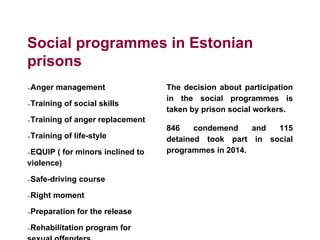
Social programmes in Estonian
prisons
➢Anger management
➢Training of social skills
➢Training of anger replacement
➢Training of life-style
➢EQUIP ( for minors inclined to
violence)
➢Safe-driving course
➢Right moment
➢Preparation for the release
➢Rehabilitation program for
sexual offenders
The decision about participation
in the social programmes is
taken by prison social workers.
846 condemend and 115
detained took part in social
programmes in 2014.
Other supportive activities
*Chapel and chaplain service
*Music band
*Sport
*Library
*Workshops
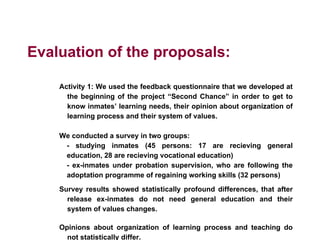
Evaluation of the proposals:
Activity 1: We used the feedback questionnaire that we developed at
the beginning of the project “Second Chance” in order to get to
know inmates’ learning needs, their opinion about organization of
learning process and their system of values.
We conducted a survey in two groups:
- studying inmates (45 persons: 17 are recieving general
education, 28 are recieving vocational education)
- ex-inmates under probation supervision, who are following the
adoptation programme of regaining working skills (32 persons)
Survey results showed statistically profound differences, that after
release ex-inmates do not need general education and their
system of values changes.
Opinions about organization of learning process and teaching do
not statistically differ.
Results of research of system of
values
Significant
values (inmates)
Significant values
(ex-inmates)
Values Rank Values Rank
Family 1,875 Money 1,33
Health 4,563 Power 3,22
Freedom 5,688 Popularity 4,235
Friendship 5,75 Status 5,05
Love 6 Success 6,322
Money 6,813 Independence 7,45
Independence 7,81 Health 8,656
Education 8,75
Results of research of learning
needs
The main characteristic: ex-inmates under probation
supervision didn't mention such learning needs as self-
development or increase of educational status. Their
learning needs are very practical: these are mostly well-
paid and in demand vocations with high possibility of job
placement.
Results of research of opinion about
organization of learning process
There are no significant differencies between inmates and ex-
inmates under probabition supervision opinions.
Both groups insist on
- individual approach – (71% of inmates / 68% of ex-inmates)
- practicality (53/61%)
- teacher's empathy and non-judgemental attitude (64/66%)
- interesting way of teaching and variety of activities (45/50%)
Evaluation of proposals
Activity 2: We organized an information stand or corner in Ida-
Virumaa Vocational Education Centre with booklets, posters
and brochures about the available and possible future
education and professional development of inmates.
The information stands were organized in the libraries of Ida-Virumaa
Vocational Education Centre and Viru Prison (open prison).
Evaluation of proposals
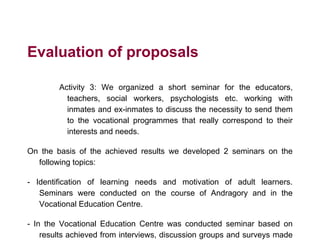
Activity 3: We organized a short seminar for the educators,
teachers, social workers, psychologists etc. working with
inmates and ex-inmates to discuss the necessity to send them
to the vocational programmes that really correspond to their
interests and needs.
On the basis of the achieved results we developed 2 seminars on the
following topics:
- Identification of learning needs and motivation of adult learners.
Seminars were conducted on the course of Andragory and in the
Vocational Education Centre.
- In the Vocational Education Centre was conducted seminar based on
results achieved from interviews, discussion groups and surveys made
Final conclusions
*We need a spesific theoretical and practical approach to
teaching inmates, that would be based on humanistic concept
of learner's autonomy and teachers as facilitators of the
learning process.
*Released inmates need psychological, social as well as
educational support.
*Learning is an instrument of reintegration into society.
*There is a need to conduct a scientific research in order to
understand all the factors that favour inmates' reintegration in
to society after release. On the basis of this research we could
propose innovations in the system of educational and social
services.
Changes that have been produced in the last
two years as a result of the project
On the basis of the information received in the discussion groups there
were changes made in the methodology and working methods with ex-
inmates;
On the basis of the information received in the discussion groups and from
the questionnaires where ex-inmates underlined teacher's personality,
we pay more attention not only to the aims of our social programmes
but also to interpesonal communication of ex-inmates and teachers;
Exchange activities opened new traits and personality sides of ex-inmates
(creativity, depth of emotions and feelings);
information about learning needs that we received from the questionnaires
creates the question how to support the motivation to learn and
increase educational status.

Presentació Projecte Grundtvig Estonia. Galina Kushanova

  • 1.
    1 Estonia Psühholoogilise Abi Keskus Ariadna NataljaSkvortsova Galina Kushanova 26.03.2015 Avís legal Aquesta obra està subjecta a una llicència Reconeixement 3.0 de Creative Commons. Se'n permet la reproducció, la distribució, la comunicació del material sempre que se citi l’autoria del material i el Centre d’Estudis Jurídics i Formació Especialitzada (Departament de Justícia) i no se'n faci un ús comercial ni es transformi per generar obres derivades. La llicència Reconeixement–No comercial–Sense obres derivades es pot consultar a http://creativecommons.org/licenses/by-nc-nd/3.0/es/deed.ca .
  • 2.
    General information *According tothe initial estimate of the Statistics of Estonia, the population number of Estonia as at 1 January 2015 was 1,312,300. *There are 4 prisons meant for 3500 inmates. Below is the number of inmates kept in Estonian prisons by March 2015: Harku and Muru Prison Tallinn Prison Viru prison Tartu Prison Total Condemned 177 593 768 736 2274 Detained 361 135 80 576 Prisoners in total Including: 177 954 903 816 2850 minors 1 24 2 27 women 98 42 9 5 154 life imprisonment 19 21 40 open prison 109 100 209
  • 3.
    Viru Prison Opened in2008. I has 1000 places in closed prisonhouse, 150 places in aresthouse and 100 places in open regime prison. The complex also has a school, a sport hall, rooms for social work, a chapel and workshops. Viru Prison is the first in the history of Estonia’s prison service to have a heightened supervision department. There is also a juvenile department, accommodating up to 250 minors. All underage prisoners who have been convicted or who are being held in custody and all young prisoners who have been convicted are held here.
  • 4.
    Basic education Basic education(9 grades) is available in Estonian and Russian languages. The inmates who were studying on simplified basic education programme can continue studying on simplified programme in prison. Gymnasium education (12 grades) implies studies in Estonian language, but Viru Prison offers it in Russian language too. In 2015 basic education is being recieved by app. 260 imates.
  • 5.
    Vocational-technical education The mostcommon professions are metal and woodwork, construction, gardening, sewing, welding, electrician, cooking and small enterprise. The programmes comply with state requirements and last 1-2 years. In 2015 vocational education is being recieved by app. 270 inmates. The inmates from open prison recieve education outside the prison, in vocational education centre.
  • 6.
    Estonian language Non-Estonians areintegrated into the Estonian society by the state language and civic duty courses organized by the prison. There are 793 the state language studying places created for the inmates. 715 condemned and 48 detained prisoners took part in Estonian language courses in 2014. Estonian language courses are available until C1. Those who want can take the state Estonian language examination.
  • 7.
    Social programmes inEstonian prisons ➢Anger management ➢Training of social skills ➢Training of anger replacement ➢Training of life-style ➢EQUIP ( for minors inclined to violence) ➢Safe-driving course ➢Right moment ➢Preparation for the release ➢Rehabilitation program for sexual offenders The decision about participation in the social programmes is taken by prison social workers. 846 condemend and 115 detained took part in social programmes in 2014.
  • 8.
    Other supportive activities *Chapeland chaplain service *Music band *Sport *Library *Workshops
  • 9.
    Evaluation of theproposals: Activity 1: We used the feedback questionnaire that we developed at the beginning of the project “Second Chance” in order to get to know inmates’ learning needs, their opinion about organization of learning process and their system of values. We conducted a survey in two groups: - studying inmates (45 persons: 17 are recieving general education, 28 are recieving vocational education) - ex-inmates under probation supervision, who are following the adoptation programme of regaining working skills (32 persons) Survey results showed statistically profound differences, that after release ex-inmates do not need general education and their system of values changes. Opinions about organization of learning process and teaching do not statistically differ.
  • 10.
    Results of researchof system of values Significant values (inmates) Significant values (ex-inmates) Values Rank Values Rank Family 1,875 Money 1,33 Health 4,563 Power 3,22 Freedom 5,688 Popularity 4,235 Friendship 5,75 Status 5,05 Love 6 Success 6,322 Money 6,813 Independence 7,45 Independence 7,81 Health 8,656 Education 8,75
  • 11.
    Results of researchof learning needs The main characteristic: ex-inmates under probation supervision didn't mention such learning needs as self- development or increase of educational status. Their learning needs are very practical: these are mostly well- paid and in demand vocations with high possibility of job placement.
  • 12.
    Results of researchof opinion about organization of learning process There are no significant differencies between inmates and ex- inmates under probabition supervision opinions. Both groups insist on - individual approach – (71% of inmates / 68% of ex-inmates) - practicality (53/61%) - teacher's empathy and non-judgemental attitude (64/66%) - interesting way of teaching and variety of activities (45/50%)
  • 13.
    Evaluation of proposals Activity2: We organized an information stand or corner in Ida- Virumaa Vocational Education Centre with booklets, posters and brochures about the available and possible future education and professional development of inmates. The information stands were organized in the libraries of Ida-Virumaa Vocational Education Centre and Viru Prison (open prison).
  • 14.
    Evaluation of proposals Activity3: We organized a short seminar for the educators, teachers, social workers, psychologists etc. working with inmates and ex-inmates to discuss the necessity to send them to the vocational programmes that really correspond to their interests and needs. On the basis of the achieved results we developed 2 seminars on the following topics: - Identification of learning needs and motivation of adult learners. Seminars were conducted on the course of Andragory and in the Vocational Education Centre. - In the Vocational Education Centre was conducted seminar based on results achieved from interviews, discussion groups and surveys made
  • 15.
    Final conclusions *We needa spesific theoretical and practical approach to teaching inmates, that would be based on humanistic concept of learner's autonomy and teachers as facilitators of the learning process. *Released inmates need psychological, social as well as educational support. *Learning is an instrument of reintegration into society. *There is a need to conduct a scientific research in order to understand all the factors that favour inmates' reintegration in to society after release. On the basis of this research we could propose innovations in the system of educational and social services.
  • 16.
    Changes that havebeen produced in the last two years as a result of the project On the basis of the information received in the discussion groups there were changes made in the methodology and working methods with ex- inmates; On the basis of the information received in the discussion groups and from the questionnaires where ex-inmates underlined teacher's personality, we pay more attention not only to the aims of our social programmes but also to interpesonal communication of ex-inmates and teachers; Exchange activities opened new traits and personality sides of ex-inmates (creativity, depth of emotions and feelings); information about learning needs that we received from the questionnaires creates the question how to support the motivation to learn and increase educational status.