ENFOQUES METODOLÓGICOS Y ESTRATEGIAS DE ENSEÑANZA-APRENDIZAJE PARA EL DESARROLLO DE LAS COMPETENCIAS BÁSICAS EN EL ÁREA DE INGLÉS CEP CÓRDOBA. FEBRERO 2009.
JUSTIFICATION Silently but surely, the term “Basic COMPETENCES” has entered our official curriculum guidelines.  There is no turning back: COMPETENCES are new and revolutionary proposals for education which all industrialised countries are gradually incorporating into their education systems.  Teaching to attain COMPETENCES means a drastic change in all curricular elements, especially methodology.  Strategies based instruction will be presented as a useful tool to implement learner autonomy, life long learning and basic COMPETENCES.  BASIC COMPETENCES AND FOREIGN LANGUAGE TEACHING
OBJECTIVES To analyse and reflect upon the Basic COMPETENCES and their incorporation in our National Curriculum.  To learn about Learning Strategies and Strategies Based Instruction, from theory to classroom practice.  To explore how strategies based instruction can assist us in developing the Basic COMPETENCES and curriculum integration in our schools.  To Practice and improve our English.    BASIC COMPETENCES AND FOREIGN LANGUAGE TEACHING
CONTENTS  Basic COMPETENCES in the Spanish Education System, especially in the EFL curriculum.  Learning Strategies and Strategies Based Instruction as a means to developing basic COMPETENCES.  Proposals for the evaluation of COMPETENCES.  Interaction in English.  BASIC COMPETENCES AND FOREIGN LANGUAGE TEACHING
METHODOLOGY  This is a practical workshop in which there will be a combination of learning theory, reflection, discussion, and collaborative work caried out by participants.  The sessions will be caried out in English with the aim of offering particiants the opportunity of English language practice and improvement.   BASIC COMPETENCES AND FOREIGN LANGUAGE TEACHING
Sesion 1: 11th February BASIC COMPETENCES. PART I What you know and what you’d like to know. How it all began: ideology, philosophy and reality in the 21st century. Competences around the world, OECD, PISA. Competences in the EU. BASIC COMPETENCES AND FOREIGN LANGUAGE TEACHING
SESIÓN 1: 11th February BASIC COMPETENCES. PART II. What are they and how are they included in our official curriculum?  How do they affect our teaching? How do they affect our schools? Outcomes of training for Basic Competences BASIC COMPETENCES AND FOREIGN LANGUAGE TEACHING
Session 2: 18th February Learning strategies: Latest Learning Theories Origins, Evolution and Latest Trends in Learning Strategies Cognitive strategies Metacognitive strategies Social strategies Affective strategies Outcomes of learning strategies BASIC COMPETENCES AND FOREIGN LANGUAGE TEACHING
Session 3: 25th February Teaching strategies  How to implement SBI:  Cognitive Metacognitive Social Affective Evaluation Reasons for evaluating Evaluating strategy use Evaluating COMPETENCES  Instruments, registers, reports, portfolios…  BASIC COMPETENCES AND FOREIGN LANGUAGE TEACHING
Session 1: INITIAL QUESTIONNAIRE Tell us what you already know about basic COMPETENCES and learning  strategies… Have you done courses? Have you read articles, books? Have you discussed them at school with colleagues? What are your fears, worries, doubts about them? ………………………… ..? ………………………… ..? ………………………… .? BASIC COMPETENCES AND FOREIGN LANGUAGE TEACHING
How it all began: ideology, philosophy and technology in the 21st century. Jacques Delors  “learning the treasure within” 1996: learning to know, to do, to live together, to be.  http://www.unesco.org/delors/ Howard Gardner : frames of mind  (multiple intelligences theory). Five minds for the future, 2007: the disciplined mind, the synthtizing mind, the creative mind, the respectful mind, the ethical mind.  http://www.brr.com.au/event/1ACD/60122/27697/wmp/e39dcpuj7c   http://www.teachers.tv/video/5452  (  excellent podcast) BASIC COMPETENCES AND FOREIGN LANGUAGE TEACHING
Too often we give children answers to remember rather than problems to solve.  ~Roger Lewin BASIC COMPETENCES AND FOREIGN LANGUAGE TEACHING
Learning to know Mastery of learning tools Broad general education and small number of subjects in depth. Concentration skills Memory skills: associative memorization. Thinking Combination of deductive and inductive reasoning Too often we give children answers to remember rather than problems to solve.  ~Roger Lewin BASIC COMPETENCES AND FOREIGN LANGUAGE TEACHING
If the Romans had been obliged to learn Latin, they would never have found time to conquer the world.   ~Heinrich Heine BASIC COMPETENCES AND FOREIGN LANGUAGE TEACHING
Education for the future labour market Increased skills requirement: knowledge & job skills Interpersonal skills Information and communication skills Intuition, common sense, judgement and leadership skills. BASIC COMPETENCES AND FOREIGN LANGUAGE TEACHING
He who opens a school door, closes a prison. ~Victor Hugo BASIC COMPETENCES AND FOREIGN LANGUAGE TEACHING
Learning to live together Promoting the peaceful solution to conflict  Tolerance  Social and cultural awareness Empathy and recognition of human rights Dialogue and discussion Collaborative projects Humanitarian action/projects He who opens a school door, closes a prison. ~Victor Hugo BASIC COMPETENCES AND FOREIGN LANGUAGE TEACHING
Education's purpose is to replace an empty mind with an open one.   ~Malcolm S. Forbes BASIC COMPETENCES AND FOREIGN LANGUAGE TEACHING
Personal development Interpersonal and intrapersonal relationships  Report: Learning to be 1972 Fairness, responsibility. Freedom of thought, feeling, imagination… Respect for minorities Education's purpose is to replace an empty mind with an open one.  ~Malcolm S. Forbes BASIC COMPETENCES AND FOREIGN LANGUAGE TEACHING
The movement of capital and other market instruments around the globe The movement of human beings across borders, 100 million immigrants at any one time around the world 3. The movement of information through cyberspace 4. The movement of popular culture (clothing, Food) across borders BASIC COMPETENCES AND FOREIGN LANGUAGE TEACHING
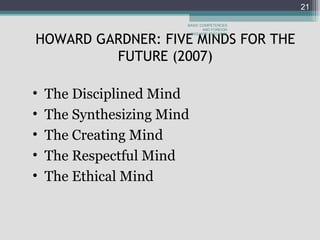
HOWARD GARDNER: FIVE MINDS FOR THE FUTURE (2007) The Disciplined Mind The Synthesizing Mind The Creating Mind The Respectful Mind The Ethical Mind BASIC COMPETENCES AND FOREIGN LANGUAGE TEACHING
The whole purpose of education is to turn mirrors into windows.   Sydney J. Harris The disciplined mind BASIC COMPETENCES AND FOREIGN LANGUAGE TEACHING
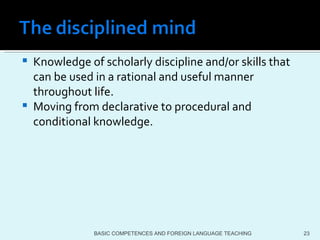
Knowledge of scholarly discipline and/or skills that can be used in a rational and useful manner throughout life. Moving from declarative to procedural and conditional knowledge. BASIC COMPETENCES AND FOREIGN LANGUAGE TEACHING
Education... has produced a vast population able to read but unable to distinguish what is worth reading.   ~G.M. Trevelyan The Synthesizing mind  BASIC COMPETENCES AND FOREIGN LANGUAGE TEACHING
Sifting information Organising information Communicating information BASIC COMPETENCES AND FOREIGN LANGUAGE TEACHING
There are those who look at things the way they are, and ask why... I dream of things that never were, and ask why not?  Robert Kennedy .  The Creative Mind BASIC COMPETENCES AND FOREIGN LANGUAGE TEACHING
Thinking outside the box.  Using knowledge and synthesis to look for solutions to challenges. BASIC COMPETENCES AND FOREIGN LANGUAGE TEACHING
What is objectionable, what is dangerous about extremists, is not that they are extreme, but that they are intolerant. The evil is not what they say about their cause, but what they say about their opponents.  Robert Kennedy   The respectful mind BASIC COMPETENCES AND FOREIGN LANGUAGE TEACHING
Tolerance Accepts human diversity Empathizes with the other Cultivate an atmosphere of openness and reciprocity.  BASIC COMPETENCES AND FOREIGN LANGUAGE TEACHING
It is not enough to understand, or to see clearly. The future will be shaped in the arena of human activity, by those willing to commit their minds and their bodies to the task.  Robert Kennedy   The Ethical mind BASIC COMPETENCES AND FOREIGN LANGUAGE TEACHING
Respect  Good workers Good citizens of their community, their region, and the globe  Constructive, non egocentric.  BASIC COMPETENCES AND FOREIGN LANGUAGE TEACHING
In conclusion " An educational system isn't worth  a great deal  if it teaches  young people how to  make  a living  but doesn't  teach them how to  make a life ."  . THE ILLITERATE OF THE 21ST CENTURY WILL NOT BE THOSE WHO CANNOT READ AND WRITE, BUT THOSE WHO CANNOT LEARN, UNLEARN, AND RELEARN.   ALVIN TOFFLER BASIC COMPETENCES AND FOREIGN LANGUAGE TEACHING
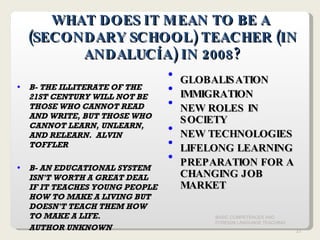
BASIC COMPETENCES AND FOREIGN LANGUAGE TEACHING WHAT DOES IT MEAN TO BE A  (SECONDARY SCHOOL) TEACHER (IN ANDALUCÍA) IN 2008? B- THE ILLITERATE OF THE 21ST CENTURY WILL NOT BE THOSE WHO CANNOT READ AND WRITE, BUT THOSE WHO CANNOT LEARN, UNLEARN, AND RELEARN.  ALVIN TOFFLER B- AN EDUCATIONAL SYSTEM ISN'T WORTH A GREAT DEAL IF IT TEACHES YOUNG PEOPLE HOW TO MAKE A LIVING BUT DOESN'T TEACH THEM HOW TO MAKE A LIFE.   AUTHOR UNKNOWN GLOBALISATION IMMIGRATION NEW ROLES IN SOCIETY NEW TECHNOLOGIES  LIFELONG LEARNING PREPARATION FOR A CHANGING JOB MARKET
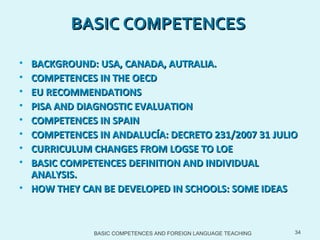
BASIC COMPETENCES AND FOREIGN LANGUAGE TEACHING BASIC COMPETENCES  BACKGROUND: USA, CANADA, AUTRALIA. COMPETENCES IN THE OECD  EU RECOMMENDATIONS PISA AND DIAGNOSTIC EVALUATION COMPETENCES IN SPAIN  COMPETENCES IN ANDALUCÍA: DECRETO 231/2007 31 JULIO CURRICULUM CHANGES FROM LOGSE TO LOE BASIC COMPETENCES DEFINITION AND INDIVIDUAL ANALYSIS.  HOW THEY CAN BE DEVELOPED IN SCHOOLS: SOME IDEAS
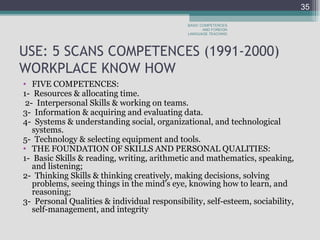
USE: 5 SCANS COMPETENCES (1991-2000)  WORKPLACE KNOW HOW  FIVE COMPETENCES:  1-  Resources & allocating time. 2-  Interpersonal Skills & working on teams.  3-  Information & acquiring and evaluating data.  4-  Systems & understanding social, organizational, and technological systems.  5-  Technology & selecting equipment and tools.  THE FOUNDATION OF SKILLS AND PERSONAL QUALITIES: 1-  Basic Skills & reading, writing, arithmetic and mathematics, speaking, and listening; 2-  Thinking Skills & thinking creatively, making decisions, solving problems, seeing things in the mind's eye, knowing how to learn, and reasoning; 3-  Personal Qualities & individual responsibility, self-esteem, sociability, self-management, and integrity BASIC COMPETENCES AND FOREIGN LANGUAGE TEACHING
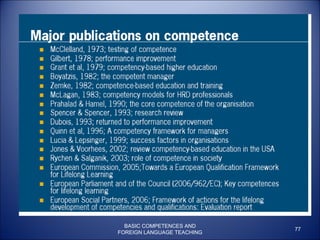
BASIC COMPETENCES AND FOREIGN LANGUAGE TEACHING
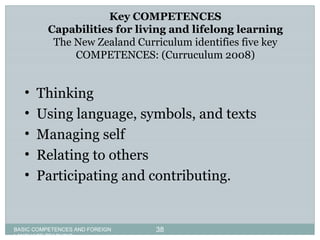
BASIC COMPETENCES AND FOREIGN LANGUAGE TEACHING Key COMPETENCES Capabilities for living and lifelong learning The New Zealand Curriculum identifies five key COMPETENCES: (Curruculum 2008) Thinking  Using language, symbols, and texts  Managing self  Relating to others  Participating and contributing.
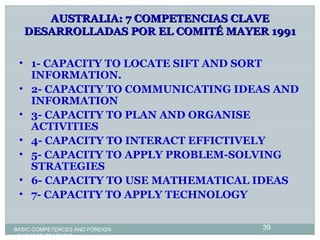
BASIC COMPETENCES AND FOREIGN LANGUAGE TEACHING AUSTRALIA: 7 COMPETENCIAS CLAVE DESARROLLADAS POR EL COMITÉ MAYER 1991 1- CAPACITY TO LOCATE SIFT AND SORT INFORMATION. 2- CAPACITY TO COMMUNICATING IDEAS AND INFORMATION 3- CAPACITY TO PLAN AND ORGANISE ACTIVITIES 4- CAPACITY TO INTERACT EFFICTIVELY 5- CAPACITY TO APPLY PROBLEM-SOLVING STRATEGIES 6- CAPACITY TO USE MATHEMATICAL IDEAS 7- CAPACITY TO APPLY TECHNOLOGY
DEFINITION COMPETENCES Why are COMPETENCES so important today? Globalisation and modernisation are creating an increasingly diverse and interconnected world. To make sense of and function well in this world, individuals need for example to master changing technologies and to make sense of large amounts of available information. They also face collective challenges as societies – such as balancing economic growth with environmental sustainability, and prosperity with social equity. In these contexts, the COMPETENCES that individuals need to meet their goals have become more complex, requiring more than the mastery of certain narrowly defined skills. “ Sustainable development and social cohesion depend critically on the COMPETENCES of all of our population – with COMPETENCES understood to cover knowledge, skills, attitudes and values.” OECD Education Ministers 2005. BASIC COMPETENCES AND FOREIGN LANGUAGE TEACHING
USE TOOLS INTERACTIVELY INTERCAT IN HETEROGENOUS GROUPS ACT AUTONOMOUSLY BASIC COMPETENCES AND FOREIGN LANGUAGE TEACHING
BASIC COMPETENCES AND FOREIGN LANGUAGE TEACHING EUROPEAN UNION
Why EU is involved in  Education? Article 149 To contribute to the development of quality education by encouraging cooperation between Member States and, if necessary, by supporting and supplementing their action. BASIC COMPETENCES AND FOREIGN LANGUAGE TEACHING
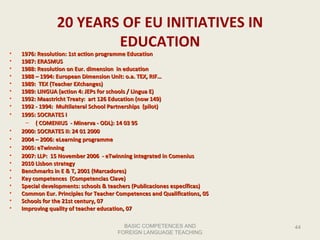
BASIC COMPETENCES AND FOREIGN LANGUAGE TEACHING 20 YEARS OF EU INITIATIVES IN EDUCATION 1976: Resolution: 1st action programme Education 1987: ERASMUS 1988: Resolution on Eur. dimension  in education 1988 – 1994: European Dimension Unit: o.a. TEX, RIF… 1989:  TEX (Teacher EXchanges) 1989: LINGUA (action 4: JEPs for schools / Lingua E) 1992: Maastricht Treaty:  ar t  126 Education (now 149) 1992 - 1994:  Multilateral School Partnerships  (pilot) 1995: SOCRATES I  ( COMENIUS   - Minerva - ODL ): 14  03  95 2000: SOCRATES II: 24  01  2000 2004 – 2006: eLearning programme 2005: eTwinning 2007: LLP:  15 November 2006  - eTwinning integrated in Comenius 2010 Lisbon strategy Benchmarks in E & T, 2001 (Marcadores) Key competences  (Competencias Clave) Special developments :  schools & teachers (Publicaciones específicas) Common Eur. Principles for Teacher Competences and Qualifications, 05 Schools for the 21st century, 07 Improving quality of teacher education, 07
BASIC COMPETENCES AND FOREIGN LANGUAGE TEACHING Lisbon Summit 23-24/03/2000 Report on the concrete future objectives of E & T systems The European Union is to become  the most competitive and dynamic knowledge-based economy  in the world, capable of  sustainable economic growth  with  more and better jobs and greater social cohesion
Benchmarks by 2010 Halve the rate of  early school leavers , in order to achieve an EU-average rate of 10%or less. Halve the level of gender imbalance among graduates in  MST  & secure an significant increase of the total number of graduates, Average  % of 25-64 yrs in the EU with at least  upper sec. education  reaches 80%or more Halve % of  low-achieving 15 year olds in reading, mathematical and scientific literacy Increase EU-average level of  participation in LLL  to at least 15% of working adults . BASIC COMPETENCES AND FOREIGN LANGUAGE TEACHING
THREE MAJOR GOALS FOR 2010: to improve the quality and effectiveness of EU education and training systems;  to ensure that they are accessible to all;  to open up education and training to the wider world.  BASIC COMPETENCES AND FOREIGN LANGUAGE TEACHING
THREE MAJOR GOALS FOR 2010: to improve the quality and effectiveness of EU education and training systems;  1.1. Improving education and training for teachers and trainers  1.2. Developing skills for the knowledge society  1.3. Ensuring access to ICT for everyone  1.4. Increasing recruitment to scientific and technical studies  1.5. Making the best use of resources  BASIC COMPETENCES AND FOREIGN LANGUAGE TEACHING
THREE MAJOR GOALS FOR 2010: 2. to ensure that they are accessible to all;  2.1. Open learning environment 2.2. Making learning more attractive 2.3. Supporting active citizenship, equal opportunities and social cohesion BASIC COMPETENCES AND FOREIGN LANGUAGE TEACHING
THREE MAJOR GOALS FOR 2010: 3. to open up education and training to the wider world.  3.1. Strengthening the links with working life and research and society at large 3.2. Developing the spirit of enterprise 3.3. Improving foreign language learning 3.4. Increasing mobility and exchange  3.5. Strengthening the European co-operation BASIC COMPETENCES AND FOREIGN LANGUAGE TEACHING
BASIC COMPETENCES AND FOREIGN LANGUAGE TEACHING THE BARCELONA SUMMIT 2002 : 13 objectives 1.1. Improving education and training for teachers and trainers  1.2. Developing skills for the knowledge society  1.3. Ensuring access to ICT for everyone  1.4. Increasing recruitment to scientific and technical studies  1.5. Making the best use of resources  2.1. Open learning environment 2.2. Making learning more attractive 2.3. Supporting active citizenship, equal opportunities and social cohesion 3.1. Strengthening the links with working life and research and society at large 3.2. Developing the spirit of enterprise 3.3. Improving foreign language learning 3.4. Increasing mobility and exchange  3.5. Strengthening the European co-operation
EXPECTED OUTCOMES OF EU BENCHMARKS  2 million fewer young people would have left school early 2 million more would have graduated from upper secondary education 200.000 less 15 years olds would be low performers in reading literacy 4 million more adults would participate in lifelong learning All students leaving school would be able to communicate in two foreign languages BASIC COMPETENCES AND FOREIGN LANGUAGE TEACHING
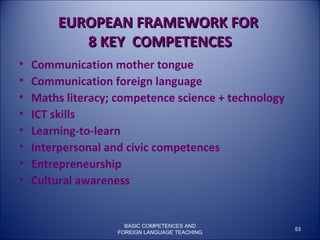
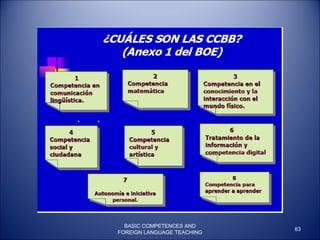
EUROPEAN FRAMEWORK FOR  8  KEY  COMPETENCES Communication mother tongue Communication foreign language Maths literacy; competence science + technology ICT skills Learning-to-learn Interpersonal and civic competences Entrepreneurship Cultural awareness BASIC COMPETENCES AND FOREIGN LANGUAGE TEACHING
PISA:  Programme for International Student Assessment   A joint survey of the OECD member countries to assess how 15-year-olds master the essential knowledge and skills necessary for work and the quality of life in future society.  The tests are administered in schools every three years to 15-year-olds in the domains of mathematics, science, reading literacy and problem-solving skills.  BASIC COMPETENCES AND FOREIGN LANGUAGE TEACHING
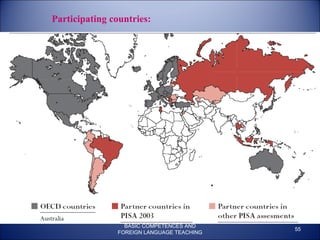
Participating countries: BASIC COMPETENCES AND FOREIGN LANGUAGE TEACHING
SUMMARY COMPETENCES EUROPEAN UNION (LISBON SUMMIT, 2000) OECD (DeSeCo, 2002) PISA (2000, 2003, 2006) EU MEMBER STATES HAVE ADOPTED OR ARE ADOPTING THEM IN THEIR EDUCATION SYSTEMS. USA, AUSTRALIA… BASIC COMPETENCES AND FOREIGN LANGUAGE TEACHING
BASIC COMPETENCES AND FOREIGN LANGUAGE TEACHING CONCLUSIONS COMPETENCES THEY DON’T BELONG TO A COUNTRY / NATION / CONTINENT  THEY DON’T BELONG TO A POLITICAL PARTY  THEY DON’T BELONG TO A NATIONAL OR INTERNATIONAL ORGANISATION. THEY ARE NOT A PASSING FAD: THEY HAVE A DEGREE OF PERMANENCE
Key COMPETENCES - the challenge Globalisation and modernisation are  creating an increasingly diverse and interconnected world. To make sense of and function well in this world, individuals need for example to master changing technologies and to make sense of large amounts of available information. They also face collective challenges as societies – such as balancing economic growth with environmental sustainability, and prosperity with social equity. In these contexts, the COMPETENCES that individuals need to meet their goals have become more complex, requiring more than the mastery of certain narrowly defined skills.  The challenge is being taken up on a global scale. Individuals, organisations, regions, nations and international groupings are addressing the issue of identifying, developing and validating the COMPETENCES required for living and working in the 21st Century. BASIC COMPETENCES AND FOREIGN LANGUAGE TEACHING
Communucation in foreign languages Definition: Communication in foreign languages broadly shares the main skill dimensions of communication in the mother tongue: it is based on the ability to understand, express and interpret concepts, thoughts, feelings, facts and opinions in both oral and written form (listening, speaking, reading and writing) in an appropriate range of societal and cultural contexts (in education and training, work, home and leisure) according to one's wants or needs. Communication in foreign languages also calls for skills such as mediation and intercultural understanding. An individual's level of proficiency will vary between the four dimensions (listening, speaking, reading and writing) and between the different languages, and according to that individual's social and cultural background, environment, needs and/or interests. Essential knowledge, skills and attitudes: Competence in foreign languages requires knowledge of vocabulary and functional grammar and an awareness of the main types of verbal interaction and registers of language. Knowledge of societal conventions, and the cultural aspect and variability of languages is important.  Essential skills for communication in foreign languages consist of the ability to understand spoken messages, to initiate, sustain and conclude conversations and to read, understand and produce texts appropriate to the individual's needs. Individuals should also be able to use aids appropriately, and learn languages also informally as part of lifelong learning.  A positive attitude involves the appreciation of cultural diversity, and an interest and curiosity in languages and intercultural communication.   BASIC COMPETENCES AND FOREIGN LANGUAGE TEACHING
Do you think your students should be able to express themselves correctly in written and oral texts in their first language?  Do you think your students should be able to understand what they read and hear in their first language? Do you think your students should have basic knowledge of at least one foreign language, including listening, speaking, reading and writing skills? Do you think your students should be able to use mathematical reasoning in order to deal with  basic, real life situations?  Do you think your students should be able to know and understand events occurrng around them in their natural and social environment?  Do you think your students should be able to look for, find, process and communicate information by means of  ICT (informations and communications technology) skills? Do you think your students should be able to live and interact respectfully and tolerantly in a multicultural society?  Do you think your students should know about their civil rights and duties in order to participate as active and responsible citizens?  Do you think your students should know about, value and respect their social, cultural  and artistic heritage?  Do you think your students should know about other world cultures? Do you think your students should know about and understand their own learning process in order to improve it, develop learner autonomy, and lay the foundation for life long learning?  Do you think your students should be responsible, organised, emotionally stable, aware of their virtues and weaknesses and prepared to overcome difficulties and weaknesses and make an effort to learn?  Do you think your students should be able to understand and control their own emotions as well as those of their peers?  BASIC COMPETENCES AND FOREIGN LANGUAGE TEACHING
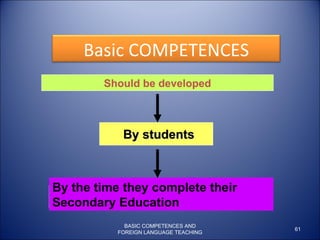
Should be developed By students By the time they complete their Secondary Education BASIC COMPETENCES AND FOREIGN LANGUAGE TEACHING Basic COMPETENCES
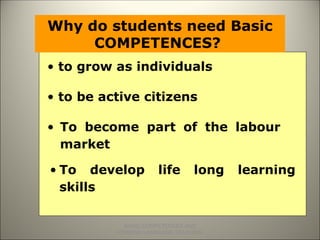
Why do students need Basic COMPETENCES?  to grow as individuals  to be active citizens To become part of the labour market To develop life long learning skills BASIC COMPETENCES AND FOREIGN LANGUAGE TEACHING
BASIC COMPETENCES AND FOREIGN LANGUAGE TEACHING
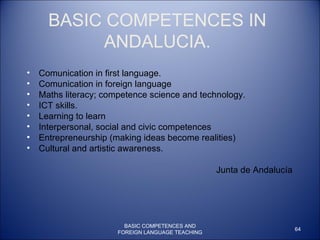
BASIC COMPETENCES IN ANDALUCIA. Comunication in first language. Comunication in foreign language Maths literacy; competence science and technology.  ICT skills. Learning to learn Interpersonal, social and civic competences Entrepreneurship (making ideas become realities)  Cultural and artistic awareness. Junta de Andalucía BASIC COMPETENCES AND FOREIGN LANGUAGE TEACHING
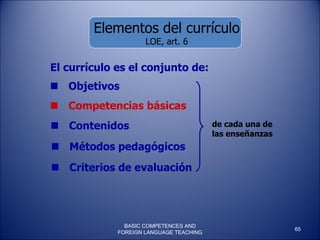
Elementos del currículo LOE, art. 6    Objetivos    Competencias básicas    Contenidos    Métodos pedagógicos    Criterios de evaluación El currículo es el conjunto de: de cada una de las enseñanzas BASIC COMPETENCES AND FOREIGN LANGUAGE TEACHING
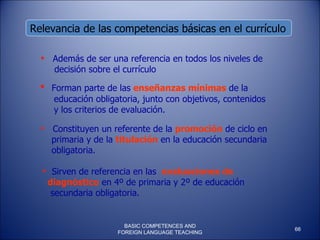
Relevancia de las competencias básicas en el currículo  Forman parte de las  enseñanzas mínimas  de la  educación obligatoria, junto con objetivos, contenidos y los criterios de evaluación.  Además de ser una referencia en todos los niveles de decisión sobre el currículo Constituyen un referente de la  promoción  de ciclo en primaria y de la  titulación  en la educación secundaria obligatoria. Sirven de referencia en las  evaluaciones de  diagnóstico  en 4º de primaria y 2º de educación secundaria obligatoria. BASIC COMPETENCES AND FOREIGN LANGUAGE TEACHING
BASIC COMPETENCES AND FOREIGN LANGUAGE TEACHING
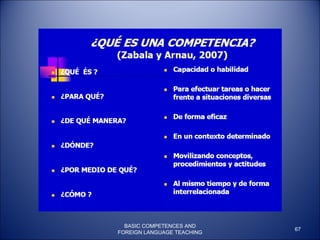
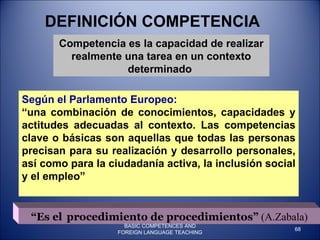
DEFINICIÓN COMPETENCIA Competencia es la capacidad de realizar realmente una tarea en un contexto determinado   Según el Parlamento Europeo:   “ una combinación de conocimientos, capacidades y actitudes adecuadas al contexto. Las competencias clave o básicas son aquellas que todas las personas precisan para su realización y desarrollo personales, así como para la ciudadanía activa, la inclusión social y el empleo”  “ Es el   procedimiento de procedimientos”  (A.Zabala) BASIC COMPETENCES AND FOREIGN LANGUAGE TEACHING
Definición de competencia “ La “competencia” se define como la capacidad de responder a demandas complejas y llevar a cabo tareas diversas de forma adecuada. Supone una combinación de habilidades prácticas, conocimiento, motivación, valores éticos, actitudes, emociones y otros componentes sociales y de comportamiento que se movilizan conjuntamente para lograr una acción eficaz. ”  LEA BASIC COMPETENCES AND FOREIGN LANGUAGE TEACHING
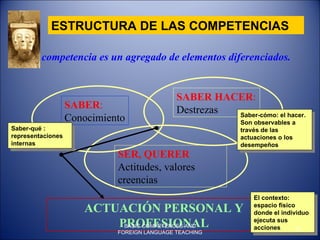
La competencia es un agregado de elementos diferenciados. ACTUACIÓN PERSONAL Y PROFESIONAL SABER : Conocimiento Saber-qué : representaciones internas El contexto: espacio físico donde el individuo ejecuta sus acciones Saber-cómo: el hacer.  Son observables a través de las actuaciones o los desempeños ESTRUCTURA DE LAS COMPETENCIAS BASIC COMPETENCES AND FOREIGN LANGUAGE TEACHING SABER HACER : Destrezas SER, QUERER Actitudes, valores creencias
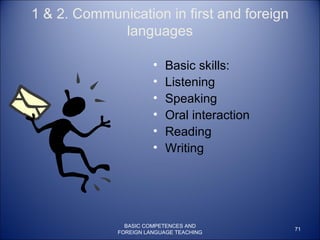
1 & 2. Communication in first and foreign languages Basic skills: Listening Speaking Oral interaction Reading Writing BASIC COMPETENCES AND FOREIGN LANGUAGE TEACHING
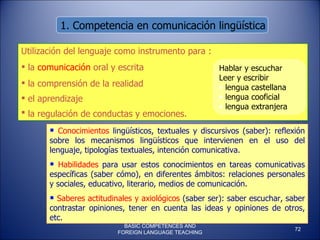
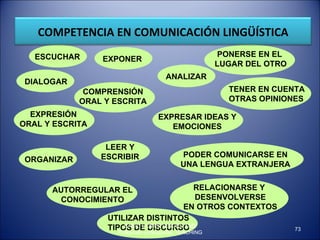
Utilización del lenguaje como instrumento  para  : la  comunicación  oral y escrita la comprensión de la realidad el aprendizaje la  regulación de conductas y emociones.   Conocimientos  lingüísticos, textuales y discursivos (saber): reflexión sobre los mecanismos lingüísticos que intervienen en el uso del lenguaje, tipologías textuales, intención comunicativa. Habilidades  para usar estos conocimientos en tareas comunicativas específicas (saber cómo), en diferentes ámbitos: relaciones personales y sociales, educativo, literario, medios de comunicación. Saberes actitudinales y axiológicos  (saber ser): saber escuchar, saber contrastar opiniones, tener en cuenta las ideas y opiniones de otros, etc.   Hablar y escuchar Leer y escribir lengua castellana lengua cooficial lengua extranjera 1. Competencia en comunicación lingüística BASIC COMPETENCES AND FOREIGN LANGUAGE TEACHING
BASIC COMPETENCES AND FOREIGN LANGUAGE TEACHING ESCUCHAR EXPONER DIALOGAR COMPRENSIÓN ORAL Y ESCRITA EXPRESIÓN ORAL Y ESCRITA LEER Y ESCRIBIR ORGANIZAR AUTORREGULAR EL CONOCIMIENTO UTILIZAR DISTINTOS TIPOS DE DISCURSO PONERSE EN EL LUGAR DEL OTRO ANALIZAR TENER EN CUENTA OTRAS OPINIONES EXPRESAR IDEAS Y EMOCIONES PODER COMUNICARSE EN UNA LENGUA EXTRANJERA RELACIONARSE Y  DESENVOLVERSE EN OTROS CONTEXTOS COMPETENCIA EN COMUNICACIÓN LINGÜÍSTICA
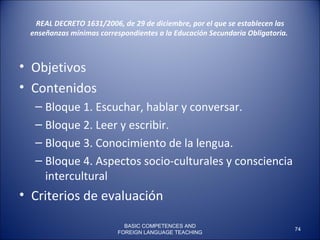
REAL DECRETO 1631/2006, de 29 de diciembre, por el que se establecen las enseñanzas mínimas correspondientes a la Educación Secundaria Obligatoria.    Objetivos  Contenidos Bloque 1. Escuchar, hablar y conversar. Bloque 2. Leer y escribir. Bloque 3. Conocimiento de la lengua. Bloque 4. Aspectos socio-culturales y consciencia intercultural Criterios de evaluación BASIC COMPETENCES AND FOREIGN LANGUAGE TEACHING
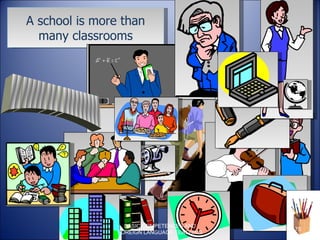
A school is more than many classrooms __ _____ __ _ _________ BASIC COMPETENCES AND FOREIGN LANGUAGE TEACHING
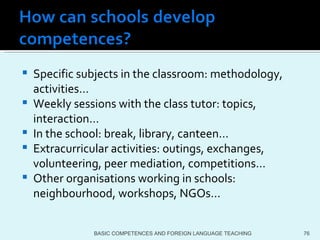
Specific subjects in the classroom: methodology, activities… Weekly sessions with the class tutor: topics, interaction… In the school: break, library, canteen… Extracurricular activities: outings, exchanges, volunteering, peer mediation, competitions… Other organisations working in schools: neighbourhood, workshops, NGOs… BASIC COMPETENCES AND FOREIGN LANGUAGE TEACHING
BASIC COMPETENCES AND FOREIGN LANGUAGE TEACHING

Estrategias de enseñanza aprendizaje CCBB Inglés

  • 1.
    ENFOQUES METODOLÓGICOS YESTRATEGIAS DE ENSEÑANZA-APRENDIZAJE PARA EL DESARROLLO DE LAS COMPETENCIAS BÁSICAS EN EL ÁREA DE INGLÉS CEP CÓRDOBA. FEBRERO 2009.
  • 2.
    JUSTIFICATION Silently butsurely, the term “Basic COMPETENCES” has entered our official curriculum guidelines. There is no turning back: COMPETENCES are new and revolutionary proposals for education which all industrialised countries are gradually incorporating into their education systems. Teaching to attain COMPETENCES means a drastic change in all curricular elements, especially methodology. Strategies based instruction will be presented as a useful tool to implement learner autonomy, life long learning and basic COMPETENCES. BASIC COMPETENCES AND FOREIGN LANGUAGE TEACHING
  • 3.
    OBJECTIVES To analyseand reflect upon the Basic COMPETENCES and their incorporation in our National Curriculum. To learn about Learning Strategies and Strategies Based Instruction, from theory to classroom practice. To explore how strategies based instruction can assist us in developing the Basic COMPETENCES and curriculum integration in our schools. To Practice and improve our English.   BASIC COMPETENCES AND FOREIGN LANGUAGE TEACHING
  • 4.
    CONTENTS BasicCOMPETENCES in the Spanish Education System, especially in the EFL curriculum. Learning Strategies and Strategies Based Instruction as a means to developing basic COMPETENCES. Proposals for the evaluation of COMPETENCES. Interaction in English.  BASIC COMPETENCES AND FOREIGN LANGUAGE TEACHING
  • 5.
    METHODOLOGY Thisis a practical workshop in which there will be a combination of learning theory, reflection, discussion, and collaborative work caried out by participants. The sessions will be caried out in English with the aim of offering particiants the opportunity of English language practice and improvement.   BASIC COMPETENCES AND FOREIGN LANGUAGE TEACHING
  • 6.
    Sesion 1: 11thFebruary BASIC COMPETENCES. PART I What you know and what you’d like to know. How it all began: ideology, philosophy and reality in the 21st century. Competences around the world, OECD, PISA. Competences in the EU. BASIC COMPETENCES AND FOREIGN LANGUAGE TEACHING
  • 7.
    SESIÓN 1: 11thFebruary BASIC COMPETENCES. PART II. What are they and how are they included in our official curriculum? How do they affect our teaching? How do they affect our schools? Outcomes of training for Basic Competences BASIC COMPETENCES AND FOREIGN LANGUAGE TEACHING
  • 8.
    Session 2: 18thFebruary Learning strategies: Latest Learning Theories Origins, Evolution and Latest Trends in Learning Strategies Cognitive strategies Metacognitive strategies Social strategies Affective strategies Outcomes of learning strategies BASIC COMPETENCES AND FOREIGN LANGUAGE TEACHING
  • 9.
    Session 3: 25thFebruary Teaching strategies How to implement SBI: Cognitive Metacognitive Social Affective Evaluation Reasons for evaluating Evaluating strategy use Evaluating COMPETENCES Instruments, registers, reports, portfolios… BASIC COMPETENCES AND FOREIGN LANGUAGE TEACHING
  • 10.
    Session 1: INITIALQUESTIONNAIRE Tell us what you already know about basic COMPETENCES and learning strategies… Have you done courses? Have you read articles, books? Have you discussed them at school with colleagues? What are your fears, worries, doubts about them? ………………………… ..? ………………………… ..? ………………………… .? BASIC COMPETENCES AND FOREIGN LANGUAGE TEACHING
  • 11.
    How it allbegan: ideology, philosophy and technology in the 21st century. Jacques Delors “learning the treasure within” 1996: learning to know, to do, to live together, to be. http://www.unesco.org/delors/ Howard Gardner : frames of mind (multiple intelligences theory). Five minds for the future, 2007: the disciplined mind, the synthtizing mind, the creative mind, the respectful mind, the ethical mind. http://www.brr.com.au/event/1ACD/60122/27697/wmp/e39dcpuj7c http://www.teachers.tv/video/5452 ( excellent podcast) BASIC COMPETENCES AND FOREIGN LANGUAGE TEACHING
  • 12.
    Too often wegive children answers to remember rather than problems to solve.  ~Roger Lewin BASIC COMPETENCES AND FOREIGN LANGUAGE TEACHING
  • 13.
    Learning to knowMastery of learning tools Broad general education and small number of subjects in depth. Concentration skills Memory skills: associative memorization. Thinking Combination of deductive and inductive reasoning Too often we give children answers to remember rather than problems to solve.  ~Roger Lewin BASIC COMPETENCES AND FOREIGN LANGUAGE TEACHING
  • 14.
    If the Romanshad been obliged to learn Latin, they would never have found time to conquer the world.  ~Heinrich Heine BASIC COMPETENCES AND FOREIGN LANGUAGE TEACHING
  • 15.
    Education for thefuture labour market Increased skills requirement: knowledge & job skills Interpersonal skills Information and communication skills Intuition, common sense, judgement and leadership skills. BASIC COMPETENCES AND FOREIGN LANGUAGE TEACHING
  • 16.
    He who opensa school door, closes a prison. ~Victor Hugo BASIC COMPETENCES AND FOREIGN LANGUAGE TEACHING
  • 17.
    Learning to livetogether Promoting the peaceful solution to conflict Tolerance Social and cultural awareness Empathy and recognition of human rights Dialogue and discussion Collaborative projects Humanitarian action/projects He who opens a school door, closes a prison. ~Victor Hugo BASIC COMPETENCES AND FOREIGN LANGUAGE TEACHING
  • 18.
    Education's purpose isto replace an empty mind with an open one.  ~Malcolm S. Forbes BASIC COMPETENCES AND FOREIGN LANGUAGE TEACHING
  • 19.
    Personal development Interpersonaland intrapersonal relationships Report: Learning to be 1972 Fairness, responsibility. Freedom of thought, feeling, imagination… Respect for minorities Education's purpose is to replace an empty mind with an open one.  ~Malcolm S. Forbes BASIC COMPETENCES AND FOREIGN LANGUAGE TEACHING
  • 20.
    The movement ofcapital and other market instruments around the globe The movement of human beings across borders, 100 million immigrants at any one time around the world 3. The movement of information through cyberspace 4. The movement of popular culture (clothing, Food) across borders BASIC COMPETENCES AND FOREIGN LANGUAGE TEACHING
  • 21.
    HOWARD GARDNER: FIVEMINDS FOR THE FUTURE (2007) The Disciplined Mind The Synthesizing Mind The Creating Mind The Respectful Mind The Ethical Mind BASIC COMPETENCES AND FOREIGN LANGUAGE TEACHING
  • 22.
    The whole purposeof education is to turn mirrors into windows.  Sydney J. Harris The disciplined mind BASIC COMPETENCES AND FOREIGN LANGUAGE TEACHING
  • 23.
    Knowledge of scholarlydiscipline and/or skills that can be used in a rational and useful manner throughout life. Moving from declarative to procedural and conditional knowledge. BASIC COMPETENCES AND FOREIGN LANGUAGE TEACHING
  • 24.
    Education... has produceda vast population able to read but unable to distinguish what is worth reading.  ~G.M. Trevelyan The Synthesizing mind BASIC COMPETENCES AND FOREIGN LANGUAGE TEACHING
  • 25.
    Sifting information Organisinginformation Communicating information BASIC COMPETENCES AND FOREIGN LANGUAGE TEACHING
  • 26.
    There are thosewho look at things the way they are, and ask why... I dream of things that never were, and ask why not? Robert Kennedy . The Creative Mind BASIC COMPETENCES AND FOREIGN LANGUAGE TEACHING
  • 27.
    Thinking outside thebox. Using knowledge and synthesis to look for solutions to challenges. BASIC COMPETENCES AND FOREIGN LANGUAGE TEACHING
  • 28.
    What is objectionable,what is dangerous about extremists, is not that they are extreme, but that they are intolerant. The evil is not what they say about their cause, but what they say about their opponents. Robert Kennedy The respectful mind BASIC COMPETENCES AND FOREIGN LANGUAGE TEACHING
  • 29.
    Tolerance Accepts humandiversity Empathizes with the other Cultivate an atmosphere of openness and reciprocity. BASIC COMPETENCES AND FOREIGN LANGUAGE TEACHING
  • 30.
    It is notenough to understand, or to see clearly. The future will be shaped in the arena of human activity, by those willing to commit their minds and their bodies to the task. Robert Kennedy The Ethical mind BASIC COMPETENCES AND FOREIGN LANGUAGE TEACHING
  • 31.
    Respect Goodworkers Good citizens of their community, their region, and the globe Constructive, non egocentric. BASIC COMPETENCES AND FOREIGN LANGUAGE TEACHING
  • 32.
    In conclusion "An educational system isn't worth a great deal if it teaches young people how to make a living but doesn't teach them how to make a life ." . THE ILLITERATE OF THE 21ST CENTURY WILL NOT BE THOSE WHO CANNOT READ AND WRITE, BUT THOSE WHO CANNOT LEARN, UNLEARN, AND RELEARN.  ALVIN TOFFLER BASIC COMPETENCES AND FOREIGN LANGUAGE TEACHING
  • 33.
    BASIC COMPETENCES ANDFOREIGN LANGUAGE TEACHING WHAT DOES IT MEAN TO BE A (SECONDARY SCHOOL) TEACHER (IN ANDALUCÍA) IN 2008? B- THE ILLITERATE OF THE 21ST CENTURY WILL NOT BE THOSE WHO CANNOT READ AND WRITE, BUT THOSE WHO CANNOT LEARN, UNLEARN, AND RELEARN.  ALVIN TOFFLER B- AN EDUCATIONAL SYSTEM ISN'T WORTH A GREAT DEAL IF IT TEACHES YOUNG PEOPLE HOW TO MAKE A LIVING BUT DOESN'T TEACH THEM HOW TO MAKE A LIFE.  AUTHOR UNKNOWN GLOBALISATION IMMIGRATION NEW ROLES IN SOCIETY NEW TECHNOLOGIES LIFELONG LEARNING PREPARATION FOR A CHANGING JOB MARKET
  • 34.
    BASIC COMPETENCES ANDFOREIGN LANGUAGE TEACHING BASIC COMPETENCES BACKGROUND: USA, CANADA, AUTRALIA. COMPETENCES IN THE OECD EU RECOMMENDATIONS PISA AND DIAGNOSTIC EVALUATION COMPETENCES IN SPAIN COMPETENCES IN ANDALUCÍA: DECRETO 231/2007 31 JULIO CURRICULUM CHANGES FROM LOGSE TO LOE BASIC COMPETENCES DEFINITION AND INDIVIDUAL ANALYSIS. HOW THEY CAN BE DEVELOPED IN SCHOOLS: SOME IDEAS
  • 35.
    USE: 5 SCANSCOMPETENCES (1991-2000) WORKPLACE KNOW HOW FIVE COMPETENCES: 1- Resources & allocating time. 2- Interpersonal Skills & working on teams. 3- Information & acquiring and evaluating data. 4- Systems & understanding social, organizational, and technological systems. 5- Technology & selecting equipment and tools. THE FOUNDATION OF SKILLS AND PERSONAL QUALITIES: 1- Basic Skills & reading, writing, arithmetic and mathematics, speaking, and listening; 2- Thinking Skills & thinking creatively, making decisions, solving problems, seeing things in the mind's eye, knowing how to learn, and reasoning; 3- Personal Qualities & individual responsibility, self-esteem, sociability, self-management, and integrity BASIC COMPETENCES AND FOREIGN LANGUAGE TEACHING
  • 36.
    BASIC COMPETENCES ANDFOREIGN LANGUAGE TEACHING
  • 37.
    BASIC COMPETENCES ANDFOREIGN LANGUAGE TEACHING
  • 38.
    BASIC COMPETENCES ANDFOREIGN LANGUAGE TEACHING Key COMPETENCES Capabilities for living and lifelong learning The New Zealand Curriculum identifies five key COMPETENCES: (Curruculum 2008) Thinking Using language, symbols, and texts Managing self Relating to others Participating and contributing.
  • 39.
    BASIC COMPETENCES ANDFOREIGN LANGUAGE TEACHING AUSTRALIA: 7 COMPETENCIAS CLAVE DESARROLLADAS POR EL COMITÉ MAYER 1991 1- CAPACITY TO LOCATE SIFT AND SORT INFORMATION. 2- CAPACITY TO COMMUNICATING IDEAS AND INFORMATION 3- CAPACITY TO PLAN AND ORGANISE ACTIVITIES 4- CAPACITY TO INTERACT EFFICTIVELY 5- CAPACITY TO APPLY PROBLEM-SOLVING STRATEGIES 6- CAPACITY TO USE MATHEMATICAL IDEAS 7- CAPACITY TO APPLY TECHNOLOGY
  • 40.
    DEFINITION COMPETENCES Whyare COMPETENCES so important today? Globalisation and modernisation are creating an increasingly diverse and interconnected world. To make sense of and function well in this world, individuals need for example to master changing technologies and to make sense of large amounts of available information. They also face collective challenges as societies – such as balancing economic growth with environmental sustainability, and prosperity with social equity. In these contexts, the COMPETENCES that individuals need to meet their goals have become more complex, requiring more than the mastery of certain narrowly defined skills. “ Sustainable development and social cohesion depend critically on the COMPETENCES of all of our population – with COMPETENCES understood to cover knowledge, skills, attitudes and values.” OECD Education Ministers 2005. BASIC COMPETENCES AND FOREIGN LANGUAGE TEACHING
  • 41.
    USE TOOLS INTERACTIVELYINTERCAT IN HETEROGENOUS GROUPS ACT AUTONOMOUSLY BASIC COMPETENCES AND FOREIGN LANGUAGE TEACHING
  • 42.
    BASIC COMPETENCES ANDFOREIGN LANGUAGE TEACHING EUROPEAN UNION
  • 43.
    Why EU isinvolved in Education? Article 149 To contribute to the development of quality education by encouraging cooperation between Member States and, if necessary, by supporting and supplementing their action. BASIC COMPETENCES AND FOREIGN LANGUAGE TEACHING
  • 44.
    BASIC COMPETENCES ANDFOREIGN LANGUAGE TEACHING 20 YEARS OF EU INITIATIVES IN EDUCATION 1976: Resolution: 1st action programme Education 1987: ERASMUS 1988: Resolution on Eur. dimension in education 1988 – 1994: European Dimension Unit: o.a. TEX, RIF… 1989: TEX (Teacher EXchanges) 1989: LINGUA (action 4: JEPs for schools / Lingua E) 1992: Maastricht Treaty: ar t 126 Education (now 149) 1992 - 1994: Multilateral School Partnerships (pilot) 1995: SOCRATES I ( COMENIUS - Minerva - ODL ): 14 03 95 2000: SOCRATES II: 24 01 2000 2004 – 2006: eLearning programme 2005: eTwinning 2007: LLP: 15 November 2006 - eTwinning integrated in Comenius 2010 Lisbon strategy Benchmarks in E & T, 2001 (Marcadores) Key competences (Competencias Clave) Special developments : schools & teachers (Publicaciones específicas) Common Eur. Principles for Teacher Competences and Qualifications, 05 Schools for the 21st century, 07 Improving quality of teacher education, 07
  • 45.
    BASIC COMPETENCES ANDFOREIGN LANGUAGE TEACHING Lisbon Summit 23-24/03/2000 Report on the concrete future objectives of E & T systems The European Union is to become the most competitive and dynamic knowledge-based economy in the world, capable of sustainable economic growth with more and better jobs and greater social cohesion
  • 46.
    Benchmarks by 2010Halve the rate of early school leavers , in order to achieve an EU-average rate of 10%or less. Halve the level of gender imbalance among graduates in MST & secure an significant increase of the total number of graduates, Average % of 25-64 yrs in the EU with at least upper sec. education reaches 80%or more Halve % of low-achieving 15 year olds in reading, mathematical and scientific literacy Increase EU-average level of participation in LLL to at least 15% of working adults . BASIC COMPETENCES AND FOREIGN LANGUAGE TEACHING
  • 47.
    THREE MAJOR GOALSFOR 2010: to improve the quality and effectiveness of EU education and training systems; to ensure that they are accessible to all; to open up education and training to the wider world. BASIC COMPETENCES AND FOREIGN LANGUAGE TEACHING
  • 48.
    THREE MAJOR GOALSFOR 2010: to improve the quality and effectiveness of EU education and training systems; 1.1. Improving education and training for teachers and trainers 1.2. Developing skills for the knowledge society 1.3. Ensuring access to ICT for everyone 1.4. Increasing recruitment to scientific and technical studies 1.5. Making the best use of resources BASIC COMPETENCES AND FOREIGN LANGUAGE TEACHING
  • 49.
    THREE MAJOR GOALSFOR 2010: 2. to ensure that they are accessible to all; 2.1. Open learning environment 2.2. Making learning more attractive 2.3. Supporting active citizenship, equal opportunities and social cohesion BASIC COMPETENCES AND FOREIGN LANGUAGE TEACHING
  • 50.
    THREE MAJOR GOALSFOR 2010: 3. to open up education and training to the wider world. 3.1. Strengthening the links with working life and research and society at large 3.2. Developing the spirit of enterprise 3.3. Improving foreign language learning 3.4. Increasing mobility and exchange 3.5. Strengthening the European co-operation BASIC COMPETENCES AND FOREIGN LANGUAGE TEACHING
  • 51.
    BASIC COMPETENCES ANDFOREIGN LANGUAGE TEACHING THE BARCELONA SUMMIT 2002 : 13 objectives 1.1. Improving education and training for teachers and trainers 1.2. Developing skills for the knowledge society 1.3. Ensuring access to ICT for everyone 1.4. Increasing recruitment to scientific and technical studies 1.5. Making the best use of resources 2.1. Open learning environment 2.2. Making learning more attractive 2.3. Supporting active citizenship, equal opportunities and social cohesion 3.1. Strengthening the links with working life and research and society at large 3.2. Developing the spirit of enterprise 3.3. Improving foreign language learning 3.4. Increasing mobility and exchange 3.5. Strengthening the European co-operation
  • 52.
    EXPECTED OUTCOMES OFEU BENCHMARKS 2 million fewer young people would have left school early 2 million more would have graduated from upper secondary education 200.000 less 15 years olds would be low performers in reading literacy 4 million more adults would participate in lifelong learning All students leaving school would be able to communicate in two foreign languages BASIC COMPETENCES AND FOREIGN LANGUAGE TEACHING
  • 53.
    EUROPEAN FRAMEWORK FOR 8 KEY COMPETENCES Communication mother tongue Communication foreign language Maths literacy; competence science + technology ICT skills Learning-to-learn Interpersonal and civic competences Entrepreneurship Cultural awareness BASIC COMPETENCES AND FOREIGN LANGUAGE TEACHING
  • 54.
    PISA: Programmefor International Student Assessment A joint survey of the OECD member countries to assess how 15-year-olds master the essential knowledge and skills necessary for work and the quality of life in future society. The tests are administered in schools every three years to 15-year-olds in the domains of mathematics, science, reading literacy and problem-solving skills. BASIC COMPETENCES AND FOREIGN LANGUAGE TEACHING
  • 55.
    Participating countries: BASICCOMPETENCES AND FOREIGN LANGUAGE TEACHING
  • 56.
    SUMMARY COMPETENCES EUROPEANUNION (LISBON SUMMIT, 2000) OECD (DeSeCo, 2002) PISA (2000, 2003, 2006) EU MEMBER STATES HAVE ADOPTED OR ARE ADOPTING THEM IN THEIR EDUCATION SYSTEMS. USA, AUSTRALIA… BASIC COMPETENCES AND FOREIGN LANGUAGE TEACHING
  • 57.
    BASIC COMPETENCES ANDFOREIGN LANGUAGE TEACHING CONCLUSIONS COMPETENCES THEY DON’T BELONG TO A COUNTRY / NATION / CONTINENT THEY DON’T BELONG TO A POLITICAL PARTY THEY DON’T BELONG TO A NATIONAL OR INTERNATIONAL ORGANISATION. THEY ARE NOT A PASSING FAD: THEY HAVE A DEGREE OF PERMANENCE
  • 58.
    Key COMPETENCES -the challenge Globalisation and modernisation are creating an increasingly diverse and interconnected world. To make sense of and function well in this world, individuals need for example to master changing technologies and to make sense of large amounts of available information. They also face collective challenges as societies – such as balancing economic growth with environmental sustainability, and prosperity with social equity. In these contexts, the COMPETENCES that individuals need to meet their goals have become more complex, requiring more than the mastery of certain narrowly defined skills. The challenge is being taken up on a global scale. Individuals, organisations, regions, nations and international groupings are addressing the issue of identifying, developing and validating the COMPETENCES required for living and working in the 21st Century. BASIC COMPETENCES AND FOREIGN LANGUAGE TEACHING
  • 59.
    Communucation in foreignlanguages Definition: Communication in foreign languages broadly shares the main skill dimensions of communication in the mother tongue: it is based on the ability to understand, express and interpret concepts, thoughts, feelings, facts and opinions in both oral and written form (listening, speaking, reading and writing) in an appropriate range of societal and cultural contexts (in education and training, work, home and leisure) according to one's wants or needs. Communication in foreign languages also calls for skills such as mediation and intercultural understanding. An individual's level of proficiency will vary between the four dimensions (listening, speaking, reading and writing) and between the different languages, and according to that individual's social and cultural background, environment, needs and/or interests. Essential knowledge, skills and attitudes: Competence in foreign languages requires knowledge of vocabulary and functional grammar and an awareness of the main types of verbal interaction and registers of language. Knowledge of societal conventions, and the cultural aspect and variability of languages is important. Essential skills for communication in foreign languages consist of the ability to understand spoken messages, to initiate, sustain and conclude conversations and to read, understand and produce texts appropriate to the individual's needs. Individuals should also be able to use aids appropriately, and learn languages also informally as part of lifelong learning. A positive attitude involves the appreciation of cultural diversity, and an interest and curiosity in languages and intercultural communication.   BASIC COMPETENCES AND FOREIGN LANGUAGE TEACHING
  • 60.
    Do you thinkyour students should be able to express themselves correctly in written and oral texts in their first language? Do you think your students should be able to understand what they read and hear in their first language? Do you think your students should have basic knowledge of at least one foreign language, including listening, speaking, reading and writing skills? Do you think your students should be able to use mathematical reasoning in order to deal with basic, real life situations? Do you think your students should be able to know and understand events occurrng around them in their natural and social environment? Do you think your students should be able to look for, find, process and communicate information by means of ICT (informations and communications technology) skills? Do you think your students should be able to live and interact respectfully and tolerantly in a multicultural society? Do you think your students should know about their civil rights and duties in order to participate as active and responsible citizens? Do you think your students should know about, value and respect their social, cultural and artistic heritage? Do you think your students should know about other world cultures? Do you think your students should know about and understand their own learning process in order to improve it, develop learner autonomy, and lay the foundation for life long learning? Do you think your students should be responsible, organised, emotionally stable, aware of their virtues and weaknesses and prepared to overcome difficulties and weaknesses and make an effort to learn? Do you think your students should be able to understand and control their own emotions as well as those of their peers? BASIC COMPETENCES AND FOREIGN LANGUAGE TEACHING
  • 61.
    Should be developedBy students By the time they complete their Secondary Education BASIC COMPETENCES AND FOREIGN LANGUAGE TEACHING Basic COMPETENCES
  • 62.
    Why do studentsneed Basic COMPETENCES? to grow as individuals to be active citizens To become part of the labour market To develop life long learning skills BASIC COMPETENCES AND FOREIGN LANGUAGE TEACHING
  • 63.
    BASIC COMPETENCES ANDFOREIGN LANGUAGE TEACHING
  • 64.
    BASIC COMPETENCES INANDALUCIA. Comunication in first language. Comunication in foreign language Maths literacy; competence science and technology. ICT skills. Learning to learn Interpersonal, social and civic competences Entrepreneurship (making ideas become realities) Cultural and artistic awareness. Junta de Andalucía BASIC COMPETENCES AND FOREIGN LANGUAGE TEACHING
  • 65.
    Elementos del currículoLOE, art. 6  Objetivos  Competencias básicas  Contenidos  Métodos pedagógicos  Criterios de evaluación El currículo es el conjunto de: de cada una de las enseñanzas BASIC COMPETENCES AND FOREIGN LANGUAGE TEACHING
  • 66.
    Relevancia de lascompetencias básicas en el currículo Forman parte de las enseñanzas mínimas de la educación obligatoria, junto con objetivos, contenidos y los criterios de evaluación. Además de ser una referencia en todos los niveles de decisión sobre el currículo Constituyen un referente de la promoción de ciclo en primaria y de la titulación en la educación secundaria obligatoria. Sirven de referencia en las evaluaciones de diagnóstico en 4º de primaria y 2º de educación secundaria obligatoria. BASIC COMPETENCES AND FOREIGN LANGUAGE TEACHING
  • 67.
    BASIC COMPETENCES ANDFOREIGN LANGUAGE TEACHING
  • 68.
    DEFINICIÓN COMPETENCIA Competenciaes la capacidad de realizar realmente una tarea en un contexto determinado Según el Parlamento Europeo: “ una combinación de conocimientos, capacidades y actitudes adecuadas al contexto. Las competencias clave o básicas son aquellas que todas las personas precisan para su realización y desarrollo personales, así como para la ciudadanía activa, la inclusión social y el empleo” “ Es el procedimiento de procedimientos” (A.Zabala) BASIC COMPETENCES AND FOREIGN LANGUAGE TEACHING
  • 69.
    Definición de competencia“ La “competencia” se define como la capacidad de responder a demandas complejas y llevar a cabo tareas diversas de forma adecuada. Supone una combinación de habilidades prácticas, conocimiento, motivación, valores éticos, actitudes, emociones y otros componentes sociales y de comportamiento que se movilizan conjuntamente para lograr una acción eficaz. ” LEA BASIC COMPETENCES AND FOREIGN LANGUAGE TEACHING
  • 70.
    La competencia esun agregado de elementos diferenciados. ACTUACIÓN PERSONAL Y PROFESIONAL SABER : Conocimiento Saber-qué : representaciones internas El contexto: espacio físico donde el individuo ejecuta sus acciones Saber-cómo: el hacer. Son observables a través de las actuaciones o los desempeños ESTRUCTURA DE LAS COMPETENCIAS BASIC COMPETENCES AND FOREIGN LANGUAGE TEACHING SABER HACER : Destrezas SER, QUERER Actitudes, valores creencias
  • 71.
    1 & 2.Communication in first and foreign languages Basic skills: Listening Speaking Oral interaction Reading Writing BASIC COMPETENCES AND FOREIGN LANGUAGE TEACHING
  • 72.
    Utilización del lenguajecomo instrumento para : la comunicación oral y escrita la comprensión de la realidad el aprendizaje la regulación de conductas y emociones. Conocimientos lingüísticos, textuales y discursivos (saber): reflexión sobre los mecanismos lingüísticos que intervienen en el uso del lenguaje, tipologías textuales, intención comunicativa. Habilidades para usar estos conocimientos en tareas comunicativas específicas (saber cómo), en diferentes ámbitos: relaciones personales y sociales, educativo, literario, medios de comunicación. Saberes actitudinales y axiológicos (saber ser): saber escuchar, saber contrastar opiniones, tener en cuenta las ideas y opiniones de otros, etc. Hablar y escuchar Leer y escribir lengua castellana lengua cooficial lengua extranjera 1. Competencia en comunicación lingüística BASIC COMPETENCES AND FOREIGN LANGUAGE TEACHING
  • 73.
    BASIC COMPETENCES ANDFOREIGN LANGUAGE TEACHING ESCUCHAR EXPONER DIALOGAR COMPRENSIÓN ORAL Y ESCRITA EXPRESIÓN ORAL Y ESCRITA LEER Y ESCRIBIR ORGANIZAR AUTORREGULAR EL CONOCIMIENTO UTILIZAR DISTINTOS TIPOS DE DISCURSO PONERSE EN EL LUGAR DEL OTRO ANALIZAR TENER EN CUENTA OTRAS OPINIONES EXPRESAR IDEAS Y EMOCIONES PODER COMUNICARSE EN UNA LENGUA EXTRANJERA RELACIONARSE Y DESENVOLVERSE EN OTROS CONTEXTOS COMPETENCIA EN COMUNICACIÓN LINGÜÍSTICA
  • 74.
    REAL DECRETO 1631/2006,de 29 de diciembre, por el que se establecen las enseñanzas mínimas correspondientes a la Educación Secundaria Obligatoria. Objetivos Contenidos Bloque 1. Escuchar, hablar y conversar. Bloque 2. Leer y escribir. Bloque 3. Conocimiento de la lengua. Bloque 4. Aspectos socio-culturales y consciencia intercultural Criterios de evaluación BASIC COMPETENCES AND FOREIGN LANGUAGE TEACHING
  • 75.
    A school ismore than many classrooms __ _____ __ _ _________ BASIC COMPETENCES AND FOREIGN LANGUAGE TEACHING
  • 76.
    Specific subjects inthe classroom: methodology, activities… Weekly sessions with the class tutor: topics, interaction… In the school: break, library, canteen… Extracurricular activities: outings, exchanges, volunteering, peer mediation, competitions… Other organisations working in schools: neighbourhood, workshops, NGOs… BASIC COMPETENCES AND FOREIGN LANGUAGE TEACHING
  • 77.
    BASIC COMPETENCES ANDFOREIGN LANGUAGE TEACHING