
Uploaded byBrain Dynamics
Tools to support decision making in mild cognitive impairment (2011)
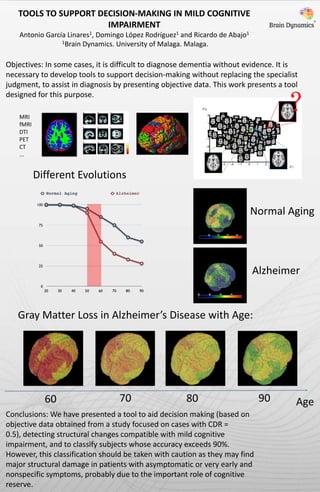
The document presents a tool designed to support decision-making in diagnosing mild cognitive impairment without replacing specialist judgment. The tool uses objective data from brain imaging techniques like MRI, fMRI, DTI, and PET to detect structural changes associated with mild cognitive impairment and classify subjects with over 90% accuracy. However, the classifications should be interpreted cautiously as significant structural damage may be found in asymptomatic or very early stage patients, likely due to the role of cognitive reserve in offsetting symptoms.
More Related Content


Similar to Tools to support decision making in mild cognitive impairment (2011)


Tools to support decision making in mild cognitive impairment (2011)
- 1. TOOLS TO SUPPORTDECISION-MAKING IN MILD COGNITIVE IMPAIRMENT ® Antonio García Linares1, Domingo López Rodríguez1 and Ricardo de Abajo1 1Brain Dynamics. University of Malaga. Malaga. Objectives: In some cases, it is difficult to diagnose dementia without evidence. It is necessary to develop tools to support decision-making without replacing the specialist judgment, to assist in diagnosis by presenting objective data. This work presents a tool designed for this purpose. MRI fMRI DTI PET CT ... Different Evolutions Normal Aging Alzheimer Gray Matter Loss in Alzheimer’s Disease with Age: 60 70 80 Conclusions: We have presented a tool to aid decision making (based on objective data obtained from a study focused on cases with CDR = 0.5), detecting structural changes compatible with mild cognitive impairment, and to classify subjects whose accuracy exceeds 90%. However, this classification should be taken with caution as they may find major structural damage in patients with asymptomatic or very early and nonspecific symptoms, probably due to the important role of cognitive reserve. 90 Age