Click to edit Master title style
Click to edit Master text styles
Second level
Third level
Fourth level
Fifth level
1
Click to edit Master title style
Click to edit Master text styles
Second level
Third level
Fourth level
Fifth level
Value of a Coordinated Approach to Monitoring
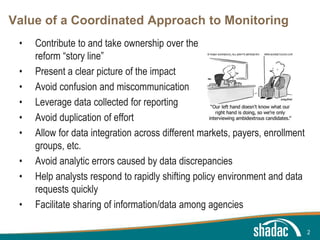
• Contribute to and take ownership over the
reform “story line”
• Present a clear picture of the impact
• Avoid confusion and miscommunication
• Leverage data collected for reporting
• Avoid duplication of effort
• Allow for data integration across different markets, payers, enrollment
groups, etc.
• Avoid analytic errors caused by data discrepancies
• Help analysts respond to rapidly shifting policy environment and data
requests quickly
• Facilitate sharing of information/data among agencies
2
Click to edit Master title style
Click to edit Master text styles
Second level
Third level
Fourth level
Fifth level
Data Collection and Reporting
1. “Public” reporting of information
• Media and medial relations staff
• Policy-makers (federal agencies, legislature, governor's office)
• Consumers/enrollees
2. Internal operations and decision making
• Data and policy analysts
• Operational staff
• Policy staff
3. Federal reporting requirements
3
Despite differences in focus, coordination is key
Click to edit Master title style
Click to edit Master text styles
Second level
Third level
Fourth level
Fifth level
Federal Data Reporting Requirements
• State-Based Marketplaces: “weekly indicator reports” to CMS/CCIIO on:
• Applications
• Determined/Assessed eligibly for QHP and Medicaid/CHIP
• Effective & Effectuated enrollment
• SHOP
• Operations (website and call center)
• Medicaid/CHIP agencies: weekly (open enrollment)/monthly reports on
12 “performance indicators” to CMS on:
• Call center performance
• Applications
• Transfers
• Renewals
• Enrollment
• Determined eligible/ineligible/pending
• Process time
4
Click to edit Master title style
Click to edit Master text styles
Second level
Third level
Fourth level
Fifth level
Developing an Evaluation and
Monitoring Framework
 Define scope
 Choose measures
 Operationalize measures
 Identify existing data sources
 Establish benchmarks and
goals
 Identify and fill data gaps
5
Click to edit Master title style
Click to edit Master text styles
Second level
Third level
Fourth level
Fifth level
Define Scope
6
• Set focus
• Focused solely on the marketplace, incorporates evaluation of Medicaid, set
within context of broader reform activities (state and federal)
• What are the key policy goals?
• Ample choice, enrollee experience, reduced uninsurance, low rate of coverage
gaps
• What issues are policymakers most concerned about?
• Market stability, health care costs, continuity of coverage, health care access
• Who is the audience?
• Internal operations staff, high level policy staff, public, the media
• Need to keep the number of topic areas manageable
• Access, cost, public health, impact on providers
Click to edit Master title style
Click to edit Master text styles
Second level
Third level
Fourth level
Fifth level
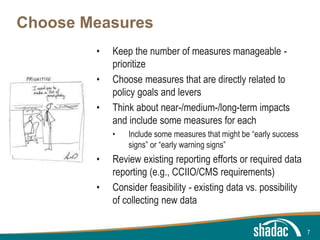
Choose Measures
• Keep the number of measures manageable -
prioritize
• Choose measures that are directly related to
policy goals and levers
• Think about near-/medium-/long-term impacts
and include some measures for each
• Include some measures that might be “early success
signs” or “early warning signs”
• Review existing reporting efforts or required data
reporting (e.g., CCIIO/CMS requirements)
• Consider feasibility - existing data vs. possibility
of collecting new data
7
Click to edit Master title style
Click to edit Master text styles
Second level
Third level
Fourth level
Fifth level
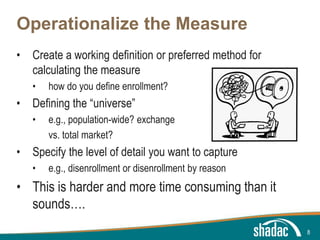
Operationalize the Measure
• Create a working definition or preferred method for
calculating the measure
• how do you define enrollment?
• Defining the “universe”
• e.g., population-wide? exchange
vs. total market?
• Specify the level of detail you want to capture
• e.g., disenrollment or disenrollment by reason
• This is harder and more time consuming than it
sounds….
8
Click to edit Master title style
Click to edit Master text styles
Second level
Third level
Fourth level
Fifth level
Identify Existing Data Sources
• Administrative data
• State Medicaid/CHIP programs
• Health insurance regulators
• Health insurance marketplaces
• Tax records
• Survey data
• Population surveys (e.g., ACS, CPS, NHIS, MEPS, BRFSS)
• Provider surveys (e.g., NAMCS)
• State surveys
• Data from health carriers, hospitals, providers
• Other?
9
Click to edit Master title style
Click to edit Master text styles
Second level
Third level
Fourth level
Fifth level
Establish Benchmarks and Goals
• Possible benchmarks
• Change over time
• Defined ideal
• Other states
• National average
• The most useful goals are
• Realistic
• Specific
• Connected to specific actions/strategies and policy priorities
• Decisions will influence choices about data sources
• Consensus around goals and benchmarks can be
challenging
10
Click to edit Master title style
Click to edit Master text styles
Second level
Third level
Fourth level
Fifth level
Identify and Fill Data Gaps
• Potential gaps - Data that is lacking or incomplete
• Market-wide data
• Data on safety net and uninsured
• Provider and system capacity
• For FFMs – Information on enrollees
• Consider collecting additional data through existing efforts
• Existing state surveys
• Provider licensure process
• State tax return
• Identify data that might come out of new systems/processes
• Health Insurance marketplace
• Upgraded IT systems
• Assess fesability of new data collection
11
Click to edit Master title style
Click to edit Master text styles
Second level
Third level
Fourth level
Fifth level
A CASE FOR COORDINATED
MONITORING: DATA
REPORTING DURING OPEN
ENROLLMENT
12
Click to edit Master title style
Click to edit Master text styles
Second level
Third level
Fourth level
Fifth level
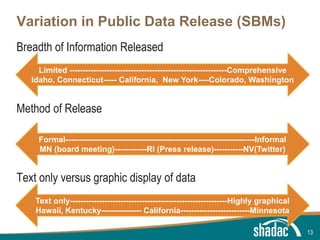
Variation in Public Data Release (SBMs)
13
Breadth of Information Released
Method of Release
Text only versus graphic display of data
Limited -----------------------------------------------------------Comprehensive
Idaho, Connecticut----- California, New York----Colorado, Washington
Formal-----------------------------------------------------------------------Informal
MN (board meeting)------------RI (Press release)-----------NV(Twitter)
Text only-----------------------------------------------------------Highly graphical
Hawaii, Kentucky--------------- California--------------------------Minnesota
Click to edit Master title style
Click to edit Master text styles
Second level
Third level
Fourth level
Fifth level
Federal Reporting During Open
Enrollment (FFM and SBMs)
• Monthly reports on key indicators (a small subset of SBM
required reporting)
• Consistency in what was being reported
• Key measures were reported at the state level
• Feds did a good job of reporting in a timely way, but lag put
them out of sync with SBM reporting
• Data were not perfect, data caveats were highlighted, but
fluidity in numbers made messaging difficult
• FFMs didn’t get an advanced look at the data
14
Click to edit Master title style
Click to edit Master text styles
Second level
Third level
Fourth level
Fifth level
Open Enrollment Reporting Challenges
• Hard to plan monitoring strategy in advance
• States could only report what
their systems produced
• Definitions were fluid and varied
• Enrollment = first month premium paid
• Enrollment = plan selected
• Enrollment = plan and payment source selected
• Enrollment messages were coming from multiple sources
(state, feds, media)
• FFMs didn’t have many data source options
• Benchmarks were unclear
15
Click to edit Master title style
Click to edit Master text styles
Second level
Third level
Fourth level
Fifth level
www.shadac.org
@shadac
Contact Information
Elizabeth Lukanen
Senior Research Fellow
elukanen@umn.edu
612.626.1537

State Performance Measurement: Considerations, Requirements, Experience

  • 1.
    Click to editMaster title style Click to edit Master text styles Second level Third level Fourth level Fifth level 1
  • 2.
    Click to editMaster title style Click to edit Master text styles Second level Third level Fourth level Fifth level Value of a Coordinated Approach to Monitoring • Contribute to and take ownership over the reform “story line” • Present a clear picture of the impact • Avoid confusion and miscommunication • Leverage data collected for reporting • Avoid duplication of effort • Allow for data integration across different markets, payers, enrollment groups, etc. • Avoid analytic errors caused by data discrepancies • Help analysts respond to rapidly shifting policy environment and data requests quickly • Facilitate sharing of information/data among agencies 2
  • 3.
    Click to editMaster title style Click to edit Master text styles Second level Third level Fourth level Fifth level Data Collection and Reporting 1. “Public” reporting of information • Media and medial relations staff • Policy-makers (federal agencies, legislature, governor's office) • Consumers/enrollees 2. Internal operations and decision making • Data and policy analysts • Operational staff • Policy staff 3. Federal reporting requirements 3 Despite differences in focus, coordination is key
  • 4.
    Click to editMaster title style Click to edit Master text styles Second level Third level Fourth level Fifth level Federal Data Reporting Requirements • State-Based Marketplaces: “weekly indicator reports” to CMS/CCIIO on: • Applications • Determined/Assessed eligibly for QHP and Medicaid/CHIP • Effective & Effectuated enrollment • SHOP • Operations (website and call center) • Medicaid/CHIP agencies: weekly (open enrollment)/monthly reports on 12 “performance indicators” to CMS on: • Call center performance • Applications • Transfers • Renewals • Enrollment • Determined eligible/ineligible/pending • Process time 4
  • 5.
    Click to editMaster title style Click to edit Master text styles Second level Third level Fourth level Fifth level Developing an Evaluation and Monitoring Framework  Define scope  Choose measures  Operationalize measures  Identify existing data sources  Establish benchmarks and goals  Identify and fill data gaps 5
  • 6.
    Click to editMaster title style Click to edit Master text styles Second level Third level Fourth level Fifth level Define Scope 6 • Set focus • Focused solely on the marketplace, incorporates evaluation of Medicaid, set within context of broader reform activities (state and federal) • What are the key policy goals? • Ample choice, enrollee experience, reduced uninsurance, low rate of coverage gaps • What issues are policymakers most concerned about? • Market stability, health care costs, continuity of coverage, health care access • Who is the audience? • Internal operations staff, high level policy staff, public, the media • Need to keep the number of topic areas manageable • Access, cost, public health, impact on providers
  • 7.
    Click to editMaster title style Click to edit Master text styles Second level Third level Fourth level Fifth level Choose Measures • Keep the number of measures manageable - prioritize • Choose measures that are directly related to policy goals and levers • Think about near-/medium-/long-term impacts and include some measures for each • Include some measures that might be “early success signs” or “early warning signs” • Review existing reporting efforts or required data reporting (e.g., CCIIO/CMS requirements) • Consider feasibility - existing data vs. possibility of collecting new data 7
  • 8.
    Click to editMaster title style Click to edit Master text styles Second level Third level Fourth level Fifth level Operationalize the Measure • Create a working definition or preferred method for calculating the measure • how do you define enrollment? • Defining the “universe” • e.g., population-wide? exchange vs. total market? • Specify the level of detail you want to capture • e.g., disenrollment or disenrollment by reason • This is harder and more time consuming than it sounds…. 8
  • 9.
    Click to editMaster title style Click to edit Master text styles Second level Third level Fourth level Fifth level Identify Existing Data Sources • Administrative data • State Medicaid/CHIP programs • Health insurance regulators • Health insurance marketplaces • Tax records • Survey data • Population surveys (e.g., ACS, CPS, NHIS, MEPS, BRFSS) • Provider surveys (e.g., NAMCS) • State surveys • Data from health carriers, hospitals, providers • Other? 9
  • 10.
    Click to editMaster title style Click to edit Master text styles Second level Third level Fourth level Fifth level Establish Benchmarks and Goals • Possible benchmarks • Change over time • Defined ideal • Other states • National average • The most useful goals are • Realistic • Specific • Connected to specific actions/strategies and policy priorities • Decisions will influence choices about data sources • Consensus around goals and benchmarks can be challenging 10
  • 11.
    Click to editMaster title style Click to edit Master text styles Second level Third level Fourth level Fifth level Identify and Fill Data Gaps • Potential gaps - Data that is lacking or incomplete • Market-wide data • Data on safety net and uninsured • Provider and system capacity • For FFMs – Information on enrollees • Consider collecting additional data through existing efforts • Existing state surveys • Provider licensure process • State tax return • Identify data that might come out of new systems/processes • Health Insurance marketplace • Upgraded IT systems • Assess fesability of new data collection 11
  • 12.
    Click to editMaster title style Click to edit Master text styles Second level Third level Fourth level Fifth level A CASE FOR COORDINATED MONITORING: DATA REPORTING DURING OPEN ENROLLMENT 12
  • 13.
    Click to editMaster title style Click to edit Master text styles Second level Third level Fourth level Fifth level Variation in Public Data Release (SBMs) 13 Breadth of Information Released Method of Release Text only versus graphic display of data Limited -----------------------------------------------------------Comprehensive Idaho, Connecticut----- California, New York----Colorado, Washington Formal-----------------------------------------------------------------------Informal MN (board meeting)------------RI (Press release)-----------NV(Twitter) Text only-----------------------------------------------------------Highly graphical Hawaii, Kentucky--------------- California--------------------------Minnesota
  • 14.
    Click to editMaster title style Click to edit Master text styles Second level Third level Fourth level Fifth level Federal Reporting During Open Enrollment (FFM and SBMs) • Monthly reports on key indicators (a small subset of SBM required reporting) • Consistency in what was being reported • Key measures were reported at the state level • Feds did a good job of reporting in a timely way, but lag put them out of sync with SBM reporting • Data were not perfect, data caveats were highlighted, but fluidity in numbers made messaging difficult • FFMs didn’t get an advanced look at the data 14
  • 15.
    Click to editMaster title style Click to edit Master text styles Second level Third level Fourth level Fifth level Open Enrollment Reporting Challenges • Hard to plan monitoring strategy in advance • States could only report what their systems produced • Definitions were fluid and varied • Enrollment = first month premium paid • Enrollment = plan selected • Enrollment = plan and payment source selected • Enrollment messages were coming from multiple sources (state, feds, media) • FFMs didn’t have many data source options • Benchmarks were unclear 15
  • 16.
    Click to editMaster title style Click to edit Master text styles Second level Third level Fourth level Fifth level www.shadac.org @shadac Contact Information Elizabeth Lukanen Senior Research Fellow elukanen@umn.edu 612.626.1537