On time /in time
At the end /in the end
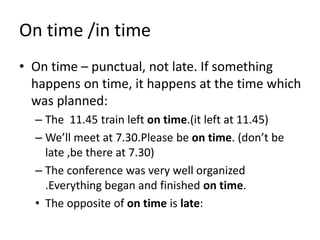
On time /in time
• On time – punctual, not late. If something
happens on time, it happens at the time which
was planned:
– The 11.45 train left on time.(it left at 11.45)
– We’ll meet at 7.30.Please be on time. (don’t be
late ,be there at 7.30)
– The conference was very well organized
.Everything began and finished on time.
• The opposite of on time is late:
In time (for something /to do
something)-soon enough
– Will you be home in time for dinner?(soon
enough for dinner)
– I’ve sent Jill her birthday present. I hope it arrives
in time (for her birthday)-(soon enough for her
birthday)
– I must hurry. I want to get home in time to see the
football match on television.
• The opposite of in time is too late.
– I got home too late to see the football match.
Just in time(almost too late)
• We got to the station just in time to catch the
train.
• A child ran across the road in front of the car
,but I managed to stop just in time.
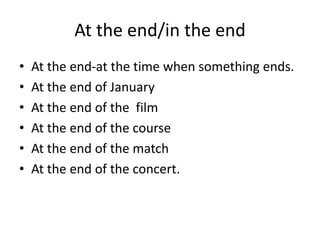
At the end/in the end
• At the end-at the time when something ends.
• At the end of January
• At the end of the film
• At the end of the course
• At the end of the match
• At the end of the concert.
– I’m going away at the end of January/at the end
of the month.
– At the end of the concert, there was great
applause.
– All the players shook hands at the end of the
match.
• You can’t say “in the end of something". So
you cannot say” in the end of January” or “in
the end of the concert”
• The opposite of at the end is at the beginning.
– At the beginning of January
– At the beginning of the concert.
In the end-finally
• We use in the end when we say what the final
result of a situation was:
– We had a lot of problems with our car. In the end we
sold it and bought another one.(finally we sold it).
– He got more and more angry . In the end he just
walked out of the room.
– Jim couldn’t decide where to go for his holidays. He
didn’t go anywhere in the end.
• The opposite of in the end is usually at first:
– At first we didn’t like each other very much, but in the
end we became good friends.
Complete the sentences with on time
or in time
• The bus was late this morning but it’s usually ……on time….
• The film was supposed to start at 8.30 but it didn’t begin…….on
time.
• I like to get up ……in time. to have a big breakfast before going
to work.
• We want to start the meeting …on time….,so please don’t be late.
• I’ve just washed this shirt. I want to wear it this evening, so I hope
it will be dry ……in time…..
• The train service is not very good. The trains are rarely …on
time……..
• I nearly missed my flight this morning. I got to the airport just ….
in time ……
• Why are you never … on time ……...?You always keep everybody
Read the situations and make
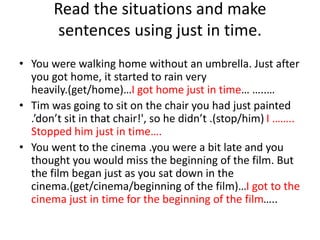
sentences using just in time.
• You were walking home without an umbrella. Just after
you got home, it started to rain very
heavily.(get/home)…I got home just in time… …..…
• Tim was going to sit on the chair you had just painted
.’don’t sit in that chair!', so he didn’t .(stop/him) I ……..
Stopped him just in time….
• You went to the cinema .you were a bit late and you
thought you would miss the beginning of the film. But
the film began just as you sat down in the
cinema.(get/cinema/beginning of the film)…I got to the
cinema just in time for the beginning of the film…..
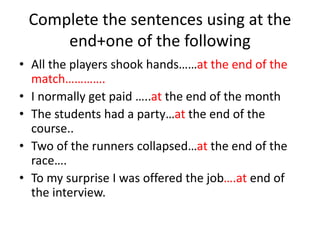
Complete the sentences using at the
end+one of the following
• All the players shook hands……at the end of the
match………….
• I normally get paid …..at the end of the month
• The students had a party…at the end of the
course..
• Two of the runners collapsed…at the end of the
race….
• To my surprise I was offered the job….at end of
the interview.
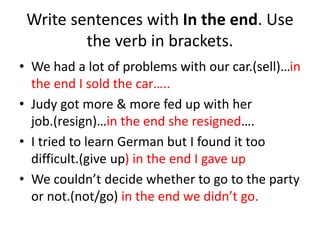
Write sentences with In the end. Use
the verb in brackets.
• We had a lot of problems with our car.(sell)…in
the end I sold the car…..
• Judy got more & more fed up with her
job.(resign)…in the end she resigned….
• I tried to learn German but I found it too
difficult.(give up) in the end I gave up
• We couldn’t decide whether to go to the party
or not.(not/go) in the end we didn’t go.
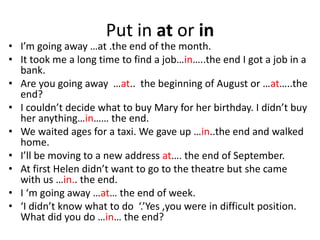
Put in at or in
• I’m going away …at .the end of the month.
• It took me a long time to find a job…in…..the end I got a job in a
bank.
• Are you going away …at.. the beginning of August or …at…..the
end?
• I couldn’t decide what to buy Mary for her birthday. I didn’t buy
her anything…in…… the end.
• We waited ages for a taxi. We gave up …in..the end and walked
home.
• I’ll be moving to a new address at…. the end of September.
• At first Helen didn’t want to go to the theatre but she came
with us …in.. the end.
• I ‘m going away …at… the end of week.
• ‘I didn’t know what to do ‘.’Yes ,you were in difficult position.
What did you do …in… the end?
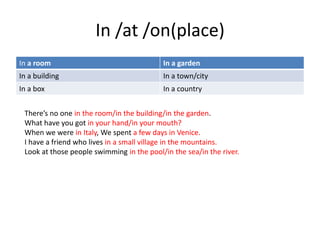
In /at /on(place)
In a room In a garden
In a building In a town/city
In a box In a country
There’s no one in the room/in the building/in the garden.
What have you got in your hand/in your mouth?
When we were in Italy, We spent a few days in Venice.
I have a friend who lives in a small village in the mountains.
Look at those people swimming in the pool/in the sea/in the river.
• We say that somebody/something is ;
– in a line /in a row/in a queue/in a street.
– in a photograph/in a picture/(look at yourself) in a
mirror.
– in the sky/in the world.
– in a book/in a newspaper/in a magazine/in a
letter(but “on a page”)
• When I go to the cinema , I prefer to sit in the
front row.
• I live in King Street. Sarah lives in Queen
Street.
• Who is the woman in that photograph?
• Have you seen this article in the newspaper?
• It was a lovely day .There wasn’t a cloud in the
sky.
In Continue……
• We say that somebody is in bed/in hospital/in
prison:
– Mark isn't up yet. He's still in bed.
– Key’s mother is in hospital.
Expressions with in
• In the rain/in the sun/in the shade/in the dark/in
bad weather etc.
– We sat in the shade. It was too hot to sit in the sun.
– Don’t go out in the rain. Wait until it stops.
• (write )in pencil/in ink.
– When you do the exam, you are not allowed to write
in pencil.
• Also: in words, in figures, in Block letters.
– Please fill in the form in block letters.
• Pay in cash
– I paid the bill in cash.
• (be/fall) in love(with somebody)
– Have you ever been in love with somebody?
• In (my) opinion
– In my opinion ,the film was not very good.
– At 5 o’clock They arrived at 5 o’clock.
– At 11.45
– At midnight
– At lunchtime
– At sunset
– On Friday/on Fridays They arrived on Friday.
– On 12 March 1991
– On Christmas Day
– On my birthday
– In October They arrived in October./They arrived in 1968
– In(the )winter
– In 1968
– In the 1970s
– In the 18th century
– In the middle ages
– In the past
– In (the)future
•In the morning /in the afternoon/in the evening
• I’ll see you in the morning?
• Do you work in the evening?
But
• On Friday morning(s)/on Sunday afternoon(s)/on
Monday evening(s)
• I’ll be at home on Friday morning.
• Do you usually go out on Saturday evenings?
• We do not use at/on /in before last/next/this
/every:
– I’ll see you next week.
– They got married last month.
• In a few minutes /in six months
– The train will be leaving in a few minutes.(a few
minutes from now)
– Jack has gone away. He’ll be back in a week(a week
from now)
– She’ll be here in a moment.(moment from now)
• We can also say’ in six months’ time.(or …. In six
months.)
– They are getting married in six months’ time.(or ….
in six months.)
• We also use in ..to say how long it takes to do
something.
– I learnt to drive in a four weeks(it took me four weeks
to learn)
At
• at the bus stop.
• at the door.
• at the window.
• at the top(of the page).
• at the bottom(of the page).
• at the end of the street.
• Who is that man standing at the bus stop/at the
door/at the window?
• Turn left at the traffic lights/at the church/at the
roundabout.
• Write your name at the top/at the bottom of the
page.
• Angela’s house is the white one at the end of the
street.
• When you leave the hotel ,please leave your key
at the reception.
• We say that somebody is at home/at work/at
school/at university/at college.
– I’ll be at work until 5.30 but I’ll be at home all
evening.
– Juliya is studying chemistry at university.
At a party/at a concert etc.
• We say that somebody is at an event(at a
party/at a conference etc.)
– Were there many people at the party/at the
meeting?
– I saw Jack at a football match/at a concert last
Saturday
At the age of ….etc
• We say at the age of …/at the speed of…/at a
temperature of ….etc.for example
– Jill left school at the age of 16.
– The train was travelling at a speed of 120 miles an
hour.
– Water boils at 100 degrees Celsius.
Compare In/at
• There were a lot of people in the shop.
• Go along this road ,then turn left at the
shop.(somebody giving directions)
• The corner
– We say ‘in the corner of a room', but at the
corner (or on the corner)of a street;
The television is in the corner of the room.
There is a public telephone at/on the corner of
the street.
The front and the back
• We say in the front /in the back of a car.
o I was sitting in the back (of the car) when we
crashed.
But
• at the front/at the back of a building
/cinema/group of people etc…
o The garden is at the back of the house.
o Let’s sit at the front (of the cinema).(but ‘in the
front row’)
o I was standing at the back, so I couldn’t see very
well.
In and at for buildings
• You can often use in or at with buildings, you can
eat in a restaurant or at a restaurant .
• We usually say at when we say where an event
takes place(for example, a concert, a film, a party,
a meeting, a sports event);
– We went to a concert at the Royal Festival Hall.
– The meeting took place at the company’s
headquarters.
– The film I want to see is showing at the
Odeon.(cinema)
• We say at the station /at the airport;
– Don’t meet me at the station . I can get a taxi.
• We say at somebody’s house;
– I was at Judy’s house last night.
• We use in when we are thinking about the
building itself;
– The rooms in Judy’s house are very small.
– I enjoyed the film but it was very cold in the
cinema.
In & at for towns
• We normally use in with cities, towns and
villages.
– Tom’s parents live in Nugegoda.
– The louver is a famous art museum in Paris .
• But you can use at or in when you think of the
place as a point or station on a journey:
• Do you know if this train stops at(or in) Nugegoda.
• We stopped at(or in) a small village on the way to
London.
• On the ceiling
• On the wall
• On the door
• On the table
• On the floor
• On a page
• On an island
• I sat on the floor/on the ground/on the
grass/on a chair /on the beach.
• There’s a dirty mark on the wall/on the
ceiling/on your nose/on your shirt.
• Have you seen the notice on the notice
board/on the door?
• You’ll find details of TV programmes on page
seven.
• On the left/on the right.
• On the ground floor/on the first floor/on the
second floor etc..
• On a map/on the menu(in a restaurant)/on a
list.
– In Britain we drive on the left(on the left hand
side)
– Our flat is on the second floor of the building.
– Here’s a shopping list. Don't buy anything that is
not on the list.
We say that a place is on a river/on a road/on
the coast:
 London is on the river Thames.
We say that a place is on the way to another
place:
 We stopped at a small village on the way to
London.
On a bus/in a car etc.
• We usually say on a bus/on a train/on a
plain/on a ship BUT in a car/in a taxi.
– The bus was very full. There were too many
people on it.
– Ann arrived in a taxi.
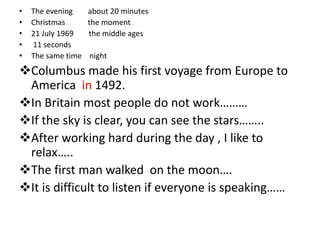
• The evening about 20 minutes
• Christmas the moment
• 21 July 1969 the middle ages
• 11 seconds
• The same time night
Columbus made his first voyage from Europe to
America in 1492.
In Britain most people do not work………
If the sky is clear, you can see the stars……..
After working hard during the day , I like to
relax…..
The first man walked on the moon….
It is difficult to listen if everyone is speaking……
• I’m just going out o the shop . I’ll be back…..
• (on the phone)”Can I speak to Clare ? I’m
afraid she’s not here…..
• In Britain people send each other cards…..
• Many Europe's great cathedrals were built……
• Bob is a very fast runner. He can run 100
meters …..
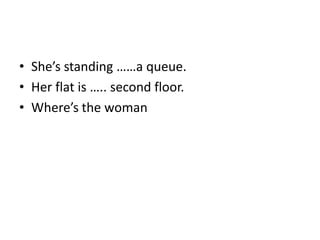
• She’s standing ……a queue.
• Her flat is ….. second floor.
• Where’s the woman
• Put in ,at or in where necessary.
• I’ll see you …. Friday
• I’ll see you …… next Friday.
• What are you doing….Saturday?
• What are you doing……. The weekend.
• They often go out….the evenings.
• They often go out ……Sunday evenings.
• Do you work on Wednesdays?
• Do you work ……every Wednesdays?
• We usually have a holiday …. . The summer.
• We often have a short holiday ……Christmas .
• Paul got married ……1991.
• Paul got married …..18 May 1991.
• Chris is getting married…… this year.
• Hurry up! we have to go ……. Few minutes.
• I’m busy just now but I’ll be with you….. A moment.
• Jenny's brother is an Engineer but he’s out of the work …… the
moment.
• …….Saturday night I went to bed …… 11 o’clock.
• I don’t like travelling …… night.
• We travelled overnight to Paris and arrived ….. 5 o’clock ……. Morning.
• The course begins ……. 7th January and ends sometime…….. April.
• I might not be at home ……Tuesday morning but I’ll probably be there
……. The afternoon.
• My car is being repaired at the garage. It will be ready…… two hours.
• Mary & Henry always go out for a meal ….. Their wedding anniversary.
• There are usually a lot of parties………….. New year’s Eve.

Preposition

  • 1.
    On time /intime At the end /in the end
  • 2.
    On time /intime • On time – punctual, not late. If something happens on time, it happens at the time which was planned: – The 11.45 train left on time.(it left at 11.45) – We’ll meet at 7.30.Please be on time. (don’t be late ,be there at 7.30) – The conference was very well organized .Everything began and finished on time. • The opposite of on time is late:
  • 3.
    In time (forsomething /to do something)-soon enough – Will you be home in time for dinner?(soon enough for dinner) – I’ve sent Jill her birthday present. I hope it arrives in time (for her birthday)-(soon enough for her birthday) – I must hurry. I want to get home in time to see the football match on television. • The opposite of in time is too late. – I got home too late to see the football match.
  • 4.
    Just in time(almosttoo late) • We got to the station just in time to catch the train. • A child ran across the road in front of the car ,but I managed to stop just in time.
  • 5.
    At the end/inthe end • At the end-at the time when something ends. • At the end of January • At the end of the film • At the end of the course • At the end of the match • At the end of the concert.
  • 6.
    – I’m goingaway at the end of January/at the end of the month. – At the end of the concert, there was great applause. – All the players shook hands at the end of the match. • You can’t say “in the end of something". So you cannot say” in the end of January” or “in the end of the concert” • The opposite of at the end is at the beginning. – At the beginning of January – At the beginning of the concert.
  • 7.
    In the end-finally •We use in the end when we say what the final result of a situation was: – We had a lot of problems with our car. In the end we sold it and bought another one.(finally we sold it). – He got more and more angry . In the end he just walked out of the room. – Jim couldn’t decide where to go for his holidays. He didn’t go anywhere in the end. • The opposite of in the end is usually at first: – At first we didn’t like each other very much, but in the end we became good friends.
  • 8.
    Complete the sentenceswith on time or in time • The bus was late this morning but it’s usually ……on time…. • The film was supposed to start at 8.30 but it didn’t begin…….on time. • I like to get up ……in time. to have a big breakfast before going to work. • We want to start the meeting …on time….,so please don’t be late. • I’ve just washed this shirt. I want to wear it this evening, so I hope it will be dry ……in time….. • The train service is not very good. The trains are rarely …on time…….. • I nearly missed my flight this morning. I got to the airport just …. in time …… • Why are you never … on time ……...?You always keep everybody
  • 9.
    Read the situationsand make sentences using just in time. • You were walking home without an umbrella. Just after you got home, it started to rain very heavily.(get/home)…I got home just in time… …..… • Tim was going to sit on the chair you had just painted .’don’t sit in that chair!', so he didn’t .(stop/him) I …….. Stopped him just in time…. • You went to the cinema .you were a bit late and you thought you would miss the beginning of the film. But the film began just as you sat down in the cinema.(get/cinema/beginning of the film)…I got to the cinema just in time for the beginning of the film…..
  • 10.
    Complete the sentencesusing at the end+one of the following • All the players shook hands……at the end of the match…………. • I normally get paid …..at the end of the month • The students had a party…at the end of the course.. • Two of the runners collapsed…at the end of the race…. • To my surprise I was offered the job….at end of the interview.
  • 11.
    Write sentences withIn the end. Use the verb in brackets. • We had a lot of problems with our car.(sell)…in the end I sold the car….. • Judy got more & more fed up with her job.(resign)…in the end she resigned…. • I tried to learn German but I found it too difficult.(give up) in the end I gave up • We couldn’t decide whether to go to the party or not.(not/go) in the end we didn’t go.
  • 12.
    Put in ator in • I’m going away …at .the end of the month. • It took me a long time to find a job…in…..the end I got a job in a bank. • Are you going away …at.. the beginning of August or …at…..the end? • I couldn’t decide what to buy Mary for her birthday. I didn’t buy her anything…in…… the end. • We waited ages for a taxi. We gave up …in..the end and walked home. • I’ll be moving to a new address at…. the end of September. • At first Helen didn’t want to go to the theatre but she came with us …in.. the end. • I ‘m going away …at… the end of week. • ‘I didn’t know what to do ‘.’Yes ,you were in difficult position. What did you do …in… the end?
  • 13.
    In /at /on(place) Ina room In a garden In a building In a town/city In a box In a country There’s no one in the room/in the building/in the garden. What have you got in your hand/in your mouth? When we were in Italy, We spent a few days in Venice. I have a friend who lives in a small village in the mountains. Look at those people swimming in the pool/in the sea/in the river.
  • 14.
    • We saythat somebody/something is ; – in a line /in a row/in a queue/in a street. – in a photograph/in a picture/(look at yourself) in a mirror. – in the sky/in the world. – in a book/in a newspaper/in a magazine/in a letter(but “on a page”)
  • 15.
    • When Igo to the cinema , I prefer to sit in the front row. • I live in King Street. Sarah lives in Queen Street. • Who is the woman in that photograph? • Have you seen this article in the newspaper? • It was a lovely day .There wasn’t a cloud in the sky.
  • 16.
    In Continue…… • Wesay that somebody is in bed/in hospital/in prison: – Mark isn't up yet. He's still in bed. – Key’s mother is in hospital.
  • 17.
    Expressions with in •In the rain/in the sun/in the shade/in the dark/in bad weather etc. – We sat in the shade. It was too hot to sit in the sun. – Don’t go out in the rain. Wait until it stops. • (write )in pencil/in ink. – When you do the exam, you are not allowed to write in pencil. • Also: in words, in figures, in Block letters. – Please fill in the form in block letters. • Pay in cash – I paid the bill in cash.
  • 18.
    • (be/fall) inlove(with somebody) – Have you ever been in love with somebody? • In (my) opinion – In my opinion ,the film was not very good.
  • 19.
    – At 5o’clock They arrived at 5 o’clock. – At 11.45 – At midnight – At lunchtime – At sunset – On Friday/on Fridays They arrived on Friday. – On 12 March 1991 – On Christmas Day – On my birthday – In October They arrived in October./They arrived in 1968 – In(the )winter – In 1968 – In the 1970s – In the 18th century – In the middle ages – In the past – In (the)future
  • 20.
    •In the morning/in the afternoon/in the evening • I’ll see you in the morning? • Do you work in the evening? But • On Friday morning(s)/on Sunday afternoon(s)/on Monday evening(s) • I’ll be at home on Friday morning. • Do you usually go out on Saturday evenings?
  • 21.
    • We donot use at/on /in before last/next/this /every: – I’ll see you next week. – They got married last month. • In a few minutes /in six months – The train will be leaving in a few minutes.(a few minutes from now) – Jack has gone away. He’ll be back in a week(a week from now) – She’ll be here in a moment.(moment from now)
  • 22.
    • We canalso say’ in six months’ time.(or …. In six months.) – They are getting married in six months’ time.(or …. in six months.) • We also use in ..to say how long it takes to do something. – I learnt to drive in a four weeks(it took me four weeks to learn)
  • 23.
    At • at thebus stop. • at the door. • at the window. • at the top(of the page). • at the bottom(of the page). • at the end of the street.
  • 24.
    • Who isthat man standing at the bus stop/at the door/at the window? • Turn left at the traffic lights/at the church/at the roundabout. • Write your name at the top/at the bottom of the page. • Angela’s house is the white one at the end of the street. • When you leave the hotel ,please leave your key at the reception.
  • 25.
    • We saythat somebody is at home/at work/at school/at university/at college. – I’ll be at work until 5.30 but I’ll be at home all evening. – Juliya is studying chemistry at university. At a party/at a concert etc. • We say that somebody is at an event(at a party/at a conference etc.) – Were there many people at the party/at the meeting? – I saw Jack at a football match/at a concert last Saturday
  • 26.
    At the ageof ….etc • We say at the age of …/at the speed of…/at a temperature of ….etc.for example – Jill left school at the age of 16. – The train was travelling at a speed of 120 miles an hour. – Water boils at 100 degrees Celsius.
  • 27.
    Compare In/at • Therewere a lot of people in the shop. • Go along this road ,then turn left at the shop.(somebody giving directions) • The corner – We say ‘in the corner of a room', but at the corner (or on the corner)of a street; The television is in the corner of the room. There is a public telephone at/on the corner of the street.
  • 28.
    The front andthe back • We say in the front /in the back of a car. o I was sitting in the back (of the car) when we crashed. But • at the front/at the back of a building /cinema/group of people etc… o The garden is at the back of the house. o Let’s sit at the front (of the cinema).(but ‘in the front row’) o I was standing at the back, so I couldn’t see very well.
  • 29.
    In and atfor buildings • You can often use in or at with buildings, you can eat in a restaurant or at a restaurant . • We usually say at when we say where an event takes place(for example, a concert, a film, a party, a meeting, a sports event); – We went to a concert at the Royal Festival Hall. – The meeting took place at the company’s headquarters. – The film I want to see is showing at the Odeon.(cinema)
  • 30.
    • We sayat the station /at the airport; – Don’t meet me at the station . I can get a taxi. • We say at somebody’s house; – I was at Judy’s house last night. • We use in when we are thinking about the building itself; – The rooms in Judy’s house are very small. – I enjoyed the film but it was very cold in the cinema.
  • 31.
    In & atfor towns • We normally use in with cities, towns and villages. – Tom’s parents live in Nugegoda. – The louver is a famous art museum in Paris . • But you can use at or in when you think of the place as a point or station on a journey: • Do you know if this train stops at(or in) Nugegoda. • We stopped at(or in) a small village on the way to London.
  • 32.
    • On theceiling • On the wall • On the door • On the table • On the floor • On a page • On an island
  • 33.
    • I saton the floor/on the ground/on the grass/on a chair /on the beach. • There’s a dirty mark on the wall/on the ceiling/on your nose/on your shirt. • Have you seen the notice on the notice board/on the door? • You’ll find details of TV programmes on page seven.
  • 34.
    • On theleft/on the right. • On the ground floor/on the first floor/on the second floor etc.. • On a map/on the menu(in a restaurant)/on a list. – In Britain we drive on the left(on the left hand side) – Our flat is on the second floor of the building. – Here’s a shopping list. Don't buy anything that is not on the list.
  • 35.
    We say thata place is on a river/on a road/on the coast:  London is on the river Thames. We say that a place is on the way to another place:  We stopped at a small village on the way to London.
  • 36.
    On a bus/ina car etc. • We usually say on a bus/on a train/on a plain/on a ship BUT in a car/in a taxi. – The bus was very full. There were too many people on it. – Ann arrived in a taxi.
  • 37.
    • The eveningabout 20 minutes • Christmas the moment • 21 July 1969 the middle ages • 11 seconds • The same time night Columbus made his first voyage from Europe to America in 1492. In Britain most people do not work……… If the sky is clear, you can see the stars…….. After working hard during the day , I like to relax….. The first man walked on the moon…. It is difficult to listen if everyone is speaking……
  • 38.
    • I’m justgoing out o the shop . I’ll be back….. • (on the phone)”Can I speak to Clare ? I’m afraid she’s not here….. • In Britain people send each other cards….. • Many Europe's great cathedrals were built…… • Bob is a very fast runner. He can run 100 meters …..
  • 39.
    • She’s standing……a queue. • Her flat is ….. second floor. • Where’s the woman
  • 40.
    • Put in,at or in where necessary. • I’ll see you …. Friday • I’ll see you …… next Friday. • What are you doing….Saturday? • What are you doing……. The weekend. • They often go out….the evenings. • They often go out ……Sunday evenings. • Do you work on Wednesdays? • Do you work ……every Wednesdays? • We usually have a holiday …. . The summer. • We often have a short holiday ……Christmas . • Paul got married ……1991. • Paul got married …..18 May 1991. • Chris is getting married…… this year.
  • 41.
    • Hurry up!we have to go ……. Few minutes. • I’m busy just now but I’ll be with you….. A moment. • Jenny's brother is an Engineer but he’s out of the work …… the moment. • …….Saturday night I went to bed …… 11 o’clock. • I don’t like travelling …… night. • We travelled overnight to Paris and arrived ….. 5 o’clock ……. Morning. • The course begins ……. 7th January and ends sometime…….. April. • I might not be at home ……Tuesday morning but I’ll probably be there ……. The afternoon. • My car is being repaired at the garage. It will be ready…… two hours. • Mary & Henry always go out for a meal ….. Their wedding anniversary. • There are usually a lot of parties………….. New year’s Eve.