The English language makes a
distinction between ‘what
people do’ and ‘events or time-tables’
(things).
 For events or time-tables – USE
present simple’.
For ‘people’ - USE the ‘present
continuous’.
SIMPLE
PRESENT -
(for THINGS)
 We use the verb in the simple
present form + adverb of future time
to avoid
confusion with the present time.
 It is not always necessary because we
can deduct that the sentence is about
the future because it begins with
‘ ’- ‘ ’.
Adverbs frequently used:
Tomorrow (morning), next (week), on
Monday, on + (future date).
Timetables
and fixed
future events
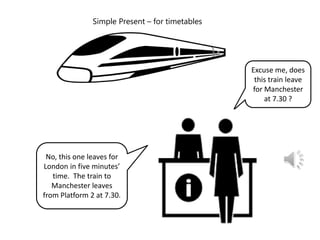
Excuse me, does
this train leave
for Manchester
at 7.30 ?
No, this one leaves for
London in five minutes’
time. The train to
Manchester leaves
from Platform 2 at 7.30.
Simple Present – for timetables
SIMPLE PRESENT - (forTHINGS)
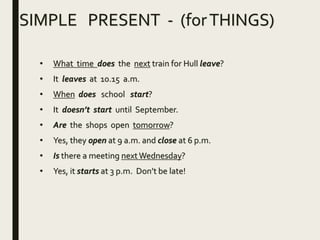
• What time does the next train for Hull leave?
• It leaves at 10.15 a.m.
• When does school start?
• It doesn’t start until September.
• Are the shops open tomorrow?
• Yes, they open at 9 a.m. and close at 6 p.m.
• Is there a meeting nextWednesday?
• Yes, it starts at 3 p.m. Don’t be late!
PRESENT
CONTINUOUS
– ( for
PEOPLE)
Future
arrangements
– Planned
actions
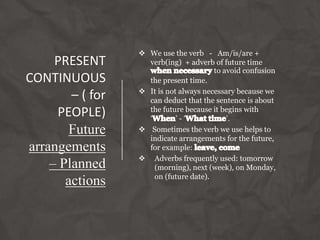
 We use the verb - Am/is/are +
verb(ing) + adverb of future time
to avoid confusion
the present time.
 It is not always necessary because we
can deduct that the sentence is about
the future because it begins with
‘ ’ - ‘ ’.
 Sometimes the verb we use helps to
indicate arrangements for the future,
for example:
 Adverbs frequently used: tomorrow
(morning), next (week), on Monday,
on (future date).
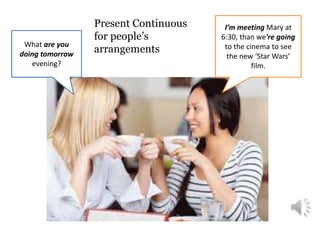
Present Continuous
for people’s
arrangements
What are you
doing tomorrow
evening?
I’m meeting Mary at
6:30, than we’re going
to the cinema to see
the new ‘Star Wars’
film.
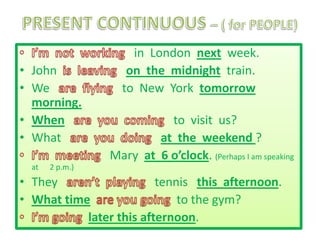
in London next week.
• John on the midnight train.
• We to New York tomorrow
morning.
• When to visit us?
• What at the weekend ?
Mary at 6 o’clock. (Perhaps I am speaking
at 2 p.m.)
• They tennis this afternoon.
• What time to the gym?
later this afternoon.
–
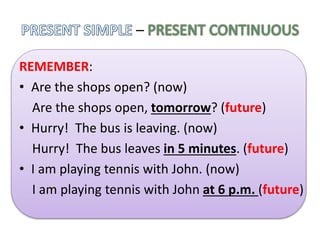
REMEMBER:
• Are the shops open? (now)
Are the shops open, tomorrow? (future)
• Hurry! The bus is leaving. (now)
Hurry! The bus leaves in 5 minutes. (future)
• I am playing tennis with John. (now)
I am playing tennis with John at 6 p.m. (future)
We use am/is/are + going to + base form of
main verb to express two types of situation:
We can only have intentions for the future, so
although we often use them, adverbs of future
time are not always necessary.
.
From what we see around us we believe that
something will happen in the very near future.
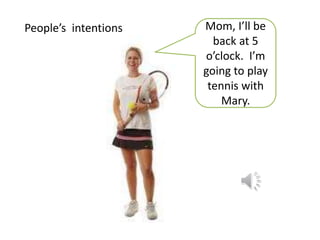
Mom, I’ll be
back at 5
o’clock. I’m
going to play
tennis with
Mary.
People’s intentions
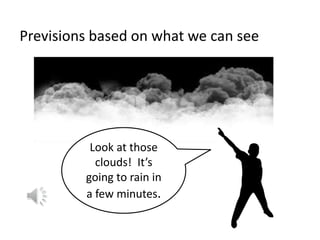
Previsions based on what we can see
Look at those
clouds! It’s
going to rain in
a few minutes.
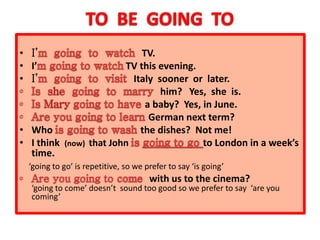
• I’ TV.
• I’ TV this evening.
• I’ Italy sooner or later.
him? Yes, she is.
a baby? Yes, in June.
German next term?
• Who the dishes? Not me!
• I think (now) that John to London in a week’s
time.
‘going to go’ is repetitive, so we prefer to say ‘is going’
with us to the cinema?
‘going to come’ doesn’t sound too good so we prefer to say ‘are you
coming’
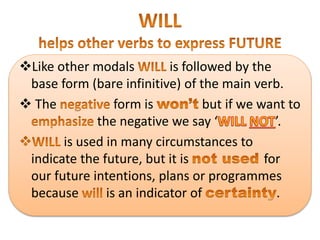
Like other modals is followed by the
base form (bare infinitive) of the main verb.
 The form is but if we want to
the negative we say ‘ ’.
is used in many circumstances to
indicate the future, but it is for
our future intentions, plans or programmes
because is an indicator of .
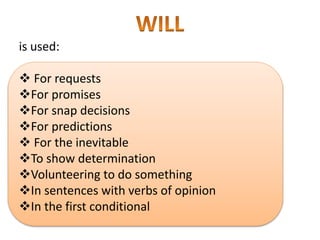
is used:
 For requests
For promises
For snap decisions
For predictions
 For the inevitable
To show determination
Volunteering to do something
In sentences with verbs of opinion
In the first conditional
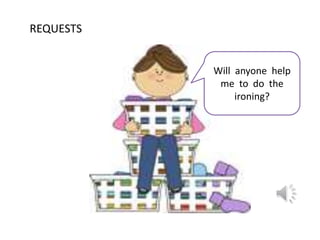
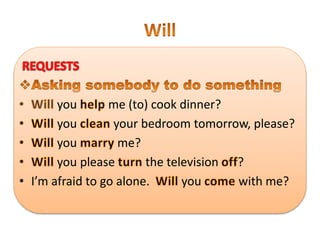
REQUESTS
Will anyone help
me to do the
ironing?
you me (to) cook dinner?
you your bedroom tomorrow, please?
you me?
you please the television ?
• I’m afraid to go alone. you with me?
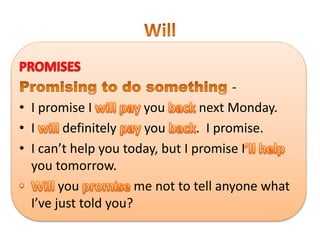
-
• I promise I you next Monday.
• I definitely you . I promise.
• I can’t help you today, but I promise I
you tomorrow.
you me not to tell anyone what
I’ve just told you?
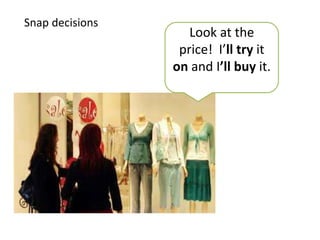
Snap decisions
Look at the
price! I’ll try it
on and I’ll buy it.
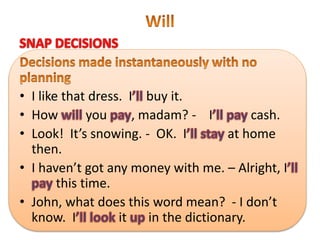
• I like that dress. I buy it.
• How you , madam? - I cash.
• Look! It’s snowing. - OK. I at home
then.
• I haven’t got any money with me. – Alright, I
this time.
• John, what does this word mean? - I don’t
know. I it in the dictionary.
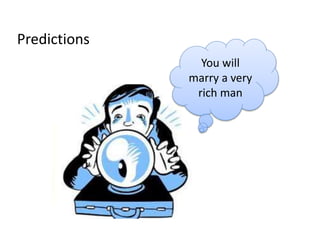
Predictions
You will
marry a very
rich man
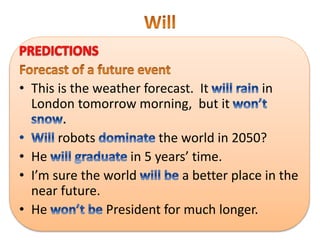
• This is the weather forecast. It in
London tomorrow morning, but it
robots the world in 2050?
• He in 5 years’ time.
• I’m sure the world a better place in the
near future.
• He President for much longer.
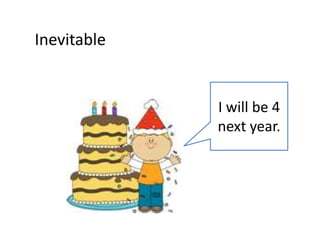
Inevitable
I will be 4
next year.
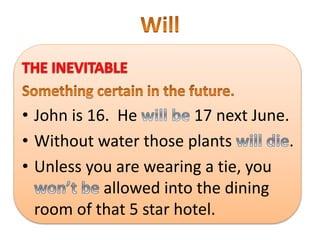
• John is 16. He 17 next June.
• Without water those plants .
• Unless you are wearing a tie, you
allowed into the dining
room of that 5 star hotel.
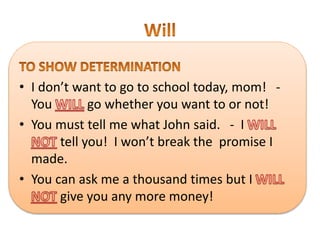
• I don’t want to go to school today, mom! -
You go whether you want to or not!
• You must tell me what John said. - I
tell you! I won’t break the promise I
made.
• You can ask me a thousand times but I
give you any more money!
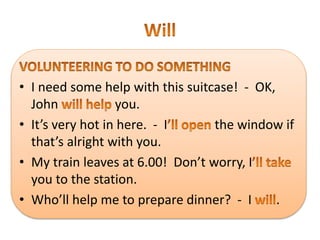
• I need some help with this suitcase! - OK,
John you.
• It’s very hot in here. - I the window if
that’s alright with you.
• My train leaves at 6.00! Don’t worry, I
you to the station.
• Who’ll help me to prepare dinner? - I .
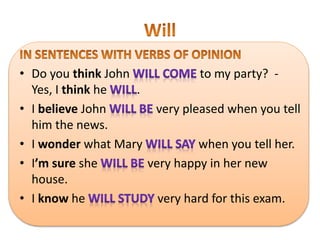
• Do you think John to my party? -
Yes, I think he .
• I believe John very pleased when you tell
him the news.
• I wonder what Mary when you tell her.
• I’m sure she very happy in her new
house.
• I know he very hard for this exam.
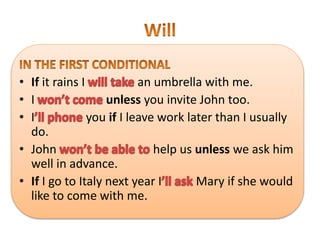
• If it rains I an umbrella with me.
• I unless you invite John too.
• I you if I leave work later than I usually
do.
• John help us unless we ask him
well in advance.
• If I go to Italy next year I Mary if she would
like to come with me.
=============================

Future Form.pptx

  • 2.
    The English languagemakes a distinction between ‘what people do’ and ‘events or time-tables’ (things).  For events or time-tables – USE present simple’. For ‘people’ - USE the ‘present continuous’.
  • 3.
    SIMPLE PRESENT - (for THINGS) We use the verb in the simple present form + adverb of future time to avoid confusion with the present time.  It is not always necessary because we can deduct that the sentence is about the future because it begins with ‘ ’- ‘ ’. Adverbs frequently used: Tomorrow (morning), next (week), on Monday, on + (future date). Timetables and fixed future events
  • 4.
    Excuse me, does thistrain leave for Manchester at 7.30 ? No, this one leaves for London in five minutes’ time. The train to Manchester leaves from Platform 2 at 7.30. Simple Present – for timetables
  • 5.
    SIMPLE PRESENT -(forTHINGS) • What time does the next train for Hull leave? • It leaves at 10.15 a.m. • When does school start? • It doesn’t start until September. • Are the shops open tomorrow? • Yes, they open at 9 a.m. and close at 6 p.m. • Is there a meeting nextWednesday? • Yes, it starts at 3 p.m. Don’t be late!
  • 6.
    PRESENT CONTINUOUS – ( for PEOPLE) Future arrangements –Planned actions  We use the verb - Am/is/are + verb(ing) + adverb of future time to avoid confusion the present time.  It is not always necessary because we can deduct that the sentence is about the future because it begins with ‘ ’ - ‘ ’.  Sometimes the verb we use helps to indicate arrangements for the future, for example:  Adverbs frequently used: tomorrow (morning), next (week), on Monday, on (future date).
  • 7.
    Present Continuous for people’s arrangements Whatare you doing tomorrow evening? I’m meeting Mary at 6:30, than we’re going to the cinema to see the new ‘Star Wars’ film.
  • 8.
    in London nextweek. • John on the midnight train. • We to New York tomorrow morning. • When to visit us? • What at the weekend ? Mary at 6 o’clock. (Perhaps I am speaking at 2 p.m.) • They tennis this afternoon. • What time to the gym? later this afternoon.
  • 9.
    – REMEMBER: • Are theshops open? (now) Are the shops open, tomorrow? (future) • Hurry! The bus is leaving. (now) Hurry! The bus leaves in 5 minutes. (future) • I am playing tennis with John. (now) I am playing tennis with John at 6 p.m. (future)
  • 10.
    We use am/is/are+ going to + base form of main verb to express two types of situation: We can only have intentions for the future, so although we often use them, adverbs of future time are not always necessary. . From what we see around us we believe that something will happen in the very near future.
  • 11.
    Mom, I’ll be backat 5 o’clock. I’m going to play tennis with Mary. People’s intentions
  • 12.
    Previsions based onwhat we can see Look at those clouds! It’s going to rain in a few minutes.
  • 13.
    • I’ TV. •I’ TV this evening. • I’ Italy sooner or later. him? Yes, she is. a baby? Yes, in June. German next term? • Who the dishes? Not me! • I think (now) that John to London in a week’s time. ‘going to go’ is repetitive, so we prefer to say ‘is going’ with us to the cinema? ‘going to come’ doesn’t sound too good so we prefer to say ‘are you coming’
  • 14.
    Like other modalsis followed by the base form (bare infinitive) of the main verb.  The form is but if we want to the negative we say ‘ ’. is used in many circumstances to indicate the future, but it is for our future intentions, plans or programmes because is an indicator of .
  • 15.
    is used:  Forrequests For promises For snap decisions For predictions  For the inevitable To show determination Volunteering to do something In sentences with verbs of opinion In the first conditional
  • 16.
    REQUESTS Will anyone help meto do the ironing?
  • 17.
    you me (to)cook dinner? you your bedroom tomorrow, please? you me? you please the television ? • I’m afraid to go alone. you with me?
  • 19.
    - • I promiseI you next Monday. • I definitely you . I promise. • I can’t help you today, but I promise I you tomorrow. you me not to tell anyone what I’ve just told you?
  • 20.
    Snap decisions Look atthe price! I’ll try it on and I’ll buy it.
  • 21.
    • I likethat dress. I buy it. • How you , madam? - I cash. • Look! It’s snowing. - OK. I at home then. • I haven’t got any money with me. – Alright, I this time. • John, what does this word mean? - I don’t know. I it in the dictionary.
  • 22.
  • 23.
    • This isthe weather forecast. It in London tomorrow morning, but it robots the world in 2050? • He in 5 years’ time. • I’m sure the world a better place in the near future. • He President for much longer.
  • 24.
  • 25.
    • John is16. He 17 next June. • Without water those plants . • Unless you are wearing a tie, you allowed into the dining room of that 5 star hotel.
  • 26.
    • I don’twant to go to school today, mom! - You go whether you want to or not! • You must tell me what John said. - I tell you! I won’t break the promise I made. • You can ask me a thousand times but I give you any more money!
  • 27.
    • I needsome help with this suitcase! - OK, John you. • It’s very hot in here. - I the window if that’s alright with you. • My train leaves at 6.00! Don’t worry, I you to the station. • Who’ll help me to prepare dinner? - I .
  • 28.
    • Do youthink John to my party? - Yes, I think he . • I believe John very pleased when you tell him the news. • I wonder what Mary when you tell her. • I’m sure she very happy in her new house. • I know he very hard for this exam.
  • 29.
    • If itrains I an umbrella with me. • I unless you invite John too. • I you if I leave work later than I usually do. • John help us unless we ask him well in advance. • If I go to Italy next year I Mary if she would like to come with me.
  • 30.