PREPARING A FUTURE
WORKFORCE
DIGITAL
TRANSFORMATION IS
TRANSFORMING
ALMOST ALL
INDUSTRIES
Doctors book appointments online and upload
your test results on a tablet or laptop.
Sales Associates need to operate customer
service platforms.
Farmers analyze data to monitor their crops.
Construction engineers can tweak a building’s
design on the spot and send it to the rest of the
team within seconds.
1
2
4
3
AND IMPACTING
COMPANIES AND
EMPLOYEES
• While digital transformation promises accelerated
innovation and economic advantages, the shift often
creates unprecedented challenges for many companies
steeped in legacy culture, process, technology, and ways
of working.
• 7 million jobs that could be lost over the next five years
through redundancy, automation, or disintermediation,
with the most significant losses in white-collar office and
administrative roles.
• As many as one-third of American workers may need to
change occupations and acquire new skills by 2030 if
automation adoption is rapid.
• Business Model Disruption and Technology
Disruption are some of the top trends impacting
companies.
There will 1.4 million open
computing jobs by 2020, but only
400,000 computer science graduates
with the skills to fill them.
DEMAND FOR WORKERS
WITH DIGITAL SKILLS IS
GROWING
Gap of 1
million
5% 23%
New jobs requiring high levels of digital skills has
more than quadrupled in 21st century
56% <30%
Number of jobs requiring few digital skills have
fallen by almost half
2 in 3 of the 13 million new jobs
created in the US since 2010 required
medium or advanced levels of digital
skills.
$17,753
$12,703
$11,144
$9,188
$3,424
$1,058
$336
OPPORTUNITIES
BECAUSE OF DIGITAL
LITERACY
Liberal arts students who bolster their
education with additional technical skills, such
as graphic design, social media, data analysis, or
computer programming, roughly double the
number of entry-level jobs available to them
and can see an estimated $6,000 bump in initial
salary.
BUILDING WORKFORCE
OF THE FUTURE
• As AI algorithms increase in sophistication and
computational power, the pace of intelligent
automation is likely to accelerate and push the
workforce to focus on higher-value activities,
upskilling and retraining.
• Majority of companies cite AI and Robotic Process
Automation as technologies that could expose their
companies to business disruption and regulatory
risks.
• But, they aren’t entirely equipped to assess their
workforce for this disruption, especially in corporate
functions such as finance, treasury, risk management,
and human resources.
Moderately prepared
Currently unprepared with no plans to rectify
Currently uprepared but taking steps to rectify
Significantly prepared
54%
9%
14%
23%
STRONG JOB-GROWTH
AREAS WHERE COMPANIES
NEED TO INVEST IN
EDUCATION
Companies need to engage at the educational level to play their part
in building the workforce they need in the future.
At the heart of this investment should be access for the workforce
to a digital literacy program.
The program would provide practical applications that are
contextual to the employee’s role.
AT&T, for example, sponsors a low-cost online master’s degree in
computer science from the Georgia Institute of Technology’s school
of computing and offers a variety of courses to retrain its
employees.
Cloud Computing
01
02
03
04
05
06
07
08
Machine Learning
Process Automation
Blockchain
Internet of Things
Mobile Computing
Social Media
Big Data/ Data Analytics
ORGANIZATIONAL CAPABILITIES NEEDED FOR
FUTURE WORKFORCE
3.65
3.73
3.84
3.89
3.95
4.05
4.14
4.27
4.3
4.46
0 1 2 3 4 5
Transdisciplinarity
Sense Making
New Media Literacy
Computational Thinking
Cognitive Load Management
Design Mindset
Social Intelligence
Novel and Adaptive Thinking
Cross Cultural Competency
Virtual Collaboration
Future Work Skills
Top 4 capabilities required:
• Virtual Collaboration
• Cross-Cultural Competency
• Novel and Adaptive Thinking
• Social Intelligence
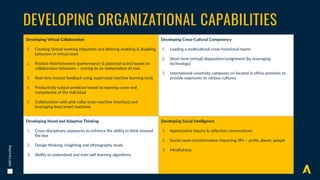
DEVELOPING ORGANIZATIONAL CAPABILITIES
Developing Virtual Collaboration
1. Creating Virtual working etiquettes and defining enabling & disabling
behaviors in virtual team
2. Positive Reinforcement (performance & potential score) based on
collaboration behaviors – scoring by an independent AI tool
3. Real-time Instant feedback using supervised machine learning tools
4. Productivity output predictor based on learning curve and
competence of the individual
5. Collaboration with pink collar (man-machine interface) and
leveraging bots/smart machines
Developing Cross-Cultural Competency
1. Leading a multicultural cross-functional teams
2. Short term (virtual) deputation/assignment (by leveraging
technology)
3. International university campuses co-located in office premises to
provide exposures to various cultures
Developing Novel and Adaptive Thinking
1. Cross-disciplinary exposures to enhance the ability to think beyond
the box
2. Design thinking, insighting and ethnography study
3. Ability to understand and train self-learning algorithms
Developing Social Intelligence
1. Appreciative inquiry & reflective conversations
2. Social cause transformation impacting 3Ps – profit, planet, people
3. Mindfulness
HOW ORGANIZATIONAL STRUCTURES WILL
CHANGE
• Adoption of agile team working dispersed across wide geographies and incorporating digital transformation in their
business model.
• Flexi-contracts supporting gig-economy workforce will come in play dismantling the “fixed office hours” model.
• More entrepreneurial and unconventional working patterns will emerge for supporting employee mobility and work-life
integration.
• Though concerns about privacy and intrusion will rise, tracking user activities and experience without using intrusive
technologies will be developed.
• The workplace environment will get redesigned to enhance collaboration and enhance user experience.
SOURCES
http://www.brinknews.com/make-digital-literacy-a-strategic-workforce-priority/
http://techhq.com/2018/04/what-companies-must-do-to-prepare-for-the-future-workforce/
https://www.peoplematters.in/article/technology/how-should-the-unconventional-future-ready-workplace-be-built-18270
http://thehill.com/blogs/congress-blog/technology/386546-its-time-to-prepare-the-workforce-of-the-future

Preparing A Future Workforce

  • 1.
  • 2.
    DIGITAL TRANSFORMATION IS TRANSFORMING ALMOST ALL INDUSTRIES Doctorsbook appointments online and upload your test results on a tablet or laptop. Sales Associates need to operate customer service platforms. Farmers analyze data to monitor their crops. Construction engineers can tweak a building’s design on the spot and send it to the rest of the team within seconds. 1 2 4 3
  • 3.
    AND IMPACTING COMPANIES AND EMPLOYEES •While digital transformation promises accelerated innovation and economic advantages, the shift often creates unprecedented challenges for many companies steeped in legacy culture, process, technology, and ways of working. • 7 million jobs that could be lost over the next five years through redundancy, automation, or disintermediation, with the most significant losses in white-collar office and administrative roles. • As many as one-third of American workers may need to change occupations and acquire new skills by 2030 if automation adoption is rapid. • Business Model Disruption and Technology Disruption are some of the top trends impacting companies.
  • 4.
    There will 1.4million open computing jobs by 2020, but only 400,000 computer science graduates with the skills to fill them. DEMAND FOR WORKERS WITH DIGITAL SKILLS IS GROWING Gap of 1 million 5% 23% New jobs requiring high levels of digital skills has more than quadrupled in 21st century 56% <30% Number of jobs requiring few digital skills have fallen by almost half 2 in 3 of the 13 million new jobs created in the US since 2010 required medium or advanced levels of digital skills.
  • 5.
    $17,753 $12,703 $11,144 $9,188 $3,424 $1,058 $336 OPPORTUNITIES BECAUSE OF DIGITAL LITERACY Liberalarts students who bolster their education with additional technical skills, such as graphic design, social media, data analysis, or computer programming, roughly double the number of entry-level jobs available to them and can see an estimated $6,000 bump in initial salary.
  • 6.
    BUILDING WORKFORCE OF THEFUTURE • As AI algorithms increase in sophistication and computational power, the pace of intelligent automation is likely to accelerate and push the workforce to focus on higher-value activities, upskilling and retraining. • Majority of companies cite AI and Robotic Process Automation as technologies that could expose their companies to business disruption and regulatory risks. • But, they aren’t entirely equipped to assess their workforce for this disruption, especially in corporate functions such as finance, treasury, risk management, and human resources. Moderately prepared Currently unprepared with no plans to rectify Currently uprepared but taking steps to rectify Significantly prepared 54% 9% 14% 23%
  • 7.
    STRONG JOB-GROWTH AREAS WHERECOMPANIES NEED TO INVEST IN EDUCATION Companies need to engage at the educational level to play their part in building the workforce they need in the future. At the heart of this investment should be access for the workforce to a digital literacy program. The program would provide practical applications that are contextual to the employee’s role. AT&T, for example, sponsors a low-cost online master’s degree in computer science from the Georgia Institute of Technology’s school of computing and offers a variety of courses to retrain its employees. Cloud Computing 01 02 03 04 05 06 07 08 Machine Learning Process Automation Blockchain Internet of Things Mobile Computing Social Media Big Data/ Data Analytics
  • 8.
    ORGANIZATIONAL CAPABILITIES NEEDEDFOR FUTURE WORKFORCE 3.65 3.73 3.84 3.89 3.95 4.05 4.14 4.27 4.3 4.46 0 1 2 3 4 5 Transdisciplinarity Sense Making New Media Literacy Computational Thinking Cognitive Load Management Design Mindset Social Intelligence Novel and Adaptive Thinking Cross Cultural Competency Virtual Collaboration Future Work Skills Top 4 capabilities required: • Virtual Collaboration • Cross-Cultural Competency • Novel and Adaptive Thinking • Social Intelligence
  • 9.
    DEVELOPING ORGANIZATIONAL CAPABILITIES DevelopingVirtual Collaboration 1. Creating Virtual working etiquettes and defining enabling & disabling behaviors in virtual team 2. Positive Reinforcement (performance & potential score) based on collaboration behaviors – scoring by an independent AI tool 3. Real-time Instant feedback using supervised machine learning tools 4. Productivity output predictor based on learning curve and competence of the individual 5. Collaboration with pink collar (man-machine interface) and leveraging bots/smart machines Developing Cross-Cultural Competency 1. Leading a multicultural cross-functional teams 2. Short term (virtual) deputation/assignment (by leveraging technology) 3. International university campuses co-located in office premises to provide exposures to various cultures Developing Novel and Adaptive Thinking 1. Cross-disciplinary exposures to enhance the ability to think beyond the box 2. Design thinking, insighting and ethnography study 3. Ability to understand and train self-learning algorithms Developing Social Intelligence 1. Appreciative inquiry & reflective conversations 2. Social cause transformation impacting 3Ps – profit, planet, people 3. Mindfulness
  • 10.
    HOW ORGANIZATIONAL STRUCTURESWILL CHANGE • Adoption of agile team working dispersed across wide geographies and incorporating digital transformation in their business model. • Flexi-contracts supporting gig-economy workforce will come in play dismantling the “fixed office hours” model. • More entrepreneurial and unconventional working patterns will emerge for supporting employee mobility and work-life integration. • Though concerns about privacy and intrusion will rise, tracking user activities and experience without using intrusive technologies will be developed. • The workplace environment will get redesigned to enhance collaboration and enhance user experience.
  • 11.