PREPARE YOUR IT INFRASTRUCTURE
      FOR THANKSGIVING:
         TAKING E-COMMERCE TO THE CLOUD


     Jeff Barr             Harish Ganesan
     Senior Manager and
                             CTO and Co-Founder
     Evangelist
                           8KMiles Cloud Solutions
     Amazon Web Services
Agenda
•   Retail E-commerce Landscape – Intro
•   Intro to AWS
•   Why consider AWS for E-commerce
•   Amazon Auto Scaling Demo
•   Q&A

      Send your questions to webinar@8kmiles.com
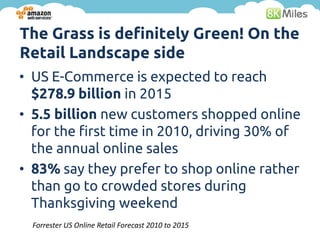
The Grass is definitely Green! On the
Retail Landscape side
• US E-Commerce is expected to reach
  $278.9 billion in 2015
• 5.5 billion new customers shopped online
  for the first time in 2010, driving 30% of
  the annual online sales
• 83% say they prefer to shop online rather
  than go to crowded stores during
  Thanksgiving weekend
  Forrester US Online Retail Forecast 2010 to 2015
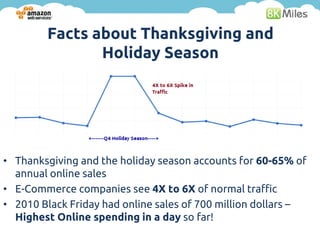
Facts about Thanksgiving and
               Holiday Season


• Thanksgiving and the holiday season accounts for 60-65% of
  annual online sales
• E-Commerce companies see 4X to 6X of normal traffic
• 2010 Black Friday had online sales of 700 million dollars –
  Highest Online spending in a day so far!
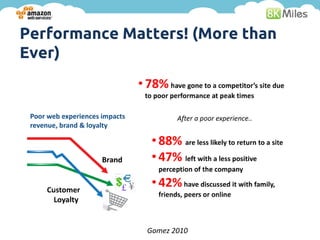
Performance Matters! (More than
Ever)


               Gomez 2010
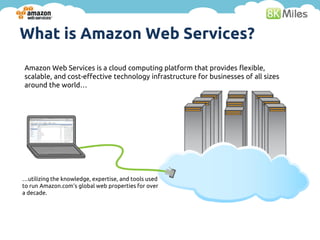
What is Amazon Web Services?
Amazon Web Services is a cloud computing platform that provides flexible,
scalable, and cost-effective technology infrastructure for businesses of all sizes
around the world…


…utilizing the knowledge, expertise, and tools used
to run Amazon.com’s global web properties for over
a decade.
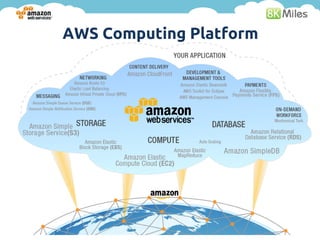
AWS Computing Platform
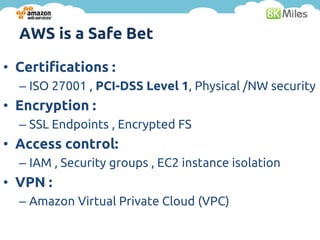
AWS is a Safe Bet

• Certifications :
  – ISO 27001 , PCI-DSS Level 1, Physical /NW security
• Encryption :
  – SSL Endpoints , Encrypted FS
• Access control:
  – IAM , Security groups , EC2 instance isolation
• VPN :
  – Amazon Virtual Private Cloud (VPC)
E-Commerce: IT Challenges

1. Capacity utilization in normal times
2. Scaling and capacity planning for
   peak times
3. Unexpected Demand Surge
4. Lead times for leasing / procurement
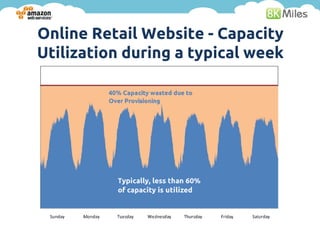
Online Retail Website - Capacity
Utilization during a typical week
E-Commerce: IT Challenges

1. Capacity utilization in normal times
2. Scaling and Capacity planning for
   peak times
3. Unexpected Demand Surge
4. Lead times for leasing /procurement
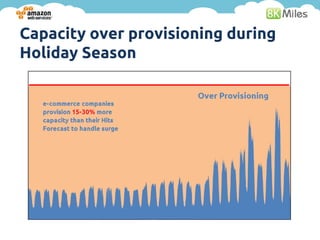
Capacity over provisioning during
Holiday Season
E-Commerce: IT Challenges

1. Capacity utilization in normal times
2. Scaling and capacity planning for
   peak times
3. Unexpected Demand Surge
4. Lead times for leasing /procurement
Unexpected Demand Surge during
Holiday season
  Opportunity Cost/Total
  Impact = [(%Downtime) +
  0.3*(%Page Load Times >4
  seconds)] * Sales
E-Commerce: IT Challenges

1. Capacity utilization in normal times
2. Scaling and capacity planning for peak
   times
3. Unexpected Demand Surge
4. Lead times for leasing /procurement
Lead Time for leasing / procurement

• Procurement of On-premise hardware
  takes over a month on average
• Leasing takes about 2-4 weeks
• Deployment may take longer depending
  on the complexity of your architecture
• Plan it in advance (or) front page of news
  papers
Which translates to the following
questions for IT
  –How to address scalability
  –How to ensure application is Highly
   Available
  –How to maintain performance
   levels
  –How to optimize costs
Solution = AWS
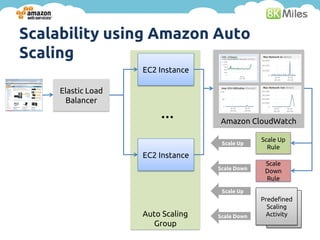
• Scalability using Amazon Auto Scaling
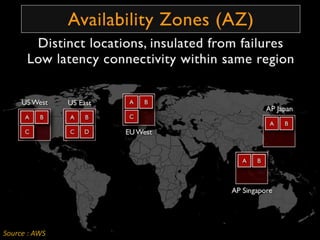
• High Availability using Multiple Availability
  Zones (AZ) and AWS building blocks
• Performance using CDN, ELB, Caching and DB
• Cost control by pay-for-use model
Scalability using Amazon Auto
Scaling
                    EC2 Instance

     Elastic Load
      Balancer
                        …          Amazon CloudWatch

                                                Scale Up
                                    Scale Up
                                                  Rule
                    EC2 Instance
                                                 Scale
                                   Scale Down
                                                 Down
                                                 Rule

                                    Scale Up
                                                Predefined
                                                  Scaling
                    Auto Scaling   Scale Down     Activity
                      Group
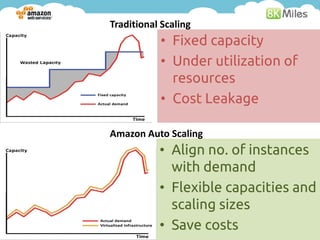
Traditional Scaling
           • Fixed capacity
           • Under utilization of
             resources
           • Cost Leakage

Amazon Auto Scaling
           • Align no. of instances
             with demand
           • Flexible capacities and
             scaling sizes
           • Save costs
Amazon Auto Scaling benefits

•   Dynamically scale fleet of EC2 instances
•   Traffic spikes can be handled with ease
•   Drive scaling from actual metrics
•   Predefined scaling activities:
    • Periodic (daily traffic surge)
    • One-time (special advertising to drive traffic)
Solution = AWS
• Scalability using Amazon Auto Scaling
• High Availability using Multiple Availability
  Zones (AZ) and AWS building blocks
• Performance using CDN, ELB, Caching and DB
• Cost control by pay-for-use model
Source : AWS
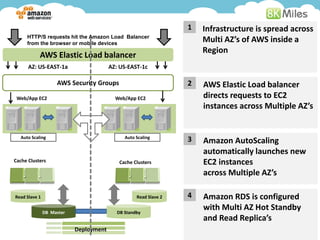
1   Infrastructure is spread across
     HTTP/S requests hit the Amazon Load Balancer
     from the browser or mobile devices
                                                                      Multi AZ’s of AWS inside a
                                                                      Region
           AWS Elastic Load balancer
      AZ: US-EAST-1a                    AZ: US-EAST-1c

                    AWS Security Groups                           2   AWS Elastic Load balancer
 Web/App EC2                              Web/App EC2                 directs requests to EC2
                                                                      instances across Multiple AZ’s


  Auto Scaling                                Auto Scaling
                                                                  3   Amazon AutoScaling
                                                                      automatically launches new
Cache Clusters                             Cache Clusters             EC2 instances
                                                                      across Multiple AZ’s

Read Slave 1                                       Read Slave 2   4   Amazon RDS is configured
               DB Master                   DB Standby
                                                                      with Multi AZ Hot Standby
                                                                      and Read Replica’s
                           Deployment
Leverage AWS Building blocks
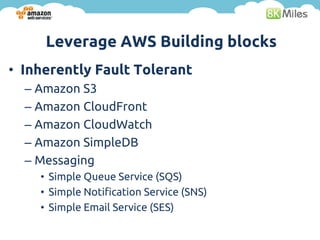
• Inherently Fault Tolerant
  – Amazon S3
  – Amazon CloudFront
  – Amazon CloudWatch
  – Amazon SimpleDB
  – Messaging
    • Simple Queue Service (SQS)
    • Simple Notification Service (SNS)
    • Simple Email Service (SES)
Solution = AWS
• Scalability using Autoscaling
• High Availability using Multi AZ and AWS
  building blocks
• Performance using CDN, ELB, Caching and
  DB
• Cost control by pay-for-use model
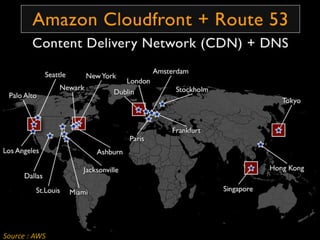
Content Delivery Networks

• Use Amazon CloudFront to distribute
  content with low latency and high data
  transfer speeds
Source : AWS
Elastic Load Balancing (ELB)
• ELB does not ramp up rapidly
  – Pre warm your Amazon Elastic Load balancers for
    the big day
• SSL offloading on ELB
Caching
• Use Caching technologies
  – Amazon ElastiCache (beta)
  – Memcached / Membase
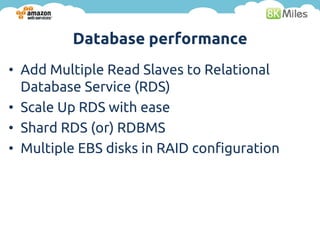
Database performance
• Add Multiple Read Slaves to Relational
  Database Service (RDS)
• Scale Up RDS with ease
• Shard RDS (or) RDBMS
• Multiple EBS disks in RAID configuration
Solution = AWS
• Scalability using Autoscaling
• High Availability using Multi AZ and AWS
  building blocks
• Performance using CDN, ELB, Caching and DB
• Cost control by pay-for-use model
AWS is Cost effective


• Cost Flexibility
• On demand
  – Pay only for what you use
  – No upfront commitments
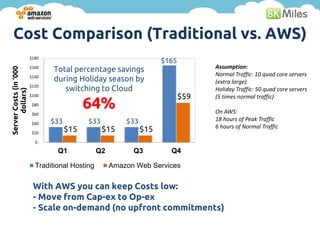
Cost Comparison (Traditional vs. AWS)
                        $180
                                                                     $165
                        $160
                                Total percentage savings                          Assumption:
Server Costs (in ‘000


                                                                                  Normal Traffic: 10 quad core servers
                        $140
                                during Holiday season by                          (extra large)
                        $120
                                   switching to Cloud                             Holiday Traffic: 50 quad core servers
      dollars)


                        $100
                                                                            $59
                                           64%
                                                                                  (5 times normal traffic)
                         $80

                         $60                                                      On AWS:
                               $33         $33           $33                      18 hours of Peak Traffic
                         $40
                                                                                  6 hours of Normal Traffic
                         $20
                                     $15         $15           $15
                          $-

                                 Q1             Q2         Q3          Q4

                          Traditional Hosting        Amazon Web Services


                         With AWS you can keep Costs low:
                         - Move from Cap-ex to Op-ex
                         - Scale on-demand (no upfront commitments)
AWS use cases for E-commerce apps

• Run your entire application on AWS
• Run AWS as your extended Data Center (DC)
• AWS as Primary site and Existing DC for
  Disaster Recovery (DR-Hot )
• AWS for Disaster Recovery (DR-Cold, Warm,
  Hot)
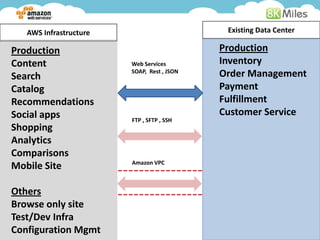
AWS Infrastructure                        Existing Data Center

Production                                  Production
Content                 Web Services        Inventory
Search
                        SOAP, Rest , JSON
                                            Order Management
Catalog                                     Payment
Recommendations                             Fulfillment
Social apps                                 Customer Service
                        FTP , SFTP , SSH
Shopping
Analytics
Comparisons
                        Amazon VPC
Mobile Site

Others
Browse only site
Test/Dev Infra
Configuration Mgmt
AWS benefits for IT

• Scale capacity on demand
• Derive value from good architecture
• No fear of lost sales because of slow load
  times or server being unavailable
• Focus on product and business
• Turn fixed costs into variable costs
• Cost Effective
Summary
• AWS is the right fit for e-commerce applications
• AWS provides cost-effective infrastructure to
  handle any level of traffic
• Multiple approaches and use cases to leverage
  AWS in addition to existing IT
• Architecture is critical
• Time to get started for this season is NOW
8KMiles - Who we are
•   Amazon Web Services Partner
•   Help companies leverage Cloud Computing
•   Expertise across the entire suite of AWS products
•   Team of experts located in United States, India &
    Singapore
Q&A
8KMiles
cloud.8KMiles.com
Call: 636-544-8413
cloud@8KMiles.com


Amazon Web Services
aws.amazon.com
aws.amazon.com/contact-us/aws-sales
Thank You!

Prepare your IT Infrastructure for Thanksgiving

  • 1.
    PREPARE YOUR ITINFRASTRUCTURE FOR THANKSGIVING: TAKING E-COMMERCE TO THE CLOUD Jeff Barr Harish Ganesan Senior Manager and CTO and Co-Founder Evangelist 8KMiles Cloud Solutions Amazon Web Services
  • 2.
    Agenda • Retail E-commerce Landscape – Intro • Intro to AWS • Why consider AWS for E-commerce • Amazon Auto Scaling Demo • Q&A Send your questions to webinar@8kmiles.com
  • 3.
    The Grass isdefinitely Green! On the Retail Landscape side • US E-Commerce is expected to reach $278.9 billion in 2015 • 5.5 billion new customers shopped online for the first time in 2010, driving 30% of the annual online sales • 83% say they prefer to shop online rather than go to crowded stores during Thanksgiving weekend Forrester US Online Retail Forecast 2010 to 2015
  • 4.
    Facts about Thanksgivingand Holiday Season • Thanksgiving and the holiday season accounts for 60-65% of annual online sales • E-Commerce companies see 4X to 6X of normal traffic • 2010 Black Friday had online sales of 700 million dollars – Highest Online spending in a day so far!
  • 5.
    Performance Matters! (Morethan Ever) Gomez 2010
  • 6.
    What is AmazonWeb Services? Amazon Web Services is a cloud computing platform that provides flexible, scalable, and cost-effective technology infrastructure for businesses of all sizes around the world… …utilizing the knowledge, expertise, and tools used to run Amazon.com’s global web properties for over a decade.
  • 7.
  • 8.
    AWS is aSafe Bet • Certifications : – ISO 27001 , PCI-DSS Level 1, Physical /NW security • Encryption : – SSL Endpoints , Encrypted FS • Access control: – IAM , Security groups , EC2 instance isolation • VPN : – Amazon Virtual Private Cloud (VPC)
  • 9.
    E-Commerce: IT Challenges 1.Capacity utilization in normal times 2. Scaling and capacity planning for peak times 3. Unexpected Demand Surge 4. Lead times for leasing / procurement
  • 10.
    Online Retail Website- Capacity Utilization during a typical week
  • 11.
    E-Commerce: IT Challenges 1.Capacity utilization in normal times 2. Scaling and Capacity planning for peak times 3. Unexpected Demand Surge 4. Lead times for leasing /procurement
  • 12.
    Capacity over provisioningduring Holiday Season
  • 13.
    E-Commerce: IT Challenges 1.Capacity utilization in normal times 2. Scaling and capacity planning for peak times 3. Unexpected Demand Surge 4. Lead times for leasing /procurement
  • 14.
    Unexpected Demand Surgeduring Holiday season Opportunity Cost/Total Impact = [(%Downtime) + 0.3*(%Page Load Times >4 seconds)] * Sales
  • 15.
    E-Commerce: IT Challenges 1.Capacity utilization in normal times 2. Scaling and capacity planning for peak times 3. Unexpected Demand Surge 4. Lead times for leasing /procurement
  • 16.
    Lead Time forleasing / procurement • Procurement of On-premise hardware takes over a month on average • Leasing takes about 2-4 weeks • Deployment may take longer depending on the complexity of your architecture • Plan it in advance (or) front page of news papers
  • 17.
    Which translates tothe following questions for IT –How to address scalability –How to ensure application is Highly Available –How to maintain performance levels –How to optimize costs
  • 18.
    Solution = AWS •Scalability using Amazon Auto Scaling • High Availability using Multiple Availability Zones (AZ) and AWS building blocks • Performance using CDN, ELB, Caching and DB • Cost control by pay-for-use model
  • 19.
    Scalability using AmazonAuto Scaling EC2 Instance Elastic Load Balancer … Amazon CloudWatch Scale Up Scale Up Rule EC2 Instance Scale Scale Down Down Rule Scale Up Predefined Scaling Auto Scaling Scale Down Activity Group
  • 20.
    Traditional Scaling • Fixed capacity • Under utilization of resources • Cost Leakage Amazon Auto Scaling • Align no. of instances with demand • Flexible capacities and scaling sizes • Save costs
  • 21.
    Amazon Auto Scalingbenefits • Dynamically scale fleet of EC2 instances • Traffic spikes can be handled with ease • Drive scaling from actual metrics • Predefined scaling activities: • Periodic (daily traffic surge) • One-time (special advertising to drive traffic)
  • 22.
    Solution = AWS •Scalability using Amazon Auto Scaling • High Availability using Multiple Availability Zones (AZ) and AWS building blocks • Performance using CDN, ELB, Caching and DB • Cost control by pay-for-use model
  • 23.
  • 24.
    1 Infrastructure is spread across HTTP/S requests hit the Amazon Load Balancer from the browser or mobile devices Multi AZ’s of AWS inside a Region AWS Elastic Load balancer AZ: US-EAST-1a AZ: US-EAST-1c AWS Security Groups 2 AWS Elastic Load balancer Web/App EC2 Web/App EC2 directs requests to EC2 instances across Multiple AZ’s Auto Scaling Auto Scaling 3 Amazon AutoScaling automatically launches new Cache Clusters Cache Clusters EC2 instances across Multiple AZ’s Read Slave 1 Read Slave 2 4 Amazon RDS is configured DB Master DB Standby with Multi AZ Hot Standby and Read Replica’s Deployment
  • 25.
    Leverage AWS Buildingblocks • Inherently Fault Tolerant – Amazon S3 – Amazon CloudFront – Amazon CloudWatch – Amazon SimpleDB – Messaging • Simple Queue Service (SQS) • Simple Notification Service (SNS) • Simple Email Service (SES)
  • 26.
    Solution = AWS •Scalability using Autoscaling • High Availability using Multi AZ and AWS building blocks • Performance using CDN, ELB, Caching and DB • Cost control by pay-for-use model
  • 27.
    Content Delivery Networks •Use Amazon CloudFront to distribute content with low latency and high data transfer speeds
  • 28.
  • 29.
    Elastic Load Balancing(ELB) • ELB does not ramp up rapidly – Pre warm your Amazon Elastic Load balancers for the big day • SSL offloading on ELB
  • 30.
    Caching • Use Cachingtechnologies – Amazon ElastiCache (beta) – Memcached / Membase
  • 31.
    Database performance • AddMultiple Read Slaves to Relational Database Service (RDS) • Scale Up RDS with ease • Shard RDS (or) RDBMS • Multiple EBS disks in RAID configuration
  • 32.
    Solution = AWS •Scalability using Autoscaling • High Availability using Multi AZ and AWS building blocks • Performance using CDN, ELB, Caching and DB • Cost control by pay-for-use model
  • 33.
    AWS is Costeffective • Cost Flexibility • On demand – Pay only for what you use – No upfront commitments
  • 34.
    Cost Comparison (Traditionalvs. AWS) $180 $165 $160 Total percentage savings Assumption: Server Costs (in ‘000 Normal Traffic: 10 quad core servers $140 during Holiday season by (extra large) $120 switching to Cloud Holiday Traffic: 50 quad core servers dollars) $100 $59 64% (5 times normal traffic) $80 $60 On AWS: $33 $33 $33 18 hours of Peak Traffic $40 6 hours of Normal Traffic $20 $15 $15 $15 $- Q1 Q2 Q3 Q4 Traditional Hosting Amazon Web Services With AWS you can keep Costs low: - Move from Cap-ex to Op-ex - Scale on-demand (no upfront commitments)
  • 35.
    AWS use casesfor E-commerce apps • Run your entire application on AWS • Run AWS as your extended Data Center (DC) • AWS as Primary site and Existing DC for Disaster Recovery (DR-Hot ) • AWS for Disaster Recovery (DR-Cold, Warm, Hot)
  • 36.
    AWS Infrastructure Existing Data Center Production Production Content Web Services Inventory Search SOAP, Rest , JSON Order Management Catalog Payment Recommendations Fulfillment Social apps Customer Service FTP , SFTP , SSH Shopping Analytics Comparisons Amazon VPC Mobile Site Others Browse only site Test/Dev Infra Configuration Mgmt
  • 37.
    AWS benefits forIT • Scale capacity on demand • Derive value from good architecture • No fear of lost sales because of slow load times or server being unavailable • Focus on product and business • Turn fixed costs into variable costs • Cost Effective
  • 38.
    Summary • AWS isthe right fit for e-commerce applications • AWS provides cost-effective infrastructure to handle any level of traffic • Multiple approaches and use cases to leverage AWS in addition to existing IT • Architecture is critical • Time to get started for this season is NOW
  • 39.
    8KMiles - Whowe are • Amazon Web Services Partner • Help companies leverage Cloud Computing • Expertise across the entire suite of AWS products • Team of experts located in United States, India & Singapore
  • 40.
    Q&A 8KMiles cloud.8KMiles.com Call: 636-544-8413 cloud@8KMiles.com Amazon WebServices aws.amazon.com aws.amazon.com/contact-us/aws-sales
  • 41.