a university for the
realworld®
S c h o o l o f I n f o r m a t i o n S y s t e m s
‹#›
a university for the
realworld®
S c h o o l o f
I n f o r m a t i o n S y s t e m s
Preference-based Resource
and Task Allocation in Business
Process Automation
ReihanehBidar,ArthurterHofstede,RenukaSindhgattaandChunOuyang
CoopIS2019,Rhodes,Greece
a university for the
realworld®
S c h o o l o f I n f o r m a t i o n S y s t e m s
Business Process Management | Service Science | Information Science
Agenda
• What is preference?
• Why preference matters?
• Resource-based preference in BPA context
• Research problem
• Conceptual model
• Resource Pattern analysis
• Detecting Resource Preference from Event Log
• Conclusion and limitation
2
a university for the
realworld®
S c h o o l o f I n f o r m a t i o n S y s t e m s
Service Science: Service Languages, Techniques and Methods
What is preference?
3
"[t]he expression of preference by means of choice and
decision making is the essence of intelligent, purposeful
behavior"- Slovic 1995
We define preference as:
The degree to which a resource has a tendency for
choosing particular types of work or for involving
particular resources in the conduct of work.
a university for the
realworld®
S c h o o l o f I n f o r m a t i o n S y s t e m s
Information Science: Human information interaction, Human data science
Why preference matters ?
o Organisations to redesign their systems to consider resource autonomy and empowerment
(Hagel et al., 2017).
o Resources are both more productive and more motivated
o Resources have different preferences, which may affect their motivation (Russell et al., 2016).
and overall process outcomes in the case of preference for certain activities (Pika et al., 2014).
o Important for increasing workplace productivity and organizational efficiency (Psychological
impact).
o Important for improvement of resource allocation and thus process performance (Technical
impact) (Vanderfeesten &Grefen, 2015).
4
a university for the
realworld®
S c h o o l o f I n f o r m a t i o n S y s t e m s
BPM: Process-based Transformation, Process Data Analysis
Preference in BPA context
Identified as an important attribute of resource behaviour and an important criterion for the purpose of
research allocation (Arias et al., 2017; Sindhgatta, 2016; Sohail et al., 2016; Huang et al., 2012).
Our objective:
• To advance the state of the art in the field of BPM by examining the notion of preference in more
detail and to set the stage for unlocking the potential of this notion in business process automation.
• Can be used in the future to support resource and task allocation
5
a university for the
realworld®
S c h o o l o f I n f o r m a t i o n S y s t e m s
BPM: Process-based Transformation, Process Data Analysis
Research purpose and contribution
RQ1) What are current manifestations of preference in a BPA context?
Conceptual phase:
6
RQ2) How can we derive certain forms of preference from event logs?
Empirical phase:
Step 1: develop a conceptual model of preference informed from literature
Synthesis of a rich notion of preference through the provision of a conceptual model of preference
Preference classified: resource-task, resource-resource, and task-resource
Step 2: resource pattern analysis: to determine to what degree they encapsulate various forms of preference,
and to see how preferences may be reflected in workflow management systems.
Detection of implicit preferences by looking at what is encoded in resource patterns
Step 3: Process event logs to show how certain forms of preference can be automatically derived
Preferences can also manifest themselves in execution logs and it is shown how some specific forms of
preference can be discovered as this opens up the possibility of automatically detecting and updating
preferences at runtime.
a university for the
realworld®
S c h o o l o f I n f o r m a t i o n S y s t e m s
BPM: Process-based Transformation, Process Data Analysis
is of
… prefers to work on
… over working on …
prefers to work on
… prefers working
with … on …
{'human', 'non-human'}
… has preference for
… when performing …
… prefers … over …
when performing …
Type of Resource
(.name)
Resource
(.id)
Non-human Resource
Human Resource
Task
(.id)
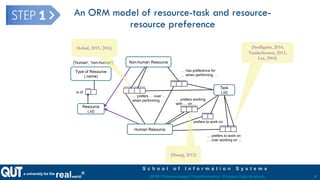
An ORM model of resource-task and resource-
resource preference
(Sindhgatta, 2016;
Vanderfeesten, 2015;
Lee, 2004)
(Sohail, 2015, 2016)
(Huang, 2012)
7
a university for the
realworld®
S c h o o l o f I n f o r m a t i o n S y s t e m s
BPM: Process-based Transformation, Process Data Analysis
for … … human
resources are
preferred ▲
◀ for … resources with … are preferred
◀ requires
… performed … … times recently
◀ is allocated to
is instance of
has ▲
is of
{'human', 'non-human'}
exhibits
Type of Resource
(.name)
Resource
(.id)
Human Resource
Task
(.id)
Skill
(.descr)
Experience
(.descr)
Work Item
(.descr)
Number
An ORM model of task-resource preference
(Cabanillas, 2013)
8
(Zhao, 2016)
a university for the
realworld®
S c h o o l o f I n f o r m a t i o n S y s t e m s
10
Design time (DT)
Run-time (RT)
Outside the scope (OS)
Not applicable (NA)
Task-resource at
design time
Resource-task at
run time
Evaluationofresourcepatterns
(fromapreferenceperspective)
(Russell, van der Aalst, ter Hofstede, 2016)
a university for the
realworld®
S c h o o l o f I n f o r m a t i o n S y s t e m s
Detecting Preferences in Process Logs
11
o We look at real-life event data and how some forms of preference may manifest themselves and how
they may be derived.
o The derivation of preferences, especially if performed on an ongoing basis as to make sure they are
up to date, can produce useful information for work allocation in the context of BPA environment.
a university for the
realworld®
S c h o o l o f I n f o r m a t i o n S y s t e m s
Information in the Event log
• Event log contains a set of events
• Each event has the following key
attributes:
• case id, status, time stamp, task, resource
• Other case attributes
• Information of a resource performing
a task is available
Case ID Task Status Timestamp Resource Amount Requested
173688 A_SUBMITTED COMPLETE 1/10/2011 0:38 112 20000
173688 A_PREACCEPTED COMPLETE 1/10/2011 0:39 112 20000
173688 W_Completeren aanvraag SCHEDULE 1/10/2011 0:39 112 20000
173688 W_Completeren aanvraag START 1/10/2011 11:36 20000
173688 A_ACCEPTED COMPLETE 1/10/2011 11:42 10862 20000
173688 A_FINALIZED COMPLETE 1/10/2011 11:45 10862 20000
173688 O_SENT COMPLETE 1/10/2011 11:45 10862 20000
173688 W_Nabellen offertes SCHEDULE 1/10/2011 11:45 20000
173688 W_Completeren aanvraag COMPLETE 1/10/2011 11:45 20000
173688 W_Nabellen offertes START 1/10/2011 12:15 20000
173688 W_Nabellen offertes COMPLETE 1/10/2011 12:17 20000
173688 W_Nabellen offertes START 8/10/2011 16:26 10913 20000
173688 W_Nabellen offertes COMPLETE 8/10/2011 16:32 10913 20000
173688 W_Nabellen offertes START 10/10/2011 11:32 11049 20000
173688 O_SENT_BACK COMPLETE 10/10/2011 11:33 11049 20000
173688 W_Valideren aanvraag SCHEDULE 10/10/2011 11:33 11049 20000
12
a university for the
realworld®
S c h o o l o f I n f o r m a t i o n S y s t e m s
Preference of Resources (Information available in the
event log)
• Preference of a resource for a Task
• There can be many tasks to be picked by from the worklist
• The resource working on a specific task may indicate preference
• Preference of a resource to work with another resource
• The handover of a task by a resource to another resource could indicate preference.
• Event log provides a manifestation of preference
• Preference can be influenced by many other operational settings of the workflow system.
• For example: All decisions are taken by the team lead.
13
a university for the
realworld®
S c h o o l o f I n f o r m a t i o n S y s t e m s
Approach : Learn Resource Preference from Data
• Use machine learning classifier to learn a function
o Determine the next selected task in a worklist
o Handover to the next resource for a subsequent task
14
a university for the
realworld®
S c h o o l o f I n f o r m a t i o n S y s t e m s
Mode1: Predicting Next Selected Task in a Worklist
(Input features)
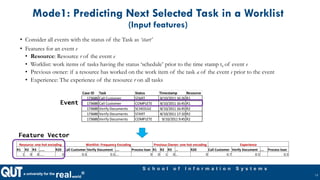
• Consider all events with the status of the Task as ‘start’
• Features for an event e
• Resource: Resource r of the event e
• Worklist: work items of tasks having the status ‘schedule’ prior to the time stamp te of event e
• Previous owner: if a resource has worked on the work item of the task a of the event e prior to the event
• Experience: The experience of the resource r on all tasks
Case ID Task Status Timestamp Resource
173688 Call Customer START 8/10/2011 16:26 R1
173688 Call Customer COMPLETE 8/10/2011 16:45 R1
173688 Verify Documents SCHEDULE 8/10/2011 16:45 R2
173688 Verify Documents START 8/10/2011 17:10 R2
173688 Verify Documents COMPLETE 9/10/2011 9:45 R2
Resource: one-hot encoding Worklist: Frequency Encoding Previous Owner: one-hot encoding Experience
R1 R2 R3 …… R20 Call Customer Verify Document …. Process loan R1 R2 R3 … R20 Call Customer Verify Document …. Process loan
1 0 0 ….. 0 0.5 0.5 …. 0 0 1 0… 0 0.7 0.5 0.5
Feature Vector
Event
15
a university for the
realworld®
S c h o o l o f I n f o r m a t i o n S y s t e m s
Predicting Next Selected Task in a Worklist
(Output)
• Consider all events with the status of the Task as ‘start’
• Features for an event e
• Resource: Resource r of the event e
• Worklist: work items of tasks having the status ‘schedule’ prior to the event e
• Previous owner: if resource has worked on the work item of the task a of the event e prior to the event
• Experience: The experience of the resource r on all tasks
• Label (Output of the function)
• Task a of the event e
Case ID Task Status Timestamp Resource
173688 Call Customer START 8/10/2011 16:26 R1
173688 Call Customer COMPLETE 8/10/2011 16:45 R1
173688 Verify Documents SCHEDULE 8/10/2011 16:45 R2
173688 Verify Documents START 8/10/2011 17:10 R2
173688 Verify Documents COMPLETE 9/10/2011 9:45 R2
Label: Call Customer
Event
16
a university for the
realworld®
S c h o o l o f I n f o r m a t i o n S y s t e m s
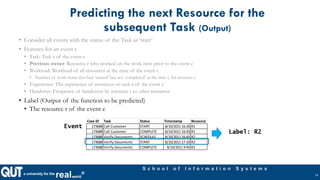
Model2: Predicting the next Resource for the
subsequent Task
• Consider all events with the status of the Task as ‘start’
• Features for an event e
• Task: Task a of the event e
• Previous owner: Resource r who worked on the work item prior to the event e
• Workload: Workload of all resources at the time of the event e
• Number of work-items that had ‘started’ but not ‘completed’ at the time te for resource r
• Experience: The experience of resources on task a of the event e
• Handover: Frequency of handovers by resource r to other resources
Case ID Task Status Timestamp Resource
173688 Call Customer START 8/10/2011 16:26 R1
173688 Call Customer COMPLETE 8/10/2011 16:45 R1
173688 Verify Documents SCHEDULE 8/10/2011 16:45 R2
173688 Verify Documents START 8/10/2011 17:10 R2
173688 Verify Documents COMPLETE 9/10/2011 9:45 R2
Previous Owner Task Workload Experience Handover
R1 R2 R3 …… R20 Call Customer Verify Document …. Process loan R1 R2 R3 … R20 R1 R2 R3 … R1 R2 R3 …… R20
1 0 0….. 0 0 1…. 0 0.2 0.5 0.5… 0 0.7 0.5 0.2… 0.3 0 0.9….. 0
Feature Vector
Event
17
a university for the
realworld®
S c h o o l o f I n f o r m a t i o n S y s t e m s
Predicting the next Resource for the
subsequent Task (Output)
• Consider all events with the status of the Task as ‘start’
• Features for an event e
• Task: Task a of the event e
• Previous owner: Resource r who worked on the work item prior to the event e
• Workload: Workload of all resources at the time of the event e
• Number of work-items that had ‘started’ but not ‘completed’ at the time te for resource r
• Experience: The experience of resources on task a of the event e
• Handover: Frequency of handovers by resource r to other resources
• Label (Output of the function to be predicted)
• The resource r of the event e
Case ID Task Status Timestamp Resource
173688 Call Customer START 8/10/2011 16:26 R1
173688 Call Customer COMPLETE 8/10/2011 16:45 R1
173688 Verify Documents SCHEDULE 8/10/2011 16:45 R2
173688 Verify Documents START 8/10/2011 17:10 R2
173688 Verify Documents COMPLETE 9/10/2011 9:45 R2
Label: R2
Event
18
a university for the
realworld®
S c h o o l o f I n f o r m a t i o n S y s t e m s
Experiments
• Two BPIC Logs containing Resource, Task, and Status information
• Log filtering :
• Considered resources who worked on at least minimum number of work items
• Distinguished tasks based on case attributes
• Two distinct bins for BPIC 2012
• Product and impact for BPIC 2013
• Support Vector Machine as the classifier
• SVM with Linear kernel was used
• 5-fold cross validation results are reported
19
a university for the
realworld®
S c h o o l o f I n f o r m a t i o n S y s t e m s
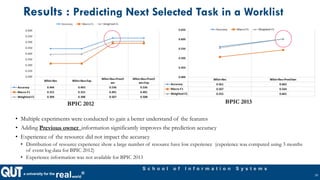
Results : Predicting Next Selected Task in a Worklist
• Multiple experiments were conducted to gain a better understand of the features
• Adding Previous owner information significantly improves the prediction accuracy
• Experience of the resource did not impact the accuracy
• Distribution of resource experience show a large number of resource have low experience (experience was computed using 3 months
of event log data for BPIC 2012)
• Experience information was not available for BPIC 2013
20
BPIC 2012 BPIC 2013
a university for the
realworld®
S c h o o l o f I n f o r m a t i o n S y s t e m s
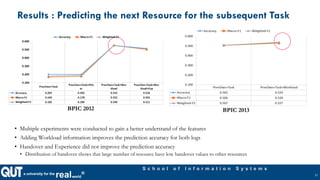
Results : Predicting the next Resource for the subsequent Task
• Multiple experiments were conducted to gain a better understand of the features
• Adding Workload information improves the prediction accuracy for both logs
• Handover and Experience did not improve the prediction accuracy
• Distribution of handover shows that large number of resource have low handover values to other resources
21
BPIC 2012 BPIC 2013
a university for the
realworld®
S c h o o l o f I n f o r m a t i o n S y s t e m s
Conclusion and Limitation
• Provides a starting point for examining preference in greater detail in a BPA context,
• in terms of the forms it can take,
• the way these forms can be used to support resource allocation
• how they can automatically be derived from event logs in order to keep them up to date
• Preference is influenced by certain factors – workload of resource, previous owner
• Limitation:
• Many forms of preference in the context of resource allocation for BPA. However, we have focused on what
we unearthed from the literature.
• Ideally, more publicly available logs will be made available in the future containing rich resource information.
• The logs could expose other forms of preference, provide more insight into the accuracy of the methods.
22
a university for the
realworld®
S c h o o l o f I n f o r m a t i o n S y s t e m s
Service Science: Service Languages, Techniques and Methods
Thank you
23
Dr. Reihaneh Bidar
Email: r.bidar@qut.edu.au
Reihaneh is an Associate Lecturer in IS
school at QUT. She received her B.S. in
software engineering, her M.S. degree in
IT, and in 2018, she earned her PhD in IS.
Her broad research interests cover,
conceptual and empirical qualitative and
quantitative research applied to systems in
the context of dynamic network and
service delivery.

Preference-Based Resource and Task Allocation in Business Process Automation

  • 1.
    a university forthe realworld® S c h o o l o f I n f o r m a t i o n S y s t e m s ‹#› a university for the realworld® S c h o o l o f I n f o r m a t i o n S y s t e m s Preference-based Resource and Task Allocation in Business Process Automation ReihanehBidar,ArthurterHofstede,RenukaSindhgattaandChunOuyang CoopIS2019,Rhodes,Greece
  • 2.
    a university forthe realworld® S c h o o l o f I n f o r m a t i o n S y s t e m s Business Process Management | Service Science | Information Science Agenda • What is preference? • Why preference matters? • Resource-based preference in BPA context • Research problem • Conceptual model • Resource Pattern analysis • Detecting Resource Preference from Event Log • Conclusion and limitation 2
  • 3.
    a university forthe realworld® S c h o o l o f I n f o r m a t i o n S y s t e m s Service Science: Service Languages, Techniques and Methods What is preference? 3 "[t]he expression of preference by means of choice and decision making is the essence of intelligent, purposeful behavior"- Slovic 1995 We define preference as: The degree to which a resource has a tendency for choosing particular types of work or for involving particular resources in the conduct of work.
  • 4.
    a university forthe realworld® S c h o o l o f I n f o r m a t i o n S y s t e m s Information Science: Human information interaction, Human data science Why preference matters ? o Organisations to redesign their systems to consider resource autonomy and empowerment (Hagel et al., 2017). o Resources are both more productive and more motivated o Resources have different preferences, which may affect their motivation (Russell et al., 2016). and overall process outcomes in the case of preference for certain activities (Pika et al., 2014). o Important for increasing workplace productivity and organizational efficiency (Psychological impact). o Important for improvement of resource allocation and thus process performance (Technical impact) (Vanderfeesten &Grefen, 2015). 4
  • 5.
    a university forthe realworld® S c h o o l o f I n f o r m a t i o n S y s t e m s BPM: Process-based Transformation, Process Data Analysis Preference in BPA context Identified as an important attribute of resource behaviour and an important criterion for the purpose of research allocation (Arias et al., 2017; Sindhgatta, 2016; Sohail et al., 2016; Huang et al., 2012). Our objective: • To advance the state of the art in the field of BPM by examining the notion of preference in more detail and to set the stage for unlocking the potential of this notion in business process automation. • Can be used in the future to support resource and task allocation 5
  • 6.
    a university forthe realworld® S c h o o l o f I n f o r m a t i o n S y s t e m s BPM: Process-based Transformation, Process Data Analysis Research purpose and contribution RQ1) What are current manifestations of preference in a BPA context? Conceptual phase: 6 RQ2) How can we derive certain forms of preference from event logs? Empirical phase: Step 1: develop a conceptual model of preference informed from literature Synthesis of a rich notion of preference through the provision of a conceptual model of preference Preference classified: resource-task, resource-resource, and task-resource Step 2: resource pattern analysis: to determine to what degree they encapsulate various forms of preference, and to see how preferences may be reflected in workflow management systems. Detection of implicit preferences by looking at what is encoded in resource patterns Step 3: Process event logs to show how certain forms of preference can be automatically derived Preferences can also manifest themselves in execution logs and it is shown how some specific forms of preference can be discovered as this opens up the possibility of automatically detecting and updating preferences at runtime.
  • 7.
    a university forthe realworld® S c h o o l o f I n f o r m a t i o n S y s t e m s BPM: Process-based Transformation, Process Data Analysis is of … prefers to work on … over working on … prefers to work on … prefers working with … on … {'human', 'non-human'} … has preference for … when performing … … prefers … over … when performing … Type of Resource (.name) Resource (.id) Non-human Resource Human Resource Task (.id) An ORM model of resource-task and resource- resource preference (Sindhgatta, 2016; Vanderfeesten, 2015; Lee, 2004) (Sohail, 2015, 2016) (Huang, 2012) 7
  • 8.
    a university forthe realworld® S c h o o l o f I n f o r m a t i o n S y s t e m s BPM: Process-based Transformation, Process Data Analysis for … … human resources are preferred ▲ ◀ for … resources with … are preferred ◀ requires … performed … … times recently ◀ is allocated to is instance of has ▲ is of {'human', 'non-human'} exhibits Type of Resource (.name) Resource (.id) Human Resource Task (.id) Skill (.descr) Experience (.descr) Work Item (.descr) Number An ORM model of task-resource preference (Cabanillas, 2013) 8 (Zhao, 2016)
  • 9.
    a university forthe realworld® S c h o o l o f I n f o r m a t i o n S y s t e m s 10 Design time (DT) Run-time (RT) Outside the scope (OS) Not applicable (NA) Task-resource at design time Resource-task at run time Evaluationofresourcepatterns (fromapreferenceperspective) (Russell, van der Aalst, ter Hofstede, 2016)
  • 10.
    a university forthe realworld® S c h o o l o f I n f o r m a t i o n S y s t e m s Detecting Preferences in Process Logs 11 o We look at real-life event data and how some forms of preference may manifest themselves and how they may be derived. o The derivation of preferences, especially if performed on an ongoing basis as to make sure they are up to date, can produce useful information for work allocation in the context of BPA environment.
  • 11.
    a university forthe realworld® S c h o o l o f I n f o r m a t i o n S y s t e m s Information in the Event log • Event log contains a set of events • Each event has the following key attributes: • case id, status, time stamp, task, resource • Other case attributes • Information of a resource performing a task is available Case ID Task Status Timestamp Resource Amount Requested 173688 A_SUBMITTED COMPLETE 1/10/2011 0:38 112 20000 173688 A_PREACCEPTED COMPLETE 1/10/2011 0:39 112 20000 173688 W_Completeren aanvraag SCHEDULE 1/10/2011 0:39 112 20000 173688 W_Completeren aanvraag START 1/10/2011 11:36 20000 173688 A_ACCEPTED COMPLETE 1/10/2011 11:42 10862 20000 173688 A_FINALIZED COMPLETE 1/10/2011 11:45 10862 20000 173688 O_SENT COMPLETE 1/10/2011 11:45 10862 20000 173688 W_Nabellen offertes SCHEDULE 1/10/2011 11:45 20000 173688 W_Completeren aanvraag COMPLETE 1/10/2011 11:45 20000 173688 W_Nabellen offertes START 1/10/2011 12:15 20000 173688 W_Nabellen offertes COMPLETE 1/10/2011 12:17 20000 173688 W_Nabellen offertes START 8/10/2011 16:26 10913 20000 173688 W_Nabellen offertes COMPLETE 8/10/2011 16:32 10913 20000 173688 W_Nabellen offertes START 10/10/2011 11:32 11049 20000 173688 O_SENT_BACK COMPLETE 10/10/2011 11:33 11049 20000 173688 W_Valideren aanvraag SCHEDULE 10/10/2011 11:33 11049 20000 12
  • 12.
    a university forthe realworld® S c h o o l o f I n f o r m a t i o n S y s t e m s Preference of Resources (Information available in the event log) • Preference of a resource for a Task • There can be many tasks to be picked by from the worklist • The resource working on a specific task may indicate preference • Preference of a resource to work with another resource • The handover of a task by a resource to another resource could indicate preference. • Event log provides a manifestation of preference • Preference can be influenced by many other operational settings of the workflow system. • For example: All decisions are taken by the team lead. 13
  • 13.
    a university forthe realworld® S c h o o l o f I n f o r m a t i o n S y s t e m s Approach : Learn Resource Preference from Data • Use machine learning classifier to learn a function o Determine the next selected task in a worklist o Handover to the next resource for a subsequent task 14
  • 14.
    a university forthe realworld® S c h o o l o f I n f o r m a t i o n S y s t e m s Mode1: Predicting Next Selected Task in a Worklist (Input features) • Consider all events with the status of the Task as ‘start’ • Features for an event e • Resource: Resource r of the event e • Worklist: work items of tasks having the status ‘schedule’ prior to the time stamp te of event e • Previous owner: if a resource has worked on the work item of the task a of the event e prior to the event • Experience: The experience of the resource r on all tasks Case ID Task Status Timestamp Resource 173688 Call Customer START 8/10/2011 16:26 R1 173688 Call Customer COMPLETE 8/10/2011 16:45 R1 173688 Verify Documents SCHEDULE 8/10/2011 16:45 R2 173688 Verify Documents START 8/10/2011 17:10 R2 173688 Verify Documents COMPLETE 9/10/2011 9:45 R2 Resource: one-hot encoding Worklist: Frequency Encoding Previous Owner: one-hot encoding Experience R1 R2 R3 …… R20 Call Customer Verify Document …. Process loan R1 R2 R3 … R20 Call Customer Verify Document …. Process loan 1 0 0 ….. 0 0.5 0.5 …. 0 0 1 0… 0 0.7 0.5 0.5 Feature Vector Event 15
  • 15.
    a university forthe realworld® S c h o o l o f I n f o r m a t i o n S y s t e m s Predicting Next Selected Task in a Worklist (Output) • Consider all events with the status of the Task as ‘start’ • Features for an event e • Resource: Resource r of the event e • Worklist: work items of tasks having the status ‘schedule’ prior to the event e • Previous owner: if resource has worked on the work item of the task a of the event e prior to the event • Experience: The experience of the resource r on all tasks • Label (Output of the function) • Task a of the event e Case ID Task Status Timestamp Resource 173688 Call Customer START 8/10/2011 16:26 R1 173688 Call Customer COMPLETE 8/10/2011 16:45 R1 173688 Verify Documents SCHEDULE 8/10/2011 16:45 R2 173688 Verify Documents START 8/10/2011 17:10 R2 173688 Verify Documents COMPLETE 9/10/2011 9:45 R2 Label: Call Customer Event 16
  • 16.
    a university forthe realworld® S c h o o l o f I n f o r m a t i o n S y s t e m s Model2: Predicting the next Resource for the subsequent Task • Consider all events with the status of the Task as ‘start’ • Features for an event e • Task: Task a of the event e • Previous owner: Resource r who worked on the work item prior to the event e • Workload: Workload of all resources at the time of the event e • Number of work-items that had ‘started’ but not ‘completed’ at the time te for resource r • Experience: The experience of resources on task a of the event e • Handover: Frequency of handovers by resource r to other resources Case ID Task Status Timestamp Resource 173688 Call Customer START 8/10/2011 16:26 R1 173688 Call Customer COMPLETE 8/10/2011 16:45 R1 173688 Verify Documents SCHEDULE 8/10/2011 16:45 R2 173688 Verify Documents START 8/10/2011 17:10 R2 173688 Verify Documents COMPLETE 9/10/2011 9:45 R2 Previous Owner Task Workload Experience Handover R1 R2 R3 …… R20 Call Customer Verify Document …. Process loan R1 R2 R3 … R20 R1 R2 R3 … R1 R2 R3 …… R20 1 0 0….. 0 0 1…. 0 0.2 0.5 0.5… 0 0.7 0.5 0.2… 0.3 0 0.9….. 0 Feature Vector Event 17
  • 17.
    a university forthe realworld® S c h o o l o f I n f o r m a t i o n S y s t e m s Predicting the next Resource for the subsequent Task (Output) • Consider all events with the status of the Task as ‘start’ • Features for an event e • Task: Task a of the event e • Previous owner: Resource r who worked on the work item prior to the event e • Workload: Workload of all resources at the time of the event e • Number of work-items that had ‘started’ but not ‘completed’ at the time te for resource r • Experience: The experience of resources on task a of the event e • Handover: Frequency of handovers by resource r to other resources • Label (Output of the function to be predicted) • The resource r of the event e Case ID Task Status Timestamp Resource 173688 Call Customer START 8/10/2011 16:26 R1 173688 Call Customer COMPLETE 8/10/2011 16:45 R1 173688 Verify Documents SCHEDULE 8/10/2011 16:45 R2 173688 Verify Documents START 8/10/2011 17:10 R2 173688 Verify Documents COMPLETE 9/10/2011 9:45 R2 Label: R2 Event 18
  • 18.
    a university forthe realworld® S c h o o l o f I n f o r m a t i o n S y s t e m s Experiments • Two BPIC Logs containing Resource, Task, and Status information • Log filtering : • Considered resources who worked on at least minimum number of work items • Distinguished tasks based on case attributes • Two distinct bins for BPIC 2012 • Product and impact for BPIC 2013 • Support Vector Machine as the classifier • SVM with Linear kernel was used • 5-fold cross validation results are reported 19
  • 19.
    a university forthe realworld® S c h o o l o f I n f o r m a t i o n S y s t e m s Results : Predicting Next Selected Task in a Worklist • Multiple experiments were conducted to gain a better understand of the features • Adding Previous owner information significantly improves the prediction accuracy • Experience of the resource did not impact the accuracy • Distribution of resource experience show a large number of resource have low experience (experience was computed using 3 months of event log data for BPIC 2012) • Experience information was not available for BPIC 2013 20 BPIC 2012 BPIC 2013
  • 20.
    a university forthe realworld® S c h o o l o f I n f o r m a t i o n S y s t e m s Results : Predicting the next Resource for the subsequent Task • Multiple experiments were conducted to gain a better understand of the features • Adding Workload information improves the prediction accuracy for both logs • Handover and Experience did not improve the prediction accuracy • Distribution of handover shows that large number of resource have low handover values to other resources 21 BPIC 2012 BPIC 2013
  • 21.
    a university forthe realworld® S c h o o l o f I n f o r m a t i o n S y s t e m s Conclusion and Limitation • Provides a starting point for examining preference in greater detail in a BPA context, • in terms of the forms it can take, • the way these forms can be used to support resource allocation • how they can automatically be derived from event logs in order to keep them up to date • Preference is influenced by certain factors – workload of resource, previous owner • Limitation: • Many forms of preference in the context of resource allocation for BPA. However, we have focused on what we unearthed from the literature. • Ideally, more publicly available logs will be made available in the future containing rich resource information. • The logs could expose other forms of preference, provide more insight into the accuracy of the methods. 22
  • 22.
    a university forthe realworld® S c h o o l o f I n f o r m a t i o n S y s t e m s Service Science: Service Languages, Techniques and Methods Thank you 23 Dr. Reihaneh Bidar Email: r.bidar@qut.edu.au Reihaneh is an Associate Lecturer in IS school at QUT. She received her B.S. in software engineering, her M.S. degree in IT, and in 2018, she earned her PhD in IS. Her broad research interests cover, conceptual and empirical qualitative and quantitative research applied to systems in the context of dynamic network and service delivery.