Predictable Revenue
and Sales Insights
Introduction
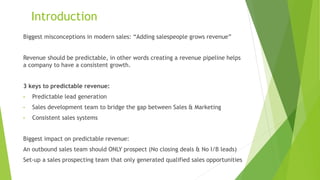
Biggest misconceptions in modern sales: “Adding salespeople grows revenue”
Revenue should be predictable, in other words creating a revenue pipeline helps
a company to have a consistent growth.
3 keys to predictable revenue:
• Predictable lead generation
• Sales development team to bridge the gap between Sales & Marketing
• Consistent sales systems
Biggest impact on predictable revenue:
An outbound sales team should ONLY prospect (No closing deals & No I/B leads)
Set-up a sales prospecting team that only generated qualified sales opportunities
Prospecting
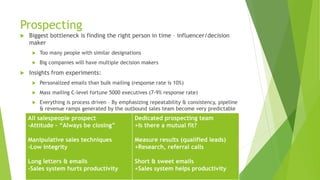
 Biggest bottleneck is finding the right person in time – influencer/decision
maker
 Too many people with similar designations
 Big companies will have multiple decision makers
 Insights from experiments:
 Personalized emails than bulk mailing (response rate is 10%)
 Mass mailing C-level fortune 5000 executives (7-9% response rate)
 Everything is process driven – By emphasizing repeatability & consistency, pipeline
& revenue ramps generated by the outbound sales team become very predictable
All salespeople prospect
-Attitude – “Always be closing”
Manipulative sales techniques
-Low integrity
Long letters & emails
-Sales system hurts productivity
Dedicated prospecting team
+Is there a mutual fit?
Measure results (qualified leads)
+Research, referral calls
Short & sweet emails
+Sales system helps productivity
Prospecting contd…
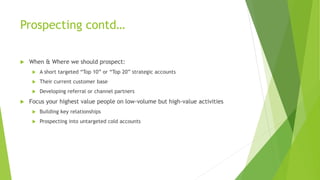
 When & Where we should prospect:
 A short targeted “Top 10” or “Top 20” strategic accounts
 Their current customer base
 Developing referral or channel partners
 Focus your highest value people on low-volume but high-value activities
 Building key relationships
 Prospecting into untargeted cold accounts
Cold calling 2.0 or Prospecting
 Resources required : 1 dedicated person for prospecting, A good CRM, Proven
product or a service that has generated revenue
 Step 1- Sales development reps to focus on generating new qualified
opportunities (ONLY doing prospecting)
 Step 2- Market response reps qualify the I/B leads coming through
website/phone & route qualified opportunities to sales persons to close
 Separate both teams to be more focused & productive
 Challenging for a rep to switch between I/B & O/B, two mind-sets
 Salesforce productivity dropped by 30% by mixing of responsibilities
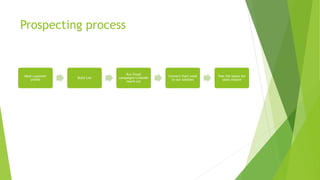
Prospecting process
Ideal customer
profile
Build List
Run Email
campaigns/LinkedIn
reach-out
Connect their need
to our solution
Pass the baton for
sales closure
Prospecting process contd..
Ideal customer profile:
Industries, Size of the company, Financial status, No in-house person,
Some kind of current system in place
Building list of targets:
Zoominfo – Higher quality of data, lower bounce rate, higher response rate
from prospects
Elance/Freelancer to find vendors
Run the email campaign:
Filter the list – Verticals, Revenue, Geography, Contact title, Company size
Connect needs to solution:
How serious are they about solving their challenges? People with power or
influence?
Qs to ask while prospecting: What are your challenges now? How are your
teams organized? Have you tried & failed with other solutions? Have you been
looking at alternatives yet?
When to pass the opportunity over:
Does the company fit our ideal client profile?
Are we speaking with someone with power & influence?
Is there clear interest in the next step?
Prospecting & Sales best practices
 Prospecting mistakes reps make
 Expecting instant results (some accounts take 3-4+ weeks to develop into an
opportunity)
 Writing long emails
 Going wide not deep (100 account once instead of 10 accounts 10 times each)
 Giving up too quickly on ideal targets
 Activity metrics to measure progress
 Prospecting tricks
 Attitude – Non-threatening researcher, not a pushy salesman
 If the prospect is not interested, ask why?
 Never give up with ideal prospects
 Always set-up a next step
Lead generation
 Type of leads
 Seeds – Word of mouth, PR
 Nets – Marketing programs
 Spears – Outbound sales, Targeted sales
 Inbound marketing – Best methods to generate leads
 Referrals
 Free trials
 SEO
 Blogs
 Webinars
 Social media
Sales machine fundamentals
 Sales 1.0 – Promotion
 Push
 Selling
 Marketing
 Positioning
 Control
 Sales 2.0 – Attraction
 Pull
 Word of mouth
 Self-managing
Principles of building a sales machine
 Be patient (4-12 months)
 Experiment
 Don’t take on one off projects
 CRM – run reports within sales systems
 Sketch out process flow
 Focus on results than activity
 Track fewer, more important metrics
 New leads per month
 No. of qualified opportunities
 % conversion rate
 Total bookings
 Win%
 Pass the baton carefully
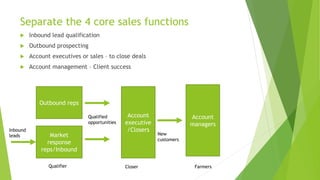
Separate the 4 core sales functions
 Inbound lead qualification
 Outbound prospecting
 Account executives or sales – to close deals
 Account management – Client success
Outbound reps
Market
response
reps/Inbound
Inbound
leads
Qualified
opportunities
Account
executive
/Closers
Account
managers
New
customers
Qualifier Closer Farmers
Hiring & Cultivating talent
“Combine one part veteran and three parts young, smart & adaptable, and mix in
the system that keeps challenging people to learn new things. The best
salespeople are the ones that have grown up in the company & know the
company’s products, customers inside and out.“
Market response reps – For qualifying inbound leads & responding to queries
Outbound sales reps – Building a targeted DB & create new sales opportunities
Account executives – Solve client problems, account management
Internal training helps productivity of salesforce:
A program with ongoing, regular format
Includes exercise/role playing & useful feedback
Is designed effectively
Follow through on everything; maintain the schedule, check progress, keep
it fresh & not let things slip up
Leadership & Management
 A no-nonsense management model
 Choose people carefully
 Self expectation & vision – Results oriented approach
 Remove obstacles
 Inspiring people – Involve the team in planning of new programs
 Developing talent
 Improve the above 5 steps
Key insights
 Prospecting strategies for targeted accounts
 Experiment with new techniques & measure results
 Measure fewer but important metrics
 More research than sales – Getting down to the ideal customer profile
 Never give up on an ideal prospect!
 Going wide not deep (100 account once instead of 10 accounts 10 times
each)
 Zoominfo database – High quality DB lists
 Use all possible channels for lead generation
 Pass the baton carefully – handover of leads/prospects to next stage
 Focus on results than activities
 Involve the entire team in big decisions to inspire workforce
Presented
by
PromptCloud.com
Thank You

Predictable Revenue

  • 1.
  • 2.
    Introduction Biggest misconceptions inmodern sales: “Adding salespeople grows revenue” Revenue should be predictable, in other words creating a revenue pipeline helps a company to have a consistent growth. 3 keys to predictable revenue: • Predictable lead generation • Sales development team to bridge the gap between Sales & Marketing • Consistent sales systems Biggest impact on predictable revenue: An outbound sales team should ONLY prospect (No closing deals & No I/B leads) Set-up a sales prospecting team that only generated qualified sales opportunities
  • 3.
    Prospecting  Biggest bottleneckis finding the right person in time – influencer/decision maker  Too many people with similar designations  Big companies will have multiple decision makers  Insights from experiments:  Personalized emails than bulk mailing (response rate is 10%)  Mass mailing C-level fortune 5000 executives (7-9% response rate)  Everything is process driven – By emphasizing repeatability & consistency, pipeline & revenue ramps generated by the outbound sales team become very predictable All salespeople prospect -Attitude – “Always be closing” Manipulative sales techniques -Low integrity Long letters & emails -Sales system hurts productivity Dedicated prospecting team +Is there a mutual fit? Measure results (qualified leads) +Research, referral calls Short & sweet emails +Sales system helps productivity
  • 4.
    Prospecting contd…  When& Where we should prospect:  A short targeted “Top 10” or “Top 20” strategic accounts  Their current customer base  Developing referral or channel partners  Focus your highest value people on low-volume but high-value activities  Building key relationships  Prospecting into untargeted cold accounts
  • 5.
    Cold calling 2.0or Prospecting  Resources required : 1 dedicated person for prospecting, A good CRM, Proven product or a service that has generated revenue  Step 1- Sales development reps to focus on generating new qualified opportunities (ONLY doing prospecting)  Step 2- Market response reps qualify the I/B leads coming through website/phone & route qualified opportunities to sales persons to close  Separate both teams to be more focused & productive  Challenging for a rep to switch between I/B & O/B, two mind-sets  Salesforce productivity dropped by 30% by mixing of responsibilities
  • 6.
    Prospecting process Ideal customer profile BuildList Run Email campaigns/LinkedIn reach-out Connect their need to our solution Pass the baton for sales closure
  • 7.
    Prospecting process contd.. Idealcustomer profile: Industries, Size of the company, Financial status, No in-house person, Some kind of current system in place Building list of targets: Zoominfo – Higher quality of data, lower bounce rate, higher response rate from prospects Elance/Freelancer to find vendors Run the email campaign: Filter the list – Verticals, Revenue, Geography, Contact title, Company size Connect needs to solution: How serious are they about solving their challenges? People with power or influence? Qs to ask while prospecting: What are your challenges now? How are your teams organized? Have you tried & failed with other solutions? Have you been looking at alternatives yet? When to pass the opportunity over: Does the company fit our ideal client profile? Are we speaking with someone with power & influence? Is there clear interest in the next step?
  • 8.
    Prospecting & Salesbest practices  Prospecting mistakes reps make  Expecting instant results (some accounts take 3-4+ weeks to develop into an opportunity)  Writing long emails  Going wide not deep (100 account once instead of 10 accounts 10 times each)  Giving up too quickly on ideal targets  Activity metrics to measure progress  Prospecting tricks  Attitude – Non-threatening researcher, not a pushy salesman  If the prospect is not interested, ask why?  Never give up with ideal prospects  Always set-up a next step
  • 9.
    Lead generation  Typeof leads  Seeds – Word of mouth, PR  Nets – Marketing programs  Spears – Outbound sales, Targeted sales  Inbound marketing – Best methods to generate leads  Referrals  Free trials  SEO  Blogs  Webinars  Social media
  • 10.
    Sales machine fundamentals Sales 1.0 – Promotion  Push  Selling  Marketing  Positioning  Control  Sales 2.0 – Attraction  Pull  Word of mouth  Self-managing
  • 11.
    Principles of buildinga sales machine  Be patient (4-12 months)  Experiment  Don’t take on one off projects  CRM – run reports within sales systems  Sketch out process flow  Focus on results than activity  Track fewer, more important metrics  New leads per month  No. of qualified opportunities  % conversion rate  Total bookings  Win%  Pass the baton carefully
  • 12.
    Separate the 4core sales functions  Inbound lead qualification  Outbound prospecting  Account executives or sales – to close deals  Account management – Client success Outbound reps Market response reps/Inbound Inbound leads Qualified opportunities Account executive /Closers Account managers New customers Qualifier Closer Farmers
  • 13.
    Hiring & Cultivatingtalent “Combine one part veteran and three parts young, smart & adaptable, and mix in the system that keeps challenging people to learn new things. The best salespeople are the ones that have grown up in the company & know the company’s products, customers inside and out.“ Market response reps – For qualifying inbound leads & responding to queries Outbound sales reps – Building a targeted DB & create new sales opportunities Account executives – Solve client problems, account management Internal training helps productivity of salesforce: A program with ongoing, regular format Includes exercise/role playing & useful feedback Is designed effectively Follow through on everything; maintain the schedule, check progress, keep it fresh & not let things slip up
  • 14.
    Leadership & Management A no-nonsense management model  Choose people carefully  Self expectation & vision – Results oriented approach  Remove obstacles  Inspiring people – Involve the team in planning of new programs  Developing talent  Improve the above 5 steps
  • 15.
    Key insights  Prospectingstrategies for targeted accounts  Experiment with new techniques & measure results  Measure fewer but important metrics  More research than sales – Getting down to the ideal customer profile  Never give up on an ideal prospect!  Going wide not deep (100 account once instead of 10 accounts 10 times each)  Zoominfo database – High quality DB lists  Use all possible channels for lead generation  Pass the baton carefully – handover of leads/prospects to next stage  Focus on results than activities  Involve the entire team in big decisions to inspire workforce
  • 16.