Berks County Workforce Investment Board
1920 Kutztown Road, Suite G
Reading, PA 19604
Michael J. Rowley Daniel W. Fogarty
Chair Director/COO
Prepared by Rory P. Stevenson
Manager, Planning & Partnership Development
March 12, 2015
PRECISION
MACHINING
OCCUPATIONS IN
BERKS AND
SURROUNDING
COUNTIES
2
Page2
Contents
1. Summary
Page 3
2. Regional Employment Trends
Page 4
3. Regional Job Listings by Occupation
Page 5
4. Regional Age Demographics by Occupation
Page 6
5. Pipeline
Page 6
6. Employer Feedback
Page 8
7. Conclusion
Page 9
8. Recent Actions and Next Steps
Page 11
Appendix A
 Employment and Projected Change by County and Occupation
Appendix B
 Occupation Breakdown by County and Occupation 2014 vs. 2020
Exhibit 1
 Berks County Precision Machining Occupations Employer Survey Results
3
Page3
Most precision machining
occupations are found in manufacturing
firms where the personnel are
responsible for performing highly
diversified and precise work in the
manufacture of parts and items from
castings, forgings, and other raw stocks
made of various metals, metal alloys,
plastics and other materials. They are
also often responsible for the
machining operations required in the
repair of such items.
Historically, this work has been
accomplished through the skilled use of
manual machine tools, but it has
become the norm in precision
machining occupations to employ
highly-sophisticated computer numeric
control (CNC) work centers that control
the machine tools and attachments. In
addition, the skills, knowledge and
abilities of the employees in these
occupations are critical to the
continuous improvement of enterprise-
wide productivity, quality, safety and
cost metrics. Precision machine
workers have been most often referred
to as machinists, tool & die makers,
CNC operators or CNC programmers.
However, advances in technology are
leading some organizations to merge
the CNC Programmer, Machinist and
CNC Operator roles into a single
position referred to as CNC Machinist.
Computer-Controlled Machine Tool
Operators, Metal & Plastic, Computer
Numerically Controlled Machine Tool
Programmers, Metal & Plastic, and
Machinists are consistently identified
as High Priority Occupations by the PA
Department of Labor & Industry in
Berks County and state-wide. Tool &
Die Maker jobs have dwindled due to
the incorporation into other machining
capabilities but are included here as a
traditional machining occupation.
Center for Advanced
Manufacturing Careers Precision
Machining Occupations – General
Description, rev. 3/11/2011
Summary:
Precision Machining was identified as one of Pennsylvania’s
top “occupational growth areas” in the Center for Advanced
Manufacturing Careers Analysis Report, November, 2010.
In September, 2014, the Berks County Workforce Investment
Board determined to investigate if this was still the case in
Berks and the surrounding counties of Chester, Lancaster,
Lebanon, Lehigh, Montgomery, and Schuylkill.
The following narrative will demonstrate that the critical need
for these skilled occupations exists and a long term strategy
of expanding a “talent pipeline’ to meet this need is
paramount to the sustainability of a key regional
manufacturing sector.
Increasingly, our industry partners are expressing a need for
skilled Machinists and Computer Numerically Controlled
(CNC) Machine Operators, ideally, with programming
knowledge. Finding qualified candidates for these key
positions is a challenge for any manufacturing organization.
The shortfall in capable Machinist and CNC Operator
applicants creates even more challenges when employers
look to hire workers proficient, specialized, and ready to plug
in “out of the gate.”
Paradoxically, area Career and Technology Centers and
other educational providers continue to struggle with
enrollment at 50% of enrollment capacity or less.
Traditional “machinist” training programs can take up to 2 to 4
years to complete.
The primary employers of these skilled occupations are
Machine Shops, Primary Battery Manufacturers, and Surgical
and Medical Instrument manufacturing.
This report will present statistics on the current state of
regional precision machining occupations, information on the
shortfall, and potential cost-effective strategies with long-term
solutions.
4
Page4
1. Regional Employment Trends:
Data obtained from Economic Modeling Specialists International (EMSI) indicates that the
need for qualified Precision Machinists is on the rise in new and replacement job employment
opportunities.‡
By 2020, Berks County and the 6 surrounding counties will account for almost 24% of the
Commonwealth of Pennsylvania’s employment in the four precision machining occupations.
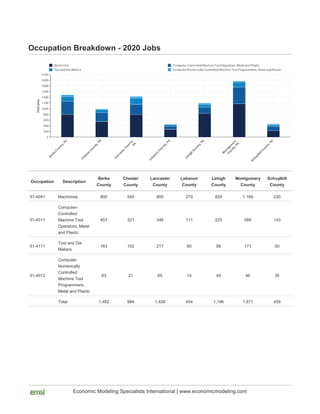
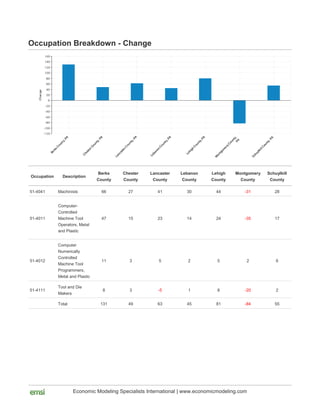
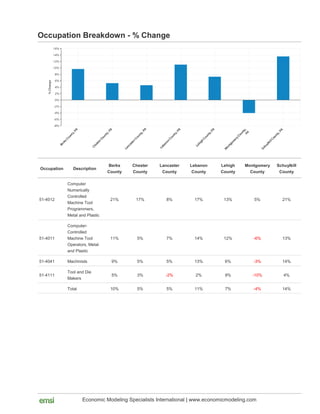
Analysis shows that the largest regional growth in precision machining occupations during the
time period 2014 through 2020 will occur in the Computer Controlled Machine Tool Operators
and Machinists jobs. The highest percentage of need in these two occupations will be in Berks,
Lebanon, and Schuylkill Counties with slight growth in three of the remaining four counties in
the region.
2014-2020 Precision Machining Growth by Occupation in Berks County
SOC Description
2014
Jobs
2020
Jobs
% Growth
51-4011
Computer-Controlled Machine Tool Operators, Metal and
Plastic
410 457 11.5%
51-4012
Computer Numerically Controlled Machine Tool
Programmers, Metal and Plastic
52 63 21%
51-4041 Machinists 734 800 9%
51-4111 Tool and Die Makers 155 163 5%
Total 1351 1483 9.7%
2014-2020 All Precision Machining Occupation Growth in 6 Surrounding Counties
Region 2014 Jobs 2020 Jobs Change % Change
Chester County, 935 984 49 5%
Lancaster County 1,365 1,428 63 5%
Lebanon County 409 454 45 11%
Lehigh County 1,115 1,196 81 7%
Montgomery
County
2,055 1,971 -84 -4%
Schuylkill County 404 459 55 14%
See Appendices A & B for employment and projected change by county and occupation.
‡ Source: EMSI data based primarily on the Quarterly Census of Employment and Wages (QCEW) from the Bureau of Labor
Statistics (BLS) and the Bureau of Economic Analysis (BEA).
5
Page5
LOCATION QUOTIENT (LQ) IS A RATIO THAT
COMPARES A REGION TO A LARGER REFERENCE
REGION ACCORDING TO SOME CHARACTERISTIC
OR ASSET. LQ IS A VALUABLE WAY OF
QUANTIFYING HOW CONCENTRATED A
PARTICULAR INDUSTRY, CLUSTER, OCCUPATION,
OR DEMOGRAPHIC GROUP IS IN A REGION AS
COMPARED TO THE NATION. IT CAN REVEAL
WHAT MAKES A PARTICULAR REGION “UNIQUE”
IN COMPARISON TO THE NATIONAL AVERAGE.
Location Quotient Breakdown - 2014 National LQ
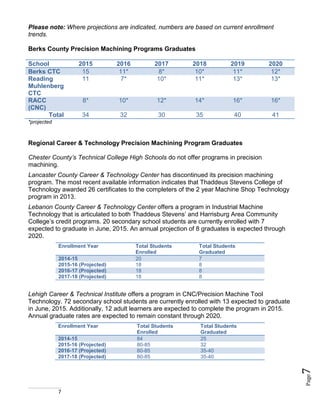
While precision machining jobs represent only 5% of total
manufacturing employment in the seven county region,
the multi-county versus national Location Quotient (LQ)
for these four occupations is 1.16 indicating a relatively
strong occupational presence within the region. The
region is historically rich with a large Metals & Metal
Fabrication manufacturing base anchored by Berks and
Lebanon Counties with a LQ for these occupations at
1.73 and Schuylkill County at a LQ of 1.69, well above
the national average, demonstrating that this remains a
key industry sector occupation.
Precision Machining LQ by County
Occupation Description
Berks
County
Chester
County
Lancaster
County
Lebanon
County
Lehigh
County
Montgomery
County
Schuylkill
County
51-4011
Computer-Controlled Machine
Tool Operators, Metal and
Plastic
2.35 1.19 1.36 1.84 1.06 1.24 2.37
51-4012
Computer Numerically
Controlled Machine Tool
Programmers, Metal and
Plastic
1.71 0.41 1.46 1.33 1.17 0.50 3.10
51-4111 Tool and Die Makers 1.59 0.69 1.68 2.01 0.85 0.69 1.60
51-4041 Machinists 1.53 0.72 1.17 1.66 1.50 0.87 1.37
Total 1.73 0.81 1.29 1.73 1.31 0.92 1.69
Source: QCEW Employees - EMSI 2014.3 Class of Worker
2. Regional Job Listings by Occupation (January, 2015)
In a 2014 survey conducted by the Greater Reading Chamber of Commerce & Industry
appraising the ease in finding required talent or skills based on a scale of 1 to 5, 1 being worst
and 5 being best, 84% of 45 responding manufacturing employers rated “Technical Positions”
with a 3 or less indicating that there is difficulty in recruitment. Precision machining was
repeatedly identified as the skill set lacking in the region.
Job postings in January, 2015 for each precision machining occupation in the region were:
 Computer Controlled Machine Tool Operators – 199 (59 unique postings*)
 CNC Machine Tool Programmers – 33 (13 unique postings*)
 Machinist – 294 (76 unique postings*)
 Tool & Die Maker – 13 (8 unique postings*)
*EMSI's de-duplicated job postings. Multiple postings that list the same job, same company, and same region are reduced to 1
unique posting.
6
Page6
3. Regional Age Demographics by Occupation
“New skilled workers will be needed not only to keep pace with expected growth in U.S.
manufacturing production but also to replace professionals who are expected to retire from the
U.S. labor force…it can be assumed that around [27% of current] machinists will retire before
2020.” †
Bureau of Labor Statistics Quarterly Census of Employment and Wages (QCEW) data
confirms that the regional workforce for these occupations is becoming increasingly lop-sided
when considering the age demographic. 56.1% of the current regional workforce occupying
precision machining occupations is 45 years or older compared to 46% of the regional
workforce in all industries.
By 2020, 26.6% of the current precision machining workforce in the seven county region will be
near, at, or above retirement age. This will result in nearly 2,000 precision machining jobs
that could be affected and in need of replacement. Add to this the 340 new jobs expected
by 2020 and an effective succession of 32% of the regional precision machining workforce will
be required. The critical need for an expanded pipeline is evident.
Age 2014 Jobs
2014
Percent
● 14-18 39 0.5%
● 19-24 539 7.1%
● 25-34 1,255 16.4%
● 35-44 1,520 19.9%
● 45-54 2,249 29.5%
● 55-64 1,637 21.4%
● 65+ 396 5.2%
Total 7,635
† Source: Excerpts from “The U.S. Skills Gap: Could It Threaten a Manufacturing Renaissance?” H. Sirkin, M. Zinser, & J. Rose. The Boston
Consulting Group.
4. Pipeline
In September, 2014 a survey of Berks County educational providers was conducted to gauge
the enrollment in precision machining programs. According to the two Berks County Career &
Technology Centers, 68 adult and secondary school students are currently enrolled with 26
due to graduate by June, 2015.
Reading Area Community College (RACC) reports graduating on average 20 CNC Operator
Certificate program completers annually but this number has fluctuated based on
unemployment levels and financial aid availability. Future numbers could be negatively
impacted by the lack of subsidizing grant funds and company tuition assistance.
7
Page7
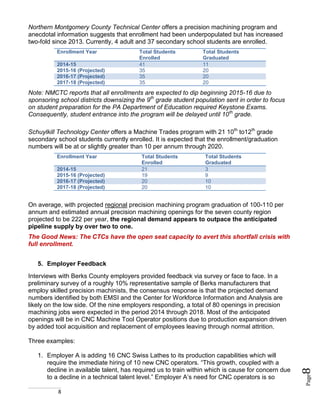
Please note: Where projections are indicated, numbers are based on current enrollment
trends.
Berks County Precision Machining Programs Graduates
School 2015 2016 2017 2018 2019 2020
Berks CTC 15 11* 8* 10* 11* 12*
Reading
Muhlenberg
CTC
11 7* 10* 11* 13* 13*
RACC
(CNC)
8* 10* 12* 14* 16* 16*
Total 34 32 30 35 40 41
*projected
Regional Career & Technology Precision Machining Program Graduates
Chester County’s Technical College High Schools do not offer programs in precision
machining.
Lancaster County Career & Technology Center has discontinued its precision machining
program. The most recent available information indicates that Thaddeus Stevens College of
Technology awarded 26 certificates to the completers of the 2 year Machine Shop Technology
program in 2013.
Lebanon County Career & Technology Center offers a program in Industrial Machine
Technology that is articulated to both Thaddeus Stevens’ and Harrisburg Area Community
College’s credit programs. 20 secondary school students are currently enrolled with 7
expected to graduate in June, 2015. An annual projection of 8 graduates is expected through
2020.
Enrollment Year Total Students
Enrolled
Total Students
Graduated
2014-15 20 7
2015-16 (Projected) 18 8
2016-17 (Projected) 18 8
2017-18 (Projected) 18 8
Lehigh Career & Technical Institute offers a program in CNC/Precision Machine Tool
Technology. 72 secondary school students are currently enrolled with 13 expected to graduate
in June, 2015. Additionally, 12 adult learners are expected to complete the program in 2015.
Annual graduate rates are expected to remain constant through 2020.
Enrollment Year Total Students
Enrolled
Total Students
Graduated
2014-15 84 25
2015-16 (Projected) 80-85 32
2016-17 (Projected) 80-85 35-40
2017-18 (Projected) 80-85 35-40
8
Page8
Northern Montgomery County Technical Center offers a precision machining program and
anecdotal information suggests that enrollment had been underpopulated but has increased
two-fold since 2013. Currently, 4 adult and 37 secondary school students are enrolled.
Enrollment Year Total Students
Enrolled
Total Students
Graduated
2014-15 41 11
2015-16 (Projected) 35 20
2016-17 (Projected) 35 20
2017-18 (Projected) 35 20
Note: NMCTC reports that all enrollments are expected to dip beginning 2015-16 due to
sponsoring school districts downsizing the 9th
grade student population sent in order to focus
on student preparation for the PA Department of Education required Keystone Exams.
Consequently, student entrance into the program will be delayed until 10th
grade.
Schuylkill Technology Center offers a Machine Trades program with 21 10th
to12th
grade
secondary school students currently enrolled. It is expected that the enrollment/graduation
numbers will be at or slightly greater than 10 per annum through 2020.
Enrollment Year Total Students
Enrolled
Total Students
Graduated
2014-15 21 3
2015-16 (Projected) 19 9
2016-17 (Projected) 20 10
2017-18 (Projected) 20 10
On average, with projected regional precision machining program graduation of 100-110 per
annum and estimated annual precision machining openings for the seven county region
projected to be 222 per year, the regional demand appears to outpace the anticipated
pipeline supply by over two to one.
The Good News: The CTCs have the open seat capacity to avert this shortfall crisis with
full enrollment.
5. Employer Feedback
Interviews with Berks County employers provided feedback via survey or face to face. In a
preliminary survey of a roughly 10% representative sample of Berks manufacturers that
employ skilled precision machinists, the consensus response is that the projected demand
numbers identified by both EMSI and the Center for Workforce Information and Analysis are
likely on the low side. Of the nine employers responding, a total of 80 openings in precision
machining jobs were expected in the period 2014 through 2018. Most of the anticipated
openings will be in CNC Machine Tool Operator positions due to production expansion driven
by added tool acquisition and replacement of employees leaving through normal attrition.
Three examples:
1. Employer A is adding 16 CNC Swiss Lathes to its production capabilities which will
require the immediate hiring of 10 new CNC operators. “This growth, coupled with a
decline in available talent, has required us to train within which is cause for concern due
to a decline in a technical talent level.” Employer A’s need for CNC operators is so
9
Page9
immediate that it has relaxed a corporate recruiting policy mandating 3+ years of
experience as a requirement for hiring consideration.
2. Employer B is experiencing rapid growth in new markets for its products that is forcing
the small 55 employee company to expand its precision machinist employment from 28
CNC operators and machinists in late 2014 to 60 by the end of 2016.
3. Employer C (50+ employees) states “Month long recruiting produces very few
candidates and most lack the needed skills. Mean age is 47 years old. Anticipate future
openings based on retirements, but even more based on future growth opportunities.”
Aggregated anecdotal opinion by the nine respondents is that the Berks County CTCs cannot
support employer demand due to enrollment challenges. Completers are being recruited for
open positions as soon as the students graduate and many employers are left to recruit
outside the region, lure incumbents from colleagues, settle for less qualified candidates, or
have positions go unfilled for extended periods.
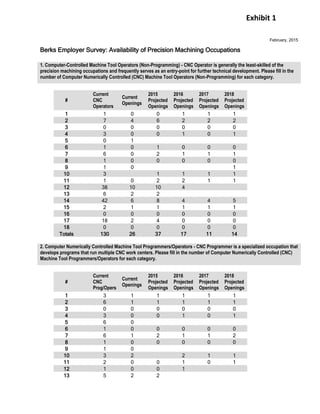
In early 2015, the Berks WIB/Chamber of Commerce co-sponsored a broader Precision
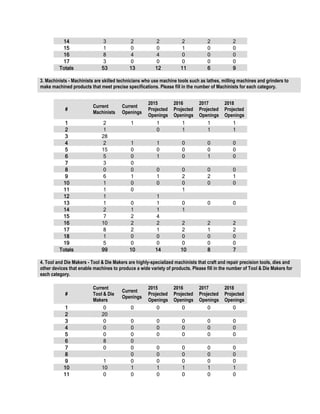
Machining employer survey (see Exhibit 1) which showed:
 84% of Berks employers responding indicated that the projected pipeline for precision
machining occupations will not support their needs during the next 4-5 years.
 58.8% responded that anticipated openings will be due to replacement while 76.5%
indicated that anticipated openings will also be due to new hires to support production
growth in the same 4-5 year period.
 Responses confirm the age demographics identified by our research, with respondents
indicating 27% of their current machining employees occupy the 55-64 year old average
age category.
6. Conclusion
Our investigation confirms that current precision
machining skills shortages will continue to grow for
Berks and the surrounding region through 2020. This
worsening shortfall carries a significant risk to the
success of a key manufacturing sector in the region.
The economic consequences of failing to find
effective solutions are magnified by the concentration
of machining employment in the seven county
regional manufacturing sector, and the primary
importance of this sector to our regional economy.
Employers unable to recruit and develop the
necessary talent will forfeit the opportunity for growth
in customer orders or not receive appropriate return
on investment.
“The U.S. high-skill manufacturing
workforce is concentrated within a
handful of professionals: 90 percent
include only ten types of workers. The top
five – machinists, welders, industrial-
machinery mechanics, industrial
engineers, and operators of computer-
controlled machine tool – account for two
thirds of skilled manufacturing work.
Although there is limited evidence of a
skills crisis today, we believe that long-
term concerns…could be more serious – if
companies do not do more to develop
future talent. “ †
† Source: Excerpts from “The U.S. Skills Gap: Could It
Threaten a Manufacturing Renaissance?” H. Sirkin,
M. Zinser, & J. Rose. The Boston Consulting Group.
10
Page10
The data contained in this document supports the following key findings:
 Workforce and economic development agencies must continuously and systematically
analyze the availability of key manufacturing skills in the region by engaging the
involvement and input of employers through Manufacturing Sector Industry
Partnerships.
 An insufficient regional pipeline exists to fill current openings and future replacement
openings for precision machining occupations.
 While the region is moderately well-off in training programs and providers, enrollment
challenges and method of delivery flexibility issues exist with regard to quality and
quantity. Solutions should be driven by the following…
o Development of a more cohesive employer/educator involvement in career
promotion to fill current open capacity with more and better matched
students/trainees.
o Development of alternative training solutions, such as shorter-term training
leading to NIMS credentialing, hybrid educational systems (technical academies),
and apprenticeships, will be required.
 Companies, large and small, need to become more proactive in addressing skills gaps
and planning for future HR needs. A return to the historical practice of investing in
internal training in order to build the worker competencies that are required to remain
competitive AND match younger talent with experienced employees is needed.
Failure to take immediate steps to initiate long-term solutions will result in a further widening of
the critical skills hiring gap and threaten the region’s existing manufacturer’s capability to
compete and expand. Economic development in this manufacturing sector will stagnate as
potential US and international companies will consider the region as unappealing talent-wise.
Why Focus on Precision Machining Careers?
These professions are consistently identified by the PA Dept. of Labor & Industry as “High
Priority Occupations” which are in demand by employers, have higher skill needs, and provide
family sustaining wages.
As this report points out, employment opportunities for new entrants into precision machining
occupations are evident. Many employers are recruiting candidates directly from the CTC and
RACC programs as they graduate and are willing to provide on the job upskilling immediately
upon hiring.
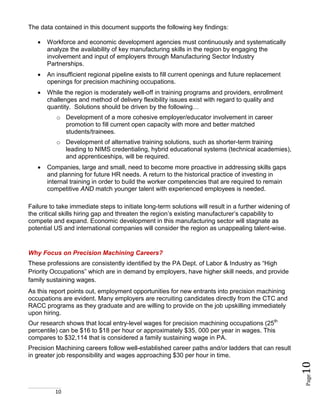
Our research shows that local entry-level wages for precision machining occupations (25th
percentile) can be $16 to $18 per hour or approximately $35, 000 per year in wages. This
compares to $32,114 that is considered a family sustaining wage in PA.
Precision Machining careers follow well-established career paths and/or ladders that can result
in greater job responsibility and wages approaching $30 per hour in time.
11
Page11
7. Recent Actions and Next Steps to Engage Employers in Cooperative Solutions
Individual employers in the region have not been successful in meeting their needs for skilled
precision machining talent on their own and are unlikely to do so in the near future. The Berks
Advanced Materials/Diversified Manufacturing Industry Partnership (AMDM IP) is well
positioned to assist employers in coming together to work on cooperative solutions.
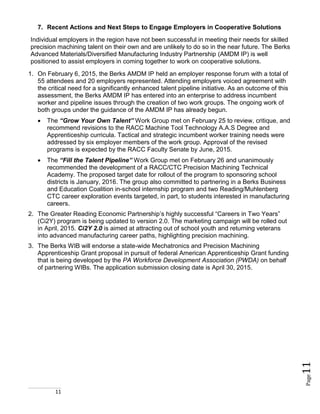
1. On February 6, 2015, the Berks AMDM IP held an employer response forum with a total of
55 attendees and 20 employers represented. Attending employers voiced agreement with
the critical need for a significantly enhanced talent pipeline initiative. As an outcome of this
assessment, the Berks AMDM IP has entered into an enterprise to address incumbent
worker and pipeline issues through the creation of two work groups. The ongoing work of
both groups under the guidance of the AMDM IP has already begun.
 The “Grow Your Own Talent” Work Group met on February 25 to review, critique, and
recommend revisions to the RACC Machine Tool Technology A.A.S Degree and
Apprenticeship curricula. Tactical and strategic incumbent worker training needs were
addressed by six employer members of the work group. Approval of the revised
programs is expected by the RACC Faculty Senate by June, 2015.
 The “Fill the Talent Pipeline” Work Group met on February 26 and unanimously
recommended the development of a RACC/CTC Precision Machining Technical
Academy. The proposed target date for rollout of the program to sponsoring school
districts is January, 2016. The group also committed to partnering in a Berks Business
and Education Coalition in-school internship program and two Reading/Muhlenberg
CTC career exploration events targeted, in part, to students interested in manufacturing
careers.
2. The Greater Reading Economic Partnership’s highly successful “Careers in Two Years”
(Ci2Y) program is being updated to version 2.0. The marketing campaign will be rolled out
in April, 2015. Ci2Y 2.0 is aimed at attracting out of school youth and returning veterans
into advanced manufacturing career paths, highlighting precision machining.
3. The Berks WIB will endorse a state-wide Mechatronics and Precision Machining
Apprenticeship Grant proposal in pursuit of federal American Apprenticeship Grant funding
that is being developed by the PA Workforce Development Association (PWDA) on behalf
of partnering WIBs. The application submission closing date is April 30, 2015.
12
Page12
APPENDIX A
The following tables show employment and projected change by county and
occupation…
Computer Controlled Machine Tool Operator (SOC 51- 4011)
County County Name 2014 Jobs 2020 Jobs
2014 - 2020
Change
2014 - 2020
% Change
42091 Montgomery County, PA 620 585 -35 -6%
42011 Berks County, PA 410 457 47 11%
42071 Lancaster County, PA 323 346 23 7%
42029 Chester County, PA 306 321 15 5%
42077 Lehigh County, PA 201 225 24 12%
42107 Schuylkill County, PA 126 143 17 13%
42075 Lebanon County, PA 97 111 14 14%
2,083 2,187 104 5%
CNC Machine Tool Programmers (SOC 51- 4012)
County County Name 2014 Jobs 2020 Jobs
2014 - 2020
Change
2014 - 2020
% Change
42071 Lancaster County, PA 60 65 5 8%
42011 Berks County, PA 52 63 11 21%
42091 Montgomery County, PA 44 46 2 5%
42077 Lehigh County, PA 39 44 5 13%
42107 Schuylkill County, PA 29 35 6 21%
42029 Chester County, PA 18 21 3 17%
42075 Lebanon County, PA 12 14 2 17%
254 288 34 13%
13
Page13
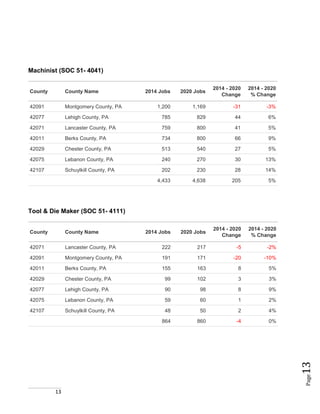
Machinist (SOC 51- 4041)
County County Name 2014 Jobs 2020 Jobs
2014 - 2020
Change
2014 - 2020
% Change
42091 Montgomery County, PA 1,200 1,169 -31 -3%
42077 Lehigh County, PA 785 829 44 6%
42071 Lancaster County, PA 759 800 41 5%
42011 Berks County, PA 734 800 66 9%
42029 Chester County, PA 513 540 27 5%
42075 Lebanon County, PA 240 270 30 13%
42107 Schuylkill County, PA 202 230 28 14%
4,433 4,638 205 5%
Tool & Die Maker (SOC 51- 4111)
County County Name 2014 Jobs 2020 Jobs
2014 - 2020
Change
2014 - 2020
% Change
42071 Lancaster County, PA 222 217 -5 -2%
42091 Montgomery County, PA 191 171 -20 -10%
42011 Berks County, PA 155 163 8 5%
42029 Chester County, PA 99 102 3 3%
42077 Lehigh County, PA 90 98 8 9%
42075 Lebanon County, PA 59 60 1 2%
42107 Schuylkill County, PA 48 50 2 4%
864 860 -4 0%
14
Page14
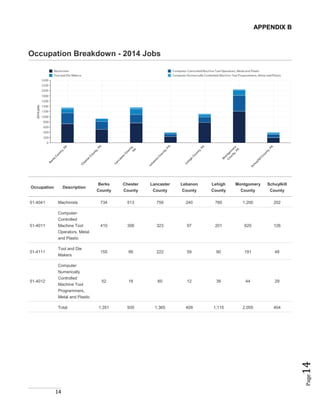
APPENDIX B
Occupation Breakdown - 2014 Jobs
Occupation Description
Berks
County
Chester
County
Lancaster
County
Lebanon
County
Lehigh
County
Montgomery
County
Schuylkill
County
51-4041 Machinists 734 513 759 240 785 1,200 202
51-4011
Computer-
Controlled
Machine Tool
Operators, Metal
and Plastic
410 306 323 97 201 620 126
51-4111
Tool and Die
Makers
155 99 222 59 90 191 48
51-4012
Computer
Numerically
Controlled
Machine Tool
Programmers,
Metal and Plastic
52 18 60 12 39 44 29
Total 1,351 935 1,365 409 1,115 2,055 404
Economic Modeling Specialists International | www.economicmodeling.com
Occupation Description
Berks
County
Chester
County
Lancaster
County
Lebanon
County
Lehigh
County
Montgomery
County
Schuylkill
County
51-4041 Machinists 800 540 800 270 829 1,169 230
51-4011
Computer-
Controlled
Machine Tool
Operators, Metal
and Plastic
457 321 346 111 225 585 143
51-4111
Tool and Die
Makers
163 102 217 60 98 171 50
51-4012
Computer
Numerically
Controlled
Machine Tool
Programmers,
Metal and Plastic
63 21 65 14 44 46 35
Total 1,482 984 1,428 454 1,196 1,971 459
Occupation Breakdown - 2020 Jobs
Economic Modeling Specialists International | www.economicmodeling.com
Occupation Description
Berks
County
Chester
County
Lancaster
County
Lebanon
County
Lehigh
County
Montgomery
County
Schuylkill
County
51-4041 Machinists 66 27 41 30 44 -31 28
51-4011
Computer-
Controlled
Machine Tool
Operators, Metal
and Plastic
47 15 23 14 24 -35 17
51-4012
Computer
Numerically
Controlled
Machine Tool
Programmers,
Metal and Plastic
11 3 5 2 5 2 6
51-4111
Tool and Die
Makers
8 3 -5 1 8 -20 2
Total 131 49 63 45 81 -84 55
Occupation Breakdown - Change
Economic Modeling Specialists International | www.economicmodeling.com
Occupation Description
Berks
County
Chester
County
Lancaster
County
Lebanon
County
Lehigh
County
Montgomery
County
Schuylkill
County
51-4012
Computer
Numerically
Controlled
Machine Tool
Programmers,
Metal and Plastic
21% 17% 8% 17% 13% 5% 21%
51-4011
Computer-
Controlled
Machine Tool
Operators, Metal
and Plastic
11% 5% 7% 14% 12% -6% 13%
51-4041 Machinists 9% 5% 5% 13% 6% -3% 14%
51-4111
Tool and Die
Makers
5% 3% -2% 2% 9% -10% 4%
Total 10% 5% 5% 11% 7% -4% 14%
Occupation Breakdown - % Change
Berks Employer Survey: Availability of Precision Machining Occupations
February, 2015
1. Computer-Controlled Machine Tool Operators (Non-Programming) - CNC Operator is generally the least-skilled of the
precision machining occupations and frequently serves as an entry-point for further technical development. Please fill in the
number of Computer Numerically Controlled (CNC) Machine Tool Operators (Non-Programming) for each category.
#
Current
CNC
Operators
Current
Openings
2015
Projected
Openings
2016
Projected
Openings
2017
Projected
Openings
2018
Projected
Openings
1 1 0 0 1 1 1
2 7 4 6 2 2 2
3 0 0 0 0 0 0
4 3 0 0 1 0 1
5 0 1
6 1 0 1 0 0 0
7 6 0 2 1 1 1
8 1 0 0 0 0 0
9 1 0 1
10 3 1 1 1 1
11 1 0 2 2 1 1
12 38 10 10 4
13 6 2 2
14 42 6 8 4 4 5
15 2 1 1 1 1 1
16 0 0 0 0 0 0
17 18 2 4 0 0 0
18 0 0 0 0 0 0
Totals 130 26 37 17 11 14
2. Computer Numerically Controlled Machine Tool Programmers/Operators - CNC Programmer is a specialized occupation that
develops programs that run multiple CNC work centers. Please fill in the number of Computer Numerically Controlled (CNC)
Machine Tool Programmers/Operators for each category.
#
Current
CNC
Prog/Opers
Current
Openings
2015
Projected
Openings
2016
Projected
Openings
2017
Projected
Openings
2018
Projected
Openings
1 3 1 1 1 1 1
2 6 1 1 1 1 1
3 0 0 0 0 0 0
4 3 0 0 1 0 1
5 6 0
6 1 0 0 0 0 0
7 6 1 2 1 1 2
8 1 0 0 0 0 0
9 1 0
10 3 2 2 1 1
11 2 0 0 1 0 1
12 1 0 0 1
13 5 2 2
Exhibit 1
14 3 2 2 2 2 2
15 1 0 0 1 0 0
16 8 4 4 0 0 0
17 3 0 0 0 0 0
Totals 53 13 12 11 6 9
3. Machinists - Machinists are skilled technicians who use machine tools such as lathes, milling machines and grinders to
make machined products that meet precise specifications. Please fill in the number of Machinists for each category.
#
Current
Machinists
Current
Openings
2015
Projected
Openings
2016
Projected
Openings
2017
Projected
Openings
2018
Projected
Openings
1 2 1 1 1 1 1
2 1 0 1 1 1
3 28
4 2 1 1 0 0 0
5 15 0 0 0 0 0
6 5 0 1 0 1 0
7 3 0
8 0 0 0 0 0 0
9 6 1 1 2 2 1
10 1 0 0 0 0 0
11 1 0 1
12 1 1
13 1 0 1 0 0 0
14 2 1 1 1
15 7 2 4
16 10 2 2 2 2 2
17 8 2 1 2 1 2
18 1 0 0 0 0 0
19 5 0 0 0 0 0
Totals 99 10 14 10 8 7
4. Tool and Die Makers - Tool & Die Makers are highly-specialized machinists that craft and repair precision tools, dies and
other devices that enable machines to produce a wide variety of products. Please fill in the number of Tool & Die Makers for
each category.
#
Current
Tool & Die
Makers
Current
Openings
2015
Projected
Openings
2016
Projected
Openings
2017
Projected
Openings
2018
Projected
Openings
1 0 0 0 0 0 0
2 20
3 0 0 0 0 0 0
4 0 0 0 0 0 0
5 0 0 0 0 0 0
6 8 0
7 0 0 0 0 0 0
8 0 0 0 0 0
9 1 0 0 0 0 0
10 10 1 1 1 1 1
11 0 0 0 0 0 0
12 0 0 0 0 0 0
13 0 0 0 0 0 0
14 0 0 0 0 0 0
15 10 0 1 3 3 3
16 3 1 1 1 1 1
17 0 0 0 0 0 0
18 0 0 0 0 0 0
Totals 52 2 3 5 5 5
5. Do you feel the projected pipeline for Precision Machining Occupations will support your need during the next 4-5 years?
Answer
Options
Response
Percent
Response
Count
Yes 26.3% 5
No 84.2% 16
answered question 19
skipped question 1
6. What is the average age of your machining employees?
Answer
Options
Response
Percent
Response
Count
under 44 18.2% 2
45 - 54 63.6% 7
55 - 64 27.3% 3
over 65 0.0% 0
answered question 11
skipped question 9
7. Do you anticipate precision machining positions to open within your company due to replacement openings or the need for
new hires to support production growth?
Answer
Options
Response
Percent
Response
Count
Replacement
Openings
58.8% 10
New Hires 76.5% 13
Other (please specify) 2
answered question 17
skipped question 3
# Other (please specify)
1 Don't anticipate any openings in the near future
2 Workforce getting too old
8. Please share any anecdotal information you may have on the recruitment issues you have faced (or anticipate facing) in
new hire precision machinist recruitment and/or forecasted replacement due to retirements.
# Response Text
1 Experienced people have positions and are difficult to find. Student co-ops have not been
prepared for the world of work in soft skills or academics.
2 Cannot find people who possess the skills we need for large fabrications. Have hired two vo-
tech graduates but have to spend time training.
3 We usually have either Coops or Tech students entering our company.
4 Just hired a part-time machinist in 2014. Becoming more difficult to find skilled individuals to fill
these positions.
5 Have had problem in the recent past recruiting qualified people. As a result we've had a couple
apprentices who started with no prior experience in the trade. Would like to see a more
coherent apprenticeship program. Current program has some gaps and should be updated.
6 We need a person to be able to be given a job (material, program, tool list) on set up and run on
CNC equipment. Then drill & polish ready for production. 46 years (mean age). No
(replacement openings). It would be nice to have a new person in the shop since at times (very
many) we are busy.
7 Month long recruiting produces very few candidates and most lack the needed skills. Mean age
is 47 years old. Anticipate future openings based on retirements, but evn more based on future
growth opportunities
8 At this point, as I have stated in in survey, there is no projected growth. Having said that, we are
in the early stages of expansion in terms of adding a second CNC. Our initial plan is to run 2
CNCs with one operator. Obviously, workload could change this requirement in terms of
manpower.
9 We have an even greater need for Machine Rebuilders, who in our shop, not only need to know
how to operate various machine tools, but also understand the intricacies of how machine tools
work, how to troubleshoot problems, how to service those problems, whether through repair,
rebuilding, retrofitting, etc. The skills learned in CTC Machine Shop Technology/Precision
Machining programs are essential and foundational to our work. Our company is also engaged
in production/manufacturing work requiring precision machining, but this comprises
approximately 50% of our overall work volume. Note: Within the next few years, we anticipate
the retirement of at least 2 veteran rebuilders. Replacing that skill and knowledge is impossible;
it is acquired and intuitive. These veterans tell us it takes a minimum of 5-7 years to approach
the levels of experience and knowledge for basic competency. The best candidates we have
found recently have been graduates of the BCTC Computerized/Precision Machining
Technology program.
10 Every time we advertise for qualified machinist the people that answer are warehouse workers
and forklift operators. Finding people with a basic understanding of machining and the passion
for the industry (is difficult).
11 I have employed students from north Montco in the past. My involvement with them is the
program needs to better prepare students for the workplace. My son, currently a Senior at
BCTC, has worked for me for the past two summers. I am impressed with how well prepared he
was after only his Junior year. I expect his Senior year to well prepare him for CNC experience.
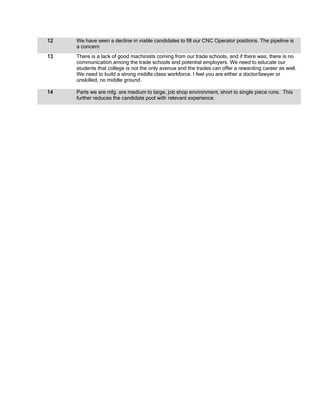
12 We have seen a decline in viable candidates to fill our CNC Operator positions. The pipeline is
a concern
13 There is a lack of good machinists coming from our trade schools, and if there was, there is no
communication among the trade schools and potential employers. We need to educate our
students that college is not the only avenue and the trades can offer a rewarding career as well.
We need to build a strong middle class workforce. I feel you are either a doctor/lawyer or
unskilled, no middle ground.
14 Parts we are mfg. are medium to large, job shop environment, short to single piece runs. This
further reduces the candidate pool with relevant experience.

Precision Machining Abstract_Final

  • 1.
    Berks County WorkforceInvestment Board 1920 Kutztown Road, Suite G Reading, PA 19604 Michael J. Rowley Daniel W. Fogarty Chair Director/COO Prepared by Rory P. Stevenson Manager, Planning & Partnership Development March 12, 2015 PRECISION MACHINING OCCUPATIONS IN BERKS AND SURROUNDING COUNTIES
  • 2.
    2 Page2 Contents 1. Summary Page 3 2.Regional Employment Trends Page 4 3. Regional Job Listings by Occupation Page 5 4. Regional Age Demographics by Occupation Page 6 5. Pipeline Page 6 6. Employer Feedback Page 8 7. Conclusion Page 9 8. Recent Actions and Next Steps Page 11 Appendix A  Employment and Projected Change by County and Occupation Appendix B  Occupation Breakdown by County and Occupation 2014 vs. 2020 Exhibit 1  Berks County Precision Machining Occupations Employer Survey Results
  • 3.
    3 Page3 Most precision machining occupationsare found in manufacturing firms where the personnel are responsible for performing highly diversified and precise work in the manufacture of parts and items from castings, forgings, and other raw stocks made of various metals, metal alloys, plastics and other materials. They are also often responsible for the machining operations required in the repair of such items. Historically, this work has been accomplished through the skilled use of manual machine tools, but it has become the norm in precision machining occupations to employ highly-sophisticated computer numeric control (CNC) work centers that control the machine tools and attachments. In addition, the skills, knowledge and abilities of the employees in these occupations are critical to the continuous improvement of enterprise- wide productivity, quality, safety and cost metrics. Precision machine workers have been most often referred to as machinists, tool & die makers, CNC operators or CNC programmers. However, advances in technology are leading some organizations to merge the CNC Programmer, Machinist and CNC Operator roles into a single position referred to as CNC Machinist. Computer-Controlled Machine Tool Operators, Metal & Plastic, Computer Numerically Controlled Machine Tool Programmers, Metal & Plastic, and Machinists are consistently identified as High Priority Occupations by the PA Department of Labor & Industry in Berks County and state-wide. Tool & Die Maker jobs have dwindled due to the incorporation into other machining capabilities but are included here as a traditional machining occupation. Center for Advanced Manufacturing Careers Precision Machining Occupations – General Description, rev. 3/11/2011 Summary: Precision Machining was identified as one of Pennsylvania’s top “occupational growth areas” in the Center for Advanced Manufacturing Careers Analysis Report, November, 2010. In September, 2014, the Berks County Workforce Investment Board determined to investigate if this was still the case in Berks and the surrounding counties of Chester, Lancaster, Lebanon, Lehigh, Montgomery, and Schuylkill. The following narrative will demonstrate that the critical need for these skilled occupations exists and a long term strategy of expanding a “talent pipeline’ to meet this need is paramount to the sustainability of a key regional manufacturing sector. Increasingly, our industry partners are expressing a need for skilled Machinists and Computer Numerically Controlled (CNC) Machine Operators, ideally, with programming knowledge. Finding qualified candidates for these key positions is a challenge for any manufacturing organization. The shortfall in capable Machinist and CNC Operator applicants creates even more challenges when employers look to hire workers proficient, specialized, and ready to plug in “out of the gate.” Paradoxically, area Career and Technology Centers and other educational providers continue to struggle with enrollment at 50% of enrollment capacity or less. Traditional “machinist” training programs can take up to 2 to 4 years to complete. The primary employers of these skilled occupations are Machine Shops, Primary Battery Manufacturers, and Surgical and Medical Instrument manufacturing. This report will present statistics on the current state of regional precision machining occupations, information on the shortfall, and potential cost-effective strategies with long-term solutions.
  • 4.
    4 Page4 1. Regional EmploymentTrends: Data obtained from Economic Modeling Specialists International (EMSI) indicates that the need for qualified Precision Machinists is on the rise in new and replacement job employment opportunities.‡ By 2020, Berks County and the 6 surrounding counties will account for almost 24% of the Commonwealth of Pennsylvania’s employment in the four precision machining occupations. Analysis shows that the largest regional growth in precision machining occupations during the time period 2014 through 2020 will occur in the Computer Controlled Machine Tool Operators and Machinists jobs. The highest percentage of need in these two occupations will be in Berks, Lebanon, and Schuylkill Counties with slight growth in three of the remaining four counties in the region. 2014-2020 Precision Machining Growth by Occupation in Berks County SOC Description 2014 Jobs 2020 Jobs % Growth 51-4011 Computer-Controlled Machine Tool Operators, Metal and Plastic 410 457 11.5% 51-4012 Computer Numerically Controlled Machine Tool Programmers, Metal and Plastic 52 63 21% 51-4041 Machinists 734 800 9% 51-4111 Tool and Die Makers 155 163 5% Total 1351 1483 9.7% 2014-2020 All Precision Machining Occupation Growth in 6 Surrounding Counties Region 2014 Jobs 2020 Jobs Change % Change Chester County, 935 984 49 5% Lancaster County 1,365 1,428 63 5% Lebanon County 409 454 45 11% Lehigh County 1,115 1,196 81 7% Montgomery County 2,055 1,971 -84 -4% Schuylkill County 404 459 55 14% See Appendices A & B for employment and projected change by county and occupation. ‡ Source: EMSI data based primarily on the Quarterly Census of Employment and Wages (QCEW) from the Bureau of Labor Statistics (BLS) and the Bureau of Economic Analysis (BEA).
  • 5.
    5 Page5 LOCATION QUOTIENT (LQ)IS A RATIO THAT COMPARES A REGION TO A LARGER REFERENCE REGION ACCORDING TO SOME CHARACTERISTIC OR ASSET. LQ IS A VALUABLE WAY OF QUANTIFYING HOW CONCENTRATED A PARTICULAR INDUSTRY, CLUSTER, OCCUPATION, OR DEMOGRAPHIC GROUP IS IN A REGION AS COMPARED TO THE NATION. IT CAN REVEAL WHAT MAKES A PARTICULAR REGION “UNIQUE” IN COMPARISON TO THE NATIONAL AVERAGE. Location Quotient Breakdown - 2014 National LQ While precision machining jobs represent only 5% of total manufacturing employment in the seven county region, the multi-county versus national Location Quotient (LQ) for these four occupations is 1.16 indicating a relatively strong occupational presence within the region. The region is historically rich with a large Metals & Metal Fabrication manufacturing base anchored by Berks and Lebanon Counties with a LQ for these occupations at 1.73 and Schuylkill County at a LQ of 1.69, well above the national average, demonstrating that this remains a key industry sector occupation. Precision Machining LQ by County Occupation Description Berks County Chester County Lancaster County Lebanon County Lehigh County Montgomery County Schuylkill County 51-4011 Computer-Controlled Machine Tool Operators, Metal and Plastic 2.35 1.19 1.36 1.84 1.06 1.24 2.37 51-4012 Computer Numerically Controlled Machine Tool Programmers, Metal and Plastic 1.71 0.41 1.46 1.33 1.17 0.50 3.10 51-4111 Tool and Die Makers 1.59 0.69 1.68 2.01 0.85 0.69 1.60 51-4041 Machinists 1.53 0.72 1.17 1.66 1.50 0.87 1.37 Total 1.73 0.81 1.29 1.73 1.31 0.92 1.69 Source: QCEW Employees - EMSI 2014.3 Class of Worker 2. Regional Job Listings by Occupation (January, 2015) In a 2014 survey conducted by the Greater Reading Chamber of Commerce & Industry appraising the ease in finding required talent or skills based on a scale of 1 to 5, 1 being worst and 5 being best, 84% of 45 responding manufacturing employers rated “Technical Positions” with a 3 or less indicating that there is difficulty in recruitment. Precision machining was repeatedly identified as the skill set lacking in the region. Job postings in January, 2015 for each precision machining occupation in the region were:  Computer Controlled Machine Tool Operators – 199 (59 unique postings*)  CNC Machine Tool Programmers – 33 (13 unique postings*)  Machinist – 294 (76 unique postings*)  Tool & Die Maker – 13 (8 unique postings*) *EMSI's de-duplicated job postings. Multiple postings that list the same job, same company, and same region are reduced to 1 unique posting.
  • 6.
    6 Page6 3. Regional AgeDemographics by Occupation “New skilled workers will be needed not only to keep pace with expected growth in U.S. manufacturing production but also to replace professionals who are expected to retire from the U.S. labor force…it can be assumed that around [27% of current] machinists will retire before 2020.” † Bureau of Labor Statistics Quarterly Census of Employment and Wages (QCEW) data confirms that the regional workforce for these occupations is becoming increasingly lop-sided when considering the age demographic. 56.1% of the current regional workforce occupying precision machining occupations is 45 years or older compared to 46% of the regional workforce in all industries. By 2020, 26.6% of the current precision machining workforce in the seven county region will be near, at, or above retirement age. This will result in nearly 2,000 precision machining jobs that could be affected and in need of replacement. Add to this the 340 new jobs expected by 2020 and an effective succession of 32% of the regional precision machining workforce will be required. The critical need for an expanded pipeline is evident. Age 2014 Jobs 2014 Percent ● 14-18 39 0.5% ● 19-24 539 7.1% ● 25-34 1,255 16.4% ● 35-44 1,520 19.9% ● 45-54 2,249 29.5% ● 55-64 1,637 21.4% ● 65+ 396 5.2% Total 7,635 † Source: Excerpts from “The U.S. Skills Gap: Could It Threaten a Manufacturing Renaissance?” H. Sirkin, M. Zinser, & J. Rose. The Boston Consulting Group. 4. Pipeline In September, 2014 a survey of Berks County educational providers was conducted to gauge the enrollment in precision machining programs. According to the two Berks County Career & Technology Centers, 68 adult and secondary school students are currently enrolled with 26 due to graduate by June, 2015. Reading Area Community College (RACC) reports graduating on average 20 CNC Operator Certificate program completers annually but this number has fluctuated based on unemployment levels and financial aid availability. Future numbers could be negatively impacted by the lack of subsidizing grant funds and company tuition assistance.
  • 7.
    7 Page7 Please note: Whereprojections are indicated, numbers are based on current enrollment trends. Berks County Precision Machining Programs Graduates School 2015 2016 2017 2018 2019 2020 Berks CTC 15 11* 8* 10* 11* 12* Reading Muhlenberg CTC 11 7* 10* 11* 13* 13* RACC (CNC) 8* 10* 12* 14* 16* 16* Total 34 32 30 35 40 41 *projected Regional Career & Technology Precision Machining Program Graduates Chester County’s Technical College High Schools do not offer programs in precision machining. Lancaster County Career & Technology Center has discontinued its precision machining program. The most recent available information indicates that Thaddeus Stevens College of Technology awarded 26 certificates to the completers of the 2 year Machine Shop Technology program in 2013. Lebanon County Career & Technology Center offers a program in Industrial Machine Technology that is articulated to both Thaddeus Stevens’ and Harrisburg Area Community College’s credit programs. 20 secondary school students are currently enrolled with 7 expected to graduate in June, 2015. An annual projection of 8 graduates is expected through 2020. Enrollment Year Total Students Enrolled Total Students Graduated 2014-15 20 7 2015-16 (Projected) 18 8 2016-17 (Projected) 18 8 2017-18 (Projected) 18 8 Lehigh Career & Technical Institute offers a program in CNC/Precision Machine Tool Technology. 72 secondary school students are currently enrolled with 13 expected to graduate in June, 2015. Additionally, 12 adult learners are expected to complete the program in 2015. Annual graduate rates are expected to remain constant through 2020. Enrollment Year Total Students Enrolled Total Students Graduated 2014-15 84 25 2015-16 (Projected) 80-85 32 2016-17 (Projected) 80-85 35-40 2017-18 (Projected) 80-85 35-40
  • 8.
    8 Page8 Northern Montgomery CountyTechnical Center offers a precision machining program and anecdotal information suggests that enrollment had been underpopulated but has increased two-fold since 2013. Currently, 4 adult and 37 secondary school students are enrolled. Enrollment Year Total Students Enrolled Total Students Graduated 2014-15 41 11 2015-16 (Projected) 35 20 2016-17 (Projected) 35 20 2017-18 (Projected) 35 20 Note: NMCTC reports that all enrollments are expected to dip beginning 2015-16 due to sponsoring school districts downsizing the 9th grade student population sent in order to focus on student preparation for the PA Department of Education required Keystone Exams. Consequently, student entrance into the program will be delayed until 10th grade. Schuylkill Technology Center offers a Machine Trades program with 21 10th to12th grade secondary school students currently enrolled. It is expected that the enrollment/graduation numbers will be at or slightly greater than 10 per annum through 2020. Enrollment Year Total Students Enrolled Total Students Graduated 2014-15 21 3 2015-16 (Projected) 19 9 2016-17 (Projected) 20 10 2017-18 (Projected) 20 10 On average, with projected regional precision machining program graduation of 100-110 per annum and estimated annual precision machining openings for the seven county region projected to be 222 per year, the regional demand appears to outpace the anticipated pipeline supply by over two to one. The Good News: The CTCs have the open seat capacity to avert this shortfall crisis with full enrollment. 5. Employer Feedback Interviews with Berks County employers provided feedback via survey or face to face. In a preliminary survey of a roughly 10% representative sample of Berks manufacturers that employ skilled precision machinists, the consensus response is that the projected demand numbers identified by both EMSI and the Center for Workforce Information and Analysis are likely on the low side. Of the nine employers responding, a total of 80 openings in precision machining jobs were expected in the period 2014 through 2018. Most of the anticipated openings will be in CNC Machine Tool Operator positions due to production expansion driven by added tool acquisition and replacement of employees leaving through normal attrition. Three examples: 1. Employer A is adding 16 CNC Swiss Lathes to its production capabilities which will require the immediate hiring of 10 new CNC operators. “This growth, coupled with a decline in available talent, has required us to train within which is cause for concern due to a decline in a technical talent level.” Employer A’s need for CNC operators is so
  • 9.
    9 Page9 immediate that ithas relaxed a corporate recruiting policy mandating 3+ years of experience as a requirement for hiring consideration. 2. Employer B is experiencing rapid growth in new markets for its products that is forcing the small 55 employee company to expand its precision machinist employment from 28 CNC operators and machinists in late 2014 to 60 by the end of 2016. 3. Employer C (50+ employees) states “Month long recruiting produces very few candidates and most lack the needed skills. Mean age is 47 years old. Anticipate future openings based on retirements, but even more based on future growth opportunities.” Aggregated anecdotal opinion by the nine respondents is that the Berks County CTCs cannot support employer demand due to enrollment challenges. Completers are being recruited for open positions as soon as the students graduate and many employers are left to recruit outside the region, lure incumbents from colleagues, settle for less qualified candidates, or have positions go unfilled for extended periods. In early 2015, the Berks WIB/Chamber of Commerce co-sponsored a broader Precision Machining employer survey (see Exhibit 1) which showed:  84% of Berks employers responding indicated that the projected pipeline for precision machining occupations will not support their needs during the next 4-5 years.  58.8% responded that anticipated openings will be due to replacement while 76.5% indicated that anticipated openings will also be due to new hires to support production growth in the same 4-5 year period.  Responses confirm the age demographics identified by our research, with respondents indicating 27% of their current machining employees occupy the 55-64 year old average age category. 6. Conclusion Our investigation confirms that current precision machining skills shortages will continue to grow for Berks and the surrounding region through 2020. This worsening shortfall carries a significant risk to the success of a key manufacturing sector in the region. The economic consequences of failing to find effective solutions are magnified by the concentration of machining employment in the seven county regional manufacturing sector, and the primary importance of this sector to our regional economy. Employers unable to recruit and develop the necessary talent will forfeit the opportunity for growth in customer orders or not receive appropriate return on investment. “The U.S. high-skill manufacturing workforce is concentrated within a handful of professionals: 90 percent include only ten types of workers. The top five – machinists, welders, industrial- machinery mechanics, industrial engineers, and operators of computer- controlled machine tool – account for two thirds of skilled manufacturing work. Although there is limited evidence of a skills crisis today, we believe that long- term concerns…could be more serious – if companies do not do more to develop future talent. “ † † Source: Excerpts from “The U.S. Skills Gap: Could It Threaten a Manufacturing Renaissance?” H. Sirkin, M. Zinser, & J. Rose. The Boston Consulting Group.
  • 10.
    10 Page10 The data containedin this document supports the following key findings:  Workforce and economic development agencies must continuously and systematically analyze the availability of key manufacturing skills in the region by engaging the involvement and input of employers through Manufacturing Sector Industry Partnerships.  An insufficient regional pipeline exists to fill current openings and future replacement openings for precision machining occupations.  While the region is moderately well-off in training programs and providers, enrollment challenges and method of delivery flexibility issues exist with regard to quality and quantity. Solutions should be driven by the following… o Development of a more cohesive employer/educator involvement in career promotion to fill current open capacity with more and better matched students/trainees. o Development of alternative training solutions, such as shorter-term training leading to NIMS credentialing, hybrid educational systems (technical academies), and apprenticeships, will be required.  Companies, large and small, need to become more proactive in addressing skills gaps and planning for future HR needs. A return to the historical practice of investing in internal training in order to build the worker competencies that are required to remain competitive AND match younger talent with experienced employees is needed. Failure to take immediate steps to initiate long-term solutions will result in a further widening of the critical skills hiring gap and threaten the region’s existing manufacturer’s capability to compete and expand. Economic development in this manufacturing sector will stagnate as potential US and international companies will consider the region as unappealing talent-wise. Why Focus on Precision Machining Careers? These professions are consistently identified by the PA Dept. of Labor & Industry as “High Priority Occupations” which are in demand by employers, have higher skill needs, and provide family sustaining wages. As this report points out, employment opportunities for new entrants into precision machining occupations are evident. Many employers are recruiting candidates directly from the CTC and RACC programs as they graduate and are willing to provide on the job upskilling immediately upon hiring. Our research shows that local entry-level wages for precision machining occupations (25th percentile) can be $16 to $18 per hour or approximately $35, 000 per year in wages. This compares to $32,114 that is considered a family sustaining wage in PA. Precision Machining careers follow well-established career paths and/or ladders that can result in greater job responsibility and wages approaching $30 per hour in time.
  • 11.
    11 Page11 7. Recent Actionsand Next Steps to Engage Employers in Cooperative Solutions Individual employers in the region have not been successful in meeting their needs for skilled precision machining talent on their own and are unlikely to do so in the near future. The Berks Advanced Materials/Diversified Manufacturing Industry Partnership (AMDM IP) is well positioned to assist employers in coming together to work on cooperative solutions. 1. On February 6, 2015, the Berks AMDM IP held an employer response forum with a total of 55 attendees and 20 employers represented. Attending employers voiced agreement with the critical need for a significantly enhanced talent pipeline initiative. As an outcome of this assessment, the Berks AMDM IP has entered into an enterprise to address incumbent worker and pipeline issues through the creation of two work groups. The ongoing work of both groups under the guidance of the AMDM IP has already begun.  The “Grow Your Own Talent” Work Group met on February 25 to review, critique, and recommend revisions to the RACC Machine Tool Technology A.A.S Degree and Apprenticeship curricula. Tactical and strategic incumbent worker training needs were addressed by six employer members of the work group. Approval of the revised programs is expected by the RACC Faculty Senate by June, 2015.  The “Fill the Talent Pipeline” Work Group met on February 26 and unanimously recommended the development of a RACC/CTC Precision Machining Technical Academy. The proposed target date for rollout of the program to sponsoring school districts is January, 2016. The group also committed to partnering in a Berks Business and Education Coalition in-school internship program and two Reading/Muhlenberg CTC career exploration events targeted, in part, to students interested in manufacturing careers. 2. The Greater Reading Economic Partnership’s highly successful “Careers in Two Years” (Ci2Y) program is being updated to version 2.0. The marketing campaign will be rolled out in April, 2015. Ci2Y 2.0 is aimed at attracting out of school youth and returning veterans into advanced manufacturing career paths, highlighting precision machining. 3. The Berks WIB will endorse a state-wide Mechatronics and Precision Machining Apprenticeship Grant proposal in pursuit of federal American Apprenticeship Grant funding that is being developed by the PA Workforce Development Association (PWDA) on behalf of partnering WIBs. The application submission closing date is April 30, 2015.
  • 12.
    12 Page12 APPENDIX A The followingtables show employment and projected change by county and occupation… Computer Controlled Machine Tool Operator (SOC 51- 4011) County County Name 2014 Jobs 2020 Jobs 2014 - 2020 Change 2014 - 2020 % Change 42091 Montgomery County, PA 620 585 -35 -6% 42011 Berks County, PA 410 457 47 11% 42071 Lancaster County, PA 323 346 23 7% 42029 Chester County, PA 306 321 15 5% 42077 Lehigh County, PA 201 225 24 12% 42107 Schuylkill County, PA 126 143 17 13% 42075 Lebanon County, PA 97 111 14 14% 2,083 2,187 104 5% CNC Machine Tool Programmers (SOC 51- 4012) County County Name 2014 Jobs 2020 Jobs 2014 - 2020 Change 2014 - 2020 % Change 42071 Lancaster County, PA 60 65 5 8% 42011 Berks County, PA 52 63 11 21% 42091 Montgomery County, PA 44 46 2 5% 42077 Lehigh County, PA 39 44 5 13% 42107 Schuylkill County, PA 29 35 6 21% 42029 Chester County, PA 18 21 3 17% 42075 Lebanon County, PA 12 14 2 17% 254 288 34 13%
  • 13.
    13 Page13 Machinist (SOC 51-4041) County County Name 2014 Jobs 2020 Jobs 2014 - 2020 Change 2014 - 2020 % Change 42091 Montgomery County, PA 1,200 1,169 -31 -3% 42077 Lehigh County, PA 785 829 44 6% 42071 Lancaster County, PA 759 800 41 5% 42011 Berks County, PA 734 800 66 9% 42029 Chester County, PA 513 540 27 5% 42075 Lebanon County, PA 240 270 30 13% 42107 Schuylkill County, PA 202 230 28 14% 4,433 4,638 205 5% Tool & Die Maker (SOC 51- 4111) County County Name 2014 Jobs 2020 Jobs 2014 - 2020 Change 2014 - 2020 % Change 42071 Lancaster County, PA 222 217 -5 -2% 42091 Montgomery County, PA 191 171 -20 -10% 42011 Berks County, PA 155 163 8 5% 42029 Chester County, PA 99 102 3 3% 42077 Lehigh County, PA 90 98 8 9% 42075 Lebanon County, PA 59 60 1 2% 42107 Schuylkill County, PA 48 50 2 4% 864 860 -4 0%
  • 14.
    14 Page14 APPENDIX B Occupation Breakdown- 2014 Jobs Occupation Description Berks County Chester County Lancaster County Lebanon County Lehigh County Montgomery County Schuylkill County 51-4041 Machinists 734 513 759 240 785 1,200 202 51-4011 Computer- Controlled Machine Tool Operators, Metal and Plastic 410 306 323 97 201 620 126 51-4111 Tool and Die Makers 155 99 222 59 90 191 48 51-4012 Computer Numerically Controlled Machine Tool Programmers, Metal and Plastic 52 18 60 12 39 44 29 Total 1,351 935 1,365 409 1,115 2,055 404
  • 15.
    Economic Modeling SpecialistsInternational | www.economicmodeling.com Occupation Description Berks County Chester County Lancaster County Lebanon County Lehigh County Montgomery County Schuylkill County 51-4041 Machinists 800 540 800 270 829 1,169 230 51-4011 Computer- Controlled Machine Tool Operators, Metal and Plastic 457 321 346 111 225 585 143 51-4111 Tool and Die Makers 163 102 217 60 98 171 50 51-4012 Computer Numerically Controlled Machine Tool Programmers, Metal and Plastic 63 21 65 14 44 46 35 Total 1,482 984 1,428 454 1,196 1,971 459 Occupation Breakdown - 2020 Jobs
  • 16.
    Economic Modeling SpecialistsInternational | www.economicmodeling.com Occupation Description Berks County Chester County Lancaster County Lebanon County Lehigh County Montgomery County Schuylkill County 51-4041 Machinists 66 27 41 30 44 -31 28 51-4011 Computer- Controlled Machine Tool Operators, Metal and Plastic 47 15 23 14 24 -35 17 51-4012 Computer Numerically Controlled Machine Tool Programmers, Metal and Plastic 11 3 5 2 5 2 6 51-4111 Tool and Die Makers 8 3 -5 1 8 -20 2 Total 131 49 63 45 81 -84 55 Occupation Breakdown - Change
  • 17.
    Economic Modeling SpecialistsInternational | www.economicmodeling.com Occupation Description Berks County Chester County Lancaster County Lebanon County Lehigh County Montgomery County Schuylkill County 51-4012 Computer Numerically Controlled Machine Tool Programmers, Metal and Plastic 21% 17% 8% 17% 13% 5% 21% 51-4011 Computer- Controlled Machine Tool Operators, Metal and Plastic 11% 5% 7% 14% 12% -6% 13% 51-4041 Machinists 9% 5% 5% 13% 6% -3% 14% 51-4111 Tool and Die Makers 5% 3% -2% 2% 9% -10% 4% Total 10% 5% 5% 11% 7% -4% 14% Occupation Breakdown - % Change
  • 18.
    Berks Employer Survey:Availability of Precision Machining Occupations February, 2015 1. Computer-Controlled Machine Tool Operators (Non-Programming) - CNC Operator is generally the least-skilled of the precision machining occupations and frequently serves as an entry-point for further technical development. Please fill in the number of Computer Numerically Controlled (CNC) Machine Tool Operators (Non-Programming) for each category. # Current CNC Operators Current Openings 2015 Projected Openings 2016 Projected Openings 2017 Projected Openings 2018 Projected Openings 1 1 0 0 1 1 1 2 7 4 6 2 2 2 3 0 0 0 0 0 0 4 3 0 0 1 0 1 5 0 1 6 1 0 1 0 0 0 7 6 0 2 1 1 1 8 1 0 0 0 0 0 9 1 0 1 10 3 1 1 1 1 11 1 0 2 2 1 1 12 38 10 10 4 13 6 2 2 14 42 6 8 4 4 5 15 2 1 1 1 1 1 16 0 0 0 0 0 0 17 18 2 4 0 0 0 18 0 0 0 0 0 0 Totals 130 26 37 17 11 14 2. Computer Numerically Controlled Machine Tool Programmers/Operators - CNC Programmer is a specialized occupation that develops programs that run multiple CNC work centers. Please fill in the number of Computer Numerically Controlled (CNC) Machine Tool Programmers/Operators for each category. # Current CNC Prog/Opers Current Openings 2015 Projected Openings 2016 Projected Openings 2017 Projected Openings 2018 Projected Openings 1 3 1 1 1 1 1 2 6 1 1 1 1 1 3 0 0 0 0 0 0 4 3 0 0 1 0 1 5 6 0 6 1 0 0 0 0 0 7 6 1 2 1 1 2 8 1 0 0 0 0 0 9 1 0 10 3 2 2 1 1 11 2 0 0 1 0 1 12 1 0 0 1 13 5 2 2 Exhibit 1
  • 19.
    14 3 22 2 2 2 15 1 0 0 1 0 0 16 8 4 4 0 0 0 17 3 0 0 0 0 0 Totals 53 13 12 11 6 9 3. Machinists - Machinists are skilled technicians who use machine tools such as lathes, milling machines and grinders to make machined products that meet precise specifications. Please fill in the number of Machinists for each category. # Current Machinists Current Openings 2015 Projected Openings 2016 Projected Openings 2017 Projected Openings 2018 Projected Openings 1 2 1 1 1 1 1 2 1 0 1 1 1 3 28 4 2 1 1 0 0 0 5 15 0 0 0 0 0 6 5 0 1 0 1 0 7 3 0 8 0 0 0 0 0 0 9 6 1 1 2 2 1 10 1 0 0 0 0 0 11 1 0 1 12 1 1 13 1 0 1 0 0 0 14 2 1 1 1 15 7 2 4 16 10 2 2 2 2 2 17 8 2 1 2 1 2 18 1 0 0 0 0 0 19 5 0 0 0 0 0 Totals 99 10 14 10 8 7 4. Tool and Die Makers - Tool & Die Makers are highly-specialized machinists that craft and repair precision tools, dies and other devices that enable machines to produce a wide variety of products. Please fill in the number of Tool & Die Makers for each category. # Current Tool & Die Makers Current Openings 2015 Projected Openings 2016 Projected Openings 2017 Projected Openings 2018 Projected Openings 1 0 0 0 0 0 0 2 20 3 0 0 0 0 0 0 4 0 0 0 0 0 0 5 0 0 0 0 0 0 6 8 0 7 0 0 0 0 0 0 8 0 0 0 0 0 9 1 0 0 0 0 0 10 10 1 1 1 1 1 11 0 0 0 0 0 0
  • 20.
    12 0 00 0 0 0 13 0 0 0 0 0 0 14 0 0 0 0 0 0 15 10 0 1 3 3 3 16 3 1 1 1 1 1 17 0 0 0 0 0 0 18 0 0 0 0 0 0 Totals 52 2 3 5 5 5 5. Do you feel the projected pipeline for Precision Machining Occupations will support your need during the next 4-5 years? Answer Options Response Percent Response Count Yes 26.3% 5 No 84.2% 16 answered question 19 skipped question 1 6. What is the average age of your machining employees? Answer Options Response Percent Response Count under 44 18.2% 2 45 - 54 63.6% 7 55 - 64 27.3% 3 over 65 0.0% 0 answered question 11 skipped question 9 7. Do you anticipate precision machining positions to open within your company due to replacement openings or the need for new hires to support production growth? Answer Options Response Percent Response Count Replacement Openings 58.8% 10 New Hires 76.5% 13 Other (please specify) 2 answered question 17 skipped question 3 # Other (please specify) 1 Don't anticipate any openings in the near future 2 Workforce getting too old
  • 21.
    8. Please shareany anecdotal information you may have on the recruitment issues you have faced (or anticipate facing) in new hire precision machinist recruitment and/or forecasted replacement due to retirements. # Response Text 1 Experienced people have positions and are difficult to find. Student co-ops have not been prepared for the world of work in soft skills or academics. 2 Cannot find people who possess the skills we need for large fabrications. Have hired two vo- tech graduates but have to spend time training. 3 We usually have either Coops or Tech students entering our company. 4 Just hired a part-time machinist in 2014. Becoming more difficult to find skilled individuals to fill these positions. 5 Have had problem in the recent past recruiting qualified people. As a result we've had a couple apprentices who started with no prior experience in the trade. Would like to see a more coherent apprenticeship program. Current program has some gaps and should be updated. 6 We need a person to be able to be given a job (material, program, tool list) on set up and run on CNC equipment. Then drill & polish ready for production. 46 years (mean age). No (replacement openings). It would be nice to have a new person in the shop since at times (very many) we are busy. 7 Month long recruiting produces very few candidates and most lack the needed skills. Mean age is 47 years old. Anticipate future openings based on retirements, but evn more based on future growth opportunities 8 At this point, as I have stated in in survey, there is no projected growth. Having said that, we are in the early stages of expansion in terms of adding a second CNC. Our initial plan is to run 2 CNCs with one operator. Obviously, workload could change this requirement in terms of manpower. 9 We have an even greater need for Machine Rebuilders, who in our shop, not only need to know how to operate various machine tools, but also understand the intricacies of how machine tools work, how to troubleshoot problems, how to service those problems, whether through repair, rebuilding, retrofitting, etc. The skills learned in CTC Machine Shop Technology/Precision Machining programs are essential and foundational to our work. Our company is also engaged in production/manufacturing work requiring precision machining, but this comprises approximately 50% of our overall work volume. Note: Within the next few years, we anticipate the retirement of at least 2 veteran rebuilders. Replacing that skill and knowledge is impossible; it is acquired and intuitive. These veterans tell us it takes a minimum of 5-7 years to approach the levels of experience and knowledge for basic competency. The best candidates we have found recently have been graduates of the BCTC Computerized/Precision Machining Technology program. 10 Every time we advertise for qualified machinist the people that answer are warehouse workers and forklift operators. Finding people with a basic understanding of machining and the passion for the industry (is difficult). 11 I have employed students from north Montco in the past. My involvement with them is the program needs to better prepare students for the workplace. My son, currently a Senior at BCTC, has worked for me for the past two summers. I am impressed with how well prepared he was after only his Junior year. I expect his Senior year to well prepare him for CNC experience.
  • 22.
    12 We haveseen a decline in viable candidates to fill our CNC Operator positions. The pipeline is a concern 13 There is a lack of good machinists coming from our trade schools, and if there was, there is no communication among the trade schools and potential employers. We need to educate our students that college is not the only avenue and the trades can offer a rewarding career as well. We need to build a strong middle class workforce. I feel you are either a doctor/lawyer or unskilled, no middle ground. 14 Parts we are mfg. are medium to large, job shop environment, short to single piece runs. This further reduces the candidate pool with relevant experience.