Precast Post-tensioned Concrete Structures
•	 Dutchland, Inc. is a Precast/Prestressed
Concrete Institute (PCI) manufacturing
facility with American Concrete Institute
(ACI) certified Quality Control personnel
and Post-tensioning Institute (PTI) certified
installation personnel.
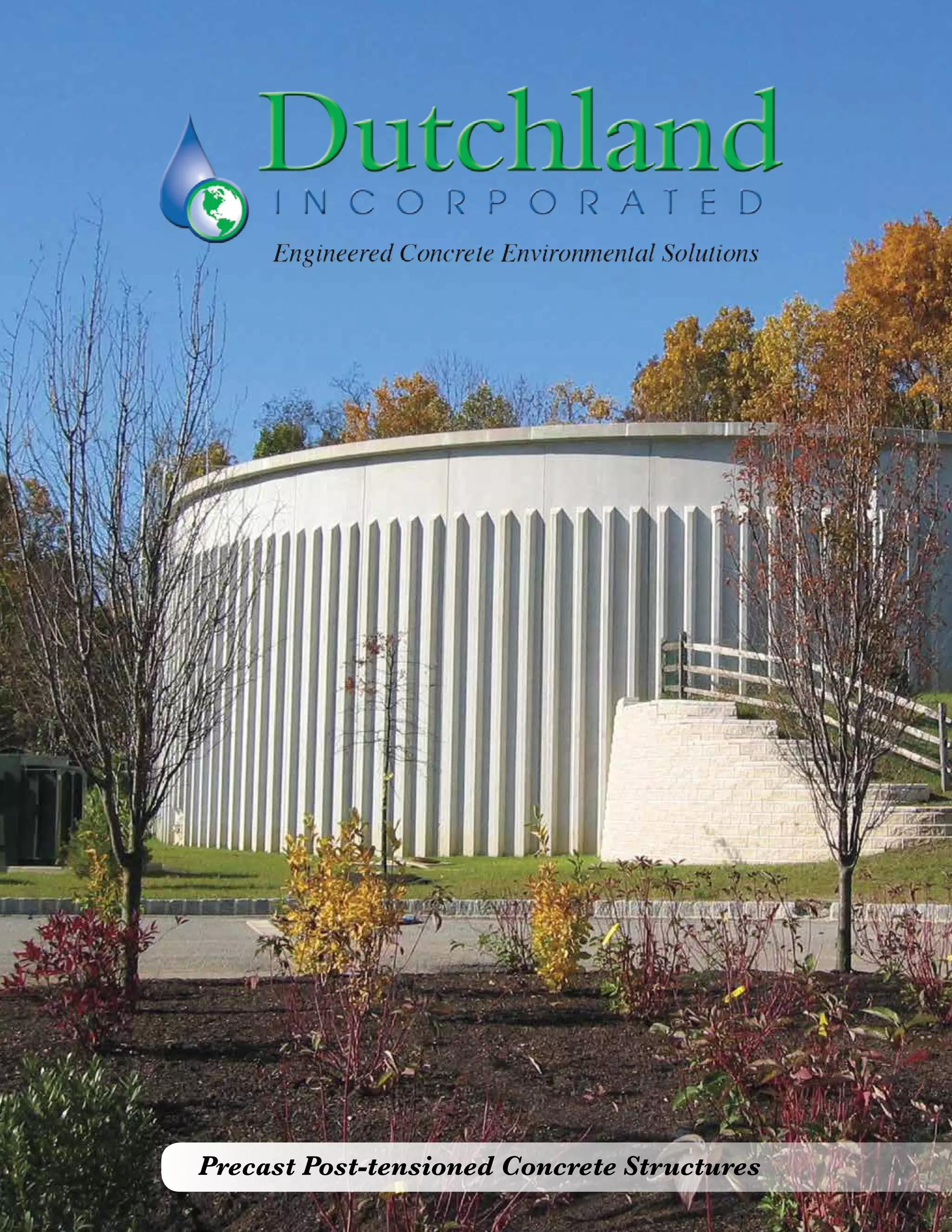
• 	 Dutchland, Inc. specializes in many types of
precast post-tensioned concrete structures,
including circular, rectangular, and
elliptical structures.
• 	 Dutchland, Inc. surveys all customers. All
customers surveyed indicated they would
contract with Dutchland, Inc. again.
•	 A no hassle ten-year structural warranty
covers the base, wall, roof systems, and tank
appurtenances of all post-tensioned tank
structures manufactured and installed by
Dutchland, Inc.
C E R T I F I E D P L A N T
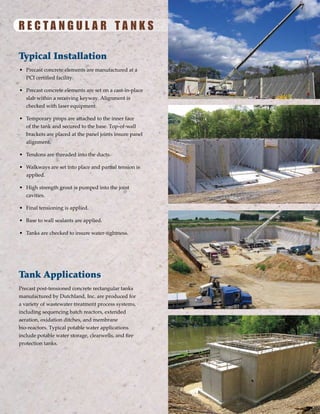
Typical Installation
• 	 Precast concrete elements are manufactured at a
PCI certified facility.
• 	 Precast concrete elements are set on a cast-in-place
slab within a receiving keyway. Alignment is
checked with laser equipment.
• 	 Temporary props are attached to the inner face
of the tank and secured to the base. Top-of-wall
brackets are placed at the panel joints insure panel
alignment.
• 	 Tendons are threaded into the ducts.
• 	 Walkways are set into place and partial tension is
applied.
• 	 High strength grout is pumped into the joint
cavities.
• 	 Final tensioning is applied.
• 	 Base to wall sealants are applied.
• 	 Tanks are checked to insure water-tightness.
Tank Applications
Precast post-tensioned concrete rectangular tanks
manufactured by Dutchland, Inc. are produced for
a variety of wastewater treatment process systems,
including sequencing batch reactors, extended
aeration, oxidation ditches, and membrane
bio-reactors. Typical potable water applications
include potable water storage, clearwells, and fire
protection tanks.
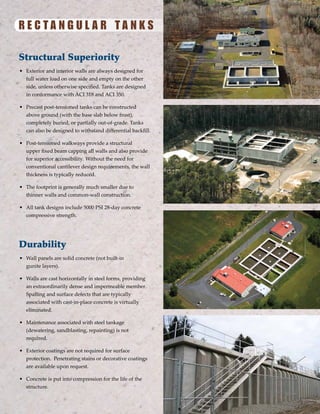
Structural Superiority
• 	 Exterior and interior walls are always designed for
full water load on one side and empty on the other
side, unless otherwise specified. Tanks are designed
in conformance with ACI 318 and ACI 350.
• 	 Precast post-tensioned tanks can be constructed
above ground (with the base slab below frost),
completely buried, or partially out-of-grade. Tanks
can also be designed to withstand differential backfill.
• 	 Post-tensioned walkways provide a structural
upper fixed beam capping all walls and also provide
for superior accessibility. Without the need for
conventional cantilever design requirements, the wall
thickness is typically reduced.
• 	 The footprint is generally much smaller due to
thinner walls and common-wall construction.
•	 All tank designs include 5000 PSI 28-day concrete
compressive strength.
Durability
•	 Wall panels are solid concrete (not built-in
gunite layers).
•	 Walls are cast horizontally in steel forms, providing
an extraordinarily dense and impermeable member.
Spalling and surface defects that are typically
associated with cast-in-place concrete is virtually
eliminated.
•	 Maintenance associated with steel tankage
(dewatering, sandblasting, repainting) is not
required.
•	 Exterior coatings are not required for surface
protection. Penetrating stains or decorative coatings
are available upon request.
•	 Concrete is put into compression for the life of the
structure.
CAST-IN-PLACE POST-TENSIONED
BASE SLAB
	 Post-tensioned base slabs are cast on-site.
Post-tensioned base slabs are in compression,
eliminating cracking.
	 •	 Reinforcement is placed within the base form.
	 •	 Tendons are placed within the form work.
	 •	 Keyway forms are placed and checked for
			 elevation and distance from center of the tank.
	 •	 Concrete is placed in a continuous monolithic
			 pour and steel trowel finished.
	 •	 The forms are removed and the base is covered or
			 sprinkled with water to achieve proper curing.
	 •	 Initial post-tensioning is applied after approximately
			 20 hours by Post-Tensioning Institute (PTI) certified
			 personnel.
	 •	 Final post-tensioning is applied upon concrete
			 achieving 75% of design strength.
	 •	 Tendon tails are removed and the anchor pockets
			 are cleaned, primed and filled with grout.
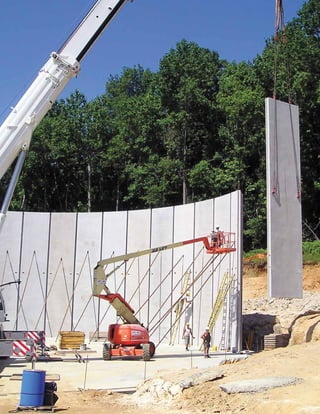
TANK WALL PANEL INSTALLATION
	 Conforming to the AWWA D-115 standard, all
	 production and installation procedures insure a
	 high quality tank system.
	 •	 Bearing pads and shims are placed in the keyways.
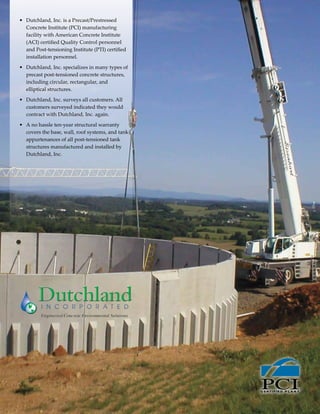
	 •	 Wall panels are lifted by a crane and set into the
			 keyway. Alignment is checked with laser equipment.
	 •	 Temporary props are attached to the inner face of the
			 wall panels and secured to the base.
	 •	 Tendon duct extensions are placed and sealed between
			 the wall panels.
	 • 	 Tendons are threaded into the ducts.
	 • 	 Vertical joints are formed. Grout is pumped into the
			 joint cavity and consolidated.
	 • 	 Circumferential post-tensioning is administered by PTI
			 certified personnel.
	 •	 Expanding grout is pumped into the tendon ducts to
			 permanently encase the tendons and create a bond to
			 the tank walls.
	 • 	 A sealant is used to seal the base to wall connection.
	 • 	 The tank is held in constant compression by the
			 internal post-tensioned tendons.
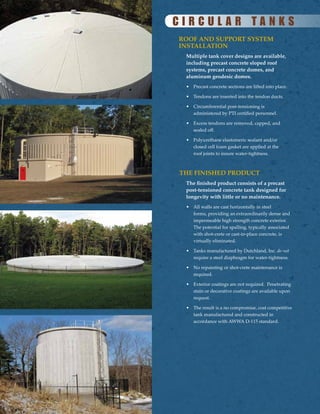
ROOF AND SUPPORT SYSTEM
INSTALLATION
	 Multiple tank cover designs are available,
including precast concrete sloped roof
systems, precast concrete domes, and
aluminum geodesic domes.
	 •	 Precast concrete sections are lifted into place.
	 •	 Tendons are inserted into the tendon ducts.
	 •	 Circumferential post-tensioning is
			 administered by PTI certified personnel.
	 •	 Excess tendons are removed, capped, and
			 sealed off.
	 • 	 Polyurethane elastomeric sealant and/or
			 closed cell foam gasket are applied at the
			 roof joints to insure water-tightness.
THE FINISHED PRODUCT
	 The finished product consists of a precast
post-tensioned concrete tank designed for
longevity with little or no maintenance.
	 •	 All walls are cast horizontally in steel
			 forms, providing an extraordinarily dense and
			 impermeable high strength concrete exterior.
			 The potential for spalling, typically associated
			 with shot-crete or cast-in-place concrete, is
			 virtually eliminated.
	 •	 Tanks manufactured by Dutchland, Inc. do not
			 require a steel diaphragm for water-tightness.
	 •	 No repainting or shot-crete maintenance is
			 required.
	 •	 Exterior coatings are not required. Penetrating
			 stain or decorative coatings are available upon
			 request.
	 •	 The result is a no compromise, cost competitive
			 tank manufactured and constructed in
			 accordance with AWWA D-115 standard.
CONSTRUCTION
	 •	 Elliptical tanks are constructed with methods similar to precast post-tensioned rectangular and circular tanks.
	 • 	 Elliptical tanks include base, walls and walkways.
BENEFITS
	 •	 Rounded tank ends are easier to fabricate by utilizing precast rather than cast-in-place concrete.
	 •	 Less time is generally required in construction for precast concrete than cast-in-place concrete.
	 •	 Various configurations are available to meet the requirements of specific equipment suppliers, including
			 but not limited to, Kruger, Siemens and Ovivo.
	 •	 Dutchland, Inc. typically works directly with the equipment manufacturer during the design / submittal
			 phase to ensure compatibility, resulting in better coordination.
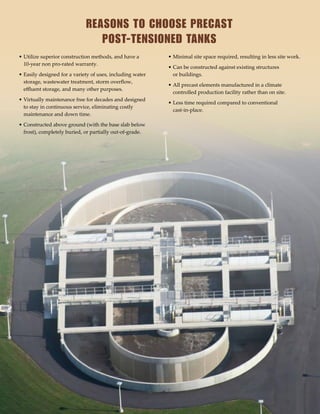
•	Utilize superior construction methods, and have a
10-year non pro-rated warranty.
•	Easily designed for a variety of uses, including water
storage, wastewater treatment, storm overflow,
effluent storage, and many other purposes.
•	Virtually maintenance free for decades and designed
to stay in continuous service, eliminating costly
maintenance and down time.
•	Constructed above ground (with the base slab below
frost), completely buried, or partially out-of-grade.
•	Minimal site space required, resulting in less site work.
•	Can be constructed against existing structures
or buildings.
•	All precast elements manufactured in a climate
controlled production facility rather than on site.
•	Less time required compared to conventional
cast-in-place.
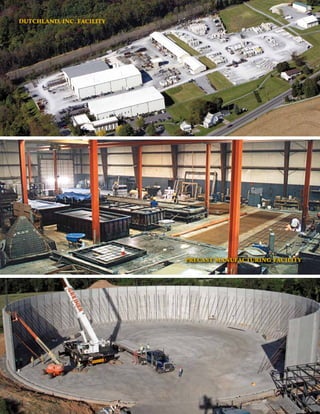
DUTCHLAND, INC. FACILITY
PRECAST MANUFACTURING FACILITY
160 Rt. 41 • PO Box 549 • Gap, PA 17527 • (P) 717.442.8282 • (F) 717.442.9330 • www.dutchlandinc.com
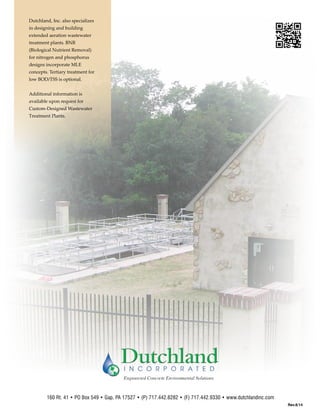
Dutchland, Inc. also specializes
in designing and building
extended aeration wastewater
treatment plants. BNR
(Biological Nutrient Removal)
for nitrogen and phosphorus
designs incorporate MLE
concepts. Tertiary treatment for
low BOD/TSS is optional.
Additional information is
available upon request for
Custom-Designed Wastewater
Treatment Plants.
Rev.8/14

Precast post tensioned tank brochure

  • 1.
  • 2.
    • Dutchland, Inc.is a Precast/Prestressed Concrete Institute (PCI) manufacturing facility with American Concrete Institute (ACI) certified Quality Control personnel and Post-tensioning Institute (PTI) certified installation personnel. • Dutchland, Inc. specializes in many types of precast post-tensioned concrete structures, including circular, rectangular, and elliptical structures. • Dutchland, Inc. surveys all customers. All customers surveyed indicated they would contract with Dutchland, Inc. again. • A no hassle ten-year structural warranty covers the base, wall, roof systems, and tank appurtenances of all post-tensioned tank structures manufactured and installed by Dutchland, Inc. C E R T I F I E D P L A N T
  • 3.
    Typical Installation • Precast concrete elements are manufactured at a PCI certified facility. • Precast concrete elements are set on a cast-in-place slab within a receiving keyway. Alignment is checked with laser equipment. • Temporary props are attached to the inner face of the tank and secured to the base. Top-of-wall brackets are placed at the panel joints insure panel alignment. • Tendons are threaded into the ducts. • Walkways are set into place and partial tension is applied. • High strength grout is pumped into the joint cavities. • Final tensioning is applied. • Base to wall sealants are applied. • Tanks are checked to insure water-tightness. Tank Applications Precast post-tensioned concrete rectangular tanks manufactured by Dutchland, Inc. are produced for a variety of wastewater treatment process systems, including sequencing batch reactors, extended aeration, oxidation ditches, and membrane bio-reactors. Typical potable water applications include potable water storage, clearwells, and fire protection tanks.
  • 4.
    Structural Superiority • Exterior and interior walls are always designed for full water load on one side and empty on the other side, unless otherwise specified. Tanks are designed in conformance with ACI 318 and ACI 350. • Precast post-tensioned tanks can be constructed above ground (with the base slab below frost), completely buried, or partially out-of-grade. Tanks can also be designed to withstand differential backfill. • Post-tensioned walkways provide a structural upper fixed beam capping all walls and also provide for superior accessibility. Without the need for conventional cantilever design requirements, the wall thickness is typically reduced. • The footprint is generally much smaller due to thinner walls and common-wall construction. • All tank designs include 5000 PSI 28-day concrete compressive strength. Durability • Wall panels are solid concrete (not built-in gunite layers). • Walls are cast horizontally in steel forms, providing an extraordinarily dense and impermeable member. Spalling and surface defects that are typically associated with cast-in-place concrete is virtually eliminated. • Maintenance associated with steel tankage (dewatering, sandblasting, repainting) is not required. • Exterior coatings are not required for surface protection. Penetrating stains or decorative coatings are available upon request. • Concrete is put into compression for the life of the structure.
  • 5.
    CAST-IN-PLACE POST-TENSIONED BASE SLAB Post-tensioned base slabs are cast on-site. Post-tensioned base slabs are in compression, eliminating cracking. • Reinforcement is placed within the base form. • Tendons are placed within the form work. • Keyway forms are placed and checked for elevation and distance from center of the tank. • Concrete is placed in a continuous monolithic pour and steel trowel finished. • The forms are removed and the base is covered or sprinkled with water to achieve proper curing. • Initial post-tensioning is applied after approximately 20 hours by Post-Tensioning Institute (PTI) certified personnel. • Final post-tensioning is applied upon concrete achieving 75% of design strength. • Tendon tails are removed and the anchor pockets are cleaned, primed and filled with grout. TANK WALL PANEL INSTALLATION Conforming to the AWWA D-115 standard, all production and installation procedures insure a high quality tank system. • Bearing pads and shims are placed in the keyways. • Wall panels are lifted by a crane and set into the keyway. Alignment is checked with laser equipment. • Temporary props are attached to the inner face of the wall panels and secured to the base. • Tendon duct extensions are placed and sealed between the wall panels. • Tendons are threaded into the ducts. • Vertical joints are formed. Grout is pumped into the joint cavity and consolidated. • Circumferential post-tensioning is administered by PTI certified personnel. • Expanding grout is pumped into the tendon ducts to permanently encase the tendons and create a bond to the tank walls. • A sealant is used to seal the base to wall connection. • The tank is held in constant compression by the internal post-tensioned tendons.
  • 6.
    ROOF AND SUPPORTSYSTEM INSTALLATION Multiple tank cover designs are available, including precast concrete sloped roof systems, precast concrete domes, and aluminum geodesic domes. • Precast concrete sections are lifted into place. • Tendons are inserted into the tendon ducts. • Circumferential post-tensioning is administered by PTI certified personnel. • Excess tendons are removed, capped, and sealed off. • Polyurethane elastomeric sealant and/or closed cell foam gasket are applied at the roof joints to insure water-tightness. THE FINISHED PRODUCT The finished product consists of a precast post-tensioned concrete tank designed for longevity with little or no maintenance. • All walls are cast horizontally in steel forms, providing an extraordinarily dense and impermeable high strength concrete exterior. The potential for spalling, typically associated with shot-crete or cast-in-place concrete, is virtually eliminated. • Tanks manufactured by Dutchland, Inc. do not require a steel diaphragm for water-tightness. • No repainting or shot-crete maintenance is required. • Exterior coatings are not required. Penetrating stain or decorative coatings are available upon request. • The result is a no compromise, cost competitive tank manufactured and constructed in accordance with AWWA D-115 standard.
  • 8.
    CONSTRUCTION • Ellipticaltanks are constructed with methods similar to precast post-tensioned rectangular and circular tanks. • Elliptical tanks include base, walls and walkways. BENEFITS • Rounded tank ends are easier to fabricate by utilizing precast rather than cast-in-place concrete. • Less time is generally required in construction for precast concrete than cast-in-place concrete. • Various configurations are available to meet the requirements of specific equipment suppliers, including but not limited to, Kruger, Siemens and Ovivo. • Dutchland, Inc. typically works directly with the equipment manufacturer during the design / submittal phase to ensure compatibility, resulting in better coordination.
  • 10.
    • Utilize superior constructionmethods, and have a 10-year non pro-rated warranty. • Easily designed for a variety of uses, including water storage, wastewater treatment, storm overflow, effluent storage, and many other purposes. • Virtually maintenance free for decades and designed to stay in continuous service, eliminating costly maintenance and down time. • Constructed above ground (with the base slab below frost), completely buried, or partially out-of-grade. • Minimal site space required, resulting in less site work. • Can be constructed against existing structures or buildings. • All precast elements manufactured in a climate controlled production facility rather than on site. • Less time required compared to conventional cast-in-place.
  • 11.
    DUTCHLAND, INC. FACILITY PRECASTMANUFACTURING FACILITY
  • 12.
    160 Rt. 41• PO Box 549 • Gap, PA 17527 • (P) 717.442.8282 • (F) 717.442.9330 • www.dutchlandinc.com Dutchland, Inc. also specializes in designing and building extended aeration wastewater treatment plants. BNR (Biological Nutrient Removal) for nitrogen and phosphorus designs incorporate MLE concepts. Tertiary treatment for low BOD/TSS is optional. Additional information is available upon request for Custom-Designed Wastewater Treatment Plants. Rev.8/14