Practice - Oriented
Teaching and Learning
.
Objectives
 By the end of this training trainees will be able to:
 Identify and apply the components of practice-oriented teaching
and learning.
 List and evaluate the advantages of practice-oriented teaching
and learning.
 Identify the challenges and strategies in implementing practice-
oriented teaching and learning.
 Lead and support the transition process of Dilla University to
UASs by properly implementing practice-oriented teaching and
learning.
Practice Oriented Teaching and Learning ….
 Practice oriented teaching and
learning, also known as
 hands-on or experiential
learning, is an educational
approach that emphasizes
active engagement and
practical application of
knowledge and skills.
Practice Oriented Teaching and Learning ….
 Unlike traditional lecture-based methods,
which primarily involve passive reception of
information, Practice oriented teaching and
learning focuses on providing students with
opportunities to actively participate in
activities that mimic real-world scenarios.
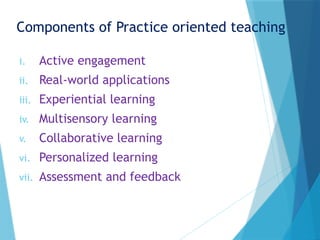
Components of Practice oriented teaching
i. Active engagement
ii. Real-world applications
iii. Experiential learning
iv. Multisensory learning
v. Collaborative learning
vi. Personalized learning
vii. Assessment and feedback
Components of Practice oriented teaching…
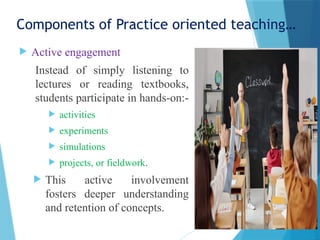
 Active engagement
Instead of simply listening to
lectures or reading textbooks,
students participate in hands-on:-
 activities
 experiments
 simulations
 projects, or fieldwork.
 This active involvement
fosters deeper understanding
and retention of concepts.
Components of Practice oriented teaching…
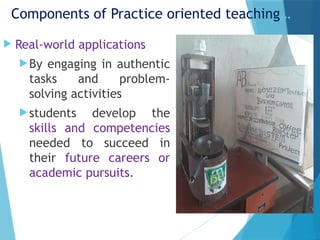
 Real-world applications
By engaging in authentic
tasks and problem-
solving activities
students develop the
skills and competencies
needed to succeed in
their future careers or
academic pursuits.
Components of Practice oriented teaching…
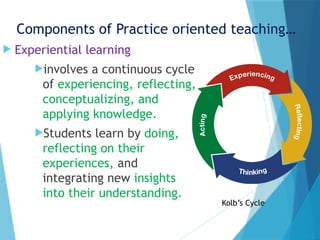
 Experiential learning
involves a continuous cycle
of experiencing, reflecting,
conceptualizing, and
applying knowledge.
Students learn by doing,
reflecting on their
experiences, and
integrating new insights
into their understanding.
Kolb’s Cycle
Components of Practice oriented teaching…
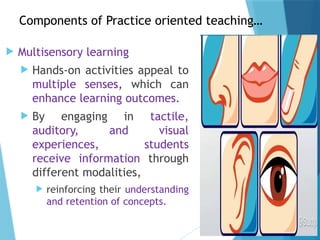
 Multisensory learning
 Hands-on activities appeal to
multiple senses, which can
enhance learning outcomes.
 By engaging in tactile,
auditory, and visual
experiences, students
receive information through
different modalities,
 reinforcing their understanding
and retention of concepts.
Components of Practice oriented teaching…
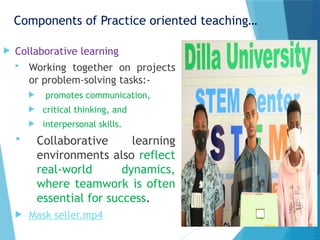
 Collaborative learning
 Working together on projects
or problem-solving tasks:-
 promotes communication,
 critical thinking, and
 interpersonal skills.
 Collaborative learning
environments also reflect
real-world dynamics,
where teamwork is often
essential for success.
 Mask seller.mp4
Components of Practice oriented teaching…
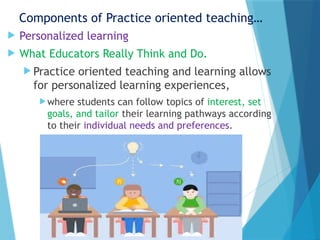
 Personalized learning
 What Educators Really Think and Do.
 Practice oriented teaching and learning allows
for personalized learning experiences,
where students can follow topics of interest, set
goals, and tailor their learning pathways according
to their individual needs and preferences.
Components of Practice oriented teaching…
 Assessment and feedback
evaluating students' abilities to apply
knowledge and skills in practical contexts.
Components of Practice oriented teaching…
Assessment may include
 project-based assessments,
 portfolios, presentations, or
 performance evaluations.
 Feedback is provided to help students
improve their understanding and
performance.
Reflection
Which component of practice oriented teaching
and learning frequently used in our education
system?
i. Active engagement
ii. Real-world applications
iii. Experiential learning
iv. Multisensory learning
v. Collaborative learning
vi. Personalized learning
vii. Assessment and feedback
The shift towards more hands-on and experiential
learning approaches
 Since practice oriented teaching needs more hands-on
and experiential learning approach, a shift to it from
the traditional – lecture based approach is crucial.
 It has several advantages:
 Active Engagement = Increase Confidence and self-efficacy
 Real world relevance = Applicability
 Skill Development = Critical thinking and problem solving
 Multisensory Learning
 Improve Retention & transfer= Lifelong learning
 Creativity and innovation=
 Preparation for the Future= Employability
Benefits of Practice Oriented Teaching and Learning
• Active engagement
 active engagement enhances understanding, retention, and
application of knowledge.
• Real-world relevance
 helps learners understand how knowledge is used in practical
situations.
 makes learning more meaningful and
 motivates learners by demonstrating the practical value of what
they are learning.
• Skill development
 provides opportunities for learners to develop practical skills
such as
 problem-solving,
 critical thinking,
 communication, and collaboration.
Benefits of Practice Oriented Teaching and
Learning…
 Multisensory learning
 As experiential learning engages multiple senses,
such as sight, touch, and hearing, it enhances
learning outcomes by providing different pathways/
diverse learning styles and preferences for information
processing.
 Retention and transfer
 hands-on learning promotes better retention of
information and facilitate the transfer of
knowledge to new contexts.
 By actively applying what they have learned,
learners deepen their understanding and build
connections between concepts.
Benefits of Practice Oriented Teaching and
Learning…
 Fostering Creativity and Innovation
 encourages experimentation and exploration,
fostering creativity and innovation.
 By engaging in hands-on projects, learners have
the opportunity to think critically, take risks,
and generate new ideas.
 Preparation for the Future
 Helps learners to equip with the skills and mindset that
are needed to navigate through today's rapidly changing
world/ dynamic landscape where technological
advancements and automation are reshaping industries.
Benefits of Practice Oriented Teaching and
Learning…
 By incorporating practical experiences into the
curriculum, educators can create:-
 rich learning environments that inspire curiosity,
creativity, and lifelong learning.
 Developing practical skills and knowledge is crucial for
personal fulfillment, career success, and contributing
positively to society.
 It empowers individuals to navigate life's challenges,
pursue their passions, and make meaningful
contributions to their communities.
Reflection
 What are the challenges of practice oriented teaching and learning
at DU?
Challenges in Implementing Practice
Oriented Teaching and Learning
 While Practice oriented teaching and learning offer
numerous benefits, implementing these approaches
also presents several challenges:
 Resource constraint
 Time constraint
 Class room management
 Assessment and evaluation
 Teacher training and support
 Curriculum integration
 Equity and access
 Technology challenges
Challenges in Implementing Practice
Oriented Teaching and Learning…
 Addressing these challenges
requires
 careful planning,
 collaboration, and
 continuous support from
educational stakeholders.
Strategies for Effective Implementation of Practice
oriented teaching and learning
 Implementing Practice oriented teaching and learning effectively
requires careful planning, support, and commitment from educators and
educational institutions.
 Here are some strategies for successful implementation:
 Set clear learning objectives
 Provide adequate resources
 Offer professional development
 Promote collaboration
 Differentiate instruction
 Integrate technology
 Balance theory and practice
 Provide feedback and assessment
 Foster reflection
 Cultivate a positive learning environment
How German UAS realize the practical
approach?
 Curricula focused on the profession not the scientific
community
 Problem-based learning as systematic and
comprehensive approach, strategic concept
 Companies provide problems to solve for student
groups (who compete sometimes for the solution)
 Excursions, case studies, simulation games, lab work
 Bachelor and master theses in cooperation with
companies / potential employers
 Integration of professionally recognized certificates
into curriculum (e.g. Microsoft certificates in
computer studies)
Thank You!

Practical Oriented Teaching and Learning.pptx

  • 1.
  • 2.
    Objectives  By theend of this training trainees will be able to:  Identify and apply the components of practice-oriented teaching and learning.  List and evaluate the advantages of practice-oriented teaching and learning.  Identify the challenges and strategies in implementing practice- oriented teaching and learning.  Lead and support the transition process of Dilla University to UASs by properly implementing practice-oriented teaching and learning.
  • 3.
    Practice Oriented Teachingand Learning ….  Practice oriented teaching and learning, also known as  hands-on or experiential learning, is an educational approach that emphasizes active engagement and practical application of knowledge and skills.
  • 4.
    Practice Oriented Teachingand Learning ….  Unlike traditional lecture-based methods, which primarily involve passive reception of information, Practice oriented teaching and learning focuses on providing students with opportunities to actively participate in activities that mimic real-world scenarios.
  • 5.
    Components of Practiceoriented teaching i. Active engagement ii. Real-world applications iii. Experiential learning iv. Multisensory learning v. Collaborative learning vi. Personalized learning vii. Assessment and feedback
  • 6.
    Components of Practiceoriented teaching…  Active engagement Instead of simply listening to lectures or reading textbooks, students participate in hands-on:-  activities  experiments  simulations  projects, or fieldwork.  This active involvement fosters deeper understanding and retention of concepts.
  • 7.
    Components of Practiceoriented teaching…  Real-world applications By engaging in authentic tasks and problem- solving activities students develop the skills and competencies needed to succeed in their future careers or academic pursuits.
  • 8.
    Components of Practiceoriented teaching…  Experiential learning involves a continuous cycle of experiencing, reflecting, conceptualizing, and applying knowledge. Students learn by doing, reflecting on their experiences, and integrating new insights into their understanding. Kolb’s Cycle
  • 9.
    Components of Practiceoriented teaching…  Multisensory learning  Hands-on activities appeal to multiple senses, which can enhance learning outcomes.  By engaging in tactile, auditory, and visual experiences, students receive information through different modalities,  reinforcing their understanding and retention of concepts.
  • 10.
    Components of Practiceoriented teaching…  Collaborative learning  Working together on projects or problem-solving tasks:-  promotes communication,  critical thinking, and  interpersonal skills.  Collaborative learning environments also reflect real-world dynamics, where teamwork is often essential for success.  Mask seller.mp4
  • 11.
    Components of Practiceoriented teaching…  Personalized learning  What Educators Really Think and Do.  Practice oriented teaching and learning allows for personalized learning experiences, where students can follow topics of interest, set goals, and tailor their learning pathways according to their individual needs and preferences.
  • 12.
    Components of Practiceoriented teaching…  Assessment and feedback evaluating students' abilities to apply knowledge and skills in practical contexts.
  • 13.
    Components of Practiceoriented teaching… Assessment may include  project-based assessments,  portfolios, presentations, or  performance evaluations.  Feedback is provided to help students improve their understanding and performance.
  • 14.
    Reflection Which component ofpractice oriented teaching and learning frequently used in our education system? i. Active engagement ii. Real-world applications iii. Experiential learning iv. Multisensory learning v. Collaborative learning vi. Personalized learning vii. Assessment and feedback
  • 15.
    The shift towardsmore hands-on and experiential learning approaches  Since practice oriented teaching needs more hands-on and experiential learning approach, a shift to it from the traditional – lecture based approach is crucial.  It has several advantages:  Active Engagement = Increase Confidence and self-efficacy  Real world relevance = Applicability  Skill Development = Critical thinking and problem solving  Multisensory Learning  Improve Retention & transfer= Lifelong learning  Creativity and innovation=  Preparation for the Future= Employability
  • 16.
    Benefits of PracticeOriented Teaching and Learning • Active engagement  active engagement enhances understanding, retention, and application of knowledge. • Real-world relevance  helps learners understand how knowledge is used in practical situations.  makes learning more meaningful and  motivates learners by demonstrating the practical value of what they are learning. • Skill development  provides opportunities for learners to develop practical skills such as  problem-solving,  critical thinking,  communication, and collaboration.
  • 17.
    Benefits of PracticeOriented Teaching and Learning…  Multisensory learning  As experiential learning engages multiple senses, such as sight, touch, and hearing, it enhances learning outcomes by providing different pathways/ diverse learning styles and preferences for information processing.  Retention and transfer  hands-on learning promotes better retention of information and facilitate the transfer of knowledge to new contexts.  By actively applying what they have learned, learners deepen their understanding and build connections between concepts.
  • 18.
    Benefits of PracticeOriented Teaching and Learning…  Fostering Creativity and Innovation  encourages experimentation and exploration, fostering creativity and innovation.  By engaging in hands-on projects, learners have the opportunity to think critically, take risks, and generate new ideas.  Preparation for the Future  Helps learners to equip with the skills and mindset that are needed to navigate through today's rapidly changing world/ dynamic landscape where technological advancements and automation are reshaping industries.
  • 19.
    Benefits of PracticeOriented Teaching and Learning…  By incorporating practical experiences into the curriculum, educators can create:-  rich learning environments that inspire curiosity, creativity, and lifelong learning.  Developing practical skills and knowledge is crucial for personal fulfillment, career success, and contributing positively to society.  It empowers individuals to navigate life's challenges, pursue their passions, and make meaningful contributions to their communities.
  • 20.
    Reflection  What arethe challenges of practice oriented teaching and learning at DU?
  • 21.
    Challenges in ImplementingPractice Oriented Teaching and Learning  While Practice oriented teaching and learning offer numerous benefits, implementing these approaches also presents several challenges:  Resource constraint  Time constraint  Class room management  Assessment and evaluation  Teacher training and support  Curriculum integration  Equity and access  Technology challenges
  • 22.
    Challenges in ImplementingPractice Oriented Teaching and Learning…  Addressing these challenges requires  careful planning,  collaboration, and  continuous support from educational stakeholders.
  • 23.
    Strategies for EffectiveImplementation of Practice oriented teaching and learning  Implementing Practice oriented teaching and learning effectively requires careful planning, support, and commitment from educators and educational institutions.  Here are some strategies for successful implementation:  Set clear learning objectives  Provide adequate resources  Offer professional development  Promote collaboration  Differentiate instruction  Integrate technology  Balance theory and practice  Provide feedback and assessment  Foster reflection  Cultivate a positive learning environment
  • 24.
    How German UASrealize the practical approach?  Curricula focused on the profession not the scientific community  Problem-based learning as systematic and comprehensive approach, strategic concept  Companies provide problems to solve for student groups (who compete sometimes for the solution)  Excursions, case studies, simulation games, lab work  Bachelor and master theses in cooperation with companies / potential employers  Integration of professionally recognized certificates into curriculum (e.g. Microsoft certificates in computer studies)
  • 25.