Practical Organic Chemistry
Detection of Carbon and Hydrogen
Liebig’s Test
Test For Nitrogen
Sodium nitroprusside test:
The one portion of the extract, a few drops sodium
nitroprusside are added. The appearance of violet colouration
indicates sulphur.
Test For Sulphur
Test For Halogens
Test for phosphorus
Test for unsaturation
Addition of bromine to an alkene results in the formation
of vicinal dibromide. The reddish orange colour of the
solution of bromine in carbon tetrachloride disappears
on reaction with an alkene
Bromine water Test:
Test for unsaturation
Alkenes decolourise the neutral/alkaline KMnO4
solution
and vicinal glycols are formed (Bayer’s test).
Bayer’s Test
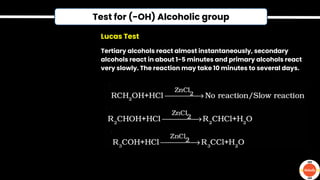
Test for (-OH) Alcoholic group
Alcoholic compounds on reaction with ceric ammonium
nitrate give a red colouration due to the formation of a
complex.
Ceric ammonium nitrate Test
Test for (-OH) Alcoholic group
Tertiary alcohols react almost instantaneously, secondary
alcohols react in about 1-5 minutes and primary alcohols react
very slowly. The reaction may take 10 minutes to several days.
Lucas Test
Test for Phenols
Ferric Chloride Test
Phenols give coloured complex with neutral ferric
chloride solution.
Test for Phenols
Phthalein dye test
Phenols condense with phthalic anhydride in the presence of
concentrated H2
SO4
, Phenol condenses to give phenolphthalein
which gives a dark pink colour with NaOH solution.
Test for Phenols
Phthalein dye test
Test for Phenols
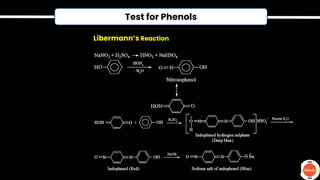
Libermann’s Reaction
While phenol is reacted with NaNO2
and concentrated
H2
SO4
, it provides a deep green colour which changes
to red on dilution with water. while generated alkaline
along with NaOH, blue colour is restored.
Test for Phenols
Libermann’s Reaction
Test for Phenols
Bromine Water Test
Aqueous or alcoholic solution of the organic
compound is mixed with bromine water. A yellowish
white precipitate is formed.
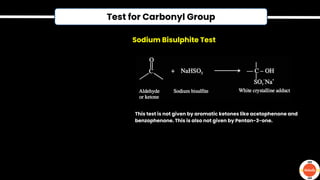
Test for Carbonyl Group
On reaction with 2,4-dinitrophenylhydrazine (2,4-DNP), they form the
respective 2,4–dinitrophenyl hydrazones.
2,4-DNP Test
Test for Carbonyl Group
This test is not given by aromatic ketones like acetophenone and
benzophenone. This is also not given by Pentan-3-one.
Sodium Bisulphite Test
Test for Aldehyde only
Both aliphatic and aromatic aldehydes give this test but
ketones do not respond to this test because like aldehydes they
are not good reducing agent.
Tollen’s Test
Test for Aldehyde only
This test is given only by aliphatic aldehydes but not by
aromatic aldehydes
Fehling’s Test
Test for Aldehyde only
Benedict modified the original Fehling’s test by using a single
solution which is more convenient for the test. Benedict’s
solution is more stable than Fehling’s reagent and can be stored
for a long time. It is an alkaline solution containing a mixture of
copper sulphate and sodium citrate (2Na3
C6
H5
O7
.11H2
O).
Benedicts test
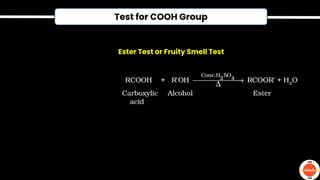
Test for COOH Group
RCOOH + NaHCO3
→ RCOONa + H2
O + CO2
↑
Sodium Bicarbonate Test
Test for COOH Group
Ester Test or Fruity Smell Test
Test for Amines
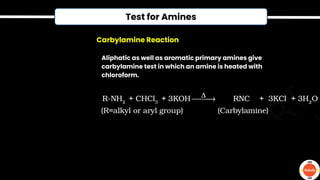
Carbylamine Reaction
Aliphatic as well as aromatic primary amines give
carbylamine test in which an amine is heated with
chloroform.
Test for Amines
Nitrous acid Test
Test for Amines
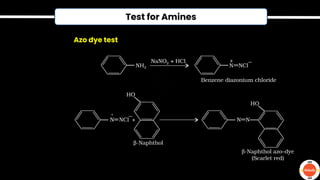
Azo dye test
Aromatic primary amines can be confirmed by azo dye test.
Primary amine e.g. aniline reacts with nitrous acid generated in
situ by the reaction of sodium nitrite with HCl at 0–5°C to
produce diazonium salt. This couples with β-naphthol to give a
scarlet red dye, which is sparingly soluble in water.
Test for Amines
Azo dye test
Test for Amines
Hinsberg’s Test
Benzenesulphonyl chloride (C6
H5
SO2
Cl), which is also known
as Hinsberg’s reagent, reacts with primary and secondary
amines to form sulphonamides
Test for Amines
Hinsberg’s Test (Primary Amines)
Test for Amines
Insoluble in alkali
Hinsberg’s Test (Secondary Amines)
Biuret Test
The biuret test is a chemical test that can be used to see if an
analyte has peptide bonds or not. As a result, the biuret test may
be used to figure out how much protein is in the analyte. In this
test, the presence of peptides induces the copper (II) ion to form
pale purple (or mauve) coordination complexes (when the
solution is sufficiently alkaline).
Molisch’s Test
In Molisch’s test, the carbohydrate (if present) undergoes
dehydration upon the introduction of concentrated hydrochloric or
sulphuric acid, resulting in the formation of an aldehyde. This
aldehyde undergoes condensation along with two phenol-type
molecules (such as α-naphthol, resorcinol, and thymol), resulting
in the formation of a purple or reddish-purple coloured complex.
Molisch’s Test
Seliwanoff’s Test
Seliwanoff’s test is used to distinguish aldoses from ketoses. On
treatment with a concentrated Acid, ketoses are dehydrated more
rapidly to give furfural derivatives and on condensation with
resorcinol give cherry red complex. The test will be answered by
fructose, sucrose and other keto containing carbohydrates. If the
reaction is allowed for a longer time (more than 10 minutes),
aldoses also may produce positive results. Seliwanoff’s test is
often considered to be a test for ketohexoses in carbohydrates.
● Seliwanoff’s reagent: Add 0.05% resorcinol
(m-hydroxybenzene) in 3 N HCl. Dissolve 50 mg
resorcinol in 33 ml concentrated HCl and make it 100 ml
with water.
Barfoed Test
● The Barfoed’s test is used to differentiate reducing monosaccharide
from a disaccharide sugar. The reaction is conducted in a slightly acidic
medium.
● A mixture of ethanoic (acetic) acid and copper(II) acetate, is added to
the test solution and boiled.
● Reducing monosaccharides react with Bedford’s reagent much faster
than disaccharides and produce a copious amount of red precipitate of
copper (I) oxide within three minutes. Disaccharide sugars as they are
weaker reducing agents, react at a slower rate and so do not form red
precipitate even for ten minutes. Some hydrolysis of disaccharides may
lead to trace precipitates which tends to adhere to the walls of the test
tube.
Ninhydrin Test
The ninhydrin test is a chemical test which is used to check whether a
given analyte contains amines or α-amino acids. In this test, ninhydrin
(a chemical compound with the formula C9
H6
O4
; IUPAC name:
2,2-dihydroxyindane-1,3-dione) is added to a test solution of the
analyte. The development of a deep blue colour indicates the presence
of ammonia, primary/secondary amines, or amino acids in the
analyte.
Xanthoproteic Test
Xanthoproteic test is a biochemical test for the detection of amino acids
containing phenolic or indolic groups like phenylalanine, tyrosine, and
tryptophan (aromatic amino acids). The Xanthoproteic test is based on the
fact that aromatic groups in the amino acids are nitrated by heating with
concentrated HNO3 to yield intensely yellow-colored nitro derivative. On the
addition of alkali, however, the residue turns orange due to the formation of
a salt of the tautomeric form of the nitro compound. Benzene
ring-containing amino acids like phenylalanine don’t give a positive test to
this test because the phenyl group in phenylalanine is very stable, which
doesn’t react with nitric acid in the conditions of this test.
Quantitative analysis
Estimation of Carbon and Hydrogen:
Estimation of Nitrogen
Estimation of Halogens
Estimation of Sulphur and Phosphorus
Q- The tests performed on compound X and their inferences are :
Compound ‘X’ is JEE Main 2019
Test Inference
(a) 2, 4 - DNP test Coloured precipitate
(b) Iodoform test Yellow precipitate
(c) Azo-dye test No dye formation
A B
C D
Q- The tests performed on compound X and their inferences are :
Compound ‘X’ is JEE Main 2019
Test Inference
(a) 2, 4 - DNP test Coloured precipitate
(b) Iodoform test Yellow precipitate
(c) Azo-dye test No dye formation
A B
C D
Solution:
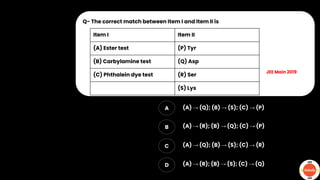
Q- The correct match between Item I and Item II is
A
B
C
D
(A) → (Q); (B) → (S); (C) → (P)
(A) → (R); (B) → (Q); (C) → (P)
(A) → (Q); (B) → (S); (C) → (R)
(A) → (R); (B) → (S); (C) → (Q)
JEE Main 2019
Item I Item II
(A) Ester test (P) Tyr
(B) Carbylamine test (Q) Asp
(C) Phthalein dye test (R) Ser
(S) Lys
Q- The correct match between Item I and Item II is
A
B
C
D
(A) → (Q); (B) → (S); (C) → (P)
(A) → (R); (B) → (Q); (C) → (P)
(A) → (Q); (B) → (S); (C) → (R)
(A) → (R); (B) → (S); (C) → (Q)
JEE Main 2019
Item I Item II
(A) Ester test (P) Tyr
(B) Carbylamine test (Q) Asp
(C) Phthalein dye test (R) Ser
(S) Lys
Solution:
Q- The organic compound that gives following qualitative analysis is
JEE Main 2019
Test Inference
(a) Dil.HCl Insoluble
(b) NaOH solution Soluble
(c) Br2
/water Decolourization
A B
C D
Q- The organic compound that gives following qualitative analysis is
JEE Main 2019
Test Inference
(a) Dil.HCl Insoluble
(b) NaOH solution Soluble
(c) Br2
/water Decolourization
A B
C D
Solution:
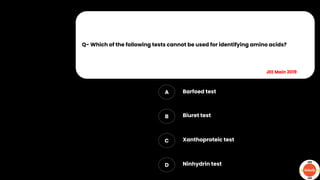
Q- Which of the following tests cannot be used for identifying amino acids?
A
B
C
D
Barfoed test
Biuret test
Xanthoproteic test
Ninhydrin test
JEE Main 2019
Q- Which of the following tests cannot be used for identifying amino acids?
A
B
C
D
Barfoed test
Biuret test
Xanthoproteic test
Ninhydrin test
JEE Main 2019
Solution:
Barfoed test is used for carbohydrate to check reducing nature of sugar.
Q- Fructose and glucose can be distinguished by:
A
B
C
D
Fehling's test
Seliwanoff's test
Barfoed's test
Benedict's test
JEE Main 2019
Q- Fructose and glucose can be distinguished by:
A
B
C
D
Fehling's test
Seliwanoff's test
Barfoed's test
Benedict's test
JEE Main 2019
Solution:
Seliwanoff's test is used to distinguish aldose and ketose.
Q- The peptide that gives positive ceric ammonium nitrate and carbylamine tests
is
A
B
C
D
Ser - Lys
Lys - Asp
Gln - Asp
Asp - Gln
JEE Main 2019
Q- The peptide that gives positive ceric ammonium nitrate and carbylamine tests
is
A
B
C
D
Ser - Lys
Lys - Asp
Gln - Asp
Asp - Gln
JEE Main 2019
Solution:
Ceric ammonium nitrate test is given by alcohol. Only serine(ser) contain —OH group.
Q- Match the following :
A
B
C
D
(i) - (b), (ii) - (d), (iii) - (e), (iv) - (a)
(i) - (d), (ii) - (c), (iii) - (e), (iv) - (a)
(i) - (b), (ii) - (a), (iii) - (c), (iv) - (d)
(i) - (d), (ii) - (c), (iii) - (b), (iv) - (e)
JEE Main 2020
Test / Method Reagent
(i) Lucas Test (a)C6
H5
SO2
Cl/aq. KOH
(ii) Dumas method (b) HNO3
/ AgNO3
(iii) Kjeldahl’s method (c) CuO/CO2
(iv) Hinsberg test (d) Conc. HCl and ZnCl2
(e) H2
SO4
Q- Match the following :
A
B
C
D
(i) - (b), (ii) - (d), (iii) - (e), (iv) - (a)
(i) - (d), (ii) - (c), (iii) - (e), (iv) - (a)
(i) - (b), (ii) - (a), (iii) - (c), (iv) - (d)
(i) - (d), (ii) - (c), (iii) - (b), (iv) - (e)
JEE Main 2020
Test / Method Reagent
(i) Lucas Test (a)C6
H5
SO2
Cl/aq. KOH
(ii) Dumas method (b) HNO3
/ AgNO3
(iii) Kjeldahl’s method (c) CuO/CO2
(iv) Hinsberg test (d) Conc. HCl and ZnCl2
(e) H2
SO4
Solution:
Lucas Test - Conc. HCl/ZnCl2
Dumas method - CuO/CO2
Kjeldahl’s method - H2
SO4
Hinsberg test - C6
H5
SO2
Cl/aq. KOH
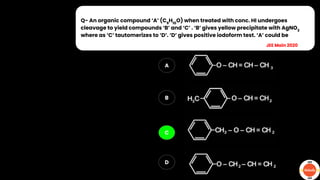
Q- An organic compound ‘A’ (C9
H10
O) when treated with conc. HI undergoes
cleavage to yield compounds ‘B’ and ‘C’ . ‘B’ gives yellow precipitate with AgNO3
where as ‘C’ tautomerizes to ‘D’. ‘D’ gives positive iodoform test. ‘A’ could be
A
B
C
D
JEE Main 2020
Q- An organic compound ‘A’ (C9
H10
O) when treated with conc. HI undergoes
cleavage to yield compounds ‘B’ and ‘C’ . ‘B’ gives yellow precipitate with AgNO3
where as ‘C’ tautomerizes to ‘D’. ‘D’ gives positive iodoform test. ‘A’ could be
A
B
C
D
JEE Main 2020
Solution:
Q- A chemist has 4 samples of artificial sweetener A, B, C and D. To identify these
samples, he performed certain experiments and noted the following observations :
(i) A and D both form blue-violet colour with ninhydrin.
(ii) Lassaigne extract of C gives positive AgNO3
test and negative Fe4
[Fe(CN)6
]3
test.
(iii) Lassaigne extract of B and D gives positive sodium nitroprusside test.
Based on these observations which option is correct?
A
B
C
D
A : Aspartame; B : Alitame; C : Saccharin; D : Sucralose
A : Saccharin; B : Alitame; C : Sucralose; D : Aspartame
A : Alitame; B : Saccharin; C : Aspartame; D : Sucralose
A : Aspartame; B : Saccharin; C : Sucralose; D : Alitame
JEE Main 2020
Q- A chemist has 4 samples of artificial sweetener A, B, C and D. To identify these
samples, he performed certain experiments and noted the following observations :
(i) A and D both form blue-violet colour with ninhydrin.
(ii) Lassaigne extract of C gives positive AgNO3
test and negative Fe4
[Fe(CN)6
]3
test.
(iii) Lassaigne extract of B and D gives positive sodium nitroprusside test.
Based on these observations which option is correct?
A
B
C
D
A : Aspartame; B : Alitame; C : Saccharin; D : Sucralose
A : Saccharin; B : Alitame; C : Sucralose; D : Aspartame
A : Alitame; B : Saccharin; C : Aspartame; D : Sucralose
A : Aspartame; B : Saccharin; C : Sucralose; D : Alitame
JEE Main 2020
Solution:
● Ninhydrin test is specific for amino acids.
● Both aspartame and alitame contains amino acids.
● Alitame is sulphur containing compound thats why gives sodium
nitroprusside test
● Saccharin also contains sulphur
● Sucralose contains chloro group thats why its Lassaigne extract
gives white ppt with AgNO3
.
∴ A = Aspartame, B = Saccharin C = Sucralose, D = Alitame.
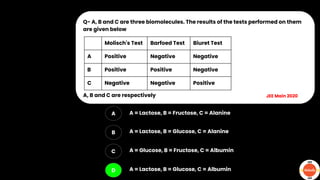
Q- A, B and C are three biomolecules. The results of the tests performed on them
are given below
A, B and C are respectively
A
B
C
D
A = Lactose, B = Fructose, C = Alanine
A = Lactose, B = Glucose, C = Alanine
A = Glucose, B = Fructose, C = Albumin
A = Lactose, B = Glucose, C = Albumin
JEE Main 2020
Molisch's Test Barfoed Test Biuret Test
A Positive Negative Negative
B Positive Positive Negative
C Negative Negative Positive
Q- A, B and C are three biomolecules. The results of the tests performed on them
are given below
A, B and C are respectively
A
B
C
D
A = Lactose, B = Fructose, C = Alanine
A = Lactose, B = Glucose, C = Alanine
A = Glucose, B = Fructose, C = Albumin
A = Lactose, B = Glucose, C = Albumin
JEE Main 2020
Molisch's Test Barfoed Test Biuret Test
A Positive Negative Negative
B Positive Positive Negative
C Negative Negative Positive
Solution:
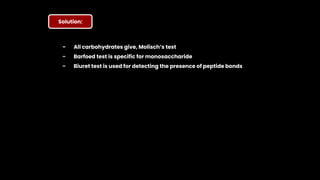
- All carbohydrates give, Molisch’s test
- Barfoed test is specific for monosaccharide
- Biuret test is used for detecting the presence of peptide bonds
Q- Ceric ammonium nitrate and CHCl3
/alc. KOH are used for the identification of
functional groups present in ___ and __ respectively
A
B
C
D
Alcohol, phenol
Amine, phenol
Amine, alcohol
Alcohol, amine
JEE Main 2021
Q- Ceric ammonium nitrate and CHCl3
/alc. KOH are used for the identification of
functional groups present in ___ and __ respectively
A
B
C
D
Alcohol, phenol
Amine, phenol
Amine, alcohol
Alcohol, amine
JEE Main 2021
Q- 2, 4 - DNP test can be used to identify
A
B
C
D
Aldehyde
Amine
Ether
Halogens
JEE Main 2021
Q- 2, 4 - DNP test can be used to identify
A
B
C
D
Aldehyde
Amine
Ether
Halogens
JEE Main 2021
Q- An unsaturated hydrocarbon X on ozonolysis gives A. Compound A when
warmed with ammonical silver nitrate forms a bright silver mirror along the sides
of the test tube. The unsaturated hydrocarbon X is :
A
B
C
D
HC ≡ C ー CH2
ー CH3
CH3
ー C ≡ C ー CH3
JEE Main 2021
Q- An unsaturated hydrocarbon X on ozonolysis gives A. Compound A when
warmed with ammonical silver nitrate forms a bright silver mirror along the sides
of the test tube. The unsaturated hydrocarbon X is :
A
B
C
D
HC ≡ C ー CH2
ー CH3
CH3
ー C ≡ CーCH3
JEE Main 2021
Solution:
Q- In Tollen's test for aldehyde, the overall number of electron(s) transferred to the
Tollen's reagent formula [Ag(NH3
)2
]+
per aldehyde group to form silver mirror is
____.
(Round off to the Nearest Integer).
JEE Main 2021
Q- In Tollen's test for aldehyde, the overall number of electron(s) transferred to the
Tollen's reagent formula [Ag(NH3
)2
]+
per aldehyde group to form silver mirror is
____.
(Round off to the Nearest Integer).
JEE Main 2021
Ans 2
Solution:
Q- A reaction of benzonitrile with one equivalent CH3
MgBr followed by hydrolysis
produces a yellow liquid "P". The compound "P" will give positive ______.
A
B
C
D
Tollen's test
Schiff's test
Ninhydrin's test
lodoform test
JEE Main 2021
Q- A reaction of benzonitrile with one equivalent CH3
MgBr followed by hydrolysis
produces a yellow liquid "P". The compound "P" will give positive ______.
A
B
C
D
Tollen's test
Schiff's test
Ninhydrin's test
lodoform test
JEE Main 2021
Solution:
Q- Which one of the following tests used for the identification of functional groups
in organic compounds does not use copper reagent?
A
B
C
D
Seliwanoff’s test
Barfoed's test
Benedict's test
Biuret test for peptide bond
JEE Main 2021
Q- Which one of the following tests used for the identification of functional groups
in organic compounds does not use copper reagent?
A
B
C
D
Seliwanoff’s test
Barfoed's test
Benedict's test
Biuret test for peptide bond
JEE Main 2021
Solution:
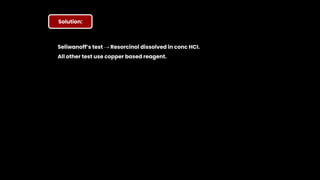
Seliwanoff’s test → Resorcinol dissolved in conc HCI.
All other test use copper based reagent.
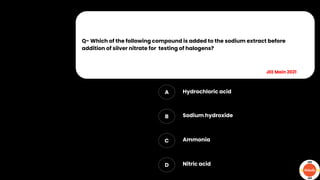
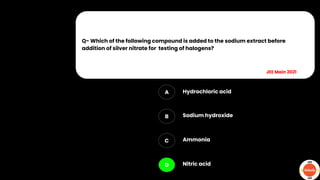
Q- Which of the following compound is added to the sodium extract before
addition of silver nitrate for testing of halogens?
A
B
C
D
Hydrochloric acid
Sodium hydroxide
Ammonia
Nitric acid
JEE Main 2021
Q- Which of the following compound is added to the sodium extract before
addition of silver nitrate for testing of halogens?
A
B
C
D
Hydrochloric acid
Sodium hydroxide
Ammonia
Nitric acid
JEE Main 2021
Solution:
The sodium fusion extract is acidified with nitric acid and then treated with silver nitrate.
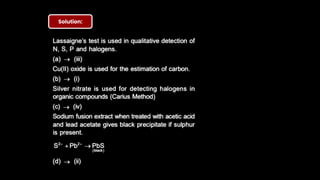
Q- Match List-I with List-II
The correct match is:
A
B
C
D
(a)-(iii), (b)-(i), (c)-(iv), (d)-(ii)
(a)-(i), (b)-(iv), (c)-(iii), (d)-(ii)
(a)-(iii), (b)-(i), (c)-(ii), (d)-(iv)
(a)-(i), (b)-(ii), (c)-(iv), (d)-(iii)
JEE Main 2021
List-I Test/Reagents/ Observation(s) List-II Species detected
(a) Lassaigne's Test (i) Carbon
(b) Cu(II) oxide (ii) Sulphur
(c) Silver nitrate (iii) N, S, P, and halogen
(d) The sodium fusion extract gives black
precipitate with acetic acid and lead acetate
(iv) Halogen Specifically
Q- Match List-I with List-II
The correct match is:
A
B
C
D
(a)-(iii), (b)-(i), (c)-(iv), (d)-(ii)
(a)-(i), (b)-(iv), (c)-(iii), (d)-(ii)
(a)-(iii), (b)-(i), (c)-(ii), (d)-(iv)
(a)-(i), (b)-(ii), (c)-(iv), (d)-(iii)
JEE Main 2021
List-I Test/Reagents/ Observation(s) List-II Species detected
(a) Lassaigne's Test (i) Carbon
(b) Cu(II) oxide (ii) Sulphur
(c) Silver nitrate (iii) N, S, P, and halogen
(d) The sodium fusion extract gives black
precipitate with acetic acid and lead acetate
(iv) Halogen Specifically
Solution:
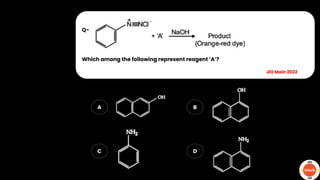
Q-
Which among the following represent reagent ‘A’?
JEE Main 2022
A B
C D
Q-
Which among the following represent reagent ‘A’?
JEE Main 2022
A B
C D
Solution:
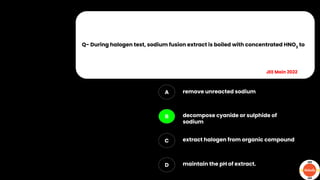
Q- During halogen test, sodium fusion extract is boiled with concentrated HNO3
to
A
B
C
D
remove unreacted sodium
decompose cyanide or sulphide of
sodium
extract halogen from organic compound
maintain the pH of extract.
JEE Main 2022
Q- During halogen test, sodium fusion extract is boiled with concentrated HNO3
to
A
B
C
D
remove unreacted sodium
decompose cyanide or sulphide of
sodium
extract halogen from organic compound
maintain the pH of extract.
JEE Main 2022
Solution:
During test for halogen. if nitrogen or sulphur is also present in the compound, then
sodium fusion extract is first boiled with concentrated nitric acid to decompose cyanide
or sulphide of sodium formed during Lassaigne's test.
Q- The formula of the purple colour formed in Lassaigne's test for sulphur using
sodium nitroprusside is
A
B
C
D
NaFe[Fe(CN)6
]
Na[Cr(NH3
)2
(NCS)4
]
Na2
[Fe(CN)5
(NO)]
Na4
[Fe(CN5
)(NOS)]
JEE Main 2022
Q- The formula of the purple colour formed in Lassaigne's test for sulphur using
sodium nitroprusside is
A
B
C
D
NaFe[Fe(CN)6
]
Na[Cr(NH3
)2
(NCS)4
]
Na2
[Fe(CN)5
(NO)]
Na4
[Fe(CN5
)(NOS)]
JEE Main 2022
Solution:
Purple
S2-
+ [Fe(CN)5
NO]2-
→ [Fe(CN)5
(NOS)]4-
You can contact me
BeastChemist
flexaryan_/Beastchemist
@BEASTCHEMIST
Mohit Ryan Sir
Join Vedantu JEE
Telegram channel
NOW!
https://vdnt.in/JEEVedantu
Assignments
Daily Update
Notes
Practical Organic Chemistry problems for Jee

Practical Organic Chemistry problems for Jee

  • 1.
  • 2.
    Detection of Carbonand Hydrogen Liebig’s Test
  • 3.
  • 4.
    Sodium nitroprusside test: Theone portion of the extract, a few drops sodium nitroprusside are added. The appearance of violet colouration indicates sulphur. Test For Sulphur
  • 5.
  • 6.
  • 7.
    Test for unsaturation Additionof bromine to an alkene results in the formation of vicinal dibromide. The reddish orange colour of the solution of bromine in carbon tetrachloride disappears on reaction with an alkene Bromine water Test:
  • 8.
    Test for unsaturation Alkenesdecolourise the neutral/alkaline KMnO4 solution and vicinal glycols are formed (Bayer’s test). Bayer’s Test
  • 9.
    Test for (-OH)Alcoholic group Alcoholic compounds on reaction with ceric ammonium nitrate give a red colouration due to the formation of a complex. Ceric ammonium nitrate Test
  • 10.
    Test for (-OH)Alcoholic group Tertiary alcohols react almost instantaneously, secondary alcohols react in about 1-5 minutes and primary alcohols react very slowly. The reaction may take 10 minutes to several days. Lucas Test
  • 11.
    Test for Phenols FerricChloride Test Phenols give coloured complex with neutral ferric chloride solution.
  • 12.
    Test for Phenols Phthaleindye test Phenols condense with phthalic anhydride in the presence of concentrated H2 SO4 , Phenol condenses to give phenolphthalein which gives a dark pink colour with NaOH solution.
  • 13.
  • 14.
    Test for Phenols Libermann’sReaction While phenol is reacted with NaNO2 and concentrated H2 SO4 , it provides a deep green colour which changes to red on dilution with water. while generated alkaline along with NaOH, blue colour is restored.
  • 15.
  • 16.
    Test for Phenols BromineWater Test Aqueous or alcoholic solution of the organic compound is mixed with bromine water. A yellowish white precipitate is formed.
  • 17.
    Test for CarbonylGroup On reaction with 2,4-dinitrophenylhydrazine (2,4-DNP), they form the respective 2,4–dinitrophenyl hydrazones. 2,4-DNP Test
  • 18.
    Test for CarbonylGroup This test is not given by aromatic ketones like acetophenone and benzophenone. This is also not given by Pentan-3-one. Sodium Bisulphite Test
  • 19.
    Test for Aldehydeonly Both aliphatic and aromatic aldehydes give this test but ketones do not respond to this test because like aldehydes they are not good reducing agent. Tollen’s Test
  • 20.
    Test for Aldehydeonly This test is given only by aliphatic aldehydes but not by aromatic aldehydes Fehling’s Test
  • 21.
    Test for Aldehydeonly Benedict modified the original Fehling’s test by using a single solution which is more convenient for the test. Benedict’s solution is more stable than Fehling’s reagent and can be stored for a long time. It is an alkaline solution containing a mixture of copper sulphate and sodium citrate (2Na3 C6 H5 O7 .11H2 O). Benedicts test
  • 22.
    Test for COOHGroup RCOOH + NaHCO3 → RCOONa + H2 O + CO2 ↑ Sodium Bicarbonate Test
  • 23.
    Test for COOHGroup Ester Test or Fruity Smell Test
  • 24.
    Test for Amines CarbylamineReaction Aliphatic as well as aromatic primary amines give carbylamine test in which an amine is heated with chloroform.
  • 25.
  • 26.
    Test for Amines Azodye test Aromatic primary amines can be confirmed by azo dye test. Primary amine e.g. aniline reacts with nitrous acid generated in situ by the reaction of sodium nitrite with HCl at 0–5°C to produce diazonium salt. This couples with β-naphthol to give a scarlet red dye, which is sparingly soluble in water.
  • 27.
  • 28.
    Test for Amines Hinsberg’sTest Benzenesulphonyl chloride (C6 H5 SO2 Cl), which is also known as Hinsberg’s reagent, reacts with primary and secondary amines to form sulphonamides
  • 29.
    Test for Amines Hinsberg’sTest (Primary Amines)
  • 30.
    Test for Amines Insolublein alkali Hinsberg’s Test (Secondary Amines)
  • 31.
    Biuret Test The biurettest is a chemical test that can be used to see if an analyte has peptide bonds or not. As a result, the biuret test may be used to figure out how much protein is in the analyte. In this test, the presence of peptides induces the copper (II) ion to form pale purple (or mauve) coordination complexes (when the solution is sufficiently alkaline).
  • 32.
    Molisch’s Test In Molisch’stest, the carbohydrate (if present) undergoes dehydration upon the introduction of concentrated hydrochloric or sulphuric acid, resulting in the formation of an aldehyde. This aldehyde undergoes condensation along with two phenol-type molecules (such as α-naphthol, resorcinol, and thymol), resulting in the formation of a purple or reddish-purple coloured complex.
  • 33.
  • 34.
    Seliwanoff’s Test Seliwanoff’s testis used to distinguish aldoses from ketoses. On treatment with a concentrated Acid, ketoses are dehydrated more rapidly to give furfural derivatives and on condensation with resorcinol give cherry red complex. The test will be answered by fructose, sucrose and other keto containing carbohydrates. If the reaction is allowed for a longer time (more than 10 minutes), aldoses also may produce positive results. Seliwanoff’s test is often considered to be a test for ketohexoses in carbohydrates. ● Seliwanoff’s reagent: Add 0.05% resorcinol (m-hydroxybenzene) in 3 N HCl. Dissolve 50 mg resorcinol in 33 ml concentrated HCl and make it 100 ml with water.
  • 35.
    Barfoed Test ● TheBarfoed’s test is used to differentiate reducing monosaccharide from a disaccharide sugar. The reaction is conducted in a slightly acidic medium. ● A mixture of ethanoic (acetic) acid and copper(II) acetate, is added to the test solution and boiled. ● Reducing monosaccharides react with Bedford’s reagent much faster than disaccharides and produce a copious amount of red precipitate of copper (I) oxide within three minutes. Disaccharide sugars as they are weaker reducing agents, react at a slower rate and so do not form red precipitate even for ten minutes. Some hydrolysis of disaccharides may lead to trace precipitates which tends to adhere to the walls of the test tube.
  • 36.
    Ninhydrin Test The ninhydrintest is a chemical test which is used to check whether a given analyte contains amines or α-amino acids. In this test, ninhydrin (a chemical compound with the formula C9 H6 O4 ; IUPAC name: 2,2-dihydroxyindane-1,3-dione) is added to a test solution of the analyte. The development of a deep blue colour indicates the presence of ammonia, primary/secondary amines, or amino acids in the analyte.
  • 37.
    Xanthoproteic Test Xanthoproteic testis a biochemical test for the detection of amino acids containing phenolic or indolic groups like phenylalanine, tyrosine, and tryptophan (aromatic amino acids). The Xanthoproteic test is based on the fact that aromatic groups in the amino acids are nitrated by heating with concentrated HNO3 to yield intensely yellow-colored nitro derivative. On the addition of alkali, however, the residue turns orange due to the formation of a salt of the tautomeric form of the nitro compound. Benzene ring-containing amino acids like phenylalanine don’t give a positive test to this test because the phenyl group in phenylalanine is very stable, which doesn’t react with nitric acid in the conditions of this test.
  • 38.
  • 39.
    Estimation of Carbonand Hydrogen:
  • 40.
  • 41.
  • 42.
  • 43.
    Estimation of Sulphurand Phosphorus
  • 44.
    Q- The testsperformed on compound X and their inferences are : Compound ‘X’ is JEE Main 2019 Test Inference (a) 2, 4 - DNP test Coloured precipitate (b) Iodoform test Yellow precipitate (c) Azo-dye test No dye formation A B C D
  • 45.
    Q- The testsperformed on compound X and their inferences are : Compound ‘X’ is JEE Main 2019 Test Inference (a) 2, 4 - DNP test Coloured precipitate (b) Iodoform test Yellow precipitate (c) Azo-dye test No dye formation A B C D
  • 46.
  • 47.
    Q- The correctmatch between Item I and Item II is A B C D (A) → (Q); (B) → (S); (C) → (P) (A) → (R); (B) → (Q); (C) → (P) (A) → (Q); (B) → (S); (C) → (R) (A) → (R); (B) → (S); (C) → (Q) JEE Main 2019 Item I Item II (A) Ester test (P) Tyr (B) Carbylamine test (Q) Asp (C) Phthalein dye test (R) Ser (S) Lys
  • 48.
    Q- The correctmatch between Item I and Item II is A B C D (A) → (Q); (B) → (S); (C) → (P) (A) → (R); (B) → (Q); (C) → (P) (A) → (Q); (B) → (S); (C) → (R) (A) → (R); (B) → (S); (C) → (Q) JEE Main 2019 Item I Item II (A) Ester test (P) Tyr (B) Carbylamine test (Q) Asp (C) Phthalein dye test (R) Ser (S) Lys
  • 49.
  • 50.
    Q- The organiccompound that gives following qualitative analysis is JEE Main 2019 Test Inference (a) Dil.HCl Insoluble (b) NaOH solution Soluble (c) Br2 /water Decolourization A B C D
  • 51.
    Q- The organiccompound that gives following qualitative analysis is JEE Main 2019 Test Inference (a) Dil.HCl Insoluble (b) NaOH solution Soluble (c) Br2 /water Decolourization A B C D
  • 52.
  • 53.
    Q- Which ofthe following tests cannot be used for identifying amino acids? A B C D Barfoed test Biuret test Xanthoproteic test Ninhydrin test JEE Main 2019
  • 54.
    Q- Which ofthe following tests cannot be used for identifying amino acids? A B C D Barfoed test Biuret test Xanthoproteic test Ninhydrin test JEE Main 2019
  • 55.
    Solution: Barfoed test isused for carbohydrate to check reducing nature of sugar.
  • 56.
    Q- Fructose andglucose can be distinguished by: A B C D Fehling's test Seliwanoff's test Barfoed's test Benedict's test JEE Main 2019
  • 57.
    Q- Fructose andglucose can be distinguished by: A B C D Fehling's test Seliwanoff's test Barfoed's test Benedict's test JEE Main 2019
  • 58.
    Solution: Seliwanoff's test isused to distinguish aldose and ketose.
  • 59.
    Q- The peptidethat gives positive ceric ammonium nitrate and carbylamine tests is A B C D Ser - Lys Lys - Asp Gln - Asp Asp - Gln JEE Main 2019
  • 60.
    Q- The peptidethat gives positive ceric ammonium nitrate and carbylamine tests is A B C D Ser - Lys Lys - Asp Gln - Asp Asp - Gln JEE Main 2019
  • 61.
    Solution: Ceric ammonium nitratetest is given by alcohol. Only serine(ser) contain —OH group.
  • 62.
    Q- Match thefollowing : A B C D (i) - (b), (ii) - (d), (iii) - (e), (iv) - (a) (i) - (d), (ii) - (c), (iii) - (e), (iv) - (a) (i) - (b), (ii) - (a), (iii) - (c), (iv) - (d) (i) - (d), (ii) - (c), (iii) - (b), (iv) - (e) JEE Main 2020 Test / Method Reagent (i) Lucas Test (a)C6 H5 SO2 Cl/aq. KOH (ii) Dumas method (b) HNO3 / AgNO3 (iii) Kjeldahl’s method (c) CuO/CO2 (iv) Hinsberg test (d) Conc. HCl and ZnCl2 (e) H2 SO4
  • 63.
    Q- Match thefollowing : A B C D (i) - (b), (ii) - (d), (iii) - (e), (iv) - (a) (i) - (d), (ii) - (c), (iii) - (e), (iv) - (a) (i) - (b), (ii) - (a), (iii) - (c), (iv) - (d) (i) - (d), (ii) - (c), (iii) - (b), (iv) - (e) JEE Main 2020 Test / Method Reagent (i) Lucas Test (a)C6 H5 SO2 Cl/aq. KOH (ii) Dumas method (b) HNO3 / AgNO3 (iii) Kjeldahl’s method (c) CuO/CO2 (iv) Hinsberg test (d) Conc. HCl and ZnCl2 (e) H2 SO4
  • 64.
    Solution: Lucas Test -Conc. HCl/ZnCl2 Dumas method - CuO/CO2 Kjeldahl’s method - H2 SO4 Hinsberg test - C6 H5 SO2 Cl/aq. KOH
  • 65.
    Q- An organiccompound ‘A’ (C9 H10 O) when treated with conc. HI undergoes cleavage to yield compounds ‘B’ and ‘C’ . ‘B’ gives yellow precipitate with AgNO3 where as ‘C’ tautomerizes to ‘D’. ‘D’ gives positive iodoform test. ‘A’ could be A B C D JEE Main 2020
  • 66.
    Q- An organiccompound ‘A’ (C9 H10 O) when treated with conc. HI undergoes cleavage to yield compounds ‘B’ and ‘C’ . ‘B’ gives yellow precipitate with AgNO3 where as ‘C’ tautomerizes to ‘D’. ‘D’ gives positive iodoform test. ‘A’ could be A B C D JEE Main 2020
  • 67.
  • 68.
    Q- A chemisthas 4 samples of artificial sweetener A, B, C and D. To identify these samples, he performed certain experiments and noted the following observations : (i) A and D both form blue-violet colour with ninhydrin. (ii) Lassaigne extract of C gives positive AgNO3 test and negative Fe4 [Fe(CN)6 ]3 test. (iii) Lassaigne extract of B and D gives positive sodium nitroprusside test. Based on these observations which option is correct? A B C D A : Aspartame; B : Alitame; C : Saccharin; D : Sucralose A : Saccharin; B : Alitame; C : Sucralose; D : Aspartame A : Alitame; B : Saccharin; C : Aspartame; D : Sucralose A : Aspartame; B : Saccharin; C : Sucralose; D : Alitame JEE Main 2020
  • 69.
    Q- A chemisthas 4 samples of artificial sweetener A, B, C and D. To identify these samples, he performed certain experiments and noted the following observations : (i) A and D both form blue-violet colour with ninhydrin. (ii) Lassaigne extract of C gives positive AgNO3 test and negative Fe4 [Fe(CN)6 ]3 test. (iii) Lassaigne extract of B and D gives positive sodium nitroprusside test. Based on these observations which option is correct? A B C D A : Aspartame; B : Alitame; C : Saccharin; D : Sucralose A : Saccharin; B : Alitame; C : Sucralose; D : Aspartame A : Alitame; B : Saccharin; C : Aspartame; D : Sucralose A : Aspartame; B : Saccharin; C : Sucralose; D : Alitame JEE Main 2020
  • 70.
    Solution: ● Ninhydrin testis specific for amino acids. ● Both aspartame and alitame contains amino acids. ● Alitame is sulphur containing compound thats why gives sodium nitroprusside test ● Saccharin also contains sulphur ● Sucralose contains chloro group thats why its Lassaigne extract gives white ppt with AgNO3 . ∴ A = Aspartame, B = Saccharin C = Sucralose, D = Alitame.
  • 71.
    Q- A, Band C are three biomolecules. The results of the tests performed on them are given below A, B and C are respectively A B C D A = Lactose, B = Fructose, C = Alanine A = Lactose, B = Glucose, C = Alanine A = Glucose, B = Fructose, C = Albumin A = Lactose, B = Glucose, C = Albumin JEE Main 2020 Molisch's Test Barfoed Test Biuret Test A Positive Negative Negative B Positive Positive Negative C Negative Negative Positive
  • 72.
    Q- A, Band C are three biomolecules. The results of the tests performed on them are given below A, B and C are respectively A B C D A = Lactose, B = Fructose, C = Alanine A = Lactose, B = Glucose, C = Alanine A = Glucose, B = Fructose, C = Albumin A = Lactose, B = Glucose, C = Albumin JEE Main 2020 Molisch's Test Barfoed Test Biuret Test A Positive Negative Negative B Positive Positive Negative C Negative Negative Positive
  • 73.
    Solution: - All carbohydratesgive, Molisch’s test - Barfoed test is specific for monosaccharide - Biuret test is used for detecting the presence of peptide bonds
  • 74.
    Q- Ceric ammoniumnitrate and CHCl3 /alc. KOH are used for the identification of functional groups present in ___ and __ respectively A B C D Alcohol, phenol Amine, phenol Amine, alcohol Alcohol, amine JEE Main 2021
  • 75.
    Q- Ceric ammoniumnitrate and CHCl3 /alc. KOH are used for the identification of functional groups present in ___ and __ respectively A B C D Alcohol, phenol Amine, phenol Amine, alcohol Alcohol, amine JEE Main 2021
  • 76.
    Q- 2, 4- DNP test can be used to identify A B C D Aldehyde Amine Ether Halogens JEE Main 2021
  • 77.
    Q- 2, 4- DNP test can be used to identify A B C D Aldehyde Amine Ether Halogens JEE Main 2021
  • 78.
    Q- An unsaturatedhydrocarbon X on ozonolysis gives A. Compound A when warmed with ammonical silver nitrate forms a bright silver mirror along the sides of the test tube. The unsaturated hydrocarbon X is : A B C D HC ≡ C ー CH2 ー CH3 CH3 ー C ≡ C ー CH3 JEE Main 2021
  • 79.
    Q- An unsaturatedhydrocarbon X on ozonolysis gives A. Compound A when warmed with ammonical silver nitrate forms a bright silver mirror along the sides of the test tube. The unsaturated hydrocarbon X is : A B C D HC ≡ C ー CH2 ー CH3 CH3 ー C ≡ CーCH3 JEE Main 2021
  • 80.
  • 81.
    Q- In Tollen'stest for aldehyde, the overall number of electron(s) transferred to the Tollen's reagent formula [Ag(NH3 )2 ]+ per aldehyde group to form silver mirror is ____. (Round off to the Nearest Integer). JEE Main 2021
  • 82.
    Q- In Tollen'stest for aldehyde, the overall number of electron(s) transferred to the Tollen's reagent formula [Ag(NH3 )2 ]+ per aldehyde group to form silver mirror is ____. (Round off to the Nearest Integer). JEE Main 2021 Ans 2
  • 83.
  • 84.
    Q- A reactionof benzonitrile with one equivalent CH3 MgBr followed by hydrolysis produces a yellow liquid "P". The compound "P" will give positive ______. A B C D Tollen's test Schiff's test Ninhydrin's test lodoform test JEE Main 2021
  • 85.
    Q- A reactionof benzonitrile with one equivalent CH3 MgBr followed by hydrolysis produces a yellow liquid "P". The compound "P" will give positive ______. A B C D Tollen's test Schiff's test Ninhydrin's test lodoform test JEE Main 2021
  • 86.
  • 87.
    Q- Which oneof the following tests used for the identification of functional groups in organic compounds does not use copper reagent? A B C D Seliwanoff’s test Barfoed's test Benedict's test Biuret test for peptide bond JEE Main 2021
  • 88.
    Q- Which oneof the following tests used for the identification of functional groups in organic compounds does not use copper reagent? A B C D Seliwanoff’s test Barfoed's test Benedict's test Biuret test for peptide bond JEE Main 2021
  • 89.
    Solution: Seliwanoff’s test →Resorcinol dissolved in conc HCI. All other test use copper based reagent.
  • 90.
    Q- Which ofthe following compound is added to the sodium extract before addition of silver nitrate for testing of halogens? A B C D Hydrochloric acid Sodium hydroxide Ammonia Nitric acid JEE Main 2021
  • 91.
    Q- Which ofthe following compound is added to the sodium extract before addition of silver nitrate for testing of halogens? A B C D Hydrochloric acid Sodium hydroxide Ammonia Nitric acid JEE Main 2021
  • 92.
    Solution: The sodium fusionextract is acidified with nitric acid and then treated with silver nitrate.
  • 93.
    Q- Match List-Iwith List-II The correct match is: A B C D (a)-(iii), (b)-(i), (c)-(iv), (d)-(ii) (a)-(i), (b)-(iv), (c)-(iii), (d)-(ii) (a)-(iii), (b)-(i), (c)-(ii), (d)-(iv) (a)-(i), (b)-(ii), (c)-(iv), (d)-(iii) JEE Main 2021 List-I Test/Reagents/ Observation(s) List-II Species detected (a) Lassaigne's Test (i) Carbon (b) Cu(II) oxide (ii) Sulphur (c) Silver nitrate (iii) N, S, P, and halogen (d) The sodium fusion extract gives black precipitate with acetic acid and lead acetate (iv) Halogen Specifically
  • 94.
    Q- Match List-Iwith List-II The correct match is: A B C D (a)-(iii), (b)-(i), (c)-(iv), (d)-(ii) (a)-(i), (b)-(iv), (c)-(iii), (d)-(ii) (a)-(iii), (b)-(i), (c)-(ii), (d)-(iv) (a)-(i), (b)-(ii), (c)-(iv), (d)-(iii) JEE Main 2021 List-I Test/Reagents/ Observation(s) List-II Species detected (a) Lassaigne's Test (i) Carbon (b) Cu(II) oxide (ii) Sulphur (c) Silver nitrate (iii) N, S, P, and halogen (d) The sodium fusion extract gives black precipitate with acetic acid and lead acetate (iv) Halogen Specifically
  • 95.
  • 96.
    Q- Which among thefollowing represent reagent ‘A’? JEE Main 2022 A B C D
  • 97.
    Q- Which among thefollowing represent reagent ‘A’? JEE Main 2022 A B C D
  • 98.
  • 99.
    Q- During halogentest, sodium fusion extract is boiled with concentrated HNO3 to A B C D remove unreacted sodium decompose cyanide or sulphide of sodium extract halogen from organic compound maintain the pH of extract. JEE Main 2022
  • 100.
    Q- During halogentest, sodium fusion extract is boiled with concentrated HNO3 to A B C D remove unreacted sodium decompose cyanide or sulphide of sodium extract halogen from organic compound maintain the pH of extract. JEE Main 2022
  • 101.
    Solution: During test forhalogen. if nitrogen or sulphur is also present in the compound, then sodium fusion extract is first boiled with concentrated nitric acid to decompose cyanide or sulphide of sodium formed during Lassaigne's test.
  • 102.
    Q- The formulaof the purple colour formed in Lassaigne's test for sulphur using sodium nitroprusside is A B C D NaFe[Fe(CN)6 ] Na[Cr(NH3 )2 (NCS)4 ] Na2 [Fe(CN)5 (NO)] Na4 [Fe(CN5 )(NOS)] JEE Main 2022
  • 103.
    Q- The formulaof the purple colour formed in Lassaigne's test for sulphur using sodium nitroprusside is A B C D NaFe[Fe(CN)6 ] Na[Cr(NH3 )2 (NCS)4 ] Na2 [Fe(CN)5 (NO)] Na4 [Fe(CN5 )(NOS)] JEE Main 2022
  • 104.
  • 105.
    You can contactme BeastChemist flexaryan_/Beastchemist @BEASTCHEMIST Mohit Ryan Sir
  • 106.
    Join Vedantu JEE Telegramchannel NOW! https://vdnt.in/JEEVedantu Assignments Daily Update Notes