Practical Manual AGRO-233 Principles and Practices of Natural Farming
2.
Dr. Vithalrao VikhePatil Foundation’s College of Agriculture
Wadgaon Gupta (Vilad Ghat), P.O. MIDC, Ahilyanagar 414111
Affiliated to
Mahatma Phule Krishi Vidyapeeth, Rahuri, Dist.-
Ahilyanagar (M.S.)
Practical Manual
AGRO-233
Principles and Practices of Natural Farming
Semester: III
Credit Hours: 2 (1+1)
Course Teacher
Mr. M. A. Khedekar,
Assistant Professor
Section of Agronomy
Academic Year: 2025-2026
Prepared for Students of B.Sc. (Hons.) Agriculture
3.
Mr. M. A.Khedekar Asst. Prof Agronomy COA, Viladghat. Mob. 9403183404
PRACTICAL [AGRO-233]
Exercise No. Exercise Title Page No. Date Signature
1
Visit of natural farm and chemical-free
traditional farms to study the various
components and operations of Natural
Farming principles at the farm
2 – 3
Indigenous Technical Knowledge (ITK) for
seed, tillage, water, nutrient, insect-pest,
disease and weed management
4
On-farm inputs preparation methods and
protocols
5
Studies in green manuring in-situ and green
leaf manuring
6 – 7
Studies on different types of botanicals and
animal urine and dung based non-aerated
and aerated inputs for plant growth
8 Nutrient management in Natural Farming
9 – 10
Insect, pest, and disease management in
Natural Farming
11
Weed management practices in Natural
Farming
12
Techniques of Indigenous Seed Production –
Storage and marketing
13
Partial and complete nutrient and financial
budgeting in Natural Farming
14
Evaluation of ecosystem services in Natural
Farming (Crop, Field and System)
15 – 16
Case studies and Success stories in Natural
Farming and Chemical-free Traditional
Farming
Date:
Course teacher Signature Head of Section (Agronomy)
4.
Mr. M. A.Khedekar Asst. Prof Agronomy COA, Viladghat. Mob. 9403183404
Suggested Readings [AGRO-233]:
1. Ayachit, S.M. 2002. Kashyapi Krishi Sukti (A Treatise on Agriculture by Kashyapa). Brig Sayeed
Road, Secunderabad, Telangana: Asian Agri-History Foundation 4: 205.
2. Boeringa, R. (Eed.). 1980. Alternative Methods of Agriculture. Elsevier, Amsterdam, 199 pp.
3. Das, P., Das, S.K., Arya, H.P.S., Reddy, G. Subba, Mishra, A. and others: Inventory of Indigenous
Technical Knowledge in Agriculture: Mission mode Project on Collection, Documentation and
Validation of Indigenous Technical Knowledge, Document 1 To 7, Indian Council of Agricultural
Research, New Delhi.
4. Ecological Farming -The Seven Principles of a Food System That Has People at its Heart.
May 2015, Greenpeace.
5. FAO. 2018. The 10 Elements of Agro-ecology: Guiding the Transition to Sustainable Food and
Agricultural system. https://www.fao.org/3/i9037en/i9037en.pdf Agro-ecosystem Analysis for
Research and Development Gordon R. Conway.1985.
6. Fukuoka, M. 1978. The One-Straw Revolution: An Introduction to Natural Farming. Rodale
Press, Emmaus, PA. 181 pp.
5.
Mr. M. A.Khedekar Asst. Prof Agronomy COA, Viladghat. Mob. 9403183404
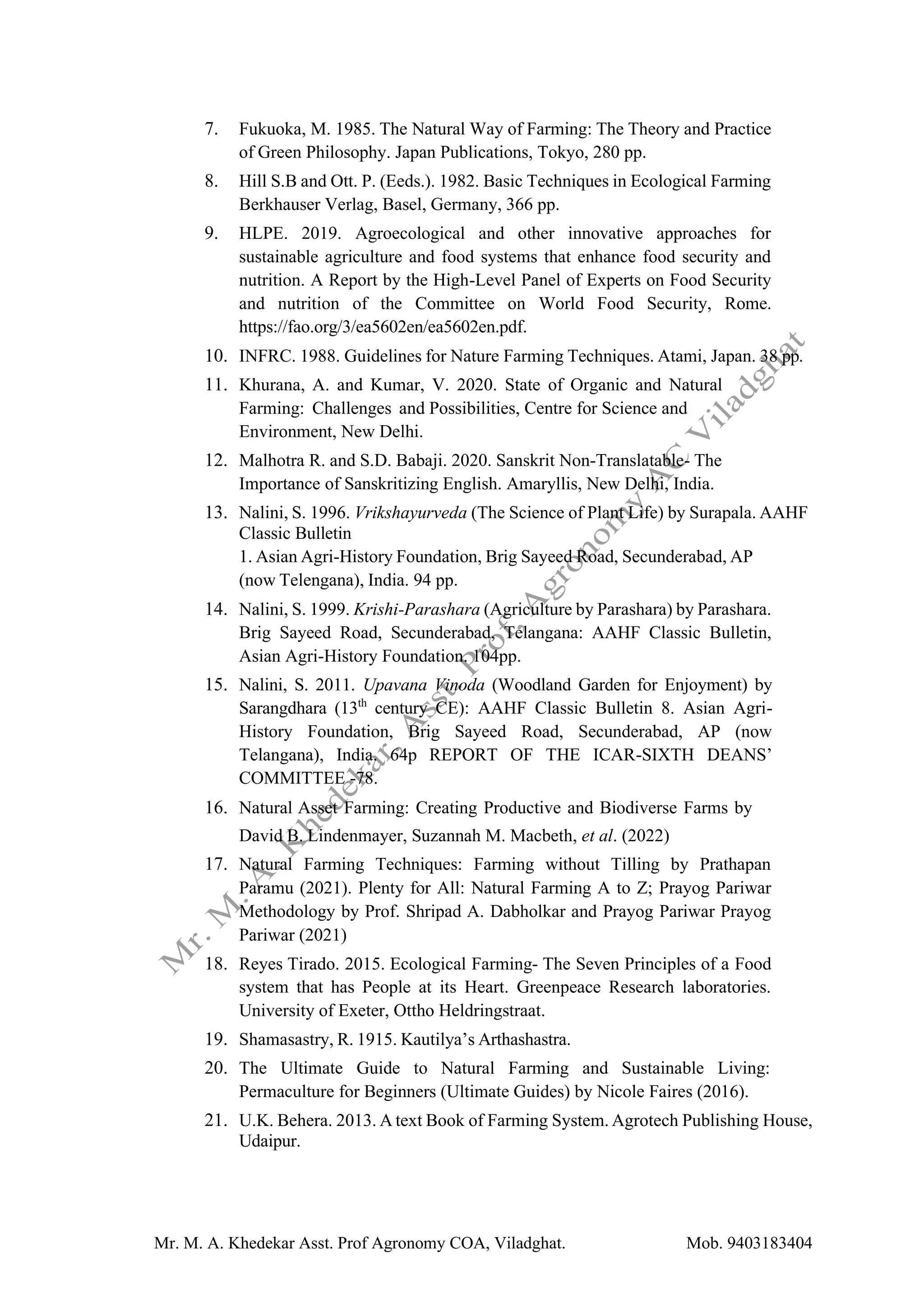
7. Fukuoka, M. 1985. The Natural Way of Farming: The Theory and Practice
of Green Philosophy. Japan Publications, Tokyo, 280 pp.
8. Hill S.B and Ott. P. (Eeds.). 1982. Basic Techniques in Ecological Farming
Berkhauser Verlag, Basel, Germany, 366 pp.
9. HLPE. 2019. Agroecological and other innovative approaches for
sustainable agriculture and food systems that enhance food security and
nutrition. A Report by the High-Level Panel of Experts on Food Security
and nutrition of the Committee on World Food Security, Rome.
https://fao.org/3/ea5602en/ea5602en.pdf.
10. INFRC. 1988. Guidelines for Nature Farming Techniques. Atami, Japan. 38 pp.
11. Khurana, A. and Kumar, V. 2020. State of Organic and Natural
Farming: Challenges and Possibilities, Centre for Science and
Environment, New Delhi.
12. Malhotra R. and S.D. Babaji. 2020. Sanskrit Non-Translatable- The
Importance of Sanskritizing English. Amaryllis, New Delhi, India.
13. Nalini, S. 1996. Vrikshayurveda (The Science of Plant Life) by Surapala. AAHF
Classic Bulletin
1. Asian Agri-History Foundation, Brig Sayeed Road, Secunderabad, AP
(now Telengana), India. 94 pp.
14. Nalini, S. 1999. Krishi-Parashara (Agriculture by Parashara) by Parashara.
Brig Sayeed Road, Secunderabad, Telangana: AAHF Classic Bulletin,
Asian Agri-History Foundation. 104pp.
15. Nalini, S. 2011. Upavana Vinoda (Woodland Garden for Enjoyment) by
Sarangdhara (13th
century CE): AAHF Classic Bulletin 8. Asian Agri-
History Foundation, Brig Sayeed Road, Secunderabad, AP (now
Telangana), India. 64p REPORT OF THE ICAR-SIXTH DEANS’
COMMITTEE -78.
16. Natural Asset Farming: Creating Productive and Biodiverse Farms by
David B. Lindenmayer, Suzannah M. Macbeth, et al. (2022)
17. Natural Farming Techniques: Farming without Tilling by Prathapan
Paramu (2021). Plenty for All: Natural Farming A to Z; Prayog Pariwar
Methodology by Prof. Shripad A. Dabholkar and Prayog Pariwar Prayog
Pariwar (2021)
18. Reyes Tirado. 2015. Ecological Farming- The Seven Principles of a Food
system that has People at its Heart. Greenpeace Research laboratories.
University of Exeter, Ottho Heldringstraat.
19. Shamasastry, R. 1915. Kautilya’s Arthashastra.
20. The Ultimate Guide to Natural Farming and Sustainable Living:
Permaculture for Beginners (Ultimate Guides) by Nicole Faires (2016).
21. U.K. Behera. 2013. A text Book of Farming System. Agrotech Publishing House,
Udaipur.
6.
Mr. M. A.Khedekar Asst. Prof Agronomy COA, Viladghat. Mob. 9403183404
EXERCISE NO. 1
VISIT OF NATURAL FARM AND CHEMICAL-FREE
TRADITIONAL FARMS TO STUDY THE VARIOUS
COMPONENTS AND OPERATIONS OF NATURAL FARMING
PRINCIPLES AT THE FARM
a. Core Principles of Natural Farming
Natural Farming is a chemical-free, ecological agriculture approach that focuses on
living soil, indigenous practices, and minimal external inputs.
Key Principles:
1. No Tillage – Avoid disturbing soil structure and microbial life.
2. No Chemical Fertilizers – Rely on organic and biological inputs.
3. No Pesticides – Use natural pest control methods.
4. No Weeding by Tillage or Herbicides – Manage weeds through mulching and
biodiversity.
5. Use of Indigenous Seeds – Preserve and plant locally adapted varieties.
6. Mulching & Cover Crops – Retain moisture, suppress weeds, and enrich soil.
b. Key Components at the Farm
1. Soil Health Management
• Jeevamrut – A microbial-rich solution to boost soil life.
• Bijamrut – Seed treatment to prevent disease and improve germination.
• Mulching – Conserves moisture and adds organic matter.
2. Water Management
• Moisture Retention – Achieved through mulching and cover crops.
• Contour Bunding – Prevents erosion and conserves water.
3. Pest & Disease Control
• Natural repellents: Agniastra, Brahmastra, Neemastra.
• Companion planting and encouraging beneficial insects.
4. Crop Diversification & Rotation
• Intercropping and integration of nitrogen-fixing plants.
5. Seed Preservation
• Indigenous seed saving.
7.
Mr. M. A.Khedekar Asst. Prof Agronomy COA, Viladghat. Mob. 9403183404
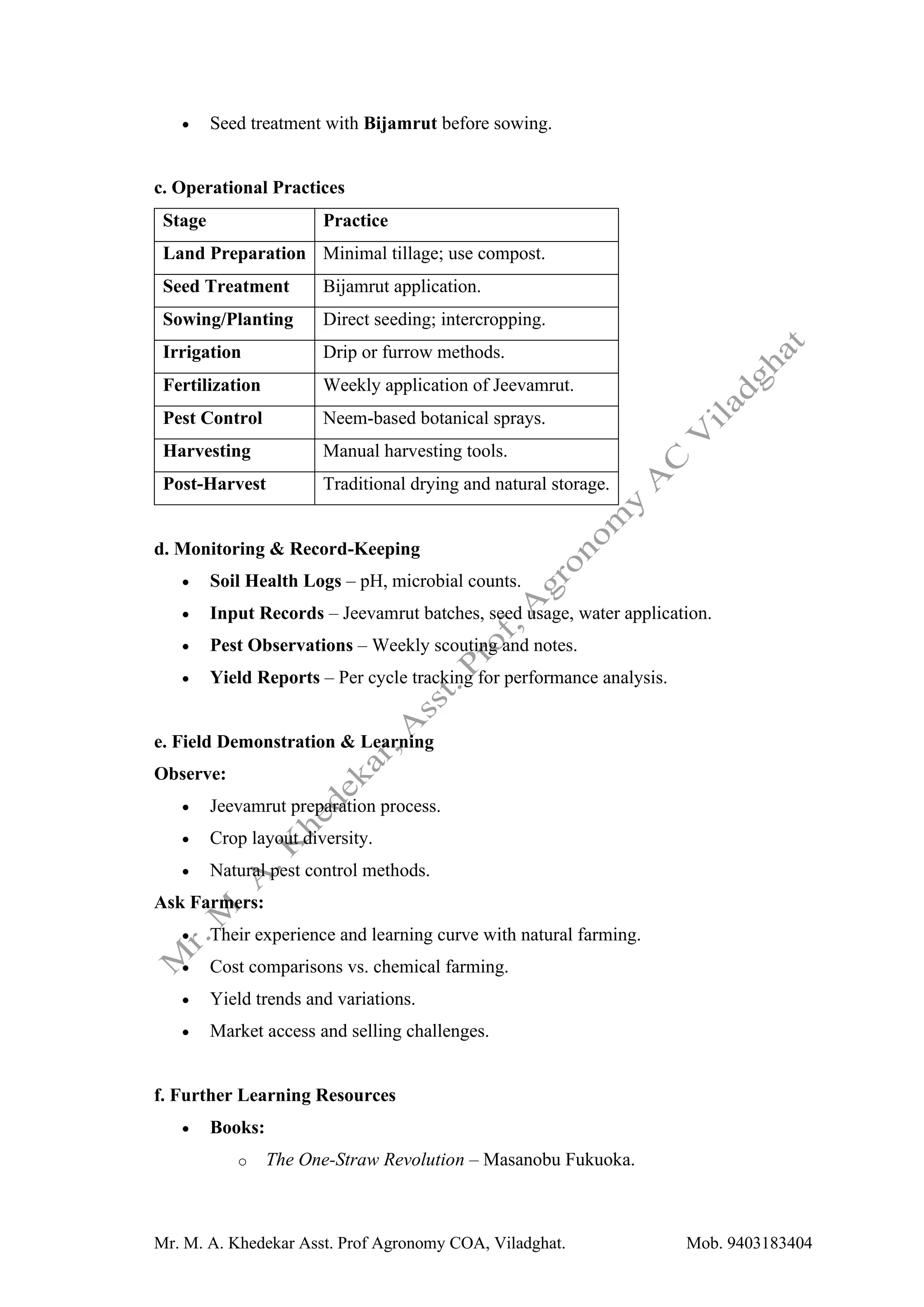
• Seed treatment with Bijamrut before sowing.
c. Operational Practices
Stage Practice
Land Preparation Minimal tillage; use compost.
Seed Treatment Bijamrut application.
Sowing/Planting Direct seeding; intercropping.
Irrigation Drip or furrow methods.
Fertilization Weekly application of Jeevamrut.
Pest Control Neem-based botanical sprays.
Harvesting Manual harvesting tools.
Post-Harvest Traditional drying and natural storage.
d. Monitoring & Record-Keeping
• Soil Health Logs – pH, microbial counts.
• Input Records – Jeevamrut batches, seed usage, water application.
• Pest Observations – Weekly scouting and notes.
• Yield Reports – Per cycle tracking for performance analysis.
e. Field Demonstration & Learning
Observe:
• Jeevamrut preparation process.
• Crop layout diversity.
• Natural pest control methods.
Ask Farmers:
• Their experience and learning curve with natural farming.
• Cost comparisons vs. chemical farming.
• Yield trends and variations.
• Market access and selling challenges.
f. Further Learning Resources
• Books:
o The One-Straw Revolution – Masanobu Fukuoka.
8.
Mr. M. A.Khedekar Asst. Prof Agronomy COA, Viladghat. Mob. 9403183404
o Subhash Palekar’s Natural Farming guides.
• Videos:
o YouTube tutorials and demonstrations on natural farming techniques.
• Workshops:
o ZBNF (Zero Budget Natural Farming) trainings.
o Permaculture courses.
9.
Mr. M. A.Khedekar Asst. Prof Agronomy COA, Viladghat. Mob. 9403183404
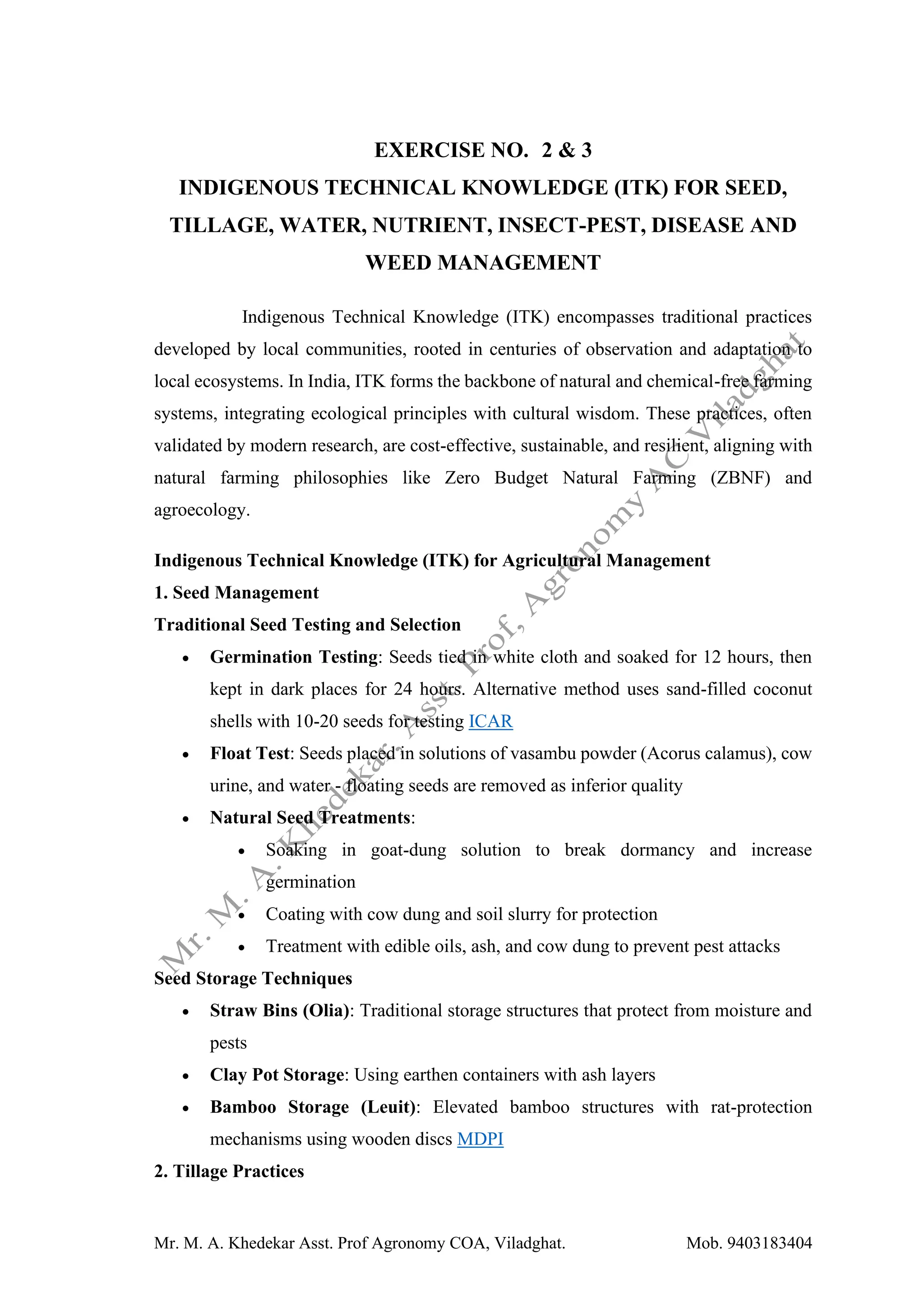
EXERCISE NO. 2 & 3
INDIGENOUS TECHNICAL KNOWLEDGE (ITK) FOR SEED,
TILLAGE, WATER, NUTRIENT, INSECT-PEST, DISEASE AND
WEED MANAGEMENT
Indigenous Technical Knowledge (ITK) encompasses traditional practices
developed by local communities, rooted in centuries of observation and adaptation to
local ecosystems. In India, ITK forms the backbone of natural and chemical-free farming
systems, integrating ecological principles with cultural wisdom. These practices, often
validated by modern research, are cost-effective, sustainable, and resilient, aligning with
natural farming philosophies like Zero Budget Natural Farming (ZBNF) and
agroecology.
Indigenous Technical Knowledge (ITK) for Agricultural Management
1. Seed Management
Traditional Seed Testing and Selection
• Germination Testing: Seeds tied in white cloth and soaked for 12 hours, then
kept in dark places for 24 hours. Alternative method uses sand-filled coconut
shells with 10-20 seeds for testing ICAR
• Float Test: Seeds placed in solutions of vasambu powder (Acorus calamus), cow
urine, and water - floating seeds are removed as inferior quality
• Natural Seed Treatments:
• Soaking in goat-dung solution to break dormancy and increase
germination
• Coating with cow dung and soil slurry for protection
• Treatment with edible oils, ash, and cow dung to prevent pest attacks
Seed Storage Techniques
• Straw Bins (Olia): Traditional storage structures that protect from moisture and
pests
• Clay Pot Storage: Using earthen containers with ash layers
• Bamboo Storage (Leuit): Elevated bamboo structures with rat-protection
mechanisms using wooden discs MDPI
2. Tillage Practices
10.
Mr. M. A.Khedekar Asst. Prof Agronomy COA, Viladghat. Mob. 9403183404
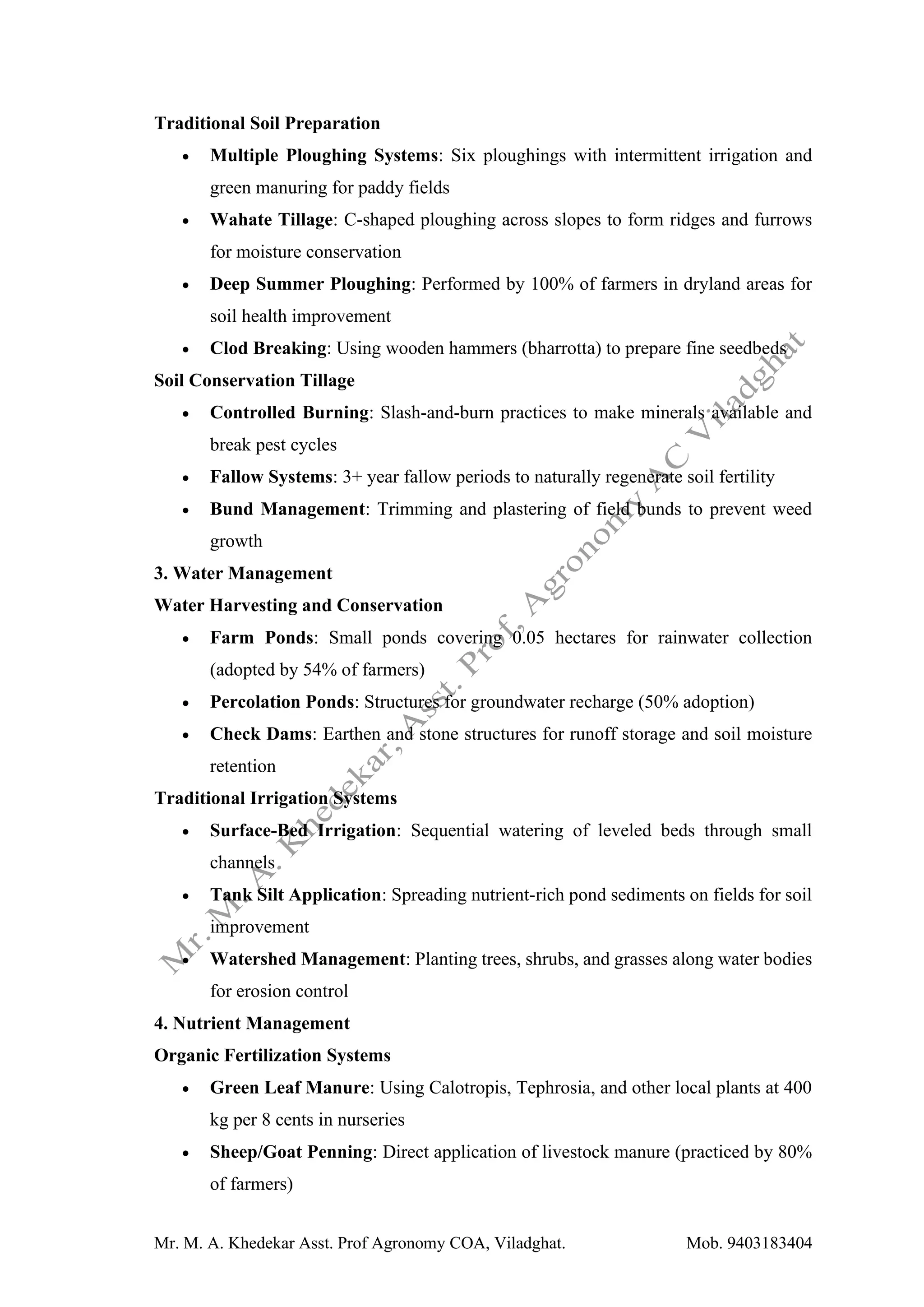
Traditional Soil Preparation
• Multiple Ploughing Systems: Six ploughings with intermittent irrigation and
green manuring for paddy fields
• Wahate Tillage: C-shaped ploughing across slopes to form ridges and furrows
for moisture conservation
• Deep Summer Ploughing: Performed by 100% of farmers in dryland areas for
soil health improvement
• Clod Breaking: Using wooden hammers (bharrotta) to prepare fine seedbeds
Soil Conservation Tillage
• Controlled Burning: Slash-and-burn practices to make minerals available and
break pest cycles
• Fallow Systems: 3+ year fallow periods to naturally regenerate soil fertility
• Bund Management: Trimming and plastering of field bunds to prevent weed
growth
3. Water Management
Water Harvesting and Conservation
• Farm Ponds: Small ponds covering 0.05 hectares for rainwater collection
(adopted by 54% of farmers)
• Percolation Ponds: Structures for groundwater recharge (50% adoption)
• Check Dams: Earthen and stone structures for runoff storage and soil moisture
retention
Traditional Irrigation Systems
• Surface-Bed Irrigation: Sequential watering of leveled beds through small
channels
• Tank Silt Application: Spreading nutrient-rich pond sediments on fields for soil
improvement
• Watershed Management: Planting trees, shrubs, and grasses along water bodies
for erosion control
4. Nutrient Management
Organic Fertilization Systems
• Green Leaf Manure: Using Calotropis, Tephrosia, and other local plants at 400
kg per 8 cents in nurseries
• Sheep/Goat Penning: Direct application of livestock manure (practiced by 80%
of farmers)
11.
Mr. M. A.Khedekar Asst. Prof Agronomy COA, Viladghat. Mob. 9403183404
• Farm Yard Manure (FYM): Universal practice among traditional farmers
(100% adoption)
• Amritpani: Fermented mixture of cow ghee, cow dung, and honey in water to
enhance soil microbial activity
Traditional Soil Amendments
• Tank Silt: Application of nutrient-rich pond sediments (29% adoption)
• Ash Application: Wood ash for nutrient supply and pest control
• Bone Meal: Buried cattle bones near tree basins for phosphorus supply
• Forest Humus (Surubuk): Collection and application of decomposed forest
organic matter
5. Insect-Pest Management
Plant-Based Pest Control
• Botanical Pesticides:
• Neem (Azadirachta indica) extracts, leaves, cake, and oil
• Bitter gourd (Momordica charantia) extracts as repellents
• Garlic-chili-soap combinations for pod borers and sucking pests
• Aromatic Repellents: Pelah besar (Goniothalamus scortechinii) branches placed
in fields to repel rodents
Physical and Cultural Controls
• Trap Cropping: Marigold with tomato/brinjal for nematode control; castor
around groundnut for pest diversion
• Manual Methods: Hand-picking pests, beating metal objects to repel birds
• Timing Adjustments: Coordinating planting/harvesting with pest life cycles
• Ash Applications: Dusting crops with wood ash for pest deterrence
6. Disease Management
Preventive Measures
• Soil Sterilization: Burning crop residues in nursery beds to eliminate pathogens
• Seed Treatments: Using cow urine, buttermilk, and botanical extracts
• Resistant Varieties: Maintaining local seed varieties with natural disease
resistance
• Field Sanitation: Removal and burning of infected plant material
Traditional Disease Suppressants
• Fermented Plant Extracts: Preparation of bio-formulations from local medicinal
plants
12.
Mr. M. A.Khedekar Asst. Prof Agronomy COA, Viladghat. Mob. 9403183404
• Organic Amendments: Compost and vermicompost to improve plant immunity
• Mud and Lime Applications: Physical barriers against soilborne pathogens
7. Weed Management
Mechanical and Cultural Methods
• Tillage-Based Control: Use of tooth harrow (Bida) after garamai (soil
preparation)
• Mulching: Application of crop residues like sugarcane trash and sunflower stalks
• Cover Crops: Growing vegetation to suppress weeds (9.6% adoption)
• Hand Weeding: Manual removal combined with organic matter incorporation
Allelopathic Practices
• Kochila Leaves: Incorporation of Strychnos nuxvomica leaves for weed
suppression
• Natural Herbicides: Using plant extracts with weed-suppressive properties
• Companion Planting: Strategic intercropping to reduce weed pressure
Key Principles of ITK Systems
Sustainability Features
• Ecological Balance: Emphasis on repelling rather than killing beneficial
organisms
• Resource Recycling: Use of locally available organic materials
• Knowledge Transmission: Oral tradition and community-based learning
• Adaptability: Practices modified based on local conditions and observations
Scientific Validation
Many ITK practices have been scientifically validated for their effectiveness:
• Plant-based pesticides show proven repellent properties
• Organic amendments improve soil health and water retention
• Traditional storage methods effectively prevent post-harvest losses
• Integrated approaches reduce dependency on external inputs
13.
Mr. M. A.Khedekar Asst. Prof Agronomy COA, Viladghat. Mob. 9403183404
EXERCISE NO. 4
ON-FARM INPUTS PREPARATION METHODS AND
PROTOCOLS
In natural farming, on-farm inputs are prepared using locally available, natural,
and organic materials to enhance soil fertility, manage pests, and promote plant growth
without relying on synthetic chemicals. Below is a concise overview of the different types
of on-farm inputs commonly used in natural farming, based on principles like those of
Zero Budget Natural Farming (ZBNF) and other organic practices.
On-farm made Natural Farming bio-inputs like Jeevamrut, Beejamrut, etc are
derived from natural resources like plant and animal materials. They play a crucial role
in promoting soil health, enhancing plant growth, and reducing reliance on externally
purchased synthetic chemical inputs. These NF bio-inputs are rich in beneficial microbes,
enzymes, and organic compounds, supporting nutrient cycling, pest management, and
soil rejuvenation, making them vital for sustainable agricultural practices.
Preparing on-farm inputs is a critical aspect of natural farming, as it allows
farmers to produce their own resources like compost, biofertilizers, biopesticides, and
seed treatments using locally available materials.
1. Liquid Manures: -
a. Beejamrut (Beejamrutha or Bheejamrutham): -
➢ Composition:
• 5 kg fresh desi cow dung
• 5 liters desi cow urine
• 50-100 g virgin soil (preferably from forests, banyan trees, or termite mounds)
• 50 g calcium chloride
• 20 liters water
➢ Preparation:
• Mix all ingredients thoroughly.
• Ferment the mixture for 24 hours.
➢ Application Methods:
• Seed Dressing: Coat seeds with Beejamrut and dry in the shade before sowing.
• Seedling Root Dip: Dip seedling roots in Beejamrut before planting.
14.
Mr. M. A.Khedekar Asst. Prof Agronomy COA, Viladghat. Mob. 9403183404
➢ Benefits:
• Protects seeds and seedlings from soil-borne and seed-borne pathogens.
• Reduces germination time.
• Enhances seedling vigor.
• Promotes root proliferation and increases root dry weight.
• Improves nitrogen, nutrient, and water uptake.
• Enhances shoot and root length.
• Improves overall crop performance through beneficial microbial activity.
• Positions microbes in soil to colonize seedling roots, protecting against diseases
and pests.
a. Ghan-Jeevamrut:
• Description: A solid organic fertilizer prepared using desi cow dung and other
natural ingredients to enhance soil fertility and microbial activity.
• Ingredients:
❖ Desi cow dung (150 kg, or as specified)
❖ Jaggery (1 kg)
❖ Pulse flour (2 kg)
❖ Virgin fertile soil for microbial culture (50-100 g)
❖ Desi cow urine (as required, depending on method)
• Preparation Methods:
1. Method 1:
▪ Mix 150 kg desi cow dung, 1 kg jaggery, 2 kg pulse flour, and 50-
100 g virgin soil.
▪ Add a small amount of cow urine as needed to bind the mixture.
▪ Dry in shade for 2-4 days.
▪ Grind into small aggregates after drying.
▪ Store in shade; usable for up to 6 months.
2. Method 2:
▪ Take 1-1.5 quintals (100-150 kg) of well-rotted desi cow dung
manure.
▪ Sprinkle 8-10 liters of Jeevamrut solution and mix well.
▪ Cover and store in shade; usable for up to 6 months.
▪ Broadcast uniformly in the field.
3. Method 3:
15.
Mr. M. A.Khedekar Asst. Prof Agronomy COA, Viladghat. Mob. 9403183404
▪ Mix 1.5 quintals of dry biogas slurry, 1 kg jaggery, 2 kg pulse
flour, and a handful of virgin soil.
▪ Alternatively, sprinkle Jeevamrut solution on the slurry (no need
to add jaggery, pulse flour, or soil separately).
▪ Broadcast uniformly in the field.
4. Method 4 (Best Quality):
▪ Form a pile of fresh cow dung (partially dried for 3-4 days) to a
height of 1.5 feet (e.g., 12x3 feet).
▪ Make holes 1 foot apart using a wooden log and fill with prepared
Jeevamrut.
▪ Turn the pile after one week, remake holes, and refill with
Jeevamrut.
▪ Repeat the process 2-3 times over 30-35 days.
▪ Pound into small particles and broadcast in the field or store in
shade under gunny bags.
• Application:
o Recommended dose: 800-1000 kg per acre as a basal dose.
o Can also be applied as top dressing based on crop duration.
o Broadcast uniformly in the field.
• Storage:
o Store in shade, covered with gunny bags.
o Usable for up to 6 months.
This solid formulation enhances soil microbial activity and supports sustainable crop
growth. Let me know if you need further clarification or specific applications
Advantages
• Soil Health: Enhances soil microbial activity, improving soil structure and
fertility.
• Nutrient Availability: Increases availability of nitrogen, phosphorus, and
micronutrients through microbial decomposition.
• Crop Growth: Promotes vigorous root and shoot growth, leading to higher
yields.
• Disease Resistance: Beneficial microbes suppress soil-borne pathogens, reducing
disease incidence.
• Sustainability: Reduces dependency on chemical fertilizers, supporting eco-
16.
Mr. M. A.Khedekar Asst. Prof Agronomy COA, Viladghat. Mob. 9403183404
friendly farming.
• Cost-Effective: Made from locally available materials, lowering input costs.
• Versatility: Suitable for a wide range of crops, from cereals to fruit trees.
Crop-Specific Benefits
• Cereals: Improves grain filling and yield by enhancing nutrient uptake.
• Pulses: Boosts nodulation and nitrogen fixation, increasing pod yield.
• Vegetables: Enhances fruit size, quality, and shelf life through better nutrient
absorption.
• Fruit Crops: Improves fruit set and quality, reduces flower drop, and enhances
tree vigor.
• Cash Crops: Increases biomass and yield, improves resistance to pests and stress.
C. Jeevamrut (Jivamrita, Jeevamrutha, Jeevamrutham):
• Description: A fermented microbial culture used in organic farming to enhance
soil fertility and promote crop growth through microbial activity.
• Ingredients:
o 10 kg fresh desi cow dung
o 10 liters aged desi cow urine
o 1.5 kg cane jaggery or sweet fruit pulp
o 1.5 kg pulse flour
o 180 liters water
o 50-100 g virgin soil (from banyan tree areas, forests, or termite mounds)
as a microbial inoculant
• Preparation:
o Mix all ingredients in a barrel.
o Stir daily and ferment in the shade for 48 hours.
o Fermentation duration: 3-4 days in summer, 6-7 days in winter.
o During fermentation, aerobic and anaerobic bacteria from cow dung and
urine multiply, decomposing organic matter. Jaggery enhances
fermentation, and pulse flour provides protein energy.
• Crop wise Use and Protocols:
o Cereals (Rice, Wheat, Maize):
▪ Application: 300-500 liters/acre, applied twice monthly via
irrigation water or drip/sprinkler systems.
17.
Mr. M. A.Khedekar Asst. Prof Agronomy COA, Viladghat. Mob. 9403183404
▪ Protocol: Add to irrigation water during land preparation or at
tillering stage (20-30 days after sowing). For foliar spray, dilute
1:10 with water and apply during early morning.
o Pulses (Lentils, Chickpeas, Pigeon Pea):
▪ Application: 200-400 liters/acre, applied twice monthly.
▪ Protocol: Mix with irrigation water during sowing or vegetative
growth (25-35 days). Foliar spray (1:10 dilution) at flowering
stage to boost nodulation.
o Vegetables (Tomato, Brinjal, Okra, Leafy Greens):
▪ Application: 400-600 liters/acre, applied every 15-20 days.
▪ Protocol: Apply through drip irrigation during transplanting or
early growth. For foliar spray, dilute 1:10 and apply to leaves in
the evening to enhance fruit quality.
o Fruit Crops (Mango, Citrus, Banana):
▪ Application: 500-600 liters/acre or 10-15 liters per tree, applied
twice monthly.
▪ Protocol: Use in drip irrigation around the drip line or as a soil
drench during pre-flowering and fruit-setting stages. Foliar spray
(1:10 dilution) can be used for young trees.
o Cash Crops (Cotton, Sugarcane):
▪ Application: 400-600 liters/acre, applied every 15-20 days.
▪ Protocol: Apply via irrigation during land preparation or active
growth phases. Foliar spray (1:10 dilution) during vegetative
growth improves biomass.
• General Application Guidelines:
o Dosage: 200-600 liters/acre, depending on crop type and soil conditions,
applied twice monthly.
o Methods:
▪ Add to irrigation water (drip or sprinkler preferred).
▪ Use as a foliar spray (dilute 1:10 with water).
o Precaution: Apply in early morning or evening to avoid leaf burn during
foliar spraying. Ensure uniform application for optimal nutrient
distribution.
o Storage: Use within 7 days of preparation for maximum microbial
18.
Mr. M. A.Khedekar Asst. Prof Agronomy COA, Viladghat. Mob. 9403183404
activity. Store in a shaded, cool place.
• Advantages:
o Soil Fertility: Acts as a catalyst to boost soil microorganism activity,
including earthworms, improving soil structure.
o Nutrient Availability: Enhances availability of nitrogen, phosphorus, and
micronutrients through microbial decomposition.
o Crop Growth: Promotes vigorous root and shoot growth, leading to
higher yields.
o Disease Suppression: Beneficial microbes reduce soil-borne pathogens,
improving crop resilience.
o Sustainability: Reduces reliance on chemical fertilizers, supporting eco-
friendly farming.
o Cost-Effective: Made from on-farm ingredients, lowering input costs.
o Crop-Specific Benefits:
▪ Cereals: Improves grain quality and yield through enhanced
nutrient uptake.
▪ Pulses: Boosts nitrogen fixation and pod yield.
▪ Vegetables: Enhances fruit size, quality, and shelf life.
▪ Fruit Crops: Improves fruit set, reduces flower drop, and
enhances tree vigor.
▪ Cash Crops: Increases biomass, improves pest resistance, and
supports higher yields.
• Note: Jeevamrut from indigenous (desi) cow dung and urine is most effective due
to higher beneficial microbial populations.
2. Botanical concoctions for insect Management:
As such, natural farming promotes the use of various kashaya
(decoctions) from locally sourced ingredients like cow urine, neem leaves, green
chilies, garlic, tobacco, sour buttermilk, etc., to act as natural fungicides and
pesticides. Some of the prominent ones used are Agniastra, Bramhastra,
Neemastra and Dashparni ark. Prophylactic spray of these botanical concoctions
every 15 days or in a month depending upon the crops are recommended under
natural farming.
A. Agniastra: -
Agniastra is an organic biopesticide prepared from local cow urine and
19.
Mr. M. A.Khedekar Asst. Prof Agronomy COA, Viladghat. Mob. 9403183404
natural ingredients to control various crop pests effectively. It is a fermented
solution used as a foliar spray to manage pest infestations in organic farming.
Ingredients
• Local cow urine: 20 liters
• Crushed tobacco powder: 500 g
• Green chili: 0.5 kg
• Garlic: 0.25 kg
• Neem leaves: 5 kg
Preparation
• Combine all ingredients in a pot with 20 liters of local cow urine.
• Stir thoroughly, bring to a boil, and allow to cool.
• Ferment the mixture for 48 hours in a shaded area.
• After fermentation, filter the solution using a cloth.
• Store the filtered solution in a cool, shaded place; usable for up to 3 months.
Crop wise Use and Protocols
• Cereals (Rice, Wheat, Maize):
o Target Pests: Stem borer, leaf roller.
o Application: Dilute 6-8 liters of filtered Agniastra in 200 liters of water
per acre. Spray during early pest infestation or at tillering stage (20-30
days after sowing).
o Protocol: Apply as a foliar spray in the early morning or late evening to
avoid leaf burn. Ensure thorough coverage of leaves and stems.
• Pulses (Lentils, Chickpeas, Pigeon Pea):
o Target Pests: Pod borer.
o Application: Use 6-8 liters in 200 liters of water per acre, applied every
15-20 days during pod formation.
o Protocol: Spray evenly on foliage, focusing on pod-bearing areas. Repeat
if pest resurgence is observed.
• Vegetables (Tomato, Brinjal, Okra):
o Target Pests: Fruit borer, leaf roller.
o Application: Dilute 6-8 liters in 200 liters of water per acre, applied every
10-15 days during flowering and fruiting stages.
o Protocol: Spray on leaves and fruits, ensuring complete coverage. Apply
during cooler parts of the day to maximize efficacy.
20.
Mr. M. A.Khedekar Asst. Prof Agronomy COA, Viladghat. Mob. 9403183404
• Fruit Crops (Mango, Citrus, Banana):
o Target Pests: Fruit borer, leaf-eating pests.
o Application: Use 6-8 liters in 200 liters of water per acre or 1-2 liters per
tree, applied every 15-20 days during fruit development.
o Protocol: Spray on foliage and fruit clusters. For larger trees, ensure the
spray reaches the canopy. Avoid spraying during flowering to protect
pollinators.
• Cash Crops (Cotton, Sugarcane):
o Target Pests: Bollworm (cotton), stem borer (sugarcane).
o Application: Dilute 6-8 liters in 200 liters of water per acre, applied every
15 days during active growth or pest appearance.
o Protocol: Spray uniformly on leaves and stems. Monitor pest levels and
reapply as needed.
General Application Guidelines
• Dosage: 6-8 liters of filtered Agniastra diluted in 200 liters of water per acre.
• Method: Apply as a foliar spray using a sprayer for uniform coverage.
• Frequency: Spray every 10-20 days, depending on pest pressure and crop stage.
• Precaution:
o Apply during early morning or late evening to prevent leaf burn and
ensure better absorption.
o Avoid spraying during heavy rain or strong winds.
o Use protective gear during preparation and application due to the strong
odor and potential irritation from tobacco and chili.
• Storage: Store in a cool, shaded place in a sealed container. Use within 3 months
for maximum potency.
Advantages
• Pest Control: Effectively controls pests like leaf roller, stem borer, fruit borer,
and pod borer.
• Organic Solution: Made from natural ingredients, reducing reliance on chemical
pesticides.
• Soil and Crop Safety: Safe for crops, soil microorganisms, and beneficial insects
when used correctly.
• Cost-Effective: Utilizes locally available ingredients, lowering input costs.
• Environmental Benefits: Supports eco-friendly farming by minimizing chemical
21.
Mr. M. A.Khedekar Asst. Prof Agronomy COA, Viladghat. Mob. 9403183404
residues in soil and water.
• Crop-Specific Benefits:
o Cereals: Reduces stem and leaf damage, improving grain yield.
o Pulses: Protects pods, enhancing yield and quality.
o Vegetables: Prevents fruit damage, improving marketable produce.
o Fruit Crops: Reduces fruit loss and improves fruit quality.
o Cash Crops: Minimizes pest-related yield losses, supporting higher
productivity.
Notes
• Agniastra is most effective when used at the early stages of pest infestation.
• Regular monitoring of pest populations is recommended to optimize application
timing.
• Combine with other organic practices like crop rotation and intercropping for
integrated pest management.
B. Brahmastra: Description
Brahmastra is an organic biopesticide formulated from desi cow urine and a paste of
specific plant leaves, designed to control sucking pests, fruit borers, and pod borers in
organic farming. It is applied as a foliar spray after fermentation.
Ingredients
• Desi cow urine: 10 liters
• Paste of leaves (2 kg each):
o Neem
o Pongamia (karanj)
o Custard apple
o Castor
o Datura
Preparation
• Manually crush 2 kg each of neem, Pongamia, custard apple, castor, and datura
leaves into a paste.
• Mix the paste with 10 liters of desi cow urine in a pot.
• Boil the mixture until frothing appears.
• Filter the boiled mixture using a cloth.
• Ferment the filtered solution in the shade for 48 hours, stirring twice daily.
• Store in a cool, shaded place; use within one month for maximum efficacy.
22.
Mr. M. A.Khedekar Asst. Prof Agronomy COA, Viladghat. Mob. 9403183404
Cropwise Use and Protocols
• Cereals (Rice, Wheat, Maize):
o Target Pests: Sucking pests (e.g., aphids, whiteflies), leaf borers.
o Application: Dilute 6-8 liters of Brahmastra in 200 liters of water per acre.
Spray during early pest infestation or at tillering stage (20-30 days after
sowing).
o Protocol: Apply as a foliar spray in early morning or late evening,
ensuring thorough coverage of leaves and stems.
• Pulses (Lentils, Chickpeas, Pigeon Pea):
o Target Pests: Pod borer, sucking pests (e.g., aphids).
o Application: Use 6-8 liters in 200 liters of water per acre, applied every
15-20 days during pod formation.
o Protocol: Spray evenly on foliage and pods. Repeat application if pest
pressure persists.
• Vegetables (Tomato, Brinjal, Okra):
o Target Pests: Fruit borer, sucking pests (e.g., whiteflies, thrips).
o Application: Dilute 6-8 liters in 200 liters of water per acre, applied every
10-15 days during flowering and fruiting.
o Protocol: Spray on leaves and fruits, focusing on pest-prone areas. Apply
during cooler parts of the day.
• Fruit Crops (Mango, Citrus, Banana):
o Target Pests: Fruit borer, sucking pests (e.g., mealybugs, scale insects).
o Application: Use 6-8 liters in 200 liters of water per acre or 1-2 liters per
tree, applied every 15-20 days during fruit development.
o Protocol: Spray on foliage and fruit clusters, ensuring canopy coverage.
Avoid spraying during flowering to protect pollinators.
• Cash Crops (Cotton, Sugarcane):
o Target Pests: Bollworm (cotton), sucking pests (e.g., jassids, aphids).
o Application: Dilute 6-8 liters in 200 liters of water per acre, applied every
15 days during active growth or pest appearance.
o Protocol: Spray uniformly on leaves and stems. Monitor pest levels and
reapply as needed.
General Application Guidelines
• Dosage: 6-8 liters of filtered Brahmastra diluted in 200 liters of water per acre.
23.
Mr. M. A.Khedekar Asst. Prof Agronomy COA, Viladghat. Mob. 9403183404
• Method: Apply as a foliar spray using a sprayer for uniform coverage.
• Frequency: Spray every 10-20 days, depending on pest pressure and crop stage.
• Precaution:
o Apply during early morning or late evening to prevent leaf burn and
ensure better absorption.
o Avoid spraying during heavy rain or strong winds.
o Use protective gear during preparation and application due to potential
irritation from datura and other ingredients.
• Storage: Store in a sealed container in a cool, shaded place. Use within one month
for optimal potency.
Advantages
• Pest Control: Effectively manages sucking pests (e.g., aphids, whiteflies, thrips),
fruit borers, and pod borers.
• Organic Solution: Made from natural plant-based ingredients and cow urine,
reducing reliance on chemical pesticides.
• Crop Safety: Safe for crops and beneficial insects when applied correctly.
• Cost-Effective: Utilizes locally available plant materials and cow urine,
minimizing input costs.
• Environmental Benefits: Promotes eco-friendly farming by reducing chemical
residues in soil and water.
• Crop-Specific Benefits:
o Cereals: Protects leaves and stems, improving grain yield.
o Pulses: Safeguards pods, enhancing yield and quality.
o Vegetables: Prevents fruit damage, improving marketable produce.
o Fruit Crops: Reduces fruit loss and improves quality.
o Cash Crops: Minimizes pest-related yield losses, supporting higher
productivity.
Notes
• Brahmastra is most effective when applied at the early stages of pest infestation.
• Regular pest monitoring is recommended to optimize application timing.
• Combine with other organic practices (e.g., crop rotation, intercropping) for
integrated pest management.
• Handle datura with care due to its toxic properties; avoid contact with skin and
eyes during preparation.
24.
Mr. M. A.Khedekar Asst. Prof Agronomy COA, Viladghat. Mob. 9403183404
C. Neemastra
Neemastra is an organic biopesticide formulated from desi cow urine, fresh cow
dung, and neem leaf paste to control sucking pests (e.g., aphids, whiteflies, thrips) and
leaf-eating caterpillars in organic farming. It is applied as a foliar spray after
fermentation.
Ingredients
• Desi cow urine: 5 liters
• Fresh desi cow dung: 1 kg
• Neem leaf paste: 5 kg
• Water: 100 liters
Preparation
• Mix 5 liters of desi cow urine, 1 kg of fresh cow dung, and 5 kg of neem leaf paste
in 100 liters of water.
• Ferment the mixture in a shaded area for 48-96 hours, stirring twice daily.
• Filter the fermented solution using a cloth.
• Store in a cool, shaded place; use within one month for maximum efficacy.
General Application Protocols
• Application Rate: Use 100 liters of filtered Neemastra per acre, diluted in 200
liters of water if needed for sprayer compatibility or better coverage.
• Method: Apply as a foliar spray using a sprayer for uniform distribution.
• Frequency: Spray every 10-20 days, depending on pest pressure and crop stage.
• Timing: Apply in early morning or late evening to prevent leaf burn and ensure
optimal absorption.
• Precautions:
o Avoid spraying during heavy rain or strong winds.
o Use protective gear during preparation and application to avoid skin or
eye irritation from neem paste.
o Ensure thorough filtration to prevent sprayer clogging.
• Storage: Store in a sealed container in a cool, shaded place. Use within one month
for best results.
Advantages
• Pest Control: Effectively controls sucking pests (e.g., aphids, whiteflies, thrips)
and leaf-eating caterpillars.
25.
Mr. M. A.Khedekar Asst. Prof Agronomy COA, Viladghat. Mob. 9403183404
• Organic Solution: Made from natural ingredients, reducing reliance on chemical
pesticides.
• Crop Safety: Safe for crops, soil microorganisms, and beneficial insects when
applied correctly.
• Cost-Effective: Utilizes locally available cow dung, urine, and neem leaves,
lowering input costs.
• Environmental Benefits: Promotes eco-friendly farming by minimizing
chemical residues in soil and water.
Notes
• Neemastra is most effective when applied at the early stages of pest infestation.
• Regular pest monitoring is recommended to optimize application timing.
• Combine with other organic practices (e.g., crop rotation, intercropping) for
integrated pest management.
• Use fresh neem leaves for maximum potency of active compounds.
D. Dashparni Ark
Dashparni Ark is an organic biopesticide prepared from native cow urine, cow
dung, and leaves of ten specific plants, along with other natural ingredients. It is used as
a foliar spray to control borers, maggots, and caterpillars in organic farming.
Ingredients
• Water: 200 liters
• Native cow urine: 20 liters
• Native cow dung: 2 kg
• Leaves (2 kg each) of ten plants: Neem, Karanj (Pongamia), Castor, Sitaphal
(Custard Apple), Bael, Marigold, Tulsi, Dhatura, Mango, Aak (Calotropis)
• Turmeric powder: 500 g
• Asafoetida (heeng) powder: 10 g
• Ginger chutney: 500 g
• Dry ginger powder: 200 g
• Tobacco powder: 1 kg
• Hot green chili chutney: 1 kg
• Desi garlic chutney: 1 kg
Preparation
• Dissolve 2 kg native cow dung and 20 liters native cow urine in 200 liters of
water; let it sit for 2 hours.
26.
Mr. M. A.Khedekar Asst. Prof Agronomy COA, Viladghat. Mob. 9403183404
• Add 500 g turmeric powder, 500 g ginger chutney, and 10 g asafoetida powder;
mix well and keep in the shade for 24 hours.
• Stir the mixture, then add 200 g dry ginger powder, 1 kg tobacco powder, 1 kg
hot green chili chutney, and 1 kg desi garlic chutney; mix thoroughly and let it sit
for another 24 hours.
• Crush 2 kg each of the ten plant leaves (Neem, Karanj, Castor, Sitaphal, Bael,
Marigold, Tulsi, Dhatura, Mango, Aak) and mix into the solution.
• Cover the mixture with a gunny bag and ferment for 30-40 days, stirring for 2-3
minutes twice daily (morning and evening).
• After fermentation, filter the solution using a cloth.
• Store in a cool, shaded place; use within 2-3 months for maximum efficacy.
General Application Protocols
• Application Rate: Dilute 6-8 liters of filtered Dashparni Ark in 200 liters of water
per acre.
• Method: Apply as a foliar spray using a sprayer for uniform coverage.
• Frequency: Spray every 10-15 days, depending on pest pressure and crop stage.
• Timing: Apply in early morning or late evening to prevent leaf burn and ensure
optimal absorption.
• Precautions:
o Avoid spraying during heavy rain or strong winds.
o Use protective gear during preparation and application to avoid irritation
from ingredients like tobacco, chili, or Dhatura.
o Ensure thorough filtration to prevent sprayer clogging.
o Handle Dhatura with care due to its toxic properties; avoid contact with
skin and eyes.
• Storage: Store in a sealed container in a cool, shaded place. Use within 2-3
months for best results.
Advantages
• Pest Control: Effectively controls borers, maggots, and caterpillars.
• Organic Solution: Made from natural plant-based ingredients and cow products,
reducing reliance on chemical pesticides.
• Crop Safety: Safe for crops, soil microorganisms, and beneficial insects when
applied correctly.
• Cost-Effective: Utilizes locally available materials, lowering input costs.
27.
Mr. M. A.Khedekar Asst. Prof Agronomy COA, Viladghat. Mob. 9403183404
• Environmental Benefits: Promotes eco-friendly farming by minimizing
chemical residues in soil and water.
• Broad-Spectrum Action: The combination of diverse plant extracts and spices
enhances its efficacy against multiple pests.
Notes
• Dashparni Ark is most effective when applied at the early stages of pest
infestation.
• Regular pest monitoring is recommended to optimize application timing.
• Combine with other organic practices (e.g., crop rotation, intercropping) for
integrated pest management.
• Use fresh plant leaves and high-quality ingredients for maximum potency.
3. Botanical concoctions for disease management: -
A. Sonthastra: Preparation, Advantages, and General Protocols
Sonthastra is an organic antifungal spray prepared from dry ginger, desi cow's
milk, and water. It is used as a foliar spray to control fungal diseases in crops, promoting
healthy plant growth in organic farming.
Ingredients
• Dry ginger: 200 g
• Desi cow's milk: 5 liters
• Water: 200 liters
Preparation
• Grind 200 g dry ginger into a fine powder.
• Mix the ginger powder with 2 liters of water and boil until reduced to 1 liter; allow
to cool.
• Boil 5 liters of desi cow's milk once in a pot and let it cool.
• Remove the cream from the milk and reserve it for domestic use.
• Filter the cooled ginger water and boiled milk through a cloth.
• Mix the filtered ginger water and milk with 200 liters of water to prepare the final
solution.
• Store in a cool, shaded place; use within 24-48 hours for maximum efficacy.
General Application Protocols
• Application Rate: Use the prepared 200 liters of Sonthastra solution per acre.
• Method: Apply as a foliar spray using a sprayer for uniform coverage.
• Frequency: Spray every 7-14 days, depending on fungal pressure and crop stage,
28.
Mr. M. A.Khedekar Asst. Prof Agronomy COA, Viladghat. Mob. 9403183404
or as a preventive measure during humid conditions.
• Timing: Apply in early morning or late evening to prevent leaf burn and ensure
optimal absorption.
• Precautions:
o Avoid spraying during heavy rain or strong winds to prevent wash-off.
o Ensure thorough filtration to avoid clogging the sprayer.
o Use protective gear during preparation and application to avoid irritation
from ginger.
o Apply immediately after preparation or within 24-48 hours for best
results.
• Storage: Store in a sealed container in a cool, shaded place. Use within 24-48
hours to maintain potency.
Advantages
• Fungal Control: Effectively controls fungal diseases (e.g., powdery mildew, leaf
spot) on crops.
• Organic Solution: Made from natural ingredients, reducing reliance on chemical
fungicides.
• Crop Safety: Safe for crops, soil microorganisms, and beneficial insects when
applied correctly.
• Cost-Effective: Utilizes locally available ingredients like desi cow’s milk and dry
ginger, lowering input costs.
• Environmental Benefits: Promotes eco-friendly farming by minimizing
chemical residues in soil and water.
• Plant Health: Enhances plant resilience by reducing fungal infections, leading to
improved yield and quality.
Notes
• Sonthastra is most effective when applied preventively or at the early stages of
fungal infection.
• Regular monitoring of crops for fungal symptoms (e.g., white patches, leaf spots)
is recommended to optimize application timing.
• Combine with other organic practices (e.g., proper crop spacing, removal of
infected plant debris) for integrated disease management.
• Use fresh desi cow’s milk for optimal microbial activity and efficacy.
B. Khatti lassi (Sour butter milk):
29.
Mr. M. A.Khedekar Asst. Prof Agronomy COA, Viladghat. Mob. 9403183404
Description
Copper-Lassi-Turmeric Spray is an organic formulation designed to control
fungal diseases and act as a virus killer in crops. It is prepared using khatti lassi
(fermented buttermilk), copper, turmeric powder, and water, and applied as a foliar spray
in organic farming.
Ingredients
• Water: 100 liters
• Khatti lassi (3-5 days old): 5 liters
• Small piece of copper
• Turmeric powder: 50 g
Preparation
• Submerge a small piece of copper in 5 liters of khatti lassi (3-5 days old) and let
it sit for 3-5 days.
• Mix the copper-infused khatti lassi with 100 liters of water.
• Dissolve 50 g of turmeric powder in the mixture and stir well.
• Filter the solution through a cloth to remove any residues.
• Store in a cool, shaded place; use within 24-48 hours for maximum efficacy.
General Application Protocols
• Application Rate: Use the prepared 100 liters of Copper-Lassi-Turmeric Spray
per acre.
• Method: Apply as a foliar spray using a sprayer for uniform coverage.
• Frequency: Spray every 7-14 days, depending on fungal or viral pressure, or as
a preventive measure during humid conditions.
• Timing: Apply in early morning or late evening to prevent leaf burn and ensure
optimal absorption.
• Precautions:
o Avoid spraying during heavy rain or strong winds to prevent wash-off.
o Ensure thorough filtration to avoid clogging the sprayer.
o Use protective gear during preparation and application to avoid irritation
from turmeric or copper residues.
o Apply immediately after preparation or within 24-48 hours for best
results.
• Storage: Store in a sealed container in a cool, shaded place. Use within 24-48
hours to maintain potency.
30.
Mr. M. A.Khedekar Asst. Prof Agronomy COA, Viladghat. Mob. 9403183404
C. Use of cow urine:
Apply 30-40 liters of cow urine along with pre- sowing irrigation for controlling
soil and seed borne diseases. It also controls seedling and wilt diseases in plants. The 10-
20% spray of cow urine helps in controlling canopy diseases of crops. While planting
fruit crops, apply 10% urine (one liter cow urine in 10 liter water) in the pits filled with
the mixture of soil and cow dung manure/Ghan Jeevamrut before planting orchard
seedlings. After planting, occasional application of 10-20% cow urine protects the plant
from bacterial and fungal diseases.
D. Saptdhanyankur ark:
Saptdhanyakur Ark is an organic extract made from seven types of sprouted seeds, cow
urine, and water. It is used as a foliar spray to enhance grain shine and weight, reduce
flower and fruit drop, and promote healthy crop development during critical growth
stages in organic farming.
Ingredients
• Seeds (100 g each):
o Sesame (oilseed)
o Moong (mung bean)
o Urad (black gram)
o Cowpea
o Moth (moth bean)
o Gram (chickpea)
o Wheat
• Cow urine: 10 liters
• Water: 200 liters
Preparation
• Soak 100 g of sesame seeds in a small amount of water overnight in a bowl.
• On the second day, mix sesame seeds with 100 g each of moong, urad, cowpea,
moth, gram, and wheat seeds, and soak all in water overnight.
• On the third day, drain the water (reserve it for later use), tie the seeds in a coarse
cotton cloth bundle, and hang inside the house to sprout.
• Once the seeds have sprouted, grind them into a sauce-like (chutney) consistency.
• Mix 200 liters of water, 10 liters of cow urine, and the reserved seed-soaking
water.
• Add the sprouted seed chutney to the mixture and stir thoroughly with a wooden
31.
Mr. M. A.Khedekar Asst. Prof Agronomy COA, Viladghat. Mob. 9403183404
stick.
• Cover the mixture with a gunny bag and let it sit for 2 hours.
• Filter the solution through a cloth to obtain Saptdhanyakur Ark.
• Store in a cool, shaded place; use within 48 hours for maximum efficacy.
General Application Protocols
• Application Rate: Use the prepared 200 liters of Saptdhanyakur Ark per acre.
• Method: Apply as a foliar spray using a sprayer for uniform coverage.
• Frequency: Apply once or twice during the milk stage of grains, infancy of fruits
(small beans), or bud stage of flower crops.
• Timing: Spray in early morning or late evening to prevent leaf burn and ensure
optimal absorption.
• Precautions:
o Avoid spraying during heavy rain or strong winds to prevent wash-off.
o Ensure thorough filtration to avoid clogging the sprayer.
o Use protective gear during preparation and application to avoid irritation
from seed chutney or cow urine.
o Use within 48 hours of preparation to maintain potency.
• Storage: Store in a sealed container in a cool, shaded place. Use within 48 hours
for best results.
Advantages
• Grain Quality: Enhances grain shine and increases grain weight, improving
market value.
• Flower and Fruit Retention: Reduces dropping of flowers and fruits, leading to
higher yields.
• Plant Health: Promotes healthy development during critical growth stages (milk
stage of grains, infancy of fruits, bud stage of flowers).
• Organic Solution: Made from natural ingredients (sprouted seeds and cow
urine), eliminating the need for chemical growth enhancers.
• Cost-Effective: Utilizes locally available seeds and cow urine, reducing input
costs.
• Environmental Benefits: Supports eco-friendly farming by minimizing chemical
residues in soil and water.
• Nutrient Boost: Sprouted seeds provide natural growth-promoting compounds,
enhancing crop vigor.
32.
Mr. M. A.Khedekar Asst. Prof Agronomy COA, Viladghat. Mob. 9403183404
EXERCISE NO. 5
STUDIES IN GREEN MANURING IN-SITU AND GREEN LEAF
MANURING
Introduction to Green Manuring
Green manuring is a sustainable agricultural practice that involves incorporating
undecomposed green plant tissue into the soil to improve its physical, chemical, and
biological properties. This practice enhances soil fertility, reduces reliance on synthetic
fertilizers, and promotes environmental sustainability. There are two primary types of
green manuring: in-situ green manuring and green leaf manuring.
In-Situ Green Manuring
Definition
In-situ green manuring refers to growing green manure crops directly in the field where
the main crop will be planted. These crops are then incorporated into the soil, typically
by ploughing or tilling, before the main crop is sown.
Benefits of In-Situ Green Manuring
• Improved Soil Structure: The roots of green manure crops help to break up
compacted soil, improving aeration and water infiltration. The organic matter
added to the soil enhances its structure, making it more friable and easier to work.
• Enhanced Soil Fertility: Green manure crops fix atmospheric nitrogen through
symbiotic relationships with bacteria in their root nodules. When incorporated
into the soil, this nitrogen becomes available to subsequent crops. They also help
in solubilizing unavailable forms of phosphorus and potassium.
• Weed Suppression: A dense stand of green manure crops can suppress weed
growth by competing for resources such as sunlight, water, and nutrients.
• Reduced Soil Erosion: The cover provided by green manure crops protects the
soil from wind and water erosion, conserving topsoil and preventing nutrient loss.
• Increased Soil Organic Matter: The incorporation of green manure adds organic
matter to the soil, which improves its water-holding capacity, nutrient retention,
and overall soil health.
• Beneficial Microbe Activity: Green manuring promotes the growth and activity
of beneficial soil microorganisms, such as bacteria and fungi, which play a crucial
role in nutrient cycling and disease suppression.
33.
Mr. M. A.Khedekar Asst. Prof Agronomy COA, Viladghat. Mob. 9403183404
Methods of In-Situ Green Manuring
1. Growing Green Manure Crops Before the Main Crop: This involves planting
a green manure crop after harvesting the previous main crop and allowing it to
grow for a specific period before incorporating it into the soil.
2. Intercropping Green Manure Crops with the Main Crop: Green manure crops
can be intercropped with the main crop, either in rows or as a cover crop between
rows. The green manure crop is then incorporated into the soil after the main crop
is harvested or at a suitable stage of growth.
3. Relay Cropping Green Manure Crops: This involves planting the green
manure crop before harvesting the main crop, allowing it to establish before the
main crop is removed. The green manure crop then continues to grow and is later
incorporated into the soil.
Suitable Crops for In-Situ Green Manuring
• Legumes: Legumes such as cowpea (Vigna unguiculata), sunn hemp (Crotalaria
juncea), dhaincha (Sesbania aculeata), and cluster bean (Cyamopsis
tetragonoloba) are excellent green manure crops due to their ability to fix
atmospheric nitrogen.
• Non-Legumes: Non-legumes such as mustard (Brassica juncea), buckwheat
(Fagopyrum esculentum), and rye (Secale cereale) can also be used as green
manure crops. They are effective at scavenging nutrients from the soil and
improving soil structure.
Considerations for In-Situ Green Manuring
• Timing: The timing of planting and incorporating the green manure crop is
crucial. It should be planted early enough to allow sufficient growth before
incorporation, but not so late that it interferes with the planting of the main crop.
• Incorporation: The green manure crop should be incorporated into the soil when
it is succulent and easily decomposable. This is typically at the flowering stage.
• Moisture: Adequate soil moisture is essential for the decomposition of green
manure. If the soil is dry, irrigation may be necessary.
• Nutrient Management: The amount of nitrogen fixed by the green manure crop
depends on factors such as the species of crop, soil conditions, and management
practices. It is important to consider the nutrient requirements of the subsequent
crop and adjust fertilizer applications accordingly.
Green Leaf Manuring
34.
Mr. M. A.Khedekar Asst. Prof Agronomy COA, Viladghat. Mob. 9403183404
Definition
Green leaf manuring involves collecting green leaves and twigs from trees, shrubs, and
other plants growing in nearby areas and incorporating them into the soil of cultivated
fields.
Benefits of Green Leaf Manuring
• Nutrient Enrichment: Green leaves are rich in essential plant nutrients such as
nitrogen, phosphorus, and potassium. When incorporated into the soil, these
nutrients are released slowly, providing a sustained supply to the crop.
• Improved Soil Structure: The organic matter added through green leaf manuring
improves soil structure, increasing its water-holding capacity and aeration.
• Weed Suppression: A layer of green leaves on the soil surface can suppress weed
growth by blocking sunlight and preventing weed seeds from germinating.
• Reduced Soil Erosion: Green leaf manure acts as a mulch, protecting the soil
from wind and water erosion.
• Cost-Effective: Green leaf manuring can be a cost-effective alternative to
synthetic fertilizers, especially in areas where green leaves are readily available.
Methods of Green Leaf Manuring
1. Collection of Green Leaves: Green leaves and twigs are collected from trees,
shrubs, and other plants growing in nearby areas.
2. Application to the Field: The collected green leaves are spread evenly over the
field before plowing or tilling.
3. Incorporation into the Soil: The green leaves are incorporated into the soil by
plowing or tilling.
Suitable Sources of Green Leaves
• Leguminous Trees: Leguminous trees such as Gliricidia sepium, Leucaena
leucocephala, and Sesbania grandiflora are excellent sources of green leaves due
to their high nitrogen content.
• Non-Leguminous Trees: Non-leguminous trees such as neem (Azadirachta
indica), pongamia (Pongamia pinnata), and subabul (Leucaena leucocephala) can
also be used as sources of green leaves.
• Shrubs and Weeds: Certain shrubs and weeds can also be used as sources of
green leaves, provided they are not toxic or invasive.
Considerations for Green Leaf Manuring
• Availability: The availability of green leaves is a major consideration. It is
35.
Mr. M. A.Khedekar Asst. Prof Agronomy COA, Viladghat. Mob. 9403183404
important to ensure that there is a sustainable supply of green leaves without
depleting natural resources.
• Decomposition: The rate of decomposition of green leaves depends on factors
such as the species of plant, the age of the leaves, and soil conditions. It is
important to choose leaves that decompose readily.
• Nutrient Content: The nutrient content of green leaves varies depending on the
species of plant and growing conditions. It is important to analyze the nutrient
content of the leaves to determine the appropriate application rate.
• Labor Requirements: Green leaf manuring can be labor-intensive, especially for
collection and application. It is important to consider the labor requirements when
planning to use this practice.
36.
Mr. M. A.Khedekar Asst. Prof Agronomy COA, Viladghat. Mob. 9403183404
EXERCISE NO. 6 & 7
STUDIES ON DIFFERENT TYPES OF BOTANICALS AND
ANIMAL URINE AND DUNG BASED NON-AERATED AND
AERATED INPUTS FOR PLANT GROWTH
In natural farming, botanicals (plant-based extracts) and animal urine and dung-
based inputs (aerated or non-aerated) are used as organic alternatives to synthetic
fertilizers and pesticides. These inputs enhance plant growth, improve soil health, and
manage pests by leveraging natural compounds and microbial activity. Below is a
comprehensive overview of the different types of botanicals and animal-based inputs,
categorized as non-aerated (anaerobic fermentation) and aerated (aerobic preparation),
used in natural farming.
1. Botanical Inputs
Botanical inputs are derived from plant materials such as leaves, seeds, or bark, processed
into extracts, decoctions, or ferments to provide nutrients, stimulate growth, or control
pests. These are typically prepared using fermentation (non-aerated) or infusion (aerated)
methods.
Non-Aerated Botanical Inputs (Anaerobic Fermentation)
These involve fermenting plant materials in sealed containers with minimal oxygen to
extract bioactive compounds.
1. Neem Seed Kernel Extract10 kg of neem seeds, 100 liters water, 200 g jaggery,
7-10 days fermentation.
o Purpose: Pest repellent (controls aphids, whiteflies, caterpillars) due to
azadirachtin.
o Preparation:
▪ Crush 10 kg neem seeds and soak in 100 liters water with 200 g
jaggery.
▪ Ferment in a sealed drum for 7-10 days, stirring daily.
▪ Filter and dilute (1:10) for foliar spray.
o Application: Spray on crops every 10-15 days.
2. Garlic-Chili Extract:
o Purpose: Controls sucking pests (e.g., aphids, thrips) and fungal diseases.
o Preparation:
▪ Blend 1 kg garlic and 500 g green chilies with 10 liters water.
37.
Mr. M. A.Khedekar Asst. Prof Agronomy COA, Viladghat. Mob. 9403183404
▪ Ferment in a sealed container for 5-7 days.
▪ Filter, add 50 ml soap solution, and dilute (1:10) for spraying.
o Application: Spray on affected plants during early morning or evening.
3. Tobacco Decoction:
o Purpose: Repels pests like caterpillars and beetles.
o Preparation:
▪ Soak 1 kg tobacco leaves in 10 liters water with 200 g jaggery.
▪ Ferment for 7-10 days in a sealed container.
▪ Filter and dilute (1:20) for spraying.
o Application: Use cautiously due to nicotine toxicity; spray sparingly.
4. Fermented Plantintre (commonly Dacus or Calotropis leaves):
o Purpose: Growth stimulant and pest repellent due to allelochemicals.
o Preparation:
▪ Chop 5 kg Datura leaves and ferment in 50 liters water with 100
g jaggery for 7-10 days.
▪ Filter and dilute (1:10) for foliar application.
o Application: Spray on crops to deter pests and promote growth.
Aerated Botanical Inputs (Aerobic Infusion)
These are prepared with exposure to air, often through steeping or boiling, allowing
oxygen to facilitate extraction.
1. Neem Leaf Infusion:
o Purpose: Pest repellent and mild nutrient source.
o Preparation:
▪ Boil 5 kg neem leaves in 50 liters water for 30 minutes.
▪ Cool, filter, and dilute (ස
System: (Aerated Botanical Inputs continued)
• Application: Spray diluted infusion (1:10) on crops to deter pests and enhance
growth.
• Notes: Less potent than neem seed extract but easier to prepare.
2. Marigold Leaf Infusion:
o Purpose: Repels pests and adds minor nutrients (e.g., nitrogen,
potassium).
o Preparation:
38.
Mr. M. A.Khedekar Asst. Prof Agronomy COA, Viladghat. Mob. 9403183404
▪ Steep 5 kg marigold leaves in 50 liters warm water for 24 hours
with aeration (e.g., using an aquarium pump).
▪ Filter and dilute (1:10) for spraying.
o Application: Spray on crops to control pests like whiteflies and improve
plant Vigor.
3. Tulsi (Holy Basil) Infusion:
o Purpose: Promotes growth and controls fungal diseases (e.g., powdery
mildew).
o Preparation:
▪ Boil 2 kg Tulsi leaves in 20 liters water for 20-30 minutes.
▪ Cool, ව
System: (Aerated Botanical Inputs continued)
• Application: Spray diluted solution (1:10) to enhance plant immunity and
growth.
• Notes: Rich in antioxidants and essential oils; effective against foliar diseases.
4. Lantana (Lantana camara) Extract:
o Purpose: Insect repellent and growth promoter.
o Preparation:
▪ Steep 5 kg lantana leaves in 50 liters warm water for 24 hours with
aeration.
▪ Filter and dilute (1:10) for foliar application.
o Application: Spray on crops to deter pests and improve soil health.
2. Animal Urine and Dung-Based Inputs
These inputs, derived from cow, goat, or other animal urine and dung, are widely used in
natural farming (e.g., Zero Budget Natural Farming) to provide nutrients and stimulate
microbial activity. They can be prepared under non-aerated (anaerobic) or aerated
(aerobic) conditions.
Non-Aerated Animal-Based Inputs (Anaerobic Fermentation)
1. Jeevamruth:
o Purpose: Supplies nutrients (nitrogen, phosphorus, potassium) and
enhances soil microbial activity.
o Preparation:
▪ Mix 10 kg cow dung, 10 liters cow urine, 2 kg jaggery, 2 kg pulse
39.
Mr. M. A.Khedekar Asst. Prof Agronomy COA, Viladghat. Mob. 9403183404
flour, and 200 liters water in a sealed drum.
▪ Ferment for 3-4 days, stirring twice daily.
▪ Filter and dilute (1:10) for soil or foliar application.
o Application: Apply 200-400 liters/ha every 15 days via irrigation or
Age**: Spray on crops every 7-10 days for pest control.
2. Panchagavya:
o Purpose: Provides macro- and micronutrients, enhances plant immunity,
and controls pests.
o Preparation:
▪ Mix 5 kg cow dung, 3 liters cow urine, 2 liters cow milk, 2 liters
curd, 1 kg ghee, 500 g jaggery, and 12 ripe bananas in a sealed
drum.
▪ Ferment for 7-10 days, stirring daily.
▪ Filter and dilute (3 liters in 100 liters water) for spraying or soil
application.
o Application: Apply 500 liters/ha every 15-20 days as a foliar spray or soil
drench.
3. Cow Urine Ferment:
o Purpose: Repels pests and provides minor nutrients (e.g., potassium).
o Preparation:
▪ Mix 10 liters cow urine with 1 kg jaggery in a sealed container.
▪ Ferment for 5-7 days, releasing gas daily.
▪ Filter and dilute (1:10) for spraying.
o Application: Spray on crops or apply to soil to deter pests and promote
growth.
4. Fermented Buttermilk:
o Purpose: Controls fungal diseases (e.g., powdery mildew) and adds
nutrients.
o Preparation:
▪ Mix 5 liters sour buttermilk with 50 liters water and 500 g jaggery
in a sealed drum.
▪ Ferment for 5-7 days, stirring daily.
▪ Filter and dilute (1:100) for foliar spraying.
o Application: Spray on crops every 10-15 days to manage fungal issues.
40.
Mr. M. A.Khedekar Asst. Prof Agronomy COA, Viladghat. Mob. 9403183404
5. Fish Amino Acid:
o Purpose: High-nitrogen liquid fertilizer for foliar application.
o Preparation:
▪ Ferment 10 kg fish waste with 1 kg jaggery in a sealed drum for
15-20 days.
▪ Filter and dilute (1:100) for spraying.
o Application: Spray on crops every 10-15 days to boost vegetative growth.
Aerated Animal-Based Inputs (Aerobic Preparation)
1. Aerated Cow Dung Tea:
o Purpose: Supplies balanced nutrients and stimulates soil microbes.
o Preparation:
▪ Steep 5 kg cow dung in 50 liters water in an open container with
aeration (e.g., aquarium pump) for 24-48 hours.
▪ Filter and use immediately or store for up to a week.
o Application: Apply 200-400 liters/ha via irrigation or drenching for
nutrient supply.
2. Vermi-wash:
o Purpose: Nutrient-rich liquid for foliar or soil application.
o Preparation:
▪ Collect liquid runoff from vermicompost beds (5 kg worms, 50 kg
organic matter).
▪ Dilute with water (1:10) and aerate for 24 hours using an air pump.
▪ Filter and use fresh for maximum microbial activity.
o Application: Spray on crops or apply to soil every 7-14 days.
3. Aerated Compost Tea:
o Purpose: Enhances soil microbial activity and provides nutrients.
o Preparation:
▪ Steep 5 kg mature compost in 50 liters water with 500 g molasses
in an open container with aeration for 24-48 hours.
▪ Filter and use immediately for optimal microbial benefits.
o Application: Apply 200-400 liters/ha via irrigation or foliar spray every
10-15 days.
Key Characteristics and Notes
• Botanical Inputs:
41.
Mr. M. A.Khedekar Asst. Prof Agronomy COA, Viladghat. Mob. 9403183404
o Non-Aerated: Rich in secondary metabolites (e.g., azadirachtin in neem,
allicin in garlic) for pest control; slow-release nutrients. Fermentation
enhances bioactive compounds but requires longer preparation time (5-20
days).
o Aerated: Faster preparation (24-48 hours), higher microbial activity for
soil health, but lower pest-repellent potency compared to non-aerated
versions.
• Animal-Based Inputs:
o Non-Aerated: Higher nutrient concentration (e.g., Jeevamruth: 2-3% N,
1% P, 2% K) and bioactive compounds for pest/disease control. Requires
3-20 days fermentation, limiting immediate use.
o Aerated: Lower nutrient concentration but higher microbial activity for
soil health. Ready in 1-2 days, ideal for frequent applications.
• Sustainability in Natural Farming:
o Both botanical and animal-based inputs align with natural farming
principles by using locally available materials (e.g., cow products, local
plants).
o Non-aerated inputs are preferred for pest control and long-term nutrient
release.
o Aerated inputs are favoured for soil microbial enhancement and quick
preparation.
• Application Tips:
o Apply during early morning or late evening to avoid sunlight degradation
of microbes.
o Combine with compost or green manure for synergistic effects.
o Store non-aerated inputs for 1-3 months; use aerated inputs within days
for maximum efficacy.
42.
Mr. M. A.Khedekar Asst. Prof Agronomy COA, Viladghat. Mob. 9403183404
EXERCISE NO. 8
NUTRIENT MANAGEMENT IN NATURAL FARMING
Natural Farming, at its core, emphasizes working in harmony with nature to create a
self-sustaining agricultural ecosystem. Nutrient management in this context is not about
directly supplying nutrients to plants through synthetic fertilizers. Instead, it focuses on
creating a thriving soil ecosystem that naturally provides plants with the nutrients they
need. Key principles include:
• Soil as a Living Ecosystem: Recognizing the soil as a complex web of life,
including bacteria, fungi, earthworms, and other organisms, is fundamental.
These organisms play a crucial role in nutrient cycling and availability.
• Minimizing Soil Disturbance: Tillage disrupts the soil structure and harms
beneficial organisms. Natural Farming advocates for minimal or no-till practices
to preserve soil health.
• Cover Cropping and Mulching: These practices protect the soil surface,
suppress weeds, retain moisture, and add organic matter, which feeds soil
organisms.
• On-Farm Input Generation: Natural Farming promotes the use of locally
available resources to create nutrient-rich inputs, reducing reliance on external
sources.
• Diversity and Integration: Integrating diverse crops and livestock creates a more
resilient and balanced ecosystem, enhancing nutrient cycling.
Key Practices for Nutrient Management
Several key practices are employed in Natural Farming to manage nutrients effectively:
1. Enhancing Soil Health
• No-Till or Minimal Tillage: Avoiding or minimizing tillage preserves soil
structure, reduces erosion, and protects beneficial soil organisms.
• Cover Cropping: Planting cover crops between cash crops helps improve soil
fertility, suppress weeds, and prevent erosion. Leguminous cover crops, such as
clover or vetch, fix atmospheric nitrogen, enriching the soil.
• Mulching: Applying organic mulches, such as straw, leaves, or wood chips, helps
retain soil moisture, suppress weeds, regulate soil temperature, and add organic
matter as they decompose.
• Composting: Composting organic waste materials, such as crop residues, animal
43.
Mr. M. A.Khedekar Asst. Prof Agronomy COA, Viladghat. Mob. 9403183404
manure, and kitchen scraps, creates a nutrient-rich soil amendment. Compost
improves soil structure, water-holding capacity, and nutrient availability.
2. On-Farm Input Preparation
Natural Farming emphasizes the use of locally available resources to create nutrient-rich
inputs. Some common preparations include:
• Jivamrita: A fermented microbial culture made from cow dung, cow urine,
jaggery, pulse flour, and soil. Jivamrita is applied to the soil to inoculate it with
beneficial microorganisms, which enhance nutrient availability and soil health.
• Beejamrita: A seed treatment made from cow dung, cow urine, lime, and soil.
Beejamrita protects seeds from soilborne pathogens and promotes germination
and seedling vigor.
• Ghanajivamrita: A solid form of Jivamrita, made by drying and powdering the
fermented mixture. Ghanajivamrita is applied to the soil as a slow-release
fertilizer.
• Neemastra: A biopesticide made from neem leaves, cow urine, and water.
Neemastra repels pests and protects crops from damage.
• Brahmastra: A biopesticide made from various plant extracts, such as neem,
datura, and custard apple leaves. Brahmastra is used to control a wider range of
pests.
• Agniastra: A biopesticide made from tobacco, green chilies, garlic, ginger, and
cow urine. Agniastra is used to control sucking pests.
3. Optimizing Nutrient Availability
• Crop Rotation: Rotating crops with different nutrient requirements helps prevent
nutrient depletion and improves soil health. Legumes, for example, fix nitrogen
in the soil, benefiting subsequent crops.
• Intercropping: Growing multiple crops together can enhance nutrient utilization
and suppress weeds. Companion planting, where specific crops are grown
together to benefit each other, is also a valuable strategy.
• Panchagavya: A fermented mixture of cow dung, cow urine, milk, curd, and
ghee. Panchagavya is used as a foliar spray to promote plant growth and enhance
nutrient uptake.
• Effective Microorganisms (EM): EM solutions contain a consortium of
beneficial microorganisms that can improve soil health, enhance nutrient
availability, and suppress plant diseases.
44.
Mr. M. A.Khedekar Asst. Prof Agronomy COA, Viladghat. Mob. 9403183404
Benefits of Nutrient Management in Natural Farming
• Improved Soil Health: Natural Farming practices enhance soil structure, water-
holding capacity, and nutrient availability, leading to healthier and more fertile
soils.
• Reduced Reliance on External Inputs: By utilizing on-farm resources and
promoting natural nutrient cycling, Natural Farming minimizes the need for
synthetic fertilizers and pesticides.
• Enhanced Crop Quality: Crops grown using Natural Farming methods are often
more nutritious and have better flavour and shelf life.
• Increased Biodiversity: Natural Farming promotes biodiversity by creating a
more diverse and balanced ecosystem.
• Environmental Sustainability: Natural Farming practices reduce pollution,
conserve water, and promote carbon sequestration, contributing to a more
sustainable agricultural system.
• Climate Resilience: Healthy soils are more resilient to climate change impacts,
such as drought and flooding.
Challenges and Considerations
While Natural Farming offers numerous benefits, it also presents some challenges:
• Transition Period: Converting to Natural Farming may require a transition
period during which yields may initially decline.
• Knowledge and Skill: Successful implementation of Natural Farming requires a
good understanding of soil ecology, crop management, and on-farm input
preparation.
• Labor Intensive: Some Natural Farming practices, such as on-farm input
preparation, can be labor-intensive.
• Market Access: Access to markets that value and reward Natural Farming
products may be limited in some areas.
• Validation and Research: More research is needed to validate the effectiveness
of Natural Farming practices and to optimize them for different agro-ecological
zones.
Nutrient management in Natural Farming is a holistic approach that focuses on building
healthy soils and promoting natural nutrient cycling. By adopting practices such as no-
till farming, cover cropping, mulching, on-farm input preparation, and crop
diversification, farmers can create self-sustaining agricultural ecosystems that are both
45.
Mr. M. A.Khedekar Asst. Prof Agronomy COA, Viladghat. Mob. 9403183404
productive and environmentally sustainable. While challenges exist, the benefits of
Natural Farming for soil health, crop quality, and environmental sustainability make it a
promising approach for the future of agriculture.
46.
Mr. M. A.Khedekar Asst. Prof Agronomy COA, Viladghat. Mob. 9403183404
EXERCISE NO. 9 & 10
INSECT- PEST, AND DISEASE MANAGEMENT IN NATURAL
FARMING
Natural farming emphasizes sustainable, eco-friendly methods to manage insects,
pests, and diseases, focusing on maintaining ecological balance rather than eradicating
pests entirely. Below is a concise overview of strategies used in natural farming for insect,
pest, and disease management, based on principles like those in Zero Budget Natural
Farming (ZBNF) and organic practices:
Natural pest and disease management practices harness the ecological principles
such as biodiversity, food web, resilience, natural pest suppression, etc. to control pest
populations and disease incidence in a sustainable way, without relying on usage of inputs
such as pesticides, insecticides etc. A natural farming farm invites a wide range of
organisms, including beneficial insects, birds etc providing ecosystem services such as
pollination, natural pest control, maintenance of natural food cycle (predator-prey
relationships which reduces the likelihood of pest outbreaks). By fostering environmental
balance, promoting biodiversity, and ensuring long-term soil health, it aligns with the
principles of sustainable agriculture and Natural Farming.
A. Insect- pest management in natural farming
The ecological and economical problems of pests and pesticides in agriculture
gave rise to several eco-friendly innovative approaches which do not rely on the use of
chemical pesticides. These initiatives involved rediscovering traditional practices and
contemporary grass root innovations supplemented by strong scientific analysis mainly
supported by non-formal institutions like NGOs. Such innovations have begun to play an
important role in development sector. This trend has important implications both for
policy and practice.
The “Non Pesticidal Management” which emanates from collaborative work of
public institutions, civil society organizations and Farmers in Andhra Pradesh shows how
diverse players join hands to work in generating new knowledge and practice, can evolve
more sustainable models of development.
Several voluntary agencies, farmers from different regions and few scientists
from the subject area established that:
❖ Red Hairy Caterpillar
➢ This pest infests crops only on light red soils
47.
Mr. M. A.Khedekar Asst. Prof Agronomy COA, Viladghat. Mob. 9403183404
➢ There is only one generation of moths that lay eggs producing the cater- pillars
which later hibernate in the soils. Adult moths appear in waves at the onset of the
monsoon. Controlling the pest necessitated the destruction of the early emergence
moths.
➢ The caterpillars are also attracted to some wild non-economical plants such as
Calotropis, wild castor, yellow cucumber.
➢ The later instars of larvae had dense red hairs all over the body, which prevents
pesticides from reaching the body of the insects as a result any pesticide sprayed
will not cause the mortality of the insect.
Package of practices were evolved based on the insect behaviour, which can
manage the RHC before it reaches damaging stages and proportions. Deep summer
ploughing exposes the resting pupae, adults of RHC. These insects are attracted to light-
community bonfires. Bonfires were used to attract the insects and kill them. Alternatively
light traps (electric bulbs or solar light) were also used. Trenches around the field to trap
migrating larvae by use of Calotropis and jatropha cuttings were found to be effective.
Neem sprays on the early instar larvae were found to be effective.
Pest is not a problem but a symptom. Disturbance in the ecological balance among
different components of crop ecosystem makes certain insects reach pest status. From
this perspective evolved the Non Pesticidal Management which is an “ecological
approach to pest management using knowledge and skill-based practices to prevent
insects from reaching damaging stages and damaging pro- portions by making best use
of local resources, natural processes and community action.
❖ Non Pesticidal Management is mainly based on:
➢ Understanding crop ecosystem and suitably modifying it by adopting suitable
cropping systems and crop production practices. The type of pests and their
behaviour differs with crop ecosystems. Similarly, the natural enemies’
composition also varies with the cropping systems.
➢ Understanding insect biology and behaviour and adopting suitable preventive
measures to reduce the pest numbers.
➢ Building farmers knowledge and skills in making the best use of local resources
and natural processes and community action. Natural ecological balance which
ensures that pests do not reach a critical number in the field that endangers the
yield. Nature can restore such a balance if it is not too much meddled with. Hence
48.
Mr. M. A.Khedekar Asst. Prof Agronomy COA, Viladghat. Mob. 9403183404
no chemical pesticides/pesticide are applied to the crops. For an effective
communication to farmers about the concept effectively, and to differentiate from
Integrated Pest Management which believes that chemical pesticides can be safely
used and are essential as lost resort it is termed as “Non Pesticidal Management.
❖ Growing Healthy Plants from Good Quality Seed
• Seed Selection:
o Choose locally adapted seeds (traditional farmers’ varieties or improved
varieties from public sector institutions).
o Use a seed matrix to evaluate:
▪ Suitability for cropping patterns.
▪ Compatibility with soil types.
▪ Resistance to insect pests and diseases.
▪ Alignment with consumption preferences.
o Maintain seeds in seed banks for timely sowing and farmer control.
• Timely Sowing:
o Critical in rainfed areas to ensure crop health and productivity.
o Enables optimal use of monsoon rains and reduces pest/disease
vulnerability.
• Seed Treatment:
o Cow urine, ash, and asafoetida concoction: Protects against seed-borne
diseases (e.g., rice blast).
o Beejamrutha: Promotes soil microbial activity and eliminates seed-borne
pathogens.
o Milk dipping for brinjal seedlings: Dip seedlings or fingers in milk
before transplanting to prevent viral infections.
• Non-Pesticidal Management (NPM):
o Adopt practices to prevent insects from reaching damaging stages or
populations:
▪ Crop rotation and intercropping: Disrupt pest life cycles.
▪ Trap crops: Attract pests away from main crops (e.g., Calotropis
for Red Hairy Caterpillar).
▪ Biological control: Encourage natural predators (e.g., birds,
Trichogramma wasps) or use Bacillus thuringiensis (Bt).
▪ Physical barriers: Use nets, row covers, or sticky traps.
49.
Mr. M. A.Khedekar Asst. Prof Agronomy COA, Viladghat. Mob. 9403183404
▪ Natural repellents: Apply neem-based solutions (e.g.,
Agninastra), wood ash, or cow dung ash.
▪ Field sanitation: Remove crop residues and weeds to reduce pest
habitats.
▪ Light/pheromone traps: Capture moths to prevent egg-laying
(e.g., Red Hairy Caterpillar moths).
▪ Hand-picking: Remove early instar larvae to prevent population
buildup.
❖ Reduce Stress
The pest and disease susceptibility increases with abiotic stress. Practices like
mulching will improve the soil moisture availability.
Fig. 1 Schematic representation of non-pesticidal management.
❖ Build Healthy Soils
Healthy soils lead to healthy crops. Overuse of chemical fertilizers especially
nitrogen-based ones can make plants overly succulent, which attracts sucking pests such
as the brown plant hopper in rice.
To maintain soil fertility and improve crop resilience, adopt production practices such
as:
• Applying crop residues or other biomass as surface mulch.
• Using compost and green manures.
50.
Mr. M. A.Khedekar Asst. Prof Agronomy COA, Viladghat. Mob. 9403183404
• Intercropping legumes within cropping systems.
• Employing biological control methods to manage insect pests and diseases.
These practices not only enhance yields but also sustain long-term soil health.
❖ Understanding the Crop Ecosystem
The pest complex (types of pests present) and the natural enemy complex (beneficial
predators and Parasitoides) are determined by the specific crop ecosystem.
• The pest complex of cotton is entirely different from that of sorghum.
• In rice, pests in a wet ecosystem differ from those in a dry ecosystem.
Key Considerations for Pest Management
Any pest management decision should be based on the characteristics of the crop
ecosystem, which include:
• Cropping pattern
• Pest–predator population balance
• Stage of crop growth
Note: Management practices effective for one crop may not be suitable for another.
Examples
• Helicoverpa in pigeon pea (Andhra Pradesh & Gulbarga): Farmers shake
the plants so that the insects fall onto a sheet, where they are collected and
destroyed.
• Leaf folder in paddy: A rope is pulled over the standing crop to dislodge and
control the pest.
❖ Examples of Practices for Natural Pest and Disease Management
o Disease management in natural farming
A plant is considered diseased when it cannot function normally, with the primary
causes being pathogens and environmental factors. Pathogens include viruses,
bacteria, fungi, nematodes, mycoplasma-like organisms, and parasitic higher plants,
with fungal pathogens being the most prevalent, responsible for seed rots, root rots,
foliage diseases, wilts, cankers, diebacks, galls, trunk rots, and decay in aging trees.
Environmental factors such as extreme temperatures, moisture stress, high winds, and
ice can directly damage plants and make them more susceptible to pest attacks.
Biodiversity plays an important role in sustainable agriculture, and crop
diversification—particularly mixing crop varieties—can significantly reduce disease
epidemics, though the best ways to structure such mixtures are still being studied.
Disease management strategies can be broadly grouped into two principles: prevention
51.
Mr. M. A.Khedekar Asst. Prof Agronomy COA, Viladghat. Mob. 9403183404
(prophylaxis), which involves measures to avoid disease occurrence, and therapy,
which focuses on treating or controlling existing diseases.
I. Prophylactic Methods
A. Field Sanitation – Regularly remove weeds and infected crop residues to reduce
pest breeding grounds.
B. Seed Treatment – Coat seeds with natural substances (e.g., cow urine or ash) to
protect them from soil-borne pests.
II. Cultural Methods
A. Crop Rotation – Rotate crops to disrupt pest life cycles. Example: Rotating cereals
with legumes breaks pest cycles and improves soil health.
B. Intercropping – Grow pest-repellent plants alongside crops. Example: Marigold or
garlic with vegetables to deter pests.
C. Trap Crops – Plant trap crops (e.g., marigold, castor) near main crops to attract
pests away and monitor populations.
III. Adjusting Planting Schedules
• Time sowing and harvesting to avoid peak pest seasons.
• Example: Planting early-season crops can help avoid pest infestations during
peak breeding periods.
IV. Biological Methods
A. Habitat for Beneficial Insects – Create environments for natural predators such as
ladybugs, spiders, and predatory wasps. Example: Plant flowering hedgerows around
fields.
B. Botanical Extracts – Spray natural plant-based solutions to manage pest
populations.
Common Botanical Extracts:
1. Neemastra – Neem leaves + cow dung + cow urine; effective against sucking
pests and caterpillars.
2. Neem Seed Kernel Extract – Contact insecticide that disrupts pest growth
cycles.
3. Brahmastra – Neem, custard apple, papaya, and guava leaves fermented with
cow urine; bio-pesticide.
4. Agniastra – Chili-garlic extract; natural pest repellent.
5. Dashparni – Fermented mixture of 10 pest-repellent plant leaves for spray
applications.
52.
Mr. M. A.Khedekar Asst. Prof Agronomy COA, Viladghat. Mob. 9403183404
EXERCISE NO. 11
WEED MANAGEMENT PRACTICES IN NATURAL FARMING
Weed management in natural farming focuses on ecological balance, soil health,
and minimal external inputs, aiming to suppress weeds without synthetic herbicides. It
emphasizes working with natural processes to manage weeds while maintaining crop
productivity. Below is a comprehensive overview of weed management practices in
natural farming, based on principles like those advocated by pioneers such as Masanobu
Fukuoka and practices observed in natural farming systems globally.
Key Principles of Weed Management in Natural Farming
1. Minimal Soil Disturbance: Avoiding tillage preserves soil structure, reduces
weed seed germination, and maintains beneficial microbial activity.
2. Crop Diversity and Rotation: Diverse cropping systems and rotations disrupt
weed life cycles and reduce dominance of specific weed species.
3. Soil Cover: Continuous soil cover with crops, cover crops, or mulch suppresses
weed growth by blocking sunlight and improving soil health.
4. Enhancing Natural Competition: Healthy crops and beneficial microorganisms
outcompete weeds for resources like light, water, and nutrients.
5. No Synthetic Inputs: Avoiding chemical herbicides and relying on natural
methods to control weeds.
Weed Management in Natural Farming: - Name of Practices
1. Mulching.
2. Mixed cropping.
3. Crop diversification.
4. Cover crop.
5. Water management.
6. Use of Weed Free Seeds
1. Mulching
Brief Description:
• Mulching or covering the soil surface can prevent weed seed germination by
blocking light transmission preventing seed germination.
• Mulches physically suppress weed seeds emergence.
• There are many forms of mulches available. The following two are suitable
practices of mulching in natural farming:
53.
Mr. M. A.Khedekar Asst. Prof Agronomy COA, Viladghat. Mob. 9403183404
o Living mulch/Organic mulch:
▪ Usually a plant species that grows densely and low to the ground
such as clover.
▪ Can be planted before or after a crop is established.
▪ Important to kill and till in, or manage living mulch so it does not
compete with the actual crop.
▪ Primary purpose is to improve soil structure, aid fertility, or reduce
pest problems; weed suppression may be an added benefit.
o Soil mulch:
▪ Involves creating a protective layer of soil around plants or over
the soil surface to mimic natural processes.
▪ Particularly suited to regions with limited access to organic mulch
materials or where soil conservation is essential.
o Plant residue mulching:
▪ Uses leftover crop parts (e.g., straw, stalks, leaves, husks) as a
protective layer.
▪ Sustainable and cost-effective.
▪ Enhances soil fertility and reduces reliance on external inputs.
Benefits (Impact):
• Creates a physical barrier by covering the soil surface.
• Blocks sunlight from reaching weed seeds → inhibits germination and growth.
• Thick mulch layer suffocates small/emerging weeds.
• Fills soil gaps, leaving less space for weeds to establish.
• Prevents weed seed dispersion via wind/water.
• Maintains consistent moisture, discouraging weeds that thrive in dry conditions.
• Stabilizes soil temperature to prevent germination of weeds adapted to
fluctuations.
Protocol:
• Remove large weeds manually or with shallow tillage.
• Use crop residues like straw, husks, or leaves as by-products to minimize costs.
• Material should decompose naturally, enriching the soil with organic matter.
• Examples: Legumes (cowpea, mung bean), cereal residues (wheat, rice straw).
• Use residues that effectively block sunlight (e.g., maize stalks, sugarcane leaves).
• Ensure residues are pest- and disease-free.
54.
Mr. M. A.Khedekar Asst. Prof Agronomy COA, Viladghat. Mob. 9403183404
• Avoid residues with toxic compounds (e.g., walnut, eucalyptus leaves).
• Select biomass-rich crops for thick, uniform mulch (e.g., sunflower stalks,
sorghum, pigeon pea).
• Choose residues suited to local soil and climate (e.g., grass clippings in tropics,
straw in temperate zones).
• Residues from nutrient-rich crops (e.g., groundnut, chickpea) can enhance
fertility.
• Consider crops with added benefits (e.g., erosion control, moisture conservation,
beneficial microbes).
• Apply 5–10 cm thick mulch; adjust based on material type.
• Leave 3–5 cm gap around stems to prevent rotting/pests.
• Spread mulch evenly to avoid patchy coverage.
2. Mixed Cropping
Brief Description:
• Age-old practice of cultivating two or more crops simultaneously on the same
land.
• Aligns with natural farming principles: ecological balance, biodiversity
conservation, low-input farming.
• Uses natural symbiotic relationships between crops to maintain productivity
without synthetic inputs.
Benefits (Impact):
• Combines crops with different growth patterns (e.g., tall + spreading) to shade
soil and limit sunlight for weeds.
• Example: Maize (vertical) + cowpea (spreading).
• Efficient nutrient use leaves fewer resources for weeds.
• Varied rooting depths exploit water differently, depriving weeds of moisture.
• Combined root systems occupy soil niches, preventing weed establishment.
• Some crops release allelochemicals (e.g., mustard, sorghum) that inhibit weed
germination/growth.
• Crop residues after harvest act as natural mulch.
• Crop diversity disrupts weed species lifecycles and alters microclimate to affect
weed seed germination/viability.
Protocol:
• Ensure crops have complementary growth habits and resource needs.
55.
Mr. M. A.Khedekar Asst. Prof Agronomy COA, Viladghat. Mob. 9403183404
• Use suitable row ratios (e.g., 2:1, 4:1) for maximum coverage.
• Synchronize sowing to establish canopy early for weed suppression.
• Monitor fields in early stages to address weeds promptly.
• Grow crops with varied root depths, canopy structures, and growth habits.
• Grow different family crops to break weed cycles and change microclimate.
3. Crop Diversification
Brief Description:
• Sustainable natural farming approach to foster ecosystem health, optimize
resource use, and improve resilience.
• Enhances productivity while reducing environmental footprint.
Benefits (Impact):
• Different crops use different sunlight, water, and nutrients, limiting resources for
weeds.
• Tall crops (e.g., maize) shade soil; ground-hugging crops (e.g., legumes) cover
soil.
• Dense canopy prevents sunlight from reaching weed seeds.
• Allelopathic crops (e.g., mustard, sorghum, sunflower) inhibit weed germination.
• Crop rotation breaks weed lifecycles and prevents resistance.
• Varying root depths occupy different soil layers, reducing weed establishment.
• Example: Legumes (shallow roots) + maize/sunflower (deep roots).
• Reduced soil disturbance in diversified systems prevents weed seeds from being
exposed to favorable germination conditions.
• Example: Cover crops in rotation suppress weeds by maintaining continuous
cover.
Protocol:
• Understand local soil, climate, water, and pest pressure.
• Select crops with complementary growth patterns.
• Ensure crops differ in nutrient, water, and sunlight needs.
• Include allelopathic crops in the system.
• Design rotations alternating legumes and cereals.
• Use appropriate crop density for optimal canopy formation.
• Choose crops with staggered maturity periods for continuous coverage.
4. Cover Crops
Brief Description:
56.
Mr. M. A.Khedekar Asst. Prof Agronomy COA, Viladghat. Mob. 9403183404
• Plants grown primarily to cover soil, not for harvest.
• Used in natural farming to enhance soil health, manage weeds, and support
sustainability.
• Typically planted in off-season or between main crop cycles.
Benefits (Impact):
• Rapid growth forms dense canopies that shade soil, blocking sunlight to weed
seeds.
• Compete with weeds for water, nutrients, and space.
• Some release allelopathic compounds (e.g., mustard, sunflower) to suppress
weeds.
• Roots disturb soil, making weed establishment harder.
• When mowed/decomposed, act as mulch and add organic matter.
• Rotation of cover crops disrupts weeds adapted to specific systems.
Protocol:
• Choose cover crops suited to climate, soil, and weed control needs.
• Legumes (e.g., clover, vetch) → add nitrogen + canopy suppression.
• Grasses (e.g., rye, oats) → quick coverage + root competition.
• Brassicas (e.g., mustard, radish) → allelopathic suppression.
• Broadleaf (e.g., buckwheat) → fast growth + smothering foliage.
• Plant at right time for maximum suppression.
• Ensure dense planting.
• Rotate cover crop species regularly.
5. Water Management
Brief Description:
• Effective water use in natural farming helps control weeds by influencing
germination, establishment, and competition.
Benefits (Impact):
• Timed irrigation (e.g., after crop emergence) reduces weed germination.
• Drip irrigation minimizes water for weeds between rows.
• Maintains soil moisture optimal for crops, limiting shallow-rooted weeds.
• Dry periods can prevent many weeds from germinating.
• Wetting/drying cycles can be managed to reduce weeds.
• Combining with mulching boosts weed control.
• Controlled water levels in wetland systems can suppress invasive weeds.
57.
Mr. M. A.Khedekar Asst. Prof Agronomy COA, Viladghat. Mob. 9403183404
Protocol:
• Use drip irrigation to deliver water to root zones.
• Adjust water to crop needs by growth stage.
• Use moisture checks (e.g., feel test, sensors).
• Avoid over-saturation that favors weeds.
• Apply small, frequent amounts for consistent root zone moisture.
• Ensure good drainage.
• Schedule irrigation to limit weed germination.
• Avoid watering right after weeding or tilling.
• Reduce irrigation during warm/moist peak weed growth conditions.
• Use rainwater harvesting if possible.
• Weed or mulch before irrigating.
6. Use of Weed-Free Seeds
Brief Description:
• Important to prevent introduction/spread of weed species on a farm.
Benefits (Impact):
• Prevents weed spread through contaminated seeds.
• Avoids replenishing weed seed bank in soil.
• Allows crops to grow without resource competition from weeds.
• Improves yields and crop health.
• Consistent use prevents new weed populations and reduces need for frequent
weeding.
Protocol:
• Choose high-quality indigenous seeds.
• Inspect seeds for visible weeds or contaminants.
• Clean seeds manually if needed:
o Sieving: Removes small weed seeds and debris.
o Air Screening: Removes lighter weed seeds and chaff.
o Washing: Removes dirt and contaminants.
• Store seeds in clean, dry, cool, airtight containers.
• Keep storage dark to reduce mold, pests, and weeds.
• Clean storage areas regularly.
• Ensure soil and environment are weed-free before planting.
• Combine with mulching and crop rotation for effective management.
58.
Mr. M. A.Khedekar Asst. Prof Agronomy COA, Viladghat. Mob. 9403183404
EXERCISE NO. 12
TECHNIQUES OF INDIGENOUS SEED PRODUCTION –
STORAGE AND MARKETING
Indigenous seed production in natural farming focuses on preserving local, heirloom, or
native seed varieties that are adapted to specific environments, climates, and soils. These
seeds are often resilient to pests, droughts, and other stresses without relying on synthetic
inputs. Natural farming pioneers like Masanobu Fukuoka and organizations such as
Navdanya emphasize community-led systems that maintain biodiversity, crop Vigor, and
socio-cultural networks. The process integrates seed selection, production, storage, and
marketing to create self-reliant farming systems. Below is an overview based on
traditional and sustainable practices.
Key Principles
1. Biodiversity and Adaptation: Prioritize seeds with high intra-population
variation, selected for resilience to local conditions like drought, floods, and pests.
2. Community Involvement: Farmers, often women and elders, lead selection,
exchange, and banking to foster reciprocity and knowledge sharing.
3. Minimal Inputs: Avoid chemicals; rely on natural methods like sun-drying,
companion planting, and organic treatments.
4. Sustainability: Techniques aim to reduce genetic erosion, enhance soil health,
and support long-term food sovereignty.
5. Integration with Ecosystems: Mimic natural processes, such as using cover
crops or polycultures to aid seed production.
Techniques for Indigenous Seed Production
Production involves selecting, growing, and harvesting seeds from native varieties in
ways that maintain genetic diversity and crop health.
1. Seed Selection:
o Choose plants that are healthier, taller (20-25% bigger), plumper, and
resistant to local stresses. For cereals like maize or wheat, select from
robust patches with larger cobs or panicles; thresh by hand and sun-dry.
For pulses (e.g., horsegram, pigeonpea), pick from vigorous plants and
winnow to remove low-quality seeds.
o Methods include mass selection (bulk harvest from superior plants), pure
line selection (isolating uniform traits), or class-bulking (grouping similar
59.
Mr. M. A.Khedekar Asst. Prof Agronomy COA, Viladghat. Mob. 9403183404
varieties). Farmers use criteria like high yield without inputs, early
maturity, and pest resistance across five crop stages (seedling to maturity).
o In participatory plant breeding (PPB), collaborate with communities to
adapt varieties for organic systems.
2. Field Preparation and Planting:
o Use well-drained soils (sandy loams or silt loams) isolated from hybrid
varieties to prevent cross-pollination. Control weeds through minimal
tillage or summer fallow.
o Row spacing: 30-48 inches for species like Arizona cottontop or plains
bristlegrass to facilitate cultivation and higher yields. Plant at 25-50 pure
live seeds per linear foot, shallowly (0.25-1 inch deep).
o Timing: Late summer or spring for irrigated fields; ensure moisture for
germination. Incorporate intercropping or polycultures to enhance
biodiversity.
3. Harvesting:
o Harvest at hard-dough stage for optimal germination; use thumbnail test
(seed indents under pressure). Methods: Direct combining for short plants,
swathing for shatter-prone species, or mechanical brush/vacuum for large
quantities.
o For rice, harvest whole panicles; use ratooning or cloning for asexual
propagation. Sun-dry post-harvest to 13-14% moisture.
4. Fertilization and Weed Control:
o Avoid nitrogen during establishment; use phosphorus if soil tests indicate
need. For established fields, apply natural fertilizers like compost.
o Mechanical inter-row cultivation (1-2 inches deep) or hand-roguing for
weeds; promote natural competition.
Techniques for Seed Storage
Storage preserves viability, preventing mold, pests, and genetic degradation. Aim for
cool, dry conditions (temperature + humidity < 100).
1. Drying:
o Naturally sun-dry seeds to 10-15% moisture; use warm air (<108°F) for
bulk. Smoke treatment for some vegetables.
2. Containers and Methods:
o Traditional: Clay pots, earthenware, calabashes, or handcrafted vessels
60.
Mr. M. A.Khedekar Asst. Prof Agronomy COA, Viladghat. Mob. 9403183404
sealed with mud, neem leaves, ash, sand, or matchsticks for pest control.
Store on shelves to avoid moisture.
o Vacuum sealing for tropical climates; wooden boxes or soil pits for tubers
like potatoes.
o Community Seed Banks: Store orthodox seeds (e.g., rice, maize) at room
temperature or controlled (0-10°C active, -20°C base). Digital
documentation via apps for traits and knowledge.
3. Duration and Monitoring:
o Viability lasts 3-6 years under ideal conditions; check regularly for
infections. Regenerate in similar environments if needed.
Techniques for Marketing
Marketing focuses on value addition, community networks, and niche markets for
organic, heritage seeds.
1. Community Exchanges and Loans:
o Exchange within villages or networks; return with 20-25% interest to
account for losses. Seed loans via cooperatives foster reciprocity.
2. Cooperatives and Sales:
o Form Farmer Producer Organizations (FPOs) for local/online sales,
organic markets, or festivals. Package as "climate-smart" or "heritage"
with certifications. Value addition: Process into grains or products for
revenue.
3. Seed Tourism and Digital Platforms:
o Promote villages via trails, festivals, and workshops; generate income for
conservation. Use online databases (e.g., Genesys) for global access.
4. Contracts and Niche Markets:
o Secure contracts with agencies for restoration; certify for purity to
enhance marketability.
Advantages
• Resilience: Indigenous seeds reduce input costs and improve yields in changing
climates.
• Biodiversity: Preserves genetic diversity, supporting food sovereignty.
• Economic: Low-cost methods; marketing creates income through cooperatives.
• Cultural: Strengthens community networks and traditional knowledge.
Challenges
61.
Mr. M. A.Khedekar Asst. Prof Agronomy COA, Viladghat. Mob. 9403183404
• Genetic Erosion: Modern varieties threaten indigenous ones; requires active
conservation.
• Storage Risks: High humidity/pests in tropics; initial setup for banks.
• Market Access: Limited demand; competition from hybrids.
• Labor: Selection and exchange can be time-intensive.
Pragmatic guidance
• Start with local varieties; document traits digitally for sharing.
• Test small plots for selection; involve women in vegetable exchanges.
• Use neem/ash mixtures for pest-free storage; regenerate seeds every 2-3 years.
• Build cooperatives for marketing; attend seed festivals to network.
• Adapt to climate: Select drought-resistant traits in red zones.
62.
Mr. M. A.Khedekar Asst. Prof Agronomy COA, Viladghat. Mob. 9403183404
EXERCISE NO. 13
PARTIAL AND COMPLETE NUTRIENT AND FINANCIAL
BUDGETING IN NATURAL FARMING
Partial and Complete Nutrient and Financial Budgeting in Natural Farming
Natural farming prioritizes sustainable, low-input systems that enhance soil
health, biodiversity, and self-sufficiency without synthetic chemicals. Nutrient budgeting
in this context assesses the balance of essential elements like nitrogen (N), phosphorus
(P), and potassium (K) through natural cycles, while financial budgeting focuses on
minimizing costs and maximizing returns via local resources. These tools help farmers
evaluate efficiency, identify imbalances, and make informed decisions. Below is an
expanded overview drawing from organic and zero-budget natural farming (ZBNF)
practices, incorporating additional data from case studies and research. In ZBNF, nutrient
sources include microbial inoculants, mulching, and crop residues, aiming for a closed-
loop system where 98-98.5% of plant nutrition comes from air, water, and sunlight, and
only 1.5% from soil. Budgets can be partial (simplified) or complete (comprehensive),
applied at field, rotation, or farm levels.
Nutrient Budgeting in Natural Farming
Nutrient budgeting quantifies inputs (e.g., atmospheric deposition, biological
fixation, manures) and outputs (e.g., crop removal, losses via leaching) to maintain soil
fertility. In natural farming, it aligns with principles like using Jeevamrutha (microbial
cultures) and mulching to recycle nutrients. Additional research highlights the role of
nutrient budgets in quantifying sustainability across scales, from plots to national levels,
with challenges in measuring terms like gaseous losses or internal transfers. For instance,
in East African mixed farming systems, field-scale budgets revealed N surpluses of 10-
30 kg/ha in high-input fields but deficits in low-input ones, emphasizing the need for
legume integration.
Key Principles
• Focus on Sustainability: Emphasizes biological fixation (e.g., legumes fixing
100-200 kg N/ha in clover leys), minimal external inputs, and reducing losses
through cover crops and no-till. In organic farms, farm-gate budgets assess N, P,
K, S, and Mg, showing surpluses (e.g., +20 kg N/ha) in livestock-integrated
systems but deficits in stockless ones.
• Nutrients Considered: Primarily N, P, K; secondary macronutrients (Ca, Mg, S)
63.
Mr. M. A.Khedekar Asst. Prof Agronomy COA, Viladghat. Mob. 9403183404
and micronutrients (e.g., Zn, Cu) in detailed assessments.
• Data Sources: Farm records, soil tests, published tables (e.g., nutrient content in
manures, crops), and lab analyses.
Partial Nutrient Budgeting
This simplified approach compares major inputs and outputs without accounting for all
losses (e.g., erosion, runoff) or additions (e.g., sediment deposition), making it practical
for quick assessments. It's useful in natural farming for monitoring harvested nutrients
vs. applied organic matter. In maize-based systems under low-external-input farming,
partial budgets showed N balances of -5 to +15 kg/ha, with improved efficiency from
intercropping.
• Methods and Calculations:
o Steps:
1. Measure crop yield (e.g., dry matter in tons/ha).
2. Determine nutrient removal using concentrations (e.g., % N in
crop) and formulas like: Nutrient removal (kg/ha) =
(Concentration % / 100) × Dry matter yield (kg/ha).
3. Sum inputs (e.g., manures, fixation) and subtract removals: Budget
(kg/ha) = Inputs - Removals.
o Applications: For single crops or fields; positive budgets build soil
reserves, negative deplete them. In India, partial budgets for primary
nutrients indicate national deficits (e.g., -10 to -20 kg K/ha), highlighting
overuse of N but underuse of K in natural systems.
• Example: In a ZBNF paddy field, partial budget for N might show inputs from
Jeevamrutha (providing ~39% of needs) minus crop removal, revealing a deficit
if not supplemented by fixation. For alfalfa, removal is ~12 kg P₂O₅/ton dry
matter. A potato case study details partial N budgets, estimating removals of 150-
200 kg N/ha based on yield, aiding fertilizer adjustments in organic setups.
Complete Nutrient Budgeting
This holistic method includes all inputs, outputs, internal flows (e.g., crop residues,
manure cycling), and losses, providing a full picture for long-term soil health in natural
farming. In forage and grain crops, complete budgets measure removals via sampling,
with N losses up to 50 kg/ha from leaching in high-rainfall areas.
• Methods and Calculations:
o Steps:
64.
Mr. M. A.Khedekar Asst. Prof Agronomy COA, Viladghat. Mob. 9403183404
1. Record all inputs: Fixation (e.g., 100-200 kg N/ha from clover),
deposition, manures (e.g., 50 kg N/ton cattle slurry).
2. Track outputs: Crop off-take (e.g., 150 kg N/ha in wheat),
livestock products, losses (leaching ~30 kg N/ha surplus target).
3. Include internal cycles: Residues returned to soil.
4. Calculate surplus/deficit: Surplus (kg/ha) = Total inputs - (Outputs
+ Losses).
o Systems Framework: Covers Soil-Plant, Animal, and integrated systems.
In wastewater-agroforestry integration, complete budgets in Jamaica
showed nutrient recovery rates of 70-80% for N and P.
• Example: On a mixed organic farm (60 ha), complete budget shows N surplus
+51 kg/ha, P +1 kg/ha, K -19 kg/ha, guiding adjustments like more legumes for
K balance. In German organic farms, farm-gate budgets revealed S deficits (-5
kg/ha) in vegetable systems, recommending sulfur-rich amendments.
Comparison of Partial vs. Complete Nutrient Budgeting
Aspect Partial Budgeting Complete Budgeting
Scope Inputs vs. removals only All inputs, outputs, losses,
internal flows
Complexity Simple, quick Detailed, time-intensive
Accuracy Approximate; ignores losses Comprehensive; accounts for
sustainability
Use in Natural
Farming
Monitoring crop-specific needs
(e.g., ZBNF deficits)
Long-term planning (e.g.,
rotations)
Example Surplus +20 kg N/ha (inputs - harvest) +51 kg N/ha (including
fixation - losses)
Added Data
Example
Maize: -5 to +15 kg N/ha in low-
input systems
Organic farms: S deficit -5
kg/ha in vegetables
Financial Budgeting in Natural Farming
Financial budgeting plans income, expenses, and cash flows, emphasizing cost reduction
in natural farming through local inputs like cow dung and mulching. In ZBNF, it's "zero-
budget" as net costs approach zero via self-produced inputs. Case studies from Andhra
Pradesh show ZBNF reducing input costs by 9-36%, with yields 1-23% higher,
potentially saving Rs. 12,396 crore statewide if scaled. In Karnataka, ZBNF adoption via
65.
Mr. M. A.Khedekar Asst. Prof Agronomy COA, Viladghat. Mob. 9403183404
peasant movements has scaled to millions, with economic benefits from reduced debt.
Key Principles
• Low-Cost Focus: Eliminate chemical inputs; use on-farm resources (e.g.,
Jeevamrutha costs ~3-75% less). Partial ZBNF adopters spend INR 4,664/acre on
mixed inputs.
• Types: Enterprise (crop-specific), whole-farm (overall), cash flow (timing
inflows/outflows).
• Government Support: Schemes like PKVY (Rs. 12,200/ha over 3 years) aid
transitions.
Partial Financial Budgeting
Assesses marginal changes (e.g., adopting mulching), comparing added
revenues/reduced costs vs. reduced revenues/added costs. In soil health case studies,
partial budgets showed ROI of 15-30% from practices like cover cropping.
• Methods and Calculations:
o Steps: List gains (e.g., higher yields) and losses (e.g., new tool costs);
calculate net change: Net = Total gains - Total losses.
o Applications: Evaluate shifts like herbicide-resistant seeds in natural
contexts.
• Example: Switching to ZBNF for rice: Gains (22.6% lower costs, Rs. 42,765/ha
vs. Rs. 55,286/ha conventional) minus losses (potential yield drop); net +Rs.
12,521/ha if yields stable. In AP, partial budgets for ZBNF showed cost savings
of INR 3,000-5,000/acre in initial years.
Complete Financial Budgeting
Whole-farm or cash flow budgets cover all operations, forecasting revenues (e.g., crop
sales) and expenses (e.g., labor). In climate-resilient ZBNF, complete budgets in
Anantapuramu district revealed 20-40% higher net incomes due to diversified cropping.
• Methods and Calculations:
o Steps: Project inflows (sales, subsidies) and outflows (inputs, labor);
monitor monthly cash flow.
o Applications: For diversified farms; in ZBNF, aims for zero net (e.g.,
savings Rs. 300-360 crores statewide).
• Example: Andhra Pradesh ZBNF farm: Costs 9-36% lower, yields 1-23% higher,
net revenues up, with state savings Rs. 12,396 crore if scaled. A multi-state study
showed ZBNF farms achieving net profits 15-25% higher than conventional due
66.
Mr. M. A.Khedekar Asst. Prof Agronomy COA, Viladghat. Mob. 9403183404
to lower subsidies needs.
Advantages
• Nutrient: Improves soil health, reduces pollution; ZBNF cuts N deficit risks with
supplements. Soil health practices yield long-term benefits like reduced erosion
costs.
• Financial: Lowers debt (e.g., diversified systems economically preferable).
Enhances resilience; ZBNF could save fertilizer subsidies in India.
Challenges
• Nutrient: Initial deficits in ZBNF (e.g., 37-54% yield drops without manure).
Data accuracy issues; scaling challenges in variable climates.
• Financial: Yield variability affects returns; scaling risks food security.
Constraints include knowledge gaps and market access.
67.
Mr. M. A.Khedekar Asst. Prof Agronomy COA, Viladghat. Mob. 9403183404
EXERCISE NO. 14
EVALUATION OF ECOSYSTEM SERVICES IN NATURAL
FARMING (CROP, FIELD AND SYSTEM)
Ecosystem services (ES) refer to the benefits humans derive from ecosystems,
categorized into provisioning (e.g., food, water), regulating (e.g., pest control, climate
regulation), supporting (e.g., nutrient cycling, soil formation), and cultural (e.g.,
recreation, education). Natural farming, encompassing practices like organic,
regenerative, and agroecological systems with minimal inputs, no-till, and biodiversity
enhancement, promotes these services by mimicking natural processes. Evaluation
involves assessing indicators through field measurements, economic valuation (e.g.,
willingness to pay, contingent valuation), and modeling to quantify benefits, synergies,
and trade-offs. This overview draws from studies on organic and regenerative systems,
often analogous to natural farming, evaluating ES at crop (individual plant/crop focus),
field (plot-scale interactions), and system (farm/landscape integration) levels.
Evaluation at Crop Level
At the crop level, ES focus on direct benefits to plant growth, yield, and quality,
emphasizing provisioning (biomass, food) and regulating services (pollination, pest
control). Natural farming enhances these through diverse varieties, intercropping, and
biological inputs, reducing chemical dependency.
• Key Services and Benefits:
o Provisioning: Higher biomass for food/feed, e.g., in organic systems, crop
yields can match conventional with added resilience.
o Regulating: Pollination (e.g., by insects) and biological pest control via
beneficial predators; intercropping reduces pest infestations.
o Supporting: Nutrient uptake and soil fertility enhancement from microbial
activity.
o Cultural: Aesthetic value from diverse crops.
• Evaluation Methods and Indicators:
o Methods: Yield measurements, pollinator surveys, and pest predation
rates; economic valuation via minimum support prices for food/by-
products.
o Indicators: Crop yield (tons/ha), pollinator abundance (e.g., bee
68.
Mr. M. A.Khedekar Asst. Prof Agronomy COA, Viladghat. Mob. 9403183404
visits/plant), pest control efficiency (predation rates), nutrient uptake
(kg/ha). For rice in eastern India, provisioning ES (food/by-products)
valued at US$1052–1234/ha/year, with biological pest control at US$1.6–
2.9/ha/year. In agroecological systems, win-win outcomes include
enhanced wheat yield with erosion control in conservation agriculture.
• Data and Examples: In regenerative cereal crops, crop-level ES benefits include
$196,504 (Fund I) for biological control, with net benefits of $3,762/acre over
conventional. Organic cotton in agroecological systems shows yield
enhancements with soil carbon increases. Trade-offs: Lower cereal yields in
organic transitions but higher biodiversity.
Evaluation at Field Level
Field-level evaluation examines plot-scale interactions, including soil health, water
management, and biodiversity, with strong emphasis on regulating (erosion control,
nutrient cycling) and supporting services (soil structure).
• Key Services and Benefits:
o Provisioning: Soil fertility for sustained yields; cover crops provide
additional biomass.
o Regulating: Erosion reduction, water retention, and pest/weed control via
cover/intercropping.
o Supporting: Soil organic matter buildup, microbial diversity.
o Cultural: Scenic beauty from heterogeneous fields.
• Evaluation Methods and Indicators:
o Methods: Soil sampling (e.g., organic carbon, erosion rates via RUSLE),
biodiversity surveys, and water infiltration tests; monetization (e.g.,
Int.$3453/ha/year for regulating in grasslands).
o Indicators: Soil carbon levels (%), water infiltration (mm/hour), species
richness (arthropods/plants), erosion loss (tons/ha). In rice fields, soil
formation valued at US$2.8 × 10⁻⁸/ha/year, hydrological flow at
US$11.4/ha/year. Field robots/drones for real-time data on microclimates.
• Data and Examples: Organic farmlands in Taiwan show higher field-level ES
values for water purification and soil conservation than conventional.
Regenerative fields generate $10.2 million (Fund I) in habitat services, with air
quality benefits of $4.9 million net over conventional. In SRI, field practices like
intermittent flooding enhance water regulation and soil fertility. Challenges:
69.
Mr. M. A.Khedekar Asst. Prof Agronomy COA, Viladghat. Mob. 9403183404
Initial yield drops (37-54%) in transitions without manure.
Evaluation at System Level
System-level assessment integrates farm/landscape scales, focusing on resilience,
connectivity, and broader impacts like climate regulation and biodiversity.
• Key Services and Benefits:
o Provisioning: Overall food security via diversified systems.
o Regulating: Carbon sequestration, flood mitigation, air purification.
o Supporting: Habitat connectivity, genetic diversity.
o Cultural: Education, recreation, spiritual value.
• Evaluation Methods and Indicators:
o Methods: Landscape modeling (e.g., habitat connectivity), GHG
accounting (COMET-Farm), and stakeholder surveys (willingness to pay
via CVM); PCA/cluster analysis for variability.
o Indicators: Biodiversity indices, carbon storage (tons/ha), resilience
metrics (recovery post-disturbance), landscape heterogeneity (hedgerow
density). System ES in organic farms: Int.$8096/ha/year for regulating,
Int.$3016/ha/year for habitat.
• Data and Examples: Total ES in eastern India rice systems: US$1238–
1688/ha/year, with supporting services like nutrient cycling at US$64–
487/ha/year. Regenerative systems net $21.4 million (Fund I) in ES benefits,
including $34.4 million for habitat. Organic systems in Taiwan have highest
overall ES value among farmland types. In AEI, >50% win-win outcomes in
conservation and precision agriculture for multifunctionality.
70.
Mr. M. A.Khedekar Asst. Prof Agronomy COA, Viladghat. Mob. 9403183404
EXERCISE NO. 15 & 16
CASE STUDIES AND SUCCESS STORIES IN NATURAL
FARMING AND CHEMICAL-FREE TRADITIONAL FARMING
Natural farming and chemical-free traditional farming in India emphasize
sustainable practices like Zero Budget Natural Farming (ZBNF), organic methods,
vermicomposting, and agroecology, rooted in traditional knowledge and modern ecology.
These approaches reduce input costs, enhance soil health, boost biodiversity, and improve
farmer incomes while addressing environmental challenges like soil degradation and
water scarcity. Below is a compilation of key case studies and success stories, drawn from
government initiatives, research, and farmer experiences across states. They highlight
transitions from chemical-intensive to natural/organic systems, with quantifiable
outcomes where available.
Andhra Pradesh: Community Managed Natural Farming (APCNF)
Andhra Pradesh hosts the world's largest agroecology program, APCNF, launched in
2018 by Rythu Sadhikara Samstha (RySS). It aims to transition 6 million farmers and 8
million hectares to natural farming, rejecting synthetic inputs in favor of harmony with
nature.
• Background and Practices: Farmers use peer-to-peer extension via Community
Resource Persons (CRPs), women-led Self-Help Groups (SHGs), and practices
like cover cropping, mulching, and bio-inputs (e.g., Jeevamrutha). The whole-
village saturation model starts small-scale experimentation, scaling based on
results. It integrates economic, environmental, and climate goals.
• Impacts and Outcomes: Reaches over 1 million farmers (mostly women) on
500,000 hectares. Net income rises 56–80% in 1–2 years due to lower costs (e.g.,
9–36% reduction) and higher yields (1–23% increase). Environmental benefits
include 50% water savings, 7-fold earthworm increase, 55% more birds, 66.4%
pest reduction, and 29.7–91.1% lower emissions per crop. Government ROI: $6–
8 per $1 invested. Challenges: Labor shortages and 3–5 year behavioral change
period. Recognized with the 2024 Gulbenkian Prize.
Rajasthan: Transitions to Organic Farming
Rajasthan has ~60,000 hectares under organic farming, with state initiatives identifying
blocks for full conversion. Case studies from rural areas show successful shifts:
• Gopal Lal Sharma (Narayanpura, Bhilwara district): Integrated organic
71.
Mr. M. A.Khedekar Asst. Prof Agronomy COA, Viladghat. Mob. 9403183404
farming on 7 bigha land with vegetables (e.g., ladyfinger, turmeric), horticulture
(guava, papaya), and livestock. Practices: Vermicompost, organic insecticides.
Challenges: Variable rainfall, low initial income. Outcomes: Annual earnings Rs.
7 lakh (Rs. 1 lakh/bigha), net profit Rs. 5 lakh from agriculture + Rs. 1.5 lakh
from dairy; improved family education.
• Ruby Pareek (Khatwa, Dausa district): Organic ginger in Aonla orchards,
vermicomposting, Azolla for feed. Practices: Training women on organic
methods via farmer clubs. Challenges: Lack of knowledge, weather delays, social
discouragement. Outcomes: First female ginger grower in division; trained 300+
women; NABARD award (2012); enhanced livelihoods and environmental
health.
• Haji Babu Khan (Dantiwada, Jodhpur district): Organic horticulture (lemon,
pomegranate) with drip irrigation and gypsum for salty water. Practices: Seed
production, demonstration farm. Challenges: Water scarcity. Outcomes:
Produced diverse seeds; mentored farmers; CAZRI Krishak Mitra award (2017).
• Behari Lal Gurjar (Padra Visthapit, Sawai Madhopur district): Organic
wheat and guava on 2 bigha. Practices: Vermicomposting from dung. Challenges:
Barren land post-resettlement, initial low yields. Outcomes: Bumper crops with
better taste; motivated villagers to adopt practices.
• Manju Chaudhary (Maheshvaas, Jaipur district): Organic farming on 12
hectares with vegetables, animal husbandry, water harvesting. Practices:
Vermicomposting, shed net houses, incense business. Challenges: Water issues,
social barriers. Outcomes: Earnings Rs. 6 lakh (agriculture) + Rs. 3 lakh
(vermicompost) + Rs. 1.4 lakh (vegetables); role model for women.
• Mava Ram (Karmal, Udaipur district): Pure organic vegetables (cabbage,
spinach), double cropping wheat/maize. Practices: Vermiwash, organic manures.
Challenges: Unfertile soil, poverty. Outcomes: Income from Rs. 24,000 to Rs.
60,000 annually; doubled production, restored soil.
Tamil Nadu: Organic Practices in Crops
Tamil Nadu promotes eco-friendly technologies through institutions like TNAU.
• P. Gomathinayagam and V. Antonysamy (Puliangudi, Tirunelveli district):
Rice varieties (Kitchili Samba, Trichi-1). Practices: Panchakavya seed treatment,
tank silt, green manure, biogas slurry, bio-repellents. Outcomes: Yields 6–9.25
tonnes/ha; costs Rs. 12,500–14,000/ha; premium prices (Rs. 30/kg); healthy straw
72.
Mr. M. A.Khedekar Asst. Prof Agronomy COA, Viladghat. Mob. 9403183404
for animals.
• D. Bharani (Kothangudi, Nagapattinam district): Vermicompost unit with
local materials; organic Rasthali banana. Practices: Panchagavya dips, FYM.
Outcomes: Vermicompost sales Rs. 5–8/kg; banana net income Rs. 80,000 (first
yield); profit Rs. 50,000 after costs.
• Rajareega (Muthupatti, Sivaganga district): Bio-pesticides for vegetables.
Practices: Five-leaf extract, ginger-garlic mix with cow urine. Outcomes: Input
costs Rs. 500–1,000/ha (vs. Rs. 6,000–7,000 chemical); effective pest control;
debt-free farming.
• Kulandaisamy (Marunkulam, Thanjavur district): Rasthali/Robust banana,
maize, paddy. Practices: Compost, neem, Panchakavya; high-density planting.
Outcomes: Bunches 20–35 kg; premium sales (Rs. 200/bunch); integrated with
dairy for sustainability.
• Dr. S. Sundaravadivel (Chennai): Mango yield enhancement. Practices:
Vermicompost, organic inputs (details truncated in source, but focused on natural
methods). Outcomes: Increased yields; better fruit quality.
Other States: State-Level Initiatives and Stories
• Sikkim: First 100% organic state, benefiting 66,000 families. Transition boosted
tourism 50% (2014–2017); sustainable livelihoods in hills.
• Madhya Pradesh: 40% of India's organic share; 100,000+ farmers. Focus on
Narmada River areas for organic allocation.
• Maharashtra: 8–10 lakh hectares organic; 4 million farmers in MOFF. Dr.
Shashikant Salunkhe (Satara district): 13 years organic; Art of Living teacher.
Practices: Natural inputs. Outcomes: Improved yields, community training.
• Meghalaya: Mission Organic (2015) targets 2 lakh hectares; 'Organic Meghalaya'
initiative for sustainability.
• Assam: Rising demand in hills; holistic benefits rediscovered for livelihoods.
Comparative Overview of Outcomes
State/Region Key Practices Average
Outcomes
Challenges
Andhra Pradesh Bio-inputs, SHGs,
farmer-led extension
56–80% income
rise; 50% water
savings; pest
Labor shortages,
transition time
(3–5 years)
73.
Mr. M. A.Khedekar Asst. Prof Agronomy COA, Viladghat. Mob. 9403183404
reduction 66.4%
Rajasthan Vermicomposting,
integrated horticulture
Income 2–3x
increase (e.g., Rs.
24k to 60k); soil
restoration
Water scarcity,
social barriers
Tamil Nadu Panchakavya, bio-
pesticides, high-density
planting
Yields 6–9
tonnes/ha; costs
50–80% lower
Initial setup for
units
Sikkim/Madhya
Pradesh
State-wide organic
conversion
Tourism boost
50%; 100k+
farmers
Scaling to full
adoption
![Mr. M. A. Khedekar Asst. Prof Agronomy COA, Viladghat. Mob. 9403183404
PRACTICAL [AGRO-233]
Exercise No. Exercise Title Page No. Date Signature
1
Visit of natural farm and chemical-free
traditional farms to study the various
components and operations of Natural
Farming principles at the farm
2 – 3
Indigenous Technical Knowledge (ITK) for
seed, tillage, water, nutrient, insect-pest,
disease and weed management
4
On-farm inputs preparation methods and
protocols
5
Studies in green manuring in-situ and green
leaf manuring
6 – 7
Studies on different types of botanicals and
animal urine and dung based non-aerated
and aerated inputs for plant growth
8 Nutrient management in Natural Farming
9 – 10
Insect, pest, and disease management in
Natural Farming
11
Weed management practices in Natural
Farming
12
Techniques of Indigenous Seed Production –
Storage and marketing
13
Partial and complete nutrient and financial
budgeting in Natural Farming
14
Evaluation of ecosystem services in Natural
Farming (Crop, Field and System)
15 – 16
Case studies and Success stories in Natural
Farming and Chemical-free Traditional
Farming
Date:
Course teacher Signature Head of Section (Agronomy)](https://image.slidesharecdn.com/233finalmanulal-250814162452-2363c2ec/75/Practical-Manual-AGRO-233-Principles-and-Practices-of-Natural-Farming-3-2048.jpg)
![Mr. M. A. Khedekar Asst. Prof Agronomy COA, Viladghat. Mob. 9403183404
Suggested Readings [AGRO-233]:
1. Ayachit, S.M. 2002. Kashyapi Krishi Sukti (A Treatise on Agriculture by Kashyapa). Brig Sayeed
Road, Secunderabad, Telangana: Asian Agri-History Foundation 4: 205.
2. Boeringa, R. (Eed.). 1980. Alternative Methods of Agriculture. Elsevier, Amsterdam, 199 pp.
3. Das, P., Das, S.K., Arya, H.P.S., Reddy, G. Subba, Mishra, A. and others: Inventory of Indigenous
Technical Knowledge in Agriculture: Mission mode Project on Collection, Documentation and
Validation of Indigenous Technical Knowledge, Document 1 To 7, Indian Council of Agricultural
Research, New Delhi.
4. Ecological Farming -The Seven Principles of a Food System That Has People at its Heart.
May 2015, Greenpeace.
5. FAO. 2018. The 10 Elements of Agro-ecology: Guiding the Transition to Sustainable Food and
Agricultural system. https://www.fao.org/3/i9037en/i9037en.pdf Agro-ecosystem Analysis for
Research and Development Gordon R. Conway.1985.
6. Fukuoka, M. 1978. The One-Straw Revolution: An Introduction to Natural Farming. Rodale
Press, Emmaus, PA. 181 pp.](https://image.slidesharecdn.com/233finalmanulal-250814162452-2363c2ec/75/Practical-Manual-AGRO-233-Principles-and-Practices-of-Natural-Farming-4-2048.jpg)