simple software solutions to big business problems
Making Software. Better.
Digital By Default
Building APIs for Government
2
I believe the creation of the Government
Digital Service is one of the great unsung
triumphs of the last Parliament.
Prime Minister David Cameron
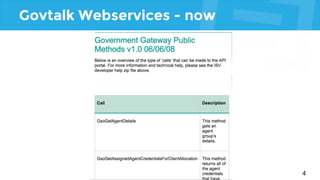
Govtalk Webservices - now
4
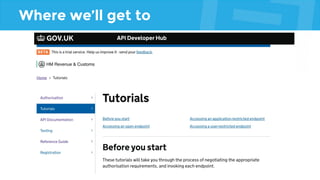
Where we’ll get to
Why an API platform
HMRC wants to improve end-user experience, and
reduce errors. An API platform allows HMRC to take
control of the business logic again, simplifying
integration. By doing that, software vendors
produce more innovative products or even better
free software
API Benefits for others
Organisations can benefit from APIs in many other
ways too. Business expansion with limited
involvement (franchises) and simpler integration
with partners and internal software vendors.
10 Years of AWS - APIs are forever
“.......Once customers started building their
applications and systems using our APIs, changing
those APIs becomes impossible, as we would be
impacting our customer’s business operations if we
would do so. We knew that designing APIs was a
very important task as we’d only have one chance
to get it right.”
http://www.allthingsdistributed.com/2016/03/10-lessons-from-10-years-of-aws.html
A Practical GuideTo Building APIs at HMRC Digital
Practical Guide to Building APIs
Set out your visionSet out your vision
Always start with a vision
Your vision must be ambitious, clear, precise. It
must set out where you want to get to, not where
you are.
10 Years of AWS - APIs are forever
“.......Once customers started building their
applications and systems using our APIs, changing
those APIs becomes impossible, as we would be
impacting our customer’s business operations if we
would do so. We knew that designing APIs was a
very important task as we’d only have one chance
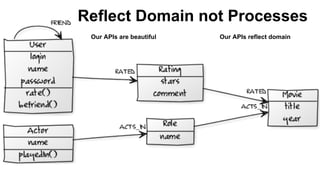
to get it right.”
http://www.allthingsdistributed.com/2016/03/10-lessons-from-10-years-of-aws.html
Your organisation is ready
The fact that your organisation wants to create an
API platform means they are ready to be better.
“We are not mature enough” does not hold.
An API Manifesto
At HMRC we have documented our vision into an
API Manifesto, that is shared with the business,
architects and whole delivery team.
Our APIs are beautiful
HMRC Digital’s APIs are more than an interface to
our code. They are a reflection of our brand, quality
and pride. They are the “web front end” to our
services. Beauty is the following of standard
RESTFul principles, HMRC Digital API standards and
consensus.
Our APIs are RESTFul
HMRC Digital APIs are RESTFul and therefore
display all the characteristics of REST. There is no
acknowledgement of multiple levels of REST and
terms such as “Pragmatic REST” and “RPC REST”
are not valid.
Our APIs reflect domain - not process
HMRC Digital’s APIs are focussed on the domain at
hand. We do not reflect business processes as
these represent internal implementation.
Our APIs must perform
HMRC Digital’s APIs must perform. Volumes,
Throughput, Consistency, Accuracy, Security, Ease
of Integration. Our APIs take advantage of the web
infrastructure for scalability and ubiquity. We only
get one chance to make a good impression but
hundreds of chances to get it wrong.
Our APIs are built for the end consumer
HMRC Digital APIs are not built for a specific
system or application. They are not built to fulfil a
technical problem. They are built with our end
consumer in mind and fulfil customer need.
Our Microservices are API First
All our microservices on the platform follow the
guidelines of APIs, ensuring all of them are
publishable even if not intended to be so.
Be RESTFul
Our APIs are RESTFul
Our APIs are Beautiful
Our APIs must perform
Be RESTFul
Our APIs must be beautiful
Our APIs are RESTFul
Our APIs must perform
No Hypermedia, No REST
“If the engine of application state (and hence
the API) is not being driven by hypertext, then
it cannot be RESTful and cannot be a REST API.
Period.” - Roy Fielding
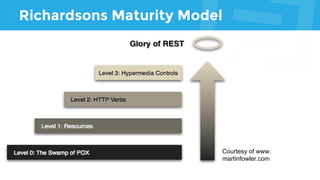
Richardsons Maturity Model
Courtesy of www.
martinfowler.com
But it’s misused and abused
Richardson’s Maturity Model has become a
justification to not use Hypermedia. It is not
meant to be a model for levels of valid REST
development. Just an observation of an
organisation’s proximity to REST
Examples
Media Types
Media types give a structure for the content of
your APIs, allowing clients to negotiate through
Hypermedia controls without needing prior
knowledge of those controls.
Standards Based
A number of media types are attempting to be
standards is this area. HAL, JSON-LD,
Collections+JSON are some of the better
known ones in the JSON arena. These tend to
be generic and ensure looser coupling.
Examples
Vendor Specific Media Types
Vendor specific media types are custom types
created for your organisation. These could be
general organisation or specific by resource.
Organisation specific
While you like the idea of a generic media type
for all cases, the standards based ones seem
like overkill to you, so one for your entire
organisation fits better.
Resource specific
Resource specific media types would be
created at a resource or domain level. For
example, a media type for a customer and one
for order etc
Verbs
The HTTP spec has 8 standard verbs that the
RESTFul Architectural Style takes advantage of.
These have their very own characteristics and
should be used correctly
GET
The GET verb is safe and idempotent according
to the spec. Do not abuse this. Clients expect
that and if abused can bring about many side
effects. Only use to retrieve a resource.
POST
The POST verb is neither safe nor idempotent.
The HTTP spec does not say how this should be
use. However, standard practice is when you
wish to create a new resource whose ID is
unknown.
PUT
The PUT verb is unsafe but idempotent.
Standard usage is for creating a new resource
where you know the ID or where you an
updating an existing resource.
DELETE
The DELETE verb is unsafe but idempotent.
Does what it says on the tin.
OPTIONS
Not widely used enough, the OPTIONS verb
gives you information regarding an endpoint -
what verbs apply, what content type and
relevant documentation. Take advantage of it.
Your clients will thank you.
Others
PATCH is for partial updates. Best to avoid
where possible. HEAD, TRACE and CONNECT
rarely used or needed in your API platform
Status Codes
HTTP Status Codes provide a standard way to
tell the client software what is happening. Use
them correctly and they save you a lot of time.
Status Codes - some patterns
Use 200 - OK
when successfully returning a GET
Use 201 - Created
when successfully creating a resource
return resource location in header
Use 202 - Accepted
when request is valid and can be created
return resource location in header
Caching
The REST Architectural Style takes advantage
of the web architecture to improve scalability.
You need to take advantage of it by using the
correct HTTP headers.
Caching HTTP Headers
Expires and Cache-Control are the two
response headers that allow for caching. These
set either expiry date or TTL.
RESTFul means loose coupling
By controlling flow and business logic within
the API, thereby hiding implementation, you
ensure loose coupling between the client and
the API.
REST means Smaller Payloads
Hypermedia can allow for smaller payloads.
This reduces latency by having less sent over
the wire but also minimising the amount of
orchestration on the server.
REST takes advantage of caching
The web architecture allows for caching and
taking advantage of the GET method gives us
efficient responses.
Better/Cheaper Client Software
The biggest advantage of the RESTFul
Architectural Style is that it minimises the
amount of knowledge your clients need to have
about your system. Allowing them to integrate
quickly and innovate more rapidly.
Reflect Domain
Our APIs are Beautiful
Our APIs reflect domain - not process
Reflect Domain not Processes
Our APIs are beautiful Our APIs reflect domain
Why not business processes?
Business processes were not created for the
digital world. They were created for cryptic
commands into mainframe terminals, paper
forms and human (intelligent) intervention.
Reflect these digitally and you limit APIs
SOA’s biggest failure
SOA made the business process the key part of
the process. Business Process Models were the
central artefacts. This created services that
were too cumbersome and too tightly coupled
to the non-digital age.
Domain not processes
Create APIs that reflect your domain, using
Domain Driven Design concepts. You will not
limit yourselves to existing processes, you’ll
hide the implementation and you’ll use industry
language. In so doing, complexity is
reduced/isolated/removed.
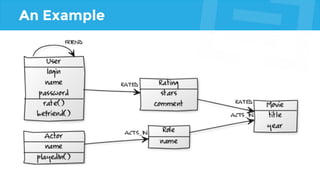
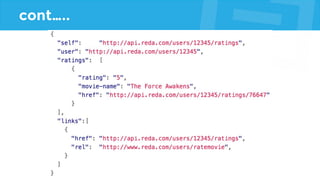
An Example
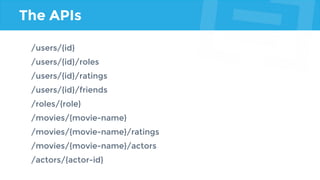
The APIs
/users/{id}
/users/{id}/roles
/users/{id}/ratings
/users/{id}/friends
/roles/{role}
/movies/{movie-name}
/movies/{movie-name}/ratings
/movies/{movie-name}/actors
/actors/{actor-id}
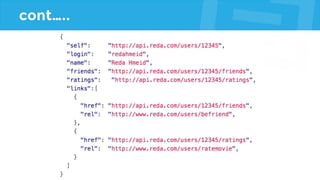
cont…..
cont…..
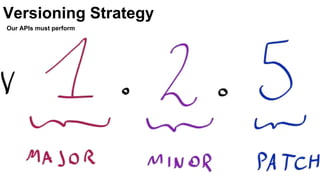
Versioning Strategy
Versioning Strategy
Our APIs must perform
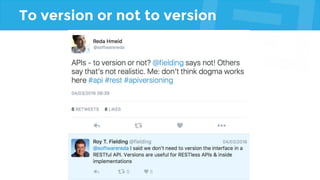
To version or not to version
Why it’s best not to version
Versioning APIs introduces a number of
significant complexities that you would need to
overcome. How many versions should you
support, how do you support them, what
counts as a new version, what sort of
deprecation strategy, what if you backend
systems are not versioned etc…..
Why you shouldn’t need to version
Hypermedia controls should mean your clients
are so loosely coupled to your APIs that they
need not be affected by changes. They would
ignore changes until they are ready.
Why you need to think about versioning
What if you cannot prevent breaking changes?
What if too many clients are hard coding
instead of using Hypermedia controls?
Versioning guidelines - Include versions
Include a version number in your APIs - ideally
in the header as part of the Accept header but
at least as part of the url.
Versioning guidelines - Don’t do it
Do everything you can to avoid breaking
changes and backwards compatibility. Follow
RESTFul guidelines and you will find this easy
Versioning guidelines - Deprecate
With every new version, deprecate your old
version straight away with a maximum support
period for bug fixes. New features will not be
included in deprecated version
Ensure Security
Secure your APIs
Our APIs must perform
Web Security Economics
“1. Good enough is good enough. 2. Good
enough always beats perfect. 3. The really hard
part is determining what is good enough”
Prof. Ravi Sandhu
Valet Parking Problem
One of the biggest and most prominent issues
in web security is over privileging users. Like
giving your keys to a valet, they can find out
where you live, have your house keys and know
where you’ll be for next 2 hours.
Switch on TLS Encryption
TLS/SSL performance is no longer the issue it
once was. Companies such as Netflix have
switched on encryption for its video streaming.
With the low overhead it would be silly not to.
HTTP Basic Auth
The simplest form of API authentication, uses
Base64 encoding. Easiest to implement and
easiest integrate with. But also easiest to hack.
Encoding is not the same as encryption. Only
use with TLS
OAuth 2.0
The current defacto standard for API
authentication and authorisation. Will only
work with TLS. Works by exchanging of
encrypted tokens.
OAuth 2.0
The user is granting access to certain privileges
for the software. With trusted clients, implicit
grant access can be provided.
OAuth 2.0
Tokens are tied to developers - allowing closing
down a link with a developer that may have
been compromised rather than the whole
platform.
These are not enough
Beyond your API platform, the rest of your
technical platform must be secure and your
organisation must be secure. Techniques such
as transaction monitoring and fraud detection
can be useful.
Ultimately, it’s about quality
All the encryption, TLS, auth, firewalls or big
burly bouncers will do you no good if your code
has bugs and your design is flawed.
Documenting your APIs
Our APIs are beautiful
Our APIs are RESTFul
Documentation Tools
There are a number of REST JSON
documentation tools. RAML, Swagger and
Hydra. But they each have flaws.
RAML and Swagger
RAML and Swagger are more than just
documentation tools. They provide define,
build, test and documentation frameworks.
However, they do not support RESTFul
attributes, in particular hypermedia controls
Hydra
Less of a fully functioning framework than the
other two but does support hypermedia
controls…...but only if you use the JSON-LD
media type
Proprietary Documentation
It’s important to not be tempted to limit your
vision to use those great tools. Instead, in this
case, a proprietary documentation tool built in-
house will be preferable. Make it easy for your
developers.
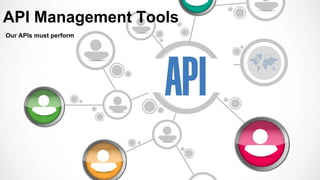
API Management Tools
Our APIs must perform
Features
API Management tools provide a number of
important features:
Manage API Accesses
Manage Traffic
Monitoring
Manage Available APIs
Products
Leading API Management tools are provided by
WSO2, CA Technologies, Mulesoft, Mashery
Don’t be constrained
Your API Manager needs to support your vision.
Don’t change your vision for the tool. But don’t
try doing it yourselves.
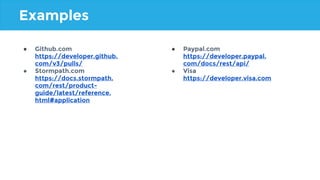
Good API Platforms
● Github.com
https://developer.github.
com/v3/pulls/
● Stormpath.com
https://docs.stormpath.
com/rest/product-
guide/latest/reference.
html#application
● Paypal.com
https://developer.paypal.
com/docs/rest/api/
● Visa
https://developer.visa.com
Examples
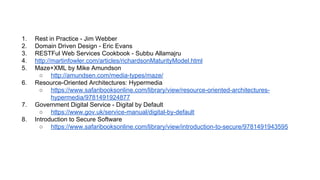
Homework
1. Rest in Practice - Jim Webber
2. Domain Driven Design - Eric Evans
3. RESTFul Web Services Cookbook - Subbu Allamajru
4. http://martinfowler.com/articles/richardsonMaturityModel.html
5. Maze+XML by Mike Amundson
○ http://amundsen.com/media-types/maze/
6. Resource-Oriented Architectures: Hypermedia
○ https://www.safaribooksonline.com/library/view/resource-oriented-architectures-
hypermedia/9781491924877
7. Government Digital Service - Digital by Default
○ https://www.gov.uk/service-manual/digital-by-default
8. Introduction to Secure Software
○ https://www.safaribooksonline.com/library/view/introduction-to-secure/9781491943595
Thank You
Twitter
@EqualExperts
LinkedIn
linkedin.com/company/equal-experts
UNITED KINGDOM
+44 203 603 7830
helloUK@equalexperts.com
Equal Experts UK Ltd
30 Brock Street
London NW1 3FG
INDIA
+91 20 6607 7763
helloIndia@equalexperts.com
Equal Experts India Private Ltd
Office No. 4-C
Cerebrum IT Park No. B3
Kumar City, Kalyani Nagar
Pune, 411006
Web
www.equalexperts.com
CANADA
+1 403 775 4861
helloCanada@equalexperts.com
Equal Experts Devices Inc
205 - 279 Midpark way S.E.
T2X 1M2
Calgary, Alberta
Twitter:
@softwarereda
LinkedIn:
linkedin.com/in/redahmeid

Practical guide to building public APIs

  • 1.
    simple software solutionsto big business problems Making Software. Better. Digital By Default Building APIs for Government
  • 2.
    2 I believe thecreation of the Government Digital Service is one of the great unsung triumphs of the last Parliament. Prime Minister David Cameron
  • 4.
  • 5.
  • 6.
    Why an APIplatform HMRC wants to improve end-user experience, and reduce errors. An API platform allows HMRC to take control of the business logic again, simplifying integration. By doing that, software vendors produce more innovative products or even better free software
  • 7.
    API Benefits forothers Organisations can benefit from APIs in many other ways too. Business expansion with limited involvement (franchises) and simpler integration with partners and internal software vendors.
  • 8.
    10 Years ofAWS - APIs are forever “.......Once customers started building their applications and systems using our APIs, changing those APIs becomes impossible, as we would be impacting our customer’s business operations if we would do so. We knew that designing APIs was a very important task as we’d only have one chance to get it right.” http://www.allthingsdistributed.com/2016/03/10-lessons-from-10-years-of-aws.html
  • 9.
    A Practical GuideToBuilding APIs at HMRC Digital Practical Guide to Building APIs
  • 10.
    Set out yourvisionSet out your vision
  • 11.
    Always start witha vision Your vision must be ambitious, clear, precise. It must set out where you want to get to, not where you are.
  • 12.
    10 Years ofAWS - APIs are forever “.......Once customers started building their applications and systems using our APIs, changing those APIs becomes impossible, as we would be impacting our customer’s business operations if we would do so. We knew that designing APIs was a very important task as we’d only have one chance to get it right.” http://www.allthingsdistributed.com/2016/03/10-lessons-from-10-years-of-aws.html
  • 13.
    Your organisation isready The fact that your organisation wants to create an API platform means they are ready to be better. “We are not mature enough” does not hold.
  • 14.
    An API Manifesto AtHMRC we have documented our vision into an API Manifesto, that is shared with the business, architects and whole delivery team.
  • 15.
    Our APIs arebeautiful HMRC Digital’s APIs are more than an interface to our code. They are a reflection of our brand, quality and pride. They are the “web front end” to our services. Beauty is the following of standard RESTFul principles, HMRC Digital API standards and consensus.
  • 16.
    Our APIs areRESTFul HMRC Digital APIs are RESTFul and therefore display all the characteristics of REST. There is no acknowledgement of multiple levels of REST and terms such as “Pragmatic REST” and “RPC REST” are not valid.
  • 17.
    Our APIs reflectdomain - not process HMRC Digital’s APIs are focussed on the domain at hand. We do not reflect business processes as these represent internal implementation.
  • 18.
    Our APIs mustperform HMRC Digital’s APIs must perform. Volumes, Throughput, Consistency, Accuracy, Security, Ease of Integration. Our APIs take advantage of the web infrastructure for scalability and ubiquity. We only get one chance to make a good impression but hundreds of chances to get it wrong.
  • 19.
    Our APIs arebuilt for the end consumer HMRC Digital APIs are not built for a specific system or application. They are not built to fulfil a technical problem. They are built with our end consumer in mind and fulfil customer need.
  • 20.
    Our Microservices areAPI First All our microservices on the platform follow the guidelines of APIs, ensuring all of them are publishable even if not intended to be so.
  • 21.
    Be RESTFul Our APIsare RESTFul Our APIs are Beautiful Our APIs must perform Be RESTFul Our APIs must be beautiful Our APIs are RESTFul Our APIs must perform
  • 22.
    No Hypermedia, NoREST “If the engine of application state (and hence the API) is not being driven by hypertext, then it cannot be RESTful and cannot be a REST API. Period.” - Roy Fielding
  • 23.
    Richardsons Maturity Model Courtesyof www. martinfowler.com
  • 24.
    But it’s misusedand abused Richardson’s Maturity Model has become a justification to not use Hypermedia. It is not meant to be a model for levels of valid REST development. Just an observation of an organisation’s proximity to REST
  • 25.
  • 26.
    Media Types Media typesgive a structure for the content of your APIs, allowing clients to negotiate through Hypermedia controls without needing prior knowledge of those controls.
  • 27.
    Standards Based A numberof media types are attempting to be standards is this area. HAL, JSON-LD, Collections+JSON are some of the better known ones in the JSON arena. These tend to be generic and ensure looser coupling.
  • 28.
  • 29.
    Vendor Specific MediaTypes Vendor specific media types are custom types created for your organisation. These could be general organisation or specific by resource.
  • 30.
    Organisation specific While youlike the idea of a generic media type for all cases, the standards based ones seem like overkill to you, so one for your entire organisation fits better.
  • 31.
    Resource specific Resource specificmedia types would be created at a resource or domain level. For example, a media type for a customer and one for order etc
  • 32.
    Verbs The HTTP spechas 8 standard verbs that the RESTFul Architectural Style takes advantage of. These have their very own characteristics and should be used correctly
  • 33.
    GET The GET verbis safe and idempotent according to the spec. Do not abuse this. Clients expect that and if abused can bring about many side effects. Only use to retrieve a resource.
  • 34.
    POST The POST verbis neither safe nor idempotent. The HTTP spec does not say how this should be use. However, standard practice is when you wish to create a new resource whose ID is unknown.
  • 35.
    PUT The PUT verbis unsafe but idempotent. Standard usage is for creating a new resource where you know the ID or where you an updating an existing resource.
  • 36.
    DELETE The DELETE verbis unsafe but idempotent. Does what it says on the tin.
  • 37.
    OPTIONS Not widely usedenough, the OPTIONS verb gives you information regarding an endpoint - what verbs apply, what content type and relevant documentation. Take advantage of it. Your clients will thank you.
  • 38.
    Others PATCH is forpartial updates. Best to avoid where possible. HEAD, TRACE and CONNECT rarely used or needed in your API platform
  • 39.
    Status Codes HTTP StatusCodes provide a standard way to tell the client software what is happening. Use them correctly and they save you a lot of time.
  • 40.
    Status Codes -some patterns Use 200 - OK when successfully returning a GET Use 201 - Created when successfully creating a resource return resource location in header Use 202 - Accepted when request is valid and can be created return resource location in header
  • 41.
    Caching The REST ArchitecturalStyle takes advantage of the web architecture to improve scalability. You need to take advantage of it by using the correct HTTP headers.
  • 42.
    Caching HTTP Headers Expiresand Cache-Control are the two response headers that allow for caching. These set either expiry date or TTL.
  • 43.
    RESTFul means loosecoupling By controlling flow and business logic within the API, thereby hiding implementation, you ensure loose coupling between the client and the API.
  • 44.
    REST means SmallerPayloads Hypermedia can allow for smaller payloads. This reduces latency by having less sent over the wire but also minimising the amount of orchestration on the server.
  • 45.
    REST takes advantageof caching The web architecture allows for caching and taking advantage of the GET method gives us efficient responses.
  • 46.
    Better/Cheaper Client Software Thebiggest advantage of the RESTFul Architectural Style is that it minimises the amount of knowledge your clients need to have about your system. Allowing them to integrate quickly and innovate more rapidly.
  • 47.
    Reflect Domain Our APIsare Beautiful Our APIs reflect domain - not process Reflect Domain not Processes Our APIs are beautiful Our APIs reflect domain
  • 48.
    Why not businessprocesses? Business processes were not created for the digital world. They were created for cryptic commands into mainframe terminals, paper forms and human (intelligent) intervention. Reflect these digitally and you limit APIs
  • 49.
    SOA’s biggest failure SOAmade the business process the key part of the process. Business Process Models were the central artefacts. This created services that were too cumbersome and too tightly coupled to the non-digital age.
  • 50.
    Domain not processes CreateAPIs that reflect your domain, using Domain Driven Design concepts. You will not limit yourselves to existing processes, you’ll hide the implementation and you’ll use industry language. In so doing, complexity is reduced/isolated/removed.
  • 51.
  • 52.
  • 53.
  • 54.
  • 55.
  • 56.
    To version ornot to version
  • 57.
    Why it’s bestnot to version Versioning APIs introduces a number of significant complexities that you would need to overcome. How many versions should you support, how do you support them, what counts as a new version, what sort of deprecation strategy, what if you backend systems are not versioned etc…..
  • 58.
    Why you shouldn’tneed to version Hypermedia controls should mean your clients are so loosely coupled to your APIs that they need not be affected by changes. They would ignore changes until they are ready.
  • 59.
    Why you needto think about versioning What if you cannot prevent breaking changes? What if too many clients are hard coding instead of using Hypermedia controls?
  • 60.
    Versioning guidelines -Include versions Include a version number in your APIs - ideally in the header as part of the Accept header but at least as part of the url.
  • 61.
    Versioning guidelines -Don’t do it Do everything you can to avoid breaking changes and backwards compatibility. Follow RESTFul guidelines and you will find this easy
  • 62.
    Versioning guidelines -Deprecate With every new version, deprecate your old version straight away with a maximum support period for bug fixes. New features will not be included in deprecated version
  • 63.
    Ensure Security Secure yourAPIs Our APIs must perform
  • 64.
    Web Security Economics “1.Good enough is good enough. 2. Good enough always beats perfect. 3. The really hard part is determining what is good enough” Prof. Ravi Sandhu
  • 65.
    Valet Parking Problem Oneof the biggest and most prominent issues in web security is over privileging users. Like giving your keys to a valet, they can find out where you live, have your house keys and know where you’ll be for next 2 hours.
  • 66.
    Switch on TLSEncryption TLS/SSL performance is no longer the issue it once was. Companies such as Netflix have switched on encryption for its video streaming. With the low overhead it would be silly not to.
  • 67.
    HTTP Basic Auth Thesimplest form of API authentication, uses Base64 encoding. Easiest to implement and easiest integrate with. But also easiest to hack. Encoding is not the same as encryption. Only use with TLS
  • 68.
    OAuth 2.0 The currentdefacto standard for API authentication and authorisation. Will only work with TLS. Works by exchanging of encrypted tokens.
  • 69.
    OAuth 2.0 The useris granting access to certain privileges for the software. With trusted clients, implicit grant access can be provided.
  • 70.
    OAuth 2.0 Tokens aretied to developers - allowing closing down a link with a developer that may have been compromised rather than the whole platform.
  • 71.
    These are notenough Beyond your API platform, the rest of your technical platform must be secure and your organisation must be secure. Techniques such as transaction monitoring and fraud detection can be useful.
  • 72.
    Ultimately, it’s aboutquality All the encryption, TLS, auth, firewalls or big burly bouncers will do you no good if your code has bugs and your design is flawed.
  • 73.
    Documenting your APIs OurAPIs are beautiful Our APIs are RESTFul
  • 74.
    Documentation Tools There area number of REST JSON documentation tools. RAML, Swagger and Hydra. But they each have flaws.
  • 75.
    RAML and Swagger RAMLand Swagger are more than just documentation tools. They provide define, build, test and documentation frameworks. However, they do not support RESTFul attributes, in particular hypermedia controls
  • 76.
    Hydra Less of afully functioning framework than the other two but does support hypermedia controls…...but only if you use the JSON-LD media type
  • 77.
    Proprietary Documentation It’s importantto not be tempted to limit your vision to use those great tools. Instead, in this case, a proprietary documentation tool built in- house will be preferable. Make it easy for your developers.
  • 78.
    API Management Tools OurAPIs must perform
  • 79.
    Features API Management toolsprovide a number of important features: Manage API Accesses Manage Traffic Monitoring Manage Available APIs
  • 80.
    Products Leading API Managementtools are provided by WSO2, CA Technologies, Mulesoft, Mashery
  • 81.
    Don’t be constrained YourAPI Manager needs to support your vision. Don’t change your vision for the tool. But don’t try doing it yourselves.
  • 82.
  • 83.
  • 84.
  • 85.
    1. Rest inPractice - Jim Webber 2. Domain Driven Design - Eric Evans 3. RESTFul Web Services Cookbook - Subbu Allamajru 4. http://martinfowler.com/articles/richardsonMaturityModel.html 5. Maze+XML by Mike Amundson ○ http://amundsen.com/media-types/maze/ 6. Resource-Oriented Architectures: Hypermedia ○ https://www.safaribooksonline.com/library/view/resource-oriented-architectures- hypermedia/9781491924877 7. Government Digital Service - Digital by Default ○ https://www.gov.uk/service-manual/digital-by-default 8. Introduction to Secure Software ○ https://www.safaribooksonline.com/library/view/introduction-to-secure/9781491943595
  • 86.
    Thank You Twitter @EqualExperts LinkedIn linkedin.com/company/equal-experts UNITED KINGDOM +44203 603 7830 helloUK@equalexperts.com Equal Experts UK Ltd 30 Brock Street London NW1 3FG INDIA +91 20 6607 7763 helloIndia@equalexperts.com Equal Experts India Private Ltd Office No. 4-C Cerebrum IT Park No. B3 Kumar City, Kalyani Nagar Pune, 411006 Web www.equalexperts.com CANADA +1 403 775 4861 helloCanada@equalexperts.com Equal Experts Devices Inc 205 - 279 Midpark way S.E. T2X 1M2 Calgary, Alberta Twitter: @softwarereda LinkedIn: linkedin.com/in/redahmeid