Practical & Motivating Facilitation Karen Carleton, M.Ed., M.S. Facilitator
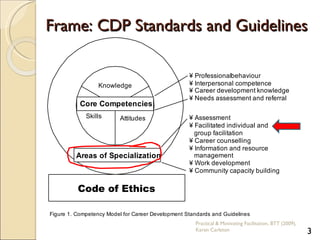
Frame: CDP Standards and Guidelines Practical & Motivating Facilitation, BTT (2009), Karen Carleton
Intended Learning Outcomes To learn tools for planning motivating sessions To learn tips for effective group facilitation To support quality career development services  Client-Centered Practical & Motivating Facilitation, BTT (2009), Karen Carleton
Session Objectives To discuss & apply Adult Learning realities Nine Events of Instruction ARCS Motivation Facilitation Tips To hear a Case Study To share ideas  (brainstorming,  discussion) To practice workshop planning  (group scenarios) Practical & Motivating Facilitation, BTT (2009), Karen Carleton
A need to learn  – purposeful & relevant Self-directed  – no instructor needed Prior experience  – incorporate & build on Readiness  – timely & desired Problem-solving  -  critical & creative thinking Intrinsic Motivation  - desire to learn or achieve a goal Adult Learning Principles 1 example for each  “ Androgogy” = helping adults learn Practical & Motivating Facilitation, BTT (2009), Karen Carleton ALWAYS TRUE ?
Adult Learning Realities Adults are  time-pressed Seek  relevant  & immediately  applicable  learning (not theory)    needed; solves problems Need for  social interaction Have  prior experience  to build on     People  learn differently  – auditory, visual, hands-on, reflective How do these realities affect facilitation? Practical & Motivating Facilitation, BTT (2009), Karen Carleton
Learning Research Meaningful Learning Tie new knowledge/skills to what learner already knows Information Processing Mind like a computer (organized memory) Learning progression Concrete to abstract - hands-on, pictures,  and language Socio-cultural aspect of learning: Context is personal,  and social Practical & Motivating Facilitation, BTT (2009), Karen Carleton
Nine Events of Instruction Research on  effective learning and instruction Order  of teaching/learning events Importance of  feedback Lesson Plan Introduction Objective Pre-assessment  Motivational hook Presentation Practice Post-assessment Summary & Conclusion NAIT: http://www.nait.ca/docs/LessonPlanChecklist.pdf  Practical & Motivating Facilitation, BTT (2009), Karen Carleton
Nine Events of Instruction Gain learners’ attention Inform learners of objective Stimulate learners’ recall of prior knowledge Present new content Provide learning guidance Elicit performance (practice skill,  apply knowledge) Provide feedback (guide practice) Assess learners’ performance Enhance retention & transfer of learning 2 Ideas for facilitating each Event Practical & Motivating Facilitation, BTT (2009), Karen Carleton
Workshop Planning Practice Groups:  Draft a  CD Workshop Plan  Scenario card Worksheet 1-2 sentences for an activity for each Element Roles (recorder, presenter, facilitator/timer) 25 minutes, then debrief Nine Events: Gain attention - Inform of objective - Stimulate prior learning - Present content - Provide guidance - Elicit performance - Provide feedback - Assess performance - Enhance retention & transfer of learning - Practical & Motivating Facilitation, BTT (2009), Karen Carleton
Learning & Motivation Motivation strongly influences learning & achievement Old view:  “Carrots-and-sticks” (*extrinsic) New view:  Considers learners’ thoughts, perceptions, prior experience (*internal)  and  learning context (incentives & environment) Meaningful = better learning Practical & Motivating Facilitation, BTT (2009), Karen Carleton
Learner Motivation “ Locus of Control” Internal vs. External Effort & Ability (internal) “ Luck” (external) What learners attribute their success/failure to (self vs. environment) Client examples? Example:  “ I   should have revised  my resume, arrived on  time for the interview &  tailored my  cover letter. Next time.”  vs.  “Just my luck, I didn’t  get hired ! Stupid company.” Self-responsibility Belief in the ability to achieve personal goals Practical & Motivating Facilitation, BTT (2009), Karen Carleton
Learner Motivation Self-confidence-Learning link Prior experience Designed for learner success Encourage attributions to self Supports achievable goals Captures learners’ Interest  (motivation-learning tie) Encourages  persistence & positive attitude Avoids “seductive” (irrelevant) details Clear ,  organized materials Practical & Motivating Facilitation, BTT (2009), Karen Carleton Ideas?
Learner Motivation Expectations: Perception of  ability  to succeed  at goal (getting a job) Perception of  value  of achieving  goal (getting a job = pride, self-reliance) Real  problem-solving Boost client self-confidence Break goals into steps Promote client responsibility for results Practical & Motivating Facilitation, BTT (2009), Karen Carleton How can we help clients reframe their perceptions?
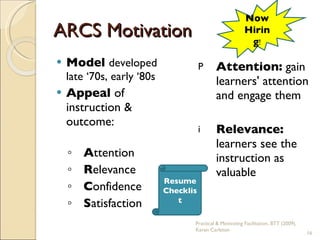
ARCS Motivation Model  developed late ‘70s, early ‘80s Appeal  of instruction & outcome: A ttention R elevance C onfidence S atisfaction Attention:  gain learners' attention and engage them Relevance:  learners see the instruction as valuable Now Hiring ! Resume Checklist Practical & Motivating Facilitation, BTT (2009), Karen Carleton
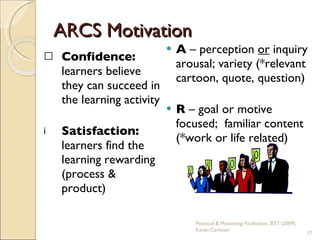
ARCS Motivation Confidence:   learners believe they can succeed in the learning activity Satisfaction:  learners find the learning rewarding (process & product) A  – perception  or  inquiry arousal; variety (*relevant cartoon, quote, question) R  – goal or motive focused;  familiar content (*work or life related) Practical & Motivating Facilitation, BTT (2009), Karen Carleton
C  – high chance for success, ownership (*gradual skill practice, feedback) S  – reinforce intrinsic locus; external incentives/praise (*feel satisfied, in control, equal) Regroup (5 mins): How you would  include ARCS  elements in the  Workshop plan? ARCS Motivation WIIFM Practical & Motivating Facilitation, BTT (2009), Karen Carleton
Case Study Career Preparation workshops  Boise State University’s Career Centre & International Student Office Prior experience  (miners,  business college,  ABE & High school students) Instructional Design  project Learner & Facilitator guides  plus materials (*customized) Two target audiences : International students Engineering students Practical & Motivating Facilitation, BTT (2009), Karen Carleton
Details 350 international students per yearly Seek part-time on-campus jobs, internships,  or post-grad employment Lack local career knowledge & skills (resumes, interviews) High motivation  (eager to work) Need  info & guided practice Case Study Practical & Motivating Facilitation, BTT (2009), Karen Carleton
Case Study Career Preparation Workshop Seeking part-time work on campus? Want to create a winning resume and an effective cover letter?  Need help with job interview practice?  Looking for an internship or post-graduate work? Practical & Motivating Facilitation, BTT (2009), Karen Carleton
Career Preparation Workshop Agenda When:  Saturday, February 9, 2008, 1:00-4:00pm 1:00-1:30pm US Employer Expectations 1:30-2:15pm Resume & Cover Letter writing talk 2:15-2:30pm Break 2:30-3:00 Resumes & Cover Letter practice 3:00-4:00pm Interview Skills Practice Where:  Room 301, Micron Engineering Center To register email:  [email_address] Cost:  FREE   Seats:  30 Case Study Practical & Motivating Facilitation, BTT (2009), Karen Carleton
Topics: US Employer Expectations Resume & Cover Letter writing discussion Resumes & Cover Letter practice (*electronic templates saved to PC desktops) Interview Skills Practice (*demos & role-plays) Nine Events: Gained attention -  questions Explained and wrote  objectives  (& learners’ own) Prior experience  stories (US & at home) Discussed  content  & handouts Guided practice with feedback Checklists for  transfer of learning Case Study Practical & Motivating Facilitation, BTT (2009), Karen Carleton
ARCS Attention:  high interest Relevance:  wanted or needed work Confidence:  gained   knowledge & skills Satisfaction:  high success rate Case Study Old-new knowledge link  – meaningful & memorable learning Flowchart  – from application to hiring Resume/cover letter writing & interview practice  (*feedback - 2 facilitators) Practical & Motivating Facilitation, BTT (2009), Karen Carleton
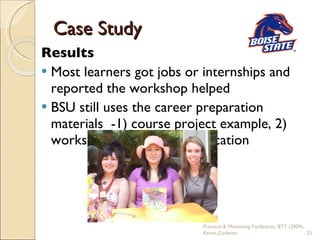
Case Study Results Most learners got jobs or internships and reported the workshop helped BSU still uses the career preparation materials  -1) course project example, 2) workshops & 3) online publication Practical & Motivating Facilitation, BTT (2009), Karen Carleton
Facilitation Basics Ease  participants towards their goals Facilitator Qualities Respectful Flexible Organized Good-humoured Patient, good listener Cooperative Responsive Practical & Motivating Facilitation, BTT (2009), Karen Carleton
Facilitation Basics Introductions   & Expectations Agenda or schedule Housekeeping (washrooms, breaks, cell phones) Icebreakers & activities Group guidelines (respect, “share the floor,” participation, cooperation) Objectives  (general & personal) Visual aids, interaction & role-plays Prepare -  handouts, door signs etc Practical & Motivating Facilitation, BTT (2009), Karen Carleton Additional suggestions?
Activity Facilitation Explain  directions & check understanding Suggest group roles  (presenter, facilitator, recorder, timer) Thank  speakers & participants Lead & debrief  activities Invite  questions & comments Brainstorming  -   no evaluation/criticism; use speaker’s own words Practical & Motivating Facilitation, BTT (2009), Karen Carleton Others activity tips?
Facilitation Tips Engaging  -   relevant, involvement,  variety Hands-on Diversity  - allow varied perspectives, needs & objectives Guided practice & Feedback Address unruly participants  ASAP (guidelines, private chat)  Evaluate  skills & knowledge learned Follow-up  if possible Questions? Practical & Motivating Facilitation, BTT (2009), Karen Carleton
Session Summary Plan  for learner motivation (adult learning realities, Nine Events, ARCS) Prepare  client-centered  sessions Customize activities & materials Guided practice & give feedback Borrow  tips & ideas, and Have fun , try new approaches Thanks for sharing!
Bibliography Carliner,  S. (2003).  Training design basics .  Alexandria, VA:  ASTD. Driscoll, M. P. (2004).  Psychology of learning for instruction  (3rd ed.). Boston: Allyn and Bacon.  Gagne, R. M.,  & Rohwer Jr., W. D. (1969). Instructional psychology.  Annual Review of Psychology, 20 , 381-418. Keller, J. (1987). Strategies for stimulating the motivation to learn.  Performance and Instruction, 26 (8), 1-7. NAIT (n.d.). Lesson Plan Checklist. Retrieved May 31, 2009 from,  http://www.nait.ca/docs/LessonPlanChecklist.pdf   Practical & Motivating Facilitation, BTT (2009), Karen Carleton
Electronic Resources Certificate in Adult & Continuing Education/CACE (U of A) - http://www.extension.ualberta.ca/cace/index.aspx   Facilitation resources - http://chriscorrigan.com/parkinglot/?page_id=958   http://managementhelp.org/grp_skll/facltate/facltate.htm   Facilitator Training (online & in-person)- http://www.leadstrat.com/ Lesson Plan Checklist -  http://www.nait.ca/docs/LessonPlanChecklist.pdf   Karen Carleton’s “DIY “carer prep materials (Engineering students) here:  http://coen.boisestate.edu/students/career_resources.asp   Instructor Training (BMI modules at NAIT) - http://www.nait.ca/39248.htm   Practical & Motivating Facilitation, BTT (2009), Karen Carleton
Print Resources Brookfield, S.D.  (1990). Understanding and facilitating adult learning. San Fransisco,CA: Jossey-Bass Caffarella, R.S.  (2002).  Planning program for adult learners:  A practical guide   for educators, trainers and staff developers.  2 nd  Edition, San Francisco, CA: Jossey-Bass.  Johnson, D.W. & Johnson, F. P. (2003).  Joining Together: Group Theory and Group Skills.  Toronto: Allen and Bacon. Merriam, S. B. (2001).  Andragogy and self-directed learning: Pillars of adult learning theory.  New Directions for Adult & Continuing Education, 89 , 3-13 Simonsen, P. (1997). Promoting a career development culture in your organization: Using career development as a change agent. Palo Alto, CA: Davies-Black.  Practical & Motivating Facilitation, BTT (2009), Karen Carleton

Practical & Motiv Facilitation

  • 1.
    Practical & MotivatingFacilitation Karen Carleton, M.Ed., M.S. Facilitator
  • 3.
    Frame: CDP Standardsand Guidelines Practical & Motivating Facilitation, BTT (2009), Karen Carleton
  • 4.
    Intended Learning OutcomesTo learn tools for planning motivating sessions To learn tips for effective group facilitation To support quality career development services Client-Centered Practical & Motivating Facilitation, BTT (2009), Karen Carleton
  • 5.
    Session Objectives Todiscuss & apply Adult Learning realities Nine Events of Instruction ARCS Motivation Facilitation Tips To hear a Case Study To share ideas (brainstorming, discussion) To practice workshop planning (group scenarios) Practical & Motivating Facilitation, BTT (2009), Karen Carleton
  • 6.
    A need tolearn – purposeful & relevant Self-directed – no instructor needed Prior experience – incorporate & build on Readiness – timely & desired Problem-solving - critical & creative thinking Intrinsic Motivation - desire to learn or achieve a goal Adult Learning Principles 1 example for each “ Androgogy” = helping adults learn Practical & Motivating Facilitation, BTT (2009), Karen Carleton ALWAYS TRUE ?
  • 7.
    Adult Learning RealitiesAdults are time-pressed Seek relevant & immediately applicable learning (not theory)  needed; solves problems Need for social interaction Have prior experience to build on  People learn differently – auditory, visual, hands-on, reflective How do these realities affect facilitation? Practical & Motivating Facilitation, BTT (2009), Karen Carleton
  • 8.
    Learning Research MeaningfulLearning Tie new knowledge/skills to what learner already knows Information Processing Mind like a computer (organized memory) Learning progression Concrete to abstract - hands-on, pictures, and language Socio-cultural aspect of learning: Context is personal, and social Practical & Motivating Facilitation, BTT (2009), Karen Carleton
  • 9.
    Nine Events ofInstruction Research on effective learning and instruction Order of teaching/learning events Importance of feedback Lesson Plan Introduction Objective Pre-assessment Motivational hook Presentation Practice Post-assessment Summary & Conclusion NAIT: http://www.nait.ca/docs/LessonPlanChecklist.pdf Practical & Motivating Facilitation, BTT (2009), Karen Carleton
  • 10.
    Nine Events ofInstruction Gain learners’ attention Inform learners of objective Stimulate learners’ recall of prior knowledge Present new content Provide learning guidance Elicit performance (practice skill, apply knowledge) Provide feedback (guide practice) Assess learners’ performance Enhance retention & transfer of learning 2 Ideas for facilitating each Event Practical & Motivating Facilitation, BTT (2009), Karen Carleton
  • 11.
    Workshop Planning PracticeGroups: Draft a CD Workshop Plan Scenario card Worksheet 1-2 sentences for an activity for each Element Roles (recorder, presenter, facilitator/timer) 25 minutes, then debrief Nine Events: Gain attention - Inform of objective - Stimulate prior learning - Present content - Provide guidance - Elicit performance - Provide feedback - Assess performance - Enhance retention & transfer of learning - Practical & Motivating Facilitation, BTT (2009), Karen Carleton
  • 12.
    Learning & MotivationMotivation strongly influences learning & achievement Old view: “Carrots-and-sticks” (*extrinsic) New view: Considers learners’ thoughts, perceptions, prior experience (*internal) and learning context (incentives & environment) Meaningful = better learning Practical & Motivating Facilitation, BTT (2009), Karen Carleton
  • 13.
    Learner Motivation “Locus of Control” Internal vs. External Effort & Ability (internal) “ Luck” (external) What learners attribute their success/failure to (self vs. environment) Client examples? Example: “ I should have revised my resume, arrived on time for the interview & tailored my cover letter. Next time.” vs. “Just my luck, I didn’t get hired ! Stupid company.” Self-responsibility Belief in the ability to achieve personal goals Practical & Motivating Facilitation, BTT (2009), Karen Carleton
  • 14.
    Learner Motivation Self-confidence-Learninglink Prior experience Designed for learner success Encourage attributions to self Supports achievable goals Captures learners’ Interest (motivation-learning tie) Encourages persistence & positive attitude Avoids “seductive” (irrelevant) details Clear , organized materials Practical & Motivating Facilitation, BTT (2009), Karen Carleton Ideas?
  • 15.
    Learner Motivation Expectations:Perception of ability to succeed at goal (getting a job) Perception of value of achieving goal (getting a job = pride, self-reliance) Real problem-solving Boost client self-confidence Break goals into steps Promote client responsibility for results Practical & Motivating Facilitation, BTT (2009), Karen Carleton How can we help clients reframe their perceptions?
  • 16.
    ARCS Motivation Model developed late ‘70s, early ‘80s Appeal of instruction & outcome: A ttention R elevance C onfidence S atisfaction Attention: gain learners' attention and engage them Relevance: learners see the instruction as valuable Now Hiring ! Resume Checklist Practical & Motivating Facilitation, BTT (2009), Karen Carleton
  • 17.
    ARCS Motivation Confidence: learners believe they can succeed in the learning activity Satisfaction: learners find the learning rewarding (process & product) A – perception or inquiry arousal; variety (*relevant cartoon, quote, question) R – goal or motive focused; familiar content (*work or life related) Practical & Motivating Facilitation, BTT (2009), Karen Carleton
  • 18.
    C –high chance for success, ownership (*gradual skill practice, feedback) S – reinforce intrinsic locus; external incentives/praise (*feel satisfied, in control, equal) Regroup (5 mins): How you would include ARCS elements in the Workshop plan? ARCS Motivation WIIFM Practical & Motivating Facilitation, BTT (2009), Karen Carleton
  • 19.
    Case Study CareerPreparation workshops Boise State University’s Career Centre & International Student Office Prior experience (miners, business college, ABE & High school students) Instructional Design project Learner & Facilitator guides plus materials (*customized) Two target audiences : International students Engineering students Practical & Motivating Facilitation, BTT (2009), Karen Carleton
  • 20.
    Details 350 internationalstudents per yearly Seek part-time on-campus jobs, internships, or post-grad employment Lack local career knowledge & skills (resumes, interviews) High motivation (eager to work) Need info & guided practice Case Study Practical & Motivating Facilitation, BTT (2009), Karen Carleton
  • 21.
    Case Study CareerPreparation Workshop Seeking part-time work on campus? Want to create a winning resume and an effective cover letter? Need help with job interview practice? Looking for an internship or post-graduate work? Practical & Motivating Facilitation, BTT (2009), Karen Carleton
  • 22.
    Career Preparation WorkshopAgenda When: Saturday, February 9, 2008, 1:00-4:00pm 1:00-1:30pm US Employer Expectations 1:30-2:15pm Resume & Cover Letter writing talk 2:15-2:30pm Break 2:30-3:00 Resumes & Cover Letter practice 3:00-4:00pm Interview Skills Practice Where: Room 301, Micron Engineering Center To register email: [email_address] Cost: FREE Seats: 30 Case Study Practical & Motivating Facilitation, BTT (2009), Karen Carleton
  • 23.
    Topics: US EmployerExpectations Resume & Cover Letter writing discussion Resumes & Cover Letter practice (*electronic templates saved to PC desktops) Interview Skills Practice (*demos & role-plays) Nine Events: Gained attention - questions Explained and wrote objectives (& learners’ own) Prior experience stories (US & at home) Discussed content & handouts Guided practice with feedback Checklists for transfer of learning Case Study Practical & Motivating Facilitation, BTT (2009), Karen Carleton
  • 24.
    ARCS Attention: high interest Relevance: wanted or needed work Confidence: gained knowledge & skills Satisfaction: high success rate Case Study Old-new knowledge link – meaningful & memorable learning Flowchart – from application to hiring Resume/cover letter writing & interview practice (*feedback - 2 facilitators) Practical & Motivating Facilitation, BTT (2009), Karen Carleton
  • 25.
    Case Study ResultsMost learners got jobs or internships and reported the workshop helped BSU still uses the career preparation materials -1) course project example, 2) workshops & 3) online publication Practical & Motivating Facilitation, BTT (2009), Karen Carleton
  • 26.
    Facilitation Basics Ease participants towards their goals Facilitator Qualities Respectful Flexible Organized Good-humoured Patient, good listener Cooperative Responsive Practical & Motivating Facilitation, BTT (2009), Karen Carleton
  • 27.
    Facilitation Basics Introductions & Expectations Agenda or schedule Housekeeping (washrooms, breaks, cell phones) Icebreakers & activities Group guidelines (respect, “share the floor,” participation, cooperation) Objectives (general & personal) Visual aids, interaction & role-plays Prepare - handouts, door signs etc Practical & Motivating Facilitation, BTT (2009), Karen Carleton Additional suggestions?
  • 28.
    Activity Facilitation Explain directions & check understanding Suggest group roles (presenter, facilitator, recorder, timer) Thank speakers & participants Lead & debrief activities Invite questions & comments Brainstorming - no evaluation/criticism; use speaker’s own words Practical & Motivating Facilitation, BTT (2009), Karen Carleton Others activity tips?
  • 29.
    Facilitation Tips Engaging - relevant, involvement, variety Hands-on Diversity - allow varied perspectives, needs & objectives Guided practice & Feedback Address unruly participants ASAP (guidelines, private chat) Evaluate skills & knowledge learned Follow-up if possible Questions? Practical & Motivating Facilitation, BTT (2009), Karen Carleton
  • 30.
    Session Summary Plan for learner motivation (adult learning realities, Nine Events, ARCS) Prepare client-centered sessions Customize activities & materials Guided practice & give feedback Borrow tips & ideas, and Have fun , try new approaches Thanks for sharing!
  • 31.
    Bibliography Carliner, S. (2003). Training design basics . Alexandria, VA: ASTD. Driscoll, M. P. (2004). Psychology of learning for instruction (3rd ed.). Boston: Allyn and Bacon. Gagne, R. M., & Rohwer Jr., W. D. (1969). Instructional psychology. Annual Review of Psychology, 20 , 381-418. Keller, J. (1987). Strategies for stimulating the motivation to learn. Performance and Instruction, 26 (8), 1-7. NAIT (n.d.). Lesson Plan Checklist. Retrieved May 31, 2009 from, http://www.nait.ca/docs/LessonPlanChecklist.pdf Practical & Motivating Facilitation, BTT (2009), Karen Carleton
  • 32.
    Electronic Resources Certificatein Adult & Continuing Education/CACE (U of A) - http://www.extension.ualberta.ca/cace/index.aspx Facilitation resources - http://chriscorrigan.com/parkinglot/?page_id=958 http://managementhelp.org/grp_skll/facltate/facltate.htm Facilitator Training (online & in-person)- http://www.leadstrat.com/ Lesson Plan Checklist - http://www.nait.ca/docs/LessonPlanChecklist.pdf Karen Carleton’s “DIY “carer prep materials (Engineering students) here: http://coen.boisestate.edu/students/career_resources.asp Instructor Training (BMI modules at NAIT) - http://www.nait.ca/39248.htm Practical & Motivating Facilitation, BTT (2009), Karen Carleton
  • 33.
    Print Resources Brookfield,S.D. (1990). Understanding and facilitating adult learning. San Fransisco,CA: Jossey-Bass Caffarella, R.S. (2002). Planning program for adult learners: A practical guide for educators, trainers and staff developers. 2 nd Edition, San Francisco, CA: Jossey-Bass. Johnson, D.W. & Johnson, F. P. (2003). Joining Together: Group Theory and Group Skills. Toronto: Allen and Bacon. Merriam, S. B. (2001). Andragogy and self-directed learning: Pillars of adult learning theory. New Directions for Adult & Continuing Education, 89 , 3-13 Simonsen, P. (1997). Promoting a career development culture in your organization: Using career development as a change agent. Palo Alto, CA: Davies-Black. Practical & Motivating Facilitation, BTT (2009), Karen Carleton

Editor's Notes

  • #2 Good morning everyone. My name is Karen Carleton and I am t e facilitator for this session on Practical and Motivating Facilitation. How many people are from out of town? How many are from Edmonton? It’s great to have all of you here. Do most of you deliver or plan to deliver career development workshops? For whom do you deliver workshops on behalfof – government, educational institutions,.... Today I’m going to share some tools and tips for planning and facilitating motivating career development workshops, based on my experience. I have facilitated career preparation workshops for ESL and adult basic education students, business college students, industrial workers and university students. My work was in the Northwest Territories, northern Alberta and most recently, in Idaho.
  • #3 Career-related motivation is sometimes thought of as coercive. [laughs] But we’re going to talk about a more respectful and better way to motivate your clients.
  • #4 Poll: How many of you have facilitated (or will facilitate) career development workshops? This workshop relates to the “Facilitating group learning” specialization for Career Development Practitioners or CDPs
  • #5 By the end of the session I hope you will take away some practical tool and tricks for planning and delivering motivating sessions for your client groups.
  • #6 This session should provide “a jumping off point” for planning engaging engaging career development workshops. The case study focuses on a well-received career preparation workshop and materials, which were tailored to two audiences. It showcases the application of the tools discussed. Throughout the session I will invite you to share your experiences and collaborate with colleagues. Finally, you will work in groups to apply what you learned to draft a career development workshop.
  • #7 How many of you have ever heard of “Pedagogy”? (Ask for a definition) Pedagogy = science and art of teaching children. How about “Androgogy”? (Ask for definition) Androgogy = helping adults learn. “Facilitate”= is from the French for “to make easy”. Often we speak of adult learning “facilitators” rather than instructors because no one knows everything about a subject any more, given that information doubles every few years. However, as career development practitioners you support client groups to gain the knowledge and skills allowing them to be more employable - not an easy task in today’s economy. Let’s think of 1-2 examples for each principle. 1) Need to Learn - someone having their first baby buys a book to read up on the subject 2) Self-directed - searching for info on internet 3) Prior experience – new employee gets used to a new printer, copier etc (transferable knowledge and skills from previous experience) 4) Readiness – other adult responsibilities are taken care of and someone decides to return to school to finish their degree online 5) Problem-solving – memorization and regurgitation are not adequate today; adults need to think critically and develop creative solutions to meet their needs 6) Intrinsic motivation – want to study Spanish prior to a trip to Mexico These principles are still widely known but to a much lesser degree accepted as always true for all adult learners. The principles don’t apply to all adults or in all situations.
  • #8 Pairs discussion of where participants see some of these client realities in their groups. (5 minutes with a nearby partner) Share a few ideas with the larger group
  • #9 Here I want to mention learning theory and some of the research as it relates to effective wokshop planning. Learning is more meaningful and memorable when we tap into what learners already know about a subject (or a related one), prior to learning new content. This has to do with how memory works, and includes a tendency to start with more concrete or hands-on learning and gradually move towards the more abstract. Increasingly, educators, instructional designers and others are recognizing the value of learning from others in groups, both formally and informally. Taking into account varied personal experiences and different perspectives of learners are also important to ensure learning is respectful and builds on prior knowledge.
  • #10 Activity: Discussion - ask the group to reflect on where they see each of the Nine Events fitting into the basic lesson plan format. Participants to share a couple examples for each, with the larger group. Example: Introduction – 1 st Event – Gain attention - ask learners an engaging question on the topic Objective – 2 nd Event – Inform learner’s of objective Pre-assessment – 3 rd Event – Stimulate prior knowledge Motivational hook – 1 st Event – Gain attention Presentation – 4 th Event – Present new content (verbal, read, demonstration or video viewed) Practice – 6 th Event – Elicit Performance (*could also have 7 th Event – Provide Feedback to guide performance) Post-assessment – 7 th Event – Provide Feedback and or 8 th Event – Assess Learner’s Performance Summary & Conclusion – 9 th Event - Enhance retention & transfer of learning by linking learning to another situation.
  • #11 Robert Gagne. an educational psychologist, published the Conditions of Learning (with 4 editions between 1965 and 1995), and marked the shift from a focus on in-class behaviour and its change, to a focus on the learner’s mental processes. His Nine Events of Instruction was a main part of his book. The Nine Events tend to exist in effective lesson plans despite different structures
  • #12 Activity (20 minutes): Find partners (or 3s/triads) and use either the Nine Events structure to draft a career development workshop from the scenario card you receive. Alternately, you can use your own real career development workshop scenario. Write a 1-2 sentences explaining what you will do for each of the 9 events. Time permitting, a few groups will be asked to briefly share their 9-step workshop plans with the larger group. (5 mins each for 10 mins total)
  • #13 How many of you remember the ol’ carrot and the stick method of motivation used by parents or teachers? (hand raising poll). Those early reward and punishment techniques for shaping behavior often worked but forcing people to do something, especially adults, tends to kill their motivation. Today we see the value in involving adults in their learning choices and building on their personal interests and experiences to enhance their learning engagement. Research has long shown a link between higher engagement or intrinsic motivation and higher effort to persist in learning more and better. Therefore, personalizing your workshop will enhance the learning process for your clients.
  • #14 “ Locus of control” is what a person attributes their success or failure to (i.e. Their own hard work and qualities, or “fate”). Those with an “internal locus of control” take responsibility for controlling the outcome of their situation (to a large extent). Those people with an “external locus of control”tend to blame others or their situation (environment) for their lack of success or achievement. Externally-locused people tend to not take responsibility for and actions towards a more positive future by giving up control to fate, God, or luck – something outside themselves controlling their destiny. There may even be a cultural influence at play here as well in terms of belief in fate. In any case, as career development practitioners you have an important role in helping people visualize employment and support them to be successful on the path towards becoming employed or more employable by encouraging them to take actions (e.g. redo their resumes, dress for success, use effective interview skills, exhaust all avenues for job search, etc)
  • #15 Learners who are more self-confident tend to learn more effectively and believe in their opportunities for success (e.g. securing a job in their field) [Read]
  • #16 Motivated learners believe they can succeeded at their career development goals, and see achieving the goal as a valuable outcome Adult learners tend to like learning that is directly relevant to them and immediately applicable for helping them solve real problems (e.g. Earning a living, finding a job using their expertise) Helping clients believe they can reach their career development goals is half the battle [Invite 3 tips from participants for motivating clients]
  • #17 Much of what we know and do as facilitators and career development practitioners is based on customizing our sessions and materials to our clients. That is the same thinking behind John Keller’s ARCS motivation model. The 4 ARCS elements are reminders about how we can engage our client-learners. [Read]
  • #19 WIIFM = What’s In It for Me?” – personal connection to the learning/topic at hand Activities: Pairs – discuss with a nearby colleague your “WIIFM” client strategy (e.g. tailoring your activity, content), see if they relate to an ARCS element
  • #20 This was originally a course project I developed with a classmate for an instructional design class. Today the materials we created are an example of a “well-done” project for future classes. The idea was based on a need I saw from interaction with international students on campus who were seeking work. The career center offered workshops but didn’t cover basics of employment in the US. Later, I voluntarily delivered the workshop. The Career Center Director offered to assist with and learner support. The workshop was very well-received and led to me tailor the materials as part of my job, supporting the success of Engineering students. Similarly, those students appreciated the take-always including the electronic templates for effective resumes and cover letters. In fact, my supervisor published my materials on the College’s website for future use, freeing up much of the student support coordinator’s time spent coaching students or revising student resumes/cover letters. Both groups appreciated the guided practice, tips and templates. Recently, I was Idaho for my graduation and learned that my resources for both target audiences (international students, and undergraduate Engineering students) are still in use today.
  • #21 Some foreign students’ lack of knowledge and skills in the career preparation realm include: how to organize a resume and what to including (not height, weight, marital status, country of origin, picture), lack of familiarity with writing a cover letter, and discomfort with handshakes and eye-contact in interview, and uncertainty about what to wear to an interview ARCS model elements were naturally embedded in this career workshop plan
  • #22 ARCS elements were at the heart of this workshop ad too: Attention – meets one of their needs/goals Relevance – many international students need on-campus work to supplement their meagre funding Confidence – many foreign students lack confidence with their fluency in English and cultural norms, especially in professional situations Satisfaction – workshop participants can imagine feeling satisfied once their career preparation needs have been met, enabling them to secure employment
  • #23 The schedule and order was negotiated with learners at the outset of the workshop so they knew roughly what to anticipate and when, since some needed to leave part way through Learners were encouraged to bring a memory stick to download the electronic templates or email them (along with ones they developed in the workshop) to themselves at the end of the workshop Roughly 27 people attended, representing international students from Asia, Europe, South America and Russia; some were undergraduates while others were graduate students with varied levels of work experience both in the North America and at home
  • #24 The overview of the workshop contained within it both the Nine Events of Instruction and ARCS elements. Ironically, I have been developing and adapting the workshop for different groups over the years and later learned about these best planning practices later
  • #25 [Read]
  • #26 The outcome of the workshop was that many learners found work, internships or post-grad employment, as indicated by the numbers of papers filed in the International Student Office for applying for work in the US and also for the pre-requisite social security number This picture shows me with two of my Russian participants who became my friends; we all recently graduated with a Master’s degrees in different fields and they both said they were grateful they had the opportunity to attend my career prep workshop because they are more confident in their search for employment in the US as a result of what they learned
  • #27 Large group brainstorm
  • #28 Expectations - learners should know what to anticipate and why they are there. Set the tone - so participants know what behaviour is expected Group guidelines - can be presented and/or negotiated with participants – good idea to post them on a flipchart in case you need to refer back to them if a participant violates one of the guidelines A visual aid (flowchart) of the career preparation process is helpful, especially for ESL and visual learners Interview role-plays can be done in pairs and then partners can switch. Scenarios can either be provided by you the facilitator or created based on the reality of the participants themselves. It’s a good idea to demonstrate an effective interview performance with a participant acting as the interviewer reading the questions, so people can see a good example to follow. For fun, a second mock interview can be done with the facilitator playing an ineffective or poor interviewee, then asking the group the differences and how they are likely to be perceived by the interviewer.